
Oracle Critical Patch Update October 2021
Released October 2021 · Oracle's advisory ↗ · ← Critical Patch Update, July 2021 · Critical Patch Update, January 2022 →
231 CVEs in this release, one square each
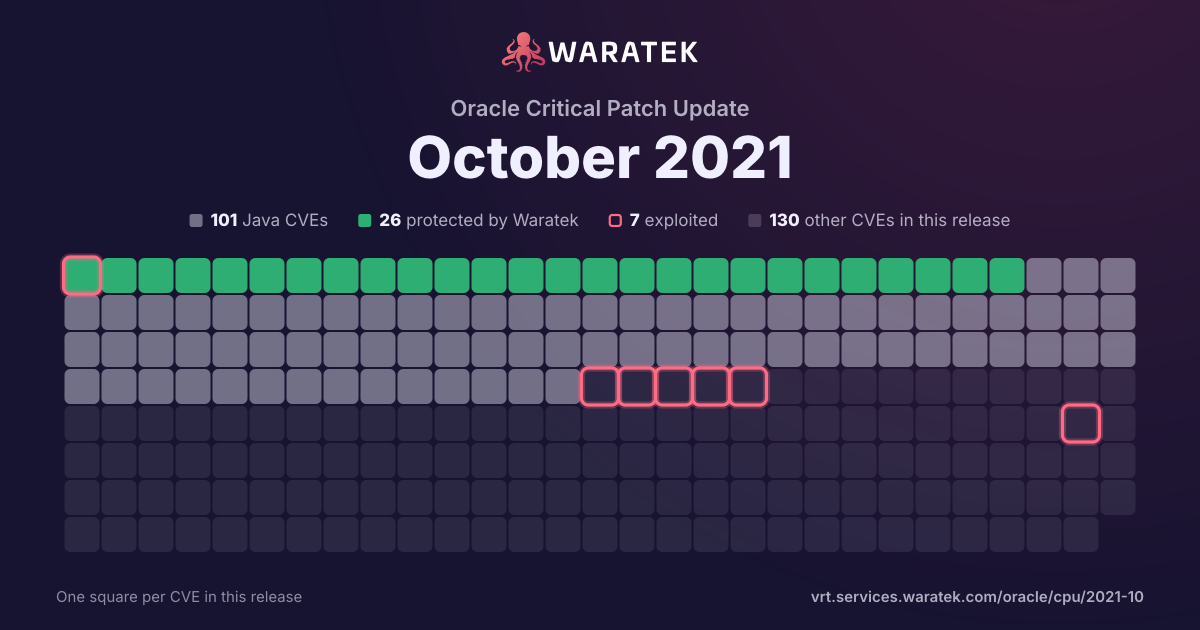
By status
26Protected by Waratek3Mitigation candidate72No exploit published42Outside Waratek scope88Not applicable
7Exploited, marked by the ring
No exploit published. For 52 of them, Oracle's security advisory is the source of public detail.
Protected by Waratek. Waratek RASP can block exploitation of these on systems that have not applied the patch yet.
Overview 231 matches · 101 in Waratek scope · 26 protected · 7 exploited · 4 CISA KEV · 19 public PoC · 24 EPSS ≥ 0.5
231matches
101in Waratek scope43.7%
26protected11.3%
7exploited3.0%
4CISA KEV1.7%
19public PoC8.2%
24EPSS ≥ 0.510.4%
Protected by Waratek
26
11.3%
Rule in development
0
0.0%
Mitigation candidate
3
1.3%
No exploit published
72
31.2%
Outside Waratek scope
42
18.2%
Not applicable
88
38.1%
Withdrawn CVE
0
0.0%
blocked by ARMR today
26
11.3%
partly blocked
0
0.0%
not blocked
205
88.7%
not established
0
0.0%
unrecorded
0
0.0%
split by
peak 137 / quarter
Q3 161
Outside Waratek scope1
High1
not blocked1
Proof of concept only1
Q4 161
Protected by Waratek1
Critical1
blocked by ARMR today1
No public exploit1
Q1 170
Q2 171
Outside Waratek scope1
Critical1
not blocked1
Exploited1
Q3 170
Q4 170
Q1 181
Protected by Waratek1
Critical1
blocked by ARMR today1
No public exploit1
Q2 181
Protected by Waratek1
Medium1
blocked by ARMR today1
No public exploit1
Q3 180
Q4 180
Q1 192
Outside Waratek scope1
Not applicable1
High1
Medium1
not blocked2
No public exploit2
Q2 193
Outside Waratek scope2
Not applicable1
High2
Medium1
not blocked3
Exploited1
Working exploit published1
No public exploit1
Q3 194
Protected by Waratek2
Outside Waratek scope2
Critical1
High1
Medium2
blocked by ARMR today2
not blocked2
No public exploit4
Q4 192
Protected by Waratek1
Outside Waratek scope1
Critical1
Medium1
blocked by ARMR today1
not blocked1
Proof of concept only1
No public exploit1
Q1 203
No exploit published1
Outside Waratek scope2
High3
not blocked3
Proof of concept only1
No public exploit2
Q2 209
Protected by Waratek2
Outside Waratek scope7
Critical1
High4
Medium3
Low1
blocked by ARMR today2
not blocked7
Exploited2
Working exploit published1
Proof of concept only1
No public exploit5
Q3 208
Protected by Waratek2
No exploit published3
Outside Waratek scope2
Not applicable1
Critical2
High4
Medium1
Low1
blocked by ARMR today2
not blocked6
No public exploit8
Q4 2011
Protected by Waratek3
No exploit published4
Outside Waratek scope4
Critical1
High5
Medium4
Low1
blocked by ARMR today3
not blocked8
Exploited1
Proof of concept only1
No public exploit9
Q1 2120
Protected by Waratek3
No exploit published7
Outside Waratek scope5
Not applicable5
Critical4
High9
Medium7
blocked by ARMR today3
not blocked17
Exploited2
Working exploit published1
Proof of concept only1
No public exploit16
Q2 2115
Protected by Waratek3
Mitigation candidate1
No exploit published6
Outside Waratek scope2
Not applicable3
Critical1
High10
Medium4
blocked by ARMR today3
not blocked12
Working exploit published3
Forecast only2
No public exploit10
Q3 2112
No exploit published6
Outside Waratek scope3
Not applicable3
Critical2
High6
Medium4
not blocked12
Proof of concept only1
Forecast only2
No public exploit9
Q4 21137
Protected by Waratek7
Mitigation candidate2
No exploit published45
Outside Waratek scope9
Not applicable74
Critical2
High34
Medium90
Low11
blocked by ARMR today7
not blocked130
Proof of concept only4
Forecast only6
No public exploit127
Q4 16Q2 17Q4 17Q2 18Q4 18Q2 19Q4 19Q2 20Q4 20Q2 21Q4 21
| CVE | Severity | Published▾ | Status | Exploitation | Description |
|---|---|---|---|---|---|
| CVE-2020-5413 | Critical | 2020-07-31 | No exploit published | No public exploit | Spring Integration framework provides Kryo Codec implementations as an alternative for Java (de)serialization. When Kryo is configured with default options, all unregistered classes are resolved on demand. This leads to the "deserialization gadgets" exploit when provided data contains malicious code for execution during deserialization. In order to protect against this type of attack, Kryo can be configured to require a set of trusted classes for (de)serialization. Spring Integration should be proactive against blocking unknown "deserialization gadgets" when configuring Kryo in code. |
| CVE-2020-8203 | High | 2020-07-15 | Not applicable | No public exploit | Prototype pollution attack when using _.zipObjectDeep in lodash before 4.17.20. |
| CVE-2020-11994 | High | 2020-07-08 | No exploit published | No public exploit | Server-Side Template Injection and arbitrary file disclosure on Camel templating components |
| CVE-2020-10878 | High | 2020-06-05 | Outside Waratek scope | No public exploit | Perl before 5.30.3 has an integer overflow related to mishandling of a "PL_regkind[OP(n)] == NOTHING" situation. A crafted regular expression could lead to malformed bytecode with a possibility of instruction injection. |
| CVE-2020-10543 | High | 2020-06-05 | Outside Waratek scope | No public exploit | Perl before 5.30.3 on 32-bit platforms allows a heap-based buffer overflow because nested regular expression quantifiers have an integer overflow. |
| CVE-2020-9484 | High | 2020-05-20 | Protected by Waratek | Working exploit published | When using Apache Tomcat versions 10.0.0-M1 to 10.0.0-M4, 9.0.0.M1 to 9.0.34, 8.5.0 to 8.5.54 and 7.0.0 to 7.0.103 if a) an attacker is able to control the contents and name of a file on the server; and b) the server is configured to use the PersistenceManager with a FileStore; and c) the PersistenceManager is configured with sessionAttributeValueClassNameFilter="null" (the default unless a SecurityManager is used) or a sufficiently lax filter to allow the attacker provided object to be deserialized; and d) the attacker knows the relative file path from the storage location used by FileStore to the file the attacker has control over; then, using a specifically crafted request, the attacker will be able to trigger remote code execution via deserialization of the file under their control. Note that all of conditions a) to d) must be true for the attack to succeed. |
| CVE-2020-1945 | Medium | 2020-05-14 | Outside Waratek scope | No public exploit | Apache Ant 1.1 to 1.9.14 and 1.10.0 to 1.10.7 uses the default temporary directory identified by the Java system property java.io.tmpdir for several tasks and may thus leak sensitive information. The fixcrlf and replaceregexp tasks also copy files from the temporary directory back into the build tree allowing an attacker to inject modified source files into the build process. |
| CVE-2020-10683 | Critical | 2020-05-01 | Protected by Waratek | No public exploit | dom4j before 2.0.3 and 2.1.x before 2.1.3 allows external DTDs and External Entities by default, which might enable XXE attacks. However, there is popular external documentation from OWASP showing how to enable the safe, non-default behavior in any application that uses dom4j. |
| CVE-2020-11023 | Medium | 2020-04-29 | Outside Waratek scope | Exploited | In jQuery versions greater than or equal to 1.0.3 and before 3.5.0, passing HTML containing <option> elements from untrusted sources - even after sanitizing it - to one of jQuery's DOM manipulation methods (i.e. .html(), .append(), and others) may execute untrusted code. This problem is patched in jQuery 3.5.0. |
| CVE-2020-11022 | Medium | 2020-04-29 | Outside Waratek scope | Exploited | In jQuery starting with 1.12.0 and before 3.5.0, passing HTML from untrusted sources - even after sanitizing it - to one of jQuery's DOM manipulation methods (i.e. .html(), .append(), and others) may execute untrusted code. This problem is patched in jQuery 3.5.0. |
| CVE-2020-9488 | Low | 2020-04-27 | Outside Waratek scope | No public exploit | Improper validation of certificate with host mismatch in Apache Log4j SMTP appender. This could allow an SMTPS connection to be intercepted by a man-in-the-middle attack which could leak any log messages sent through that appender. Fixed in Apache Log4j 2.12.3 and 2.13.1 |
| CVE-2020-1967 | High | 2020-04-21 | Outside Waratek scope | Proof of concept only | Server or client applications that call the SSL_check_chain() function during or after a TLS 1.3 handshake may crash due to a NULL pointer dereference as a result of incorrect handling of the "signature_algorithms_cert" TLS extension. The crash occurs if an invalid or unrecognised signature algorithm is received from the peer. This could be exploited by a malicious peer in a Denial of Service attack. OpenSSL version 1.1.1d, 1.1.1e, and 1.1.1f are affected by this issue. This issue did not affect OpenSSL versions prior to 1.1.1d. Fixed in OpenSSL 1.1.1g (Affected 1.1.1d-1.1.1f). |
| CVE-2020-5258 | High | 2020-03-10 | Outside Waratek scope | No public exploit | In affected versions of dojo (NPM package), the deepCopy method is vulnerable to Prototype Pollution. Prototype Pollution refers to the ability to inject properties into existing JavaScript language construct prototypes, such as objects. An attacker manipulates these attributes to overwrite, or pollute, a JavaScript application object prototype of the base object by injecting other values. This has been patched in versions 1.12.8, 1.13.7, 1.14.6, 1.15.3 and 1.16.2 |
| CVE-2020-7226 | High | 2020-01-24 | No exploit published | No public exploit | CiphertextHeader.java in Cryptacular 1.2.3, as used in Apereo CAS and other products, allows attackers to trigger excessive memory allocation during a decode operation, because the nonce array length associated with "new byte" may depend on untrusted input within the header of encoded data. |
| CVE-2020-5398 | High | 2020-01-17 | Outside Waratek scope | Proof of concept only | In Spring Framework, versions 5.2.x prior to 5.2.3, versions 5.1.x prior to 5.1.13, and versions 5.0.x prior to 5.0.16, an application is vulnerable to a reflected file download (RFD) attack when it sets a "Content-Disposition" header in the response where the filename attribute is derived from user supplied input. |
| CVE-2019-12415 | Medium | 2019-10-23 | Protected by Waratek | No public exploit | In Apache POI up to 4.1.0, when using the tool XSSFExportToXml to convert user-provided Microsoft Excel documents, a specially crafted document can allow an attacker to read files from the local filesystem or from internal network resources via XML External Entity (XXE) Processing. |
| CVE-2019-17195 | Critical | 2019-10-15 | Outside Waratek scope | Proof of concept only | Connect2id Nimbus JOSE+JWT before v7.9 can throw various uncaught exceptions while parsing a JWT, which could result in an application crash (potential information disclosure) or a potential authentication bypass. |
| CVE-2019-3740 | Medium | 2019-09-18 | Outside Waratek scope | No public exploit | RSA BSAFE Crypto-J versions prior to 6.2.5 are vulnerable to an Information Exposure Through Timing Discrepancy vulnerabilities during DSA key generation. A malicious remote attacker could potentially exploit those vulnerabilities to recover DSA keys. |
| CVE-2019-12400 | Medium | 2019-08-23 | Protected by Waratek | No public exploit | In version 2.0.3 Apache Santuario XML Security for Java, a caching mechanism was introduced to speed up creating new XML documents using a static pool of DocumentBuilders. However, if some untrusted code can register a malicious implementation with the thread context class loader first, then this implementation might be cached and re-used by Apache Santuario - XML Security for Java, leading to potential security flaws when validating signed documents, etc. The vulnerability affects Apache Santuario - XML Security for Java 2.0.x releases from 2.0.3 and all 2.1.x releases before 2.1.4. |
| CVE-2019-10086 | High | 2019-08-20 | Protected by Waratek | No public exploit | In Apache Commons Beanutils 1.9.2, a special BeanIntrospector class was added which allows suppressing the ability for an attacker to access the classloader via the class property available on all Java objects. We, however were not using this by default characteristic of the PropertyUtilsBean. |
| CVE-2019-13990 | Critical | 2019-07-26 | Outside Waratek scope | No public exploit | initDocumentParser in xml/XMLSchedulingDataProcessor.java in Terracotta Quartz Scheduler through 2.3.0 allows XXE attacks via a job description. |
| CVE-2018-20843 | High | 2019-06-24 | Not applicable | No public exploit | In libexpat in Expat before 2.2.7, XML input including XML names that contain a large number of colons could make the XML parser consume a high amount of RAM and CPU resources while processing (enough to be usable for denial-of-service attacks). |
| CVE-2019-0227 | High | 2019-05-01 | Outside Waratek scope | Working exploit published | A Server Side Request Forgery (SSRF) vulnerability affected the Apache Axis 1.4 distribution that was last released in 2006. Security and bug commits commits continue in the projects Axis 1.x Subversion repository, legacy users are encouraged to build from source. The successor to Axis 1.x is Axis2, the latest version is 1.7.9 and is not vulnerable to this issue. |
| CVE-2019-11358 | Medium | 2019-04-20 | Outside Waratek scope | Exploited | jQuery before 3.4.0, as used in Drupal, Backdrop CMS, and other products, mishandles jQuery.extend(true, {}, ...) because of Object.prototype pollution. If an unsanitized source object contained an enumerable __proto__ property, it could extend the native Object.prototype. |
| CVE-2018-20034 | High | 2019-03-21 | Outside Waratek scope | No public exploit | A Denial of Service vulnerability related to adding an item to a list in lmgrd and vendor daemon components of FlexNet Publisher version 11.16.1.0 and earlier allows a remote attacker to send a combination of messages to lmgrd or the vendor daemon, causing the heartbeat between lmgrd and the vendor daemon to stop, and the vendor daemon to shut down. |
| CVE-2019-7317 | Medium | 2019-02-04 | Not applicable | No public exploit | png_image_free in png.c in libpng 1.6.x before 1.6.37 has a use-after-free because png_image_free_function is called under png_safe_execute. |
| CVE-2018-10237 | Medium | 2018-04-26 | Protected by Waratek | No public exploit | Unbounded memory allocation in Google Guava 11.0 through 24.x before 24.1.1 allows remote attackers to conduct denial of service attacks against servers that depend on this library and deserialize attacker-provided data, because the AtomicDoubleArray class (when serialized with Java serialization) and the CompoundOrdering class (when serialized with GWT serialization) perform eager allocation without appropriate checks on what a client has sent and whether the data size is reasonable. |
| CVE-2018-8088 | Critical | 2018-03-20 | Protected by Waratek | No public exploit | org.slf4j.ext.EventData in the slf4j-ext module in QOS.CH SLF4J before 1.8.0-beta2 allows remote attackers to bypass intended access restrictions via crafted data. EventData in the slf4j-ext module in QOS.CH SLF4J, has been fixed in SLF4J versions 1.7.26 later and in the 2.0.x series. |
| CVE-2017-9841 | Critical | 2017-06-27 | Outside Waratek scope | Exploited | Util/PHP/eval-stdin.php in PHPUnit before 4.8.28 and 5.x before 5.6.3 allows remote attackers to execute arbitrary PHP code via HTTP POST data beginning with a "<?php " substring, as demonstrated by an attack on a site with an exposed /vendor folder, i.e., external access to the /vendor/phpunit/phpunit/src/Util/PHP/eval-stdin.php URI. |
| CVE-2016-1000031 | Critical | 2016-10-25 | Protected by Waratek | No public exploit | Apache Commons FileUpload before 1.3.3 DiskFileItem File Manipulation Remote Code Execution |
| CVE-2016-2183 | High | 2016-09-01 | Outside Waratek scope | Proof of concept only | The DES and Triple DES ciphers, as used in the TLS, SSH, and IPSec protocols and other protocols and products, have a birthday bound of approximately four billion blocks, which makes it easier for remote attackers to obtain cleartext data via a birthday attack against a long-duration encrypted session, as demonstrated by an HTTPS session using Triple DES in CBC mode, aka a "Sweet32" attack. |