
Oracle Critical Patch Update April 2021
Released April 2021 · Oracle's advisory ↗ · ← Critical Patch Update, January 2021 · Critical Patch Update, July 2021 →
258 CVEs in this release, one square each
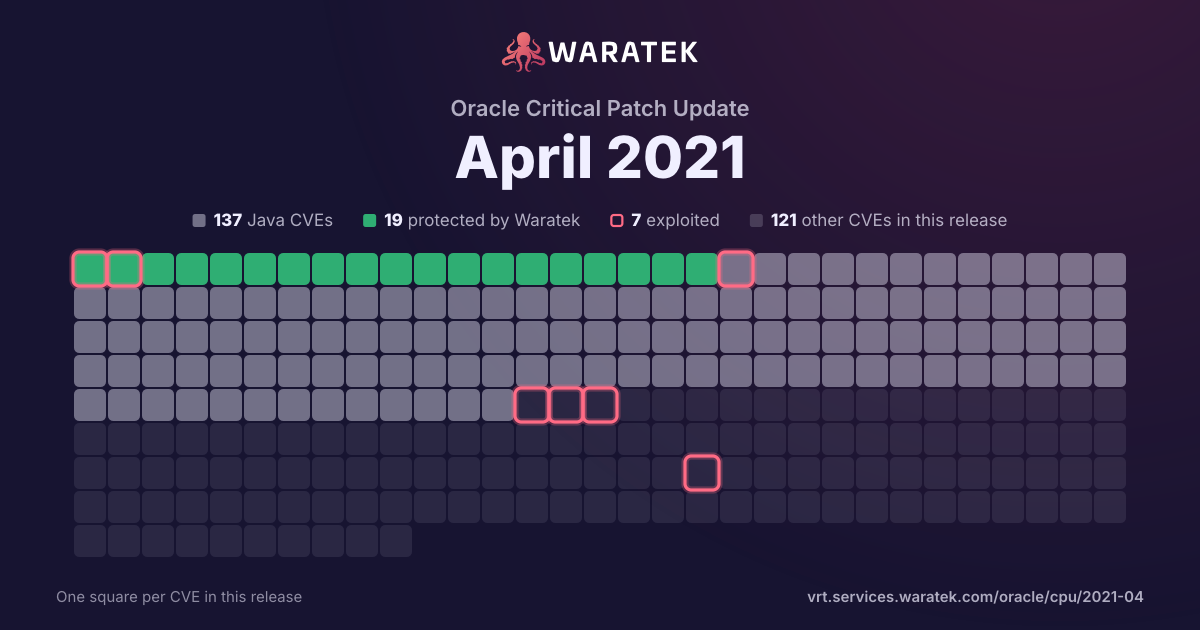
By status
20Protected by Waratek9Mitigation candidate125No exploit published2Outside Waratek scope102Not applicable
7Exploited, marked by the ring
No exploit published. For 101 of them, Oracle's security advisory is the source of public detail.
Protected by Waratek. Waratek RASP can block exploitation of these on systems that have not applied the patch yet.
Overview 20 matches · 0 in Waratek scope · 0 protected · 1 exploited · 1 CISA KEV · 5 public PoC · 5 EPSS ≥ 0.5
20matches
0in Waratek scope0.0%
0protected0.0%
1exploited5.0%
1CISA KEV5.0%
5public PoC25.0%
5EPSS ≥ 0.525.0%
Protected by Waratek
0
0.0%
Rule in development
0
0.0%
Mitigation candidate
0
0.0%
No exploit published
0
0.0%
Outside Waratek scope
0
0.0%
Not applicable
20
100.0%
Withdrawn CVE
0
0.0%
blocked by ARMR today
0
0.0%
partly blocked
0
0.0%
not blocked
20
100.0%
not established
0
0.0%
unrecorded
0
0.0%
Exploited
1
5.0%
Working exploit published
0
0.0%
Proof of concept only
4
20.0%
Forecast only
1
5.0%
No public exploit
14
70.0%
split by
peak 6 / quarter
Q3 171
Not applicable1
High1
not blocked1
No public exploit1
Q4 170
Q1 180
Q2 180
Q3 180
Q4 180
Q1 191
Not applicable1
Medium1
not blocked1
No public exploit1
Q2 191
Not applicable1
High1
not blocked1
No public exploit1
Q3 190
Q4 190
Q1 202
Not applicable2
High1
Medium1
not blocked2
No public exploit2
Q2 203
Not applicable3
High3
not blocked3
Proof of concept only1
No public exploit2
Q3 202
Not applicable2
Critical1
High1
not blocked2
Exploited1
No public exploit1
Q4 204
Not applicable4
High2
Medium2
not blocked4
Proof of concept only2
No public exploit2
Q1 216
Not applicable6
High2
Medium4
not blocked6
Proof of concept only1
Forecast only1
No public exploit4
Q3 17Q1 18Q3 18Q1 19Q3 19Q1 20Q3 20Q1 21
| CVE | Severity | Published▾ | Status | Exploitation | Description |
|---|---|---|---|---|---|
| CVE-2021-3450 | High | 2021-03-25 | Not applicable | No public exploit | The X509_V_FLAG_X509_STRICT flag enables additional security checks of the certificates present in a certificate chain. It is not set by default. Starting from OpenSSL version 1.1.1h a check to disallow certificates in the chain that have explicitly encoded elliptic curve parameters was added as an additional strict check. An error in the implementation of this check meant that the result of a previous check to confirm that certificates in the chain are valid CA certificates was overwritten. This effectively bypasses the check that non-CA certificates must not be able to issue other certificates. If a "purpose" has been configured then there is a subsequent opportunity for checks that the certificate is a valid CA. All of the named "purpose" values implemented in libcrypto perform this check. Therefore, where a purpose is set the certificate chain will still be rejected even when the strict flag has been used. A purpose is set by default in libssl client and server certificate verification routines, but it can be overridden or removed by an application. In order to be affected, an application must explicitly set the X509_V_FLAG_X509_STRICT verification flag and either not set a purpose for the certificate verification or, in the case of TLS client or server applications, override the default purpose. OpenSSL versions 1.1.1h and newer are affected by this issue. Users of these versions should upgrade to OpenSSL 1.1.1k. OpenSSL 1.0.2 is not impacted by this issue. Fixed in OpenSSL 1.1.1k (Affected 1.1.1h-1.1.1j). |
| CVE-2021-3449 | Medium | 2021-03-25 | Not applicable | Proof of concept only | An OpenSSL TLS server may crash if sent a maliciously crafted renegotiation ClientHello message from a client. If a TLSv1.2 renegotiation ClientHello omits the signature_algorithms extension (where it was present in the initial ClientHello), but includes a signature_algorithms_cert extension then a NULL pointer dereference will result, leading to a crash and a denial of service attack. A server is only vulnerable if it has TLSv1.2 and renegotiation enabled (which is the default configuration). OpenSSL TLS clients are not impacted by this issue. All OpenSSL 1.1.1 versions are affected by this issue. Users of these versions should upgrade to OpenSSL 1.1.1k. OpenSSL 1.0.2 is not impacted by this issue. Fixed in OpenSSL 1.1.1k (Affected 1.1.1-1.1.1j). |
| CVE-2021-20227 | Medium | 2021-03-23 | Not applicable | No public exploit | A flaw was found in SQLite's SELECT query functionality (src/select.c). This flaw allows an attacker who is capable of running SQL queries locally on the SQLite database to cause a denial of service or possible code execution by triggering a use-after-free. The highest threat from this vulnerability is to system availability. |
| CVE-2021-22883 | High | 2021-03-03 | Not applicable | Forecast only | Node.js before 10.24.0, 12.21.0, 14.16.0, and 15.10.0 is vulnerable to a denial of service attack when too many connection attempts with an 'unknownProtocol' are established. This leads to a leak of file descriptors. If a file descriptor limit is configured on the system, then the server is unable to accept new connections and prevent the process also from opening, e.g. a file. If no file descriptor limit is configured, then this lead to an excessive memory usage and cause the system to run out of memory. |
| CVE-2021-23841 | Medium | 2021-02-16 | Not applicable | No public exploit | The OpenSSL public API function X509_issuer_and_serial_hash() attempts to create a unique hash value based on the issuer and serial number data contained within an X509 certificate. However it fails to correctly handle any errors that may occur while parsing the issuer field (which might occur if the issuer field is maliciously constructed). This may subsequently result in a NULL pointer deref and a crash leading to a potential denial of service attack. The function X509_issuer_and_serial_hash() is never directly called by OpenSSL itself so applications are only vulnerable if they use this function directly and they use it on certificates that may have been obtained from untrusted sources. OpenSSL versions 1.1.1i and below are affected by this issue. Users of these versions should upgrade to OpenSSL 1.1.1j. OpenSSL versions 1.0.2x and below are affected by this issue. However OpenSSL 1.0.2 is out of support and no longer receiving public updates. Premium support customers of OpenSSL 1.0.2 should upgrade to 1.0.2y. Other users should upgrade to 1.1.1j. Fixed in OpenSSL 1.1.1j (Affected 1.1.1-1.1.1i). Fixed in OpenSSL 1.0.2y (Affected 1.0.2-1.0.2x). |
| CVE-2020-27842 | Medium | 2021-01-05 | Not applicable | No public exploit | There's a flaw in openjpeg's t2 encoder in versions prior to 2.4.0. An attacker who is able to provide crafted input to be processed by openjpeg could cause a null pointer dereference. The highest impact of this flaw is to application availability. |
| CVE-2020-8286 | High | 2020-12-14 | Not applicable | No public exploit | curl 7.41.0 through 7.73.0 is vulnerable to an improper check for certificate revocation due to insufficient verification of the OCSP response. |
| CVE-2020-1971 | Medium | 2020-12-08 | Not applicable | Proof of concept only | The X.509 GeneralName type is a generic type for representing different types of names. One of those name types is known as EDIPartyName. OpenSSL provides a function GENERAL_NAME_cmp which compares different instances of a GENERAL_NAME to see if they are equal or not. This function behaves incorrectly when both GENERAL_NAMEs contain an EDIPARTYNAME. A NULL pointer dereference and a crash may occur leading to a possible denial of service attack. OpenSSL itself uses the GENERAL_NAME_cmp function for two purposes: 1) Comparing CRL distribution point names between an available CRL and a CRL distribution point embedded in an X509 certificate 2) When verifying that a timestamp response token signer matches the timestamp authority name (exposed via the API functions TS_RESP_verify_response and TS_RESP_verify_token) If an attacker can control both items being compared then that attacker could trigger a crash. For example if the attacker can trick a client or server into checking a malicious certificate against a malicious CRL then this may occur. Note that some applications automatically download CRLs based on a URL embedded in a certificate. This checking happens prior to the signatures on the certificate and CRL being verified. OpenSSL's s_server, s_client and verify tools have support for the "-crl_download" option which implements automatic CRL downloading and this attack has been demonstrated to work against those tools. Note that an unrelated bug means that affected versions of OpenSSL cannot parse or construct correct encodings of EDIPARTYNAME. However it is possible to construct a malformed EDIPARTYNAME that OpenSSL's parser will accept and hence trigger this attack. All OpenSSL 1.1.1 and 1.0.2 versions are affected by this issue. Other OpenSSL releases are out of support and have not been checked. Fixed in OpenSSL 1.1.1i (Affected 1.1.1-1.1.1h). Fixed in OpenSSL 1.0.2x (Affected 1.0.2-1.0.2w). |
| CVE-2020-8277 | High | 2020-11-19 | Not applicable | Proof of concept only | A Node.js application that allows an attacker to trigger a DNS request for a host of their choice could trigger a Denial of Service in versions < 15.2.1, < 14.15.1, and < 12.19.1 by getting the application to resolve a DNS record with a larger number of responses. This is fixed in 15.2.1, 14.15.1, and 12.19.1. |
| CVE-2020-27193 | Medium | 2020-11-12 | Not applicable | No public exploit | A cross-site scripting (XSS) vulnerability in the Color Dialog plugin for CKEditor 4.15.0 allows remote attackers to run arbitrary web script after persuading a user to copy and paste crafted HTML code into one of editor inputs. |
| CVE-2020-1472 | Critical | 2020-08-17 | Not applicable | Exploited | An elevation of privilege vulnerability exists when an attacker establishes a vulnerable Netlogon secure channel connection to a domain controller, using the Netlogon Remote Protocol (MS-NRPC). An attacker who successfully exploited the vulnerability could run a specially crafted application on a device on the network. To exploit the vulnerability, an unauthenticated attacker would be required to use MS-NRPC to connect to a domain controller to obtain domain administrator access. Microsoft is addressing the vulnerability in a phased two-part rollout. These updates address the vulnerability by modifying how Netlogon handles the usage of Netlogon secure channels. For guidelines on how to manage the changes required for this vulnerability and more information on the phased rollout, see How to manage the changes in Netlogon secure channel connections associated with CVE-2020-1472 (updated September 28, 2020). When the second phase of Windows updates become available in Q1 2021, customers will be notified via a revision to this security vulnerability. If you wish to be notified when these updates are released, we recommend that you register for the security notifications mailer to be alerted of content changes to this advisory. See Microsoft Technical Security Notifications. |
| CVE-2020-8203 | High | 2020-07-15 | Not applicable | No public exploit | Prototype pollution attack when using _.zipObjectDeep in lodash before 4.17.20. |
| CVE-2020-13871 | High | 2020-06-06 | Not applicable | No public exploit | SQLite 3.32.2 has a use-after-free in resetAccumulator in select.c because the parse tree rewrite for window functions is too late. |
| CVE-2020-10878 | High | 2020-06-05 | Not applicable | No public exploit | Perl before 5.30.3 has an integer overflow related to mishandling of a "PL_regkind[OP(n)] == NOTHING" situation. A crafted regular expression could lead to malformed bytecode with a possibility of instruction injection. |
| CVE-2020-1967 | High | 2020-04-21 | Not applicable | Proof of concept only | Server or client applications that call the SSL_check_chain() function during or after a TLS 1.3 handshake may crash due to a NULL pointer dereference as a result of incorrect handling of the "signature_algorithms_cert" TLS extension. The crash occurs if an invalid or unrecognised signature algorithm is received from the peer. This could be exploited by a malicious peer in a Denial of Service attack. OpenSSL version 1.1.1d, 1.1.1e, and 1.1.1f are affected by this issue. This issue did not affect OpenSSL versions prior to 1.1.1d. Fixed in OpenSSL 1.1.1g (Affected 1.1.1d-1.1.1f). |
| CVE-2020-9281 | Medium | 2020-03-07 | Not applicable | No public exploit | A cross-site scripting (XSS) vulnerability in the HTML Data Processor for CKEditor 4.0 before 4.14 allows remote attackers to inject arbitrary web script through a crafted "protected" comment (with the cke_protected syntax). |
| CVE-2019-5064 | High | 2020-01-03 | Not applicable | No public exploit | An exploitable heap buffer overflow vulnerability exists in the data structure persistence functionality of OpenCV, before version 4.2.0. A specially crafted JSON file can cause a buffer overflow, resulting in multiple heap corruptions and potentially code execution. An attacker can provide a specially crafted file to trigger this vulnerability. |
| CVE-2018-20843 | High | 2019-06-24 | Not applicable | No public exploit | In libexpat in Expat before 2.2.7, XML input including XML names that contain a large number of colons could make the XML parser consume a high amount of RAM and CPU resources while processing (enough to be usable for denial-of-service attacks). |
| CVE-2019-7317 | Medium | 2019-02-04 | Not applicable | No public exploit | png_image_free in png.c in libpng 1.6.x before 1.6.37 has a use-after-free because png_image_free_function is called under png_safe_execute. |
| CVE-2017-1000061 | High | 2017-07-17 | Not applicable | No public exploit | xmlsec 1.2.23 and before is vulnerable to XML External Entity Expansion when parsing crafted input documents, resulting in possible information disclosure or denial of service |