
Oracle Critical Patch Update April 2021
Released April 2021 · Oracle's advisory ↗ · ← Critical Patch Update, January 2021 · Critical Patch Update, July 2021 →
258 CVEs in this release, one square each
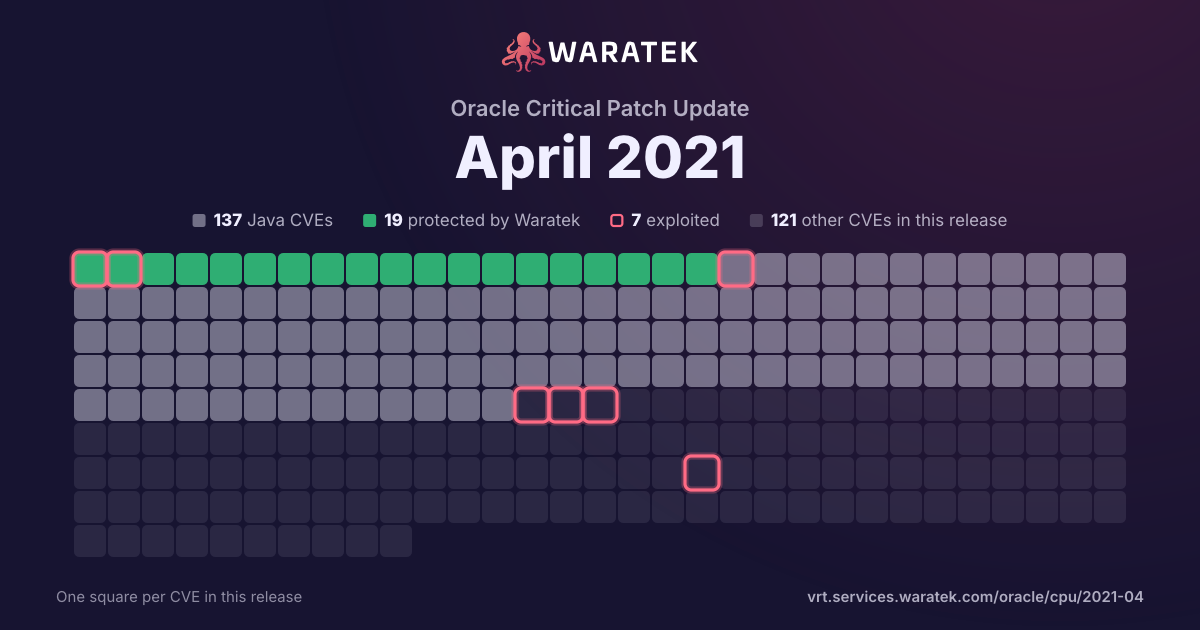
By status
19Protected by Waratek3Mitigation candidate115No exploit published67Outside Waratek scope54Not applicable
7Exploited, marked by the ring
No exploit published. For 97 of them, Oracle's security advisory is the source of public detail.
Protected by Waratek. Waratek RASP can block exploitation of these on systems that have not applied the patch yet.
Overview 121 matches · 86 in Waratek scope · 7 protected · 0 exploited · 0 CISA KEV · 5 public PoC · 8 EPSS ≥ 0.5
121matches
86in Waratek scope71.1%
7protected5.8%
0exploited0.0%
0CISA KEV0.0%
5public PoC4.1%
8EPSS ≥ 0.56.6%
Protected by Waratek
7
5.8%
Rule in development
0
0.0%
Mitigation candidate
0
0.0%
No exploit published
79
65.3%
Outside Waratek scope
10
8.3%
Not applicable
25
20.7%
Withdrawn CVE
0
0.0%
blocked by ARMR today
7
5.8%
partly blocked
0
0.0%
not blocked
114
94.2%
not established
0
0.0%
unrecorded
0
0.0%
split by
peak 86 / quarter
Q3 171
Not applicable1
High1
not blocked1
No public exploit1
Q4 170
Q1 181
No exploit published1
High1
not blocked1
No public exploit1
Q2 181
No exploit published1
High1
not blocked1
No public exploit1
Q3 180
Q4 180
Q1 190
Q2 193
Outside Waratek scope2
Not applicable1
High3
not blocked3
Working exploit published1
No public exploit2
Q3 192
Protected by Waratek1
No exploit published1
High2
blocked by ARMR today1
not blocked1
No public exploit2
Q4 191
Protected by Waratek1
High1
blocked by ARMR today1
No public exploit1
Q1 203
No exploit published1
Outside Waratek scope1
Not applicable1
High3
not blocked3
Proof of concept only1
No public exploit2
Q2 205
Protected by Waratek1
Outside Waratek scope3
Not applicable1
High5
blocked by ARMR today1
not blocked4
Proof of concept only1
No public exploit4
Q3 203
Protected by Waratek1
No exploit published1
Not applicable1
High3
blocked by ARMR today1
not blocked2
No public exploit3
Q4 2011
Protected by Waratek3
No exploit published4
Outside Waratek scope3
Not applicable1
High11
blocked by ARMR today3
not blocked8
Working exploit published1
Proof of concept only1
No public exploit9
Q1 214
No exploit published2
Not applicable2
High4
not blocked4
Forecast only1
No public exploit3
Q2 2186
No exploit published68
Outside Waratek scope1
Not applicable17
High86
not blocked86
Forecast only2
No public exploit84
Q4 17Q2 18Q4 18Q2 19Q4 19Q2 20Q4 20Q2 21
| CVE | Severity | Published▾ | Status | Exploitation | Description |
|---|---|---|---|---|---|
| CVE-2020-11979 | High | 2020-10-01 | No exploit published | No public exploit | As mitigation for CVE-2020-1945 Apache Ant 1.10.8 changed the permissions of temporary files it created so that only the current user was allowed to access them. Unfortunately the fixcrlf task deleted the temporary file and created a new one without said protection, effectively nullifying the effort. This would still allow an attacker to inject modified source files into the build process. |
| CVE-2020-24750 | High | 2020-09-17 | Protected by Waratek | No public exploit | FasterXML jackson-databind 2.x before 2.9.10.6 mishandles the interaction between serialization gadgets and typing, related to com.pastdev.httpcomponents.configuration.JndiConfiguration. |
| CVE-2020-8203 | High | 2020-07-15 | Not applicable | No public exploit | Prototype pollution attack when using _.zipObjectDeep in lodash before 4.17.20. |
| CVE-2020-11994 | High | 2020-07-08 | No exploit published | No public exploit | Server-Side Template Injection and arbitrary file disclosure on Camel templating components |
| CVE-2020-14195 | High | 2020-06-16 | Protected by Waratek | No public exploit | FasterXML jackson-databind 2.x before 2.9.10.5 mishandles the interaction between serialization gadgets and typing, related to org.jsecurity.realm.jndi.JndiRealmFactory (aka org.jsecurity). |
| CVE-2020-13871 | High | 2020-06-06 | Not applicable | No public exploit | SQLite 3.32.2 has a use-after-free in resetAccumulator in select.c because the parse tree rewrite for window functions is too late. |
| CVE-2020-10878 | High | 2020-06-05 | Outside Waratek scope | No public exploit | Perl before 5.30.3 has an integer overflow related to mishandling of a "PL_regkind[OP(n)] == NOTHING" situation. A crafted regular expression could lead to malformed bytecode with a possibility of instruction injection. |
| CVE-2020-1967 | High | 2020-04-21 | Outside Waratek scope | Proof of concept only | Server or client applications that call the SSL_check_chain() function during or after a TLS 1.3 handshake may crash due to a NULL pointer dereference as a result of incorrect handling of the "signature_algorithms_cert" TLS extension. The crash occurs if an invalid or unrecognised signature algorithm is received from the peer. This could be exploited by a malicious peer in a Denial of Service attack. OpenSSL version 1.1.1d, 1.1.1e, and 1.1.1f are affected by this issue. This issue did not affect OpenSSL versions prior to 1.1.1d. Fixed in OpenSSL 1.1.1g (Affected 1.1.1d-1.1.1f). |
| CVE-2020-11612 | High | 2020-04-07 | Outside Waratek scope | No public exploit | The ZlibDecoders in Netty 4.1.x before 4.1.46 allow for unbounded memory allocation while decoding a ZlibEncoded byte stream. An attacker could send a large ZlibEncoded byte stream to the Netty server, forcing the server to allocate all of its free memory to a single decoder. |
| CVE-2020-5398 | High | 2020-01-17 | Outside Waratek scope | Proof of concept only | In Spring Framework, versions 5.2.x prior to 5.2.3, versions 5.1.x prior to 5.1.13, and versions 5.0.x prior to 5.0.16, an application is vulnerable to a reflected file download (RFD) attack when it sets a "Content-Disposition" header in the response where the filename attribute is derived from user supplied input. |
| CVE-2019-12423 | High | 2020-01-16 | No exploit published | No public exploit | Apache CXF ships with a OpenId Connect JWK Keys service, which allows a client to obtain the public keys in JWK format, which can then be used to verify the signature of tokens issued by the service. Typically, the service obtains the public key from a local keystore (JKS/PKCS12) by specifing the path of the keystore and the alias of the keystore entry. This case is not vulnerable. However it is also possible to obtain the keys from a JWK keystore file, by setting the configuration parameter "rs.security.keystore.type" to "jwk". For this case all keys are returned in this file "as is", including all private key and secret key credentials. This is an obvious security risk if the user has configured the signature keystore file with private or secret key credentials. From CXF 3.3.5 and 3.2.12, it is mandatory to specify an alias corresponding to the id of the key in the JWK file, and only this key is returned. In addition, any private key information is omitted by default. "oct" keys, which contain secret keys, are not returned at all. |
| CVE-2019-5064 | High | 2020-01-03 | Not applicable | No public exploit | An exploitable heap buffer overflow vulnerability exists in the data structure persistence functionality of OpenCV, before version 4.2.0. A specially crafted JSON file can cause a buffer overflow, resulting in multiple heap corruptions and potentially code execution. An attacker can provide a specially crafted file to trigger this vulnerability. |
| CVE-2017-18640 | High | 2019-12-12 | Protected by Waratek | No public exploit | The Alias feature in SnakeYAML before 1.26 allows entity expansion during a load operation, a related issue to CVE-2003-1564. |
| CVE-2019-12402 | High | 2019-08-30 | No exploit published | No public exploit | The file name encoding algorithm used internally in Apache Commons Compress 1.15 to 1.18 can get into an infinite loop when faced with specially crafted inputs. This can lead to a denial of service attack if an attacker can choose the file names inside of an archive created by Compress. |
| CVE-2019-10086 | High | 2019-08-20 | Protected by Waratek | No public exploit | In Apache Commons Beanutils 1.9.2, a special BeanIntrospector class was added which allows suppressing the ability for an attacker to access the classloader via the class property available on all Java objects. We, however were not using this by default characteristic of the PropertyUtilsBean. |
| CVE-2018-20843 | High | 2019-06-24 | Not applicable | No public exploit | In libexpat in Expat before 2.2.7, XML input including XML names that contain a large number of colons could make the XML parser consume a high amount of RAM and CPU resources while processing (enough to be usable for denial-of-service attacks). |
| CVE-2019-0227 | High | 2019-05-01 | Outside Waratek scope | Working exploit published | A Server Side Request Forgery (SSRF) vulnerability affected the Apache Axis 1.4 distribution that was last released in 2006. Security and bug commits commits continue in the projects Axis 1.x Subversion repository, legacy users are encouraged to build from source. The successor to Axis 1.x is Axis2, the latest version is 1.7.9 and is not vulnerable to this issue. |
| CVE-2019-3900 | High | 2019-04-25 | Outside Waratek scope | No public exploit | An infinite loop issue was found in the vhost_net kernel module in Linux Kernel up to and including v5.1-rc6, while handling incoming packets in handle_rx(). It could occur if one end sends packets faster than the other end can process them. A guest user, maybe remote one, could use this flaw to stall the vhost_net kernel thread, resulting in a DoS scenario. |
| CVE-2018-1000180 | High | 2018-06-05 | No exploit published | No public exploit | Bouncy Castle BC 1.54 - 1.59, BC-FJA 1.0.0, BC-FJA 1.0.1 and earlier have a flaw in the Low-level interface to RSA key pair generator, specifically RSA Key Pairs generated in low-level API with added certainty may have less M-R tests than expected. This appears to be fixed in versions BC 1.60 beta 4 and later, BC-FJA 1.0.2 and later. |
| CVE-2017-12626 | High | 2018-01-29 | No exploit published | No public exploit | Apache POI in versions prior to release 3.17 are vulnerable to Denial of Service Attacks: 1) Infinite Loops while parsing crafted WMF, EMF, MSG and macros (POI bugs 61338 and 61294), and 2) Out of Memory Exceptions while parsing crafted DOC, PPT and XLS (POI bugs 52372 and 61295). |
| CVE-2017-1000061 | High | 2017-07-17 | Not applicable | No public exploit | xmlsec 1.2.23 and before is vulnerable to XML External Entity Expansion when parsing crafted input documents, resulting in possible information disclosure or denial of service |