
Oracle Critical Patch Update April 2021
Released April 2021 · Oracle's advisory ↗ · ← Critical Patch Update, January 2021 · Critical Patch Update, July 2021 →
258 CVEs in this release, one square each
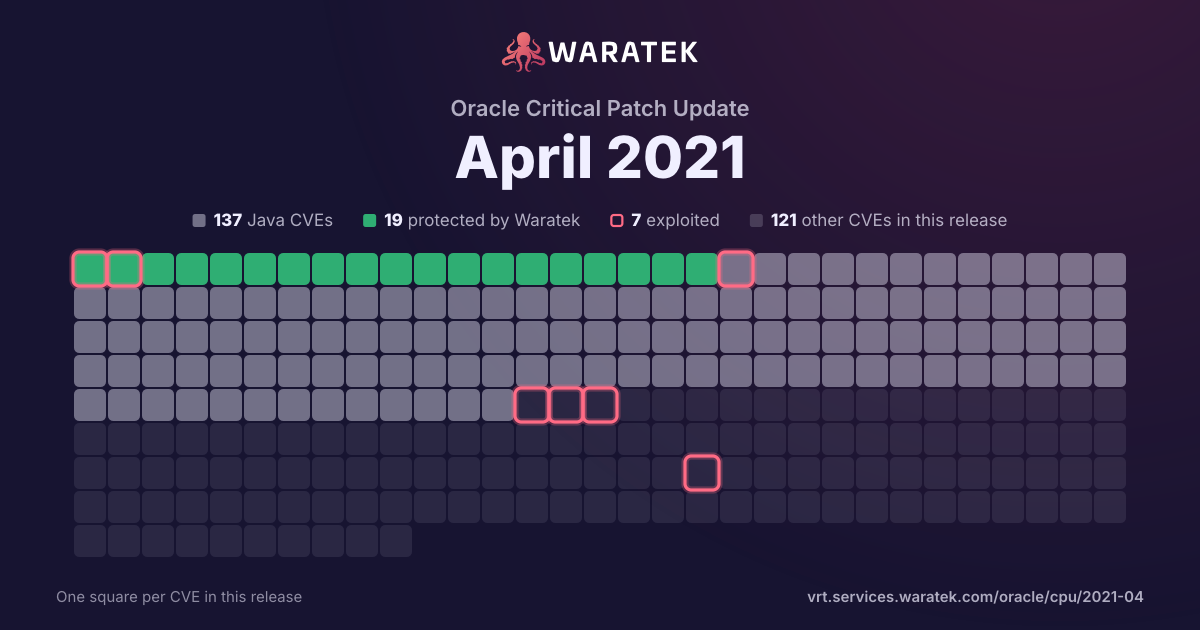
By status
20Protected by Waratek9Mitigation candidate125No exploit published2Outside Waratek scope102Not applicable
7Exploited, marked by the ring
No exploit published. For 101 of them, Oracle's security advisory is the source of public detail.
Protected by Waratek. Waratek RASP can block exploitation of these on systems that have not applied the patch yet.
Overview 107 matches · 6 protected · 2 exploited · 1 CISA KEV · 3 public PoC · 4 EPSS ≥ 0.5
Protected by Waratek
6
5.6%
Rule in development
0
0.0%
Mitigation candidate
1
0.9%
No exploit published
100
93.5%
blocked by ARMR today
6
5.6%
partly blocked
0
0.0%
not blocked
101
94.4%
not established
0
0.0%
unrecorded
0
0.0%
Exploited
2
1.9%
Working exploit published
0
0.0%
Proof of concept only
1
0.9%
Forecast only
3
2.8%
No public exploit
101
94.4%
split by
peak 96 / month
Dec 208
Protected by Waratek3
No exploit published5
Critical1
High4
Medium2
Low1
blocked by ARMR today3
not blocked5
Exploited1
No public exploit7
Jan 210
Feb 213
No exploit published3
High2
Medium1
not blocked3
Forecast only1
No public exploit2
Mar 210
Apr 2196
Protected by Waratek3
Mitigation candidate1
No exploit published92
Critical7
High68
Medium18
Low3
blocked by ARMR today3
not blocked93
Exploited1
Proof of concept only1
Forecast only2
No public exploit92
Dec 20Jan 21Feb 21Mar 21Apr 21
| CVE | Severity | Published▾ | Status | Exploitation | Description |
|---|---|---|---|---|---|
| CVE-2020-5360 | High | 2020-12-16 | No exploit published | No public exploit | Dell BSAFE Micro Edition Suite, versions prior to 4.5, are vulnerable to a Buffer Under-Read Vulnerability. An unauthenticated remote attacker could potentially exploit this vulnerability resulting in undefined behaviour, or a crash of the affected systems. |
| CVE-2020-17530 | Critical | 2020-12-11 | Protected by Waratek | Exploited | Forced OGNL evaluation, when evaluated on raw user input in tag attributes, may lead to remote code execution. Affected software : Apache Struts 2.0.0 - Struts 2.5.25. |
| CVE-2020-8908 | Low | 2020-12-10 | No exploit published | No public exploit | A temp directory creation vulnerability exists in all versions of Guava, allowing an attacker with access to the machine to potentially access data in a temporary directory created by the Guava API com.google.common.io.Files.createTempDir(). By default, on unix-like systems, the created directory is world-readable (readable by an attacker with access to the system). The method in question has been marked @Deprecated in versions 30.0 and later and should not be used. For Android developers, we recommend choosing a temporary directory API provided by Android, such as context.getCacheDir(). For other Java developers, we recommend migrating to the Java 7 API java.nio.file.Files.createTempDirectory() which explicitly configures permissions of 700, or configuring the Java runtime's java.io.tmpdir system property to point to a location whose permissions are appropriately configured. |
| CVE-2020-17521 | Medium | 2020-12-07 | Protected by Waratek | No public exploit | Apache Groovy provides extension methods to aid with creating temporary directories. Prior to this fix, Groovy's implementation of those extension methods was using a now superseded Java JDK method call that is potentially not secure on some operating systems in some contexts. Users not using the extension methods mentioned in the advisory are not affected, but may wish to read the advisory for further details. Versions Affected: 2.0 to 2.4.20, 2.5.0 to 2.5.13, 3.0.0 to 3.0.6, and 4.0.0-alpha-1. Fixed in versions 2.4.21, 2.5.14, 3.0.7, 4.0.0-alpha-2. |
| CVE-2020-25649 | High | 2020-12-03 | Protected by Waratek | No public exploit | A flaw was found in FasterXML Jackson Databind, where it did not have entity expansion secured properly. This flaw allows vulnerability to XML external entity (XXE) attacks. The highest threat from this vulnerability is data integrity. |
| CVE-2020-17527 | High | 2020-12-03 | No exploit published | No public exploit | While investigating bug 64830 it was discovered that Apache Tomcat 10.0.0-M1 to 10.0.0-M9, 9.0.0-M1 to 9.0.39 and 8.5.0 to 8.5.59 could re-use an HTTP request header value from the previous stream received on an HTTP/2 connection for the request associated with the subsequent stream. While this would most likely lead to an error and the closure of the HTTP/2 connection, it is possible that information could leak between requests. |
| CVE-2020-13956 | Medium | 2020-12-02 | No exploit published | No public exploit | Apache HttpClient versions prior to version 4.5.13 and 5.0.3 can misinterpret malformed authority component in request URIs passed to the library as java.net.URI object and pick the wrong target host for request execution. |