
Oracle Critical Patch Update April 2021
Released April 2021 · Oracle's advisory ↗ · ← Critical Patch Update, January 2021 · Critical Patch Update, July 2021 →
258 CVEs in this release, one square each
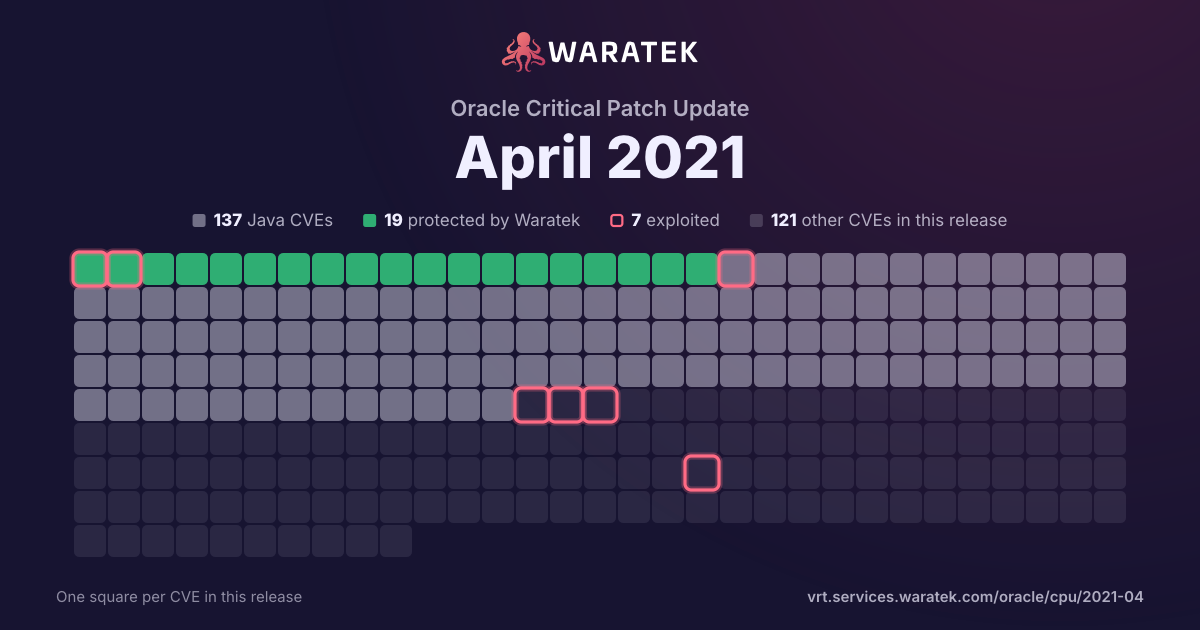
By status
20Protected by Waratek9Mitigation candidate125No exploit published2Outside Waratek scope102Not applicable
7Exploited, marked by the ring
No exploit published. For 101 of them, Oracle's security advisory is the source of public detail.
Protected by Waratek. Waratek RASP can block exploitation of these on systems that have not applied the patch yet.
Overview 122 matches · 11 protected · 3 exploited · 1 CISA KEV · 5 public PoC · 5 EPSS ≥ 0.5
Protected by Waratek
11
9.0%
Rule in development
0
0.0%
Mitigation candidate
2
1.6%
No exploit published
109
89.3%
blocked by ARMR today
11
9.0%
partly blocked
0
0.0%
not blocked
111
91.0%
not established
0
0.0%
unrecorded
0
0.0%
split by
peak 96 / month
Jun 202
Protected by Waratek1
Mitigation candidate1
Critical1
High1
blocked by ARMR today1
not blocked1
Exploited1
No public exploit1
Jul 203
No exploit published3
Critical2
High1
not blocked3
No public exploit3
Aug 200
Sep 203
Protected by Waratek2
No exploit published1
Critical1
High1
Medium1
blocked by ARMR today2
not blocked1
No public exploit3
Oct 202
No exploit published2
High2
not blocked2
No public exploit2
Nov 205
Protected by Waratek2
No exploit published3
High3
Medium2
blocked by ARMR today2
not blocked3
Working exploit published1
No public exploit4
Dec 208
Protected by Waratek3
No exploit published5
Critical1
High4
Medium2
Low1
blocked by ARMR today3
not blocked5
Exploited1
No public exploit7
Jan 210
Feb 213
No exploit published3
High2
Medium1
not blocked3
Forecast only1
No public exploit2
Mar 210
Apr 2196
Protected by Waratek3
Mitigation candidate1
No exploit published92
Critical7
High68
Medium18
Low3
blocked by ARMR today3
not blocked93
Exploited1
Proof of concept only1
Forecast only2
No public exploit92
Jun 20Jul 20Aug 20Sep 20Oct 20Nov 20Dec 20Jan 21Feb 21Mar 21Apr 21
| CVE | Severity | Published▾ | Status | Exploitation | Description |
|---|---|---|---|---|---|
| CVE-2020-5360 | High | 2020-12-16 | No exploit published | No public exploit | Dell BSAFE Micro Edition Suite, versions prior to 4.5, are vulnerable to a Buffer Under-Read Vulnerability. An unauthenticated remote attacker could potentially exploit this vulnerability resulting in undefined behaviour, or a crash of the affected systems. |
| CVE-2020-17530 | Critical | 2020-12-11 | Protected by Waratek | Exploited | Forced OGNL evaluation, when evaluated on raw user input in tag attributes, may lead to remote code execution. Affected software : Apache Struts 2.0.0 - Struts 2.5.25. |
| CVE-2020-8908 | Low | 2020-12-10 | No exploit published | No public exploit | A temp directory creation vulnerability exists in all versions of Guava, allowing an attacker with access to the machine to potentially access data in a temporary directory created by the Guava API com.google.common.io.Files.createTempDir(). By default, on unix-like systems, the created directory is world-readable (readable by an attacker with access to the system). The method in question has been marked @Deprecated in versions 30.0 and later and should not be used. For Android developers, we recommend choosing a temporary directory API provided by Android, such as context.getCacheDir(). For other Java developers, we recommend migrating to the Java 7 API java.nio.file.Files.createTempDirectory() which explicitly configures permissions of 700, or configuring the Java runtime's java.io.tmpdir system property to point to a location whose permissions are appropriately configured. |
| CVE-2020-17521 | Medium | 2020-12-07 | Protected by Waratek | No public exploit | Apache Groovy provides extension methods to aid with creating temporary directories. Prior to this fix, Groovy's implementation of those extension methods was using a now superseded Java JDK method call that is potentially not secure on some operating systems in some contexts. Users not using the extension methods mentioned in the advisory are not affected, but may wish to read the advisory for further details. Versions Affected: 2.0 to 2.4.20, 2.5.0 to 2.5.13, 3.0.0 to 3.0.6, and 4.0.0-alpha-1. Fixed in versions 2.4.21, 2.5.14, 3.0.7, 4.0.0-alpha-2. |
| CVE-2020-25649 | High | 2020-12-03 | Protected by Waratek | No public exploit | A flaw was found in FasterXML Jackson Databind, where it did not have entity expansion secured properly. This flaw allows vulnerability to XML external entity (XXE) attacks. The highest threat from this vulnerability is data integrity. |
| CVE-2020-17527 | High | 2020-12-03 | No exploit published | No public exploit | While investigating bug 64830 it was discovered that Apache Tomcat 10.0.0-M1 to 10.0.0-M9, 9.0.0-M1 to 9.0.39 and 8.5.0 to 8.5.59 could re-use an HTTP request header value from the previous stream received on an HTTP/2 connection for the request associated with the subsequent stream. While this would most likely lead to an error and the closure of the HTTP/2 connection, it is possible that information could leak between requests. |
| CVE-2020-13956 | Medium | 2020-12-02 | No exploit published | No public exploit | Apache HttpClient versions prior to version 4.5.13 and 5.0.3 can misinterpret malformed authority component in request URIs passed to the library as java.net.URI object and pick the wrong target host for request execution. |
| CVE-2020-27218 | Medium | 2020-11-28 | No exploit published | No public exploit | In Eclipse Jetty version 9.4.0.RC0 to 9.4.34.v20201102, 10.0.0.alpha0 to 10.0.0.beta2, and 11.0.0.alpha0 to 11.0.0.beta2, if GZIP request body inflation is enabled and requests from different clients are multiplexed onto a single connection, and if an attacker can send a request with a body that is received entirely but not consumed by the application, then a subsequent request on the same connection will see that body prepended to its body. The attacker will not see any data but may inject data into the body of the subsequent request. |
| CVE-2020-26217 | High | 2020-11-16 | Protected by Waratek | Working exploit published | XStream before version 1.4.14 is vulnerable to Remote Code Execution.The vulnerability may allow a remote attacker to run arbitrary shell commands only by manipulating the processed input stream. Only users who rely on blocklists are affected. Anyone using XStream's Security Framework allowlist is not affected. The linked advisory provides code workarounds for users who cannot upgrade. The issue is fixed in version 1.4.14. |
| CVE-2020-13954 | Medium | 2020-11-12 | No exploit published | No public exploit | By default, Apache CXF creates a /services page containing a listing of the available endpoint names and addresses. This webpage is vulnerable to a reflected Cross-Site Scripting (XSS) attack via the styleSheetPath, which allows a malicious actor to inject javascript into the web page. This vulnerability affects all versions of Apache CXF prior to 3.4.1 and 3.3.8. Please note that this is a separate issue to CVE-2019-17573. |
| CVE-2019-17566 | High | 2020-11-12 | Protected by Waratek | No public exploit | Apache Batik is vulnerable to server-side request forgery, caused by improper input validation by the "xlink:href" attributes. By using a specially-crafted argument, an attacker could exploit this vulnerability to cause the underlying server to make arbitrary GET requests. |
| CVE-2020-28196 | High | 2020-11-06 | No exploit published | No public exploit | MIT Kerberos 5 (aka krb5) before 1.17.2 and 1.18.x before 1.18.3 allows unbounded recursion via an ASN.1-encoded Kerberos message because the lib/krb5/asn.1/asn1_encode.c support for BER indefinite lengths lacks a recursion limit. |
| CVE-2020-7760 | High | 2020-10-30 | No exploit published | No public exploit | This affects the package codemirror before 5.58.2; the package org.apache.marmotta.webjars:codemirror before 5.58.2. The vulnerable regular expression is located in https://github.com/codemirror/CodeMirror/blob/cdb228ac736369c685865b122b736cd0d397836c/mode/javascript/javascript.jsL129. The ReDOS vulnerability of the regex is mainly due to the sub-pattern (s|/*.*?*/)* |
| CVE-2020-11979 | High | 2020-10-01 | No exploit published | No public exploit | As mitigation for CVE-2020-1945 Apache Ant 1.10.8 changed the permissions of temporary files it created so that only the current user was allowed to access them. Unfortunately the fixcrlf task deleted the temporary file and created a new one without said protection, effectively nullifying the effort. This would still allow an attacker to inject modified source files into the build process. |
| CVE-2020-5421 | Medium | 2020-09-19 | No exploit published | No public exploit | In Spring Framework versions 5.2.0 - 5.2.8, 5.1.0 - 5.1.17, 5.0.0 - 5.0.18, 4.3.0 - 4.3.28, and older unsupported versions, the protections against RFD attacks from CVE-2015-5211 may be bypassed depending on the browser used through the use of a jsessionid path parameter. |
| CVE-2020-24750 | High | 2020-09-17 | Protected by Waratek | No public exploit | FasterXML jackson-databind 2.x before 2.9.10.6 mishandles the interaction between serialization gadgets and typing, related to com.pastdev.httpcomponents.configuration.JndiConfiguration. |
| CVE-2020-11998 | Critical | 2020-09-10 | Protected by Waratek | No public exploit | A regression has been introduced in the commit preventing JMX re-bind. By passing an empty environment map to RMIConnectorServer, instead of the map that contains the authentication credentials, it leaves ActiveMQ open to the following attack: https://docs.oracle.com/javase/8/docs/technotes/guides/management/agent.html "A remote client could create a javax.management.loading.MLet MBean and use it to create new MBeans from arbitrary URLs, at least if there is no security manager. In other words, a rogue remote client could make your Java application execute arbitrary code." Mitigation: Upgrade to Apache ActiveMQ 5.15.13 |
| CVE-2020-5413 | Critical | 2020-07-31 | No exploit published | No public exploit | Spring Integration framework provides Kryo Codec implementations as an alternative for Java (de)serialization. When Kryo is configured with default options, all unregistered classes are resolved on demand. This leads to the "deserialization gadgets" exploit when provided data contains malicious code for execution during deserialization. In order to protect against this type of attack, Kryo can be configured to require a set of trusted classes for (de)serialization. Spring Integration should be proactive against blocking unknown "deserialization gadgets" when configuring Kryo in code. |
| CVE-2019-17638 | Critical | 2020-07-09 | No exploit published | No public exploit | In Eclipse Jetty, versions 9.4.27.v20200227 to 9.4.29.v20200521, in case of too large response headers, Jetty throws an exception to produce an HTTP 431 error. When this happens, the ByteBuffer containing the HTTP response headers is released back to the ByteBufferPool twice. Because of this double release, two threads can acquire the same ByteBuffer from the pool and while thread1 is about to use the ByteBuffer to write response1 data, thread2 fills the ByteBuffer with other data. Thread1 then proceeds to write the buffer that now contains different data. This results in client1, which issued request1 seeing data from another request or response which could contain sensitive data belonging to client2 (HTTP session ids, authentication credentials, etc.). If the Jetty version cannot be upgraded, the vulnerability can be significantly reduced by configuring a responseHeaderSize significantly larger than the requestHeaderSize (12KB responseHeaderSize and 8KB requestHeaderSize). |
| CVE-2020-11994 | High | 2020-07-08 | No exploit published | No public exploit | Server-Side Template Injection and arbitrary file disclosure on Camel templating components |
| CVE-2020-9480 | Critical | 2020-06-23 | Mitigation candidate | Exploited | In Apache Spark 2.4.5 and earlier, a standalone resource manager's master may be configured to require authentication (spark.authenticate) via a shared secret. When enabled, however, a specially-crafted RPC to the master can succeed in starting an application's resources on the Spark cluster, even without the shared key. This can be leveraged to execute shell commands on the host machine. This does not affect Spark clusters using other resource managers (YARN, Mesos, etc). |
| CVE-2020-14195 | High | 2020-06-16 | Protected by Waratek | No public exploit | FasterXML jackson-databind 2.x before 2.9.10.5 mishandles the interaction between serialization gadgets and typing, related to org.jsecurity.realm.jndi.JndiRealmFactory (aka org.jsecurity). |