
Oracle Critical Patch Update April 2021
Released April 2021 · Oracle's advisory ↗ · ← Critical Patch Update, January 2021 · Critical Patch Update, July 2021 →
258 CVEs in this release, one square each
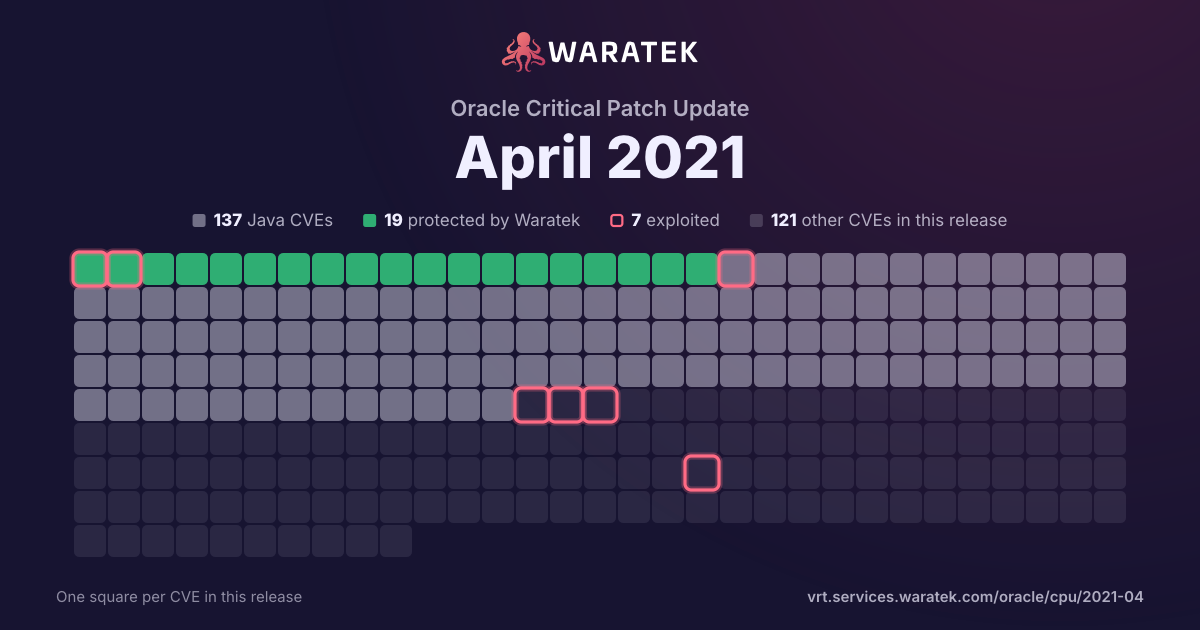
By status
19Protected by Waratek3Mitigation candidate115No exploit published67Outside Waratek scope54Not applicable
7Exploited, marked by the ring
No exploit published. For 97 of them, Oracle's security advisory is the source of public detail.
Protected by Waratek. Waratek RASP can block exploitation of these on systems that have not applied the patch yet.
Overview 18 matches · 7 in Waratek scope · 4 protected · 7 exploited · 3 CISA KEV · 12 EPSS ≥ 0.5
Protected by Waratek
4
22.2%
Rule in development
0
0.0%
Mitigation candidate
3
16.7%
No exploit published
0
0.0%
Outside Waratek scope
9
50.0%
Not applicable
2
11.1%
Withdrawn CVE
0
0.0%
blocked by ARMR today
4
22.2%
partly blocked
0
0.0%
not blocked
14
77.8%
not established
0
0.0%
unrecorded
0
0.0%
Exploited
7
38.9%
Working exploit published
4
22.2%
Proof of concept only
7
38.9%
Forecast only
0
0.0%
No public exploit
0
0.0%
split by
peak 4 / quarter
Q1 171
Protected by Waratek1
Medium1
blocked by ARMR today1
Working exploit published1
Q2 170
Q3 170
Q4 170
Q1 180
Q2 180
Q3 180
Q4 180
Q1 190
Q2 193
Mitigation candidate1
Outside Waratek scope2
High1
Medium2
not blocked3
Exploited1
Working exploit published2
Q3 190
Q4 191
Outside Waratek scope1
Critical1
not blocked1
Proof of concept only1
Q1 201
Outside Waratek scope1
High1
not blocked1
Proof of concept only1
Q2 204
Mitigation candidate1
Outside Waratek scope3
Critical1
High1
Medium2
not blocked4
Exploited3
Proof of concept only1
Q3 201
Not applicable1
Critical1
not blocked1
Exploited1
Q4 204
Protected by Waratek2
Outside Waratek scope1
Not applicable1
Critical1
High2
Medium1
blocked by ARMR today2
not blocked2
Exploited1
Working exploit published1
Proof of concept only2
Q1 211
Outside Waratek scope1
Medium1
not blocked1
Proof of concept only1
Q2 212
Protected by Waratek1
Mitigation candidate1
Critical2
blocked by ARMR today1
not blocked1
Exploited1
Proof of concept only1
Q2 17Q4 17Q2 18Q4 18Q2 19Q4 19Q2 20Q4 20Q2 21
| CVE | Severity | Published▾ | Status | Exploitation | Description |
|---|---|---|---|---|---|
| CVE-2021-2302 | Critical | 2021-04-22 | Mitigation candidate | Proof of concept only | Vulnerability in the Oracle Platform Security for Java product of Oracle Fusion Middleware (component: OPSS). Supported versions that are affected are 11.1.1.9.0, 12.2.1.3.0 and 12.2.1.4.0. Easily exploitable vulnerability allows unauthenticated attacker with network access via HTTP to compromise Oracle Platform Security for Java. Successful attacks of this vulnerability can result in takeover of Oracle Platform Security for Java. CVSS 3.1 Base Score 9.8 (Confidentiality, Integrity and Availability impacts). CVSS Vector: (CVSS:3.1/AV:N/AC:L/PR:N/UI:N/S:U/C:H/I:H/A:H). |
| CVE-2021-2135 | Critical | 2021-04-22 | Protected by Waratek | Exploited | Vulnerability in the Oracle WebLogic Server product of Oracle Fusion Middleware (component: Coherence Container). Supported versions that are affected are 12.2.1.3.0, 12.2.1.4.0 and 14.1.1.0.0. Easily exploitable vulnerability allows unauthenticated attacker with network access via T3, IIOP to compromise Oracle WebLogic Server. Successful attacks of this vulnerability can result in takeover of Oracle WebLogic Server. CVSS 3.1 Base Score 9.8 (Confidentiality, Integrity and Availability impacts). CVSS Vector: (CVSS:3.1/AV:N/AC:L/PR:N/UI:N/S:U/C:H/I:H/A:H). |
| CVE-2021-3449 | Medium | 2021-03-25 | Outside Waratek scope | Proof of concept only | An OpenSSL TLS server may crash if sent a maliciously crafted renegotiation ClientHello message from a client. If a TLSv1.2 renegotiation ClientHello omits the signature_algorithms extension (where it was present in the initial ClientHello), but includes a signature_algorithms_cert extension then a NULL pointer dereference will result, leading to a crash and a denial of service attack. A server is only vulnerable if it has TLSv1.2 and renegotiation enabled (which is the default configuration). OpenSSL TLS clients are not impacted by this issue. All OpenSSL 1.1.1 versions are affected by this issue. Users of these versions should upgrade to OpenSSL 1.1.1k. OpenSSL 1.0.2 is not impacted by this issue. Fixed in OpenSSL 1.1.1k (Affected 1.1.1-1.1.1j). |
| CVE-2020-17530 | Critical | 2020-12-11 | Protected by Waratek | Exploited | Forced OGNL evaluation, when evaluated on raw user input in tag attributes, may lead to remote code execution. Affected software : Apache Struts 2.0.0 - Struts 2.5.25. |
| CVE-2020-1971 | Medium | 2020-12-08 | Outside Waratek scope | Proof of concept only | The X.509 GeneralName type is a generic type for representing different types of names. One of those name types is known as EDIPartyName. OpenSSL provides a function GENERAL_NAME_cmp which compares different instances of a GENERAL_NAME to see if they are equal or not. This function behaves incorrectly when both GENERAL_NAMEs contain an EDIPARTYNAME. A NULL pointer dereference and a crash may occur leading to a possible denial of service attack. OpenSSL itself uses the GENERAL_NAME_cmp function for two purposes: 1) Comparing CRL distribution point names between an available CRL and a CRL distribution point embedded in an X509 certificate 2) When verifying that a timestamp response token signer matches the timestamp authority name (exposed via the API functions TS_RESP_verify_response and TS_RESP_verify_token) If an attacker can control both items being compared then that attacker could trigger a crash. For example if the attacker can trick a client or server into checking a malicious certificate against a malicious CRL then this may occur. Note that some applications automatically download CRLs based on a URL embedded in a certificate. This checking happens prior to the signatures on the certificate and CRL being verified. OpenSSL's s_server, s_client and verify tools have support for the "-crl_download" option which implements automatic CRL downloading and this attack has been demonstrated to work against those tools. Note that an unrelated bug means that affected versions of OpenSSL cannot parse or construct correct encodings of EDIPARTYNAME. However it is possible to construct a malformed EDIPARTYNAME that OpenSSL's parser will accept and hence trigger this attack. All OpenSSL 1.1.1 and 1.0.2 versions are affected by this issue. Other OpenSSL releases are out of support and have not been checked. Fixed in OpenSSL 1.1.1i (Affected 1.1.1-1.1.1h). Fixed in OpenSSL 1.0.2x (Affected 1.0.2-1.0.2w). |
| CVE-2020-8277 | High | 2020-11-19 | Not applicable | Proof of concept only | A Node.js application that allows an attacker to trigger a DNS request for a host of their choice could trigger a Denial of Service in versions < 15.2.1, < 14.15.1, and < 12.19.1 by getting the application to resolve a DNS record with a larger number of responses. This is fixed in 15.2.1, 14.15.1, and 12.19.1. |
| CVE-2020-26217 | High | 2020-11-16 | Protected by Waratek | Working exploit published | XStream before version 1.4.14 is vulnerable to Remote Code Execution.The vulnerability may allow a remote attacker to run arbitrary shell commands only by manipulating the processed input stream. Only users who rely on blocklists are affected. Anyone using XStream's Security Framework allowlist is not affected. The linked advisory provides code workarounds for users who cannot upgrade. The issue is fixed in version 1.4.14. |
| CVE-2020-1472 | Critical | 2020-08-17 | Not applicable | Exploited | An elevation of privilege vulnerability exists when an attacker establishes a vulnerable Netlogon secure channel connection to a domain controller, using the Netlogon Remote Protocol (MS-NRPC). An attacker who successfully exploited the vulnerability could run a specially crafted application on a device on the network. To exploit the vulnerability, an unauthenticated attacker would be required to use MS-NRPC to connect to a domain controller to obtain domain administrator access. Microsoft is addressing the vulnerability in a phased two-part rollout. These updates address the vulnerability by modifying how Netlogon handles the usage of Netlogon secure channels. For guidelines on how to manage the changes required for this vulnerability and more information on the phased rollout, see How to manage the changes in Netlogon secure channel connections associated with CVE-2020-1472 (updated September 28, 2020). When the second phase of Windows updates become available in Q1 2021, customers will be notified via a revision to this security vulnerability. If you wish to be notified when these updates are released, we recommend that you register for the security notifications mailer to be alerted of content changes to this advisory. See Microsoft Technical Security Notifications. |
| CVE-2020-9480 | Critical | 2020-06-23 | Mitigation candidate | Exploited | In Apache Spark 2.4.5 and earlier, a standalone resource manager's master may be configured to require authentication (spark.authenticate) via a shared secret. When enabled, however, a specially-crafted RPC to the master can succeed in starting an application's resources on the Spark cluster, even without the shared key. This can be leveraged to execute shell commands on the host machine. This does not affect Spark clusters using other resource managers (YARN, Mesos, etc). |
| CVE-2020-11023 | Medium | 2020-04-29 | Outside Waratek scope | Exploited | In jQuery versions greater than or equal to 1.0.3 and before 3.5.0, passing HTML containing <option> elements from untrusted sources - even after sanitizing it - to one of jQuery's DOM manipulation methods (i.e. .html(), .append(), and others) may execute untrusted code. This problem is patched in jQuery 3.5.0. |
| CVE-2020-11022 | Medium | 2020-04-29 | Outside Waratek scope | Exploited | In jQuery starting with 1.12.0 and before 3.5.0, passing HTML from untrusted sources - even after sanitizing it - to one of jQuery's DOM manipulation methods (i.e. .html(), .append(), and others) may execute untrusted code. This problem is patched in jQuery 3.5.0. |
| CVE-2020-1967 | High | 2020-04-21 | Outside Waratek scope | Proof of concept only | Server or client applications that call the SSL_check_chain() function during or after a TLS 1.3 handshake may crash due to a NULL pointer dereference as a result of incorrect handling of the "signature_algorithms_cert" TLS extension. The crash occurs if an invalid or unrecognised signature algorithm is received from the peer. This could be exploited by a malicious peer in a Denial of Service attack. OpenSSL version 1.1.1d, 1.1.1e, and 1.1.1f are affected by this issue. This issue did not affect OpenSSL versions prior to 1.1.1d. Fixed in OpenSSL 1.1.1g (Affected 1.1.1d-1.1.1f). |
| CVE-2020-5398 | High | 2020-01-17 | Outside Waratek scope | Proof of concept only | In Spring Framework, versions 5.2.x prior to 5.2.3, versions 5.1.x prior to 5.1.13, and versions 5.0.x prior to 5.0.16, an application is vulnerable to a reflected file download (RFD) attack when it sets a "Content-Disposition" header in the response where the filename attribute is derived from user supplied input. |
| CVE-2019-17195 | Critical | 2019-10-15 | Outside Waratek scope | Proof of concept only | Connect2id Nimbus JOSE+JWT before v7.9 can throw various uncaught exceptions while parsing a JWT, which could result in an application crash (potential information disclosure) or a potential authentication bypass. |
| CVE-2019-0221 | Medium | 2019-05-28 | Mitigation candidate | Working exploit published | The SSI printenv command in Apache Tomcat 9.0.0.M1 to 9.0.0.17, 8.5.0 to 8.5.39 and 7.0.0 to 7.0.93 echoes user provided data without escaping and is, therefore, vulnerable to XSS. SSI is disabled by default. The printenv command is intended for debugging and is unlikely to be present in a production website. |
| CVE-2019-0227 | High | 2019-05-01 | Outside Waratek scope | Working exploit published | A Server Side Request Forgery (SSRF) vulnerability affected the Apache Axis 1.4 distribution that was last released in 2006. Security and bug commits commits continue in the projects Axis 1.x Subversion repository, legacy users are encouraged to build from source. The successor to Axis 1.x is Axis2, the latest version is 1.7.9 and is not vulnerable to this issue. |
| CVE-2019-11358 | Medium | 2019-04-20 | Outside Waratek scope | Exploited | jQuery before 3.4.0, as used in Drupal, Backdrop CMS, and other products, mishandles jQuery.extend(true, {}, ...) because of Object.prototype pollution. If an unsanitized source object contained an enumerable __proto__ property, it could extend the native Object.prototype. |
| CVE-2016-5725 | Medium | 2017-01-19 | Protected by Waratek | Working exploit published | Directory traversal vulnerability in JCraft JSch before 0.1.54 on Windows, when the mode is ChannelSftp.OVERWRITE, allows remote SFTP servers to write to arbitrary files via a ..\ (dot dot backslash) in a response to a recursive GET command. |