
Oracle Critical Patch Update April 2021
Released April 2021 · Oracle's advisory ↗ · ← Critical Patch Update, January 2021 · Critical Patch Update, July 2021 →
258 CVEs in this release, one square each
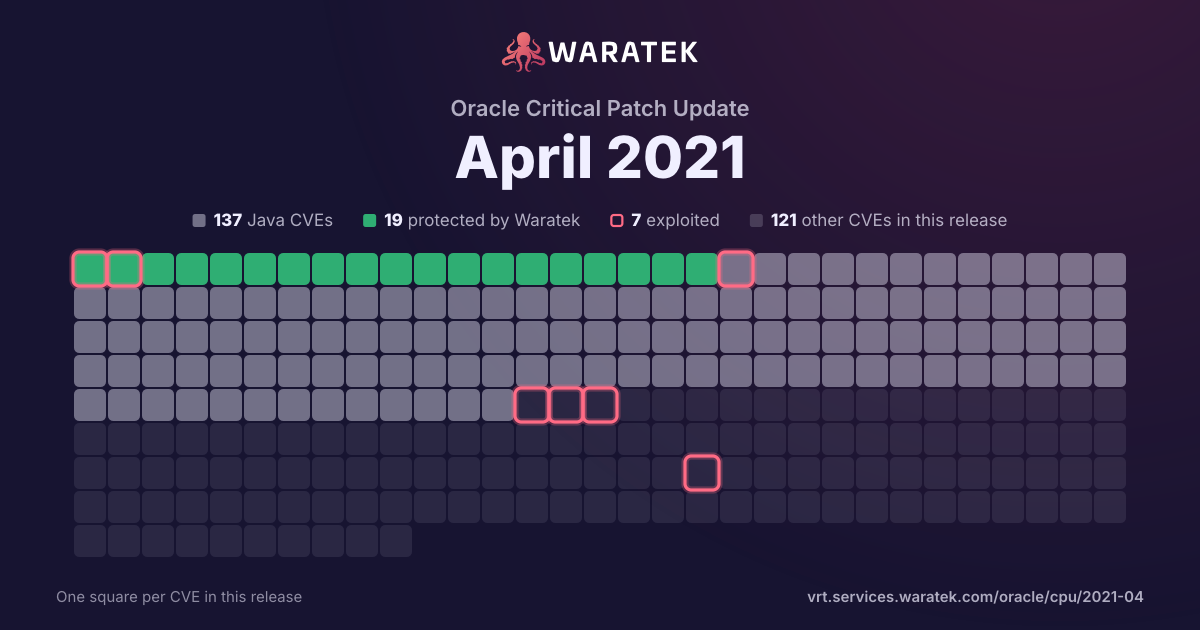
By status
20Protected by Waratek9Mitigation candidate125No exploit published2Outside Waratek scope102Not applicable
7Exploited, marked by the ring
No exploit published. For 101 of them, Oracle's security advisory is the source of public detail.
Protected by Waratek. Waratek RASP can block exploitation of these on systems that have not applied the patch yet.
Overview 11 matches · 2 protected · 4 exploited · 2 CISA KEV · 8 public PoC
Protected by Waratek
2
18.2%
Rule in development
0
0.0%
Mitigation candidate
6
54.5%
No exploit published
3
27.3%
blocked by ARMR today
2
18.2%
partly blocked
0
0.0%
not blocked
9
81.8%
not established
0
0.0%
unrecorded
0
0.0%
Exploited
4
36.4%
Working exploit published
3
27.3%
Proof of concept only
1
9.1%
Forecast only
3
27.3%
No public exploit
0
0.0%
split by
peak 3 / quarter
Q2 193
Mitigation candidate3
High1
Medium2
not blocked3
Exploited1
Working exploit published2
Q3 190
Q4 190
Q1 202
Mitigation candidate1
No exploit published1
Critical1
High1
not blocked2
Proof of concept only1
Forecast only1
Q2 203
Mitigation candidate2
No exploit published1
Medium3
not blocked3
Exploited2
Forecast only1
Q3 200
Q4 202
Protected by Waratek2
Critical1
High1
blocked by ARMR today2
Exploited1
Working exploit published1
Q1 211
No exploit published1
Medium1
not blocked1
Forecast only1
Q2 19Q3 19Q4 19Q1 20Q2 20Q3 20Q4 20Q1 21
| CVE | Severity | Published▾ | Status | Exploitation | Description |
|---|---|---|---|---|---|
| CVE-2020-27223 | Medium | 2021-02-26 | No exploit published | Forecast only | In Eclipse Jetty 9.4.6.v20170531 to 9.4.36.v20210114 (inclusive), 10.0.0, and 11.0.0 when Jetty handles a request containing multiple Accept headers with a large number of “quality” (i.e. q) parameters, the server may enter a denial of service (DoS) state due to high CPU usage processing those quality values, resulting in minutes of CPU time exhausted processing those quality values. |
| CVE-2020-17530 | Critical | 2020-12-11 | Protected by Waratek | Exploited | Forced OGNL evaluation, when evaluated on raw user input in tag attributes, may lead to remote code execution. Affected software : Apache Struts 2.0.0 - Struts 2.5.25. |
| CVE-2020-26217 | High | 2020-11-16 | Protected by Waratek | Working exploit published | XStream before version 1.4.14 is vulnerable to Remote Code Execution.The vulnerability may allow a remote attacker to run arbitrary shell commands only by manipulating the processed input stream. Only users who rely on blocklists are affected. Anyone using XStream's Security Framework allowlist is not affected. The linked advisory provides code workarounds for users who cannot upgrade. The issue is fixed in version 1.4.14. |
| CVE-2020-11023 | Medium | 2020-04-29 | Mitigation candidate | Exploited | In jQuery versions greater than or equal to 1.0.3 and before 3.5.0, passing HTML containing <option> elements from untrusted sources - even after sanitizing it - to one of jQuery's DOM manipulation methods (i.e. .html(), .append(), and others) may execute untrusted code. This problem is patched in jQuery 3.5.0. |
| CVE-2020-11022 | Medium | 2020-04-29 | Mitigation candidate | Exploited | In jQuery starting with 1.12.0 and before 3.5.0, passing HTML from untrusted sources - even after sanitizing it - to one of jQuery's DOM manipulation methods (i.e. .html(), .append(), and others) may execute untrusted code. This problem is patched in jQuery 3.5.0. |
| CVE-2020-1927 | Medium | 2020-04-02 | No exploit published | Forecast only | In Apache HTTP Server 2.4.0 to 2.4.41, redirects configured with mod_rewrite that were intended to be self-referential might be fooled by encoded newlines and redirect instead to an an unexpected URL within the request URL. |
| CVE-2020-10188 | Critical | 2020-03-06 | No exploit published | Forecast only | utility.c in telnetd in netkit telnet through 0.17 allows remote attackers to execute arbitrary code via short writes or urgent data, because of a buffer overflow involving the netclear and nextitem functions. |
| CVE-2020-5398 | High | 2020-01-17 | Mitigation candidate | Proof of concept only | In Spring Framework, versions 5.2.x prior to 5.2.3, versions 5.1.x prior to 5.1.13, and versions 5.0.x prior to 5.0.16, an application is vulnerable to a reflected file download (RFD) attack when it sets a "Content-Disposition" header in the response where the filename attribute is derived from user supplied input. |
| CVE-2019-0221 | Medium | 2019-05-28 | Mitigation candidate | Working exploit published | The SSI printenv command in Apache Tomcat 9.0.0.M1 to 9.0.0.17, 8.5.0 to 8.5.39 and 7.0.0 to 7.0.93 echoes user provided data without escaping and is, therefore, vulnerable to XSS. SSI is disabled by default. The printenv command is intended for debugging and is unlikely to be present in a production website. |
| CVE-2019-0227 | High | 2019-05-01 | Mitigation candidate | Working exploit published | A Server Side Request Forgery (SSRF) vulnerability affected the Apache Axis 1.4 distribution that was last released in 2006. Security and bug commits commits continue in the projects Axis 1.x Subversion repository, legacy users are encouraged to build from source. The successor to Axis 1.x is Axis2, the latest version is 1.7.9 and is not vulnerable to this issue. |
| CVE-2019-11358 | Medium | 2019-04-20 | Mitigation candidate | Exploited | jQuery before 3.4.0, as used in Drupal, Backdrop CMS, and other products, mishandles jQuery.extend(true, {}, ...) because of Object.prototype pollution. If an unsanitized source object contained an enumerable __proto__ property, it could extend the native Object.prototype. |