
Oracle Critical Patch Update January 2021
Released January 2021 · Oracle's advisory ↗ · ← Critical Patch Update, October 2020 · Critical Patch Update, April 2021 →
202 CVEs in this release, one square each
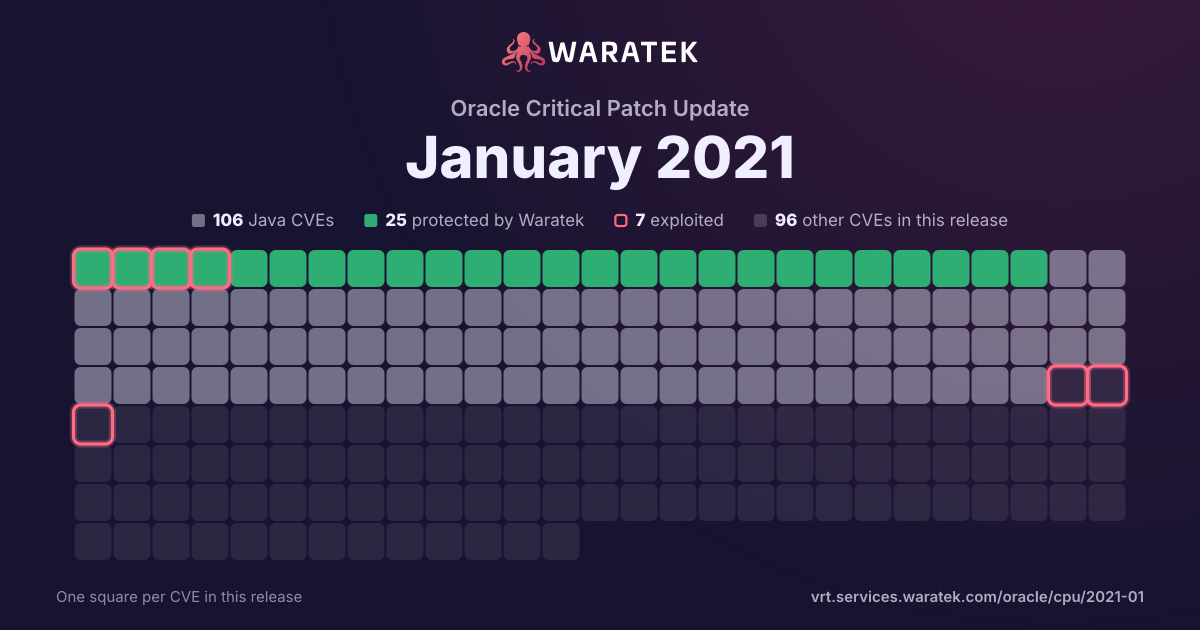
By status
25Protected by Waratek3Mitigation candidate78No exploit published59Outside Waratek scope37Not applicable
7Exploited, marked by the ring
No exploit published. For 66 of them, Oracle's security advisory is the source of public detail.
Protected by Waratek. Waratek RASP can block exploitation of these on systems that have not applied the patch yet.
Overview 7 matches · 0 in Waratek scope · 0 protected · 0 exploited · 0 CISA KEV · 3 public PoC · 3 EPSS ≥ 0.5
7matches
0in Waratek scope0.0%
0protected0.0%
0exploited0.0%
0CISA KEV0.0%
3public PoC42.9%
3EPSS ≥ 0.542.9%
Protected by Waratek
0
0.0%
Rule in development
0
0.0%
Mitigation candidate
0
0.0%
No exploit published
0
0.0%
Outside Waratek scope
7
100.0%
Not applicable
0
0.0%
Withdrawn CVE
0
0.0%
blocked by ARMR today
0
0.0%
partly blocked
0
0.0%
not blocked
7
100.0%
not established
0
0.0%
unrecorded
0
0.0%
Exploited
0
0.0%
Working exploit published
1
14.3%
Proof of concept only
2
28.6%
Forecast only
0
0.0%
No public exploit
4
57.1%
split by
peak 3 / quarter
Q4 181
Outside Waratek scope1
High1
not blocked1
No public exploit1
Q1 190
Q2 191
Outside Waratek scope1
High1
not blocked1
Working exploit published1
Q3 190
Q4 190
Q1 201
Outside Waratek scope1
High1
not blocked1
Proof of concept only1
Q2 203
Outside Waratek scope3
High3
not blocked3
Proof of concept only1
No public exploit2
Q3 200
Q4 200
Q1 211
Outside Waratek scope1
High1
not blocked1
No public exploit1
Q4 18Q1 19Q2 19Q3 19Q4 19Q1 20Q2 20Q3 20Q4 20Q1 21
| CVE | Severity | Published▾ | Status | Exploitation | Description |
|---|---|---|---|---|---|
| CVE-2021-2018 | High | 2021-01-20 | Outside Waratek scope | No public exploit | Vulnerability in the Advanced Networking Option component of Oracle Database Server. Supported versions that are affected are 18c and 19c. Difficult to exploit vulnerability allows unauthenticated attacker with network access via Oracle Net to compromise Advanced Networking Option. Successful attacks require human interaction from a person other than the attacker and while the vulnerability is in Advanced Networking Option, attacks may significantly impact additional products. Successful attacks of this vulnerability can result in takeover of Advanced Networking Option. Note: CVE-2021-2018 affects Windows platform only. CVSS 3.1 Base Score 8.3 (Confidentiality, Integrity and Availability impacts). CVSS Vector: (CVSS:3.1/AV:N/AC:H/PR:N/UI:R/S:C/C:H/I:H/A:H). |
| CVE-2020-11080 | High | 2020-06-03 | Outside Waratek scope | No public exploit | In nghttp2 before version 1.41.0, the overly large HTTP/2 SETTINGS frame payload causes denial of service. The proof of concept attack involves a malicious client constructing a SETTINGS frame with a length of 14,400 bytes (2400 individual settings entries) over and over again. The attack causes the CPU to spike at 100%. nghttp2 v1.41.0 fixes this vulnerability. There is a workaround to this vulnerability. Implement nghttp2_on_frame_recv_callback callback, and if received frame is SETTINGS frame and the number of settings entries are large (e.g., > 32), then drop the connection. |
| CVE-2020-1967 | High | 2020-04-21 | Outside Waratek scope | Proof of concept only | Server or client applications that call the SSL_check_chain() function during or after a TLS 1.3 handshake may crash due to a NULL pointer dereference as a result of incorrect handling of the "signature_algorithms_cert" TLS extension. The crash occurs if an invalid or unrecognised signature algorithm is received from the peer. This could be exploited by a malicious peer in a Denial of Service attack. OpenSSL version 1.1.1d, 1.1.1e, and 1.1.1f are affected by this issue. This issue did not affect OpenSSL versions prior to 1.1.1d. Fixed in OpenSSL 1.1.1g (Affected 1.1.1d-1.1.1f). |
| CVE-2020-11612 | High | 2020-04-07 | Outside Waratek scope | No public exploit | The ZlibDecoders in Netty 4.1.x before 4.1.46 allow for unbounded memory allocation while decoding a ZlibEncoded byte stream. An attacker could send a large ZlibEncoded byte stream to the Netty server, forcing the server to allocate all of its free memory to a single decoder. |
| CVE-2020-5398 | High | 2020-01-17 | Outside Waratek scope | Proof of concept only | In Spring Framework, versions 5.2.x prior to 5.2.3, versions 5.1.x prior to 5.1.13, and versions 5.0.x prior to 5.0.16, an application is vulnerable to a reflected file download (RFD) attack when it sets a "Content-Disposition" header in the response where the filename attribute is derived from user supplied input. |
| CVE-2019-0227 | High | 2019-05-01 | Outside Waratek scope | Working exploit published | A Server Side Request Forgery (SSRF) vulnerability affected the Apache Axis 1.4 distribution that was last released in 2006. Security and bug commits commits continue in the projects Axis 1.x Subversion repository, legacy users are encouraged to build from source. The successor to Axis 1.x is Axis2, the latest version is 1.7.9 and is not vulnerable to this issue. |
| CVE-2018-15756 | High | 2018-10-18 | Outside Waratek scope | No public exploit | Spring Framework, version 5.1, versions 5.0.x prior to 5.0.10, versions 4.3.x prior to 4.3.20, and older unsupported versions on the 4.2.x branch provide support for range requests when serving static resources through the ResourceHttpRequestHandler, or starting in 5.0 when an annotated controller returns an org.springframework.core.io.Resource. A malicious user (or attacker) can add a range header with a high number of ranges, or with wide ranges that overlap, or both, for a denial of service attack. This vulnerability affects applications that depend on either spring-webmvc or spring-webflux. Such applications must also have a registration for serving static resources (e.g. JS, CSS, images, and others), or have an annotated controller that returns an org.springframework.core.io.Resource. Spring Boot applications that depend on spring-boot-starter-web or spring-boot-starter-webflux are ready to serve static resources out of the box and are therefore vulnerable. |