
Oracle Critical Patch Update October 2020
Released October 2020 · Oracle's advisory ↗ · ← Critical Patch Update, July 2020 · Critical Patch Update, January 2021 →
230 CVEs in this release, one square each
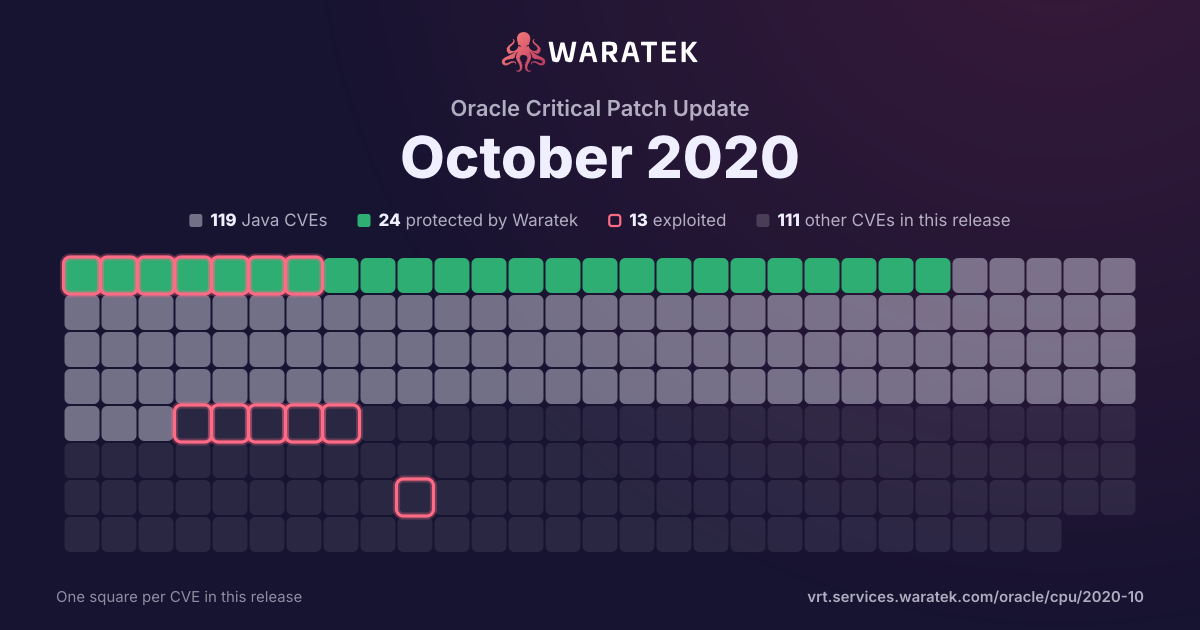
By status
24Protected by Waratek2Mitigation candidate93No exploit published64Outside Waratek scope47Not applicable
13Exploited, marked by the ring
No exploit published. For 75 of them, Oracle's security advisory is the source of public detail.
Protected by Waratek. Waratek RASP can block exploitation of these on systems that have not applied the patch yet.
Overview 119 matches · 23 protected · 7 exploited · 6 CISA KEV · 11 public PoC · 13 EPSS ≥ 0.5
Protected by Waratek
24
20.2%
Rule in development
0
0.0%
Mitigation candidate
2
1.7%
No exploit published
93
78.2%
blocked by ARMR today
23
19.3%
partly blocked
1
0.8%
not blocked
95
79.8%
not established
0
0.0%
unrecorded
0
0.0%
split by
peak 80 / quarter
Q2 161
Protected by Waratek1
High1
blocked by ARMR today1
Forecast only1
Q3 160
Q4 161
Protected by Waratek1
Critical1
blocked by ARMR today1
No public exploit1
Q1 170
Q2 171
Protected by Waratek1
Critical1
blocked by ARMR today1
Working exploit published1
Q3 170
Q4 171
Protected by Waratek1
High1
blocked by ARMR today1
Proof of concept only1
Q1 181
Protected by Waratek1
Critical1
blocked by ARMR today1
No public exploit1
Q2 182
No exploit published2
Critical1
High1
not blocked2
No public exploit2
Q3 180
Q4 180
Q1 191
Protected by Waratek1
Critical1
blocked by ARMR today1
Exploited1
Q2 193
No exploit published3
High1
Medium2
not blocked3
Forecast only1
No public exploit2
Q3 193
Protected by Waratek1
No exploit published2
Critical1
High2
blocked by ARMR today1
not blocked2
Forecast only1
No public exploit2
Q4 199
Protected by Waratek3
No exploit published6
Critical4
High2
Medium3
blocked by ARMR today2
partly blocked1
not blocked6
Exploited1
No public exploit8
Q1 205
Protected by Waratek2
Mitigation candidate1
No exploit published2
Critical4
Medium1
blocked by ARMR today2
not blocked3
Exploited2
No public exploit3
Q2 209
Protected by Waratek4
No exploit published5
Critical2
High3
Medium4
blocked by ARMR today4
not blocked5
Working exploit published1
No public exploit8
Q3 202
Mitigation candidate1
No exploit published1
Critical1
High1
not blocked2
Working exploit published1
No public exploit1
Q4 2080
Protected by Waratek8
No exploit published72
Critical8
High29
Medium36
Low7
blocked by ARMR today8
not blocked72
Exploited3
No public exploit77
Q2 16Q4 16Q2 17Q4 17Q2 18Q4 18Q2 19Q4 19Q2 20Q4 20
| CVE | Severity | Published▾ | Status | Exploitation | Description |
|---|---|---|---|---|---|
| CVE-2020-14897 | Medium | 2020-10-21 | No exploit published | No public exploit | Vulnerability in the Oracle FLEXCUBE Direct Banking product of Oracle Financial Services Applications (component: Pre Login). Supported versions that are affected are 12.0.1, 12.0.2 and 12.0.3. Easily exploitable vulnerability allows unauthenticated attacker with network access via HTTP to compromise Oracle FLEXCUBE Direct Banking. Successful attacks require human interaction from a person other than the attacker. Successful attacks of this vulnerability can result in unauthorized access to critical data or complete access to all Oracle FLEXCUBE Direct Banking accessible data. CVSS 3.1 Base Score 6.5 (Confidentiality impacts). CVSS Vector: (CVSS:3.1/AV:N/AC:L/PR:N/UI:R/S:U/C:H/I:N/A:N). |
| CVE-2020-14896 | Medium | 2020-10-21 | No exploit published | No public exploit | Vulnerability in the Oracle Banking Payments product of Oracle Financial Services Applications (component: Core). Supported versions that are affected are 14.1.0-14.4.0. Easily exploitable vulnerability allows low privileged attacker with network access via HTTP to compromise Oracle Banking Payments. Successful attacks of this vulnerability can result in unauthorized access to critical data or complete access to all Oracle Banking Payments accessible data. CVSS 3.1 Base Score 6.5 (Confidentiality impacts). CVSS Vector: (CVSS:3.1/AV:N/AC:L/PR:L/UI:N/S:U/C:H/I:N/A:N). |
| CVE-2020-14895 | Medium | 2020-10-21 | No exploit published | No public exploit | Vulnerability in the Oracle Utilities Framework product of Oracle Utilities Applications (component: System Wide). Supported versions that are affected are 2.2.0.0.0, 4.2.0.2.0, 4.2.0.3.0, 4.3.0.1.0 - 4.3.0.6.0, 4.4.0.0.0 and 4.4.0.2.0. Easily exploitable vulnerability allows low privileged attacker with network access via HTTP to compromise Oracle Utilities Framework. Successful attacks of this vulnerability can result in unauthorized update, insert or delete access to some of Oracle Utilities Framework accessible data as well as unauthorized read access to a subset of Oracle Utilities Framework accessible data. CVSS 3.1 Base Score 5.4 (Confidentiality and Integrity impacts). CVSS Vector: (CVSS:3.1/AV:N/AC:L/PR:L/UI:N/S:U/C:L/I:L/A:N). |
| CVE-2020-14894 | Medium | 2020-10-21 | No exploit published | No public exploit | Vulnerability in the Oracle Banking Corporate Lending product of Oracle Financial Services Applications (component: Core). Supported versions that are affected are 12.3.0 and 14.0.0-14.4.0. Easily exploitable vulnerability allows low privileged attacker with network access via HTTP to compromise Oracle Banking Corporate Lending. Successful attacks of this vulnerability can result in unauthorized access to critical data or complete access to all Oracle Banking Corporate Lending accessible data. CVSS 3.1 Base Score 6.5 (Confidentiality impacts). CVSS Vector: (CVSS:3.1/AV:N/AC:L/PR:L/UI:N/S:U/C:H/I:N/A:N). |
| CVE-2020-14890 | Medium | 2020-10-21 | No exploit published | No public exploit | Vulnerability in the Oracle FLEXCUBE Direct Banking product of Oracle Financial Services Applications (component: Pre Login). Supported versions that are affected are 12.0.1, 12.0.2 and 12.0.3. Easily exploitable vulnerability allows unauthenticated attacker with network access via HTTP to compromise Oracle FLEXCUBE Direct Banking. Successful attacks require human interaction from a person other than the attacker. Successful attacks of this vulnerability can result in unauthorized access to critical data or complete access to all Oracle FLEXCUBE Direct Banking accessible data. CVSS 3.1 Base Score 6.5 (Confidentiality impacts). CVSS Vector: (CVSS:3.1/AV:N/AC:L/PR:N/UI:R/S:U/C:H/I:N/A:N). |
| CVE-2020-14887 | Medium | 2020-10-21 | No exploit published | No public exploit | Vulnerability in the Oracle FLEXCUBE Universal Banking product of Oracle Financial Services Applications (component: Infrastructure). Supported versions that are affected are 12.3.0 and 14.0.0-14.4.0. Easily exploitable vulnerability allows low privileged attacker with network access via HTTP to compromise Oracle FLEXCUBE Universal Banking. Successful attacks of this vulnerability can result in unauthorized access to critical data or complete access to all Oracle FLEXCUBE Universal Banking accessible data. CVSS 3.1 Base Score 6.5 (Confidentiality impacts). CVSS Vector: (CVSS:3.1/AV:N/AC:L/PR:L/UI:N/S:U/C:H/I:N/A:N). |
| CVE-2020-14883 | High | 2020-10-21 | Protected by Waratek | Exploited | Vulnerability in the Oracle WebLogic Server product of Oracle Fusion Middleware (component: Console). Supported versions that are affected are 10.3.6.0.0, 12.1.3.0.0, 12.2.1.3.0, 12.2.1.4.0 and 14.1.1.0.0. Easily exploitable vulnerability allows high privileged attacker with network access via HTTP to compromise Oracle WebLogic Server. Successful attacks of this vulnerability can result in takeover of Oracle WebLogic Server. CVSS 3.1 Base Score 7.2 (Confidentiality, Integrity and Availability impacts). CVSS Vector: (CVSS:3.1/AV:N/AC:L/PR:H/UI:N/S:U/C:H/I:H/A:H). |
| CVE-2020-14882 | Critical | 2020-10-21 | Protected by Waratek | Exploited | Vulnerability in the Oracle WebLogic Server product of Oracle Fusion Middleware (component: Console). Supported versions that are affected are 10.3.6.0.0, 12.1.3.0.0, 12.2.1.3.0, 12.2.1.4.0 and 14.1.1.0.0. Easily exploitable vulnerability allows unauthenticated attacker with network access via HTTP to compromise Oracle WebLogic Server. Successful attacks of this vulnerability can result in takeover of Oracle WebLogic Server. CVSS 3.1 Base Score 9.8 (Confidentiality, Integrity and Availability impacts). CVSS Vector: (CVSS:3.1/AV:N/AC:L/PR:N/UI:N/S:U/C:H/I:H/A:H). |
| CVE-2020-14880 | High | 2020-10-21 | No exploit published | No public exploit | Vulnerability in the BI Publisher product of Oracle Fusion Middleware (component: E-Business Suite - XDO). Supported versions that are affected are 5.5.0.0.0, 11.1.1.9.0, 12.2.1.3.0 and 12.2.1.4.0. Easily exploitable vulnerability allows low privileged attacker with network access via HTTP to compromise BI Publisher. While the vulnerability is in BI Publisher, attacks may significantly impact additional products. Successful attacks of this vulnerability can result in unauthorized access to critical data or complete access to all BI Publisher accessible data as well as unauthorized update, insert or delete access to some of BI Publisher accessible data. CVSS 3.1 Base Score 8.5 (Confidentiality and Integrity impacts). CVSS Vector: (CVSS:3.1/AV:N/AC:L/PR:L/UI:N/S:C/C:H/I:L/A:N). |
| CVE-2020-14879 | High | 2020-10-21 | No exploit published | No public exploit | Vulnerability in the BI Publisher product of Oracle Fusion Middleware (component: E-Business Suite - XDO). Supported versions that are affected are 5.5.0.0.0, 11.1.1.9.0, 12.2.1.3.0 and 12.2.1.4.0. Easily exploitable vulnerability allows low privileged attacker with network access via HTTP to compromise BI Publisher. While the vulnerability is in BI Publisher, attacks may significantly impact additional products. Successful attacks of this vulnerability can result in unauthorized access to critical data or complete access to all BI Publisher accessible data as well as unauthorized update, insert or delete access to some of BI Publisher accessible data. CVSS 3.1 Base Score 8.5 (Confidentiality and Integrity impacts). CVSS Vector: (CVSS:3.1/AV:N/AC:L/PR:L/UI:N/S:C/C:H/I:L/A:N). |
| CVE-2020-14877 | Medium | 2020-10-21 | No exploit published | No public exploit | Vulnerability in the Oracle Hospitality OPERA 5 Property Services product of Oracle Hospitality Applications (component: Logging). Supported versions that are affected are 5.5 and 5.6. Easily exploitable vulnerability allows high privileged attacker with network access via HTTP to compromise Oracle Hospitality OPERA 5 Property Services. Successful attacks of this vulnerability can result in unauthorized creation, deletion or modification access to critical data or all Oracle Hospitality OPERA 5 Property Services accessible data as well as unauthorized access to critical data or complete access to all Oracle Hospitality OPERA 5 Property Services accessible data. CVSS 3.1 Base Score 6.5 (Confidentiality and Integrity impacts). CVSS Vector: (CVSS:3.1/AV:N/AC:L/PR:H/UI:N/S:U/C:H/I:H/A:N). |
| CVE-2020-14876 | Critical | 2020-10-21 | No exploit published | No public exploit | Vulnerability in the Oracle Trade Management product of Oracle E-Business Suite (component: User Interface). Supported versions that are affected are 12.1.1 - 12.1.3 and 12.2.3 - 12.2.10. Easily exploitable vulnerability allows unauthenticated attacker with network access via HTTP to compromise Oracle Trade Management. Successful attacks of this vulnerability can result in unauthorized creation, deletion or modification access to critical data or all Oracle Trade Management accessible data as well as unauthorized access to critical data or complete access to all Oracle Trade Management accessible data. CVSS 3.1 Base Score 9.1 (Confidentiality and Integrity impacts). CVSS Vector: (CVSS:3.1/AV:N/AC:L/PR:N/UI:N/S:U/C:H/I:H/A:N). |
| CVE-2020-14875 | Critical | 2020-10-21 | No exploit published | No public exploit | Vulnerability in the Oracle Marketing product of Oracle E-Business Suite (component: Marketing Administration). Supported versions that are affected are 12.1.1 - 12.1.3 and 12.2.3 - 12.2.10. Easily exploitable vulnerability allows unauthenticated attacker with network access via HTTP to compromise Oracle Marketing. Successful attacks of this vulnerability can result in unauthorized creation, deletion or modification access to critical data or all Oracle Marketing accessible data as well as unauthorized access to critical data or complete access to all Oracle Marketing accessible data. CVSS 3.1 Base Score 9.1 (Confidentiality and Integrity impacts). CVSS Vector: (CVSS:3.1/AV:N/AC:L/PR:N/UI:N/S:U/C:H/I:H/A:N). |
| CVE-2020-14865 | High | 2020-10-21 | No exploit published | No public exploit | Vulnerability in the PeopleSoft Enterprise SCM eSupplier Connection product of Oracle PeopleSoft (component: eSupplier Connection). The supported version that is affected is 9.2. Easily exploitable vulnerability allows low privileged attacker with network access via HTTP to compromise PeopleSoft Enterprise SCM eSupplier Connection. Successful attacks of this vulnerability can result in unauthorized creation, deletion or modification access to critical data or all PeopleSoft Enterprise SCM eSupplier Connection accessible data as well as unauthorized access to critical data or complete access to all PeopleSoft Enterprise SCM eSupplier Connection accessible data. CVSS 3.1 Base Score 8.1 (Confidentiality and Integrity impacts). CVSS Vector: (CVSS:3.1/AV:N/AC:L/PR:L/UI:N/S:U/C:H/I:H/A:N). |
| CVE-2020-14864 | High | 2020-10-21 | Protected by Waratek | Exploited | Vulnerability in the Oracle Business Intelligence Enterprise Edition product of Oracle Fusion Middleware (component: Installation). Supported versions that are affected are 5.5.0.0.0, 12.2.1.3.0 and 12.2.1.4.0. Easily exploitable vulnerability allows unauthenticated attacker with network access via HTTP to compromise Oracle Business Intelligence Enterprise Edition. Successful attacks of this vulnerability can result in unauthorized access to critical data or complete access to all Oracle Business Intelligence Enterprise Edition accessible data. CVSS 3.1 Base Score 7.5 (Confidentiality impacts). CVSS Vector: (CVSS:3.1/AV:N/AC:L/PR:N/UI:N/S:U/C:H/I:N/A:N). |
| CVE-2020-14863 | High | 2020-10-21 | No exploit published | No public exploit | Vulnerability in the Oracle One-to-One Fulfillment product of Oracle E-Business Suite (component: Print Server). Supported versions that are affected are 12.1.1 - 12.1.3. Easily exploitable vulnerability allows unauthenticated attacker with network access via HTTP to compromise Oracle One-to-One Fulfillment. Successful attacks require human interaction from a person other than the attacker and while the vulnerability is in Oracle One-to-One Fulfillment, attacks may significantly impact additional products. Successful attacks of this vulnerability can result in unauthorized access to critical data or complete access to all Oracle One-to-One Fulfillment accessible data as well as unauthorized update, insert or delete access to some of Oracle One-to-One Fulfillment accessible data. CVSS 3.1 Base Score 8.2 (Confidentiality and Integrity impacts). CVSS Vector: (CVSS:3.1/AV:N/AC:L/PR:N/UI:R/S:C/C:H/I:L/A:N). |
| CVE-2020-14862 | High | 2020-10-21 | No exploit published | No public exploit | Vulnerability in the Oracle Universal Work Queue product of Oracle E-Business Suite (component: Internal Operations). Supported versions that are affected are 12.2.3 - 12.2.9. Easily exploitable vulnerability allows low privileged attacker with network access via HTTP to compromise Oracle Universal Work Queue. Successful attacks of this vulnerability can result in takeover of Oracle Universal Work Queue. CVSS 3.1 Base Score 8.8 (Confidentiality, Integrity and Availability impacts). CVSS Vector: (CVSS:3.1/AV:N/AC:L/PR:L/UI:N/S:U/C:H/I:H/A:H). |
| CVE-2020-14859 | Critical | 2020-10-21 | Protected by Waratek | No public exploit | Vulnerability in the Oracle WebLogic Server product of Oracle Fusion Middleware (component: Core). Supported versions that are affected are 10.3.6.0.0, 12.1.3.0.0, 12.2.1.3.0, 12.2.1.4.0 and 14.1.1.0.0. Easily exploitable vulnerability allows unauthenticated attacker with network access via IIOP, T3 to compromise Oracle WebLogic Server. Successful attacks of this vulnerability can result in takeover of Oracle WebLogic Server. CVSS 3.1 Base Score 9.8 (Confidentiality, Integrity and Availability impacts). CVSS Vector: (CVSS:3.1/AV:N/AC:L/PR:N/UI:N/S:U/C:H/I:H/A:H). |
| CVE-2020-14858 | Medium | 2020-10-21 | No exploit published | No public exploit | Vulnerability in the Oracle Hospitality OPERA 5 Property Services product of Oracle Hospitality Applications (component: Logging). Supported versions that are affected are 5.5 and 5.6. Easily exploitable vulnerability allows high privileged attacker with network access via HTTP to compromise Oracle Hospitality OPERA 5 Property Services. Successful attacks require human interaction from a person other than the attacker. Successful attacks of this vulnerability can result in takeover of Oracle Hospitality OPERA 5 Property Services. CVSS 3.1 Base Score 6.8 (Confidentiality, Integrity and Availability impacts). CVSS Vector: (CVSS:3.1/AV:N/AC:L/PR:H/UI:R/S:U/C:H/I:H/A:H). |
| CVE-2020-14857 | High | 2020-10-21 | No exploit published | No public exploit | Vulnerability in the Oracle Trade Management product of Oracle E-Business Suite (component: User Interface). Supported versions that are affected are 12.1.1 - 12.1.3 and 12.2.3 - 12.2.10. Easily exploitable vulnerability allows unauthenticated attacker with network access via HTTP to compromise Oracle Trade Management. Successful attacks require human interaction from a person other than the attacker and while the vulnerability is in Oracle Trade Management, attacks may significantly impact additional products. Successful attacks of this vulnerability can result in unauthorized access to critical data or complete access to all Oracle Trade Management accessible data as well as unauthorized update, insert or delete access to some of Oracle Trade Management accessible data. CVSS 3.1 Base Score 8.2 (Confidentiality and Integrity impacts). CVSS Vector: (CVSS:3.1/AV:N/AC:L/PR:N/UI:R/S:C/C:H/I:L/A:N). |
| CVE-2020-14856 | High | 2020-10-21 | No exploit published | No public exploit | Vulnerability in the Oracle Trade Management product of Oracle E-Business Suite (component: User Interface). Supported versions that are affected are 12.1.1 - 12.1.3 and 12.2.3 - 12.2.10. Easily exploitable vulnerability allows unauthenticated attacker with network access via HTTP to compromise Oracle Trade Management. Successful attacks require human interaction from a person other than the attacker and while the vulnerability is in Oracle Trade Management, attacks may significantly impact additional products. Successful attacks of this vulnerability can result in unauthorized access to critical data or complete access to all Oracle Trade Management accessible data as well as unauthorized update, insert or delete access to some of Oracle Trade Management accessible data. CVSS 3.1 Base Score 8.2 (Confidentiality and Integrity impacts). CVSS Vector: (CVSS:3.1/AV:N/AC:L/PR:N/UI:R/S:C/C:H/I:L/A:N). |
| CVE-2020-14855 | Critical | 2020-10-21 | No exploit published | No public exploit | Vulnerability in the Oracle Universal Work Queue product of Oracle E-Business Suite (component: Work Provider Administration). The supported version that is affected is 12.1.3. Easily exploitable vulnerability allows unauthenticated attacker with network access via HTTP to compromise Oracle Universal Work Queue. Successful attacks of this vulnerability can result in takeover of Oracle Universal Work Queue. CVSS 3.1 Base Score 9.8 (Confidentiality, Integrity and Availability impacts). CVSS Vector: (CVSS:3.1/AV:N/AC:L/PR:N/UI:N/S:U/C:H/I:H/A:H). |
| CVE-2020-14854 | Medium | 2020-10-21 | No exploit published | No public exploit | Vulnerability in the Hyperion Infrastructure Technology product of Oracle Hyperion (component: UI and Visualization). The supported version that is affected is 11.1.2.4. Easily exploitable vulnerability allows high privileged attacker with network access via HTTP to compromise Hyperion Infrastructure Technology. Successful attacks require human interaction from a person other than the attacker. Successful attacks of this vulnerability can result in unauthorized creation, deletion or modification access to critical data or all Hyperion Infrastructure Technology accessible data as well as unauthorized access to critical data or complete access to all Hyperion Infrastructure Technology accessible data. CVSS 3.1 Base Score 6.1 (Confidentiality and Integrity impacts). CVSS Vector: (CVSS:3.1/AV:N/AC:L/PR:H/UI:R/S:U/C:H/I:H/A:N). |
| CVE-2020-14851 | High | 2020-10-21 | No exploit published | No public exploit | Vulnerability in the Oracle Trade Management product of Oracle E-Business Suite (component: User Interface). Supported versions that are affected are 12.1.1 - 12.1.3 and 12.2.3 - 12.2.10. Easily exploitable vulnerability allows unauthenticated attacker with network access via HTTP to compromise Oracle Trade Management. Successful attacks require human interaction from a person other than the attacker and while the vulnerability is in Oracle Trade Management, attacks may significantly impact additional products. Successful attacks of this vulnerability can result in unauthorized access to critical data or complete access to all Oracle Trade Management accessible data as well as unauthorized update, insert or delete access to some of Oracle Trade Management accessible data. CVSS 3.1 Base Score 8.2 (Confidentiality and Integrity impacts). CVSS Vector: (CVSS:3.1/AV:N/AC:L/PR:N/UI:R/S:C/C:H/I:L/A:N). |
| CVE-2020-14850 | High | 2020-10-21 | No exploit published | No public exploit | Vulnerability in the Oracle CRM Technical Foundation product of Oracle E-Business Suite (component: Flex Fields). Supported versions that are affected are 12.1.3 and 12.2.3 - 12.2.10. Easily exploitable vulnerability allows unauthenticated attacker with network access via HTTP to compromise Oracle CRM Technical Foundation. Successful attacks require human interaction from a person other than the attacker and while the vulnerability is in Oracle CRM Technical Foundation, attacks may significantly impact additional products. Successful attacks of this vulnerability can result in unauthorized access to critical data or complete access to all Oracle CRM Technical Foundation accessible data as well as unauthorized update, insert or delete access to some of Oracle CRM Technical Foundation accessible data. CVSS 3.1 Base Score 8.2 (Confidentiality and Integrity impacts). CVSS Vector: (CVSS:3.1/AV:N/AC:L/PR:N/UI:R/S:C/C:H/I:L/A:N). |
| CVE-2020-14849 | High | 2020-10-21 | No exploit published | No public exploit | Vulnerability in the Oracle Marketing product of Oracle E-Business Suite (component: Marketing Administration). Supported versions that are affected are 12.1.1 - 12.1.3 and 12.2.3 - 12.2.10. Easily exploitable vulnerability allows unauthenticated attacker with network access via HTTP to compromise Oracle Marketing. Successful attacks require human interaction from a person other than the attacker and while the vulnerability is in Oracle Marketing, attacks may significantly impact additional products. Successful attacks of this vulnerability can result in unauthorized access to critical data or complete access to all Oracle Marketing accessible data as well as unauthorized update, insert or delete access to some of Oracle Marketing accessible data. CVSS 3.1 Base Score 8.2 (Confidentiality and Integrity impacts). CVSS Vector: (CVSS:3.1/AV:N/AC:L/PR:N/UI:R/S:C/C:H/I:L/A:N). |
| CVE-2020-14847 | Low | 2020-10-21 | No exploit published | No public exploit | Vulnerability in the PeopleSoft Enterprise PeopleTools product of Oracle PeopleSoft (component: Query). Supported versions that are affected are 8.56, 8.57 and 8.58. Easily exploitable vulnerability allows high privileged attacker with network access via HTTP to compromise PeopleSoft Enterprise PeopleTools. Successful attacks of this vulnerability can result in unauthorized read access to a subset of PeopleSoft Enterprise PeopleTools accessible data. CVSS 3.1 Base Score 2.7 (Confidentiality impacts). CVSS Vector: (CVSS:3.1/AV:N/AC:L/PR:H/UI:N/S:U/C:L/I:N/A:N). |
| CVE-2020-14843 | High | 2020-10-21 | No exploit published | No public exploit | Vulnerability in the Oracle Business Intelligence Enterprise Edition product of Oracle Fusion Middleware (component: Analytics Actions). Supported versions that are affected are 5.5.0.0.0, 12.2.1.3.0 and 12.2.1.4.0. Easily exploitable vulnerability allows unauthenticated attacker with network access via HTTP to compromise Oracle Business Intelligence Enterprise Edition. Successful attacks require human interaction from a person other than the attacker and while the vulnerability is in Oracle Business Intelligence Enterprise Edition, attacks may significantly impact additional products. Successful attacks of this vulnerability can result in unauthorized update, insert or delete access to some of Oracle Business Intelligence Enterprise Edition accessible data as well as unauthorized read access to a subset of Oracle Business Intelligence Enterprise Edition accessible data and unauthorized ability to cause a partial denial of service (partial DOS) of Oracle Business Intelligence Enterprise Edition. CVSS 3.1 Base Score 7.1 (Confidentiality, Integrity and Availability impacts). CVSS Vector: (CVSS:3.1/AV:N/AC:L/PR:N/UI:R/S:C/C:L/I:L/A:L). |
| CVE-2020-14842 | High | 2020-10-21 | No exploit published | No public exploit | Vulnerability in the BI Publisher product of Oracle Fusion Middleware (component: BI Publisher Security). Supported versions that are affected are 5.5.0.0.0, 11.1.1.9.0, 12.2.1.3.0 and 12.2.1.4.0. Easily exploitable vulnerability allows unauthenticated attacker with network access via HTTP to compromise BI Publisher. Successful attacks require human interaction from a person other than the attacker and while the vulnerability is in BI Publisher, attacks may significantly impact additional products. Successful attacks of this vulnerability can result in unauthorized access to critical data or complete access to all BI Publisher accessible data as well as unauthorized update, insert or delete access to some of BI Publisher accessible data. CVSS 3.1 Base Score 8.2 (Confidentiality and Integrity impacts). CVSS Vector: (CVSS:3.1/AV:N/AC:L/PR:N/UI:R/S:C/C:H/I:L/A:N). |
| CVE-2020-14841 | Critical | 2020-10-21 | Protected by Waratek | No public exploit | Vulnerability in the Oracle WebLogic Server product of Oracle Fusion Middleware (component: Core). Supported versions that are affected are 10.3.6.0.0, 12.1.3.0.0, 12.2.1.3.0, 12.2.1.4.0 and 14.1.1.0.0. Easily exploitable vulnerability allows unauthenticated attacker with network access via IIOP to compromise Oracle WebLogic Server. Successful attacks of this vulnerability can result in takeover of Oracle WebLogic Server. CVSS 3.1 Base Score 9.8 (Confidentiality, Integrity and Availability impacts). CVSS Vector: (CVSS:3.1/AV:N/AC:L/PR:N/UI:N/S:U/C:H/I:H/A:H). |
| CVE-2020-14840 | Medium | 2020-10-21 | No exploit published | No public exploit | Vulnerability in the Oracle Application Object Library product of Oracle E-Business Suite (component: Diagnostics). Supported versions that are affected are 12.1.3 and 12.2.3 - 12.2.10. Easily exploitable vulnerability allows unauthenticated attacker with network access via HTTP to compromise Oracle Application Object Library. Successful attacks require human interaction from a person other than the attacker and while the vulnerability is in Oracle Application Object Library, attacks may significantly impact additional products. Successful attacks of this vulnerability can result in unauthorized update, insert or delete access to some of Oracle Application Object Library accessible data. CVSS 3.1 Base Score 4.7 (Integrity impacts). CVSS Vector: (CVSS:3.1/AV:N/AC:L/PR:N/UI:R/S:C/C:N/I:L/A:N). |
| CVE-2020-14835 | High | 2020-10-21 | No exploit published | No public exploit | Vulnerability in the Oracle Marketing product of Oracle E-Business Suite (component: Marketing Administration). Supported versions that are affected are 12.1.1 - 12.1.3. Easily exploitable vulnerability allows unauthenticated attacker with network access via HTTP to compromise Oracle Marketing. Successful attacks require human interaction from a person other than the attacker and while the vulnerability is in Oracle Marketing, attacks may significantly impact additional products. Successful attacks of this vulnerability can result in unauthorized access to critical data or complete access to all Oracle Marketing accessible data as well as unauthorized update, insert or delete access to some of Oracle Marketing accessible data. CVSS 3.1 Base Score 8.2 (Confidentiality and Integrity impacts). CVSS Vector: (CVSS:3.1/AV:N/AC:L/PR:N/UI:R/S:C/C:H/I:L/A:N). |
| CVE-2020-14834 | High | 2020-10-21 | No exploit published | No public exploit | Vulnerability in the Oracle Trade Management product of Oracle E-Business Suite (component: User Interface). Supported versions that are affected are 12.1.1 - 12.1.3 and 12.2.3 - 12.2.10. Easily exploitable vulnerability allows unauthenticated attacker with network access via HTTP to compromise Oracle Trade Management. Successful attacks require human interaction from a person other than the attacker and while the vulnerability is in Oracle Trade Management, attacks may significantly impact additional products. Successful attacks of this vulnerability can result in unauthorized access to critical data or complete access to all Oracle Trade Management accessible data as well as unauthorized update, insert or delete access to some of Oracle Trade Management accessible data. CVSS 3.1 Base Score 8.2 (Confidentiality and Integrity impacts). CVSS Vector: (CVSS:3.1/AV:N/AC:L/PR:N/UI:R/S:C/C:H/I:L/A:N). |
| CVE-2020-14833 | High | 2020-10-21 | No exploit published | No public exploit | Vulnerability in the Oracle Trade Management product of Oracle E-Business Suite (component: User Interface). Supported versions that are affected are 12.1.1 - 12.1.3 and 12.2.3 - 12.2.10. Easily exploitable vulnerability allows unauthenticated attacker with network access via HTTP to compromise Oracle Trade Management. Successful attacks require human interaction from a person other than the attacker and while the vulnerability is in Oracle Trade Management, attacks may significantly impact additional products. Successful attacks of this vulnerability can result in unauthorized access to critical data or complete access to all Oracle Trade Management accessible data as well as unauthorized update, insert or delete access to some of Oracle Trade Management accessible data. CVSS 3.1 Base Score 8.2 (Confidentiality and Integrity impacts). CVSS Vector: (CVSS:3.1/AV:N/AC:L/PR:N/UI:R/S:C/C:H/I:L/A:N). |
| CVE-2020-14832 | Medium | 2020-10-21 | No exploit published | No public exploit | Vulnerability in the PeopleSoft Enterprise PeopleTools product of Oracle PeopleSoft (component: Integration Broker). Supported versions that are affected are 8.56, 8.57 and 8.58. Easily exploitable vulnerability allows unauthenticated attacker with network access via HTTP to compromise PeopleSoft Enterprise PeopleTools. Successful attacks require human interaction from a person other than the attacker and while the vulnerability is in PeopleSoft Enterprise PeopleTools, attacks may significantly impact additional products. Successful attacks of this vulnerability can result in unauthorized update, insert or delete access to some of PeopleSoft Enterprise PeopleTools accessible data as well as unauthorized read access to a subset of PeopleSoft Enterprise PeopleTools accessible data. CVSS 3.1 Base Score 6.1 (Confidentiality and Integrity impacts). CVSS Vector: (CVSS:3.1/AV:N/AC:L/PR:N/UI:R/S:C/C:L/I:L/A:N). |
| CVE-2020-14831 | High | 2020-10-21 | No exploit published | No public exploit | Vulnerability in the Oracle Marketing product of Oracle E-Business Suite (component: Marketing Administration). Supported versions that are affected are 12.1.1 - 12.1.3 and 12.2.3 - 12.2.10. Easily exploitable vulnerability allows unauthenticated attacker with network access via HTTP to compromise Oracle Marketing. Successful attacks require human interaction from a person other than the attacker and while the vulnerability is in Oracle Marketing, attacks may significantly impact additional products. Successful attacks of this vulnerability can result in unauthorized access to critical data or complete access to all Oracle Marketing accessible data as well as unauthorized update, insert or delete access to some of Oracle Marketing accessible data. CVSS 3.1 Base Score 8.2 (Confidentiality and Integrity impacts). CVSS Vector: (CVSS:3.1/AV:N/AC:L/PR:N/UI:R/S:C/C:H/I:L/A:N). |
| CVE-2020-14826 | Medium | 2020-10-21 | No exploit published | No public exploit | Vulnerability in the Oracle Applications Manager product of Oracle E-Business Suite (component: SQL Extensions). Supported versions that are affected are 12.1.3 and 12.2.3 - 12.2.10. Easily exploitable vulnerability allows unauthenticated attacker with network access via HTTP to compromise Oracle Applications Manager. Successful attacks of this vulnerability can result in unauthorized read access to a subset of Oracle Applications Manager accessible data. CVSS 3.1 Base Score 5.3 (Confidentiality impacts). CVSS Vector: (CVSS:3.1/AV:N/AC:L/PR:N/UI:N/S:U/C:L/I:N/A:N). |
| CVE-2020-14825 | Critical | 2020-10-21 | No exploit published | No public exploit | Vulnerability in the Oracle WebLogic Server product of Oracle Fusion Middleware (component: Core). Supported versions that are affected are 12.2.1.3.0, 12.2.1.4.0 and 14.1.1.0.0. Easily exploitable vulnerability allows unauthenticated attacker with network access via IIOP, T3 to compromise Oracle WebLogic Server. Successful attacks of this vulnerability can result in takeover of Oracle WebLogic Server. CVSS 3.1 Base Score 9.8 (Confidentiality, Integrity and Availability impacts). CVSS Vector: (CVSS:3.1/AV:N/AC:L/PR:N/UI:N/S:U/C:H/I:H/A:H). |
| CVE-2020-14824 | High | 2020-10-21 | No exploit published | No public exploit | Vulnerability in the Oracle Financial Services Analytical Applications Infrastructure product of Oracle Financial Services Applications (component: Infrastructure). Supported versions that are affected are 8.0.6-8.1.0. Easily exploitable vulnerability allows unauthenticated attacker with network access via HTTP to compromise Oracle Financial Services Analytical Applications Infrastructure. While the vulnerability is in Oracle Financial Services Analytical Applications Infrastructure, attacks may significantly impact additional products. Successful attacks of this vulnerability can result in unauthorized ability to cause a hang or frequently repeatable crash (complete DOS) of Oracle Financial Services Analytical Applications Infrastructure. CVSS 3.1 Base Score 8.6 (Availability impacts). CVSS Vector: (CVSS:3.1/AV:N/AC:L/PR:N/UI:N/S:C/C:N/I:N/A:H). |
| CVE-2020-14823 | Medium | 2020-10-21 | No exploit published | No public exploit | Vulnerability in the Oracle CRM Technical Foundation product of Oracle E-Business Suite (component: Preferences). Supported versions that are affected are 12.2.3 - 12.2.10. Easily exploitable vulnerability allows high privileged attacker with network access via HTTP to compromise Oracle CRM Technical Foundation. Successful attacks of this vulnerability can result in unauthorized creation, deletion or modification access to critical data or all Oracle CRM Technical Foundation accessible data as well as unauthorized access to critical data or complete access to all Oracle CRM Technical Foundation accessible data. CVSS 3.1 Base Score 6.5 (Confidentiality and Integrity impacts). CVSS Vector: (CVSS:3.1/AV:N/AC:L/PR:H/UI:N/S:U/C:H/I:H/A:N). |
| CVE-2020-14822 | Medium | 2020-10-21 | No exploit published | No public exploit | Vulnerability in the Oracle Installed Base product of Oracle E-Business Suite (component: APIs). Supported versions that are affected are 12.1.1 - 12.1.3 and 12.2.3 - 12.2.10. Easily exploitable vulnerability allows unauthenticated attacker with network access via HTTP to compromise Oracle Installed Base. Successful attacks require human interaction from a person other than the attacker and while the vulnerability is in Oracle Installed Base, attacks may significantly impact additional products. Successful attacks of this vulnerability can result in unauthorized update, insert or delete access to some of Oracle Installed Base accessible data. CVSS 3.1 Base Score 4.7 (Integrity impacts). CVSS Vector: (CVSS:3.1/AV:N/AC:L/PR:N/UI:R/S:C/C:N/I:L/A:N). |
| CVE-2020-14820 | High | 2020-10-21 | No exploit published | No public exploit | Vulnerability in the Oracle WebLogic Server product of Oracle Fusion Middleware (component: Core). Supported versions that are affected are 10.3.6.0.0, 12.1.3.0.0, 12.2.1.3.0, 12.2.1.4.0 and 14.1.1.0.0. Easily exploitable vulnerability allows unauthenticated attacker with network access via IIOP, T3 to compromise Oracle WebLogic Server. Successful attacks of this vulnerability can result in unauthorized access to critical data or complete access to all Oracle WebLogic Server accessible data. CVSS 3.1 Base Score 7.5 (Confidentiality impacts). CVSS Vector: (CVSS:3.1/AV:N/AC:L/PR:N/UI:N/S:U/C:H/I:N/A:N). |
| CVE-2020-14819 | High | 2020-10-21 | No exploit published | No public exploit | Vulnerability in the Oracle One-to-One Fulfillment product of Oracle E-Business Suite (component: Print Server). The supported version that is affected is 12.1.3. Easily exploitable vulnerability allows unauthenticated attacker with network access via HTTP to compromise Oracle One-to-One Fulfillment. Successful attacks require human interaction from a person other than the attacker and while the vulnerability is in Oracle One-to-One Fulfillment, attacks may significantly impact additional products. Successful attacks of this vulnerability can result in unauthorized access to critical data or complete access to all Oracle One-to-One Fulfillment accessible data as well as unauthorized update, insert or delete access to some of Oracle One-to-One Fulfillment accessible data. CVSS 3.1 Base Score 8.2 (Confidentiality and Integrity impacts). CVSS Vector: (CVSS:3.1/AV:N/AC:L/PR:N/UI:R/S:C/C:H/I:L/A:N). |
| CVE-2020-14817 | High | 2020-10-21 | No exploit published | No public exploit | Vulnerability in the Oracle Marketing product of Oracle E-Business Suite (component: Marketing Administration). Supported versions that are affected are 12.1.1 - 12.1.3 and 12.2.3 - 12.2.10. Easily exploitable vulnerability allows unauthenticated attacker with network access via HTTP to compromise Oracle Marketing. Successful attacks require human interaction from a person other than the attacker and while the vulnerability is in Oracle Marketing, attacks may significantly impact additional products. Successful attacks of this vulnerability can result in unauthorized access to critical data or complete access to all Oracle Marketing accessible data as well as unauthorized update, insert or delete access to some of Oracle Marketing accessible data. CVSS 3.1 Base Score 8.2 (Confidentiality and Integrity impacts). CVSS Vector: (CVSS:3.1/AV:N/AC:L/PR:N/UI:R/S:C/C:H/I:L/A:N). |
| CVE-2020-14816 | High | 2020-10-21 | No exploit published | No public exploit | Vulnerability in the Oracle Marketing product of Oracle E-Business Suite (component: Marketing Administration). Supported versions that are affected are 12.1.1 - 12.1.3 and 12.2.3 - 12.2.10. Easily exploitable vulnerability allows unauthenticated attacker with network access via HTTP to compromise Oracle Marketing. Successful attacks require human interaction from a person other than the attacker and while the vulnerability is in Oracle Marketing, attacks may significantly impact additional products. Successful attacks of this vulnerability can result in unauthorized access to critical data or complete access to all Oracle Marketing accessible data as well as unauthorized update, insert or delete access to some of Oracle Marketing accessible data. CVSS 3.1 Base Score 8.2 (Confidentiality and Integrity impacts). CVSS Vector: (CVSS:3.1/AV:N/AC:L/PR:N/UI:R/S:C/C:H/I:L/A:N). |
| CVE-2020-14815 | High | 2020-10-21 | No exploit published | No public exploit | Vulnerability in the Oracle Business Intelligence Enterprise Edition product of Oracle Fusion Middleware (component: Analytics Actions). Supported versions that are affected are 5.5.0.0.0, 12.2.1.3.0 and 12.2.1.4.0. Easily exploitable vulnerability allows unauthenticated attacker with network access via HTTP to compromise Oracle Business Intelligence Enterprise Edition. Successful attacks require human interaction from a person other than the attacker and while the vulnerability is in Oracle Business Intelligence Enterprise Edition, attacks may significantly impact additional products. Successful attacks of this vulnerability can result in unauthorized access to critical data or complete access to all Oracle Business Intelligence Enterprise Edition accessible data as well as unauthorized update, insert or delete access to some of Oracle Business Intelligence Enterprise Edition accessible data. CVSS 3.1 Base Score 8.2 (Confidentiality and Integrity impacts). CVSS Vector: (CVSS:3.1/AV:N/AC:L/PR:N/UI:R/S:C/C:H/I:L/A:N). |
| CVE-2020-14813 | Medium | 2020-10-21 | No exploit published | No public exploit | Vulnerability in the PeopleSoft Enterprise PeopleTools product of Oracle PeopleSoft (component: PIA Grids). Supported versions that are affected are 8.56, 8.57 and 8.58. Easily exploitable vulnerability allows unauthenticated attacker with network access via HTTP to compromise PeopleSoft Enterprise PeopleTools. Successful attacks require human interaction from a person other than the attacker and while the vulnerability is in PeopleSoft Enterprise PeopleTools, attacks may significantly impact additional products. Successful attacks of this vulnerability can result in unauthorized update, insert or delete access to some of PeopleSoft Enterprise PeopleTools accessible data as well as unauthorized read access to a subset of PeopleSoft Enterprise PeopleTools accessible data. CVSS 3.1 Base Score 6.1 (Confidentiality and Integrity impacts). CVSS Vector: (CVSS:3.1/AV:N/AC:L/PR:N/UI:R/S:C/C:L/I:L/A:N). |
| CVE-2020-14811 | Medium | 2020-10-21 | No exploit published | No public exploit | Vulnerability in the Oracle Applications Manager product of Oracle E-Business Suite (component: AMP EBS Integration). Supported versions that are affected are 12.1.3 and 12.2.3 - 12.2.10. Easily exploitable vulnerability allows unauthenticated attacker with network access via HTTP to compromise Oracle Applications Manager. Successful attacks of this vulnerability can result in unauthorized read access to a subset of Oracle Applications Manager accessible data. CVSS 3.1 Base Score 5.3 (Confidentiality impacts). CVSS Vector: (CVSS:3.1/AV:N/AC:L/PR:N/UI:N/S:U/C:L/I:N/A:N). |
| CVE-2020-14808 | High | 2020-10-21 | No exploit published | No public exploit | Vulnerability in the Oracle Trade Management product of Oracle E-Business Suite (component: User Interface). Supported versions that are affected are 12.1.3 and 12.2.3 - 12.2.10. Easily exploitable vulnerability allows unauthenticated attacker with network access via HTTP to compromise Oracle Trade Management. Successful attacks require human interaction from a person other than the attacker and while the vulnerability is in Oracle Trade Management, attacks may significantly impact additional products. Successful attacks of this vulnerability can result in unauthorized access to critical data or complete access to all Oracle Trade Management accessible data as well as unauthorized update, insert or delete access to some of Oracle Trade Management accessible data. CVSS 3.1 Base Score 8.2 (Confidentiality and Integrity impacts). CVSS Vector: (CVSS:3.1/AV:N/AC:L/PR:N/UI:R/S:C/C:H/I:L/A:N). |
| CVE-2020-14806 | Medium | 2020-10-21 | No exploit published | No public exploit | Vulnerability in the PeopleSoft Enterprise PeopleTools product of Oracle PeopleSoft (component: Query). Supported versions that are affected are 8.56, 8.57 and 8.58. Easily exploitable vulnerability allows unauthenticated attacker with network access via HTTP to compromise PeopleSoft Enterprise PeopleTools. Successful attacks of this vulnerability can result in unauthorized read access to a subset of PeopleSoft Enterprise PeopleTools accessible data. CVSS 3.1 Base Score 5.3 (Confidentiality impacts). CVSS Vector: (CVSS:3.1/AV:N/AC:L/PR:N/UI:N/S:U/C:L/I:N/A:N). |
| CVE-2020-14805 | Critical | 2020-10-21 | No exploit published | No public exploit | Vulnerability in the Oracle E-Business Suite Secure Enterprise Search product of Oracle E-Business Suite (component: Search Integration Engine). Supported versions that are affected are 12.1.3 and 12.2.3 - 12.2.10. Easily exploitable vulnerability allows unauthenticated attacker with network access via HTTP to compromise Oracle E-Business Suite Secure Enterprise Search. Successful attacks of this vulnerability can result in unauthorized creation, deletion or modification access to critical data or all Oracle E-Business Suite Secure Enterprise Search accessible data as well as unauthorized access to critical data or complete access to all Oracle E-Business Suite Secure Enterprise Search accessible data. CVSS 3.1 Base Score 9.1 (Confidentiality and Integrity impacts). CVSS Vector: (CVSS:3.1/AV:N/AC:L/PR:N/UI:N/S:U/C:H/I:H/A:N). |
| CVE-2020-14803 | Medium | 2020-10-21 | Protected by Waratek | No public exploit | Vulnerability in the Java SE product of Oracle Java SE (component: Libraries). Supported versions that are affected are Java SE: 11.0.8 and 15. Easily exploitable vulnerability allows unauthenticated attacker with network access via multiple protocols to compromise Java SE. Successful attacks of this vulnerability can result in unauthorized read access to a subset of Java SE accessible data. Note: This vulnerability applies to Java deployments, typically in clients running sandboxed Java Web Start applications or sandboxed Java applets, that load and run untrusted code (e.g., code that comes from the internet) and rely on the Java sandbox for security. This vulnerability does not apply to Java deployments, typically in servers, that load and run only trusted code (e.g., code installed by an administrator). CVSS 3.1 Base Score 5.3 (Confidentiality impacts). CVSS Vector: (CVSS:3.1/AV:N/AC:L/PR:N/UI:N/S:U/C:L/I:N/A:N). |
| CVE-2020-14802 | Medium | 2020-10-21 | No exploit published | No public exploit | Vulnerability in the PeopleSoft Enterprise PeopleTools product of Oracle PeopleSoft (component: PIA Core Technology). Supported versions that are affected are 8.56, 8.57 and 8.58. Easily exploitable vulnerability allows unauthenticated attacker with network access via HTTP to compromise PeopleSoft Enterprise PeopleTools. Successful attacks require human interaction from a person other than the attacker and while the vulnerability is in PeopleSoft Enterprise PeopleTools, attacks may significantly impact additional products. Successful attacks of this vulnerability can result in unauthorized update, insert or delete access to some of PeopleSoft Enterprise PeopleTools accessible data as well as unauthorized read access to a subset of PeopleSoft Enterprise PeopleTools accessible data. CVSS 3.1 Base Score 6.1 (Confidentiality and Integrity impacts). CVSS Vector: (CVSS:3.1/AV:N/AC:L/PR:N/UI:R/S:C/C:L/I:L/A:N). |
| CVE-2020-14801 | Medium | 2020-10-21 | No exploit published | No public exploit | Vulnerability in the PeopleSoft Enterprise PeopleTools product of Oracle PeopleSoft (component: PIA Core Technology). Supported versions that are affected are 8.56, 8.57 and 8.58. Easily exploitable vulnerability allows unauthenticated attacker with network access via HTTP to compromise PeopleSoft Enterprise PeopleTools. Successful attacks require human interaction from a person other than the attacker and while the vulnerability is in PeopleSoft Enterprise PeopleTools, attacks may significantly impact additional products. Successful attacks of this vulnerability can result in unauthorized update, insert or delete access to some of PeopleSoft Enterprise PeopleTools accessible data as well as unauthorized read access to a subset of PeopleSoft Enterprise PeopleTools accessible data. CVSS 3.1 Base Score 6.1 (Confidentiality and Integrity impacts). CVSS Vector: (CVSS:3.1/AV:N/AC:L/PR:N/UI:R/S:C/C:L/I:L/A:N). |
| CVE-2020-14797 | Low | 2020-10-21 | Protected by Waratek | No public exploit | Vulnerability in the Java SE, Java SE Embedded product of Oracle Java SE (component: Libraries). Supported versions that are affected are Java SE: 7u271, 8u261, 11.0.8 and 15; Java SE Embedded: 8u261. Difficult to exploit vulnerability allows unauthenticated attacker with network access via multiple protocols to compromise Java SE, Java SE Embedded. Successful attacks of this vulnerability can result in unauthorized update, insert or delete access to some of Java SE, Java SE Embedded accessible data. Note: Applies to client and server deployment of Java. This vulnerability can be exploited through sandboxed Java Web Start applications and sandboxed Java applets. It can also be exploited by supplying data to APIs in the specified Component without using sandboxed Java Web Start applications or sandboxed Java applets, such as through a web service. CVSS 3.1 Base Score 3.7 (Integrity impacts). CVSS Vector: (CVSS:3.1/AV:N/AC:H/PR:N/UI:N/S:U/C:N/I:L/A:N). |
| CVE-2020-14795 | Medium | 2020-10-21 | No exploit published | No public exploit | Vulnerability in the PeopleSoft Enterprise PeopleTools product of Oracle PeopleSoft (component: PIA Core Technology). Supported versions that are affected are 8.57 and 8.58. Easily exploitable vulnerability allows unauthenticated attacker with network access via HTTP to compromise PeopleSoft Enterprise PeopleTools. Successful attacks require human interaction from a person other than the attacker. Successful attacks of this vulnerability can result in unauthorized access to critical data or complete access to all PeopleSoft Enterprise PeopleTools accessible data. CVSS 3.1 Base Score 6.5 (Confidentiality impacts). CVSS Vector: (CVSS:3.1/AV:N/AC:L/PR:N/UI:R/S:U/C:H/I:N/A:N). |
| CVE-2020-14792 | Medium | 2020-10-21 | No exploit published | No public exploit | Vulnerability in the Java SE, Java SE Embedded product of Oracle Java SE (component: Hotspot). Supported versions that are affected are Java SE: 7u271, 8u261, 11.0.8 and 15; Java SE Embedded: 8u261. Difficult to exploit vulnerability allows unauthenticated attacker with network access via multiple protocols to compromise Java SE, Java SE Embedded. Successful attacks require human interaction from a person other than the attacker. Successful attacks of this vulnerability can result in unauthorized update, insert or delete access to some of Java SE, Java SE Embedded accessible data as well as unauthorized read access to a subset of Java SE, Java SE Embedded accessible data. Note: Applies to client and server deployment of Java. This vulnerability can be exploited through sandboxed Java Web Start applications and sandboxed Java applets. It can also be exploited by supplying data to APIs in the specified Component without using sandboxed Java Web Start applications or sandboxed Java applets, such as through a web service. CVSS 3.1 Base Score 4.2 (Confidentiality and Integrity impacts). CVSS Vector: (CVSS:3.1/AV:N/AC:H/PR:N/UI:R/S:U/C:L/I:L/A:N). |
| CVE-2020-14788 | Medium | 2020-10-21 | No exploit published | No public exploit | Vulnerability in the Oracle Communications Diameter Signaling Router (DSR) product of Oracle Communications (component: User Interface). Supported versions that are affected are 8.0.0.0-8.4.0.5. Easily exploitable vulnerability allows unauthenticated attacker with network access via HTTP to compromise Oracle Communications Diameter Signaling Router (DSR). Successful attacks require human interaction from a person other than the attacker and while the vulnerability is in Oracle Communications Diameter Signaling Router (DSR), attacks may significantly impact additional products. Successful attacks of this vulnerability can result in unauthorized update, insert or delete access to some of Oracle Communications Diameter Signaling Router (DSR) accessible data as well as unauthorized read access to a subset of Oracle Communications Diameter Signaling Router (DSR) accessible data. CVSS 3.1 Base Score 6.1 (Confidentiality and Integrity impacts). CVSS Vector: (CVSS:3.1/AV:N/AC:L/PR:N/UI:R/S:C/C:L/I:L/A:N). |
| CVE-2020-14787 | Medium | 2020-10-21 | No exploit published | No public exploit | Vulnerability in the Oracle Communications Diameter Signaling Router (DSR) product of Oracle Communications (component: User Interface). Supported versions that are affected are 8.0.0.0-8.4.0.5. Easily exploitable vulnerability allows low privileged attacker with network access via HTTP to compromise Oracle Communications Diameter Signaling Router (DSR). Successful attacks require human interaction from a person other than the attacker and while the vulnerability is in Oracle Communications Diameter Signaling Router (DSR), attacks may significantly impact additional products. Successful attacks of this vulnerability can result in unauthorized update, insert or delete access to some of Oracle Communications Diameter Signaling Router (DSR) accessible data as well as unauthorized read access to a subset of Oracle Communications Diameter Signaling Router (DSR) accessible data. CVSS 3.1 Base Score 5.4 (Confidentiality and Integrity impacts). CVSS Vector: (CVSS:3.1/AV:N/AC:L/PR:L/UI:R/S:C/C:L/I:L/A:N). |
| CVE-2020-14784 | High | 2020-10-21 | No exploit published | No public exploit | Vulnerability in the Oracle BI Publisher product of Oracle Fusion Middleware (component: Mobile Service). Supported versions that are affected are 11.1.1.9.0, 12.2.1.3.0 and 12.2.1.4.0. Easily exploitable vulnerability allows unauthenticated attacker with network access via HTTP to compromise Oracle BI Publisher. Successful attacks require human interaction from a person other than the attacker and while the vulnerability is in Oracle BI Publisher, attacks may significantly impact additional products. Successful attacks of this vulnerability can result in unauthorized access to critical data or complete access to all Oracle BI Publisher accessible data as well as unauthorized update, insert or delete access to some of Oracle BI Publisher accessible data. CVSS 3.1 Base Score 8.2 (Confidentiality and Integrity impacts). CVSS Vector: (CVSS:3.1/AV:N/AC:L/PR:N/UI:R/S:C/C:H/I:L/A:N). |
| CVE-2020-14781 | Low | 2020-10-21 | No exploit published | No public exploit | Vulnerability in the Java SE, Java SE Embedded product of Oracle Java SE (component: JNDI). Supported versions that are affected are Java SE: 7u271, 8u261, 11.0.8 and 15; Java SE Embedded: 8u261. Difficult to exploit vulnerability allows unauthenticated attacker with network access via multiple protocols to compromise Java SE, Java SE Embedded. Successful attacks of this vulnerability can result in unauthorized read access to a subset of Java SE, Java SE Embedded accessible data. Note: Applies to client and server deployment of Java. This vulnerability can be exploited through sandboxed Java Web Start applications and sandboxed Java applets. It can also be exploited by supplying data to APIs in the specified Component without using sandboxed Java Web Start applications or sandboxed Java applets, such as through a web service. CVSS 3.1 Base Score 3.7 (Confidentiality impacts). CVSS Vector: (CVSS:3.1/AV:N/AC:H/PR:N/UI:N/S:U/C:L/I:N/A:N). |
| CVE-2020-14780 | High | 2020-10-21 | No exploit published | No public exploit | Vulnerability in the BI Publisher product of Oracle Fusion Middleware (component: BI Publisher Security). Supported versions that are affected are 5.5.0.0.0, 11.1.1.9.0, 12.2.1.3.0 and 12.2.1.4.0. Easily exploitable vulnerability allows unauthenticated attacker with network access via HTTP to compromise BI Publisher. Successful attacks require human interaction from a person other than the attacker. Successful attacks of this vulnerability can result in unauthorized access to critical data or complete access to all BI Publisher accessible data as well as unauthorized update, insert or delete access to some of BI Publisher accessible data. CVSS 3.1 Base Score 7.1 (Confidentiality and Integrity impacts). CVSS Vector: (CVSS:3.1/AV:N/AC:L/PR:N/UI:R/S:U/C:H/I:L/A:N). |
| CVE-2020-14779 | Low | 2020-10-21 | Protected by Waratek | No public exploit | Vulnerability in the Java SE, Java SE Embedded product of Oracle Java SE (component: Serialization). Supported versions that are affected are Java SE: 7u271, 8u261, 11.0.8 and 15; Java SE Embedded: 8u261. Difficult to exploit vulnerability allows unauthenticated attacker with network access via multiple protocols to compromise Java SE, Java SE Embedded. Successful attacks of this vulnerability can result in unauthorized ability to cause a partial denial of service (partial DOS) of Java SE, Java SE Embedded. Note: Applies to client and server deployment of Java. This vulnerability can be exploited through sandboxed Java Web Start applications and sandboxed Java applets. It can also be exploited by supplying data to APIs in the specified Component without using sandboxed Java Web Start applications or sandboxed Java applets, such as through a web service. CVSS 3.1 Base Score 3.7 (Availability impacts). CVSS Vector: (CVSS:3.1/AV:N/AC:H/PR:N/UI:N/S:U/C:N/I:N/A:L). |
| CVE-2020-14778 | Medium | 2020-10-21 | No exploit published | No public exploit | Vulnerability in the PeopleSoft Enterprise HCM Global Payroll Core product of Oracle PeopleSoft (component: Security). The supported version that is affected is 9.2. Easily exploitable vulnerability allows low privileged attacker with network access via HTTP to compromise PeopleSoft Enterprise HCM Global Payroll Core. Successful attacks of this vulnerability can result in unauthorized update, insert or delete access to some of PeopleSoft Enterprise HCM Global Payroll Core accessible data as well as unauthorized read access to a subset of PeopleSoft Enterprise HCM Global Payroll Core accessible data and unauthorized ability to cause a partial denial of service (partial DOS) of PeopleSoft Enterprise HCM Global Payroll Core. CVSS 3.1 Base Score 6.3 (Confidentiality, Integrity and Availability impacts). CVSS Vector: (CVSS:3.1/AV:N/AC:L/PR:L/UI:N/S:U/C:L/I:L/A:L). |
| CVE-2020-14774 | High | 2020-10-21 | No exploit published | No public exploit | Vulnerability in the Oracle CRM Technical Foundation product of Oracle E-Business Suite (component: Preferences). Supported versions that are affected are 12.1.1 - 12.1.3 and 12.2.3 - 12.2.10. Easily exploitable vulnerability allows unauthenticated attacker with network access via HTTP to compromise Oracle CRM Technical Foundation. Successful attacks of this vulnerability can result in unauthorized ability to cause a hang or frequently repeatable crash (complete DOS) of Oracle CRM Technical Foundation. CVSS 3.1 Base Score 7.5 (Availability impacts). CVSS Vector: (CVSS:3.1/AV:N/AC:L/PR:N/UI:N/S:U/C:N/I:N/A:H). |
| CVE-2020-14772 | Medium | 2020-10-21 | No exploit published | No public exploit | Vulnerability in the Hyperion Lifecycle Management product of Oracle Hyperion (component: Shared Services). The supported version that is affected is 11.1.2.4. Difficult to exploit vulnerability allows high privileged attacker with network access via HTTP to compromise Hyperion Lifecycle Management. Successful attacks require human interaction from a person other than the attacker. Successful attacks of this vulnerability can result in unauthorized creation, deletion or modification access to critical data or all Hyperion Lifecycle Management accessible data. CVSS 3.1 Base Score 4.2 (Integrity impacts). CVSS Vector: (CVSS:3.1/AV:N/AC:H/PR:H/UI:R/S:U/C:N/I:H/A:N). |
| CVE-2020-14770 | Low | 2020-10-21 | No exploit published | No public exploit | Vulnerability in the Hyperion BI+ product of Oracle Hyperion (component: IQR-Foundation service). The supported version that is affected is 11.1.2.4. Difficult to exploit vulnerability allows high privileged attacker with network access via multiple protocols to compromise Hyperion BI+. Successful attacks require human interaction from a person other than the attacker. Successful attacks of this vulnerability can result in unauthorized read access to a subset of Hyperion BI+ accessible data. CVSS 3.1 Base Score 2.0 (Confidentiality impacts). CVSS Vector: (CVSS:3.1/AV:N/AC:H/PR:H/UI:R/S:U/C:L/I:N/A:N). |
| CVE-2020-14768 | Medium | 2020-10-21 | No exploit published | No public exploit | Vulnerability in the Hyperion Analytic Provider Services product of Oracle Hyperion (component: Smart View Provider). The supported version that is affected is 11.1.2.4. Difficult to exploit vulnerability allows low privileged attacker with access to the physical communication segment attached to the hardware where the Hyperion Analytic Provider Services executes to compromise Hyperion Analytic Provider Services. Successful attacks require human interaction from a person other than the attacker. Successful attacks of this vulnerability can result in unauthorized update, insert or delete access to some of Hyperion Analytic Provider Services accessible data as well as unauthorized read access to a subset of Hyperion Analytic Provider Services accessible data and unauthorized ability to cause a partial denial of service (partial DOS) of Hyperion Analytic Provider Services. CVSS 3.1 Base Score 4.3 (Confidentiality, Integrity and Availability impacts). CVSS Vector: (CVSS:3.1/AV:A/AC:H/PR:L/UI:R/S:U/C:L/I:L/A:L). |
| CVE-2020-14767 | Medium | 2020-10-21 | No exploit published | No public exploit | Vulnerability in the Hyperion BI+ product of Oracle Hyperion (component: IQR-Foundation service). The supported version that is affected is 11.1.2.4. Difficult to exploit vulnerability allows high privileged attacker with network access via multiple protocols to compromise Hyperion BI+. Successful attacks require human interaction from a person other than the attacker. Successful attacks of this vulnerability can result in unauthorized access to critical data or complete access to all Hyperion BI+ accessible data. CVSS 3.1 Base Score 4.2 (Confidentiality impacts). CVSS Vector: (CVSS:3.1/AV:N/AC:H/PR:H/UI:R/S:U/C:H/I:N/A:N). |
| CVE-2020-14766 | High | 2020-10-21 | No exploit published | No public exploit | Vulnerability in the Oracle Business Intelligence Enterprise Edition product of Oracle Fusion Middleware (component: Analytics Web Administration). Supported versions that are affected are 5.5.0.0.0, 11.1.1.9.0, 12.2.1.3.0 and 12.2.1.4.0. Easily exploitable vulnerability allows low privileged attacker with network access via HTTP to compromise Oracle Business Intelligence Enterprise Edition. Successful attacks of this vulnerability can result in unauthorized access to critical data or complete access to all Oracle Business Intelligence Enterprise Edition accessible data as well as unauthorized update, insert or delete access to some of Oracle Business Intelligence Enterprise Edition accessible data. CVSS 3.1 Base Score 7.1 (Confidentiality and Integrity impacts). CVSS Vector: (CVSS:3.1/AV:N/AC:L/PR:L/UI:N/S:U/C:H/I:L/A:N). |
| CVE-2020-14764 | Medium | 2020-10-21 | No exploit published | No public exploit | Vulnerability in the Hyperion Planning product of Oracle Hyperion (component: Application Development Framework). The supported version that is affected is 11.1.2.4. Difficult to exploit vulnerability allows high privileged attacker with network access via HTTP to compromise Hyperion Planning. Successful attacks require human interaction from a person other than the attacker. Successful attacks of this vulnerability can result in unauthorized creation, deletion or modification access to critical data or all Hyperion Planning accessible data. CVSS 3.1 Base Score 4.2 (Integrity impacts). CVSS Vector: (CVSS:3.1/AV:N/AC:H/PR:H/UI:R/S:U/C:N/I:H/A:N). |
| CVE-2020-14761 | Medium | 2020-10-21 | No exploit published | No public exploit | Vulnerability in the Oracle Applications Manager product of Oracle E-Business Suite (component: Oracle Diagnostics Interfaces). Supported versions that are affected are 12.1.3 and 12.2.3 - 12.2.7. Easily exploitable vulnerability allows unauthenticated attacker with network access via HTTP to compromise Oracle Applications Manager. Successful attacks of this vulnerability can result in unauthorized update, insert or delete access to some of Oracle Applications Manager accessible data as well as unauthorized read access to a subset of Oracle Applications Manager accessible data. CVSS 3.1 Base Score 6.5 (Confidentiality and Integrity impacts). CVSS Vector: (CVSS:3.1/AV:N/AC:L/PR:N/UI:N/S:U/C:L/I:L/A:N). |
| CVE-2020-14757 | Medium | 2020-10-21 | No exploit published | No public exploit | Vulnerability in the Oracle WebLogic Server product of Oracle Fusion Middleware (component: Web Services). The supported version that is affected is 12.2.1.3.0. Difficult to exploit vulnerability allows unauthenticated attacker with network access via HTTP to compromise Oracle WebLogic Server. Successful attacks require human interaction from a person other than the attacker. Successful attacks of this vulnerability can result in unauthorized creation, deletion or modification access to critical data or all Oracle WebLogic Server accessible data as well as unauthorized access to critical data or complete access to all Oracle WebLogic Server accessible data. CVSS 3.1 Base Score 6.8 (Confidentiality and Integrity impacts). CVSS Vector: (CVSS:3.1/AV:N/AC:H/PR:N/UI:R/S:U/C:H/I:H/A:N). |
| CVE-2020-14753 | Medium | 2020-10-21 | No exploit published | No public exploit | Vulnerability in the Oracle Hospitality Reporting and Analytics product of Oracle Food and Beverage Applications (component: Installation). The supported version that is affected is 9.1.0. Easily exploitable vulnerability allows low privileged attacker with logon to the infrastructure where Oracle Hospitality Reporting and Analytics executes to compromise Oracle Hospitality Reporting and Analytics. Successful attacks require human interaction from a person other than the attacker and while the vulnerability is in Oracle Hospitality Reporting and Analytics, attacks may significantly impact additional products. Successful attacks of this vulnerability can result in unauthorized access to critical data or complete access to all Oracle Hospitality Reporting and Analytics accessible data. CVSS 3.1 Base Score 5.9 (Confidentiality impacts). CVSS Vector: (CVSS:3.1/AV:L/AC:L/PR:L/UI:R/S:C/C:H/I:N/A:N). |
| CVE-2020-14752 | Medium | 2020-10-21 | No exploit published | No public exploit | Vulnerability in the Hyperion Lifecycle Management product of Oracle Hyperion (component: Shared Services). The supported version that is affected is 11.1.2.4. Difficult to exploit vulnerability allows high privileged attacker with network access via HTTP to compromise Hyperion Lifecycle Management. Successful attacks require human interaction from a person other than the attacker. Successful attacks of this vulnerability can result in unauthorized creation, deletion or modification access to critical data or all Hyperion Lifecycle Management accessible data. CVSS 3.1 Base Score 4.2 (Integrity impacts). CVSS Vector: (CVSS:3.1/AV:N/AC:H/PR:H/UI:R/S:U/C:N/I:H/A:N). |
| CVE-2020-14746 | Medium | 2020-10-21 | No exploit published | No public exploit | Vulnerability in the Oracle Applications Framework product of Oracle E-Business Suite (component: Popup windows). Supported versions that are affected are 12.1.3 and 12.2.3 - 12.2.10. Easily exploitable vulnerability allows unauthenticated attacker with network access via HTTP to compromise Oracle Applications Framework. Successful attacks require human interaction from a person other than the attacker and while the vulnerability is in Oracle Applications Framework, attacks may significantly impact additional products. Successful attacks of this vulnerability can result in unauthorized update, insert or delete access to some of Oracle Applications Framework accessible data. CVSS 3.1 Base Score 4.7 (Integrity impacts). CVSS Vector: (CVSS:3.1/AV:N/AC:L/PR:N/UI:R/S:C/C:N/I:L/A:N). |
| CVE-2020-14745 | Medium | 2020-10-21 | No exploit published | No public exploit | Vulnerability in the Oracle REST Data Services product of Oracle REST Data Services (component: General). Supported versions that are affected are 11.2.0.4, 12.1.0.2, 12.2.0.1, 18c and 19c; Standalone ORDS: prior to 20.2.1. Easily exploitable vulnerability allows low privileged attacker with network access via HTTP to compromise Oracle REST Data Services. Successful attacks of this vulnerability can result in unauthorized read access to a subset of Oracle REST Data Services accessible data. CVSS 3.1 Base Score 4.3 (Confidentiality impacts). CVSS Vector: (CVSS:3.1/AV:N/AC:L/PR:L/UI:N/S:U/C:L/I:N/A:N). |
| CVE-2020-14744 | Medium | 2020-10-21 | No exploit published | No public exploit | Vulnerability in the Oracle REST Data Services product of Oracle REST Data Services (component: General). Supported versions that are affected are 11.2.0.4, 12.1.0.2, 12.2.0.1, 18c and 19c; Standalone ORDS: prior to 20.2.1. Easily exploitable vulnerability allows low privileged attacker with network access via HTTP to compromise Oracle REST Data Services. Successful attacks of this vulnerability can result in unauthorized access to critical data or complete access to all Oracle REST Data Services accessible data. CVSS 3.1 Base Score 6.5 (Confidentiality impacts). CVSS Vector: (CVSS:3.1/AV:N/AC:L/PR:L/UI:N/S:U/C:H/I:N/A:N). |
| CVE-2020-14732 | Low | 2020-10-21 | No exploit published | No public exploit | Vulnerability in the Oracle Retail Customer Management and Segmentation Foundation product of Oracle Retail Applications (component: Promotions). The supported version that is affected is 19.0. Difficult to exploit vulnerability allows low privileged attacker with network access via HTTP to compromise Oracle Retail Customer Management and Segmentation Foundation. Successful attacks of this vulnerability can result in unauthorized read access to a subset of Oracle Retail Customer Management and Segmentation Foundation accessible data. CVSS 3.1 Base Score 3.1 (Confidentiality impacts). CVSS Vector: (CVSS:3.1/AV:N/AC:H/PR:L/UI:N/S:U/C:L/I:N/A:N). |
| CVE-2020-14731 | Low | 2020-10-21 | No exploit published | No public exploit | Vulnerability in the Oracle Retail Customer Management and Segmentation Foundation product of Oracle Retail Applications (component: Segment). Supported versions that are affected are 18.0 and 19.0. Difficult to exploit vulnerability allows low privileged attacker with network access via HTTP to compromise Oracle Retail Customer Management and Segmentation Foundation. Successful attacks of this vulnerability can result in unauthorized read access to a subset of Oracle Retail Customer Management and Segmentation Foundation accessible data. CVSS 3.1 Base Score 3.1 (Confidentiality impacts). CVSS Vector: (CVSS:3.1/AV:N/AC:H/PR:L/UI:N/S:U/C:L/I:N/A:N). |
| CVE-2020-13935 | High | 2020-07-14 | Mitigation candidate | Working exploit published | The payload length in a WebSocket frame was not correctly validated in Apache Tomcat 10.0.0-M1 to 10.0.0-M6, 9.0.0.M1 to 9.0.36, 8.5.0 to 8.5.56 and 7.0.27 to 7.0.104. Invalid payload lengths could trigger an infinite loop. Multiple requests with invalid payload lengths could lead to a denial of service. |
| CVE-2019-17638 | Critical | 2020-07-09 | No exploit published | No public exploit | In Eclipse Jetty, versions 9.4.27.v20200227 to 9.4.29.v20200521, in case of too large response headers, Jetty throws an exception to produce an HTTP 431 error. When this happens, the ByteBuffer containing the HTTP response headers is released back to the ByteBufferPool twice. Because of this double release, two threads can acquire the same ByteBuffer from the pool and while thread1 is about to use the ByteBuffer to write response1 data, thread2 fills the ByteBuffer with other data. Thread1 then proceeds to write the buffer that now contains different data. This results in client1, which issued request1 seeing data from another request or response which could contain sensitive data belonging to client2 (HTTP session ids, authentication credentials, etc.). If the Jetty version cannot be upgraded, the vulnerability can be significantly reduced by configuring a responseHeaderSize significantly larger than the requestHeaderSize (12KB responseHeaderSize and 8KB requestHeaderSize). |
| CVE-2020-14195 | High | 2020-06-16 | Protected by Waratek | No public exploit | FasterXML jackson-databind 2.x before 2.9.10.5 mishandles the interaction between serialization gadgets and typing, related to org.jsecurity.realm.jndi.JndiRealmFactory (aka org.jsecurity). |
| CVE-2020-9484 | High | 2020-05-20 | Protected by Waratek | Working exploit published | When using Apache Tomcat versions 10.0.0-M1 to 10.0.0-M4, 9.0.0.M1 to 9.0.34, 8.5.0 to 8.5.54 and 7.0.0 to 7.0.103 if a) an attacker is able to control the contents and name of a file on the server; and b) the server is configured to use the PersistenceManager with a FileStore; and c) the PersistenceManager is configured with sessionAttributeValueClassNameFilter="null" (the default unless a SecurityManager is used) or a sufficiently lax filter to allow the attacker provided object to be deserialized; and d) the attacker knows the relative file path from the storage location used by FileStore to the file the attacker has control over; then, using a specifically crafted request, the attacker will be able to trigger remote code execution via deserialization of the file under their control. Note that all of conditions a) to d) must be true for the attack to succeed. |
| CVE-2020-9410 | High | 2020-05-20 | No exploit published | No public exploit | The report generator component of TIBCO Software Inc.'s TIBCO JasperReports Library, TIBCO JasperReports Library for ActiveMatrix BPM, TIBCO JasperReports Server, TIBCO JasperReports Server for AWS Marketplace, and TIBCO JasperReports Server for ActiveMatrix BPM contains a vulnerability that theoretically allows an attacker to exploit HTML injection to gain full control of a web interface containing the output of the report generator component with the privileges of any user that views the affected report(s). The attacker can theoretically exploit this vulnerability when other users view a maliciously generated report, where those reports use Fusion Charts and a data source with contents controlled by the attacker. Affected releases are TIBCO Software Inc.'s TIBCO JasperReports Library: versions 7.1.1 and below, versions 7.2.0 and 7.2.1, version 7.3.0, version 7.5.0, TIBCO JasperReports Library for ActiveMatrix BPM: versions 7.1.1 and below, TIBCO JasperReports Server: versions 7.1.1 and below, version 7.2.0, version 7.5.0, TIBCO JasperReports Server for AWS Marketplace: versions 7.5.0 and below, and TIBCO JasperReports Server for ActiveMatrix BPM: versions 7.1.1 and below. |
| CVE-2020-5408 | Medium | 2020-05-14 | No exploit published | No public exploit | Spring Security versions 5.3.x prior to 5.3.2, 5.2.x prior to 5.2.4, 5.1.x prior to 5.1.10, 5.0.x prior to 5.0.16 and 4.2.x prior to 4.2.16 use a fixed null initialization vector with CBC Mode in the implementation of the queryable text encryptor. A malicious user with access to the data that has been encrypted using such an encryptor may be able to derive the unencrypted values using a dictionary attack. |
| CVE-2020-1941 | Medium | 2020-05-14 | No exploit published | No public exploit | In Apache ActiveMQ 5.0.0 to 5.15.11, the webconsole admin GUI is open to XSS, in the view that lists the contents of a queue. |
| CVE-2020-11973 | Critical | 2020-05-14 | Protected by Waratek | No public exploit | Apache Camel Netty enables Java deserialization by default. Apache Camel 2.22.x, 2.23.x, 2.24.x, 2.25.0, 3.0.0 up to 3.1.0 are affected. 2.x users should upgrade to 2.25.1, 3.x users should upgrade to 3.2.0. |
| CVE-2020-10683 | Critical | 2020-05-01 | Protected by Waratek | No public exploit | dom4j before 2.0.3 and 2.1.x before 2.1.3 allows external DTDs and External Entities by default, which might enable XXE attacks. However, there is popular external documentation from OWASP showing how to enable the safe, non-default behavior in any application that uses dom4j. |
| CVE-2020-9489 | Medium | 2020-04-27 | No exploit published | No public exploit | A carefully crafted or corrupt file may trigger a System.exit in Tika's OneNote Parser. Crafted or corrupted files can also cause out of memory errors and/or infinite loops in Tika's ICNSParser, MP3Parser, MP4Parser, SAS7BDATParser, OneNoteParser and ImageParser. Apache Tika users should upgrade to 1.24.1 or later. The vulnerabilities in the MP4Parser were partially fixed by upgrading the com.googlecode:isoparser:1.1.22 dependency to org.tallison:isoparser:1.9.41.2. For unrelated security reasons, we upgraded org.apache.cxf to 3.3.6 as part of the 1.24.1 release. |
| CVE-2020-1954 | Medium | 2020-04-01 | No exploit published | No public exploit | Apache CXF has the ability to integrate with JMX by registering an InstrumentationManager extension with the CXF bus. If the ‘createMBServerConnectorFactory‘ property of the default InstrumentationManagerImpl is not disabled, then it is vulnerable to a man-in-the-middle (MITM) style attack. An attacker on the same host can connect to the registry and rebind the entry to another server, thus acting as a proxy to the original. They are then able to gain access to all of the information that is sent and received over JMX. |
| CVE-2020-1951 | Medium | 2020-03-23 | No exploit published | No public exploit | A carefully crafted or corrupt PSD file can cause an infinite loop in Apache Tika's PSDParser in versions 1.0-1.23. |
| CVE-2020-1953 | Critical | 2020-03-13 | No exploit published | No public exploit | Apache Commons Configuration uses a third-party library to parse YAML files which by default allows the instantiation of classes if the YAML includes special statements. Apache Commons Configuration versions 2.2, 2.3, 2.4, 2.5, 2.6 did not change the default settings of this library. So if a YAML file was loaded from an untrusted source, it could therefore load and execute code out of the control of the host application. |
| CVE-2020-9546 | Critical | 2020-03-02 | Mitigation candidate | No public exploit | FasterXML jackson-databind 2.x before 2.9.10.4 mishandles the interaction between serialization gadgets and typing, related to org.apache.hadoop.shaded.com.zaxxer.hikari.HikariConfig (aka shaded hikari-config). |
| CVE-2020-1938 | Critical | 2020-02-24 | Protected by Waratek | Exploited | When using the Apache JServ Protocol (AJP), care must be taken when trusting incoming connections to Apache Tomcat. Tomcat treats AJP connections as having higher trust than, for example, a similar HTTP connection. If such connections are available to an attacker, they can be exploited in ways that may be surprising. In Apache Tomcat 9.0.0.M1 to 9.0.0.30, 8.5.0 to 8.5.50 and 7.0.0 to 7.0.99, Tomcat shipped with an AJP Connector enabled by default that listened on all configured IP addresses. It was expected (and recommended in the security guide) that this Connector would be disabled if not required. This vulnerability report identified a mechanism that allowed: - returning arbitrary files from anywhere in the web application - processing any file in the web application as a JSP Further, if the web application allowed file upload and stored those files within the web application (or the attacker was able to control the content of the web application by some other means) then this, along with the ability to process a file as a JSP, made remote code execution possible. It is important to note that mitigation is only required if an AJP port is accessible to untrusted users. Users wishing to take a defence-in-depth approach and block the vector that permits returning arbitrary files and execution as JSP may upgrade to Apache Tomcat 9.0.31, 8.5.51 or 7.0.100 or later. A number of changes were made to the default AJP Connector configuration in 9.0.31 to harden the default configuration. It is likely that users upgrading to 9.0.31, 8.5.51 or 7.0.100 or later will need to make small changes to their configurations. |
| CVE-2020-2555 | Critical | 2020-01-15 | Protected by Waratek | Exploited | Vulnerability in the Oracle Coherence product of Oracle Fusion Middleware (component: Caching,CacheStore,Invocation). Supported versions that are affected are 3.7.1.0, 12.1.3.0.0, 12.2.1.3.0 and 12.2.1.4.0. Easily exploitable vulnerability allows unauthenticated attacker with network access via T3 to compromise Oracle Coherence. Successful attacks of this vulnerability can result in takeover of Oracle Coherence. CVSS 3.0 Base Score 9.8 (Confidentiality, Integrity and Availability impacts). CVSS Vector: (CVSS:3.0/AV:N/AC:L/PR:N/UI:N/S:U/C:H/I:H/A:H). |
| CVE-2019-17558 | High | 2019-12-30 | Protected by Waratek | Exploited | Apache Solr 5.0.0 to Apache Solr 8.3.1 are vulnerable to a Remote Code Execution through the VelocityResponseWriter. A Velocity template can be provided through Velocity templates in a configset `velocity/` directory or as a parameter. A user defined configset could contain renderable, potentially malicious, templates. Parameter provided templates are disabled by default, but can be enabled by setting `params.resource.loader.enabled` by defining a response writer with that setting set to `true`. Defining a response writer requires configuration API access. Solr 8.4 removed the params resource loader entirely, and only enables the configset-provided template rendering when the configset is `trusted` (has been uploaded by an authenticated user). |
| CVE-2019-12415 | Medium | 2019-10-23 | Protected by Waratek | No public exploit | In Apache POI up to 4.1.0, when using the tool XSSFExportToXml to convert user-provided Microsoft Excel documents, a specially crafted document can allow an attacker to read files from the local filesystem or from internal network resources via XML External Entity (XXE) Processing. |
| CVE-2019-2904 | Critical | 2019-10-16 | No exploit published | No public exploit | Vulnerability in the Oracle JDeveloper and ADF product of Oracle Fusion Middleware (component: ADF Faces). Supported versions that are affected are 11.1.1.9.0, 12.1.3.0.0 and 12.2.1.3.0. Easily exploitable vulnerability allows unauthenticated attacker with network access via HTTP to compromise Oracle JDeveloper and ADF. Successful attacks of this vulnerability can result in takeover of Oracle JDeveloper and ADF. CVSS 3.0 Base Score 9.8 (Confidentiality, Integrity and Availability impacts). CVSS Vector: (CVSS:3.0/AV:N/AC:L/PR:N/UI:N/S:U/C:H/I:H/A:H). |
| CVE-2019-2897 | Medium | 2019-10-16 | No exploit published | No public exploit | Vulnerability in the Oracle Business Intelligence Enterprise Edition product of Oracle Fusion Middleware (component: Analytics Actions). Supported versions that are affected are 12.2.1.3.0 and 12.2.1.4.0. Easily exploitable vulnerability allows low privileged attacker with network access via HTTP to compromise Oracle Business Intelligence Enterprise Edition. While the vulnerability is in Oracle Business Intelligence Enterprise Edition, attacks may significantly impact additional products. Successful attacks of this vulnerability can result in unauthorized update, insert or delete access to some of Oracle Business Intelligence Enterprise Edition accessible data as well as unauthorized read access to a subset of Oracle Business Intelligence Enterprise Edition accessible data. CVSS 3.0 Base Score 6.4 (Confidentiality and Integrity impacts). CVSS Vector: (CVSS:3.0/AV:N/AC:L/PR:L/UI:N/S:C/C:L/I:L/A:N). |