
Oracle Critical Patch Update January 2021
Released January 2021 · Oracle's advisory ↗ · ← Critical Patch Update, October 2020 · Critical Patch Update, April 2021 →
202 CVEs in this release, one square each
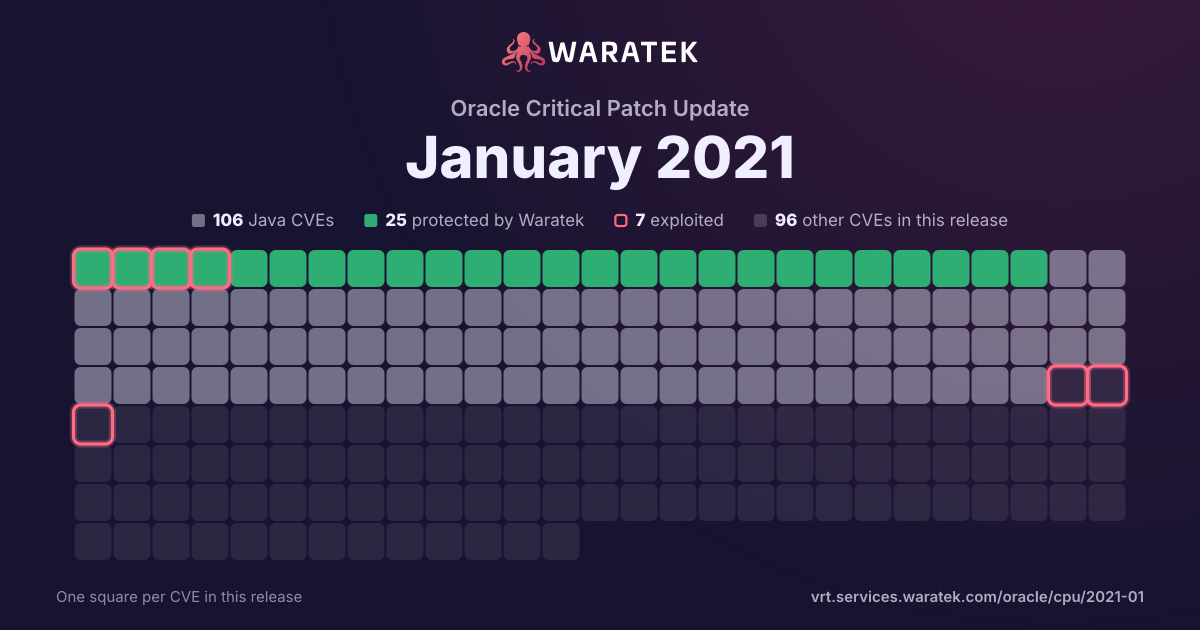
By status
27Protected by Waratek9Mitigation candidate85No exploit published81Not applicable
7Exploited, marked by the ring
No exploit published. For 68 of them, Oracle's security advisory is the source of public detail.
Protected by Waratek. Waratek RASP can block exploitation of these on systems that have not applied the patch yet.
Overview 14 matches · 0 in Waratek scope · 0 protected · 0 exploited · 0 CISA KEV · 4 public PoC · 3 EPSS ≥ 0.5
14matches
0in Waratek scope0.0%
0protected0.0%
0exploited0.0%
0CISA KEV0.0%
4public PoC28.6%
3EPSS ≥ 0.521.4%
Protected by Waratek
0
0.0%
Rule in development
0
0.0%
Mitigation candidate
0
0.0%
No exploit published
0
0.0%
Outside Waratek scope
0
0.0%
Not applicable
14
100.0%
Withdrawn CVE
0
0.0%
blocked by ARMR today
0
0.0%
partly blocked
0
0.0%
not blocked
14
100.0%
not established
0
0.0%
unrecorded
0
0.0%
Exploited
0
0.0%
Working exploit published
0
0.0%
Proof of concept only
4
28.6%
Forecast only
0
0.0%
No public exploit
10
71.4%
split by
peak 4 / quarter
Q2 151
Not applicable1
Low1
not blocked1
Proof of concept only1
Q3 150
Q4 150
Q1 160
Q2 160
Q3 160
Q4 160
Q1 170
Q2 170
Q3 170
Q4 170
Q1 180
Q2 181
Not applicable1
Critical1
not blocked1
No public exploit1
Q3 180
Q4 180
Q1 192
Not applicable2
Critical1
Medium1
not blocked2
No public exploit2
Q2 190
Q3 191
Not applicable1
Critical1
not blocked1
No public exploit1
Q4 190
Q1 201
Not applicable1
Medium1
not blocked1
No public exploit1
Q2 204
Not applicable4
High3
Medium1
not blocked4
Proof of concept only1
No public exploit3
Q3 202
Not applicable2
High1
Low1
not blocked2
No public exploit2
Q4 202
Not applicable2
High1
Medium1
not blocked2
Proof of concept only2
Q2 15Q4 15Q2 16Q4 16Q2 17Q4 17Q2 18Q4 18Q2 19Q4 19Q2 20Q4 20
| CVE | Severity | Published▾ | Status | Exploitation | Description |
|---|---|---|---|---|---|
| CVE-2020-1971 | Medium | 2020-12-08 | Not applicable | Proof of concept only | The X.509 GeneralName type is a generic type for representing different types of names. One of those name types is known as EDIPartyName. OpenSSL provides a function GENERAL_NAME_cmp which compares different instances of a GENERAL_NAME to see if they are equal or not. This function behaves incorrectly when both GENERAL_NAMEs contain an EDIPARTYNAME. A NULL pointer dereference and a crash may occur leading to a possible denial of service attack. OpenSSL itself uses the GENERAL_NAME_cmp function for two purposes: 1) Comparing CRL distribution point names between an available CRL and a CRL distribution point embedded in an X509 certificate 2) When verifying that a timestamp response token signer matches the timestamp authority name (exposed via the API functions TS_RESP_verify_response and TS_RESP_verify_token) If an attacker can control both items being compared then that attacker could trigger a crash. For example if the attacker can trick a client or server into checking a malicious certificate against a malicious CRL then this may occur. Note that some applications automatically download CRLs based on a URL embedded in a certificate. This checking happens prior to the signatures on the certificate and CRL being verified. OpenSSL's s_server, s_client and verify tools have support for the "-crl_download" option which implements automatic CRL downloading and this attack has been demonstrated to work against those tools. Note that an unrelated bug means that affected versions of OpenSSL cannot parse or construct correct encodings of EDIPARTYNAME. However it is possible to construct a malformed EDIPARTYNAME that OpenSSL's parser will accept and hence trigger this attack. All OpenSSL 1.1.1 and 1.0.2 versions are affected by this issue. Other OpenSSL releases are out of support and have not been checked. Fixed in OpenSSL 1.1.1i (Affected 1.1.1-1.1.1h). Fixed in OpenSSL 1.0.2x (Affected 1.0.2-1.0.2w). |
| CVE-2020-8277 | High | 2020-11-19 | Not applicable | Proof of concept only | A Node.js application that allows an attacker to trigger a DNS request for a host of their choice could trigger a Denial of Service in versions < 15.2.1, < 14.15.1, and < 12.19.1 by getting the application to resolve a DNS record with a larger number of responses. This is fixed in 15.2.1, 14.15.1, and 12.19.1. |
| CVE-2020-1968 | Low | 2020-09-09 | Not applicable | No public exploit | The Raccoon attack exploits a flaw in the TLS specification which can lead to an attacker being able to compute the pre-master secret in connections which have used a Diffie-Hellman (DH) based ciphersuite. In such a case this would result in the attacker being able to eavesdrop on all encrypted communications sent over that TLS connection. The attack can only be exploited if an implementation re-uses a DH secret across multiple TLS connections. Note that this issue only impacts DH ciphersuites and not ECDH ciphersuites. This issue affects OpenSSL 1.0.2 which is out of support and no longer receiving public updates. OpenSSL 1.1.1 is not vulnerable to this issue. Fixed in OpenSSL 1.0.2w (Affected 1.0.2-1.0.2v). |
| CVE-2020-8174 | High | 2020-07-24 | Not applicable | No public exploit | napi_get_value_string_*() allows various kinds of memory corruption in node < 10.21.0, 12.18.0, and < 14.4.0. |
| CVE-2020-14147 | High | 2020-06-15 | Not applicable | No public exploit | An integer overflow in the getnum function in lua_struct.c in Redis before 6.0.3 allows context-dependent attackers with permission to run Lua code in a Redis session to cause a denial of service (memory corruption and application crash) or possibly bypass intended sandbox restrictions via a large number, which triggers a stack-based buffer overflow. NOTE: this issue exists because of a CVE-2015-8080 regression. |
| CVE-2020-13871 | High | 2020-06-06 | Not applicable | No public exploit | SQLite 3.32.2 has a use-after-free in resetAccumulator in select.c because the parse tree rewrite for window functions is too late. |
| CVE-2020-10723 | Medium | 2020-05-19 | Not applicable | No public exploit | A memory corruption issue was found in DPDK versions 17.05 and above. This flaw is caused by an integer truncation on the index of a payload. Under certain circumstances, the index (a UInt) is copied and truncated into a uint16, which can lead to out of bound indexing and possible memory corruption. |
| CVE-2020-1967 | High | 2020-04-21 | Not applicable | Proof of concept only | Server or client applications that call the SSL_check_chain() function during or after a TLS 1.3 handshake may crash due to a NULL pointer dereference as a result of incorrect handling of the "signature_algorithms_cert" TLS extension. The crash occurs if an invalid or unrecognised signature algorithm is received from the peer. This could be exploited by a malicious peer in a Denial of Service attack. OpenSSL version 1.1.1d, 1.1.1e, and 1.1.1f are affected by this issue. This issue did not affect OpenSSL versions prior to 1.1.1d. Fixed in OpenSSL 1.1.1g (Affected 1.1.1d-1.1.1f). |
| CVE-2020-9281 | Medium | 2020-03-07 | Not applicable | No public exploit | A cross-site scripting (XSS) vulnerability in the HTML Data Processor for CKEditor 4.0 before 4.14 allows remote attackers to inject arbitrary web script through a crafted "protected" comment (with the cke_protected syntax). |
| CVE-2019-10744 | Critical | 2019-07-26 | Not applicable | No public exploit | Versions of lodash lower than 4.17.12 are vulnerable to Prototype Pollution. The function defaultsDeep could be tricked into adding or modifying properties of Object.prototype using a constructor payload. |
| CVE-2019-1559 | Medium | 2019-02-27 | Not applicable | No public exploit | If an application encounters a fatal protocol error and then calls SSL_shutdown() twice (once to send a close_notify, and once to receive one) then OpenSSL can respond differently to the calling application if a 0 byte record is received with invalid padding compared to if a 0 byte record is received with an invalid MAC. If the application then behaves differently based on that in a way that is detectable to the remote peer, then this amounts to a padding oracle that could be used to decrypt data. In order for this to be exploitable "non-stitched" ciphersuites must be in use. Stitched ciphersuites are optimised implementations of certain commonly used ciphersuites. Also the application must call SSL_shutdown() twice even if a protocol error has occurred (applications should not do this but some do anyway). Fixed in OpenSSL 1.0.2r (Affected 1.0.2-1.0.2q). |
| CVE-2019-7164 | Critical | 2019-02-20 | Not applicable | No public exploit | SQLAlchemy through 1.2.17 and 1.3.x through 1.3.0b2 allows SQL Injection via the order_by parameter. |
| CVE-2018-9019 | Critical | 2018-05-22 | Not applicable | No public exploit | SQL Injection vulnerability in Dolibarr before version 7.0.2 allows remote attackers to execute arbitrary SQL commands via the sortfield parameter to /accountancy/admin/accountmodel.php, /accountancy/admin/categories_list.php, /accountancy/admin/journals_list.php, /admin/dict.php, /admin/mails_templates.php, or /admin/website.php. |
| CVE-2015-4000 | Low | 2015-05-21 | Not applicable | Proof of concept only | The TLS protocol 1.2 and earlier, when a DHE_EXPORT ciphersuite is enabled on a server but not on a client, does not properly convey a DHE_EXPORT choice, which allows man-in-the-middle attackers to conduct cipher-downgrade attacks by rewriting a ClientHello with DHE replaced by DHE_EXPORT and then rewriting a ServerHello with DHE_EXPORT replaced by DHE, aka the "Logjam" issue. |