
Oracle Critical Patch Update January 2021
Released January 2021 · Oracle's advisory ↗ · ← Critical Patch Update, October 2020 · Critical Patch Update, April 2021 →
202 CVEs in this release, one square each
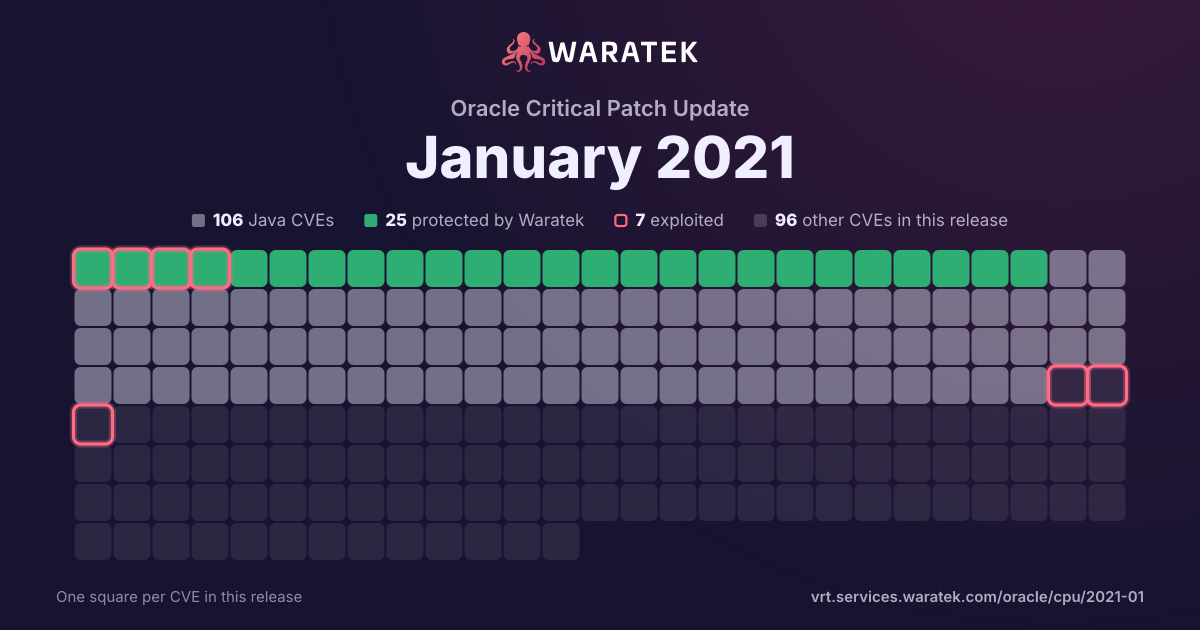
By status
27Protected by Waratek9Mitigation candidate85No exploit published81Not applicable
7Exploited, marked by the ring
No exploit published. For 68 of them, Oracle's security advisory is the source of public detail.
Protected by Waratek. Waratek RASP can block exploitation of these on systems that have not applied the patch yet.
Overview 12 matches · 8 in Waratek scope · 0 protected · 1 exploited · 0 CISA KEV · 4 public PoC · 3 EPSS ≥ 0.5
12matches
8in Waratek scope66.7%
0protected0.0%
1exploited8.3%
0CISA KEV0.0%
4public PoC33.3%
3EPSS ≥ 0.525.0%
Protected by Waratek
0
0.0%
Rule in development
0
0.0%
Mitigation candidate
3
25.0%
No exploit published
5
41.7%
Outside Waratek scope
0
0.0%
Not applicable
4
33.3%
Withdrawn CVE
0
0.0%
blocked by ARMR today
0
0.0%
partly blocked
0
0.0%
not blocked
12
100.0%
not established
0
0.0%
unrecorded
0
0.0%
split by
peak 4 / quarter
Q2 151
Not applicable1
Low1
not blocked1
Proof of concept only1
Q3 150
Q4 150
Q1 160
Q2 160
Q3 160
Q4 160
Q1 170
Q2 171
No exploit published1
Critical1
not blocked1
No public exploit1
Q3 170
Q4 171
No exploit published1
High1
not blocked1
No public exploit1
Q1 181
No exploit published1
High1
not blocked1
No public exploit1
Q2 181
Not applicable1
Critical1
not blocked1
No public exploit1
Q3 180
Q4 181
No exploit published1
High1
not blocked1
No public exploit1
Q1 192
Not applicable2
Critical1
Medium1
not blocked2
No public exploit2
Q2 194
Mitigation candidate3
No exploit published1
High1
Medium3
not blocked4
Exploited1
Working exploit published2
No public exploit1
Q2 15Q4 15Q2 16Q4 16Q2 17Q4 17Q2 18Q4 18Q2 19
| CVE | Severity | Published▾ | Status | Exploitation | Description |
|---|---|---|---|---|---|
| CVE-2019-11269 | Medium | 2019-06-12 | Mitigation candidate | Working exploit published | Spring Security OAuth versions 2.3 prior to 2.3.6, 2.2 prior to 2.2.5, 2.1 prior to 2.1.5, and 2.0 prior to 2.0.18, as well as older unsupported versions could be susceptible to an open redirector attack that can leak an authorization code. A malicious user or attacker can craft a request to the authorization endpoint using the authorization code grant type, and specify a manipulated redirection URI via the redirect_uri parameter. This can cause the authorization server to redirect the resource owner user-agent to a URI under the control of the attacker with the leaked authorization code. |
| CVE-2019-0227 | High | 2019-05-01 | Mitigation candidate | Working exploit published | A Server Side Request Forgery (SSRF) vulnerability affected the Apache Axis 1.4 distribution that was last released in 2006. Security and bug commits commits continue in the projects Axis 1.x Subversion repository, legacy users are encouraged to build from source. The successor to Axis 1.x is Axis2, the latest version is 1.7.9 and is not vulnerable to this issue. |
| CVE-2019-10247 | Medium | 2019-04-22 | No exploit published | No public exploit | In Eclipse Jetty version 7.x, 8.x, 9.2.27 and older, 9.3.26 and older, and 9.4.16 and older, the server running on any OS and Jetty version combination will reveal the configured fully qualified directory base resource location on the output of the 404 error for not finding a Context that matches the requested path. The default server behavior on jetty-distribution and jetty-home will include at the end of the Handler tree a DefaultHandler, which is responsible for reporting this 404 error, it presents the various configured contexts as HTML for users to click through to. This produced HTML includes output that contains the configured fully qualified directory base resource location for each context. |
| CVE-2019-11358 | Medium | 2019-04-20 | Mitigation candidate | Exploited | jQuery before 3.4.0, as used in Drupal, Backdrop CMS, and other products, mishandles jQuery.extend(true, {}, ...) because of Object.prototype pollution. If an unsanitized source object contained an enumerable __proto__ property, it could extend the native Object.prototype. |
| CVE-2019-1559 | Medium | 2019-02-27 | Not applicable | No public exploit | If an application encounters a fatal protocol error and then calls SSL_shutdown() twice (once to send a close_notify, and once to receive one) then OpenSSL can respond differently to the calling application if a 0 byte record is received with invalid padding compared to if a 0 byte record is received with an invalid MAC. If the application then behaves differently based on that in a way that is detectable to the remote peer, then this amounts to a padding oracle that could be used to decrypt data. In order for this to be exploitable "non-stitched" ciphersuites must be in use. Stitched ciphersuites are optimised implementations of certain commonly used ciphersuites. Also the application must call SSL_shutdown() twice even if a protocol error has occurred (applications should not do this but some do anyway). Fixed in OpenSSL 1.0.2r (Affected 1.0.2-1.0.2q). |
| CVE-2019-7164 | Critical | 2019-02-20 | Not applicable | No public exploit | SQLAlchemy through 1.2.17 and 1.3.x through 1.3.0b2 allows SQL Injection via the order_by parameter. |
| CVE-2018-15756 | High | 2018-10-18 | No exploit published | No public exploit | Spring Framework, version 5.1, versions 5.0.x prior to 5.0.10, versions 4.3.x prior to 4.3.20, and older unsupported versions on the 4.2.x branch provide support for range requests when serving static resources through the ResourceHttpRequestHandler, or starting in 5.0 when an annotated controller returns an org.springframework.core.io.Resource. A malicious user (or attacker) can add a range header with a high number of ranges, or with wide ranges that overlap, or both, for a denial of service attack. This vulnerability affects applications that depend on either spring-webmvc or spring-webflux. Such applications must also have a registration for serving static resources (e.g. JS, CSS, images, and others), or have an annotated controller that returns an org.springframework.core.io.Resource. Spring Boot applications that depend on spring-boot-starter-web or spring-boot-starter-webflux are ready to serve static resources out of the box and are therefore vulnerable. |
| CVE-2018-9019 | Critical | 2018-05-22 | Not applicable | No public exploit | SQL Injection vulnerability in Dolibarr before version 7.0.2 allows remote attackers to execute arbitrary SQL commands via the sortfield parameter to /accountancy/admin/accountmodel.php, /accountancy/admin/categories_list.php, /accountancy/admin/journals_list.php, /admin/dict.php, /admin/mails_templates.php, or /admin/website.php. |
| CVE-2017-12626 | High | 2018-01-29 | No exploit published | No public exploit | Apache POI in versions prior to release 3.17 are vulnerable to Denial of Service Attacks: 1) Infinite Loops while parsing crafted WMF, EMF, MSG and macros (POI bugs 61338 and 61294), and 2) Out of Memory Exceptions while parsing crafted DOC, PPT and XLS (POI bugs 52372 and 61295). |
| CVE-2017-8028 | High | 2017-11-27 | No exploit published | No public exploit | In Pivotal Spring-LDAP versions 1.3.0 - 2.3.1, when connected to some LDAP servers, when no additional attributes are bound, and when using LDAP BindAuthenticator with org.springframework.ldap.core.support.DefaultTlsDirContextAuthenticationStrategy as the authentication strategy, and setting userSearch, authentication is allowed with an arbitrary password when the username is correct. This occurs because some LDAP vendors require an explicit operation for the LDAP bind to take effect. |
| CVE-2015-8965 | Critical | 2017-04-06 | No exploit published | No public exploit | Rogue Wave JViews before 8.8 patch 21 and 8.9 before patch 1 allows remote attackers to execute arbitrary Java code that exists in the classpath, such as test code or administration code. The issue exists because the ilog.views.faces.IlvFacesController servlet in jviews-framework-all.jar does not require explicit configuration of servlets that can be called. |
| CVE-2015-4000 | Low | 2015-05-21 | Not applicable | Proof of concept only | The TLS protocol 1.2 and earlier, when a DHE_EXPORT ciphersuite is enabled on a server but not on a client, does not properly convey a DHE_EXPORT choice, which allows man-in-the-middle attackers to conduct cipher-downgrade attacks by rewriting a ClientHello with DHE replaced by DHE_EXPORT and then rewriting a ServerHello with DHE_EXPORT replaced by DHE, aka the "Logjam" issue. |