
Oracle Critical Patch Update October 2020
Released October 2020 · Oracle's advisory ↗ · ← Critical Patch Update, July 2020 · Critical Patch Update, January 2021 →
230 CVEs in this release, one square each
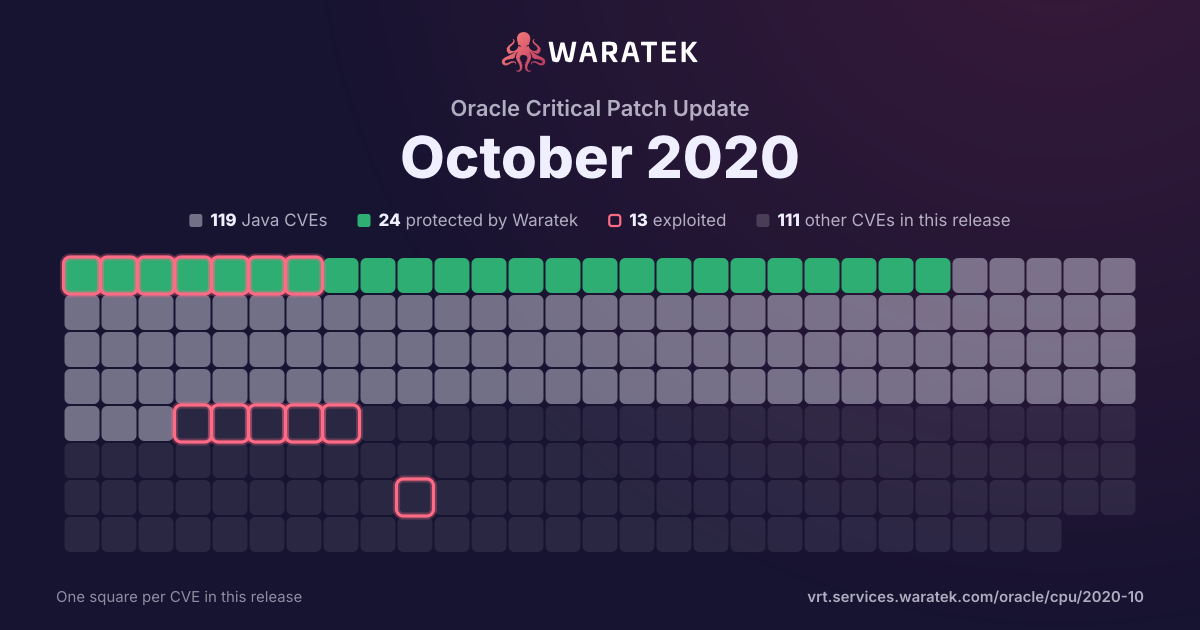
By status
24Protected by Waratek2Mitigation candidate93No exploit published64Outside Waratek scope47Not applicable
13Exploited, marked by the ring
No exploit published. For 75 of them, Oracle's security advisory is the source of public detail.
Protected by Waratek. Waratek RASP can block exploitation of these on systems that have not applied the patch yet.
Overview 11 matches · 9 protected · 7 exploited · 6 CISA KEV · 10 EPSS ≥ 0.5
Protected by Waratek
10
90.9%
Rule in development
0
0.0%
Mitigation candidate
1
9.1%
No exploit published
0
0.0%
blocked by ARMR today
9
81.8%
partly blocked
1
9.1%
not blocked
1
9.1%
not established
0
0.0%
unrecorded
0
0.0%
Exploited
7
63.6%
Working exploit published
3
27.3%
Proof of concept only
1
9.1%
Forecast only
0
0.0%
No public exploit
0
0.0%
split by
peak 3 / quarter
Q2 171
Protected by Waratek1
Critical1
blocked by ARMR today1
Working exploit published1
Q3 170
Q4 171
Protected by Waratek1
High1
blocked by ARMR today1
Proof of concept only1
Q1 180
Q2 180
Q3 180
Q4 180
Q1 191
Protected by Waratek1
Critical1
blocked by ARMR today1
Exploited1
Q2 190
Q3 190
Q4 191
Protected by Waratek1
High1
partly blocked1
Exploited1
Q1 202
Protected by Waratek2
Critical2
blocked by ARMR today2
Exploited2
Q2 201
Protected by Waratek1
High1
blocked by ARMR today1
Working exploit published1
Q3 201
Mitigation candidate1
High1
not blocked1
Working exploit published1
Q4 203
Protected by Waratek3
Critical1
High2
blocked by ARMR today3
Exploited3
Q2 17Q4 17Q2 18Q4 18Q2 19Q4 19Q2 20Q4 20
| CVE | Severity | Published▾ | Status | Exploitation | Description |
|---|---|---|---|---|---|
| CVE-2020-14883 | High | 2020-10-21 | Protected by Waratek | Exploited | Vulnerability in the Oracle WebLogic Server product of Oracle Fusion Middleware (component: Console). Supported versions that are affected are 10.3.6.0.0, 12.1.3.0.0, 12.2.1.3.0, 12.2.1.4.0 and 14.1.1.0.0. Easily exploitable vulnerability allows high privileged attacker with network access via HTTP to compromise Oracle WebLogic Server. Successful attacks of this vulnerability can result in takeover of Oracle WebLogic Server. CVSS 3.1 Base Score 7.2 (Confidentiality, Integrity and Availability impacts). CVSS Vector: (CVSS:3.1/AV:N/AC:L/PR:H/UI:N/S:U/C:H/I:H/A:H). |
| CVE-2020-14882 | Critical | 2020-10-21 | Protected by Waratek | Exploited | Vulnerability in the Oracle WebLogic Server product of Oracle Fusion Middleware (component: Console). Supported versions that are affected are 10.3.6.0.0, 12.1.3.0.0, 12.2.1.3.0, 12.2.1.4.0 and 14.1.1.0.0. Easily exploitable vulnerability allows unauthenticated attacker with network access via HTTP to compromise Oracle WebLogic Server. Successful attacks of this vulnerability can result in takeover of Oracle WebLogic Server. CVSS 3.1 Base Score 9.8 (Confidentiality, Integrity and Availability impacts). CVSS Vector: (CVSS:3.1/AV:N/AC:L/PR:N/UI:N/S:U/C:H/I:H/A:H). |
| CVE-2020-14864 | High | 2020-10-21 | Protected by Waratek | Exploited | Vulnerability in the Oracle Business Intelligence Enterprise Edition product of Oracle Fusion Middleware (component: Installation). Supported versions that are affected are 5.5.0.0.0, 12.2.1.3.0 and 12.2.1.4.0. Easily exploitable vulnerability allows unauthenticated attacker with network access via HTTP to compromise Oracle Business Intelligence Enterprise Edition. Successful attacks of this vulnerability can result in unauthorized access to critical data or complete access to all Oracle Business Intelligence Enterprise Edition accessible data. CVSS 3.1 Base Score 7.5 (Confidentiality impacts). CVSS Vector: (CVSS:3.1/AV:N/AC:L/PR:N/UI:N/S:U/C:H/I:N/A:N). |
| CVE-2020-13935 | High | 2020-07-14 | Mitigation candidate | Working exploit published | The payload length in a WebSocket frame was not correctly validated in Apache Tomcat 10.0.0-M1 to 10.0.0-M6, 9.0.0.M1 to 9.0.36, 8.5.0 to 8.5.56 and 7.0.27 to 7.0.104. Invalid payload lengths could trigger an infinite loop. Multiple requests with invalid payload lengths could lead to a denial of service. |
| CVE-2020-9484 | High | 2020-05-20 | Protected by Waratek | Working exploit published | When using Apache Tomcat versions 10.0.0-M1 to 10.0.0-M4, 9.0.0.M1 to 9.0.34, 8.5.0 to 8.5.54 and 7.0.0 to 7.0.103 if a) an attacker is able to control the contents and name of a file on the server; and b) the server is configured to use the PersistenceManager with a FileStore; and c) the PersistenceManager is configured with sessionAttributeValueClassNameFilter="null" (the default unless a SecurityManager is used) or a sufficiently lax filter to allow the attacker provided object to be deserialized; and d) the attacker knows the relative file path from the storage location used by FileStore to the file the attacker has control over; then, using a specifically crafted request, the attacker will be able to trigger remote code execution via deserialization of the file under their control. Note that all of conditions a) to d) must be true for the attack to succeed. |
| CVE-2020-1938 | Critical | 2020-02-24 | Protected by Waratek | Exploited | When using the Apache JServ Protocol (AJP), care must be taken when trusting incoming connections to Apache Tomcat. Tomcat treats AJP connections as having higher trust than, for example, a similar HTTP connection. If such connections are available to an attacker, they can be exploited in ways that may be surprising. In Apache Tomcat 9.0.0.M1 to 9.0.0.30, 8.5.0 to 8.5.50 and 7.0.0 to 7.0.99, Tomcat shipped with an AJP Connector enabled by default that listened on all configured IP addresses. It was expected (and recommended in the security guide) that this Connector would be disabled if not required. This vulnerability report identified a mechanism that allowed: - returning arbitrary files from anywhere in the web application - processing any file in the web application as a JSP Further, if the web application allowed file upload and stored those files within the web application (or the attacker was able to control the content of the web application by some other means) then this, along with the ability to process a file as a JSP, made remote code execution possible. It is important to note that mitigation is only required if an AJP port is accessible to untrusted users. Users wishing to take a defence-in-depth approach and block the vector that permits returning arbitrary files and execution as JSP may upgrade to Apache Tomcat 9.0.31, 8.5.51 or 7.0.100 or later. A number of changes were made to the default AJP Connector configuration in 9.0.31 to harden the default configuration. It is likely that users upgrading to 9.0.31, 8.5.51 or 7.0.100 or later will need to make small changes to their configurations. |
| CVE-2020-2555 | Critical | 2020-01-15 | Protected by Waratek | Exploited | Vulnerability in the Oracle Coherence product of Oracle Fusion Middleware (component: Caching,CacheStore,Invocation). Supported versions that are affected are 3.7.1.0, 12.1.3.0.0, 12.2.1.3.0 and 12.2.1.4.0. Easily exploitable vulnerability allows unauthenticated attacker with network access via T3 to compromise Oracle Coherence. Successful attacks of this vulnerability can result in takeover of Oracle Coherence. CVSS 3.0 Base Score 9.8 (Confidentiality, Integrity and Availability impacts). CVSS Vector: (CVSS:3.0/AV:N/AC:L/PR:N/UI:N/S:U/C:H/I:H/A:H). |
| CVE-2019-17558 | High | 2019-12-30 | Protected by Waratek | Exploited | Apache Solr 5.0.0 to Apache Solr 8.3.1 are vulnerable to a Remote Code Execution through the VelocityResponseWriter. A Velocity template can be provided through Velocity templates in a configset `velocity/` directory or as a parameter. A user defined configset could contain renderable, potentially malicious, templates. Parameter provided templates are disabled by default, but can be enabled by setting `params.resource.loader.enabled` by defining a response writer with that setting set to `true`. Defining a response writer requires configuration API access. Solr 8.4 removed the params resource loader entirely, and only enables the configset-provided template rendering when the configset is `trusted` (has been uploaded by an authenticated user). |
| CVE-2019-0192 | Critical | 2019-03-07 | Protected by Waratek | Exploited | In Apache Solr versions 5.0.0 to 5.5.5 and 6.0.0 to 6.6.5, the Config API allows to configure the JMX server via an HTTP POST request. By pointing it to a malicious RMI server, an attacker could take advantage of Solr's unsafe deserialization to trigger remote code execution on the Solr side. |
| CVE-2017-9096 | High | 2017-11-08 | Protected by Waratek | Proof of concept only | The XML parsers in iText before 5.5.12 and 7.x before 7.0.3 do not disable external entities, which might allow remote attackers to conduct XML external entity (XXE) attacks via a crafted PDF. |
| CVE-2017-5645 | Critical | 2017-04-17 | Protected by Waratek | Working exploit published | In Apache Log4j 2.x before 2.8.2, when using the TCP socket server or UDP socket server to receive serialized log events from another application, a specially crafted binary payload can be sent that, when deserialized, can execute arbitrary code. |