
Oracle Critical Patch Update October 2020
Released October 2020 · Oracle's advisory ↗ · ← Critical Patch Update, July 2020 · Critical Patch Update, January 2021 →
230 CVEs in this release, one square each
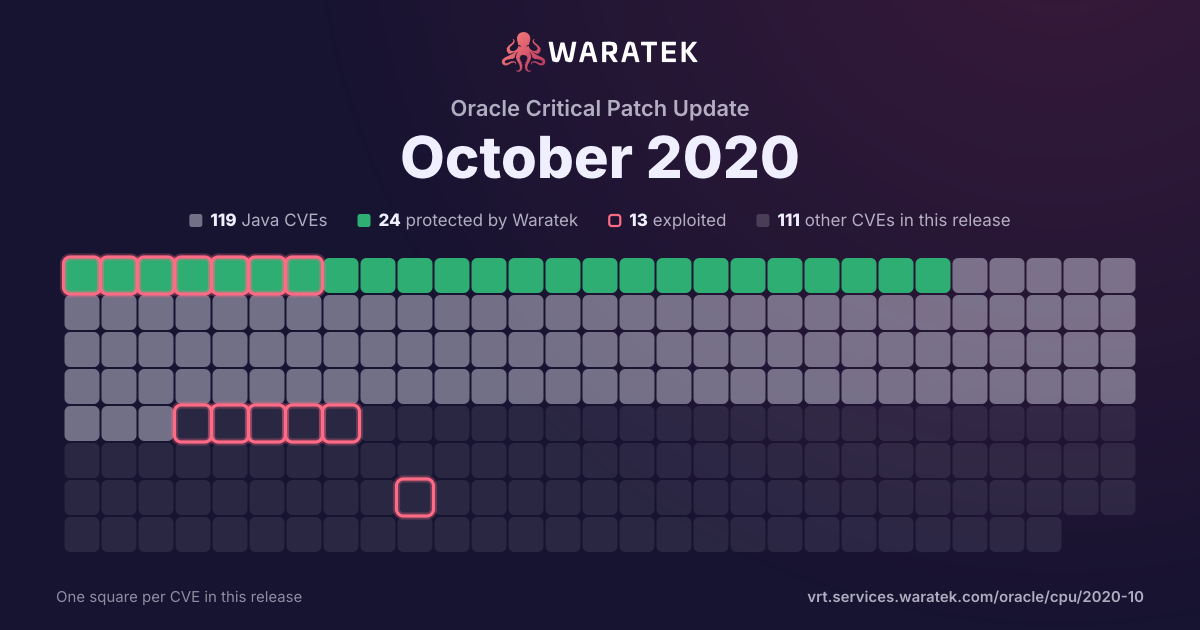
By status
24Protected by Waratek2Mitigation candidate93No exploit published64Outside Waratek scope47Not applicable
13Exploited, marked by the ring
No exploit published. For 75 of them, Oracle's security advisory is the source of public detail.
Protected by Waratek. Waratek RASP can block exploitation of these on systems that have not applied the patch yet.
Overview 230 matches · 119 in Waratek scope · 23 protected · 13 exploited · 8 CISA KEV · 19 public PoC · 22 EPSS ≥ 0.5
230matches
119in Waratek scope51.7%
23protected10.0%
13exploited5.7%
8CISA KEV3.5%
19public PoC8.3%
22EPSS ≥ 0.59.6%
Protected by Waratek
24
10.4%
Rule in development
0
0.0%
Mitigation candidate
2
0.9%
No exploit published
93
40.4%
Outside Waratek scope
64
27.8%
Not applicable
47
20.4%
Withdrawn CVE
0
0.0%
blocked by ARMR today
23
10.0%
partly blocked
1
0.4%
not blocked
206
89.6%
not established
0
0.0%
unrecorded
0
0.0%
split by
peak 160 / quarter
Q2 161
Protected by Waratek1
High1
blocked by ARMR today1
Forecast only1
Q3 160
Q4 162
Protected by Waratek1
Outside Waratek scope1
Critical2
blocked by ARMR today1
not blocked1
No public exploit2
Q1 170
Q2 171
Protected by Waratek1
Critical1
blocked by ARMR today1
Working exploit published1
Q3 171
Not applicable1
Critical1
not blocked1
No public exploit1
Q4 171
Protected by Waratek1
High1
blocked by ARMR today1
Proof of concept only1
Q1 181
Protected by Waratek1
Critical1
blocked by ARMR today1
No public exploit1
Q2 182
No exploit published2
Critical1
High1
not blocked2
No public exploit2
Q3 182
Outside Waratek scope1
Not applicable1
Critical1
Medium1
not blocked2
No public exploit2
Q4 180
Q1 191
Protected by Waratek1
Critical1
blocked by ARMR today1
Exploited1
Q2 196
No exploit published3
Outside Waratek scope1
Not applicable2
Critical1
High2
Medium3
not blocked6
Exploited1
Proof of concept only1
Forecast only1
No public exploit3
Q3 1910
Protected by Waratek1
No exploit published2
Outside Waratek scope5
Not applicable2
Critical4
High4
Medium2
blocked by ARMR today1
not blocked9
Exploited1
Forecast only1
No public exploit8
Q4 199
Protected by Waratek3
No exploit published6
Critical4
High2
Medium3
blocked by ARMR today2
partly blocked1
not blocked6
Exploited1
No public exploit8
Q1 207
Protected by Waratek2
Mitigation candidate1
No exploit published2
Outside Waratek scope2
Critical4
High1
Medium2
blocked by ARMR today2
not blocked5
Exploited2
Proof of concept only1
No public exploit4
Q2 2022
Protected by Waratek4
No exploit published5
Outside Waratek scope8
Not applicable5
Critical2
High7
Medium12
Low1
blocked by ARMR today4
not blocked18
Exploited2
Working exploit published1
Proof of concept only1
No public exploit18
Q3 204
Mitigation candidate1
No exploit published1
Outside Waratek scope1
Not applicable1
Critical2
High2
not blocked4
Exploited1
Working exploit published1
No public exploit2
Q4 20160
Protected by Waratek8
No exploit published72
Outside Waratek scope45
Not applicable35
Critical9
High35
Medium97
Low19
blocked by ARMR today8
not blocked152
Exploited4
No public exploit156
Q2 16Q4 16Q2 17Q4 17Q2 18Q4 18Q2 19Q4 19Q2 20Q4 20
| CVE | Severity | Published▾ | Status | Exploitation | Description |
|---|---|---|---|---|---|
| CVE-2019-17267 | Critical | 2019-10-07 | No exploit published | No public exploit | A Polymorphic Typing issue was discovered in FasterXML jackson-databind before 2.9.10. It is related to net.sf.ehcache.hibernate.EhcacheJtaTransactionManagerLookup. |
| CVE-2019-17091 | Medium | 2019-10-02 | Protected by Waratek | No public exploit | faces/context/PartialViewContextImpl.java in Eclipse Mojarra, as used in Mojarra for Eclipse EE4J before 2.3.10 and Mojarra JavaServer Faces before 2.2.20, allows Reflected XSS because a client window field is mishandled. |
| CVE-2019-10097 | High | 2019-09-26 | Outside Waratek scope | Exploited | In Apache HTTP Server 2.4.32-2.4.39, when mod_remoteip was configured to use a trusted intermediary proxy server using the "PROXY" protocol, a specially crafted PROXY header could trigger a stack buffer overflow or NULL pointer deference. This vulnerability could only be triggered by a trusted proxy and not by untrusted HTTP clients. |
| CVE-2019-3740 | Medium | 2019-09-18 | Outside Waratek scope | No public exploit | RSA BSAFE Crypto-J versions prior to 6.2.5 are vulnerable to an Information Exposure Through Timing Discrepancy vulnerabilities during DSA key generation. A malicious remote attacker could potentially exploit those vulnerabilities to recover DSA keys. |
| CVE-2019-5482 | Critical | 2019-09-16 | Outside Waratek scope | No public exploit | Heap buffer overflow in the TFTP protocol handler in cURL 7.19.4 to 7.65.3. |
| CVE-2019-1547 | Medium | 2019-09-10 | Not applicable | No public exploit | Normally in OpenSSL EC groups always have a co-factor present and this is used in side channel resistant code paths. However, in some cases, it is possible to construct a group using explicit parameters (instead of using a named curve). In those cases it is possible that such a group does not have the cofactor present. This can occur even where all the parameters match a known named curve. If such a curve is used then OpenSSL falls back to non-side channel resistant code paths which may result in full key recovery during an ECDSA signature operation. In order to be vulnerable an attacker would have to have the ability to time the creation of a large number of signatures where explicit parameters with no co-factor present are in use by an application using libcrypto. For the avoidance of doubt libssl is not vulnerable because explicit parameters are never used. Fixed in OpenSSL 1.1.1d (Affected 1.1.1-1.1.1c). Fixed in OpenSSL 1.1.0l (Affected 1.1.0-1.1.0k). Fixed in OpenSSL 1.0.2t (Affected 1.0.2-1.0.2s). |
| CVE-2019-12402 | High | 2019-08-30 | No exploit published | No public exploit | The file name encoding algorithm used internally in Apache Commons Compress 1.15 to 1.18 can get into an infinite loop when faced with specially crafted inputs. This can lead to a denial of service attack if an attacker can choose the file names inside of an archive created by Compress. |
| CVE-2019-12260 | Critical | 2019-08-09 | Outside Waratek scope | No public exploit | Wind River VxWorks 6.9 and vx7 has a Buffer Overflow in the TCP component (issue 2 of 4). This is an IPNET security vulnerability: TCP Urgent Pointer state confusion caused by a malformed TCP AO option. |
| CVE-2019-13990 | Critical | 2019-07-26 | Outside Waratek scope | No public exploit | initDocumentParser in xml/XMLSchedulingDataProcessor.java in Terracotta Quartz Scheduler through 2.3.0 allows XXE attacks via a job description. |
| CVE-2019-10173 | Critical | 2019-07-23 | Protected by Waratek | Forecast only | It was found that xstream API version 1.4.10 before 1.4.11 introduced a regression for a previous deserialization flaw. If the security framework has not been initialized, it may allow a remote attacker to run arbitrary shell commands when unmarshalling XML or any supported format. e.g. JSON. (regression of CVE-2013-7285) |
| CVE-2019-1010239 | High | 2019-07-19 | Not applicable | No public exploit | DaveGamble/cJSON cJSON 1.7.8 is affected by: Improper Check for Unusual or Exceptional Conditions. The impact is: Null dereference, so attack can cause denial of service. The component is: cJSON_GetObjectItemCaseSensitive() function. The attack vector is: crafted json file. The fixed version is: 1.7.9 and later. |
| CVE-2018-17196 | High | 2019-07-11 | No exploit published | No public exploit | In Apache Kafka versions between 0.11.0.0 and 2.1.0, it is possible to manually craft a Produce request which bypasses transaction/idempotent ACL validation. Only authenticated clients with Write permission on the respective topics are able to exploit this vulnerability. Users should upgrade to 2.1.1 or later where this vulnerability has been fixed. |
| CVE-2019-10072 | High | 2019-06-21 | No exploit published | Forecast only | The fix for CVE-2019-0199 was incomplete and did not address HTTP/2 connection window exhaustion on write in Apache Tomcat versions 9.0.0.M1 to 9.0.19 and 8.5.0 to 8.5.40 . By not sending WINDOW_UPDATE messages for the connection window (stream 0) clients were able to cause server-side threads to block eventually leading to thread exhaustion and a DoS. |
| CVE-2019-12900 | Critical | 2019-06-19 | Not applicable | No public exploit | BZ2_decompress in decompress.c in bzip2 through 1.0.6 has an out-of-bounds write when there are many selectors. |
| CVE-2019-11477 | High | 2019-06-19 | Not applicable | Proof of concept only | Jonathan Looney discovered that the TCP_SKB_CB(skb)->tcp_gso_segs value was subject to an integer overflow in the Linux kernel when handling TCP Selective Acknowledgments (SACKs). A remote attacker could use this to cause a denial of service. This has been fixed in stable kernel releases 4.4.182, 4.9.182, 4.14.127, 4.19.52, 5.1.11, and is fixed in commit 3b4929f65b0d8249f19a50245cd88ed1a2f78cff. |
| CVE-2019-0201 | Medium | 2019-05-23 | No exploit published | No public exploit | An issue is present in Apache ZooKeeper 1.0.0 to 3.4.13 and 3.5.0-alpha to 3.5.4-beta. ZooKeeper’s getACL() command doesn’t check any permission when retrieves the ACLs of the requested node and returns all information contained in the ACL Id field as plaintext string. DigestAuthenticationProvider overloads the Id field with the hash value that is used for user authentication. As a consequence, if Digest Authentication is in use, the unsalted hash value will be disclosed by getACL() request for unauthenticated or unprivileged users. |
| CVE-2019-10247 | Medium | 2019-04-22 | No exploit published | No public exploit | In Eclipse Jetty version 7.x, 8.x, 9.2.27 and older, 9.3.26 and older, and 9.4.16 and older, the server running on any OS and Jetty version combination will reveal the configured fully qualified directory base resource location on the output of the 404 error for not finding a Context that matches the requested path. The default server behavior on jetty-distribution and jetty-home will include at the end of the Handler tree a DefaultHandler, which is responsible for reporting this 404 error, it presents the various configured contexts as HTML for users to click through to. This produced HTML includes output that contains the configured fully qualified directory base resource location for each context. |
| CVE-2019-11358 | Medium | 2019-04-20 | Outside Waratek scope | Exploited | jQuery before 3.4.0, as used in Drupal, Backdrop CMS, and other products, mishandles jQuery.extend(true, {}, ...) because of Object.prototype pollution. If an unsanitized source object contained an enumerable __proto__ property, it could extend the native Object.prototype. |
| CVE-2019-0192 | Critical | 2019-03-07 | Protected by Waratek | Exploited | In Apache Solr versions 5.0.0 to 5.5.5 and 6.0.0 to 6.6.5, the Config API allows to configure the JMX server via an HTTP POST request. By pointing it to a malicious RMI server, an attacker could take advantage of Solr's unsafe deserialization to trigger remote code execution on the Solr side. |
| CVE-2018-11058 | Critical | 2018-09-14 | Outside Waratek scope | No public exploit | RSA BSAFE Micro Edition Suite, versions prior to 4.0.11 (in 4.0.x) and prior to 4.1.6 (in 4.1.x), and RSA BSAFE Crypto-C Micro Edition, version prior to 4.0.5.3 (in 4.0.x) contain a Buffer Over-Read vulnerability when parsing ASN.1 data. A remote attacker could use maliciously constructed ASN.1 data that would result in such issue. |
| CVE-2018-3693 | Medium | 2018-07-10 | Not applicable | No public exploit | Systems with microprocessors utilizing speculative execution and branch prediction may allow unauthorized disclosure of information to an attacker with local user access via a speculative buffer overflow and side-channel analysis. |
| CVE-2017-7658 | Critical | 2018-06-26 | No exploit published | No public exploit | In Eclipse Jetty Server, versions 9.2.x and older, 9.3.x (all non HTTP/1.x configurations), and 9.4.x (all HTTP/1.x configurations), when presented with two content-lengths headers, Jetty ignored the second. When presented with a content-length and a chunked encoding header, the content-length was ignored (as per RFC 2616). If an intermediary decided on the shorter length, but still passed on the longer body, then body content could be interpreted by Jetty as a pipelined request. If the intermediary was imposing authorization, the fake pipelined request would bypass that authorization. |
| CVE-2018-2765 | High | 2018-04-19 | No exploit published | No public exploit | Vulnerability in the Oracle Security Service component of Oracle Fusion Middleware (subcomponent: Oracle SSL API). Supported versions that are affected are 11.1.1.9.0, 12.1.3.0.0, 12.2.1.2.0 and 12.2.1.3.0. Easily exploitable vulnerability allows unauthenticated attacker with network access via HTTPS to compromise Oracle Security Service. Successful attacks of this vulnerability can result in unauthorized access to critical data or complete access to all Oracle Security Service accessible data. CVSS 3.0 Base Score 7.5 (Confidentiality impacts). CVSS Vector: (CVSS:3.0/AV:N/AC:L/PR:N/UI:N/S:U/C:H/I:N/A:N). |
| CVE-2018-8088 | Critical | 2018-03-20 | Protected by Waratek | No public exploit | org.slf4j.ext.EventData in the slf4j-ext module in QOS.CH SLF4J before 1.8.0-beta2 allows remote attackers to bypass intended access restrictions via crafted data. EventData in the slf4j-ext module in QOS.CH SLF4J, has been fixed in SLF4J versions 1.7.26 later and in the 2.0.x series. |
| CVE-2017-9096 | High | 2017-11-08 | Protected by Waratek | Proof of concept only | The XML parsers in iText before 5.5.12 and 7.x before 7.0.3 do not disable external entities, which might allow remote attackers to conduct XML external entity (XXE) attacks via a crafted PDF. |
| CVE-2017-9800 | Critical | 2017-08-11 | Not applicable | No public exploit | A maliciously constructed svn+ssh:// URL would cause Subversion clients before 1.8.19, 1.9.x before 1.9.7, and 1.10.0.x through 1.10.0-alpha3 to run an arbitrary shell command. Such a URL could be generated by a malicious server, by a malicious user committing to a honest server (to attack another user of that server's repositories), or by a proxy server. The vulnerability affects all clients, including those that use file://, http://, and plain (untunneled) svn://. |
| CVE-2017-5645 | Critical | 2017-04-17 | Protected by Waratek | Working exploit published | In Apache Log4j 2.x before 2.8.2, when using the TCP socket server or UDP socket server to receive serialized log events from another application, a specially crafted binary payload can be sent that, when deserialized, can execute arbitrary code. |
| CVE-2016-1000031 | Critical | 2016-10-25 | Protected by Waratek | No public exploit | Apache Commons FileUpload before 1.3.3 DiskFileItem File Manipulation Remote Code Execution |
| CVE-2015-1832 | Critical | 2016-10-03 | Outside Waratek scope | No public exploit | XML external entity (XXE) vulnerability in the SqlXmlUtil code in Apache Derby before 10.12.1.1, when a Java Security Manager is not in place, allows context-dependent attackers to read arbitrary files or cause a denial of service (resource consumption) via vectors involving XmlVTI and the XML datatype. |
| CVE-2016-2510 | High | 2016-04-07 | Protected by Waratek | Forecast only | BeanShell (bsh) before 2.0b6, when included on the classpath by an application that uses Java serialization or XStream, allows remote attackers to execute arbitrary code via crafted serialized data, related to XThis.Handler. |