
Oracle Critical Patch Update October 2020
Released October 2020 · Oracle's advisory ↗ · ← Critical Patch Update, July 2020 · Critical Patch Update, January 2021 →
230 CVEs in this release, one square each
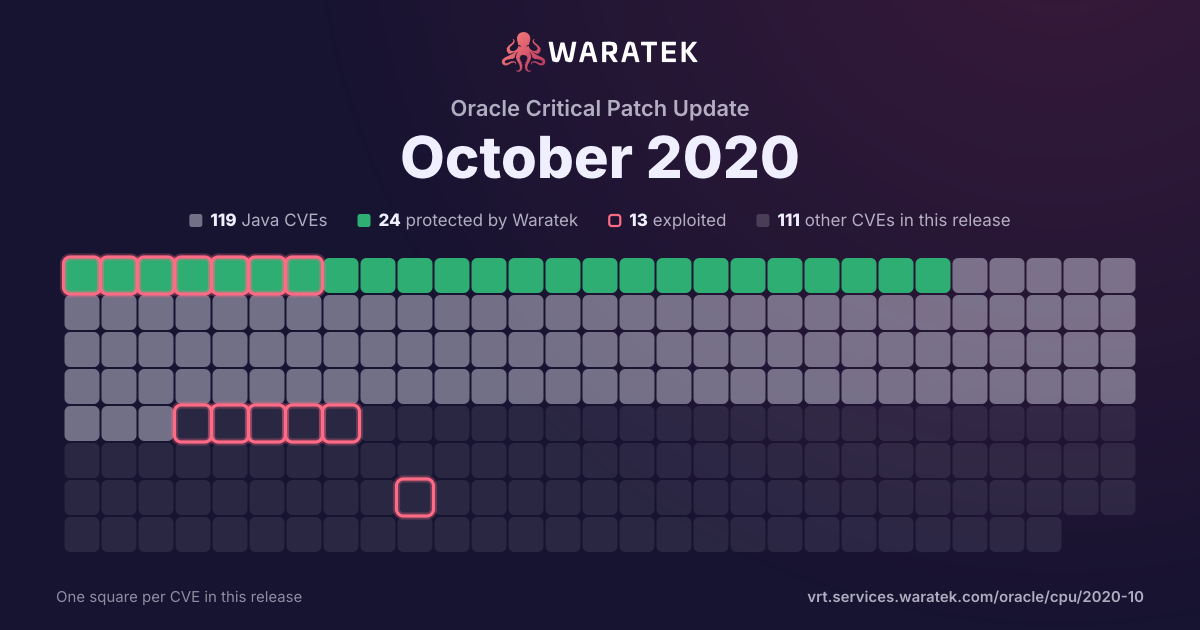
By status
24Protected by Waratek2Mitigation candidate93No exploit published64Outside Waratek scope47Not applicable
13Exploited, marked by the ring
No exploit published. For 75 of them, Oracle's security advisory is the source of public detail.
Protected by Waratek. Waratek RASP can block exploitation of these on systems that have not applied the patch yet.
Overview 120 matches · 46 in Waratek scope · 3 protected · 3 exploited · 1 CISA KEV · 3 public PoC · 3 EPSS ≥ 0.5
120matches
46in Waratek scope38.3%
3protected2.5%
3exploited2.5%
1CISA KEV0.8%
3public PoC2.5%
3EPSS ≥ 0.52.5%
Protected by Waratek
3
2.5%
Rule in development
0
0.0%
Mitigation candidate
0
0.0%
No exploit published
43
35.8%
Outside Waratek scope
44
36.7%
Not applicable
30
25.0%
Withdrawn CVE
0
0.0%
blocked by ARMR today
3
2.5%
partly blocked
0
0.0%
not blocked
117
97.5%
not established
0
0.0%
unrecorded
0
0.0%
Exploited
3
2.5%
Working exploit published
0
0.0%
Proof of concept only
0
0.0%
Forecast only
0
0.0%
No public exploit
117
97.5%
split by
peak 97 / quarter
Q3 181
Not applicable1
Medium1
not blocked1
No public exploit1
Q4 180
Q1 190
Q2 193
No exploit published2
Outside Waratek scope1
Medium3
not blocked3
Exploited1
No public exploit2
Q3 192
Outside Waratek scope1
Not applicable1
Medium2
not blocked2
No public exploit2
Q4 193
Protected by Waratek2
No exploit published1
Medium3
blocked by ARMR today2
not blocked1
No public exploit3
Q1 202
No exploit published1
Outside Waratek scope1
Medium2
not blocked2
No public exploit2
Q2 2012
No exploit published4
Outside Waratek scope4
Not applicable4
Medium12
not blocked12
Exploited2
No public exploit10
Q3 200
Q4 2097
Protected by Waratek1
No exploit published35
Outside Waratek scope37
Not applicable24
Medium97
blocked by ARMR today1
not blocked96
No public exploit97
Q3 18Q4 18Q1 19Q2 19Q3 19Q4 19Q1 20Q2 20Q3 20Q4 20
| CVE | Severity | Published▾ | Status | Exploitation | Description |
|---|---|---|---|---|---|
| CVE-2020-10722 | Medium | 2020-05-19 | Not applicable | No public exploit | A vulnerability was found in DPDK versions 18.05 and above. A missing check for an integer overflow in vhost_user_set_log_base() could result in a smaller memory map than requested, possibly allowing memory corruption. |
| CVE-2020-5408 | Medium | 2020-05-14 | No exploit published | No public exploit | Spring Security versions 5.3.x prior to 5.3.2, 5.2.x prior to 5.2.4, 5.1.x prior to 5.1.10, 5.0.x prior to 5.0.16 and 4.2.x prior to 4.2.16 use a fixed null initialization vector with CBC Mode in the implementation of the queryable text encryptor. A malicious user with access to the data that has been encrypted using such an encryptor may be able to derive the unencrypted values using a dictionary attack. |
| CVE-2020-1945 | Medium | 2020-05-14 | Outside Waratek scope | No public exploit | Apache Ant 1.1 to 1.9.14 and 1.10.0 to 1.10.7 uses the default temporary directory identified by the Java system property java.io.tmpdir for several tasks and may thus leak sensitive information. The fixcrlf and replaceregexp tasks also copy files from the temporary directory back into the build tree allowing an attacker to inject modified source files into the build process. |
| CVE-2020-1941 | Medium | 2020-05-14 | No exploit published | No public exploit | In Apache ActiveMQ 5.0.0 to 5.15.11, the webconsole admin GUI is open to XSS, in the view that lists the contents of a queue. |
| CVE-2020-11023 | Medium | 2020-04-29 | Outside Waratek scope | Exploited | In jQuery versions greater than or equal to 1.0.3 and before 3.5.0, passing HTML containing <option> elements from untrusted sources - even after sanitizing it - to one of jQuery's DOM manipulation methods (i.e. .html(), .append(), and others) may execute untrusted code. This problem is patched in jQuery 3.5.0. |
| CVE-2020-11022 | Medium | 2020-04-29 | Outside Waratek scope | Exploited | In jQuery starting with 1.12.0 and before 3.5.0, passing HTML from untrusted sources - even after sanitizing it - to one of jQuery's DOM manipulation methods (i.e. .html(), .append(), and others) may execute untrusted code. This problem is patched in jQuery 3.5.0. |
| CVE-2020-9489 | Medium | 2020-04-27 | No exploit published | No public exploit | A carefully crafted or corrupt file may trigger a System.exit in Tika's OneNote Parser. Crafted or corrupted files can also cause out of memory errors and/or infinite loops in Tika's ICNSParser, MP3Parser, MP4Parser, SAS7BDATParser, OneNoteParser and ImageParser. Apache Tika users should upgrade to 1.24.1 or later. The vulnerabilities in the MP4Parser were partially fixed by upgrading the com.googlecode:isoparser:1.1.22 dependency to org.tallison:isoparser:1.9.41.2. For unrelated security reasons, we upgraded org.apache.cxf to 3.3.6 as part of the 1.24.1 release. |
| CVE-2020-1730 | Medium | 2020-04-13 | Outside Waratek scope | No public exploit | A flaw was found in libssh versions before 0.8.9 and before 0.9.4 in the way it handled AES-CTR (or DES ciphers if enabled) ciphers. The server or client could crash when the connection hasn't been fully initialized and the system tries to cleanup the ciphers when closing the connection. The biggest threat from this vulnerability is system availability. |
| CVE-2020-1954 | Medium | 2020-04-01 | No exploit published | No public exploit | Apache CXF has the ability to integrate with JMX by registering an InstrumentationManager extension with the CXF bus. If the ‘createMBServerConnectorFactory‘ property of the default InstrumentationManagerImpl is not disabled, then it is vulnerable to a man-in-the-middle (MITM) style attack. An attacker on the same host can connect to the registry and rebind the entry to another server, thus acting as a proxy to the original. They are then able to gain access to all of the information that is sent and received over JMX. |
| CVE-2020-1951 | Medium | 2020-03-23 | No exploit published | No public exploit | A carefully crafted or corrupt PSD file can cause an infinite loop in Apache Tika's PSDParser in versions 1.0-1.23. |
| CVE-2020-9281 | Medium | 2020-03-07 | Outside Waratek scope | No public exploit | A cross-site scripting (XSS) vulnerability in the HTML Data Processor for CKEditor 4.0 before 4.14 allows remote attackers to inject arbitrary web script through a crafted "protected" comment (with the cke_protected syntax). |
| CVE-2019-12415 | Medium | 2019-10-23 | Protected by Waratek | No public exploit | In Apache POI up to 4.1.0, when using the tool XSSFExportToXml to convert user-provided Microsoft Excel documents, a specially crafted document can allow an attacker to read files from the local filesystem or from internal network resources via XML External Entity (XXE) Processing. |
| CVE-2019-2897 | Medium | 2019-10-16 | No exploit published | No public exploit | Vulnerability in the Oracle Business Intelligence Enterprise Edition product of Oracle Fusion Middleware (component: Analytics Actions). Supported versions that are affected are 12.2.1.3.0 and 12.2.1.4.0. Easily exploitable vulnerability allows low privileged attacker with network access via HTTP to compromise Oracle Business Intelligence Enterprise Edition. While the vulnerability is in Oracle Business Intelligence Enterprise Edition, attacks may significantly impact additional products. Successful attacks of this vulnerability can result in unauthorized update, insert or delete access to some of Oracle Business Intelligence Enterprise Edition accessible data as well as unauthorized read access to a subset of Oracle Business Intelligence Enterprise Edition accessible data. CVSS 3.0 Base Score 6.4 (Confidentiality and Integrity impacts). CVSS Vector: (CVSS:3.0/AV:N/AC:L/PR:L/UI:N/S:C/C:L/I:L/A:N). |
| CVE-2019-17091 | Medium | 2019-10-02 | Protected by Waratek | No public exploit | faces/context/PartialViewContextImpl.java in Eclipse Mojarra, as used in Mojarra for Eclipse EE4J before 2.3.10 and Mojarra JavaServer Faces before 2.2.20, allows Reflected XSS because a client window field is mishandled. |
| CVE-2019-3740 | Medium | 2019-09-18 | Outside Waratek scope | No public exploit | RSA BSAFE Crypto-J versions prior to 6.2.5 are vulnerable to an Information Exposure Through Timing Discrepancy vulnerabilities during DSA key generation. A malicious remote attacker could potentially exploit those vulnerabilities to recover DSA keys. |
| CVE-2019-1547 | Medium | 2019-09-10 | Not applicable | No public exploit | Normally in OpenSSL EC groups always have a co-factor present and this is used in side channel resistant code paths. However, in some cases, it is possible to construct a group using explicit parameters (instead of using a named curve). In those cases it is possible that such a group does not have the cofactor present. This can occur even where all the parameters match a known named curve. If such a curve is used then OpenSSL falls back to non-side channel resistant code paths which may result in full key recovery during an ECDSA signature operation. In order to be vulnerable an attacker would have to have the ability to time the creation of a large number of signatures where explicit parameters with no co-factor present are in use by an application using libcrypto. For the avoidance of doubt libssl is not vulnerable because explicit parameters are never used. Fixed in OpenSSL 1.1.1d (Affected 1.1.1-1.1.1c). Fixed in OpenSSL 1.1.0l (Affected 1.1.0-1.1.0k). Fixed in OpenSSL 1.0.2t (Affected 1.0.2-1.0.2s). |
| CVE-2019-0201 | Medium | 2019-05-23 | No exploit published | No public exploit | An issue is present in Apache ZooKeeper 1.0.0 to 3.4.13 and 3.5.0-alpha to 3.5.4-beta. ZooKeeper’s getACL() command doesn’t check any permission when retrieves the ACLs of the requested node and returns all information contained in the ACL Id field as plaintext string. DigestAuthenticationProvider overloads the Id field with the hash value that is used for user authentication. As a consequence, if Digest Authentication is in use, the unsalted hash value will be disclosed by getACL() request for unauthenticated or unprivileged users. |
| CVE-2019-10247 | Medium | 2019-04-22 | No exploit published | No public exploit | In Eclipse Jetty version 7.x, 8.x, 9.2.27 and older, 9.3.26 and older, and 9.4.16 and older, the server running on any OS and Jetty version combination will reveal the configured fully qualified directory base resource location on the output of the 404 error for not finding a Context that matches the requested path. The default server behavior on jetty-distribution and jetty-home will include at the end of the Handler tree a DefaultHandler, which is responsible for reporting this 404 error, it presents the various configured contexts as HTML for users to click through to. This produced HTML includes output that contains the configured fully qualified directory base resource location for each context. |
| CVE-2019-11358 | Medium | 2019-04-20 | Outside Waratek scope | Exploited | jQuery before 3.4.0, as used in Drupal, Backdrop CMS, and other products, mishandles jQuery.extend(true, {}, ...) because of Object.prototype pollution. If an unsanitized source object contained an enumerable __proto__ property, it could extend the native Object.prototype. |
| CVE-2018-3693 | Medium | 2018-07-10 | Not applicable | No public exploit | Systems with microprocessors utilizing speculative execution and branch prediction may allow unauthorized disclosure of information to an attacker with local user access via a speculative buffer overflow and side-channel analysis. |