
Oracle Critical Patch Update October 2020
Released October 2020 · Oracle's advisory ↗ · ← Critical Patch Update, July 2020 · Critical Patch Update, January 2021 →
230 CVEs in this release, one square each
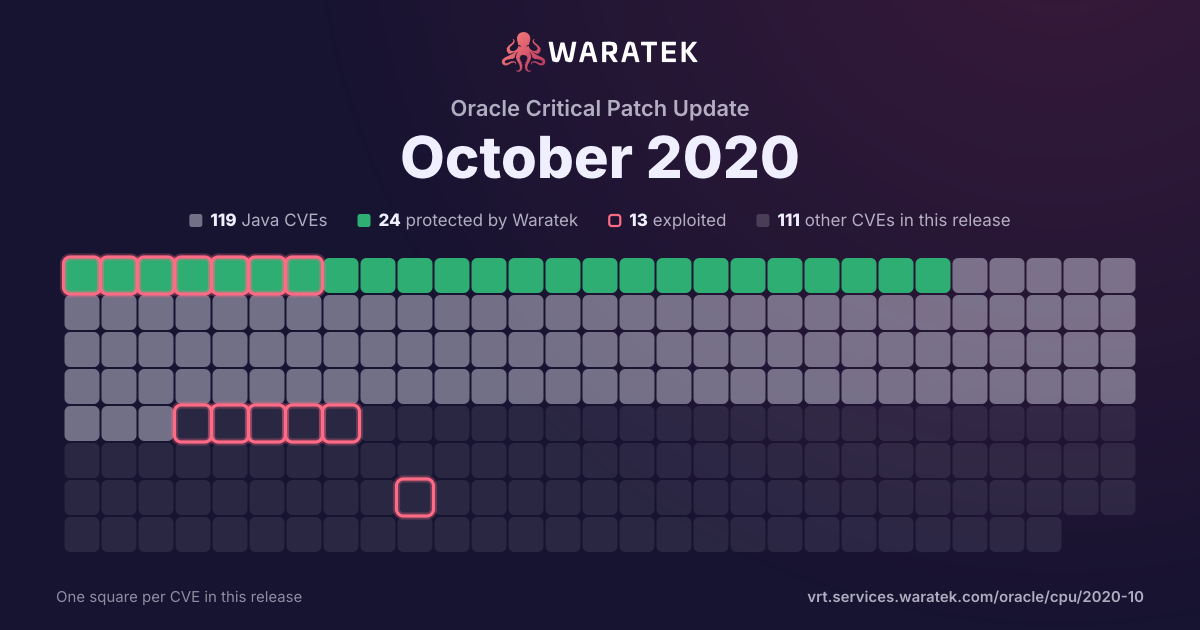
By status
24Protected by Waratek2Mitigation candidate93No exploit published64Outside Waratek scope47Not applicable
13Exploited, marked by the ring
No exploit published. For 75 of them, Oracle's security advisory is the source of public detail.
Protected by Waratek. Waratek RASP can block exploitation of these on systems that have not applied the patch yet.
Overview 119 matches · 23 protected · 7 exploited · 6 CISA KEV · 11 public PoC · 13 EPSS ≥ 0.5
Protected by Waratek
24
20.2%
Rule in development
0
0.0%
Mitigation candidate
2
1.7%
No exploit published
93
78.2%
blocked by ARMR today
23
19.3%
partly blocked
1
0.8%
not blocked
95
79.8%
not established
0
0.0%
unrecorded
0
0.0%
split by
peak 80 / quarter
Q2 161
Protected by Waratek1
High1
blocked by ARMR today1
Forecast only1
Q3 160
Q4 161
Protected by Waratek1
Critical1
blocked by ARMR today1
No public exploit1
Q1 170
Q2 171
Protected by Waratek1
Critical1
blocked by ARMR today1
Working exploit published1
Q3 170
Q4 171
Protected by Waratek1
High1
blocked by ARMR today1
Proof of concept only1
Q1 181
Protected by Waratek1
Critical1
blocked by ARMR today1
No public exploit1
Q2 182
No exploit published2
Critical1
High1
not blocked2
No public exploit2
Q3 180
Q4 180
Q1 191
Protected by Waratek1
Critical1
blocked by ARMR today1
Exploited1
Q2 193
No exploit published3
High1
Medium2
not blocked3
Forecast only1
No public exploit2
Q3 193
Protected by Waratek1
No exploit published2
Critical1
High2
blocked by ARMR today1
not blocked2
Forecast only1
No public exploit2
Q4 199
Protected by Waratek3
No exploit published6
Critical4
High2
Medium3
blocked by ARMR today2
partly blocked1
not blocked6
Exploited1
No public exploit8
Q1 205
Protected by Waratek2
Mitigation candidate1
No exploit published2
Critical4
Medium1
blocked by ARMR today2
not blocked3
Exploited2
No public exploit3
Q2 209
Protected by Waratek4
No exploit published5
Critical2
High3
Medium4
blocked by ARMR today4
not blocked5
Working exploit published1
No public exploit8
Q3 202
Mitigation candidate1
No exploit published1
Critical1
High1
not blocked2
Working exploit published1
No public exploit1
Q4 2080
Protected by Waratek8
No exploit published72
Critical8
High29
Medium36
Low7
blocked by ARMR today8
not blocked72
Exploited3
No public exploit77
Q2 16Q4 16Q2 17Q4 17Q2 18Q4 18Q2 19Q4 19Q2 20Q4 20
| CVE | Severity | Published▾ | Status | Exploitation | Description |
|---|---|---|---|---|---|
| CVE-2019-17531 | Critical | 2019-10-12 | No exploit published | No public exploit | A Polymorphic Typing issue was discovered in FasterXML jackson-databind 2.0.0 through 2.9.10. When Default Typing is enabled (either globally or for a specific property) for an externally exposed JSON endpoint and the service has the apache-log4j-extra (version 1.2.x) jar in the classpath, and an attacker can provide a JNDI service to access, it is possible to make the service execute a malicious payload. |
| CVE-2019-17495 | Critical | 2019-10-10 | No exploit published | No public exploit | A Cascading Style Sheets (CSS) injection vulnerability in Swagger UI before 3.23.11 allows attackers to use the Relative Path Overwrite (RPO) technique to perform CSS-based input field value exfiltration, such as exfiltration of a CSRF token value. In other words, this product intentionally allows the embedding of untrusted JSON data from remote servers, but it was not previously known that <style>@import within the JSON data was a functional attack method. |
| CVE-2019-17359 | High | 2019-10-08 | No exploit published | No public exploit | The ASN.1 parser in Bouncy Castle Crypto (aka BC Java) 1.63 can trigger a large attempted memory allocation, and resultant OutOfMemoryError error, via crafted ASN.1 data. This is fixed in 1.64. |
| CVE-2019-17267 | Critical | 2019-10-07 | No exploit published | No public exploit | A Polymorphic Typing issue was discovered in FasterXML jackson-databind before 2.9.10. It is related to net.sf.ehcache.hibernate.EhcacheJtaTransactionManagerLookup. |
| CVE-2019-17091 | Medium | 2019-10-02 | Protected by Waratek | No public exploit | faces/context/PartialViewContextImpl.java in Eclipse Mojarra, as used in Mojarra for Eclipse EE4J before 2.3.10 and Mojarra JavaServer Faces before 2.2.20, allows Reflected XSS because a client window field is mishandled. |
| CVE-2019-12402 | High | 2019-08-30 | No exploit published | No public exploit | The file name encoding algorithm used internally in Apache Commons Compress 1.15 to 1.18 can get into an infinite loop when faced with specially crafted inputs. This can lead to a denial of service attack if an attacker can choose the file names inside of an archive created by Compress. |
| CVE-2019-10173 | Critical | 2019-07-23 | Protected by Waratek | Forecast only | It was found that xstream API version 1.4.10 before 1.4.11 introduced a regression for a previous deserialization flaw. If the security framework has not been initialized, it may allow a remote attacker to run arbitrary shell commands when unmarshalling XML or any supported format. e.g. JSON. (regression of CVE-2013-7285) |
| CVE-2018-17196 | High | 2019-07-11 | No exploit published | No public exploit | In Apache Kafka versions between 0.11.0.0 and 2.1.0, it is possible to manually craft a Produce request which bypasses transaction/idempotent ACL validation. Only authenticated clients with Write permission on the respective topics are able to exploit this vulnerability. Users should upgrade to 2.1.1 or later where this vulnerability has been fixed. |
| CVE-2019-10072 | High | 2019-06-21 | No exploit published | Forecast only | The fix for CVE-2019-0199 was incomplete and did not address HTTP/2 connection window exhaustion on write in Apache Tomcat versions 9.0.0.M1 to 9.0.19 and 8.5.0 to 8.5.40 . By not sending WINDOW_UPDATE messages for the connection window (stream 0) clients were able to cause server-side threads to block eventually leading to thread exhaustion and a DoS. |
| CVE-2019-0201 | Medium | 2019-05-23 | No exploit published | No public exploit | An issue is present in Apache ZooKeeper 1.0.0 to 3.4.13 and 3.5.0-alpha to 3.5.4-beta. ZooKeeper’s getACL() command doesn’t check any permission when retrieves the ACLs of the requested node and returns all information contained in the ACL Id field as plaintext string. DigestAuthenticationProvider overloads the Id field with the hash value that is used for user authentication. As a consequence, if Digest Authentication is in use, the unsalted hash value will be disclosed by getACL() request for unauthenticated or unprivileged users. |
| CVE-2019-10247 | Medium | 2019-04-22 | No exploit published | No public exploit | In Eclipse Jetty version 7.x, 8.x, 9.2.27 and older, 9.3.26 and older, and 9.4.16 and older, the server running on any OS and Jetty version combination will reveal the configured fully qualified directory base resource location on the output of the 404 error for not finding a Context that matches the requested path. The default server behavior on jetty-distribution and jetty-home will include at the end of the Handler tree a DefaultHandler, which is responsible for reporting this 404 error, it presents the various configured contexts as HTML for users to click through to. This produced HTML includes output that contains the configured fully qualified directory base resource location for each context. |
| CVE-2019-0192 | Critical | 2019-03-07 | Protected by Waratek | Exploited | In Apache Solr versions 5.0.0 to 5.5.5 and 6.0.0 to 6.6.5, the Config API allows to configure the JMX server via an HTTP POST request. By pointing it to a malicious RMI server, an attacker could take advantage of Solr's unsafe deserialization to trigger remote code execution on the Solr side. |
| CVE-2017-7658 | Critical | 2018-06-26 | No exploit published | No public exploit | In Eclipse Jetty Server, versions 9.2.x and older, 9.3.x (all non HTTP/1.x configurations), and 9.4.x (all HTTP/1.x configurations), when presented with two content-lengths headers, Jetty ignored the second. When presented with a content-length and a chunked encoding header, the content-length was ignored (as per RFC 2616). If an intermediary decided on the shorter length, but still passed on the longer body, then body content could be interpreted by Jetty as a pipelined request. If the intermediary was imposing authorization, the fake pipelined request would bypass that authorization. |
| CVE-2018-2765 | High | 2018-04-19 | No exploit published | No public exploit | Vulnerability in the Oracle Security Service component of Oracle Fusion Middleware (subcomponent: Oracle SSL API). Supported versions that are affected are 11.1.1.9.0, 12.1.3.0.0, 12.2.1.2.0 and 12.2.1.3.0. Easily exploitable vulnerability allows unauthenticated attacker with network access via HTTPS to compromise Oracle Security Service. Successful attacks of this vulnerability can result in unauthorized access to critical data or complete access to all Oracle Security Service accessible data. CVSS 3.0 Base Score 7.5 (Confidentiality impacts). CVSS Vector: (CVSS:3.0/AV:N/AC:L/PR:N/UI:N/S:U/C:H/I:N/A:N). |
| CVE-2018-8088 | Critical | 2018-03-20 | Protected by Waratek | No public exploit | org.slf4j.ext.EventData in the slf4j-ext module in QOS.CH SLF4J before 1.8.0-beta2 allows remote attackers to bypass intended access restrictions via crafted data. EventData in the slf4j-ext module in QOS.CH SLF4J, has been fixed in SLF4J versions 1.7.26 later and in the 2.0.x series. |
| CVE-2017-9096 | High | 2017-11-08 | Protected by Waratek | Proof of concept only | The XML parsers in iText before 5.5.12 and 7.x before 7.0.3 do not disable external entities, which might allow remote attackers to conduct XML external entity (XXE) attacks via a crafted PDF. |
| CVE-2017-5645 | Critical | 2017-04-17 | Protected by Waratek | Working exploit published | In Apache Log4j 2.x before 2.8.2, when using the TCP socket server or UDP socket server to receive serialized log events from another application, a specially crafted binary payload can be sent that, when deserialized, can execute arbitrary code. |
| CVE-2016-1000031 | Critical | 2016-10-25 | Protected by Waratek | No public exploit | Apache Commons FileUpload before 1.3.3 DiskFileItem File Manipulation Remote Code Execution |
| CVE-2016-2510 | High | 2016-04-07 | Protected by Waratek | Forecast only | BeanShell (bsh) before 2.0b6, when included on the classpath by an application that uses Java serialization or XStream, allows remote attackers to execute arbitrary code via crafted serialized data, related to XThis.Handler. |