
Oracle Critical Patch Update July 2020
Released July 2020 · Oracle's advisory ↗ · ← Critical Patch Update, April 2020 · Critical Patch Update, October 2020 →
285 CVEs in this release, one square each
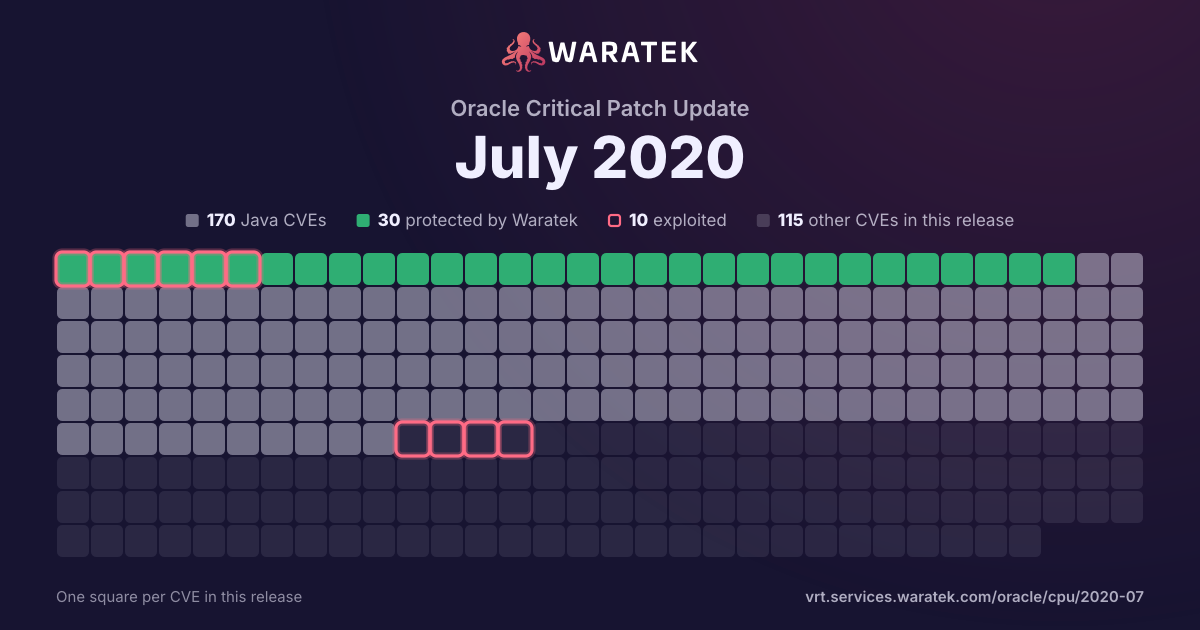
By status
30Protected by Waratek1Mitigation candidate139No exploit published68Outside Waratek scope47Not applicable
10Exploited, marked by the ring
No exploit published. For 126 of them, Oracle's security advisory is the source of public detail.
Protected by Waratek. Waratek RASP can block exploitation of these on systems that have not applied the patch yet.
Overview 89 matches · 57 in Waratek scope · 0 protected · 0 exploited · 0 CISA KEV · 3 public PoC · 3 EPSS ≥ 0.5
89matches
57in Waratek scope64.0%
0protected0.0%
0exploited0.0%
0CISA KEV0.0%
3public PoC3.4%
3EPSS ≥ 0.53.4%
Protected by Waratek
0
0.0%
Rule in development
0
0.0%
Mitigation candidate
0
0.0%
No exploit published
57
64.0%
Outside Waratek scope
17
19.1%
Not applicable
15
16.9%
Withdrawn CVE
0
0.0%
blocked by ARMR today
0
0.0%
partly blocked
0
0.0%
not blocked
89
100.0%
not established
0
0.0%
unrecorded
0
0.0%
Exploited
0
0.0%
Working exploit published
1
1.1%
Proof of concept only
3
3.4%
Forecast only
0
0.0%
No public exploit
85
95.5%
split by
peak 70 / quarter
Q4 171
Not applicable1
High1
not blocked1
No public exploit1
Q1 181
No exploit published1
High1
not blocked1
No public exploit1
Q2 182
No exploit published1
Not applicable1
High2
not blocked2
No public exploit2
Q3 180
Q4 181
Outside Waratek scope1
High1
not blocked1
No public exploit1
Q1 191
No exploit published1
High1
not blocked1
No public exploit1
Q2 191
Outside Waratek scope1
High1
not blocked1
Working exploit published1
Q3 194
No exploit published2
Outside Waratek scope2
High4
not blocked4
No public exploit4
Q4 191
No exploit published1
High1
not blocked1
No public exploit1
Q1 205
No exploit published1
Outside Waratek scope3
Not applicable1
High5
not blocked5
Proof of concept only2
No public exploit3
Q2 202
Outside Waratek scope2
High2
not blocked2
Proof of concept only1
No public exploit1
Q3 2070
No exploit published50
Outside Waratek scope8
Not applicable12
High70
not blocked70
No public exploit70
Q4 17Q1 18Q2 18Q3 18Q4 18Q1 19Q2 19Q3 19Q4 19Q1 20Q2 20Q3 20
| CVE | Severity | Published▾ | Status | Exploitation | Description |
|---|---|---|---|---|---|
| CVE-2020-2984 | High | 2020-07-15 | No exploit published | No public exploit | Vulnerability in the Oracle Configuration Manager product of Oracle Enterprise Manager (component: Discovery and collection script). The supported version that is affected is 12.1.2.0.6. Easily exploitable vulnerability allows low privileged attacker with network access via HTTP to compromise Oracle Configuration Manager. Successful attacks of this vulnerability can result in unauthorized access to critical data or complete access to all Oracle Configuration Manager accessible data as well as unauthorized update, insert or delete access to some of Oracle Configuration Manager accessible data. CVSS 3.1 Base Score 7.1 (Confidentiality and Integrity impacts). CVSS Vector: (CVSS:3.1/AV:N/AC:L/PR:L/UI:N/S:U/C:H/I:L/A:N). |
| CVE-2020-2983 | High | 2020-07-15 | No exploit published | No public exploit | Vulnerability in the Oracle Data Masking and Subsetting product of Oracle Enterprise Manager (component: Data Masking). Supported versions that are affected are 13.3.0.0 and 13.4.0.0. Easily exploitable vulnerability allows low privileged attacker with network access via HTTP to compromise Oracle Data Masking and Subsetting. Successful attacks of this vulnerability can result in unauthorized access to critical data or complete access to all Oracle Data Masking and Subsetting accessible data as well as unauthorized update, insert or delete access to some of Oracle Data Masking and Subsetting accessible data. CVSS 3.1 Base Score 7.1 (Confidentiality and Integrity impacts). CVSS Vector: (CVSS:3.1/AV:N/AC:L/PR:L/UI:N/S:U/C:H/I:L/A:N). |
| CVE-2020-2982 | High | 2020-07-15 | No exploit published | No public exploit | Vulnerability in the Enterprise Manager Base Platform product of Oracle Enterprise Manager (component: Enterprise Config Management). Supported versions that are affected are 13.3.0.0 and 13.4.0.0. Easily exploitable vulnerability allows low privileged attacker with network access via HTTP to compromise Enterprise Manager Base Platform. Successful attacks of this vulnerability can result in unauthorized access to critical data or complete access to all Enterprise Manager Base Platform accessible data as well as unauthorized update, insert or delete access to some of Enterprise Manager Base Platform accessible data. CVSS 3.1 Base Score 7.1 (Confidentiality and Integrity impacts). CVSS Vector: (CVSS:3.1/AV:N/AC:L/PR:L/UI:N/S:U/C:H/I:L/A:N). |
| CVE-2020-2981 | High | 2020-07-15 | Not applicable | No public exploit | Vulnerability in the Data Store component of Oracle Berkeley DB. The supported version that is affected is Prior to 18.1.40. Difficult to exploit vulnerability allows unauthenticated attacker with logon to the infrastructure where Data Store executes to compromise Data Store. Successful attacks require human interaction from a person other than the attacker. Successful attacks of this vulnerability can result in takeover of Data Store. CVSS 3.1 Base Score 7.0 (Confidentiality, Integrity and Availability impacts). CVSS Vector: (CVSS:3.1/AV:L/AC:H/PR:N/UI:R/S:U/C:H/I:H/A:H). |
| CVE-2020-2968 | High | 2020-07-15 | Outside Waratek scope | No public exploit | Vulnerability in the Java VM component of Oracle Database Server. Supported versions that are affected are 11.2.0.4, 12.1.0.2, 12.2.0.1, 18c and 19c. Difficult to exploit vulnerability allows low privileged attacker having Create Session, Create Procedure privilege with network access via multiple protocols to compromise Java VM. Successful attacks require human interaction from a person other than the attacker and while the vulnerability is in Java VM, attacks may significantly impact additional products. Successful attacks of this vulnerability can result in takeover of Java VM. CVSS 3.1 Base Score 8.0 (Confidentiality, Integrity and Availability impacts). CVSS Vector: (CVSS:3.1/AV:N/AC:H/PR:L/UI:R/S:C/C:H/I:H/A:H). |
| CVE-2020-2967 | High | 2020-07-15 | No exploit published | No public exploit | Vulnerability in the Oracle WebLogic Server product of Oracle Fusion Middleware (component: Web Services). Supported versions that are affected are 10.3.6.0.0, 12.1.3.0.0, 12.2.1.3.0, 12.2.1.4.0 and 14.1.1.0.0. Easily exploitable vulnerability allows unauthenticated attacker with network access via IIOP, T3 to compromise Oracle WebLogic Server. Successful attacks of this vulnerability can result in unauthorized access to critical data or complete access to all Oracle WebLogic Server accessible data. CVSS 3.1 Base Score 7.5 (Confidentiality impacts). CVSS Vector: (CVSS:3.1/AV:N/AC:L/PR:N/UI:N/S:U/C:H/I:N/A:N). |
| CVE-2020-14724 | High | 2020-07-15 | Not applicable | No public exploit | Vulnerability in the Oracle Solaris product of Oracle Systems (component: Device Driver Utility). The supported version that is affected is 11. Easily exploitable vulnerability allows low privileged attacker with logon to the infrastructure where Oracle Solaris executes to compromise Oracle Solaris. Successful attacks require human interaction from a person other than the attacker. Successful attacks of this vulnerability can result in takeover of Oracle Solaris. CVSS 3.1 Base Score 7.3 (Confidentiality, Integrity and Availability impacts). CVSS Vector: (CVSS:3.1/AV:L/AC:L/PR:L/UI:R/S:U/C:H/I:H/A:H). |
| CVE-2020-14723 | High | 2020-07-15 | No exploit published | No public exploit | Vulnerability in the Oracle Help Technologies product of Oracle Fusion Middleware (component: Web UIX). Supported versions that are affected are 11.1.1.9.0 and 12.2.1.3.0. Easily exploitable vulnerability allows unauthenticated attacker with network access via HTTP to compromise Oracle Help Technologies. Successful attacks require human interaction from a person other than the attacker and while the vulnerability is in Oracle Help Technologies, attacks may significantly impact additional products. Successful attacks of this vulnerability can result in unauthorized access to critical data or complete access to all Oracle Help Technologies accessible data as well as unauthorized update, insert or delete access to some of Oracle Help Technologies accessible data. CVSS 3.1 Base Score 8.2 (Confidentiality and Integrity impacts). CVSS Vector: (CVSS:3.1/AV:N/AC:L/PR:N/UI:R/S:C/C:H/I:L/A:N). |
| CVE-2020-14720 | High | 2020-07-15 | No exploit published | No public exploit | Vulnerability in the Oracle Internet Expenses product of Oracle E-Business Suite (component: Mobile Expenses Admin Utilities). Supported versions that are affected are 12.2.4-12.2.9. Easily exploitable vulnerability allows low privileged attacker with network access via HTTP to compromise Oracle Internet Expenses. While the vulnerability is in Oracle Internet Expenses, attacks may significantly impact additional products. Successful attacks of this vulnerability can result in unauthorized access to critical data or complete access to all Oracle Internet Expenses accessible data. CVSS 3.1 Base Score 7.7 (Confidentiality impacts). CVSS Vector: (CVSS:3.1/AV:N/AC:L/PR:L/UI:N/S:C/C:H/I:N/A:N). |
| CVE-2020-14719 | High | 2020-07-15 | No exploit published | No public exploit | Vulnerability in the Oracle Internet Expenses product of Oracle E-Business Suite (component: Mobile Expenses Admin Utilities). Supported versions that are affected are 12.2.4-12.2.9. Easily exploitable vulnerability allows low privileged attacker with network access via HTTP to compromise Oracle Internet Expenses. While the vulnerability is in Oracle Internet Expenses, attacks may significantly impact additional products. Successful attacks of this vulnerability can result in unauthorized creation, deletion or modification access to critical data or all Oracle Internet Expenses accessible data. CVSS 3.1 Base Score 7.7 (Integrity impacts). CVSS Vector: (CVSS:3.1/AV:N/AC:L/PR:L/UI:N/S:C/C:N/I:H/A:N). |
| CVE-2020-14718 | High | 2020-07-15 | No exploit published | No public exploit | Vulnerability in the Oracle GraalVM Enterprise Edition product of Oracle GraalVM (component: JVMCI). Supported versions that are affected are 19.3.2 and 20.1.0. Easily exploitable vulnerability allows high privileged attacker with network access via multiple protocols to compromise Oracle GraalVM Enterprise Edition. Successful attacks of this vulnerability can result in takeover of Oracle GraalVM Enterprise Edition. CVSS 3.1 Base Score 7.2 (Confidentiality, Integrity and Availability impacts). CVSS Vector: (CVSS:3.1/AV:N/AC:L/PR:H/UI:N/S:U/C:H/I:H/A:H). |
| CVE-2020-14713 | High | 2020-07-15 | Not applicable | No public exploit | Vulnerability in the Oracle VM VirtualBox product of Oracle Virtualization (component: Core). Supported versions that are affected are Prior to 5.2.44, prior to 6.0.24 and prior to 6.1.12. Difficult to exploit vulnerability allows high privileged attacker with logon to the infrastructure where Oracle VM VirtualBox executes to compromise Oracle VM VirtualBox. While the vulnerability is in Oracle VM VirtualBox, attacks may significantly impact additional products. Successful attacks of this vulnerability can result in takeover of Oracle VM VirtualBox. CVSS 3.1 Base Score 7.5 (Confidentiality, Integrity and Availability impacts). CVSS Vector: (CVSS:3.1/AV:L/AC:H/PR:H/UI:N/S:C/C:H/I:H/A:H). |
| CVE-2020-14709 | High | 2020-07-15 | No exploit published | No public exploit | Vulnerability in the Customer Management and Segmentation Foundation product of Oracle Retail Applications (component: Card). Supported versions that are affected are 16.0, 17.0 and 18.0. Easily exploitable vulnerability allows low privileged attacker with network access via HTTP to compromise Customer Management and Segmentation Foundation. Successful attacks of this vulnerability can result in unauthorized creation, deletion or modification access to critical data or all Customer Management and Segmentation Foundation accessible data as well as unauthorized read access to a subset of Customer Management and Segmentation Foundation accessible data. CVSS 3.1 Base Score 7.1 (Confidentiality and Integrity impacts). CVSS Vector: (CVSS:3.1/AV:N/AC:L/PR:L/UI:N/S:U/C:L/I:H/A:N). |
| CVE-2020-14699 | High | 2020-07-15 | Not applicable | No public exploit | Vulnerability in the Oracle VM VirtualBox product of Oracle Virtualization (component: Core). Supported versions that are affected are Prior to 5.2.44, prior to 6.0.24 and prior to 6.1.12. Difficult to exploit vulnerability allows high privileged attacker with logon to the infrastructure where Oracle VM VirtualBox executes to compromise Oracle VM VirtualBox. While the vulnerability is in Oracle VM VirtualBox, attacks may significantly impact additional products. Successful attacks of this vulnerability can result in takeover of Oracle VM VirtualBox. CVSS 3.1 Base Score 7.5 (Confidentiality, Integrity and Availability impacts). CVSS Vector: (CVSS:3.1/AV:L/AC:H/PR:H/UI:N/S:C/C:H/I:H/A:H). |
| CVE-2020-14697 | High | 2020-07-15 | Outside Waratek scope | No public exploit | Vulnerability in the MySQL Server product of Oracle MySQL (component: Server: Security: Privileges). Supported versions that are affected are 8.0.20 and prior. Easily exploitable vulnerability allows high privileged attacker with network access via multiple protocols to compromise MySQL Server. Successful attacks of this vulnerability can result in takeover of MySQL Server. CVSS 3.1 Base Score 7.2 (Confidentiality, Integrity and Availability impacts). CVSS Vector: (CVSS:3.1/AV:N/AC:L/PR:H/UI:N/S:U/C:H/I:H/A:H). |
| CVE-2020-14696 | High | 2020-07-15 | No exploit published | No public exploit | Vulnerability in the Oracle BI Publisher product of Oracle Fusion Middleware (component: Layout Templates). Supported versions that are affected are 11.1.1.9.0, 12.2.1.3.0 and 12.2.1.4.0. Easily exploitable vulnerability allows unauthenticated attacker with network access via HTTP to compromise Oracle BI Publisher. While the vulnerability is in Oracle BI Publisher, attacks may significantly impact additional products. Successful attacks of this vulnerability can result in unauthorized update, insert or delete access to some of Oracle BI Publisher accessible data as well as unauthorized read access to a subset of Oracle BI Publisher accessible data. CVSS 3.1 Base Score 7.2 (Confidentiality and Integrity impacts). CVSS Vector: (CVSS:3.1/AV:N/AC:L/PR:N/UI:N/S:C/C:L/I:L/A:N). |
| CVE-2020-14691 | High | 2020-07-15 | No exploit published | No public exploit | Vulnerability in the Oracle Financial Services Liquidity Risk Management product of Oracle Financial Services Applications (component: User Interface). The supported version that is affected is 8.0.6. Easily exploitable vulnerability allows low privileged attacker with network access via HTTP to compromise Oracle Financial Services Liquidity Risk Management. Successful attacks of this vulnerability can result in unauthorized creation, deletion or modification access to critical data or all Oracle Financial Services Liquidity Risk Management accessible data as well as unauthorized read access to a subset of Oracle Financial Services Liquidity Risk Management accessible data. CVSS 3.1 Base Score 7.1 (Confidentiality and Integrity impacts). CVSS Vector: (CVSS:3.1/AV:N/AC:L/PR:L/UI:N/S:U/C:L/I:H/A:N). |
| CVE-2020-14690 | High | 2020-07-15 | No exploit published | No public exploit | Vulnerability in the Oracle Business Intelligence Enterprise Edition product of Oracle Fusion Middleware (component: Analytics Actions). Supported versions that are affected are 5.5.0.0.0, 11.1.1.9.0, 12.2.1.3.0 and 12.2.1.4.0. Easily exploitable vulnerability allows unauthenticated attacker with network access via HTTP to compromise Oracle Business Intelligence Enterprise Edition. Successful attacks require human interaction from a person other than the attacker and while the vulnerability is in Oracle Business Intelligence Enterprise Edition, attacks may significantly impact additional products. Successful attacks of this vulnerability can result in unauthorized access to critical data or complete access to all Oracle Business Intelligence Enterprise Edition accessible data as well as unauthorized update, insert or delete access to some of Oracle Business Intelligence Enterprise Edition accessible data. CVSS 3.1 Base Score 8.2 (Confidentiality and Integrity impacts). CVSS Vector: (CVSS:3.1/AV:N/AC:L/PR:N/UI:R/S:C/C:H/I:L/A:N). |
| CVE-2020-14688 | High | 2020-07-15 | No exploit published | No public exploit | Vulnerability in the Oracle Common Applications product of Oracle E-Business Suite (component: CRM User Management Framework). Supported versions that are affected are 12.1.3 and 12.2.3-12.2.9. Easily exploitable vulnerability allows unauthenticated attacker with network access via HTTP to compromise Oracle Common Applications. Successful attacks require human interaction from a person other than the attacker and while the vulnerability is in Oracle Common Applications, attacks may significantly impact additional products. Successful attacks of this vulnerability can result in unauthorized access to critical data or complete access to all Oracle Common Applications accessible data as well as unauthorized update, insert or delete access to some of Oracle Common Applications accessible data. CVSS 3.1 Base Score 8.2 (Confidentiality and Integrity impacts). CVSS Vector: (CVSS:3.1/AV:N/AC:L/PR:N/UI:R/S:C/C:H/I:L/A:N). |
| CVE-2020-14686 | High | 2020-07-15 | No exploit published | No public exploit | Vulnerability in the Oracle iSupport product of Oracle E-Business Suite (component: Others). Supported versions that are affected are 12.1.1-12.1.3 and 12.2.3-12.2.9. Easily exploitable vulnerability allows unauthenticated attacker with network access via HTTP to compromise Oracle iSupport. Successful attacks require human interaction from a person other than the attacker and while the vulnerability is in Oracle iSupport, attacks may significantly impact additional products. Successful attacks of this vulnerability can result in unauthorized access to critical data or complete access to all Oracle iSupport accessible data as well as unauthorized update, insert or delete access to some of Oracle iSupport accessible data. CVSS 3.1 Base Score 8.2 (Confidentiality and Integrity impacts). CVSS Vector: (CVSS:3.1/AV:N/AC:L/PR:N/UI:R/S:C/C:H/I:L/A:N). |
| CVE-2020-14682 | High | 2020-07-15 | No exploit published | No public exploit | Vulnerability in the Oracle Depot Repair product of Oracle E-Business Suite (component: Estimate and Actual Charges). Supported versions that are affected are 12.1.1-12.1.3. Easily exploitable vulnerability allows unauthenticated attacker with network access via HTTP to compromise Oracle Depot Repair. Successful attacks require human interaction from a person other than the attacker and while the vulnerability is in Oracle Depot Repair, attacks may significantly impact additional products. Successful attacks of this vulnerability can result in unauthorized access to critical data or complete access to all Oracle Depot Repair accessible data as well as unauthorized update, insert or delete access to some of Oracle Depot Repair accessible data. CVSS 3.1 Base Score 8.2 (Confidentiality and Integrity impacts). CVSS Vector: (CVSS:3.1/AV:N/AC:L/PR:N/UI:R/S:C/C:H/I:L/A:N). |
| CVE-2020-14681 | High | 2020-07-15 | No exploit published | No public exploit | Vulnerability in the Oracle E-Business Intelligence product of Oracle E-Business Suite (component: DBI Setups). Supported versions that are affected are 12.1.1-12.1.3. Easily exploitable vulnerability allows unauthenticated attacker with network access via HTTP to compromise Oracle E-Business Intelligence. Successful attacks require human interaction from a person other than the attacker and while the vulnerability is in Oracle E-Business Intelligence, attacks may significantly impact additional products. Successful attacks of this vulnerability can result in unauthorized access to critical data or complete access to all Oracle E-Business Intelligence accessible data as well as unauthorized update, insert or delete access to some of Oracle E-Business Intelligence accessible data. CVSS 3.1 Base Score 8.2 (Confidentiality and Integrity impacts). CVSS Vector: (CVSS:3.1/AV:N/AC:L/PR:N/UI:R/S:C/C:H/I:L/A:N). |
| CVE-2020-14679 | High | 2020-07-15 | No exploit published | No public exploit | Vulnerability in the Oracle CRM Technical Foundation product of Oracle E-Business Suite (component: Preferences). Supported versions that are affected are 12.1.3 and 12.2.3-12.2.9. Easily exploitable vulnerability allows unauthenticated attacker with network access via HTTP to compromise Oracle CRM Technical Foundation. Successful attacks of this vulnerability can result in unauthorized ability to cause a hang or frequently repeatable crash (complete DOS) of Oracle CRM Technical Foundation. CVSS 3.1 Base Score 7.5 (Availability impacts). CVSS Vector: (CVSS:3.1/AV:N/AC:L/PR:N/UI:N/S:U/C:N/I:N/A:H). |
| CVE-2020-14678 | High | 2020-07-15 | Outside Waratek scope | No public exploit | Vulnerability in the MySQL Server product of Oracle MySQL (component: Server: Security: Privileges). Supported versions that are affected are 8.0.20 and prior. Easily exploitable vulnerability allows high privileged attacker with network access via multiple protocols to compromise MySQL Server. Successful attacks of this vulnerability can result in takeover of MySQL Server. CVSS 3.1 Base Score 7.2 (Confidentiality, Integrity and Availability impacts). CVSS Vector: (CVSS:3.1/AV:N/AC:L/PR:H/UI:N/S:U/C:H/I:H/A:H). |
| CVE-2020-14677 | High | 2020-07-15 | Not applicable | No public exploit | Vulnerability in the Oracle VM VirtualBox product of Oracle Virtualization (component: Core). Supported versions that are affected are Prior to 5.2.44, prior to 6.0.24 and prior to 6.1.12. Difficult to exploit vulnerability allows high privileged attacker with logon to the infrastructure where Oracle VM VirtualBox executes to compromise Oracle VM VirtualBox. While the vulnerability is in Oracle VM VirtualBox, attacks may significantly impact additional products. Successful attacks of this vulnerability can result in takeover of Oracle VM VirtualBox. CVSS 3.1 Base Score 7.5 (Confidentiality, Integrity and Availability impacts). CVSS Vector: (CVSS:3.1/AV:L/AC:H/PR:H/UI:N/S:C/C:H/I:H/A:H). |
| CVE-2020-14676 | High | 2020-07-15 | Not applicable | No public exploit | Vulnerability in the Oracle VM VirtualBox product of Oracle Virtualization (component: Core). Supported versions that are affected are Prior to 5.2.44, prior to 6.0.24 and prior to 6.1.12. Difficult to exploit vulnerability allows high privileged attacker with logon to the infrastructure where Oracle VM VirtualBox executes to compromise Oracle VM VirtualBox. While the vulnerability is in Oracle VM VirtualBox, attacks may significantly impact additional products. Successful attacks of this vulnerability can result in takeover of Oracle VM VirtualBox. CVSS 3.1 Base Score 7.5 (Confidentiality, Integrity and Availability impacts). CVSS Vector: (CVSS:3.1/AV:L/AC:H/PR:H/UI:N/S:C/C:H/I:H/A:H). |
| CVE-2020-14675 | High | 2020-07-15 | Not applicable | No public exploit | Vulnerability in the Oracle VM VirtualBox product of Oracle Virtualization (component: Core). Supported versions that are affected are Prior to 5.2.44, prior to 6.0.24 and prior to 6.1.12. Difficult to exploit vulnerability allows high privileged attacker with logon to the infrastructure where Oracle VM VirtualBox executes to compromise Oracle VM VirtualBox. While the vulnerability is in Oracle VM VirtualBox, attacks may significantly impact additional products. Successful attacks of this vulnerability can result in takeover of Oracle VM VirtualBox. CVSS 3.1 Base Score 7.5 (Confidentiality, Integrity and Availability impacts). CVSS Vector: (CVSS:3.1/AV:L/AC:H/PR:H/UI:N/S:C/C:H/I:H/A:H). |
| CVE-2020-14674 | High | 2020-07-15 | Not applicable | No public exploit | Vulnerability in the Oracle VM VirtualBox product of Oracle Virtualization (component: Core). Supported versions that are affected are Prior to 5.2.44, prior to 6.0.24 and prior to 6.1.12. Difficult to exploit vulnerability allows high privileged attacker with logon to the infrastructure where Oracle VM VirtualBox executes to compromise Oracle VM VirtualBox. While the vulnerability is in Oracle VM VirtualBox, attacks may significantly impact additional products. Successful attacks of this vulnerability can result in takeover of Oracle VM VirtualBox. CVSS 3.1 Base Score 7.5 (Confidentiality, Integrity and Availability impacts). CVSS Vector: (CVSS:3.1/AV:L/AC:H/PR:H/UI:N/S:C/C:H/I:H/A:H). |
| CVE-2020-14671 | High | 2020-07-15 | No exploit published | No public exploit | Vulnerability in the Oracle Advanced Outbound Telephony product of Oracle E-Business Suite (component: User Interface). Supported versions that are affected are 12.1.1-12.1.3. Easily exploitable vulnerability allows unauthenticated attacker with network access via HTTP to compromise Oracle Advanced Outbound Telephony. Successful attacks require human interaction from a person other than the attacker and while the vulnerability is in Oracle Advanced Outbound Telephony, attacks may significantly impact additional products. Successful attacks of this vulnerability can result in unauthorized access to critical data or complete access to all Oracle Advanced Outbound Telephony accessible data as well as unauthorized update, insert or delete access to some of Oracle Advanced Outbound Telephony accessible data. CVSS 3.1 Base Score 8.2 (Confidentiality and Integrity impacts). CVSS Vector: (CVSS:3.1/AV:N/AC:L/PR:N/UI:R/S:C/C:H/I:L/A:N). |
| CVE-2020-14670 | High | 2020-07-15 | No exploit published | No public exploit | Vulnerability in the Oracle Advanced Outbound Telephony product of Oracle E-Business Suite (component: Settings). Supported versions that are affected are 12.1.1-12.1.3 and 12.2.3-12.2.9. Easily exploitable vulnerability allows unauthenticated attacker with network access via HTTP to compromise Oracle Advanced Outbound Telephony. Successful attacks require human interaction from a person other than the attacker and while the vulnerability is in Oracle Advanced Outbound Telephony, attacks may significantly impact additional products. Successful attacks of this vulnerability can result in unauthorized access to critical data or complete access to all Oracle Advanced Outbound Telephony accessible data as well as unauthorized update, insert or delete access to some of Oracle Advanced Outbound Telephony accessible data. CVSS 3.1 Base Score 8.2 (Confidentiality and Integrity impacts). CVSS Vector: (CVSS:3.1/AV:N/AC:L/PR:N/UI:R/S:C/C:H/I:L/A:N). |
| CVE-2020-14669 | High | 2020-07-15 | No exploit published | No public exploit | Vulnerability in the Oracle Configurator product of Oracle Supply Chain (component: UI Servlet). Supported versions that are affected are 12.1 and 12.2. Easily exploitable vulnerability allows unauthenticated attacker with network access via HTTP to compromise Oracle Configurator. Successful attacks require human interaction from a person other than the attacker and while the vulnerability is in Oracle Configurator, attacks may significantly impact additional products. Successful attacks of this vulnerability can result in unauthorized access to critical data or complete access to all Oracle Configurator accessible data as well as unauthorized update, insert or delete access to some of Oracle Configurator accessible data. CVSS 3.1 Base Score 8.2 (Confidentiality and Integrity impacts). CVSS Vector: (CVSS:3.1/AV:N/AC:L/PR:N/UI:R/S:C/C:H/I:L/A:N). |
| CVE-2020-14668 | High | 2020-07-15 | No exploit published | No public exploit | Vulnerability in the Oracle E-Business Intelligence product of Oracle E-Business Suite (component: DBI Setups). Supported versions that are affected are 12.1.1-12.1.3. Easily exploitable vulnerability allows unauthenticated attacker with network access via HTTP to compromise Oracle E-Business Intelligence. Successful attacks require human interaction from a person other than the attacker and while the vulnerability is in Oracle E-Business Intelligence, attacks may significantly impact additional products. Successful attacks of this vulnerability can result in unauthorized access to critical data or complete access to all Oracle E-Business Intelligence accessible data as well as unauthorized update, insert or delete access to some of Oracle E-Business Intelligence accessible data. CVSS 3.1 Base Score 8.2 (Confidentiality and Integrity impacts). CVSS Vector: (CVSS:3.1/AV:N/AC:L/PR:N/UI:R/S:C/C:H/I:L/A:N). |
| CVE-2020-14667 | High | 2020-07-15 | No exploit published | No public exploit | Vulnerability in the Oracle CRM Technical Foundation product of Oracle E-Business Suite (component: Preferences). Supported versions that are affected are 12.1.3 and 12.2.3-12.2.9. Easily exploitable vulnerability allows low privileged attacker with network access via HTTP to compromise Oracle CRM Technical Foundation. Successful attacks require human interaction from a person other than the attacker and while the vulnerability is in Oracle CRM Technical Foundation, attacks may significantly impact additional products. Successful attacks of this vulnerability can result in unauthorized access to critical data or complete access to all Oracle CRM Technical Foundation accessible data as well as unauthorized update, insert or delete access to some of Oracle CRM Technical Foundation accessible data. CVSS 3.1 Base Score 7.6 (Confidentiality and Integrity impacts). CVSS Vector: (CVSS:3.1/AV:N/AC:L/PR:L/UI:R/S:C/C:H/I:L/A:N). |
| CVE-2020-14666 | High | 2020-07-15 | No exploit published | No public exploit | Vulnerability in the Oracle Email Center product of Oracle E-Business Suite (component: Message Display). Supported versions that are affected are 12.1.1-12.1.3 and 12.2.3-12.2.9. Easily exploitable vulnerability allows unauthenticated attacker with network access via HTTP to compromise Oracle Email Center. Successful attacks require human interaction from a person other than the attacker and while the vulnerability is in Oracle Email Center, attacks may significantly impact additional products. Successful attacks of this vulnerability can result in unauthorized access to critical data or complete access to all Oracle Email Center accessible data as well as unauthorized update, insert or delete access to some of Oracle Email Center accessible data. CVSS 3.1 Base Score 8.2 (Confidentiality and Integrity impacts). CVSS Vector: (CVSS:3.1/AV:N/AC:L/PR:N/UI:R/S:C/C:H/I:L/A:N). |
| CVE-2020-14664 | High | 2020-07-15 | Outside Waratek scope | No public exploit | Vulnerability in the Java SE product of Oracle Java SE (component: JavaFX). The supported version that is affected is Java SE: 8u251. Difficult to exploit vulnerability allows unauthenticated attacker with network access via multiple protocols to compromise Java SE. Successful attacks require human interaction from a person other than the attacker and while the vulnerability is in Java SE, attacks may significantly impact additional products. Successful attacks of this vulnerability can result in takeover of Java SE. Note: This vulnerability applies to Java deployments, typically in clients running sandboxed Java Web Start applications or sandboxed Java applets, that load and run untrusted code (e.g., code that comes from the internet) and rely on the Java sandbox for security. This vulnerability does not apply to Java deployments, typically in servers, that load and run only trusted code (e.g., code installed by an administrator). CVSS 3.1 Base Score 8.3 (Confidentiality, Integrity and Availability impacts). CVSS Vector: (CVSS:3.1/AV:N/AC:H/PR:N/UI:R/S:C/C:H/I:H/A:H). |
| CVE-2020-14663 | High | 2020-07-15 | Outside Waratek scope | No public exploit | Vulnerability in the MySQL Server product of Oracle MySQL (component: Server: Security: Privileges). Supported versions that are affected are 8.0.20 and prior. Easily exploitable vulnerability allows high privileged attacker with network access via multiple protocols to compromise MySQL Server. Successful attacks of this vulnerability can result in takeover of MySQL Server. CVSS 3.1 Base Score 7.2 (Confidentiality, Integrity and Availability impacts). CVSS Vector: (CVSS:3.1/AV:N/AC:L/PR:H/UI:N/S:U/C:H/I:H/A:H). |
| CVE-2020-14660 | High | 2020-07-15 | No exploit published | No public exploit | Vulnerability in the Oracle CRM Technical Foundation product of Oracle E-Business Suite (component: Preferences). Supported versions that are affected are 12.1.3 and 12.2.3-12.2.9. Easily exploitable vulnerability allows unauthenticated attacker with network access via HTTP to compromise Oracle CRM Technical Foundation. Successful attacks require human interaction from a person other than the attacker and while the vulnerability is in Oracle CRM Technical Foundation, attacks may significantly impact additional products. Successful attacks of this vulnerability can result in unauthorized access to critical data or complete access to all Oracle CRM Technical Foundation accessible data as well as unauthorized update, insert or delete access to some of Oracle CRM Technical Foundation accessible data. CVSS 3.1 Base Score 8.2 (Confidentiality and Integrity impacts). CVSS Vector: (CVSS:3.1/AV:N/AC:L/PR:N/UI:R/S:C/C:H/I:L/A:N). |
| CVE-2020-14657 | High | 2020-07-15 | No exploit published | No public exploit | Vulnerability in the Oracle CRM Technical Foundation product of Oracle E-Business Suite (component: Preferences). Supported versions that are affected are 12.1.3 and 12.2.3-12.2.9. Easily exploitable vulnerability allows low privileged attacker with network access via HTTP to compromise Oracle CRM Technical Foundation. Successful attacks require human interaction from a person other than the attacker and while the vulnerability is in Oracle CRM Technical Foundation, attacks may significantly impact additional products. Successful attacks of this vulnerability can result in unauthorized access to critical data or complete access to all Oracle CRM Technical Foundation accessible data as well as unauthorized update, insert or delete access to some of Oracle CRM Technical Foundation accessible data. CVSS 3.1 Base Score 7.6 (Confidentiality and Integrity impacts). CVSS Vector: (CVSS:3.1/AV:N/AC:L/PR:L/UI:R/S:C/C:H/I:L/A:N). |
| CVE-2020-14649 | High | 2020-07-15 | Not applicable | No public exploit | Vulnerability in the Oracle VM VirtualBox product of Oracle Virtualization (component: Core). Supported versions that are affected are Prior to 5.2.44, prior to 6.0.24 and prior to 6.1.12. Difficult to exploit vulnerability allows high privileged attacker with logon to the infrastructure where Oracle VM VirtualBox executes to compromise Oracle VM VirtualBox. While the vulnerability is in Oracle VM VirtualBox, attacks may significantly impact additional products. Successful attacks of this vulnerability can result in takeover of Oracle VM VirtualBox. CVSS 3.1 Base Score 7.5 (Confidentiality, Integrity and Availability impacts). CVSS Vector: (CVSS:3.1/AV:L/AC:H/PR:H/UI:N/S:C/C:H/I:H/A:H). |
| CVE-2020-14647 | High | 2020-07-15 | Not applicable | No public exploit | Vulnerability in the Oracle VM VirtualBox product of Oracle Virtualization (component: Core). Supported versions that are affected are Prior to 5.2.44, prior to 6.0.24 and prior to 6.1.12. Difficult to exploit vulnerability allows high privileged attacker with logon to the infrastructure where Oracle VM VirtualBox executes to compromise Oracle VM VirtualBox. While the vulnerability is in Oracle VM VirtualBox, attacks may significantly impact additional products. Successful attacks of this vulnerability can result in takeover of Oracle VM VirtualBox. CVSS 3.1 Base Score 7.5 (Confidentiality, Integrity and Availability impacts). CVSS Vector: (CVSS:3.1/AV:L/AC:H/PR:H/UI:N/S:C/C:H/I:H/A:H). |
| CVE-2020-14646 | High | 2020-07-15 | Not applicable | No public exploit | Vulnerability in the Oracle VM VirtualBox product of Oracle Virtualization (component: Core). Supported versions that are affected are Prior to 5.2.44, prior to 6.0.24 and prior to 6.1.12. Difficult to exploit vulnerability allows high privileged attacker with logon to the infrastructure where Oracle VM VirtualBox executes to compromise Oracle VM VirtualBox. While the vulnerability is in Oracle VM VirtualBox, attacks may significantly impact additional products. Successful attacks of this vulnerability can result in takeover of Oracle VM VirtualBox. CVSS 3.1 Base Score 7.5 (Confidentiality, Integrity and Availability impacts). CVSS Vector: (CVSS:3.1/AV:L/AC:H/PR:H/UI:N/S:C/C:H/I:H/A:H). |
| CVE-2020-14642 | High | 2020-07-15 | No exploit published | No public exploit | Vulnerability in the Oracle Coherence product of Oracle Fusion Middleware (component: CacheStore). Supported versions that are affected are 3.7.1.0, 12.1.3.0.0, 12.2.1.3.0, 12.2.1.4.0 and 14.1.1.0.0. Easily exploitable vulnerability allows unauthenticated attacker with network access via HTTP to compromise Oracle Coherence. Successful attacks of this vulnerability can result in unauthorized ability to cause a hang or frequently repeatable crash (complete DOS) of Oracle Coherence. CVSS 3.1 Base Score 7.5 (Availability impacts). CVSS Vector: (CVSS:3.1/AV:N/AC:L/PR:N/UI:N/S:U/C:N/I:N/A:H). |
| CVE-2020-14639 | High | 2020-07-15 | No exploit published | No public exploit | Vulnerability in the Oracle WebLogic Server product of Oracle Fusion Middleware (component: Sample apps). Supported versions that are affected are 12.1.3.0.0, 12.2.1.3.0, 12.2.1.4.0 and 14.1.1.0.0. Easily exploitable vulnerability allows unauthenticated attacker with network access via HTTP to compromise Oracle WebLogic Server. Successful attacks of this vulnerability can result in unauthorized access to critical data or complete access to all Oracle WebLogic Server accessible data. CVSS 3.1 Base Score 7.5 (Confidentiality impacts). CVSS Vector: (CVSS:3.1/AV:N/AC:L/PR:N/UI:N/S:U/C:H/I:N/A:N). |
| CVE-2020-14630 | High | 2020-07-15 | No exploit published | No public exploit | Vulnerability in the Oracle Enterprise Session Border Controller product of Oracle Communications Applications (component: File Upload). Supported versions that are affected are 8.1.0, 8.2.0 and 8.3.0. Easily exploitable vulnerability allows high privileged attacker with network access via HTTP to compromise Oracle Enterprise Session Border Controller. Successful attacks require human interaction from a person other than the attacker and while the vulnerability is in Oracle Enterprise Session Border Controller, attacks may significantly impact additional products. Successful attacks of this vulnerability can result in unauthorized ability to cause a hang or frequently repeatable crash (complete DOS) of Oracle Enterprise Session Border Controller as well as unauthorized update, insert or delete access to some of Oracle Enterprise Session Border Controller accessible data and unauthorized read access to a subset of Oracle Enterprise Session Border Controller accessible data. CVSS 3.1 Base Score 7.5 (Confidentiality, Integrity and Availability impacts). CVSS Vector: (CVSS:3.1/AV:N/AC:L/PR:H/UI:R/S:C/C:L/I:L/A:H). |
| CVE-2020-14628 | High | 2020-07-15 | Not applicable | No public exploit | Vulnerability in the Oracle VM VirtualBox product of Oracle Virtualization (component: Core). Supported versions that are affected are Prior to 5.2.44, prior to 6.0.24 and prior to 6.1.12. Easily exploitable vulnerability allows high privileged attacker with logon to the infrastructure where Oracle VM VirtualBox executes to compromise Oracle VM VirtualBox. While the vulnerability is in Oracle VM VirtualBox, attacks may significantly impact additional products. Successful attacks of this vulnerability can result in takeover of Oracle VM VirtualBox. Note: The CVE-2020-14628 is applicable to Windows VM only. CVSS 3.1 Base Score 8.2 (Confidentiality, Integrity and Availability impacts). CVSS Vector: (CVSS:3.1/AV:L/AC:L/PR:H/UI:N/S:C/C:H/I:H/A:H). |
| CVE-2020-14626 | High | 2020-07-15 | No exploit published | No public exploit | Vulnerability in the Oracle Business Intelligence Enterprise Edition product of Oracle Fusion Middleware (component: Analytics Web General). Supported versions that are affected are 5.5.0.0.0, 11.1.1.9.0, 12.2.1.3.0 and 12.2.1.4.0. Difficult to exploit vulnerability allows unauthenticated attacker with network access via HTTP to compromise Oracle Business Intelligence Enterprise Edition. Successful attacks of this vulnerability can result in takeover of Oracle Business Intelligence Enterprise Edition. CVSS 3.1 Base Score 8.1 (Confidentiality, Integrity and Availability impacts). CVSS Vector: (CVSS:3.1/AV:N/AC:H/PR:N/UI:N/S:U/C:H/I:H/A:H). |
| CVE-2020-14611 | High | 2020-07-15 | No exploit published | No public exploit | Vulnerability in the Oracle WebCenter Portal product of Oracle Fusion Middleware (component: Composer). Supported versions that are affected are 12.2.1.3.0 and 12.2.1.4.0. Easily exploitable vulnerability allows unauthenticated attacker with network access via HTTP to compromise Oracle WebCenter Portal. Successful attacks of this vulnerability can result in unauthorized creation, deletion or modification access to critical data or all Oracle WebCenter Portal accessible data as well as unauthorized read access to a subset of Oracle WebCenter Portal accessible data and unauthorized ability to cause a partial denial of service (partial DOS) of Oracle WebCenter Portal. CVSS 3.1 Base Score 8.6 (Confidentiality, Integrity and Availability impacts). CVSS Vector: (CVSS:3.1/AV:N/AC:L/PR:N/UI:N/S:U/C:L/I:H/A:L). |
| CVE-2020-14610 | High | 2020-07-15 | No exploit published | No public exploit | Vulnerability in the Oracle Applications Framework product of Oracle E-Business Suite (component: Attachments / File Upload). The supported version that is affected is 12.2.9. Easily exploitable vulnerability allows low privileged attacker with network access via HTTP to compromise Oracle Applications Framework. Successful attacks require human interaction from a person other than the attacker and while the vulnerability is in Oracle Applications Framework, attacks may significantly impact additional products. Successful attacks of this vulnerability can result in unauthorized access to critical data or complete access to all Oracle Applications Framework accessible data as well as unauthorized update, insert or delete access to some of Oracle Applications Framework accessible data. CVSS 3.1 Base Score 7.6 (Confidentiality and Integrity impacts). CVSS Vector: (CVSS:3.1/AV:N/AC:L/PR:L/UI:R/S:C/C:H/I:L/A:N). |
| CVE-2020-14609 | High | 2020-07-15 | No exploit published | No public exploit | Vulnerability in the Oracle Business Intelligence Enterprise Edition product of Oracle Fusion Middleware (component: Analytics Web Answers). Supported versions that are affected are 5.5.0.0.0, 11.1.1.9.0, 12.2.1.3.0 and 12.2.1.4.0. Easily exploitable vulnerability allows unauthenticated attacker with network access via HTTP to compromise Oracle Business Intelligence Enterprise Edition. Successful attacks of this vulnerability can result in unauthorized access to critical data or complete access to all Oracle Business Intelligence Enterprise Edition accessible data as well as unauthorized update, insert or delete access to some of Oracle Business Intelligence Enterprise Edition accessible data and unauthorized ability to cause a partial denial of service (partial DOS) of Oracle Business Intelligence Enterprise Edition. CVSS 3.1 Base Score 8.6 (Confidentiality, Integrity and Availability impacts). CVSS Vector: (CVSS:3.1/AV:N/AC:L/PR:N/UI:N/S:U/C:H/I:L/A:L). |
| CVE-2020-14608 | High | 2020-07-15 | No exploit published | No public exploit | Vulnerability in the Oracle Fusion Middleware MapViewer product of Oracle Fusion Middleware (component: Tile Server). The supported version that is affected is 12.2.1.3.0. Easily exploitable vulnerability allows unauthenticated attacker with network access via HTTP to compromise Oracle Fusion Middleware MapViewer. Successful attacks of this vulnerability can result in unauthorized creation, deletion or modification access to critical data or all Oracle Fusion Middleware MapViewer accessible data as well as unauthorized read access to a subset of Oracle Fusion Middleware MapViewer accessible data. CVSS 3.1 Base Score 8.2 (Confidentiality and Integrity impacts). CVSS Vector: (CVSS:3.1/AV:N/AC:L/PR:N/UI:N/S:U/C:L/I:H/A:N). |
| CVE-2020-14602 | High | 2020-07-15 | No exploit published | No public exploit | Vulnerability in the Oracle Financial Services Analytical Applications Infrastructure product of Oracle Financial Services Applications (component: Infrastructure). Supported versions that are affected are 8.0.6-8.1.0. Easily exploitable vulnerability allows low privileged attacker with network access via HTTP to compromise Oracle Financial Services Analytical Applications Infrastructure. Successful attacks of this vulnerability can result in unauthorized creation, deletion or modification access to critical data or all Oracle Financial Services Analytical Applications Infrastructure accessible data as well as unauthorized read access to a subset of Oracle Financial Services Analytical Applications Infrastructure accessible data. CVSS 3.1 Base Score 7.1 (Confidentiality and Integrity impacts). CVSS Vector: (CVSS:3.1/AV:N/AC:L/PR:L/UI:N/S:U/C:L/I:H/A:N). |
| CVE-2020-14596 | High | 2020-07-15 | No exploit published | No public exploit | Vulnerability in the Oracle iStore product of Oracle E-Business Suite (component: Address Book). Supported versions that are affected are 12.1.1-12.1.3. Easily exploitable vulnerability allows unauthenticated attacker with network access via HTTP to compromise Oracle iStore. Successful attacks require human interaction from a person other than the attacker and while the vulnerability is in Oracle iStore, attacks may significantly impact additional products. Successful attacks of this vulnerability can result in unauthorized access to critical data or complete access to all Oracle iStore accessible data as well as unauthorized update, insert or delete access to some of Oracle iStore accessible data. CVSS 3.1 Base Score 8.2 (Confidentiality and Integrity impacts). CVSS Vector: (CVSS:3.1/AV:N/AC:L/PR:N/UI:R/S:C/C:H/I:L/A:N). |
| CVE-2020-14595 | High | 2020-07-15 | No exploit published | No public exploit | Vulnerability in the Oracle iLearning product of Oracle iLearning (component: Assessment Manager). Supported versions that are affected are 6.1 and 6.1.1. Easily exploitable vulnerability allows unauthenticated attacker with network access via HTTP to compromise Oracle iLearning. Successful attacks of this vulnerability can result in unauthorized access to critical data or complete access to all Oracle iLearning accessible data and unauthorized ability to cause a partial denial of service (partial DOS) of Oracle iLearning. CVSS 3.1 Base Score 8.2 (Confidentiality and Availability impacts). CVSS Vector: (CVSS:3.1/AV:N/AC:L/PR:N/UI:N/S:U/C:H/I:N/A:L). |
| CVE-2020-14593 | High | 2020-07-15 | Outside Waratek scope | No public exploit | Vulnerability in the Java SE, Java SE Embedded product of Oracle Java SE (component: 2D). Supported versions that are affected are Java SE: 7u261, 8u251, 11.0.7 and 14.0.1; Java SE Embedded: 8u251. Easily exploitable vulnerability allows unauthenticated attacker with network access via multiple protocols to compromise Java SE, Java SE Embedded. Successful attacks require human interaction from a person other than the attacker and while the vulnerability is in Java SE, Java SE Embedded, attacks may significantly impact additional products. Successful attacks of this vulnerability can result in unauthorized creation, deletion or modification access to critical data or all Java SE, Java SE Embedded accessible data. Note: This vulnerability applies to Java deployments, typically in clients running sandboxed Java Web Start applications or sandboxed Java applets, that load and run untrusted code (e.g., code that comes from the internet) and rely on the Java sandbox for security. This vulnerability does not apply to Java deployments, typically in servers, that load and run only trusted code (e.g., code installed by an administrator). CVSS 3.1 Base Score 7.4 (Integrity impacts). CVSS Vector: (CVSS:3.1/AV:N/AC:L/PR:N/UI:R/S:C/C:N/I:H/A:N). |
| CVE-2020-14589 | High | 2020-07-15 | No exploit published | No public exploit | Vulnerability in the Oracle WebLogic Server product of Oracle Fusion Middleware (component: Web Container). Supported versions that are affected are 10.3.6.0.0, 12.1.3.0.0, 12.2.1.3.0, 12.2.1.4.0 and 14.1.1.0.0. Easily exploitable vulnerability allows unauthenticated attacker with network access via HTTP to compromise Oracle WebLogic Server. Successful attacks of this vulnerability can result in unauthorized ability to cause a hang or frequently repeatable crash (complete DOS) of Oracle WebLogic Server. CVSS 3.1 Base Score 7.5 (Availability impacts). CVSS Vector: (CVSS:3.1/AV:N/AC:L/PR:N/UI:N/S:U/C:N/I:N/A:H). |
| CVE-2020-14588 | High | 2020-07-15 | No exploit published | No public exploit | Vulnerability in the Oracle WebLogic Server product of Oracle Fusion Middleware (component: Web Container). Supported versions that are affected are 10.3.6.0.0, 12.1.3.0.0, 12.2.1.3.0, 12.2.1.4.0 and 14.1.1.0.0. Easily exploitable vulnerability allows unauthenticated attacker with network access via HTTP to compromise Oracle WebLogic Server. Successful attacks of this vulnerability can result in unauthorized creation, deletion or modification access to critical data or all Oracle WebLogic Server accessible data as well as unauthorized read access to a subset of Oracle WebLogic Server accessible data. CVSS 3.1 Base Score 8.2 (Confidentiality and Integrity impacts). CVSS Vector: (CVSS:3.1/AV:N/AC:L/PR:N/UI:N/S:U/C:L/I:H/A:N). |
| CVE-2020-14585 | High | 2020-07-15 | No exploit published | No public exploit | Vulnerability in the Oracle BI Publisher product of Oracle Fusion Middleware (component: Mobile Service). Supported versions that are affected are 11.1.1.9.0, 12.2.1.3.0 and 12.2.1.4.0. Easily exploitable vulnerability allows unauthenticated attacker with network access via HTTP to compromise Oracle BI Publisher. Successful attacks require human interaction from a person other than the attacker and while the vulnerability is in Oracle BI Publisher, attacks may significantly impact additional products. Successful attacks of this vulnerability can result in unauthorized access to critical data or complete access to all Oracle BI Publisher accessible data as well as unauthorized update, insert or delete access to some of Oracle BI Publisher accessible data. CVSS 3.1 Base Score 8.2 (Confidentiality and Integrity impacts). CVSS Vector: (CVSS:3.1/AV:N/AC:L/PR:N/UI:R/S:C/C:H/I:L/A:N). |
| CVE-2020-14584 | High | 2020-07-15 | No exploit published | No public exploit | Vulnerability in the Oracle BI Publisher product of Oracle Fusion Middleware (component: BI Publisher Security). Supported versions that are affected are 12.2.1.3.0 and 12.2.1.4.0. Easily exploitable vulnerability allows unauthenticated attacker with network access via HTTP to compromise Oracle BI Publisher. Successful attacks require human interaction from a person other than the attacker and while the vulnerability is in Oracle BI Publisher, attacks may significantly impact additional products. Successful attacks of this vulnerability can result in unauthorized access to critical data or complete access to all Oracle BI Publisher accessible data as well as unauthorized update, insert or delete access to some of Oracle BI Publisher accessible data. CVSS 3.1 Base Score 8.2 (Confidentiality and Integrity impacts). CVSS Vector: (CVSS:3.1/AV:N/AC:L/PR:N/UI:R/S:C/C:H/I:L/A:N). |
| CVE-2020-14583 | High | 2020-07-15 | Outside Waratek scope | No public exploit | Vulnerability in the Java SE, Java SE Embedded product of Oracle Java SE (component: Libraries). Supported versions that are affected are Java SE: 7u261, 8u251, 11.0.7 and 14.0.1; Java SE Embedded: 8u251. Difficult to exploit vulnerability allows unauthenticated attacker with network access via multiple protocols to compromise Java SE, Java SE Embedded. Successful attacks require human interaction from a person other than the attacker and while the vulnerability is in Java SE, Java SE Embedded, attacks may significantly impact additional products. Successful attacks of this vulnerability can result in takeover of Java SE, Java SE Embedded. Note: This vulnerability applies to Java deployments, typically in clients running sandboxed Java Web Start applications or sandboxed Java applets, that load and run untrusted code (e.g., code that comes from the internet) and rely on the Java sandbox for security. This vulnerability does not apply to Java deployments, typically in servers, that load and run only trusted code (e.g., code installed by an administrator). CVSS 3.1 Base Score 8.3 (Confidentiality, Integrity and Availability impacts). CVSS Vector: (CVSS:3.1/AV:N/AC:H/PR:N/UI:R/S:C/C:H/I:H/A:H). |
| CVE-2020-14582 | High | 2020-07-15 | No exploit published | No public exploit | Vulnerability in the Oracle iStore product of Oracle E-Business Suite (component: User Registration). Supported versions that are affected are 12.1.1-12.1.3 and 12.2.3-12.2.9. Easily exploitable vulnerability allows unauthenticated attacker with network access via HTTP to compromise Oracle iStore. Successful attacks require human interaction from a person other than the attacker and while the vulnerability is in Oracle iStore, attacks may significantly impact additional products. Successful attacks of this vulnerability can result in unauthorized access to critical data or complete access to all Oracle iStore accessible data as well as unauthorized update, insert or delete access to some of Oracle iStore accessible data. CVSS 3.1 Base Score 8.2 (Confidentiality and Integrity impacts). CVSS Vector: (CVSS:3.1/AV:N/AC:L/PR:N/UI:R/S:C/C:H/I:L/A:N). |
| CVE-2020-14580 | High | 2020-07-15 | Outside Waratek scope | No public exploit | Vulnerability in the Oracle Communications Session Border Controller product of Oracle Communications Applications (component: System Admin). Supported versions that are affected are 8.1.0, 8.2.0 and 8.3.0. Easily exploitable vulnerability allows low privileged attacker with network access via SSH to compromise Oracle Communications Session Border Controller. Successful attacks require human interaction from a person other than the attacker and while the vulnerability is in Oracle Communications Session Border Controller, attacks may significantly impact additional products. Successful attacks of this vulnerability can result in unauthorized access to critical data or complete access to all Oracle Communications Session Border Controller accessible data as well as unauthorized update, insert or delete access to some of Oracle Communications Session Border Controller accessible data and unauthorized ability to cause a partial denial of service (partial DOS) of Oracle Communications Session Border Controller. CVSS 3.1 Base Score 8.2 (Confidentiality, Integrity and Availability impacts). CVSS Vector: (CVSS:3.1/AV:N/AC:L/PR:L/UI:R/S:C/C:H/I:L/A:L). |
| CVE-2020-14571 | High | 2020-07-15 | No exploit published | No public exploit | Vulnerability in the Oracle BI Publisher product of Oracle Fusion Middleware (component: Mobile Service). Supported versions that are affected are 11.1.1.9.0, 12.2.1.3.0 and 12.2.1.4.0. Easily exploitable vulnerability allows unauthenticated attacker with network access via HTTP to compromise Oracle BI Publisher. While the vulnerability is in Oracle BI Publisher, attacks may significantly impact additional products. Successful attacks of this vulnerability can result in unauthorized update, insert or delete access to some of Oracle BI Publisher accessible data as well as unauthorized read access to a subset of Oracle BI Publisher accessible data. CVSS 3.1 Base Score 7.2 (Confidentiality and Integrity impacts). CVSS Vector: (CVSS:3.1/AV:N/AC:L/PR:N/UI:N/S:C/C:L/I:L/A:N). |
| CVE-2020-14570 | High | 2020-07-15 | No exploit published | No public exploit | Vulnerability in the Oracle BI Publisher product of Oracle Fusion Middleware (component: Mobile Service). Supported versions that are affected are 11.1.1.9.0, 12.2.1.3.0 and 12.2.1.4.0. Easily exploitable vulnerability allows unauthenticated attacker with network access via HTTP to compromise Oracle BI Publisher. Successful attacks require human interaction from a person other than the attacker. Successful attacks of this vulnerability can result in unauthorized access to critical data or complete access to all Oracle BI Publisher accessible data as well as unauthorized update, insert or delete access to some of Oracle BI Publisher accessible data. CVSS 3.1 Base Score 7.1 (Confidentiality and Integrity impacts). CVSS Vector: (CVSS:3.1/AV:N/AC:L/PR:N/UI:R/S:U/C:H/I:L/A:N). |
| CVE-2020-14569 | High | 2020-07-15 | No exploit published | No public exploit | Vulnerability in the Oracle FLEXCUBE Investor Servicing product of Oracle Financial Services Applications (component: Infrastructure). Supported versions that are affected are 12.1.0, 12.3.0, 12.4.0, 14.0.0 and 14.1.0. Easily exploitable vulnerability allows low privileged attacker with network access via HTTP to compromise Oracle FLEXCUBE Investor Servicing. Successful attacks of this vulnerability can result in unauthorized creation, deletion or modification access to critical data or all Oracle FLEXCUBE Investor Servicing accessible data as well as unauthorized access to critical data or complete access to all Oracle FLEXCUBE Investor Servicing accessible data. CVSS 3.1 Base Score 8.1 (Confidentiality and Integrity impacts). CVSS Vector: (CVSS:3.1/AV:N/AC:L/PR:L/UI:N/S:U/C:H/I:H/A:N). |
| CVE-2020-14565 | High | 2020-07-15 | No exploit published | No public exploit | Vulnerability in the Oracle Unified Directory product of Oracle Fusion Middleware (component: Security). Supported versions that are affected are 11.1.2.3.0, 12.2.1.3.0 and 12.2.1.4.0. Easily exploitable vulnerability allows high privileged attacker with network access via HTTP to compromise Oracle Unified Directory. Successful attacks require human interaction from a person other than the attacker and while the vulnerability is in Oracle Unified Directory, attacks may significantly impact additional products. Successful attacks of this vulnerability can result in unauthorized creation, deletion or modification access to critical data or all Oracle Unified Directory accessible data and unauthorized ability to cause a hang or frequently repeatable crash (complete DOS) of Oracle Unified Directory. CVSS 3.1 Base Score 8.1 (Integrity and Availability impacts). CVSS Vector: (CVSS:3.1/AV:N/AC:L/PR:H/UI:R/S:C/C:N/I:H/A:H). |
| CVE-2020-14561 | High | 2020-07-15 | No exploit published | No public exploit | Vulnerability in the Oracle Hospitality Reporting and Analytics product of Oracle Food and Beverage Applications (component: Installation). The supported version that is affected is 9.1.0. Easily exploitable vulnerability allows low privileged attacker with logon to the infrastructure where Oracle Hospitality Reporting and Analytics executes to compromise Oracle Hospitality Reporting and Analytics. Successful attacks require human interaction from a person other than the attacker. Successful attacks of this vulnerability can result in takeover of Oracle Hospitality Reporting and Analytics. CVSS 3.1 Base Score 7.3 (Confidentiality, Integrity and Availability impacts). CVSS Vector: (CVSS:3.1/AV:L/AC:L/PR:L/UI:R/S:U/C:H/I:H/A:H). |
| CVE-2020-14543 | High | 2020-07-15 | No exploit published | No public exploit | Vulnerability in the Oracle Hospitality Reporting and Analytics product of Oracle Food and Beverage Applications (component: Installation). The supported version that is affected is 9.1.0. Easily exploitable vulnerability allows low privileged attacker with logon to the infrastructure where Oracle Hospitality Reporting and Analytics executes to compromise Oracle Hospitality Reporting and Analytics. Successful attacks require human interaction from a person other than the attacker. Successful attacks of this vulnerability can result in takeover of Oracle Hospitality Reporting and Analytics. CVSS 3.1 Base Score 7.3 (Confidentiality, Integrity and Availability impacts). CVSS Vector: (CVSS:3.1/AV:L/AC:L/PR:L/UI:R/S:U/C:H/I:H/A:H). |
| CVE-2020-14536 | High | 2020-07-15 | No exploit published | No public exploit | Vulnerability in the Oracle Commerce Guided Search / Oracle Commerce Experience Manager product of Oracle Commerce (component: Workbench). Supported versions that are affected are 11.0, 11.1, 11.2 and prior to 11.3.1. Difficult to exploit vulnerability allows unauthenticated attacker with network access via HTTP to compromise Oracle Commerce Guided Search / Oracle Commerce Experience Manager. Successful attacks of this vulnerability can result in unauthorized creation, deletion or modification access to critical data or all Oracle Commerce Guided Search / Oracle Commerce Experience Manager accessible data as well as unauthorized access to critical data or complete access to all Oracle Commerce Guided Search / Oracle Commerce Experience Manager accessible data. CVSS 3.1 Base Score 7.4 (Confidentiality and Integrity impacts). CVSS Vector: (CVSS:3.1/AV:N/AC:H/PR:N/UI:N/S:U/C:H/I:H/A:N). |
| CVE-2020-14535 | High | 2020-07-15 | No exploit published | No public exploit | Vulnerability in the Oracle Commerce Service Center product of Oracle Commerce (component: Commerce Service Center). Supported versions that are affected are 11.1, 11.2 and prior to 11.3.1. Difficult to exploit vulnerability allows unauthenticated attacker with network access via HTTP to compromise Oracle Commerce Service Center. Successful attacks of this vulnerability can result in unauthorized creation, deletion or modification access to critical data or all Oracle Commerce Service Center accessible data as well as unauthorized access to critical data or complete access to all Oracle Commerce Service Center accessible data. CVSS 3.1 Base Score 7.4 (Confidentiality and Integrity impacts). CVSS Vector: (CVSS:3.1/AV:N/AC:H/PR:N/UI:N/S:U/C:H/I:H/A:N). |
| CVE-2020-14534 | High | 2020-07-15 | No exploit published | No public exploit | Vulnerability in the Oracle Applications Framework product of Oracle E-Business Suite (component: Popups). The supported version that is affected is 12.2.9. Easily exploitable vulnerability allows unauthenticated attacker with network access via HTTP to compromise Oracle Applications Framework. Successful attacks require human interaction from a person other than the attacker and while the vulnerability is in Oracle Applications Framework, attacks may significantly impact additional products. Successful attacks of this vulnerability can result in unauthorized access to critical data or complete access to all Oracle Applications Framework accessible data as well as unauthorized update, insert or delete access to some of Oracle Applications Framework accessible data. CVSS 3.1 Base Score 8.2 (Confidentiality and Integrity impacts). CVSS Vector: (CVSS:3.1/AV:N/AC:L/PR:N/UI:R/S:C/C:H/I:L/A:N). |
| CVE-2020-11080 | High | 2020-06-03 | Outside Waratek scope | No public exploit | In nghttp2 before version 1.41.0, the overly large HTTP/2 SETTINGS frame payload causes denial of service. The proof of concept attack involves a malicious client constructing a SETTINGS frame with a length of 14,400 bytes (2400 individual settings entries) over and over again. The attack causes the CPU to spike at 100%. nghttp2 v1.41.0 fixes this vulnerability. There is a workaround to this vulnerability. Implement nghttp2_on_frame_recv_callback callback, and if received frame is SETTINGS frame and the number of settings entries are large (e.g., > 32), then drop the connection. |
| CVE-2020-1967 | High | 2020-04-21 | Outside Waratek scope | Proof of concept only | Server or client applications that call the SSL_check_chain() function during or after a TLS 1.3 handshake may crash due to a NULL pointer dereference as a result of incorrect handling of the "signature_algorithms_cert" TLS extension. The crash occurs if an invalid or unrecognised signature algorithm is received from the peer. This could be exploited by a malicious peer in a Denial of Service attack. OpenSSL version 1.1.1d, 1.1.1e, and 1.1.1f are affected by this issue. This issue did not affect OpenSSL versions prior to 1.1.1d. Fixed in OpenSSL 1.1.1g (Affected 1.1.1d-1.1.1f). |
| CVE-2020-5258 | High | 2020-03-10 | Outside Waratek scope | No public exploit | In affected versions of dojo (NPM package), the deepCopy method is vulnerable to Prototype Pollution. Prototype Pollution refers to the ability to inject properties into existing JavaScript language construct prototypes, such as objects. An attacker manipulates these attributes to overwrite, or pollute, a JavaScript application object prototype of the base object by injecting other values. This has been patched in versions 1.12.8, 1.13.7, 1.14.6, 1.15.3 and 1.16.2 |
| CVE-2020-8112 | High | 2020-01-28 | Not applicable | No public exploit | opj_t1_clbl_decode_processor in openjp2/t1.c in OpenJPEG 2.3.1 through 2020-01-28 has a heap-based buffer overflow in the qmfbid==1 case, a different issue than CVE-2020-6851. |
| CVE-2020-7595 | High | 2020-01-21 | Outside Waratek scope | Proof of concept only | xmlStringLenDecodeEntities in parser.c in libxml2 2.9.10 has an infinite loop in a certain end-of-file situation. |
| CVE-2020-5398 | High | 2020-01-17 | Outside Waratek scope | Proof of concept only | In Spring Framework, versions 5.2.x prior to 5.2.3, versions 5.1.x prior to 5.1.13, and versions 5.0.x prior to 5.0.16, an application is vulnerable to a reflected file download (RFD) attack when it sets a "Content-Disposition" header in the response where the filename attribute is derived from user supplied input. |
| CVE-2019-12423 | High | 2020-01-16 | No exploit published | No public exploit | Apache CXF ships with a OpenId Connect JWK Keys service, which allows a client to obtain the public keys in JWK format, which can then be used to verify the signature of tokens issued by the service. Typically, the service obtains the public key from a local keystore (JKS/PKCS12) by specifing the path of the keystore and the alias of the keystore entry. This case is not vulnerable. However it is also possible to obtain the keys from a JWK keystore file, by setting the configuration parameter "rs.security.keystore.type" to "jwk". For this case all keys are returned in this file "as is", including all private key and secret key credentials. This is an obvious security risk if the user has configured the signature keystore file with private or secret key credentials. From CXF 3.3.5 and 3.2.12, it is mandatory to specify an alias corresponding to the id of the key in the JWK file, and only this key is returned. In addition, any private key information is omitted by default. "oct" keys, which contain secret keys, are not returned at all. |
| CVE-2019-17359 | High | 2019-10-08 | No exploit published | No public exploit | The ASN.1 parser in Bouncy Castle Crypto (aka BC Java) 1.63 can trigger a large attempted memory allocation, and resultant OutOfMemoryError error, via crafted ASN.1 data. This is fixed in 1.64. |
| CVE-2019-16056 | High | 2019-09-06 | Outside Waratek scope | No public exploit | An issue was discovered in Python through 2.7.16, 3.x through 3.5.7, 3.6.x through 3.6.9, and 3.7.x through 3.7.4. The email module wrongly parses email addresses that contain multiple @ characters. An application that uses the email module and implements some kind of checks on the From/To headers of a message could be tricked into accepting an email address that should be denied. An attack may be the same as in CVE-2019-11340; however, this CVE applies to Python more generally. |
| CVE-2019-12402 | High | 2019-08-30 | No exploit published | No public exploit | The file name encoding algorithm used internally in Apache Commons Compress 1.15 to 1.18 can get into an infinite loop when faced with specially crafted inputs. This can lead to a denial of service attack if an attacker can choose the file names inside of an archive created by Compress. |
| CVE-2019-10193 | High | 2019-07-11 | Outside Waratek scope | No public exploit | A stack-buffer overflow vulnerability was found in the Redis hyperloglog data structure versions 3.x before 3.2.13, 4.x before 4.0.14 and 5.x before 5.0.4. By corrupting a hyperloglog using the SETRANGE command, an attacker could cause Redis to perform controlled increments of up to 12 bytes past the end of a stack-allocated buffer. |
| CVE-2018-17196 | High | 2019-07-11 | No exploit published | No public exploit | In Apache Kafka versions between 0.11.0.0 and 2.1.0, it is possible to manually craft a Produce request which bypasses transaction/idempotent ACL validation. Only authenticated clients with Write permission on the respective topics are able to exploit this vulnerability. Users should upgrade to 2.1.1 or later where this vulnerability has been fixed. |
| CVE-2019-0227 | High | 2019-05-01 | Outside Waratek scope | Working exploit published | A Server Side Request Forgery (SSRF) vulnerability affected the Apache Axis 1.4 distribution that was last released in 2006. Security and bug commits commits continue in the projects Axis 1.x Subversion repository, legacy users are encouraged to build from source. The successor to Axis 1.x is Axis2, the latest version is 1.7.9 and is not vulnerable to this issue. |
| CVE-2019-0222 | High | 2019-03-28 | No exploit published | No public exploit | In Apache ActiveMQ 5.0.0 - 5.15.8, unmarshalling corrupt MQTT frame can lead to broker Out of Memory exception making it unresponsive. |
| CVE-2018-15756 | High | 2018-10-18 | Outside Waratek scope | No public exploit | Spring Framework, version 5.1, versions 5.0.x prior to 5.0.10, versions 4.3.x prior to 4.3.20, and older unsupported versions on the 4.2.x branch provide support for range requests when serving static resources through the ResourceHttpRequestHandler, or starting in 5.0 when an annotated controller returns an org.springframework.core.io.Resource. A malicious user (or attacker) can add a range header with a high number of ranges, or with wide ranges that overlap, or both, for a denial of service attack. This vulnerability affects applications that depend on either spring-webmvc or spring-webflux. Such applications must also have a registration for serving static resources (e.g. JS, CSS, images, and others), or have an annotated controller that returns an org.springframework.core.io.Resource. Spring Boot applications that depend on spring-boot-starter-web or spring-boot-starter-webflux are ready to serve static resources out of the box and are therefore vulnerable. |
| CVE-2018-1258 | High | 2018-05-11 | No exploit published | No public exploit | Spring Framework version 5.0.5 when used in combination with any versions of Spring Security contains an authorization bypass when using method security. An unauthorized malicious user can gain unauthorized access to methods that should be restricted. |
| CVE-2017-10140 | High | 2018-04-16 | Not applicable | No public exploit | Postfix before 2.11.10, 3.0.x before 3.0.10, 3.1.x before 3.1.6, and 3.2.x before 3.2.2 might allow local users to gain privileges by leveraging undocumented functionality in Berkeley DB 2.x and later, related to reading settings from DB_CONFIG in the current directory. |
| CVE-2017-12626 | High | 2018-01-29 | No exploit published | No public exploit | Apache POI in versions prior to release 3.17 are vulnerable to Denial of Service Attacks: 1) Infinite Loops while parsing crafted WMF, EMF, MSG and macros (POI bugs 61338 and 61294), and 2) Out of Memory Exceptions while parsing crafted DOC, PPT and XLS (POI bugs 52372 and 61295). |
| CVE-2017-0861 | High | 2017-11-16 | Not applicable | No public exploit | Use-after-free vulnerability in the snd_pcm_info function in the ALSA subsystem in the Linux kernel allows attackers to gain privileges via unspecified vectors. |