
Oracle Critical Patch Update July 2020
Released July 2020 · Oracle's advisory ↗ · ← Critical Patch Update, April 2020 · Critical Patch Update, October 2020 →
285 CVEs in this release, one square each
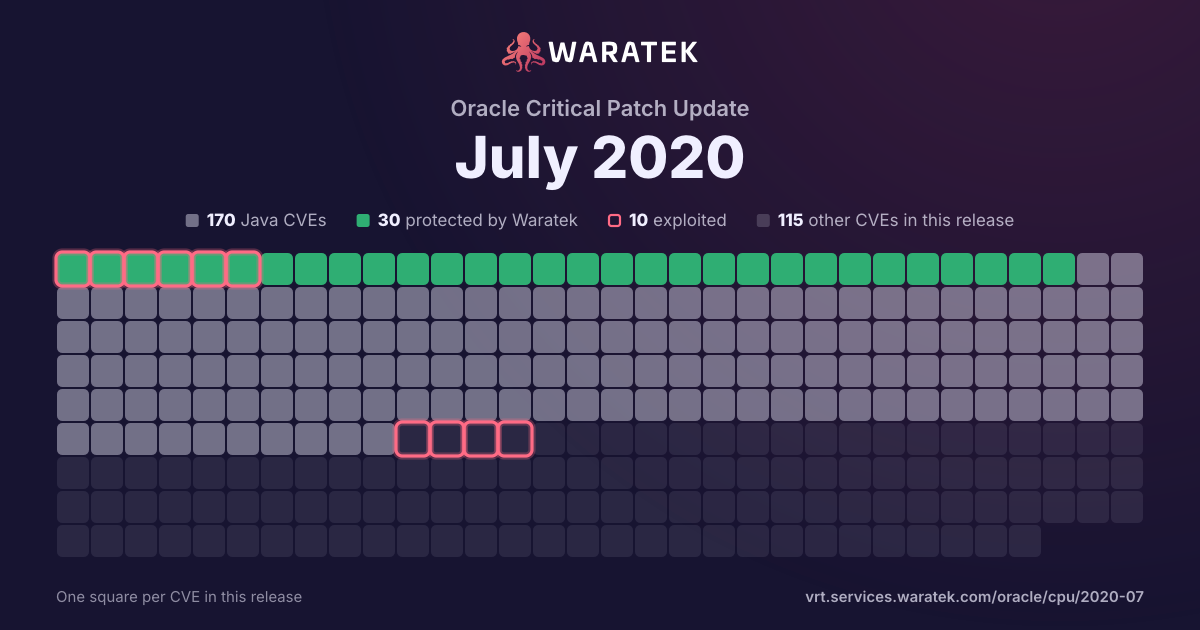
By status
30Protected by Waratek1Mitigation candidate139No exploit published68Outside Waratek scope47Not applicable
10Exploited, marked by the ring
No exploit published. For 126 of them, Oracle's security advisory is the source of public detail.
Protected by Waratek. Waratek RASP can block exploitation of these on systems that have not applied the patch yet.
Overview 14 matches · 5 exploited · 3 CISA KEV · 7 public PoC · 6 EPSS ≥ 0.5
Protected by Waratek
14
100.0%
Rule in development
0
0.0%
Mitigation candidate
0
0.0%
No exploit published
0
0.0%
blocked by ARMR today
14
100.0%
partly blocked
0
0.0%
not blocked
0
0.0%
not established
0
0.0%
unrecorded
0
0.0%
split by
peak 2 / quarter
Q4 162
Protected by Waratek2
Critical2
blocked by ARMR today2
No public exploit2
Q1 170
Q2 171
Protected by Waratek1
Critical1
blocked by ARMR today1
Working exploit published1
Q3 171
Protected by Waratek1
Critical1
blocked by ARMR today1
No public exploit1
Q4 172
Protected by Waratek2
Critical2
blocked by ARMR today2
Exploited1
No public exploit1
Q1 180
Q2 181
Protected by Waratek1
Critical1
blocked by ARMR today1
No public exploit1
Q3 180
Q4 180
Q1 190
Q2 191
Protected by Waratek1
Critical1
blocked by ARMR today1
Exploited1
Q3 191
Protected by Waratek1
Critical1
blocked by ARMR today1
No public exploit1
Q4 190
Q1 202
Protected by Waratek2
Critical2
blocked by ARMR today2
Exploited2
Q2 201
Protected by Waratek1
Critical1
blocked by ARMR today1
No public exploit1
Q3 202
Protected by Waratek2
Critical2
blocked by ARMR today2
Exploited1
Proof of concept only1
Q1 17Q3 17Q1 18Q3 18Q1 19Q3 19Q1 20Q3 20
| CVE | Severity | Published▾ | Status | Exploitation | Description |
|---|---|---|---|---|---|
| CVE-2020-14645 | Critical | 2020-07-15 | Protected by Waratek | Proof of concept only | Vulnerability in the Oracle WebLogic Server product of Oracle Fusion Middleware (component: Core). Supported versions that are affected are 10.3.6.0.0, 12.1.3.0.0, 12.2.1.3.0, 12.2.1.4.0 and 14.1.1.0.0. Easily exploitable vulnerability allows unauthenticated attacker with network access via IIOP, T3 to compromise Oracle WebLogic Server. Successful attacks of this vulnerability can result in takeover of Oracle WebLogic Server. CVSS 3.1 Base Score 9.8 (Confidentiality, Integrity and Availability impacts). CVSS Vector: (CVSS:3.1/AV:N/AC:L/PR:N/UI:N/S:U/C:H/I:H/A:H). |
| CVE-2020-14644 | Critical | 2020-07-15 | Protected by Waratek | Exploited | Vulnerability in the Oracle WebLogic Server product of Oracle Fusion Middleware (component: Core). Supported versions that are affected are 12.2.1.3.0, 12.2.1.4.0 and 14.1.1.0.0. Easily exploitable vulnerability allows unauthenticated attacker with network access via IIOP, T3 to compromise Oracle WebLogic Server. Successful attacks of this vulnerability can result in takeover of Oracle WebLogic Server. CVSS 3.1 Base Score 9.8 (Confidentiality, Integrity and Availability impacts). CVSS Vector: (CVSS:3.1/AV:N/AC:L/PR:N/UI:N/S:U/C:H/I:H/A:H). |
| CVE-2020-10683 | Critical | 2020-05-01 | Protected by Waratek | No public exploit | dom4j before 2.0.3 and 2.1.x before 2.1.3 allows external DTDs and External Entities by default, which might enable XXE attacks. However, there is popular external documentation from OWASP showing how to enable the safe, non-default behavior in any application that uses dom4j. |
| CVE-2020-1938 | Critical | 2020-02-24 | Protected by Waratek | Exploited | When using the Apache JServ Protocol (AJP), care must be taken when trusting incoming connections to Apache Tomcat. Tomcat treats AJP connections as having higher trust than, for example, a similar HTTP connection. If such connections are available to an attacker, they can be exploited in ways that may be surprising. In Apache Tomcat 9.0.0.M1 to 9.0.0.30, 8.5.0 to 8.5.50 and 7.0.0 to 7.0.99, Tomcat shipped with an AJP Connector enabled by default that listened on all configured IP addresses. It was expected (and recommended in the security guide) that this Connector would be disabled if not required. This vulnerability report identified a mechanism that allowed: - returning arbitrary files from anywhere in the web application - processing any file in the web application as a JSP Further, if the web application allowed file upload and stored those files within the web application (or the attacker was able to control the content of the web application by some other means) then this, along with the ability to process a file as a JSP, made remote code execution possible. It is important to note that mitigation is only required if an AJP port is accessible to untrusted users. Users wishing to take a defence-in-depth approach and block the vector that permits returning arbitrary files and execution as JSP may upgrade to Apache Tomcat 9.0.31, 8.5.51 or 7.0.100 or later. A number of changes were made to the default AJP Connector configuration in 9.0.31 to harden the default configuration. It is likely that users upgrading to 9.0.31, 8.5.51 or 7.0.100 or later will need to make small changes to their configurations. |
| CVE-2020-2555 | Critical | 2020-01-15 | Protected by Waratek | Exploited | Vulnerability in the Oracle Coherence product of Oracle Fusion Middleware (component: Caching,CacheStore,Invocation). Supported versions that are affected are 3.7.1.0, 12.1.3.0.0, 12.2.1.3.0 and 12.2.1.4.0. Easily exploitable vulnerability allows unauthenticated attacker with network access via T3 to compromise Oracle Coherence. Successful attacks of this vulnerability can result in takeover of Oracle Coherence. CVSS 3.0 Base Score 9.8 (Confidentiality, Integrity and Availability impacts). CVSS Vector: (CVSS:3.0/AV:N/AC:L/PR:N/UI:N/S:U/C:H/I:H/A:H). |
| CVE-2019-14379 | Critical | 2019-07-29 | Protected by Waratek | No public exploit | SubTypeValidator.java in FasterXML jackson-databind before 2.9.9.2 mishandles default typing when ehcache is used (because of net.sf.ehcache.transaction.manager.DefaultTransactionManagerLookup), leading to remote code execution. |
| CVE-2019-2729 | Critical | 2019-06-19 | Protected by Waratek | Exploited | Vulnerability in the Oracle WebLogic Server component of Oracle Fusion Middleware (subcomponent: Web Services). Supported versions that are affected are 10.3.6.0.0, 12.1.3.0.0 and 12.2.1.3.0. Easily exploitable vulnerability allows unauthenticated attacker with network access via HTTP to compromise Oracle WebLogic Server. Successful attacks of this vulnerability can result in takeover of Oracle WebLogic Server. CVSS 3.0 Base Score 9.8 (Confidentiality, Integrity and Availability impacts). CVSS Vector: (CVSS:3.0/AV:N/AC:L/PR:N/UI:N/S:U/C:H/I:H/A:H). |
| CVE-2018-8013 | Critical | 2018-05-24 | Protected by Waratek | No public exploit | In Apache Batik 1.x before 1.10, when deserializing subclass of `AbstractDocument`, the class takes a string from the inputStream as the class name which then use it to call the no-arg constructor of the class. Fix was to check the class type before calling newInstance in deserialization. |
| CVE-2017-15708 | Critical | 2017-12-11 | Protected by Waratek | No public exploit | In Apache Synapse, by default no authentication is required for Java Remote Method Invocation (RMI). So Apache Synapse 3.0.1 or all previous releases (3.0.0, 2.1.0, 2.0.0, 1.2, 1.1.2, 1.1.1) allows remote code execution attacks that can be performed by injecting specially crafted serialized objects. And the presence of Apache Commons Collections 3.2.1 (commons-collections-3.2.1.jar) or previous versions in Synapse distribution makes this exploitable. To mitigate the issue, we need to limit RMI access to trusted users only. Further upgrading to 3.0.1 version will eliminate the risk of having said Commons Collection version. In Synapse 3.0.1, Commons Collection has been updated to 3.2.2 version. |
| CVE-2015-7501 | Critical | 2017-11-09 | Protected by Waratek | Exploited | Red Hat JBoss A-MQ 6.x; BPM Suite (BPMS) 6.x; BRMS 6.x and 5.x; Data Grid (JDG) 6.x; Data Virtualization (JDV) 6.x and 5.x; Enterprise Application Platform 6.x, 5.x, and 4.3.x; Fuse 6.x; Fuse Service Works (FSW) 6.x; Operations Network (JBoss ON) 3.x; Portal 6.x; SOA Platform (SOA-P) 5.x; Web Server (JWS) 3.x; Red Hat OpenShift/xPAAS 3.x; and Red Hat Subscription Asset Manager 1.3 allow remote attackers to execute arbitrary commands via a crafted serialized Java object, related to the Apache Commons Collections (ACC) library. |
| CVE-2016-4000 | Critical | 2017-07-06 | Protected by Waratek | No public exploit | Jython before 2.7.1rc1 allows attackers to execute arbitrary code via a crafted serialized PyFunction object. |
| CVE-2017-5645 | Critical | 2017-04-17 | Protected by Waratek | Working exploit published | In Apache Log4j 2.x before 2.8.2, when using the TCP socket server or UDP socket server to receive serialized log events from another application, a specially crafted binary payload can be sent that, when deserialized, can execute arbitrary code. |
| CVE-2016-1000031 | Critical | 2016-10-25 | Protected by Waratek | No public exploit | Apache Commons FileUpload before 1.3.3 DiskFileItem File Manipulation Remote Code Execution |
| CVE-2016-5019 | Critical | 2016-10-03 | Protected by Waratek | No public exploit | CoreResponseStateManager in Apache MyFaces Trinidad 1.0.0 through 1.0.13, 1.2.x before 1.2.15, 2.0.x before 2.0.2, and 2.1.x before 2.1.2 might allow attackers to conduct deserialization attacks via a crafted serialized view state string. |