
Oracle Critical Patch Update July 2020
Released July 2020 · Oracle's advisory ↗ · ← Critical Patch Update, April 2020 · Critical Patch Update, October 2020 →
285 CVEs in this release, one square each
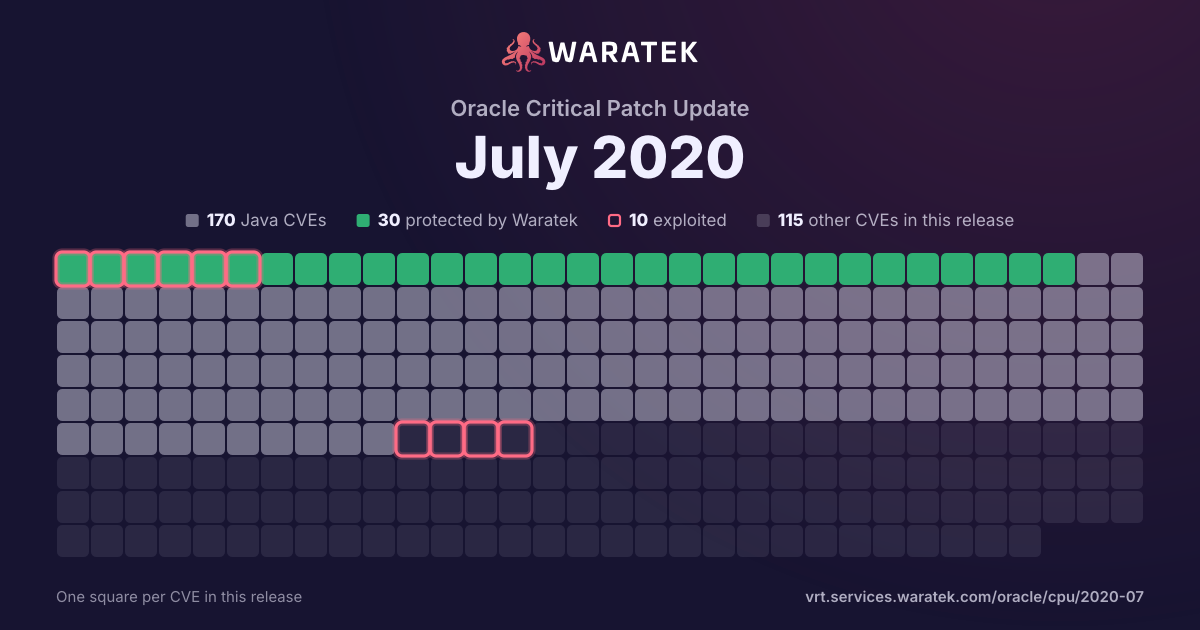
By status
30Protected by Waratek1Mitigation candidate139No exploit published68Outside Waratek scope47Not applicable
10Exploited, marked by the ring
No exploit published. For 126 of them, Oracle's security advisory is the source of public detail.
Protected by Waratek. Waratek RASP can block exploitation of these on systems that have not applied the patch yet.
Overview 27 matches · 5 protected · 0 exploited · 0 CISA KEV · 1 public PoC · 1 EPSS ≥ 0.5
Protected by Waratek
5
18.5%
Rule in development
0
0.0%
Mitigation candidate
0
0.0%
No exploit published
22
81.5%
blocked by ARMR today
5
18.5%
partly blocked
0
0.0%
not blocked
22
81.5%
not established
0
0.0%
unrecorded
0
0.0%
Exploited
0
0.0%
Working exploit published
1
3.7%
Proof of concept only
0
0.0%
Forecast only
0
0.0%
No public exploit
26
96.3%
split by
peak 17 / quarter
Q3 161
Protected by Waratek1
High1
blocked by ARMR today1
No public exploit1
Q4 160
Q1 170
Q2 170
Q3 170
Q4 170
Q1 181
No exploit published1
High1
not blocked1
No public exploit1
Q2 181
No exploit published1
High1
not blocked1
No public exploit1
Q3 180
Q4 180
Q1 191
No exploit published1
High1
not blocked1
No public exploit1
Q2 192
Protected by Waratek2
High2
blocked by ARMR today2
No public exploit2
Q3 192
Protected by Waratek1
No exploit published1
High2
blocked by ARMR today1
not blocked1
No public exploit2
Q4 191
No exploit published1
High1
not blocked1
No public exploit1
Q1 200
Q2 201
Protected by Waratek1
High1
blocked by ARMR today1
Working exploit published1
Q3 2017
No exploit published17
High17
not blocked17
No public exploit17
Q3 16Q1 17Q3 17Q1 18Q3 18Q1 19Q3 19Q1 20Q3 20
| CVE | Severity | Published▾ | Status | Exploitation | Description |
|---|---|---|---|---|---|
| CVE-2020-2967 | High | 2020-07-15 | No exploit published | No public exploit | Vulnerability in the Oracle WebLogic Server product of Oracle Fusion Middleware (component: Web Services). Supported versions that are affected are 10.3.6.0.0, 12.1.3.0.0, 12.2.1.3.0, 12.2.1.4.0 and 14.1.1.0.0. Easily exploitable vulnerability allows unauthenticated attacker with network access via IIOP, T3 to compromise Oracle WebLogic Server. Successful attacks of this vulnerability can result in unauthorized access to critical data or complete access to all Oracle WebLogic Server accessible data. CVSS 3.1 Base Score 7.5 (Confidentiality impacts). CVSS Vector: (CVSS:3.1/AV:N/AC:L/PR:N/UI:N/S:U/C:H/I:N/A:N). |
| CVE-2020-14723 | High | 2020-07-15 | No exploit published | No public exploit | Vulnerability in the Oracle Help Technologies product of Oracle Fusion Middleware (component: Web UIX). Supported versions that are affected are 11.1.1.9.0 and 12.2.1.3.0. Easily exploitable vulnerability allows unauthenticated attacker with network access via HTTP to compromise Oracle Help Technologies. Successful attacks require human interaction from a person other than the attacker and while the vulnerability is in Oracle Help Technologies, attacks may significantly impact additional products. Successful attacks of this vulnerability can result in unauthorized access to critical data or complete access to all Oracle Help Technologies accessible data as well as unauthorized update, insert or delete access to some of Oracle Help Technologies accessible data. CVSS 3.1 Base Score 8.2 (Confidentiality and Integrity impacts). CVSS Vector: (CVSS:3.1/AV:N/AC:L/PR:N/UI:R/S:C/C:H/I:L/A:N). |
| CVE-2020-14696 | High | 2020-07-15 | No exploit published | No public exploit | Vulnerability in the Oracle BI Publisher product of Oracle Fusion Middleware (component: Layout Templates). Supported versions that are affected are 11.1.1.9.0, 12.2.1.3.0 and 12.2.1.4.0. Easily exploitable vulnerability allows unauthenticated attacker with network access via HTTP to compromise Oracle BI Publisher. While the vulnerability is in Oracle BI Publisher, attacks may significantly impact additional products. Successful attacks of this vulnerability can result in unauthorized update, insert or delete access to some of Oracle BI Publisher accessible data as well as unauthorized read access to a subset of Oracle BI Publisher accessible data. CVSS 3.1 Base Score 7.2 (Confidentiality and Integrity impacts). CVSS Vector: (CVSS:3.1/AV:N/AC:L/PR:N/UI:N/S:C/C:L/I:L/A:N). |
| CVE-2020-14690 | High | 2020-07-15 | No exploit published | No public exploit | Vulnerability in the Oracle Business Intelligence Enterprise Edition product of Oracle Fusion Middleware (component: Analytics Actions). Supported versions that are affected are 5.5.0.0.0, 11.1.1.9.0, 12.2.1.3.0 and 12.2.1.4.0. Easily exploitable vulnerability allows unauthenticated attacker with network access via HTTP to compromise Oracle Business Intelligence Enterprise Edition. Successful attacks require human interaction from a person other than the attacker and while the vulnerability is in Oracle Business Intelligence Enterprise Edition, attacks may significantly impact additional products. Successful attacks of this vulnerability can result in unauthorized access to critical data or complete access to all Oracle Business Intelligence Enterprise Edition accessible data as well as unauthorized update, insert or delete access to some of Oracle Business Intelligence Enterprise Edition accessible data. CVSS 3.1 Base Score 8.2 (Confidentiality and Integrity impacts). CVSS Vector: (CVSS:3.1/AV:N/AC:L/PR:N/UI:R/S:C/C:H/I:L/A:N). |
| CVE-2020-14642 | High | 2020-07-15 | No exploit published | No public exploit | Vulnerability in the Oracle Coherence product of Oracle Fusion Middleware (component: CacheStore). Supported versions that are affected are 3.7.1.0, 12.1.3.0.0, 12.2.1.3.0, 12.2.1.4.0 and 14.1.1.0.0. Easily exploitable vulnerability allows unauthenticated attacker with network access via HTTP to compromise Oracle Coherence. Successful attacks of this vulnerability can result in unauthorized ability to cause a hang or frequently repeatable crash (complete DOS) of Oracle Coherence. CVSS 3.1 Base Score 7.5 (Availability impacts). CVSS Vector: (CVSS:3.1/AV:N/AC:L/PR:N/UI:N/S:U/C:N/I:N/A:H). |
| CVE-2020-14639 | High | 2020-07-15 | No exploit published | No public exploit | Vulnerability in the Oracle WebLogic Server product of Oracle Fusion Middleware (component: Sample apps). Supported versions that are affected are 12.1.3.0.0, 12.2.1.3.0, 12.2.1.4.0 and 14.1.1.0.0. Easily exploitable vulnerability allows unauthenticated attacker with network access via HTTP to compromise Oracle WebLogic Server. Successful attacks of this vulnerability can result in unauthorized access to critical data or complete access to all Oracle WebLogic Server accessible data. CVSS 3.1 Base Score 7.5 (Confidentiality impacts). CVSS Vector: (CVSS:3.1/AV:N/AC:L/PR:N/UI:N/S:U/C:H/I:N/A:N). |
| CVE-2020-14626 | High | 2020-07-15 | No exploit published | No public exploit | Vulnerability in the Oracle Business Intelligence Enterprise Edition product of Oracle Fusion Middleware (component: Analytics Web General). Supported versions that are affected are 5.5.0.0.0, 11.1.1.9.0, 12.2.1.3.0 and 12.2.1.4.0. Difficult to exploit vulnerability allows unauthenticated attacker with network access via HTTP to compromise Oracle Business Intelligence Enterprise Edition. Successful attacks of this vulnerability can result in takeover of Oracle Business Intelligence Enterprise Edition. CVSS 3.1 Base Score 8.1 (Confidentiality, Integrity and Availability impacts). CVSS Vector: (CVSS:3.1/AV:N/AC:H/PR:N/UI:N/S:U/C:H/I:H/A:H). |
| CVE-2020-14611 | High | 2020-07-15 | No exploit published | No public exploit | Vulnerability in the Oracle WebCenter Portal product of Oracle Fusion Middleware (component: Composer). Supported versions that are affected are 12.2.1.3.0 and 12.2.1.4.0. Easily exploitable vulnerability allows unauthenticated attacker with network access via HTTP to compromise Oracle WebCenter Portal. Successful attacks of this vulnerability can result in unauthorized creation, deletion or modification access to critical data or all Oracle WebCenter Portal accessible data as well as unauthorized read access to a subset of Oracle WebCenter Portal accessible data and unauthorized ability to cause a partial denial of service (partial DOS) of Oracle WebCenter Portal. CVSS 3.1 Base Score 8.6 (Confidentiality, Integrity and Availability impacts). CVSS Vector: (CVSS:3.1/AV:N/AC:L/PR:N/UI:N/S:U/C:L/I:H/A:L). |
| CVE-2020-14609 | High | 2020-07-15 | No exploit published | No public exploit | Vulnerability in the Oracle Business Intelligence Enterprise Edition product of Oracle Fusion Middleware (component: Analytics Web Answers). Supported versions that are affected are 5.5.0.0.0, 11.1.1.9.0, 12.2.1.3.0 and 12.2.1.4.0. Easily exploitable vulnerability allows unauthenticated attacker with network access via HTTP to compromise Oracle Business Intelligence Enterprise Edition. Successful attacks of this vulnerability can result in unauthorized access to critical data or complete access to all Oracle Business Intelligence Enterprise Edition accessible data as well as unauthorized update, insert or delete access to some of Oracle Business Intelligence Enterprise Edition accessible data and unauthorized ability to cause a partial denial of service (partial DOS) of Oracle Business Intelligence Enterprise Edition. CVSS 3.1 Base Score 8.6 (Confidentiality, Integrity and Availability impacts). CVSS Vector: (CVSS:3.1/AV:N/AC:L/PR:N/UI:N/S:U/C:H/I:L/A:L). |
| CVE-2020-14608 | High | 2020-07-15 | No exploit published | No public exploit | Vulnerability in the Oracle Fusion Middleware MapViewer product of Oracle Fusion Middleware (component: Tile Server). The supported version that is affected is 12.2.1.3.0. Easily exploitable vulnerability allows unauthenticated attacker with network access via HTTP to compromise Oracle Fusion Middleware MapViewer. Successful attacks of this vulnerability can result in unauthorized creation, deletion or modification access to critical data or all Oracle Fusion Middleware MapViewer accessible data as well as unauthorized read access to a subset of Oracle Fusion Middleware MapViewer accessible data. CVSS 3.1 Base Score 8.2 (Confidentiality and Integrity impacts). CVSS Vector: (CVSS:3.1/AV:N/AC:L/PR:N/UI:N/S:U/C:L/I:H/A:N). |
| CVE-2020-14589 | High | 2020-07-15 | No exploit published | No public exploit | Vulnerability in the Oracle WebLogic Server product of Oracle Fusion Middleware (component: Web Container). Supported versions that are affected are 10.3.6.0.0, 12.1.3.0.0, 12.2.1.3.0, 12.2.1.4.0 and 14.1.1.0.0. Easily exploitable vulnerability allows unauthenticated attacker with network access via HTTP to compromise Oracle WebLogic Server. Successful attacks of this vulnerability can result in unauthorized ability to cause a hang or frequently repeatable crash (complete DOS) of Oracle WebLogic Server. CVSS 3.1 Base Score 7.5 (Availability impacts). CVSS Vector: (CVSS:3.1/AV:N/AC:L/PR:N/UI:N/S:U/C:N/I:N/A:H). |
| CVE-2020-14588 | High | 2020-07-15 | No exploit published | No public exploit | Vulnerability in the Oracle WebLogic Server product of Oracle Fusion Middleware (component: Web Container). Supported versions that are affected are 10.3.6.0.0, 12.1.3.0.0, 12.2.1.3.0, 12.2.1.4.0 and 14.1.1.0.0. Easily exploitable vulnerability allows unauthenticated attacker with network access via HTTP to compromise Oracle WebLogic Server. Successful attacks of this vulnerability can result in unauthorized creation, deletion or modification access to critical data or all Oracle WebLogic Server accessible data as well as unauthorized read access to a subset of Oracle WebLogic Server accessible data. CVSS 3.1 Base Score 8.2 (Confidentiality and Integrity impacts). CVSS Vector: (CVSS:3.1/AV:N/AC:L/PR:N/UI:N/S:U/C:L/I:H/A:N). |
| CVE-2020-14585 | High | 2020-07-15 | No exploit published | No public exploit | Vulnerability in the Oracle BI Publisher product of Oracle Fusion Middleware (component: Mobile Service). Supported versions that are affected are 11.1.1.9.0, 12.2.1.3.0 and 12.2.1.4.0. Easily exploitable vulnerability allows unauthenticated attacker with network access via HTTP to compromise Oracle BI Publisher. Successful attacks require human interaction from a person other than the attacker and while the vulnerability is in Oracle BI Publisher, attacks may significantly impact additional products. Successful attacks of this vulnerability can result in unauthorized access to critical data or complete access to all Oracle BI Publisher accessible data as well as unauthorized update, insert or delete access to some of Oracle BI Publisher accessible data. CVSS 3.1 Base Score 8.2 (Confidentiality and Integrity impacts). CVSS Vector: (CVSS:3.1/AV:N/AC:L/PR:N/UI:R/S:C/C:H/I:L/A:N). |
| CVE-2020-14584 | High | 2020-07-15 | No exploit published | No public exploit | Vulnerability in the Oracle BI Publisher product of Oracle Fusion Middleware (component: BI Publisher Security). Supported versions that are affected are 12.2.1.3.0 and 12.2.1.4.0. Easily exploitable vulnerability allows unauthenticated attacker with network access via HTTP to compromise Oracle BI Publisher. Successful attacks require human interaction from a person other than the attacker and while the vulnerability is in Oracle BI Publisher, attacks may significantly impact additional products. Successful attacks of this vulnerability can result in unauthorized access to critical data or complete access to all Oracle BI Publisher accessible data as well as unauthorized update, insert or delete access to some of Oracle BI Publisher accessible data. CVSS 3.1 Base Score 8.2 (Confidentiality and Integrity impacts). CVSS Vector: (CVSS:3.1/AV:N/AC:L/PR:N/UI:R/S:C/C:H/I:L/A:N). |
| CVE-2020-14571 | High | 2020-07-15 | No exploit published | No public exploit | Vulnerability in the Oracle BI Publisher product of Oracle Fusion Middleware (component: Mobile Service). Supported versions that are affected are 11.1.1.9.0, 12.2.1.3.0 and 12.2.1.4.0. Easily exploitable vulnerability allows unauthenticated attacker with network access via HTTP to compromise Oracle BI Publisher. While the vulnerability is in Oracle BI Publisher, attacks may significantly impact additional products. Successful attacks of this vulnerability can result in unauthorized update, insert or delete access to some of Oracle BI Publisher accessible data as well as unauthorized read access to a subset of Oracle BI Publisher accessible data. CVSS 3.1 Base Score 7.2 (Confidentiality and Integrity impacts). CVSS Vector: (CVSS:3.1/AV:N/AC:L/PR:N/UI:N/S:C/C:L/I:L/A:N). |
| CVE-2020-14570 | High | 2020-07-15 | No exploit published | No public exploit | Vulnerability in the Oracle BI Publisher product of Oracle Fusion Middleware (component: Mobile Service). Supported versions that are affected are 11.1.1.9.0, 12.2.1.3.0 and 12.2.1.4.0. Easily exploitable vulnerability allows unauthenticated attacker with network access via HTTP to compromise Oracle BI Publisher. Successful attacks require human interaction from a person other than the attacker. Successful attacks of this vulnerability can result in unauthorized access to critical data or complete access to all Oracle BI Publisher accessible data as well as unauthorized update, insert or delete access to some of Oracle BI Publisher accessible data. CVSS 3.1 Base Score 7.1 (Confidentiality and Integrity impacts). CVSS Vector: (CVSS:3.1/AV:N/AC:L/PR:N/UI:R/S:U/C:H/I:L/A:N). |
| CVE-2020-14565 | High | 2020-07-15 | No exploit published | No public exploit | Vulnerability in the Oracle Unified Directory product of Oracle Fusion Middleware (component: Security). Supported versions that are affected are 11.1.2.3.0, 12.2.1.3.0 and 12.2.1.4.0. Easily exploitable vulnerability allows high privileged attacker with network access via HTTP to compromise Oracle Unified Directory. Successful attacks require human interaction from a person other than the attacker and while the vulnerability is in Oracle Unified Directory, attacks may significantly impact additional products. Successful attacks of this vulnerability can result in unauthorized creation, deletion or modification access to critical data or all Oracle Unified Directory accessible data and unauthorized ability to cause a hang or frequently repeatable crash (complete DOS) of Oracle Unified Directory. CVSS 3.1 Base Score 8.1 (Integrity and Availability impacts). CVSS Vector: (CVSS:3.1/AV:N/AC:L/PR:H/UI:R/S:C/C:N/I:H/A:H). |
| CVE-2020-9484 | High | 2020-05-20 | Protected by Waratek | Working exploit published | When using Apache Tomcat versions 10.0.0-M1 to 10.0.0-M4, 9.0.0.M1 to 9.0.34, 8.5.0 to 8.5.54 and 7.0.0 to 7.0.103 if a) an attacker is able to control the contents and name of a file on the server; and b) the server is configured to use the PersistenceManager with a FileStore; and c) the PersistenceManager is configured with sessionAttributeValueClassNameFilter="null" (the default unless a SecurityManager is used) or a sufficiently lax filter to allow the attacker provided object to be deserialized; and d) the attacker knows the relative file path from the storage location used by FileStore to the file the attacker has control over; then, using a specifically crafted request, the attacker will be able to trigger remote code execution via deserialization of the file under their control. Note that all of conditions a) to d) must be true for the attack to succeed. |
| CVE-2019-17359 | High | 2019-10-08 | No exploit published | No public exploit | The ASN.1 parser in Bouncy Castle Crypto (aka BC Java) 1.63 can trigger a large attempted memory allocation, and resultant OutOfMemoryError error, via crafted ASN.1 data. This is fixed in 1.64. |
| CVE-2019-12402 | High | 2019-08-30 | No exploit published | No public exploit | The file name encoding algorithm used internally in Apache Commons Compress 1.15 to 1.18 can get into an infinite loop when faced with specially crafted inputs. This can lead to a denial of service attack if an attacker can choose the file names inside of an archive created by Compress. |
| CVE-2019-10086 | High | 2019-08-20 | Protected by Waratek | No public exploit | In Apache Commons Beanutils 1.9.2, a special BeanIntrospector class was added which allows suppressing the ability for an attacker to access the classloader via the class property available on all Java objects. We, however were not using this by default characteristic of the PropertyUtilsBean. |
| CVE-2019-0188 | High | 2019-05-28 | Protected by Waratek | No public exploit | Apache Camel prior to 2.24.0 contains an XML external entity injection (XXE) vulnerability (CWE-611) due to using an outdated vulnerable JSON-lib library. This affects only the camel-xmljson component, which was removed. |
| CVE-2019-12086 | High | 2019-05-17 | Protected by Waratek | No public exploit | A Polymorphic Typing issue was discovered in FasterXML jackson-databind 2.x before 2.9.9. When Default Typing is enabled (either globally or for a specific property) for an externally exposed JSON endpoint, the service has the mysql-connector-java jar (8.0.14 or earlier) in the classpath, and an attacker can host a crafted MySQL server reachable by the victim, an attacker can send a crafted JSON message that allows them to read arbitrary local files on the server. This occurs because of missing com.mysql.cj.jdbc.admin.MiniAdmin validation. |
| CVE-2019-0222 | High | 2019-03-28 | No exploit published | No public exploit | In Apache ActiveMQ 5.0.0 - 5.15.8, unmarshalling corrupt MQTT frame can lead to broker Out of Memory exception making it unresponsive. |
| CVE-2018-1258 | High | 2018-05-11 | No exploit published | No public exploit | Spring Framework version 5.0.5 when used in combination with any versions of Spring Security contains an authorization bypass when using method security. An unauthorized malicious user can gain unauthorized access to methods that should be restricted. |
| CVE-2017-12626 | High | 2018-01-29 | No exploit published | No public exploit | Apache POI in versions prior to release 3.17 are vulnerable to Denial of Service Attacks: 1) Infinite Loops while parsing crafted WMF, EMF, MSG and macros (POI bugs 61338 and 61294), and 2) Out of Memory Exceptions while parsing crafted DOC, PPT and XLS (POI bugs 52372 and 61295). |
| CVE-2016-1181 | High | 2016-07-04 | Protected by Waratek | No public exploit | ActionServlet.java in Apache Struts 1 1.x through 1.3.10 mishandles multithreaded access to an ActionForm instance, which allows remote attackers to execute arbitrary code or cause a denial of service (unexpected memory access) via a multipart request, a related issue to CVE-2015-0899. |