
Oracle Critical Patch Update April 2020
Released April 2020 · Oracle's advisory ↗ · ← Critical Patch Update, January 2020 · Critical Patch Update, July 2020 →
300 CVEs in this release, one square each
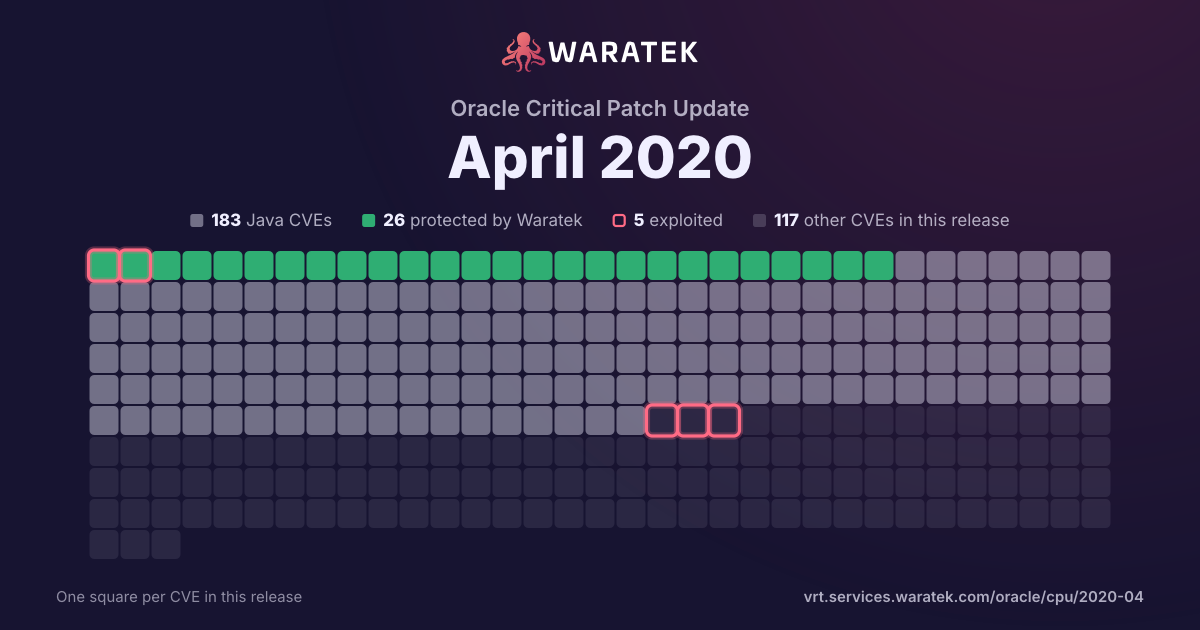
By status
28Protected by Waratek7Mitigation candidate166No exploit published6Outside Waratek scope92Not applicable1Withdrawn CVE
5Exploited, marked by the ring
No exploit published. For 145 of them, Oracle's security advisory is the source of public detail.
Protected by Waratek. Waratek RASP can block exploitation of these on systems that have not applied the patch yet.
Overview 17 matches · 11 in Waratek scope · 6 protected · 0 exploited · 0 CISA KEV · 0 public PoC · 0 EPSS ≥ 0.5
17matches
11in Waratek scope64.7%
6protected35.3%
0exploited0.0%
0CISA KEV0.0%
0public PoC0.0%
0EPSS ≥ 0.50.0%
Protected by Waratek
6
35.3%
Rule in development
0
0.0%
Mitigation candidate
0
0.0%
No exploit published
5
29.4%
Outside Waratek scope
0
0.0%
Not applicable
6
35.3%
Withdrawn CVE
0
0.0%
blocked by ARMR today
6
35.3%
partly blocked
0
0.0%
not blocked
11
64.7%
not established
0
0.0%
unrecorded
0
0.0%
Exploited
0
0.0%
Working exploit published
0
0.0%
Proof of concept only
0
0.0%
Forecast only
0
0.0%
No public exploit
17
100.0%
split by
peak 4 / quarter
Q1 151
Protected by Waratek1
High1
blocked by ARMR today1
No public exploit1
Q2 150
Q3 151
No exploit published1
Critical1
not blocked1
No public exploit1
Q4 151
No exploit published1
Medium1
not blocked1
No public exploit1
Q1 160
Q2 160
Q3 161
No exploit published1
High1
not blocked1
No public exploit1
Q4 162
Protected by Waratek2
Critical2
blocked by ARMR today2
No public exploit2
Q1 172
No exploit published1
Not applicable1
High1
Medium1
not blocked2
No public exploit2
Q2 171
Not applicable1
Critical1
not blocked1
No public exploit1
Q3 172
Protected by Waratek2
Critical1
Medium1
blocked by ARMR today2
No public exploit2
Q4 171
Not applicable1
Critical1
not blocked1
No public exploit1
Q1 184
No exploit published1
Not applicable3
High4
not blocked4
No public exploit4
Q2 181
Protected by Waratek1
Medium1
blocked by ARMR today1
No public exploit1
Q2 15Q4 15Q2 16Q4 16Q2 17Q4 17Q2 18
| CVE | Severity | Published▾ | Status | Exploitation | Description |
|---|---|---|---|---|---|
| CVE-2018-10237 | Medium | 2018-04-26 | Protected by Waratek | No public exploit | Unbounded memory allocation in Google Guava 11.0 through 24.x before 24.1.1 allows remote attackers to conduct denial of service attacks against servers that depend on this library and deserialize attacker-provided data, because the AtomicDoubleArray class (when serialized with Java serialization) and the CompoundOrdering class (when serialized with GWT serialization) perform eager allocation without appropriate checks on what a client has sent and whether the data size is reasonable. |
| CVE-2018-1165 | High | 2018-02-21 | Not applicable | No public exploit | This vulnerability allows local attackers to escalate privileges on vulnerable installations of Joyent SmartOS release-20170803-20170803T064301Z. An attacker must first obtain the ability to execute low-privileged code on the target system in order to exploit this vulnerability. The specific flaw exists within the SMB_IOC_SVCENUM IOCTL. The issue results from the lack of proper validation of the length of user-supplied data prior to copying it to a fixed-length, heap-based buffer. An attacker can leverage this vulnerability to execute code under the context of the host OS. Was ZDI-CAN-4983. |
| CVE-2017-5130 | High | 2018-02-07 | Not applicable | No public exploit | An integer overflow in xmlmemory.c in libxml2 before 2.9.5, as used in Google Chrome prior to 62.0.3202.62 and other products, allowed a remote attacker to potentially exploit heap corruption via a crafted XML file. |
| CVE-2017-3160 | High | 2018-02-01 | Not applicable | No public exploit | After the Android platform is added to Cordova the first time, or after a project is created using the build scripts, the scripts will fetch Gradle on the first build. However, since the default URI is not using https, it is vulnerable to a MiTM and the Gradle executable is not safe. The severity of this issue is high due to the fact that the build scripts immediately start a build after Gradle has been fetched. Developers who are concerned about this issue should install version 6.1.2 or higher of Cordova-Android. If developers are unable to install the latest version, this vulnerability can easily be mitigated by setting the CORDOVA_ANDROID_GRADLE_DISTRIBUTION_URL environment variable to https://services.gradle.org/distributions/gradle-2.14.1-all.zip |
| CVE-2017-12626 | High | 2018-01-29 | No exploit published | No public exploit | Apache POI in versions prior to release 3.17 are vulnerable to Denial of Service Attacks: 1) Infinite Loops while parsing crafted WMF, EMF, MSG and macros (POI bugs 61338 and 61294), and 2) Out of Memory Exceptions while parsing crafted DOC, PPT and XLS (POI bugs 52372 and 61295). |
| CVE-2017-5533 | Critical | 2017-11-15 | Not applicable | No public exploit | A vulnerability in the server content cache of TIBCO JasperReports Server, TIBCO JasperReports Server Community Edition, TIBCO JasperReports Server for ActiveMatrix BPM, TIBCO Jaspersoft for AWS with Multi-Tenancy, and TIBCO Jaspersoft Reporting and Analytics for AWS contains a vulnerability which fails to prevent remote access to all the contents of the web application, including key configuration files. Affected releases are TIBCO JasperReports Server 6.4.0, TIBCO JasperReports Server Community Edition 6.4.0, TIBCO JasperReports Server for ActiveMatrix BPM 6.4.0, TIBCO Jaspersoft for AWS with Multi-Tenancy 6.4.0, TIBCO Jaspersoft Reporting and Analytics for AWS 6.4.0. |
| CVE-2017-14735 | Medium | 2017-09-25 | Protected by Waratek | No public exploit | OWASP AntiSamy before 1.5.7 allows XSS via HTML5 entities, as demonstrated by use of : to construct a javascript: URL. |
| CVE-2016-4000 | Critical | 2017-07-06 | Protected by Waratek | No public exploit | Jython before 2.7.1rc1 allows attackers to execute arbitrary code via a crafted serialized PyFunction object. |
| CVE-2016-10328 | Critical | 2017-04-14 | Not applicable | No public exploit | FreeType 2 before 2016-12-16 has an out-of-bounds write caused by a heap-based buffer overflow related to the cff_parser_run function in cff/cffparse.c. |
| CVE-2016-7103 | Medium | 2017-03-15 | No exploit published | No public exploit | Cross-site scripting (XSS) vulnerability in jQuery UI before 1.12.0 might allow remote attackers to inject arbitrary web script or HTML via the closeText parameter of the dialog function. |
| CVE-2016-10251 | High | 2017-03-15 | Not applicable | No public exploit | Integer overflow in the jpc_pi_nextcprl function in jpc_t2cod.c in JasPer before 1.900.20 allows remote attackers to have unspecified impact via a crafted file, which triggers use of an uninitialized value. |
| CVE-2016-1000031 | Critical | 2016-10-25 | Protected by Waratek | No public exploit | Apache Commons FileUpload before 1.3.3 DiskFileItem File Manipulation Remote Code Execution |
| CVE-2015-1832 | Critical | 2016-10-03 | Protected by Waratek | No public exploit | XML external entity (XXE) vulnerability in the SqlXmlUtil code in Apache Derby before 10.12.1.1, when a Java Security Manager is not in place, allows context-dependent attackers to read arbitrary files or cause a denial of service (resource consumption) via vectors involving XmlVTI and the XML datatype. |
| CVE-2016-3092 | High | 2016-07-04 | No exploit published | No public exploit | The MultipartStream class in Apache Commons Fileupload before 1.3.2, as used in Apache Tomcat 7.x before 7.0.70, 8.x before 8.0.36, 8.5.x before 8.5.3, and 9.x before 9.0.0.M7 and other products, allows remote attackers to cause a denial of service (CPU consumption) via a long boundary string. |
| CVE-2015-7940 | Medium | 2015-11-09 | No exploit published | No public exploit | The Bouncy Castle Java library before 1.51 does not validate a point is withing the elliptic curve, which makes it easier for remote attackers to obtain private keys via a series of crafted elliptic curve Diffie Hellman (ECDH) key exchanges, aka an "invalid curve attack." |
| CVE-2015-3253 | Critical | 2015-08-13 | No exploit published | No public exploit | The MethodClosure class in runtime/MethodClosure.java in Apache Groovy 1.7.0 through 2.4.3 allows remote attackers to execute arbitrary code or cause a denial of service via a crafted serialized object. |
| CVE-2015-0254 | High | 2015-03-09 | Protected by Waratek | No public exploit | Apache Standard Taglibs before 1.2.3 allows remote attackers to execute arbitrary code or conduct external XML entity (XXE) attacks via a crafted XSLT extension in a (1) <x:parse> or (2) <x:transform> JSTL XML tag. |