
Oracle Critical Patch Update April 2020
Released April 2020 · Oracle's advisory ↗ · ← Critical Patch Update, January 2020 · Critical Patch Update, July 2020 →
300 CVEs in this release, one square each
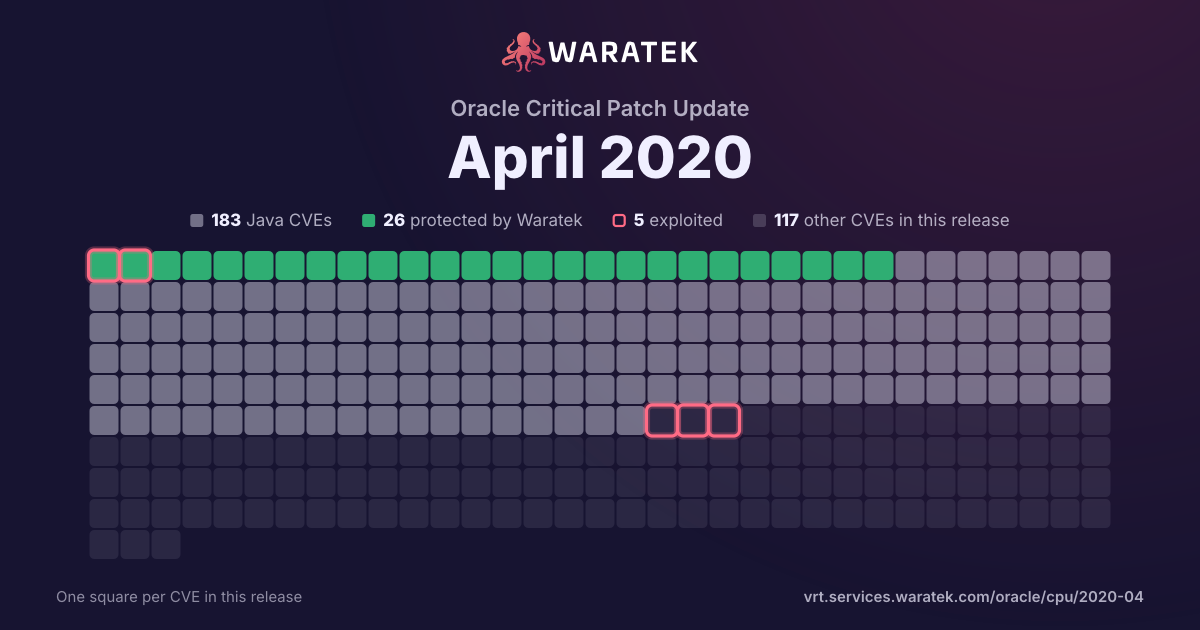
By status
26Protected by Waratek7Mitigation candidate168No exploit published6Outside Waratek scope92Not applicable1Withdrawn CVE
5Exploited, marked by the ring
No exploit published. For 145 of them, Oracle's security advisory is the source of public detail.
Protected by Waratek. Waratek RASP can block exploitation of these on systems that have not applied the patch yet.
Overview 9 matches · 4 protected · 1 exploited · 0 CISA KEV · 2 public PoC · 1 EPSS ≥ 0.5
Protected by Waratek
4
44.4%
Rule in development
0
0.0%
Mitigation candidate
1
11.1%
No exploit published
4
44.4%
blocked by ARMR today
4
44.4%
partly blocked
0
0.0%
not blocked
5
55.6%
not established
0
0.0%
unrecorded
0
0.0%
Exploited
1
11.1%
Working exploit published
1
11.1%
Proof of concept only
0
0.0%
Forecast only
0
0.0%
No public exploit
7
77.8%
split by
peak 2 / quarter
Q4 151
No exploit published1
Medium1
not blocked1
No public exploit1
Q1 160
Q2 160
Q3 161
No exploit published1
High1
not blocked1
No public exploit1
Q4 161
Protected by Waratek1
Critical1
blocked by ARMR today1
No public exploit1
Q1 170
Q2 171
Protected by Waratek1
Critical1
blocked by ARMR today1
Working exploit published1
Q3 172
Protected by Waratek2
Critical1
Medium1
blocked by ARMR today2
No public exploit2
Q4 170
Q1 182
Mitigation candidate1
No exploit published1
High1
Medium1
not blocked2
Exploited1
No public exploit1
Q2 181
No exploit published1
High1
not blocked1
No public exploit1
Q4 15Q1 16Q2 16Q3 16Q4 16Q1 17Q2 17Q3 17Q4 17Q1 18Q2 18
| CVE | Severity | Published▾ | Status | Exploitation | Description |
|---|---|---|---|---|---|
| CVE-2018-1258 | High | 2018-05-11 | No exploit published | No public exploit | Spring Framework version 5.0.5 when used in combination with any versions of Spring Security contains an authorization bypass when using method security. An unauthorized malicious user can gain unauthorized access to methods that should be restricted. |
| CVE-2017-12626 | High | 2018-01-29 | No exploit published | No public exploit | Apache POI in versions prior to release 3.17 are vulnerable to Denial of Service Attacks: 1) Infinite Loops while parsing crafted WMF, EMF, MSG and macros (POI bugs 61338 and 61294), and 2) Out of Memory Exceptions while parsing crafted DOC, PPT and XLS (POI bugs 52372 and 61295). |
| CVE-2015-9251 | Medium | 2018-01-18 | Mitigation candidate | Exploited | jQuery before 3.0.0 is vulnerable to Cross-site Scripting (XSS) attacks when a cross-domain Ajax request is performed without the dataType option, causing text/javascript responses to be executed. |
| CVE-2017-14735 | Medium | 2017-09-25 | Protected by Waratek | No public exploit | OWASP AntiSamy before 1.5.7 allows XSS via HTML5 entities, as demonstrated by use of : to construct a javascript: URL. |
| CVE-2016-4000 | Critical | 2017-07-06 | Protected by Waratek | No public exploit | Jython before 2.7.1rc1 allows attackers to execute arbitrary code via a crafted serialized PyFunction object. |
| CVE-2017-5645 | Critical | 2017-04-17 | Protected by Waratek | Working exploit published | In Apache Log4j 2.x before 2.8.2, when using the TCP socket server or UDP socket server to receive serialized log events from another application, a specially crafted binary payload can be sent that, when deserialized, can execute arbitrary code. |
| CVE-2016-1000031 | Critical | 2016-10-25 | Protected by Waratek | No public exploit | Apache Commons FileUpload before 1.3.3 DiskFileItem File Manipulation Remote Code Execution |
| CVE-2016-3092 | High | 2016-07-04 | No exploit published | No public exploit | The MultipartStream class in Apache Commons Fileupload before 1.3.2, as used in Apache Tomcat 7.x before 7.0.70, 8.x before 8.0.36, 8.5.x before 8.5.3, and 9.x before 9.0.0.M7 and other products, allows remote attackers to cause a denial of service (CPU consumption) via a long boundary string. |
| CVE-2015-7940 | Medium | 2015-11-09 | No exploit published | No public exploit | The Bouncy Castle Java library before 1.51 does not validate a point is withing the elliptic curve, which makes it easier for remote attackers to obtain private keys via a series of crafted elliptic curve Diffie Hellman (ECDH) key exchanges, aka an "invalid curve attack." |