
Oracle Critical Patch Update July 2019
Released July 2019 · Oracle's advisory ↗ · ← Critical Patch Update, April 2019 · Critical Patch Update, October 2019 →
207 CVEs in this release, one square each
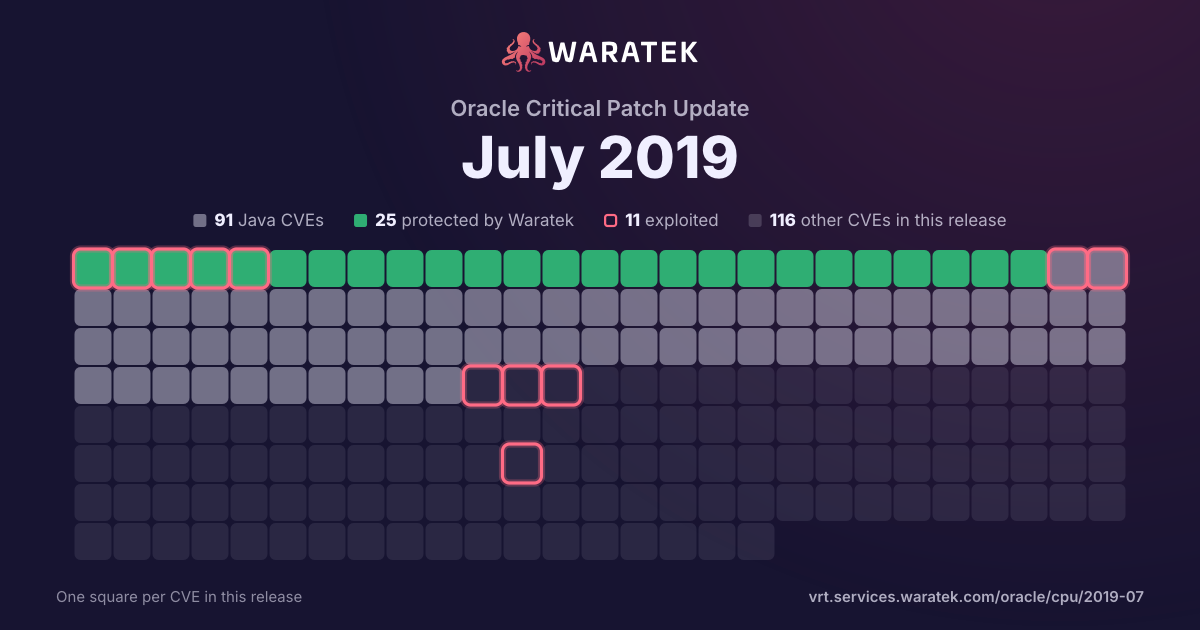
By status
25Protected by Waratek2Mitigation candidate64No exploit published55Outside Waratek scope61Not applicable
11Exploited, marked by the ring
No exploit published. For 58 of them, Oracle's security advisory is the source of public detail.
Protected by Waratek. Waratek RASP can block exploitation of these on systems that have not applied the patch yet.
Overview 207 matches · 91 in Waratek scope · 25 protected · 11 exploited · 2 CISA KEV · 14 public PoC · 13 EPSS ≥ 0.5
207matches
91in Waratek scope44.0%
25protected12.1%
11exploited5.3%
2CISA KEV1.0%
14public PoC6.8%
13EPSS ≥ 0.56.3%
Protected by Waratek
25
12.1%
Rule in development
0
0.0%
Mitigation candidate
2
1.0%
No exploit published
64
30.9%
Outside Waratek scope
55
26.6%
Not applicable
61
29.5%
Withdrawn CVE
0
0.0%
blocked by ARMR today
25
12.1%
partly blocked
0
0.0%
not blocked
181
87.4%
not established
1
0.5%
unrecorded
0
0.0%
split by
peak 157 / quarter
Q2 141
Protected by Waratek1
High1
blocked by ARMR today1
Exploited1
Q3 140
Q4 140
Q1 150
Q2 150
Q3 150
Q4 150
Q1 160
Q2 160
Q3 161
Protected by Waratek1
High1
blocked by ARMR today1
No public exploit1
Q4 161
Protected by Waratek1
Critical1
blocked by ARMR today1
No public exploit1
Q1 171
Outside Waratek scope1
Medium1
not blocked1
No public exploit1
Q2 172
Protected by Waratek1
Outside Waratek scope1
Critical1
High1
blocked by ARMR today1
not blocked1
Working exploit published1
No public exploit1
Q3 171
Protected by Waratek1
Medium1
blocked by ARMR today1
No public exploit1
Q4 172
Protected by Waratek1
Not applicable1
High1
Medium1
blocked by ARMR today1
not blocked1
No public exploit2
Q1 186
Protected by Waratek1
Outside Waratek scope5
Critical3
Medium3
blocked by ARMR today1
not blocked5
Exploited1
Working exploit published1
Proof of concept only1
No public exploit3
Q2 185
Protected by Waratek2
No exploit published2
Not applicable1
Critical2
High3
blocked by ARMR today2
not blocked3
Forecast only1
No public exploit4
Q3 184
No exploit published2
Outside Waratek scope1
Not applicable1
Critical1
High2
Medium1
not blocked4
No public exploit4
Q4 187
Protected by Waratek1
No exploit published1
Outside Waratek scope4
Not applicable1
Critical1
High1
Medium5
blocked by ARMR today1
not blocked6
Working exploit published1
No public exploit6
Q1 1910
Protected by Waratek4
No exploit published1
Outside Waratek scope2
Not applicable3
Critical3
High5
Medium2
blocked by ARMR today4
not blocked6
Exploited2
No public exploit8
Q2 199
Protected by Waratek4
No exploit published1
Outside Waratek scope2
Not applicable2
Critical3
High5
Medium1
blocked by ARMR today4
not blocked5
Exploited5
Forecast only1
No public exploit3
Q3 19157
Protected by Waratek7
Mitigation candidate2
No exploit published57
Outside Waratek scope39
Not applicable52
Critical3
High51
Medium84
Low19
blocked by ARMR today7
not blocked149
not established1
Exploited2
Working exploit published1
No public exploit154
Q3 14Q1 15Q3 15Q1 16Q3 16Q1 17Q3 17Q1 18Q3 18Q1 19Q3 19
| CVE | Severity | Published▾ | Status | Exploitation | Description |
|---|---|---|---|---|---|
| CVE-2017-14735 | Medium | 2017-09-25 | Protected by Waratek | No public exploit | OWASP AntiSamy before 1.5.7 allows XSS via HTML5 entities, as demonstrated by use of : to construct a javascript: URL. |
| CVE-2017-5664 | High | 2017-06-06 | Outside Waratek scope | No public exploit | The error page mechanism of the Java Servlet Specification requires that, when an error occurs and an error page is configured for the error that occurred, the original request and response are forwarded to the error page. This means that the request is presented to the error page with the original HTTP method. If the error page is a static file, expected behaviour is to serve content of the file as if processing a GET request, regardless of the actual HTTP method. The Default Servlet in Apache Tomcat 9.0.0.M1 to 9.0.0.M20, 8.5.0 to 8.5.14, 8.0.0.RC1 to 8.0.43 and 7.0.0 to 7.0.77 did not do this. Depending on the original request this could lead to unexpected and undesirable results for static error pages including, if the DefaultServlet is configured to permit writes, the replacement or removal of the custom error page. Notes for other user provided error pages: (1) Unless explicitly coded otherwise, JSPs ignore the HTTP method. JSPs used as error pages must must ensure that they handle any error dispatch as a GET request, regardless of the actual method. (2) By default, the response generated by a Servlet does depend on the HTTP method. Custom Servlets used as error pages must ensure that they handle any error dispatch as a GET request, regardless of the actual method. |
| CVE-2017-5645 | Critical | 2017-04-17 | Protected by Waratek | Working exploit published | In Apache Log4j 2.x before 2.8.2, when using the TCP socket server or UDP socket server to receive serialized log events from another application, a specially crafted binary payload can be sent that, when deserialized, can execute arbitrary code. |
| CVE-2016-7103 | Medium | 2017-03-15 | Outside Waratek scope | No public exploit | Cross-site scripting (XSS) vulnerability in jQuery UI before 1.12.0 might allow remote attackers to inject arbitrary web script or HTML via the closeText parameter of the dialog function. |
| CVE-2016-1000031 | Critical | 2016-10-25 | Protected by Waratek | No public exploit | Apache Commons FileUpload before 1.3.3 DiskFileItem File Manipulation Remote Code Execution |
| CVE-2016-1181 | High | 2016-07-04 | Protected by Waratek | No public exploit | ActionServlet.java in Apache Struts 1 1.x through 1.3.10 mishandles multithreaded access to an ActionForm instance, which allows remote attackers to execute arbitrary code or cause a denial of service (unexpected memory access) via a multipart request, a related issue to CVE-2015-0899. |
| CVE-2014-0114 | High | 2014-04-30 | Protected by Waratek | Exploited | Apache Commons BeanUtils, as distributed in lib/commons-beanutils-1.8.0.jar in Apache Struts 1.x through 1.3.10 and in other products requiring commons-beanutils through 1.9.2, does not suppress the class property, which allows remote attackers to "manipulate" the ClassLoader and execute arbitrary code via the class parameter, as demonstrated by the passing of this parameter to the getClass method of the ActionForm object in Struts 1. |