
Oracle Critical Patch Update July 2019
Released July 2019 · Oracle's advisory ↗ · ← Critical Patch Update, April 2019 · Critical Patch Update, October 2019 →
207 CVEs in this release, one square each
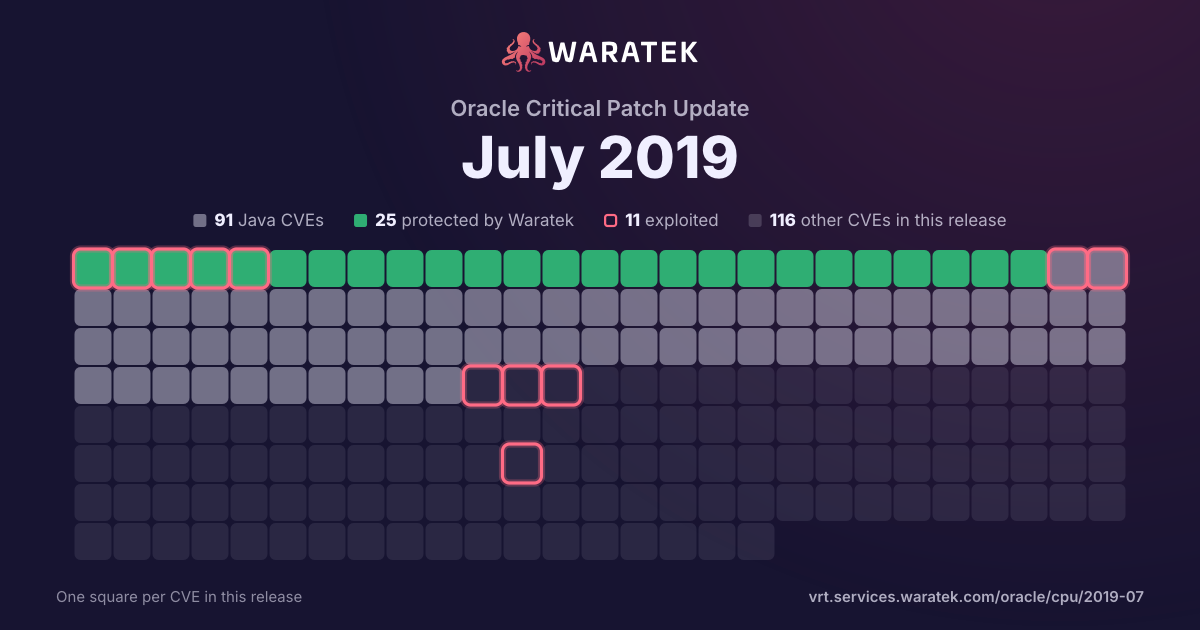
By status
25Protected by Waratek2Mitigation candidate64No exploit published55Outside Waratek scope61Not applicable
11Exploited, marked by the ring
No exploit published. For 58 of them, Oracle's security advisory is the source of public detail.
Protected by Waratek. Waratek RASP can block exploitation of these on systems that have not applied the patch yet.
Overview 23 matches · 10 protected · 3 exploited · 0 CISA KEV · 3 public PoC · 3 EPSS ≥ 0.5
Protected by Waratek
10
43.5%
Rule in development
0
0.0%
Mitigation candidate
2
8.7%
No exploit published
11
47.8%
blocked by ARMR today
10
43.5%
partly blocked
0
0.0%
not blocked
12
52.2%
not established
1
4.3%
unrecorded
0
0.0%
Exploited
3
13.0%
Working exploit published
1
4.3%
Proof of concept only
0
0.0%
Forecast only
1
4.3%
No public exploit
18
78.3%
split by
peak 9 / quarter
Q2 141
Protected by Waratek1
High1
blocked by ARMR today1
Exploited1
Q3 140
Q4 140
Q1 150
Q2 150
Q3 150
Q4 150
Q1 160
Q2 160
Q3 161
Protected by Waratek1
High1
blocked by ARMR today1
No public exploit1
Q4 161
Protected by Waratek1
Critical1
blocked by ARMR today1
No public exploit1
Q1 170
Q2 171
Protected by Waratek1
Critical1
blocked by ARMR today1
Working exploit published1
Q3 171
Protected by Waratek1
Medium1
blocked by ARMR today1
No public exploit1
Q4 170
Q1 181
Protected by Waratek1
Critical1
blocked by ARMR today1
No public exploit1
Q2 184
Protected by Waratek2
No exploit published2
Critical2
High2
blocked by ARMR today2
not blocked2
Forecast only1
No public exploit3
Q3 181
No exploit published1
High1
not blocked1
No public exploit1
Q4 180
Q1 192
Protected by Waratek1
No exploit published1
Critical1
High1
blocked by ARMR today1
not blocked1
No public exploit2
Q2 191
Protected by Waratek1
High1
blocked by ARMR today1
No public exploit1
Q3 199
Mitigation candidate2
No exploit published7
Critical1
High4
Medium4
not blocked8
not established1
Exploited2
No public exploit7
Q3 14Q1 15Q3 15Q1 16Q3 16Q1 17Q3 17Q1 18Q3 18Q1 19Q3 19
| CVE | Severity | Published▾ | Status | Exploitation | Description |
|---|---|---|---|---|---|
| CVE-2019-2858 | Medium | 2019-07-23 | No exploit published | No public exploit | Vulnerability in the Oracle Identity Manager component of Oracle Fusion Middleware (subcomponent: Advanced Console). Supported versions that are affected are 11.1.2.3.0 and 12.2.1.3.0. Easily exploitable vulnerability allows low privileged attacker with network access via HTTP to compromise Oracle Identity Manager. Successful attacks of this vulnerability can result in unauthorized update, insert or delete access to some of Oracle Identity Manager accessible data. CVSS 3.0 Base Score 4.3 (Integrity impacts). CVSS Vector: (CVSS:3.0/AV:N/AC:L/PR:L/UI:N/S:U/C:N/I:L/A:N). |
| CVE-2019-2856 | Critical | 2019-07-23 | No exploit published | No public exploit | Vulnerability in the Oracle WebLogic Server component of Oracle Fusion Middleware (subcomponent: Application Container - JavaEE). Supported versions that are affected is 12.2.1.3.0. Easily exploitable vulnerability allows unauthenticated attacker with network access via T3 to compromise Oracle WebLogic Server. Successful attacks of this vulnerability can result in takeover of Oracle WebLogic Server. CVSS 3.0 Base Score 9.8 (Confidentiality, Integrity and Availability impacts). CVSS Vector: (CVSS:3.0/AV:N/AC:L/PR:N/UI:N/S:U/C:H/I:H/A:H). |
| CVE-2019-2827 | Medium | 2019-07-23 | No exploit published | No public exploit | Vulnerability in the Oracle WebLogic Server component of Oracle Fusion Middleware (subcomponent: WLS Core Components). Supported versions that are affected are 10.3.6.0.0, 12.1.3.0.0 and 12.2.1.3.0. Easily exploitable vulnerability allows high privileged attacker with network access via HTTP to compromise Oracle WebLogic Server. Successful attacks of this vulnerability can result in unauthorized access to critical data or complete access to all Oracle WebLogic Server accessible data as well as unauthorized update, insert or delete access to some of Oracle WebLogic Server accessible data. CVSS 3.0 Base Score 5.5 (Confidentiality and Integrity impacts). CVSS Vector: (CVSS:3.0/AV:N/AC:L/PR:H/UI:N/S:U/C:H/I:L/A:N). |
| CVE-2019-2824 | Medium | 2019-07-23 | No exploit published | No public exploit | Vulnerability in the Oracle WebLogic Server component of Oracle Fusion Middleware (subcomponent: WLS Core Components). Supported versions that are affected are 10.3.6.0.0, 12.1.3.0.0 and 12.2.1.3.0. Easily exploitable vulnerability allows high privileged attacker with network access via HTTP to compromise Oracle WebLogic Server. Successful attacks of this vulnerability can result in unauthorized access to critical data or complete access to all Oracle WebLogic Server accessible data as well as unauthorized update, insert or delete access to some of Oracle WebLogic Server accessible data. CVSS 3.0 Base Score 5.5 (Confidentiality and Integrity impacts). CVSS Vector: (CVSS:3.0/AV:N/AC:L/PR:H/UI:N/S:U/C:H/I:L/A:N). |
| CVE-2019-2771 | High | 2019-07-23 | No exploit published | No public exploit | Vulnerability in the BI Publisher (formerly XML Publisher) component of Oracle Fusion Middleware (subcomponent: BI Publisher Security). Supported versions that are affected are 11.1.1.9.0 and 12.2.1.3.0. Easily exploitable vulnerability allows low privileged attacker with network access via HTTP to compromise BI Publisher (formerly XML Publisher). Successful attacks require human interaction from a person other than the attacker and while the vulnerability is in BI Publisher (formerly XML Publisher), attacks may significantly impact additional products. Successful attacks of this vulnerability can result in unauthorized creation, deletion or modification access to critical data or all BI Publisher (formerly XML Publisher) accessible data as well as unauthorized read access to a subset of BI Publisher (formerly XML Publisher) accessible data and unauthorized ability to cause a partial denial of service (partial DOS) of BI Publisher (formerly XML Publisher). CVSS 3.0 Base Score 8.2 (Confidentiality, Integrity and Availability impacts). CVSS Vector: (CVSS:3.0/AV:N/AC:L/PR:L/UI:R/S:C/C:L/I:H/A:L). |
| CVE-2019-2768 | High | 2019-07-23 | Mitigation candidate | Exploited | Vulnerability in the BI Publisher (formerly XML Publisher) component of Oracle Fusion Middleware (subcomponent: BI Publisher Security). The supported version that is affected is 11.1.1.9.0. Easily exploitable vulnerability allows unauthenticated attacker with network access via HTTP to compromise BI Publisher (formerly XML Publisher). Successful attacks of this vulnerability can result in unauthorized access to critical data or complete access to all BI Publisher (formerly XML Publisher) accessible data. CVSS 3.0 Base Score 7.5 (Confidentiality impacts). CVSS Vector: (CVSS:3.0/AV:N/AC:L/PR:N/UI:N/S:U/C:H/I:N/A:N). |
| CVE-2019-2767 | High | 2019-07-23 | Mitigation candidate | Exploited | Vulnerability in the BI Publisher (formerly XML Publisher) component of Oracle Fusion Middleware (subcomponent: BI Publisher Security). The supported version that is affected are 11.1.1.9.0, 12.2.1.3.0 and 12.2.1.4.0. Easily exploitable vulnerability allows unauthenticated attacker with network access via HTTP to compromise BI Publisher (formerly XML Publisher). While the vulnerability is in BI Publisher (formerly XML Publisher), attacks may significantly impact additional products. Successful attacks of this vulnerability can result in unauthorized update, insert or delete access to some of BI Publisher (formerly XML Publisher) accessible data as well as unauthorized read access to a subset of BI Publisher (formerly XML Publisher) accessible data. CVSS 3.0 Base Score 7.2 (Confidentiality and Integrity impacts). CVSS Vector: (CVSS:3.0/AV:N/AC:L/PR:N/UI:N/S:C/C:L/I:L/A:N). |
| CVE-2019-2751 | Medium | 2019-07-23 | No exploit published | No public exploit | Vulnerability in the Oracle HTTP Server component of Oracle Fusion Middleware (subcomponent: OHS Config MBeans). Supported versions that are affected are 12.1.3.0.0 and 12.2.1.3.0. Difficult to exploit vulnerability allows unauthenticated attacker with network access via HTTPS to compromise Oracle HTTP Server. Successful attacks of this vulnerability can result in unauthorized access to critical data or complete access to all Oracle HTTP Server accessible data. CVSS 3.0 Base Score 5.9 (Confidentiality impacts). CVSS Vector: (CVSS:3.0/AV:N/AC:H/PR:N/UI:N/S:U/C:H/I:N/A:N). |
| CVE-2019-2742 | High | 2019-07-23 | No exploit published | No public exploit | Vulnerability in the Oracle BI Publisher component of Oracle Fusion Middleware (subcomponent: Web Service API). The supported version that is affected is 11.1.1.9.0. Easily exploitable vulnerability allows unauthenticated attacker with network access via HTTP to compromise Oracle BI Publisher. While the vulnerability is in Oracle BI Publisher, attacks may significantly impact additional products. Successful attacks of this vulnerability can result in unauthorized update, insert or delete access to some of Oracle BI Publisher accessible data as well as unauthorized read access to a subset of Oracle BI Publisher accessible data. CVSS 3.0 Base Score 7.2 (Confidentiality and Integrity impacts). CVSS Vector: (CVSS:3.0/AV:N/AC:L/PR:N/UI:N/S:C/C:L/I:L/A:N). |
| CVE-2019-12086 | High | 2019-05-17 | Protected by Waratek | No public exploit | A Polymorphic Typing issue was discovered in FasterXML jackson-databind 2.x before 2.9.9. When Default Typing is enabled (either globally or for a specific property) for an externally exposed JSON endpoint, the service has the mysql-connector-java jar (8.0.14 or earlier) in the classpath, and an attacker can host a crafted MySQL server reachable by the victim, an attacker can send a crafted JSON message that allows them to read arbitrary local files on the server. This occurs because of missing com.mysql.cj.jdbc.admin.MiniAdmin validation. |
| CVE-2019-0222 | High | 2019-03-28 | No exploit published | No public exploit | In Apache ActiveMQ 5.0.0 - 5.15.8, unmarshalling corrupt MQTT frame can lead to broker Out of Memory exception making it unresponsive. |
| CVE-2018-19362 | Critical | 2019-01-02 | Protected by Waratek | No public exploit | FasterXML jackson-databind 2.x before 2.9.8 might allow attackers to have unspecified impact by leveraging failure to block the jboss-common-core class from polymorphic deserialization. |
| CVE-2018-11775 | High | 2018-09-10 | No exploit published | No public exploit | TLS hostname verification when using the Apache ActiveMQ Client before 5.15.6 was missing which could make the client vulnerable to a MITM attack between a Java application using the ActiveMQ client and the ActiveMQ server. This is now enabled by default. |
| CVE-2018-1000180 | High | 2018-06-05 | No exploit published | No public exploit | Bouncy Castle BC 1.54 - 1.59, BC-FJA 1.0.0, BC-FJA 1.0.1 and earlier have a flaw in the Low-level interface to RSA key pair generator, specifically RSA Key Pairs generated in low-level API with added certainty may have less M-R tests than expected. This appears to be fixed in versions BC 1.60 beta 4 and later, BC-FJA 1.0.2 and later. |
| CVE-2018-8013 | Critical | 2018-05-24 | Protected by Waratek | No public exploit | In Apache Batik 1.x before 1.10, when deserializing subclass of `AbstractDocument`, the class takes a string from the inputStream as the class name which then use it to call the no-arg constructor of the class. Fix was to check the class type before calling newInstance in deserialization. |
| CVE-2018-1258 | High | 2018-05-11 | No exploit published | No public exploit | Spring Framework version 5.0.5 when used in combination with any versions of Spring Security contains an authorization bypass when using method security. An unauthorized malicious user can gain unauthorized access to methods that should be restricted. |
| CVE-2018-1275 | Critical | 2018-04-11 | Protected by Waratek | Forecast only | Spring Framework, versions 5.0 prior to 5.0.5 and versions 4.3 prior to 4.3.16 and older unsupported versions, allow applications to expose STOMP over WebSocket endpoints with a simple, in-memory STOMP broker through the spring-messaging module. A malicious user (or attacker) can craft a message to the broker that can lead to a remote code execution attack. This CVE addresses the partial fix for CVE-2018-1270 in the 4.3.x branch of the Spring Framework. |
| CVE-2018-7489 | Critical | 2018-02-26 | Protected by Waratek | No public exploit | FasterXML jackson-databind before 2.7.9.3, 2.8.x before 2.8.11.1 and 2.9.x before 2.9.5 allows unauthenticated remote code execution because of an incomplete fix for the CVE-2017-7525 deserialization flaw. This is exploitable by sending maliciously crafted JSON input to the readValue method of the ObjectMapper, bypassing a blacklist that is ineffective if the c3p0 libraries are available in the classpath. |
| CVE-2017-14735 | Medium | 2017-09-25 | Protected by Waratek | No public exploit | OWASP AntiSamy before 1.5.7 allows XSS via HTML5 entities, as demonstrated by use of : to construct a javascript: URL. |
| CVE-2017-5645 | Critical | 2017-04-17 | Protected by Waratek | Working exploit published | In Apache Log4j 2.x before 2.8.2, when using the TCP socket server or UDP socket server to receive serialized log events from another application, a specially crafted binary payload can be sent that, when deserialized, can execute arbitrary code. |
| CVE-2016-1000031 | Critical | 2016-10-25 | Protected by Waratek | No public exploit | Apache Commons FileUpload before 1.3.3 DiskFileItem File Manipulation Remote Code Execution |
| CVE-2016-1181 | High | 2016-07-04 | Protected by Waratek | No public exploit | ActionServlet.java in Apache Struts 1 1.x through 1.3.10 mishandles multithreaded access to an ActionForm instance, which allows remote attackers to execute arbitrary code or cause a denial of service (unexpected memory access) via a multipart request, a related issue to CVE-2015-0899. |
| CVE-2014-0114 | High | 2014-04-30 | Protected by Waratek | Exploited | Apache Commons BeanUtils, as distributed in lib/commons-beanutils-1.8.0.jar in Apache Struts 1.x through 1.3.10 and in other products requiring commons-beanutils through 1.9.2, does not suppress the class property, which allows remote attackers to "manipulate" the ClassLoader and execute arbitrary code via the class parameter, as demonstrated by the passing of this parameter to the getClass method of the ActionForm object in Struts 1. |