
Oracle Critical Patch Update April 2019
Released April 2019 · Oracle's advisory ↗ · ← Critical Patch Update, January 2019 · Critical Patch Update, July 2019 →
207 CVEs in this release, one square each
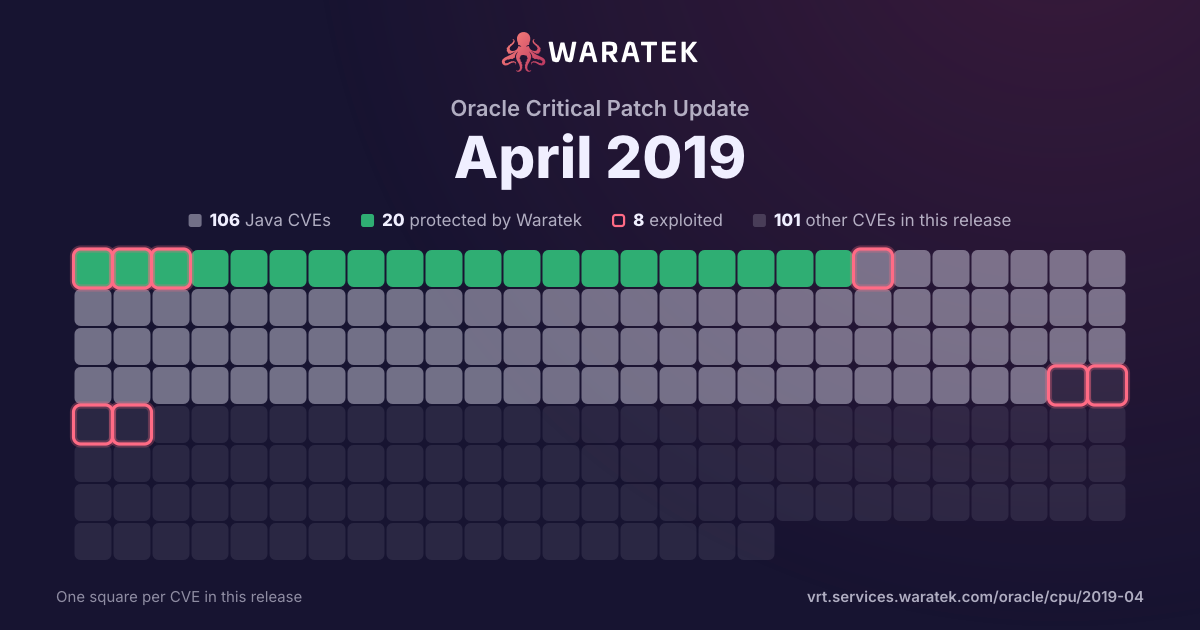
By status
20Protected by Waratek3Mitigation candidate83No exploit published58Outside Waratek scope43Not applicable
8Exploited, marked by the ring
No exploit published. For 80 of them, Oracle's security advisory is the source of public detail.
Protected by Waratek. Waratek RASP can block exploitation of these on systems that have not applied the patch yet.
Overview 77 matches · 53 in Waratek scope · 8 protected · 2 exploited · 1 CISA KEV · 7 public PoC · 3 EPSS ≥ 0.5
77matches
53in Waratek scope68.8%
8protected10.4%
2exploited2.6%
1CISA KEV1.3%
7public PoC9.1%
3EPSS ≥ 0.53.9%
Protected by Waratek
8
10.4%
Rule in development
0
0.0%
Mitigation candidate
1
1.3%
No exploit published
44
57.1%
Outside Waratek scope
8
10.4%
Not applicable
16
20.8%
Withdrawn CVE
0
0.0%
blocked by ARMR today
8
10.4%
partly blocked
0
0.0%
not blocked
69
89.6%
not established
0
0.0%
unrecorded
0
0.0%
split by
peak 62 / quarter
Q2 142
Protected by Waratek2
High2
blocked by ARMR today2
Exploited1
No public exploit1
Q3 140
Q4 140
Q1 150
Q2 150
Q3 150
Q4 150
Q1 160
Q2 160
Q3 162
Protected by Waratek1
Outside Waratek scope1
High2
blocked by ARMR today1
not blocked1
No public exploit2
Q4 160
Q1 170
Q2 171
Outside Waratek scope1
High1
not blocked1
No public exploit1
Q3 170
Q4 171
Not applicable1
High1
not blocked1
No public exploit1
Q1 180
Q2 183
No exploit published2
Not applicable1
High3
not blocked3
No public exploit3
Q3 183
Protected by Waratek2
No exploit published1
High3
blocked by ARMR today2
not blocked1
Proof of concept only1
No public exploit2
Q4 181
Outside Waratek scope1
High1
not blocked1
No public exploit1
Q1 192
Protected by Waratek1
Not applicable1
High2
blocked by ARMR today1
not blocked1
No public exploit2
Q2 1962
Protected by Waratek2
Mitigation candidate1
No exploit published41
Outside Waratek scope5
Not applicable13
High62
blocked by ARMR today2
not blocked60
Exploited1
Working exploit published4
No public exploit57
Q2 14Q4 14Q2 15Q4 15Q2 16Q4 16Q2 17Q4 17Q2 18Q4 18Q2 19
| CVE | Severity | Published▾ | Status | Exploitation | Description |
|---|---|---|---|---|---|
| CVE-2019-2723 | High | 2019-04-23 | Not applicable | No public exploit | Vulnerability in the Oracle VM VirtualBox component of Oracle Virtualization (subcomponent: Core). Supported versions that are affected are Prior to 5.2.28 and prior to 6.0.6. Easily exploitable vulnerability allows low privileged attacker with logon to the infrastructure where Oracle VM VirtualBox executes to compromise Oracle VM VirtualBox. While the vulnerability is in Oracle VM VirtualBox, attacks may significantly impact additional products. Successful attacks of this vulnerability can result in takeover of Oracle VM VirtualBox. CVSS 3.0 Base Score 8.8 (Confidentiality, Integrity and Availability impacts). CVSS Vector: (CVSS:3.0/AV:L/AC:L/PR:L/UI:N/S:C/C:H/I:H/A:H). |
| CVE-2019-2722 | High | 2019-04-23 | Not applicable | No public exploit | Vulnerability in the Oracle VM VirtualBox component of Oracle Virtualization (subcomponent: Core). Supported versions that are affected are Prior to 5.2.28 and prior to 6.0.6. Easily exploitable vulnerability allows low privileged attacker with logon to the infrastructure where Oracle VM VirtualBox executes to compromise Oracle VM VirtualBox. While the vulnerability is in Oracle VM VirtualBox, attacks may significantly impact additional products. Successful attacks of this vulnerability can result in takeover of Oracle VM VirtualBox. CVSS 3.0 Base Score 8.8 (Confidentiality, Integrity and Availability impacts). CVSS Vector: (CVSS:3.0/AV:L/AC:L/PR:L/UI:N/S:C/C:H/I:H/A:H). |
| CVE-2019-2721 | High | 2019-04-23 | Not applicable | Working exploit published | Vulnerability in the Oracle VM VirtualBox component of Oracle Virtualization (subcomponent: Core). Supported versions that are affected are Prior to 5.2.28 and prior to 6.0.6. Easily exploitable vulnerability allows low privileged attacker with logon to the infrastructure where Oracle VM VirtualBox executes to compromise Oracle VM VirtualBox. While the vulnerability is in Oracle VM VirtualBox, attacks may significantly impact additional products. Successful attacks of this vulnerability can result in takeover of Oracle VM VirtualBox. CVSS 3.0 Base Score 8.8 (Confidentiality, Integrity and Availability impacts). CVSS Vector: (CVSS:3.0/AV:L/AC:L/PR:L/UI:N/S:C/C:H/I:H/A:H). |
| CVE-2019-2706 | High | 2019-04-23 | No exploit published | No public exploit | Vulnerability in the Oracle Business Process Management Suite component of Oracle Fusion Middleware (subcomponent: BPM Foundation Services). The supported version that is affected is 11.1.1.9.0. Easily exploitable vulnerability allows unauthenticated attacker with network access via HTTP to compromise Oracle Business Process Management Suite. Successful attacks require human interaction from a person other than the attacker and while the vulnerability is in Oracle Business Process Management Suite, attacks may significantly impact additional products. Successful attacks of this vulnerability can result in unauthorized access to critical data or complete access to all Oracle Business Process Management Suite accessible data as well as unauthorized update, insert or delete access to some of Oracle Business Process Management Suite accessible data. CVSS 3.0 Base Score 8.2 (Confidentiality and Integrity impacts). CVSS Vector: (CVSS:3.0/AV:N/AC:L/PR:N/UI:R/S:C/C:H/I:L/A:N). |
| CVE-2019-2705 | High | 2019-04-23 | Not applicable | No public exploit | Vulnerability in the Oracle Outside In Technology component of Oracle Fusion Middleware (subcomponent: Outside In Filters). Supported versions that are affected are 8.5.3 and 8.5.4. Easily exploitable vulnerability allows unauthenticated attacker with network access via HTTP to compromise Oracle Outside In Technology. Successful attacks of this vulnerability can result in unauthorized ability to cause a hang or frequently repeatable crash (complete DOS) of Oracle Outside In Technology as well as unauthorized update, insert or delete access to some of Oracle Outside In Technology accessible data. Note: Outside In Technology is a suite of software development kits (SDKs). The protocol and CVSS score depend on the software that uses the Outside In Technology code. The CVSS score assumes that the software passes data received over a network directly to Outside In Technology code, but if data is not received over a network the CVSS score may be lower. CVSS 3.0 Base Score 8.2 (Integrity and Availability impacts). CVSS Vector: (CVSS:3.0/AV:N/AC:L/PR:N/UI:N/S:U/C:N/I:L/A:H). |
| CVE-2019-2703 | High | 2019-04-23 | Not applicable | No public exploit | Vulnerability in the Oracle VM VirtualBox component of Oracle Virtualization (subcomponent: Core). Supported versions that are affected are Prior to 5.2.28 and prior to 6.0.6. Easily exploitable vulnerability allows low privileged attacker with logon to the infrastructure where Oracle VM VirtualBox executes to compromise Oracle VM VirtualBox. While the vulnerability is in Oracle VM VirtualBox, attacks may significantly impact additional products. Successful attacks of this vulnerability can result in takeover of Oracle VM VirtualBox. CVSS 3.0 Base Score 8.8 (Confidentiality, Integrity and Availability impacts). CVSS Vector: (CVSS:3.0/AV:L/AC:L/PR:L/UI:N/S:C/C:H/I:H/A:H). |
| CVE-2019-2698 | High | 2019-04-23 | Outside Waratek scope | Working exploit published | Vulnerability in the Java SE component of Oracle Java SE (subcomponent: 2D). Supported versions that are affected are Java SE: 7u211 and 8u202. Difficult to exploit vulnerability allows unauthenticated attacker with network access via multiple protocols to compromise Java SE. Successful attacks of this vulnerability can result in takeover of Java SE. Note: This vulnerability applies to Java deployments, typically in clients running sandboxed Java Web Start applications or sandboxed Java applets (in Java SE 8), that load and run untrusted code (e.g., code that comes from the internet) and rely on the Java sandbox for security. This vulnerability does not apply to Java deployments, typically in servers, that load and run only trusted code (e.g., code installed by an administrator). CVSS 3.0 Base Score 8.1 (Confidentiality, Integrity and Availability impacts). CVSS Vector: (CVSS:3.0/AV:N/AC:H/PR:N/UI:N/S:U/C:H/I:H/A:H). |
| CVE-2019-2697 | High | 2019-04-23 | Outside Waratek scope | Working exploit published | Vulnerability in the Java SE component of Oracle Java SE (subcomponent: 2D). Supported versions that are affected are Java SE: 7u211 and 8u202. Difficult to exploit vulnerability allows unauthenticated attacker with network access via multiple protocols to compromise Java SE. Successful attacks of this vulnerability can result in takeover of Java SE. Note: This vulnerability applies to Java deployments, typically in clients running sandboxed Java Web Start applications or sandboxed Java applets (in Java SE 8), that load and run untrusted code (e.g., code that comes from the internet) and rely on the Java sandbox for security. This vulnerability does not apply to Java deployments, typically in servers, that load and run only trusted code (e.g., code installed by an administrator). CVSS 3.0 Base Score 8.1 (Confidentiality, Integrity and Availability impacts). CVSS Vector: (CVSS:3.0/AV:N/AC:H/PR:N/UI:N/S:U/C:H/I:H/A:H). |
| CVE-2019-2696 | High | 2019-04-23 | Not applicable | No public exploit | Vulnerability in the Oracle VM VirtualBox component of Oracle Virtualization (subcomponent: Core). Supported versions that are affected are Prior to 5.2.28 and prior to 6.0.6. Easily exploitable vulnerability allows low privileged attacker with logon to the infrastructure where Oracle VM VirtualBox executes to compromise Oracle VM VirtualBox. While the vulnerability is in Oracle VM VirtualBox, attacks may significantly impact additional products. Successful attacks of this vulnerability can result in takeover of Oracle VM VirtualBox. CVSS 3.0 Base Score 8.8 (Confidentiality, Integrity and Availability impacts). CVSS Vector: (CVSS:3.0/AV:L/AC:L/PR:L/UI:N/S:C/C:H/I:H/A:H). |
| CVE-2019-2690 | High | 2019-04-23 | Not applicable | No public exploit | Vulnerability in the Oracle VM VirtualBox component of Oracle Virtualization (subcomponent: Core). Supported versions that are affected are Prior to 5.2.28 and prior to 6.0.6. Difficult to exploit vulnerability allows low privileged attacker with logon to the infrastructure where Oracle VM VirtualBox executes to compromise Oracle VM VirtualBox. While the vulnerability is in Oracle VM VirtualBox, attacks may significantly impact additional products. Successful attacks of this vulnerability can result in takeover of Oracle VM VirtualBox. CVSS 3.0 Base Score 7.8 (Confidentiality, Integrity and Availability impacts). CVSS Vector: (CVSS:3.0/AV:L/AC:H/PR:L/UI:N/S:C/C:H/I:H/A:H). |
| CVE-2019-2682 | High | 2019-04-23 | No exploit published | No public exploit | Vulnerability in the Oracle Applications Framework component of Oracle E-Business Suite (subcomponent: Attachments / File Upload). Supported versions that are affected are 12.1.3, 12.2.3, 12.2.4, 12.2.5, 12.2.6, 12.2.7 and 12.2.8. Easily exploitable vulnerability allows unauthenticated attacker with network access via HTTP to compromise Oracle Applications Framework. Successful attacks require human interaction from a person other than the attacker and while the vulnerability is in Oracle Applications Framework, attacks may significantly impact additional products. Successful attacks of this vulnerability can result in unauthorized access to critical data or complete access to all Oracle Applications Framework accessible data as well as unauthorized update, insert or delete access to some of Oracle Applications Framework accessible data. CVSS 3.0 Base Score 8.2 (Confidentiality and Integrity impacts). CVSS Vector: (CVSS:3.0/AV:N/AC:L/PR:N/UI:R/S:C/C:H/I:L/A:N). |
| CVE-2019-2680 | High | 2019-04-23 | Not applicable | No public exploit | Vulnerability in the Oracle VM VirtualBox component of Oracle Virtualization (subcomponent: Core). Supported versions that are affected are Prior to 5.2.28 and prior to 6.0.6. Easily exploitable vulnerability allows low privileged attacker with logon to the infrastructure where Oracle VM VirtualBox executes to compromise Oracle VM VirtualBox. While the vulnerability is in Oracle VM VirtualBox, attacks may significantly impact additional products. Successful attacks of this vulnerability can result in takeover of Oracle VM VirtualBox. CVSS 3.0 Base Score 8.8 (Confidentiality, Integrity and Availability impacts). CVSS Vector: (CVSS:3.0/AV:L/AC:L/PR:L/UI:N/S:C/C:H/I:H/A:H). |
| CVE-2019-2679 | High | 2019-04-23 | Not applicable | No public exploit | Vulnerability in the Oracle VM VirtualBox component of Oracle Virtualization (subcomponent: Core). Supported versions that are affected are Prior to 5.2.28 and prior to 6.0.6. Easily exploitable vulnerability allows low privileged attacker with logon to the infrastructure where Oracle VM VirtualBox executes to compromise Oracle VM VirtualBox. While the vulnerability is in Oracle VM VirtualBox, attacks may significantly impact additional products. Successful attacks of this vulnerability can result in unauthorized ability to cause a hang or frequently repeatable crash (complete DOS) of Oracle VM VirtualBox and unauthorized read access to a subset of Oracle VM VirtualBox accessible data. CVSS 3.0 Base Score 7.3 (Confidentiality and Availability impacts). CVSS Vector: (CVSS:3.0/AV:L/AC:L/PR:L/UI:N/S:C/C:L/I:N/A:H). |
| CVE-2019-2677 | High | 2019-04-23 | No exploit published | No public exploit | Vulnerability in the Oracle Marketing component of Oracle E-Business Suite (subcomponent: Marketing Administration). Supported versions that are affected are 12.1.1, 12.1.2, 12.1.3, 12.2.3, 12.2.4, 12.2.5, 12.2.6, 12.2.7 and 12.2.8. Easily exploitable vulnerability allows unauthenticated attacker with network access via HTTP to compromise Oracle Marketing. Successful attacks require human interaction from a person other than the attacker and while the vulnerability is in Oracle Marketing, attacks may significantly impact additional products. Successful attacks of this vulnerability can result in unauthorized access to critical data or complete access to all Oracle Marketing accessible data as well as unauthorized update, insert or delete access to some of Oracle Marketing accessible data. CVSS 3.0 Base Score 8.2 (Confidentiality and Integrity impacts). CVSS Vector: (CVSS:3.0/AV:N/AC:L/PR:N/UI:R/S:C/C:H/I:L/A:N). |
| CVE-2019-2675 | High | 2019-04-23 | No exploit published | No public exploit | Vulnerability in the Oracle CRM Technical Foundation component of Oracle E-Business Suite (subcomponent: Preferences). Supported versions that are affected are 12.1.3, 12.2.3, 12.2.4, 12.2.5, 12.2.6, 12.2.7 and 12.2.8. Easily exploitable vulnerability allows unauthenticated attacker with network access via HTTP to compromise Oracle CRM Technical Foundation. Successful attacks require human interaction from a person other than the attacker and while the vulnerability is in Oracle CRM Technical Foundation, attacks may significantly impact additional products. Successful attacks of this vulnerability can result in unauthorized access to critical data or complete access to all Oracle CRM Technical Foundation accessible data as well as unauthorized update, insert or delete access to some of Oracle CRM Technical Foundation accessible data. CVSS 3.0 Base Score 8.2 (Confidentiality and Integrity impacts). CVSS Vector: (CVSS:3.0/AV:N/AC:L/PR:N/UI:R/S:C/C:H/I:L/A:N). |
| CVE-2019-2671 | High | 2019-04-23 | No exploit published | No public exploit | Vulnerability in the Oracle CRM Technical Foundation component of Oracle E-Business Suite (subcomponent: Preferences). Supported versions that are affected are 12.1.3, 12.2.3, 12.2.4, 12.2.5, 12.2.6, 12.2.7 and 12.2.8. Easily exploitable vulnerability allows unauthenticated attacker with network access via HTTP to compromise Oracle CRM Technical Foundation. Successful attacks require human interaction from a person other than the attacker and while the vulnerability is in Oracle CRM Technical Foundation, attacks may significantly impact additional products. Successful attacks of this vulnerability can result in unauthorized access to critical data or complete access to all Oracle CRM Technical Foundation accessible data as well as unauthorized update, insert or delete access to some of Oracle CRM Technical Foundation accessible data. CVSS 3.0 Base Score 8.2 (Confidentiality and Integrity impacts). CVSS Vector: (CVSS:3.0/AV:N/AC:L/PR:N/UI:R/S:C/C:H/I:L/A:N). |
| CVE-2019-2665 | High | 2019-04-23 | No exploit published | No public exploit | Vulnerability in the Oracle Common Applications component of Oracle E-Business Suite (subcomponent: CRM User Management Framework). Supported versions that are affected are 12.1.3, 12.2.3, 12.2.4, 12.2.5, 12.2.6, 12.2.7 and 12.2.8. Easily exploitable vulnerability allows unauthenticated attacker with network access via HTTP to compromise Oracle Common Applications. Successful attacks require human interaction from a person other than the attacker and while the vulnerability is in Oracle Common Applications, attacks may significantly impact additional products. Successful attacks of this vulnerability can result in unauthorized access to critical data or complete access to all Oracle Common Applications accessible data as well as unauthorized update, insert or delete access to some of Oracle Common Applications accessible data. CVSS 3.0 Base Score 8.2 (Confidentiality and Integrity impacts). CVSS Vector: (CVSS:3.0/AV:N/AC:L/PR:N/UI:R/S:C/C:H/I:L/A:N). |
| CVE-2019-2664 | High | 2019-04-23 | No exploit published | No public exploit | Vulnerability in the Oracle Marketing component of Oracle E-Business Suite (subcomponent: Marketing Administration). Supported versions that are affected are 12.1.1, 12.1.2, 12.1.3, 12.2.3, 12.2.4, 12.2.5, 12.2.6, 12.2.7 and 12.2.8. Easily exploitable vulnerability allows unauthenticated attacker with network access via HTTP to compromise Oracle Marketing. Successful attacks require human interaction from a person other than the attacker and while the vulnerability is in Oracle Marketing, attacks may significantly impact additional products. Successful attacks of this vulnerability can result in unauthorized access to critical data or complete access to all Oracle Marketing accessible data as well as unauthorized update, insert or delete access to some of Oracle Marketing accessible data. CVSS 3.0 Base Score 8.2 (Confidentiality and Integrity impacts). CVSS Vector: (CVSS:3.0/AV:N/AC:L/PR:N/UI:R/S:C/C:H/I:L/A:N). |
| CVE-2019-2663 | High | 2019-04-23 | No exploit published | No public exploit | Vulnerability in the Oracle Advanced Outbound Telephony component of Oracle E-Business Suite (subcomponent: User Interface). Supported versions that are affected are 12.1.1, 12.1.2, 12.1.3, 12.2.3, 12.2.4, 12.2.5, 12.2.6, 12.2.7 and 12.2.8. Easily exploitable vulnerability allows unauthenticated attacker with network access via HTTP to compromise Oracle Advanced Outbound Telephony. Successful attacks require human interaction from a person other than the attacker and while the vulnerability is in Oracle Advanced Outbound Telephony, attacks may significantly impact additional products. Successful attacks of this vulnerability can result in unauthorized access to critical data or complete access to all Oracle Advanced Outbound Telephony accessible data as well as unauthorized update, insert or delete access to some of Oracle Advanced Outbound Telephony accessible data. CVSS 3.0 Base Score 8.2 (Confidentiality and Integrity impacts). CVSS Vector: (CVSS:3.0/AV:N/AC:L/PR:N/UI:R/S:C/C:H/I:L/A:N). |
| CVE-2019-2662 | High | 2019-04-23 | No exploit published | No public exploit | Vulnerability in the Oracle Territory Management component of Oracle E-Business Suite (subcomponent: Territory Administration). Supported versions that are affected are 12.1.1, 12.1.2, 12.1.3, 12.2.3, 12.2.4, 12.2.5, 12.2.6, 12.2.7 and 12.2.8. Easily exploitable vulnerability allows unauthenticated attacker with network access via HTTP to compromise Oracle Territory Management. Successful attacks require human interaction from a person other than the attacker and while the vulnerability is in Oracle Territory Management, attacks may significantly impact additional products. Successful attacks of this vulnerability can result in unauthorized access to critical data or complete access to all Oracle Territory Management accessible data as well as unauthorized update, insert or delete access to some of Oracle Territory Management accessible data. CVSS 3.0 Base Score 8.2 (Confidentiality and Integrity impacts). CVSS Vector: (CVSS:3.0/AV:N/AC:L/PR:N/UI:R/S:C/C:H/I:L/A:N). |
| CVE-2019-2661 | High | 2019-04-23 | No exploit published | No public exploit | Vulnerability in the Oracle Email Center component of Oracle E-Business Suite (subcomponent: Message Display). Supported versions that are affected are 12.1.1, 12.1.2, 12.1.3, 12.2.3, 12.2.4, 12.2.5, 12.2.6, 12.2.7 and 12.2.8. Easily exploitable vulnerability allows unauthenticated attacker with network access via HTTP to compromise Oracle Email Center. Successful attacks require human interaction from a person other than the attacker and while the vulnerability is in Oracle Email Center, attacks may significantly impact additional products. Successful attacks of this vulnerability can result in unauthorized access to critical data or complete access to all Oracle Email Center accessible data as well as unauthorized update, insert or delete access to some of Oracle Email Center accessible data. CVSS 3.0 Base Score 8.2 (Confidentiality and Integrity impacts). CVSS Vector: (CVSS:3.0/AV:N/AC:L/PR:N/UI:R/S:C/C:H/I:L/A:N). |
| CVE-2019-2660 | High | 2019-04-23 | No exploit published | No public exploit | Vulnerability in the Oracle Knowledge Management component of Oracle E-Business Suite (subcomponent: Setup, Admin). Supported versions that are affected are 12.1.1, 12.1.2, 12.1.3, 12.2.3, 12.2.4, 12.2.5, 12.2.6, 12.2.7 and 12.2.8. Easily exploitable vulnerability allows unauthenticated attacker with network access via HTTP to compromise Oracle Knowledge Management. Successful attacks require human interaction from a person other than the attacker and while the vulnerability is in Oracle Knowledge Management, attacks may significantly impact additional products. Successful attacks of this vulnerability can result in unauthorized access to critical data or complete access to all Oracle Knowledge Management accessible data as well as unauthorized update, insert or delete access to some of Oracle Knowledge Management accessible data. CVSS 3.0 Base Score 8.2 (Confidentiality and Integrity impacts). CVSS Vector: (CVSS:3.0/AV:N/AC:L/PR:N/UI:R/S:C/C:H/I:L/A:N). |
| CVE-2019-2657 | High | 2019-04-23 | Not applicable | No public exploit | Vulnerability in the Oracle VM VirtualBox component of Oracle Virtualization (subcomponent: Core). Supported versions that are affected are Prior to 5.2.28 and prior to 6.0.6. Easily exploitable vulnerability allows low privileged attacker with logon to the infrastructure where Oracle VM VirtualBox executes to compromise Oracle VM VirtualBox. Successful attacks of this vulnerability can result in takeover of Oracle VM VirtualBox. CVSS 3.0 Base Score 7.8 (Confidentiality, Integrity and Availability impacts). CVSS Vector: (CVSS:3.0/AV:L/AC:L/PR:L/UI:N/S:U/C:H/I:H/A:H). |
| CVE-2019-2656 | High | 2019-04-23 | Not applicable | No public exploit | Vulnerability in the Oracle VM VirtualBox component of Oracle Virtualization (subcomponent: Core). Supported versions that are affected are Prior to 5.2.28 and prior to 6.0.6. Easily exploitable vulnerability allows low privileged attacker with logon to the infrastructure where Oracle VM VirtualBox executes to compromise Oracle VM VirtualBox. While the vulnerability is in Oracle VM VirtualBox, attacks may significantly impact additional products. Successful attacks of this vulnerability can result in takeover of Oracle VM VirtualBox. CVSS 3.0 Base Score 8.8 (Confidentiality, Integrity and Availability impacts). CVSS Vector: (CVSS:3.0/AV:L/AC:L/PR:L/UI:N/S:C/C:H/I:H/A:H). |
| CVE-2019-2655 | High | 2019-04-23 | No exploit published | No public exploit | Vulnerability in the Oracle Interaction Center Intelligence component of Oracle E-Business Suite (subcomponent: Business Intelligence (OLTP)). Supported versions that are affected are 12.1.1, 12.1.2 and 12.1.3. Easily exploitable vulnerability allows unauthenticated attacker with network access via HTTP to compromise Oracle Interaction Center Intelligence. Successful attacks require human interaction from a person other than the attacker and while the vulnerability is in Oracle Interaction Center Intelligence, attacks may significantly impact additional products. Successful attacks of this vulnerability can result in unauthorized access to critical data or complete access to all Oracle Interaction Center Intelligence accessible data as well as unauthorized update, insert or delete access to some of Oracle Interaction Center Intelligence accessible data. CVSS 3.0 Base Score 8.2 (Confidentiality and Integrity impacts). CVSS Vector: (CVSS:3.0/AV:N/AC:L/PR:N/UI:R/S:C/C:H/I:L/A:N). |
| CVE-2019-2654 | High | 2019-04-23 | No exploit published | No public exploit | Vulnerability in the Oracle One-to-One Fulfillment component of Oracle E-Business Suite (subcomponent: Print Server). Supported versions that are affected are 12.1.1, 12.1.2, 12.1.3, 12.2.3, 12.2.4, 12.2.5, 12.2.6, 12.2.7 and 12.2.8. Easily exploitable vulnerability allows unauthenticated attacker with network access via HTTP to compromise Oracle One-to-One Fulfillment. Successful attacks require human interaction from a person other than the attacker and while the vulnerability is in Oracle One-to-One Fulfillment, attacks may significantly impact additional products. Successful attacks of this vulnerability can result in unauthorized access to critical data or complete access to all Oracle One-to-One Fulfillment accessible data as well as unauthorized update, insert or delete access to some of Oracle One-to-One Fulfillment accessible data. CVSS 3.0 Base Score 8.2 (Confidentiality and Integrity impacts). CVSS Vector: (CVSS:3.0/AV:N/AC:L/PR:N/UI:R/S:C/C:H/I:L/A:N). |
| CVE-2019-2653 | High | 2019-04-23 | No exploit published | No public exploit | Vulnerability in the Oracle One-to-One Fulfillment component of Oracle E-Business Suite (subcomponent: Print Server). Supported versions that are affected are 12.1.1, 12.1.2, 12.1.3, 12.2.3, 12.2.4, 12.2.5, 12.2.6, 12.2.7 and 12.2.8. Easily exploitable vulnerability allows unauthenticated attacker with network access via HTTP to compromise Oracle One-to-One Fulfillment. Successful attacks require human interaction from a person other than the attacker and while the vulnerability is in Oracle One-to-One Fulfillment, attacks may significantly impact additional products. Successful attacks of this vulnerability can result in unauthorized access to critical data or complete access to all Oracle One-to-One Fulfillment accessible data as well as unauthorized update, insert or delete access to some of Oracle One-to-One Fulfillment accessible data. CVSS 3.0 Base Score 8.2 (Confidentiality and Integrity impacts). CVSS Vector: (CVSS:3.0/AV:N/AC:L/PR:N/UI:R/S:C/C:H/I:L/A:N). |
| CVE-2019-2652 | High | 2019-04-23 | No exploit published | No public exploit | Vulnerability in the Oracle iStore component of Oracle E-Business Suite (subcomponent: Shopping Cart). Supported versions that are affected are 12.1.1, 12.1.2, 12.1.3, 12.2.3, 12.2.4, 12.2.5, 12.2.6, 12.2.7 and 12.2.8. Easily exploitable vulnerability allows unauthenticated attacker with network access via HTTP to compromise Oracle iStore. Successful attacks require human interaction from a person other than the attacker and while the vulnerability is in Oracle iStore, attacks may significantly impact additional products. Successful attacks of this vulnerability can result in unauthorized access to critical data or complete access to all Oracle iStore accessible data as well as unauthorized update, insert or delete access to some of Oracle iStore accessible data. CVSS 3.0 Base Score 8.2 (Confidentiality and Integrity impacts). CVSS Vector: (CVSS:3.0/AV:N/AC:L/PR:N/UI:R/S:C/C:H/I:L/A:N). |
| CVE-2019-2651 | High | 2019-04-23 | No exploit published | No public exploit | Vulnerability in the Oracle Email Center component of Oracle E-Business Suite (subcomponent: Message Display). Supported versions that are affected are 12.1.1, 12.1.2, 12.1.3, 12.2.3, 12.2.4, 12.2.5, 12.2.6, 12.2.7 and 12.2.8. Easily exploitable vulnerability allows unauthenticated attacker with network access via HTTP to compromise Oracle Email Center. Successful attacks require human interaction from a person other than the attacker and while the vulnerability is in Oracle Email Center, attacks may significantly impact additional products. Successful attacks of this vulnerability can result in unauthorized access to critical data or complete access to all Oracle Email Center accessible data as well as unauthorized update, insert or delete access to some of Oracle Email Center accessible data. CVSS 3.0 Base Score 8.2 (Confidentiality and Integrity impacts). CVSS Vector: (CVSS:3.0/AV:N/AC:L/PR:N/UI:R/S:C/C:H/I:L/A:N). |
| CVE-2019-2650 | High | 2019-04-23 | No exploit published | No public exploit | Vulnerability in the Oracle WebLogic Server component of Oracle Fusion Middleware (subcomponent: WLS - Web Services). Supported versions that are affected are 10.3.6.0.0, 12.1.3.0.0 and 12.2.1.3.0. Easily exploitable vulnerability allows unauthenticated attacker with network access via HTTP to compromise Oracle WebLogic Server. Successful attacks of this vulnerability can result in unauthorized access to critical data or complete access to all Oracle WebLogic Server accessible data. CVSS 3.0 Base Score 7.5 (Confidentiality impacts). CVSS Vector: (CVSS:3.0/AV:N/AC:L/PR:N/UI:N/S:U/C:H/I:N/A:N). |
| CVE-2019-2649 | High | 2019-04-23 | No exploit published | No public exploit | Vulnerability in the Oracle WebLogic Server component of Oracle Fusion Middleware (subcomponent: WLS - Web Services). Supported versions that are affected are 10.3.6.0.0, 12.1.3.0.0 and 12.2.1.3.0. Easily exploitable vulnerability allows unauthenticated attacker with network access via HTTP to compromise Oracle WebLogic Server. Successful attacks of this vulnerability can result in unauthorized access to critical data or complete access to all Oracle WebLogic Server accessible data. CVSS 3.0 Base Score 7.5 (Confidentiality impacts). CVSS Vector: (CVSS:3.0/AV:N/AC:L/PR:N/UI:N/S:U/C:H/I:N/A:N). |
| CVE-2019-2648 | High | 2019-04-23 | No exploit published | No public exploit | Vulnerability in the Oracle WebLogic Server component of Oracle Fusion Middleware (subcomponent: WLS - Web Services). Supported versions that are affected are 10.3.6.0.0, 12.1.3.0.0 and 12.2.1.3.0. Easily exploitable vulnerability allows unauthenticated attacker with network access via HTTP to compromise Oracle WebLogic Server. Successful attacks of this vulnerability can result in unauthorized access to critical data or complete access to all Oracle WebLogic Server accessible data. CVSS 3.0 Base Score 7.5 (Confidentiality impacts). CVSS Vector: (CVSS:3.0/AV:N/AC:L/PR:N/UI:N/S:U/C:H/I:N/A:N). |
| CVE-2019-2647 | High | 2019-04-23 | No exploit published | No public exploit | Vulnerability in the Oracle WebLogic Server component of Oracle Fusion Middleware (subcomponent: WLS - Web Services). Supported versions that are affected are 10.3.6.0.0, 12.1.3.0.0 and 12.2.1.3.0. Easily exploitable vulnerability allows unauthenticated attacker with network access via HTTP to compromise Oracle WebLogic Server. Successful attacks of this vulnerability can result in unauthorized access to critical data or complete access to all Oracle WebLogic Server accessible data. CVSS 3.0 Base Score 7.5 (Confidentiality impacts). CVSS Vector: (CVSS:3.0/AV:N/AC:L/PR:N/UI:N/S:U/C:H/I:N/A:N). |
| CVE-2019-2643 | High | 2019-04-23 | No exploit published | No public exploit | Vulnerability in the Oracle Trade Management component of Oracle E-Business Suite (subcomponent: User Interface). Supported versions that are affected are 12.1.1, 12.1.2, 12.1.3, 12.2.3, 12.2.4, 12.2.5, 12.2.6, 12.2.7 and 12.2.8. Easily exploitable vulnerability allows unauthenticated attacker with network access via HTTP to compromise Oracle Trade Management. Successful attacks require human interaction from a person other than the attacker and while the vulnerability is in Oracle Trade Management, attacks may significantly impact additional products. Successful attacks of this vulnerability can result in unauthorized access to critical data or complete access to all Oracle Trade Management accessible data as well as unauthorized update, insert or delete access to some of Oracle Trade Management accessible data. CVSS 3.0 Base Score 8.2 (Confidentiality and Integrity impacts). CVSS Vector: (CVSS:3.0/AV:N/AC:L/PR:N/UI:R/S:C/C:H/I:L/A:N). |
| CVE-2019-2642 | High | 2019-04-23 | No exploit published | No public exploit | Vulnerability in the Oracle Trade Management component of Oracle E-Business Suite (subcomponent: User Interface). Supported versions that are affected are 12.1.1, 12.1.2, 12.1.3, 12.2.3, 12.2.4, 12.2.5, 12.2.6, 12.2.7 and 12.2.8. Easily exploitable vulnerability allows unauthenticated attacker with network access via HTTP to compromise Oracle Trade Management. Successful attacks require human interaction from a person other than the attacker and while the vulnerability is in Oracle Trade Management, attacks may significantly impact additional products. Successful attacks of this vulnerability can result in unauthorized access to critical data or complete access to all Oracle Trade Management accessible data as well as unauthorized update, insert or delete access to some of Oracle Trade Management accessible data. CVSS 3.0 Base Score 8.2 (Confidentiality and Integrity impacts). CVSS Vector: (CVSS:3.0/AV:N/AC:L/PR:N/UI:R/S:C/C:H/I:L/A:N). |
| CVE-2019-2641 | High | 2019-04-23 | No exploit published | No public exploit | Vulnerability in the Oracle Trade Management component of Oracle E-Business Suite (subcomponent: User Interface). Supported versions that are affected are 12.1.1, 12.1.2, 12.1.3, 12.2.3, 12.2.4, 12.2.5, 12.2.6, 12.2.7 and 12.2.8. Easily exploitable vulnerability allows unauthenticated attacker with network access via HTTP to compromise Oracle Trade Management. Successful attacks require human interaction from a person other than the attacker and while the vulnerability is in Oracle Trade Management, attacks may significantly impact additional products. Successful attacks of this vulnerability can result in unauthorized access to critical data or complete access to all Oracle Trade Management accessible data as well as unauthorized update, insert or delete access to some of Oracle Trade Management accessible data. CVSS 3.0 Base Score 8.2 (Confidentiality and Integrity impacts). CVSS Vector: (CVSS:3.0/AV:N/AC:L/PR:N/UI:R/S:C/C:H/I:L/A:N). |
| CVE-2019-2640 | High | 2019-04-23 | No exploit published | No public exploit | Vulnerability in the Oracle Trade Management component of Oracle E-Business Suite (subcomponent: User Interface). Supported versions that are affected are 12.1.1, 12.1.2, 12.1.3, 12.2.3, 12.2.4, 12.2.5, 12.2.6, 12.2.7 and 12.2.8. Easily exploitable vulnerability allows unauthenticated attacker with network access via HTTP to compromise Oracle Trade Management. Successful attacks require human interaction from a person other than the attacker and while the vulnerability is in Oracle Trade Management, attacks may significantly impact additional products. Successful attacks of this vulnerability can result in unauthorized access to critical data or complete access to all Oracle Trade Management accessible data as well as unauthorized update, insert or delete access to some of Oracle Trade Management accessible data. CVSS 3.0 Base Score 8.2 (Confidentiality and Integrity impacts). CVSS Vector: (CVSS:3.0/AV:N/AC:L/PR:N/UI:R/S:C/C:H/I:L/A:N). |
| CVE-2019-2639 | High | 2019-04-23 | No exploit published | No public exploit | Vulnerability in the Oracle CRM Technical Foundation component of Oracle E-Business Suite (subcomponent: Preferences). Supported versions that are affected are 12.1.3, 12.2.3, 12.2.4, 12.2.5, 12.2.6, 12.2.7 and 12.2.8. Easily exploitable vulnerability allows unauthenticated attacker with network access via HTTP to compromise Oracle CRM Technical Foundation. Successful attacks require human interaction from a person other than the attacker and while the vulnerability is in Oracle CRM Technical Foundation, attacks may significantly impact additional products. Successful attacks of this vulnerability can result in unauthorized access to critical data or complete access to all Oracle CRM Technical Foundation accessible data as well as unauthorized update, insert or delete access to some of Oracle CRM Technical Foundation accessible data. CVSS 3.0 Base Score 8.2 (Confidentiality and Integrity impacts). CVSS Vector: (CVSS:3.0/AV:N/AC:L/PR:N/UI:R/S:C/C:H/I:L/A:N). |
| CVE-2019-2632 | High | 2019-04-23 | Not applicable | No public exploit | Vulnerability in the MySQL Server component of Oracle MySQL (subcomponent: Server : Pluggable Auth). Supported versions that are affected are 5.7.25 and prior and 8.0.15 and prior. Easily exploitable vulnerability allows unauthenticated attacker with network access via multiple protocols to compromise MySQL Server. Successful attacks of this vulnerability can result in unauthorized access to critical data or complete access to all MySQL Server accessible data. CVSS 3.0 Base Score 7.5 (Confidentiality impacts). CVSS Vector: (CVSS:3.0/AV:N/AC:L/PR:N/UI:N/S:U/C:H/I:N/A:N). |
| CVE-2019-2619 | High | 2019-04-23 | Outside Waratek scope | No public exploit | Vulnerability in the Portable Clusterware component of Oracle Database Server. Supported versions that are affected are 11.2.0.4, 12.1.0.2, 12.2.0.1 and 18c. Easily exploitable vulnerability allows high privileged attacker having Grid Infrastructure User privilege with logon to the infrastructure where Portable Clusterware executes to compromise Portable Clusterware. While the vulnerability is in Portable Clusterware, attacks may significantly impact additional products. Successful attacks of this vulnerability can result in takeover of Portable Clusterware. CVSS 3.0 Base Score 8.2 (Confidentiality, Integrity and Availability impacts). CVSS Vector: (CVSS:3.0/AV:L/AC:L/PR:H/UI:N/S:C/C:H/I:H/A:H). |
| CVE-2019-2616 | High | 2019-04-23 | Protected by Waratek | Exploited | Vulnerability in the BI Publisher (formerly XML Publisher) component of Oracle Fusion Middleware (subcomponent: BI Publisher Security). Supported versions that are affected are 11.1.1.9.0, 12.2.1.3.0 and 12.2.1.4.0. Easily exploitable vulnerability allows unauthenticated attacker with network access via HTTP to compromise BI Publisher (formerly XML Publisher). While the vulnerability is in BI Publisher (formerly XML Publisher), attacks may significantly impact additional products. Successful attacks of this vulnerability can result in unauthorized update, insert or delete access to some of BI Publisher (formerly XML Publisher) accessible data as well as unauthorized read access to a subset of BI Publisher (formerly XML Publisher) accessible data. CVSS 3.0 Base Score 7.2 (Confidentiality and Integrity impacts). CVSS Vector: (CVSS:3.0/AV:N/AC:L/PR:N/UI:N/S:C/C:L/I:L/A:N). |
| CVE-2019-2608 | High | 2019-04-23 | Not applicable | No public exploit | Vulnerability in the Oracle Outside In Technology component of Oracle Fusion Middleware (subcomponent: Outside In Filters). Supported versions that are affected are 8.5.3 and 8.5.4. Easily exploitable vulnerability allows unauthenticated attacker with network access via HTTP to compromise Oracle Outside In Technology. Successful attacks of this vulnerability can result in unauthorized update, insert or delete access to some of Oracle Outside In Technology accessible data as well as unauthorized read access to a subset of Oracle Outside In Technology accessible data and unauthorized ability to cause a partial denial of service (partial DOS) of Oracle Outside In Technology. Note: Outside In Technology is a suite of software development kits (SDKs). The protocol and CVSS score depend on the software that uses the Outside In Technology code. The CVSS score assumes that the software passes data received over a network directly to Outside In Technology code, but if data is not received over a network the CVSS score may be lower. CVSS 3.0 Base Score 7.3 (Confidentiality, Integrity and Availability impacts). CVSS Vector: (CVSS:3.0/AV:N/AC:L/PR:N/UI:N/S:U/C:L/I:L/A:L). |
| CVE-2019-2604 | High | 2019-04-23 | No exploit published | No public exploit | Vulnerability in the Oracle Marketing component of Oracle E-Business Suite (subcomponent: Marketing Administration). Supported versions that are affected are 12.1.1, 12.1.2, 12.1.3, 12.2.3, 12.2.4, 12.2.5, 12.2.6, 12.2.7 and 12.2.8. Easily exploitable vulnerability allows unauthenticated attacker with network access via HTTP to compromise Oracle Marketing. Successful attacks require human interaction from a person other than the attacker and while the vulnerability is in Oracle Marketing, attacks may significantly impact additional products. Successful attacks of this vulnerability can result in unauthorized access to critical data or complete access to all Oracle Marketing accessible data as well as unauthorized update, insert or delete access to some of Oracle Marketing accessible data. CVSS 3.0 Base Score 8.2 (Confidentiality and Integrity impacts). CVSS Vector: (CVSS:3.0/AV:N/AC:L/PR:N/UI:R/S:C/C:H/I:L/A:N). |
| CVE-2019-2603 | High | 2019-04-23 | No exploit published | No public exploit | Vulnerability in the Oracle One-to-One Fulfillment component of Oracle E-Business Suite (subcomponent: Print Server). Supported versions that are affected are 12.1.1, 12.1.2, 12.1.3, 12.2.3, 12.2.4, 12.2.5, 12.2.6, 12.2.7 and 12.2.8. Easily exploitable vulnerability allows unauthenticated attacker with network access via HTTP to compromise Oracle One-to-One Fulfillment. Successful attacks require human interaction from a person other than the attacker and while the vulnerability is in Oracle One-to-One Fulfillment, attacks may significantly impact additional products. Successful attacks of this vulnerability can result in unauthorized access to critical data or complete access to all Oracle One-to-One Fulfillment accessible data as well as unauthorized update, insert or delete access to some of Oracle One-to-One Fulfillment accessible data. CVSS 3.0 Base Score 8.2 (Confidentiality and Integrity impacts). CVSS Vector: (CVSS:3.0/AV:N/AC:L/PR:N/UI:R/S:C/C:H/I:L/A:N). |
| CVE-2019-2602 | High | 2019-04-23 | Protected by Waratek | No public exploit | Vulnerability in the Java SE, Java SE Embedded component of Oracle Java SE (subcomponent: Libraries). Supported versions that are affected are Java SE: 7u211, 8u202, 11.0.2 and 12; Java SE Embedded: 8u201. Easily exploitable vulnerability allows unauthenticated attacker with network access via multiple protocols to compromise Java SE, Java SE Embedded. Successful attacks of this vulnerability can result in unauthorized ability to cause a hang or frequently repeatable crash (complete DOS) of Java SE, Java SE Embedded. Note: This vulnerability can only be exploited by supplying data to APIs in the specified Component without using Untrusted Java Web Start applications or Untrusted Java applets, such as through a web service. CVSS 3.0 Base Score 7.5 (Availability impacts). CVSS Vector: (CVSS:3.0/AV:N/AC:L/PR:N/UI:N/S:U/C:N/I:N/A:H). |
| CVE-2019-2601 | High | 2019-04-23 | No exploit published | No public exploit | Vulnerability in the BI Publisher (formerly XML Publisher) component of Oracle Fusion Middleware (subcomponent: BI Publisher Security). Supported versions that are affected are 11.1.1.9.0, 12.2.1.3.0 and 12.2.1.4.0. Easily exploitable vulnerability allows low privileged attacker with network access via HTTP to compromise BI Publisher (formerly XML Publisher). Successful attacks require human interaction from a person other than the attacker and while the vulnerability is in BI Publisher (formerly XML Publisher), attacks may significantly impact additional products. Successful attacks of this vulnerability can result in unauthorized access to critical data or complete access to all BI Publisher (formerly XML Publisher) accessible data as well as unauthorized update, insert or delete access to some of BI Publisher (formerly XML Publisher) accessible data. CVSS 3.0 Base Score 7.6 (Confidentiality and Integrity impacts). CVSS Vector: (CVSS:3.0/AV:N/AC:L/PR:L/UI:R/S:C/C:H/I:L/A:N). |
| CVE-2019-2600 | High | 2019-04-23 | No exploit published | No public exploit | Vulnerability in the Oracle Email Center component of Oracle E-Business Suite (subcomponent: Message Display). Supported versions that are affected are 12.1.1, 12.1.2, 12.1.3, 12.2.3, 12.2.4, 12.2.5, 12.2.6, 12.2.7 and 12.2.8. Easily exploitable vulnerability allows unauthenticated attacker with network access via HTTP to compromise Oracle Email Center. Successful attacks require human interaction from a person other than the attacker and while the vulnerability is in Oracle Email Center, attacks may significantly impact additional products. Successful attacks of this vulnerability can result in unauthorized access to critical data or complete access to all Oracle Email Center accessible data as well as unauthorized update, insert or delete access to some of Oracle Email Center accessible data. CVSS 3.0 Base Score 8.2 (Confidentiality and Integrity impacts). CVSS Vector: (CVSS:3.0/AV:N/AC:L/PR:N/UI:R/S:C/C:H/I:L/A:N). |
| CVE-2019-2598 | High | 2019-04-23 | No exploit published | No public exploit | Vulnerability in the PeopleSoft Enterprise PeopleTools component of Oracle PeopleSoft Products (subcomponent: SQR). Supported versions that are affected are 8.55, 8.56 and 8.57. Easily exploitable vulnerability allows high privileged attacker with network access via HTTP to compromise PeopleSoft Enterprise PeopleTools. While the vulnerability is in PeopleSoft Enterprise PeopleTools, attacks may significantly impact additional products. Successful attacks of this vulnerability can result in unauthorized creation, deletion or modification access to critical data or all PeopleSoft Enterprise PeopleTools accessible data as well as unauthorized access to critical data or complete access to all PeopleSoft Enterprise PeopleTools accessible data. CVSS 3.0 Base Score 8.7 (Confidentiality and Integrity impacts). CVSS Vector: (CVSS:3.0/AV:N/AC:L/PR:H/UI:N/S:C/C:H/I:H/A:N). |
| CVE-2019-2595 | High | 2019-04-23 | No exploit published | No public exploit | Vulnerability in the BI Publisher (formerly XML Publisher) component of Oracle Fusion Middleware (subcomponent: BI Publisher Security). Supported versions that are affected are 11.1.1.9.0, 12.2.1.3.0 and 12.2.1.4.0. Easily exploitable vulnerability allows unauthenticated attacker with network access via HTTP to compromise BI Publisher (formerly XML Publisher). Successful attacks require human interaction from a person other than the attacker and while the vulnerability is in BI Publisher (formerly XML Publisher), attacks may significantly impact additional products. Successful attacks of this vulnerability can result in unauthorized access to critical data or complete access to all BI Publisher (formerly XML Publisher) accessible data as well as unauthorized update, insert or delete access to some of BI Publisher (formerly XML Publisher) accessible data. CVSS 3.0 Base Score 8.2 (Confidentiality and Integrity impacts). CVSS Vector: (CVSS:3.0/AV:N/AC:L/PR:N/UI:R/S:C/C:H/I:L/A:N). |
| CVE-2019-2590 | High | 2019-04-23 | No exploit published | No public exploit | Vulnerability in the PeopleSoft Enterprise HCM Talent Acquisition Manager component of Oracle PeopleSoft Products (subcomponent: Job Opening). The supported version that is affected is 9.2. Easily exploitable vulnerability allows unauthenticated attacker with network access via HTTP to compromise PeopleSoft Enterprise HCM Talent Acquisition Manager. Successful attacks require human interaction from a person other than the attacker and while the vulnerability is in PeopleSoft Enterprise HCM Talent Acquisition Manager, attacks may significantly impact additional products. Successful attacks of this vulnerability can result in unauthorized access to critical data or complete access to all PeopleSoft Enterprise HCM Talent Acquisition Manager accessible data as well as unauthorized update, insert or delete access to some of PeopleSoft Enterprise HCM Talent Acquisition Manager accessible data. CVSS 3.0 Base Score 8.2 (Confidentiality and Integrity impacts). CVSS Vector: (CVSS:3.0/AV:N/AC:L/PR:N/UI:R/S:C/C:H/I:L/A:N). |
| CVE-2019-2583 | High | 2019-04-23 | No exploit published | No public exploit | Vulnerability in the Oracle iSupplier Portal component of Oracle E-Business Suite (subcomponent: Attachments). Supported versions that are affected are 12.1.3, 12.2.3, 12.2.4, 12.2.5, 12.2.6, 12.2.7 and 12.2.8. Easily exploitable vulnerability allows unauthenticated attacker with network access via HTTP to compromise Oracle iSupplier Portal. Successful attacks require human interaction from a person other than the attacker and while the vulnerability is in Oracle iSupplier Portal, attacks may significantly impact additional products. Successful attacks of this vulnerability can result in unauthorized access to critical data or complete access to all Oracle iSupplier Portal accessible data as well as unauthorized update, insert or delete access to some of Oracle iSupplier Portal accessible data. CVSS 3.0 Base Score 8.2 (Confidentiality and Integrity impacts). CVSS Vector: (CVSS:3.0/AV:N/AC:L/PR:N/UI:R/S:C/C:H/I:L/A:N). |
| CVE-2019-2578 | High | 2019-04-23 | Mitigation candidate | Working exploit published | Vulnerability in the Oracle WebCenter Sites component of Oracle Fusion Middleware (subcomponent: Advanced UI). The supported version that is affected is 12.2.1.3.0. Easily exploitable vulnerability allows unauthenticated attacker with network access via HTTP to compromise Oracle WebCenter Sites. While the vulnerability is in Oracle WebCenter Sites, attacks may significantly impact additional products. Successful attacks of this vulnerability can result in unauthorized access to critical data or complete access to all Oracle WebCenter Sites accessible data. CVSS 3.0 Base Score 8.6 (Confidentiality impacts). CVSS Vector: (CVSS:3.0/AV:N/AC:L/PR:N/UI:N/S:C/C:H/I:N/A:N). |
| CVE-2019-2567 | High | 2019-04-23 | No exploit published | No public exploit | Vulnerability in the Oracle Configurator component of Oracle Supply Chain Products Suite (subcomponent: Active Model Generation). Supported versions that are affected are 12.1 and 12.2. Easily exploitable vulnerability allows unauthenticated attacker with network access via HTTP to compromise Oracle Configurator. Successful attacks of this vulnerability can result in unauthorized access to critical data or complete access to all Oracle Configurator accessible data. CVSS 3.0 Base Score 7.5 (Confidentiality impacts). CVSS Vector: (CVSS:3.0/AV:N/AC:L/PR:N/UI:N/S:U/C:H/I:N/A:N). |
| CVE-2019-2565 | High | 2019-04-23 | No exploit published | No public exploit | Vulnerability in the JD Edwards World Technical Foundation component of Oracle JD Edwards Products (subcomponent: Service Enablement). Supported versions that are affected are A9.2, A9.3.1 and A9.4. Easily exploitable vulnerability allows unauthenticated attacker with network access via HTTP to compromise JD Edwards World Technical Foundation. Successful attacks of this vulnerability can result in unauthorized access to critical data or complete access to all JD Edwards World Technical Foundation accessible data. CVSS 3.0 Base Score 7.5 (Confidentiality impacts). CVSS Vector: (CVSS:3.0/AV:N/AC:L/PR:N/UI:N/S:U/C:H/I:N/A:N). |
| CVE-2019-2558 | High | 2019-04-23 | No exploit published | No public exploit | Vulnerability in the Oracle Retail Point-of-Service component of Oracle Retail Applications (subcomponent: Infrastructure). Supported versions that are affected are 13.4, 14.0 and 14.1. Easily exploitable vulnerability allows unauthenticated attacker with network access via HTTP to compromise Oracle Retail Point-of-Service. Successful attacks of this vulnerability can result in unauthorized update, insert or delete access to some of Oracle Retail Point-of-Service accessible data as well as unauthorized read access to a subset of Oracle Retail Point-of-Service accessible data and unauthorized ability to cause a partial denial of service (partial DOS) of Oracle Retail Point-of-Service. CVSS 3.0 Base Score 7.3 (Confidentiality, Integrity and Availability impacts). CVSS Vector: (CVSS:3.0/AV:N/AC:L/PR:N/UI:N/S:U/C:L/I:L/A:L). |
| CVE-2019-2551 | High | 2019-04-23 | No exploit published | No public exploit | Vulnerability in the Oracle One-to-One Fulfillment component of Oracle E-Business Suite (subcomponent: Print Server). Supported versions that are affected are 12.1.1, 12.1.2, 12.1.3, 12.2.3, 12.2.4, 12.2.5, 12.2.6, 12.2.7 and 12.2.8. Easily exploitable vulnerability allows unauthenticated attacker with network access via HTTP to compromise Oracle One-to-One Fulfillment. Successful attacks require human interaction from a person other than the attacker and while the vulnerability is in Oracle One-to-One Fulfillment, attacks may significantly impact additional products. Successful attacks of this vulnerability can result in unauthorized access to critical data or complete access to all Oracle One-to-One Fulfillment accessible data as well as unauthorized update, insert or delete access to some of Oracle One-to-One Fulfillment accessible data. CVSS 3.0 Base Score 8.2 (Confidentiality and Integrity impacts). CVSS Vector: (CVSS:3.0/AV:N/AC:L/PR:N/UI:R/S:C/C:H/I:L/A:N). |
| CVE-2019-2518 | High | 2019-04-23 | Outside Waratek scope | No public exploit | Vulnerability in the Java VM component of Oracle Database Server. Supported versions that are affected are 11.2.0.4, 12.1.0.2, 12.2.0.1, 18c and 19c. Difficult to exploit vulnerability allows low privileged attacker having Create Session, Create Procedure privilege with network access via multiple protocols to compromise Java VM. Successful attacks of this vulnerability can result in takeover of Java VM. CVSS 3.0 Base Score 7.5 (Confidentiality, Integrity and Availability impacts). CVSS Vector: (CVSS:3.0/AV:N/AC:H/PR:L/UI:N/S:U/C:H/I:H/A:H). |
| CVE-2019-2516 | High | 2019-04-23 | Outside Waratek scope | No public exploit | Vulnerability in the Portable Clusterware component of Oracle Database Server. Supported versions that are affected are 11.2.0.4, 12.1.0.2, 12.2.0.1 and 18c. Easily exploitable vulnerability allows high privileged attacker having Grid Infrastructure User privilege with logon to the infrastructure where Portable Clusterware executes to compromise Portable Clusterware. While the vulnerability is in Portable Clusterware, attacks may significantly impact additional products. Successful attacks of this vulnerability can result in takeover of Portable Clusterware. CVSS 3.0 Base Score 8.2 (Confidentiality, Integrity and Availability impacts). CVSS Vector: (CVSS:3.0/AV:L/AC:L/PR:H/UI:N/S:C/C:H/I:H/A:H). |
| CVE-2019-2424 | High | 2019-04-23 | No exploit published | No public exploit | Vulnerability in the Oracle Retail Convenience Store Back Office component of Oracle Retail Applications (subcomponent: Level 3 Maintenance Functions). The supported version that is affected is 3.6. Easily exploitable vulnerability allows unauthenticated attacker with network access via HTTP to compromise Oracle Retail Convenience Store Back Office. Successful attacks of this vulnerability can result in unauthorized update, insert or delete access to some of Oracle Retail Convenience Store Back Office accessible data as well as unauthorized read access to a subset of Oracle Retail Convenience Store Back Office accessible data and unauthorized ability to cause a partial denial of service (partial DOS) of Oracle Retail Convenience Store Back Office. CVSS 3.0 Base Score 7.3 (Confidentiality, Integrity and Availability impacts). CVSS Vector: (CVSS:3.0/AV:N/AC:L/PR:N/UI:N/S:U/C:L/I:L/A:L). |
| CVE-2018-3314 | High | 2019-04-23 | No exploit published | No public exploit | Vulnerability in the MICROS Relate CRM Software component of Oracle Retail Applications (subcomponent: Customer). The supported version that is affected is 11.4. Difficult to exploit vulnerability allows low privileged attacker with network access via HTTP to compromise MICROS Relate CRM Software. While the vulnerability is in MICROS Relate CRM Software, attacks may significantly impact additional products. Successful attacks of this vulnerability can result in unauthorized creation, deletion or modification access to critical data or all MICROS Relate CRM Software accessible data as well as unauthorized access to critical data or complete access to all MICROS Relate CRM Software accessible data. CVSS 3.0 Base Score 8.2 (Confidentiality and Integrity impacts). CVSS Vector: (CVSS:3.0/AV:N/AC:H/PR:L/UI:N/S:C/C:H/I:H/A:N). |
| CVE-2018-3120 | High | 2019-04-23 | No exploit published | No public exploit | Vulnerability in the MICROS Lucas component of Oracle Retail Applications (subcomponent: Security). Supported versions that are affected are 2.9.5.6 and 2.9.5.7. Difficult to exploit vulnerability allows low privileged attacker with network access via HTTP to compromise MICROS Lucas. Successful attacks of this vulnerability can result in takeover of MICROS Lucas. CVSS 3.0 Base Score 7.5 (Confidentiality, Integrity and Availability impacts). CVSS Vector: (CVSS:3.0/AV:N/AC:H/PR:L/UI:N/S:U/C:H/I:H/A:H). |
| CVE-2018-2880 | High | 2019-04-23 | No exploit published | No public exploit | Vulnerability in the MICROS Retail-J component of Oracle Retail Applications (subcomponent: Back Office). The supported version that is affected is 12.1.2. Easily exploitable vulnerability allows unauthenticated attacker with network access via HTTP to compromise MICROS Retail-J. Successful attacks of this vulnerability can result in unauthorized access to critical data or complete access to all MICROS Retail-J accessible data. CVSS 3.0 Base Score 7.5 (Confidentiality impacts). CVSS Vector: (CVSS:3.0/AV:N/AC:L/PR:N/UI:N/S:U/C:H/I:N/A:N). |
| CVE-2018-12023 | High | 2019-03-21 | Protected by Waratek | No public exploit | An issue was discovered in FasterXML jackson-databind prior to 2.7.9.4, 2.8.11.2, and 2.9.6. When Default Typing is enabled (either globally or for a specific property), the service has the Oracle JDBC jar in the classpath, and an attacker can provide an LDAP service to access, it is possible to make the service execute a malicious payload. |
| CVE-2018-16864 | High | 2019-01-11 | Not applicable | No public exploit | An allocation of memory without limits, that could result in the stack clashing with another memory region, was discovered in systemd-journald when a program with long command line arguments calls syslog. A local attacker may use this flaw to crash systemd-journald or escalate his privileges. Versions through v240 are vulnerable. |
| CVE-2018-15756 | High | 2018-10-18 | Outside Waratek scope | No public exploit | Spring Framework, version 5.1, versions 5.0.x prior to 5.0.10, versions 4.3.x prior to 4.3.20, and older unsupported versions on the 4.2.x branch provide support for range requests when serving static resources through the ResourceHttpRequestHandler, or starting in 5.0 when an annotated controller returns an org.springframework.core.io.Resource. A malicious user (or attacker) can add a range header with a high number of ranges, or with wide ranges that overlap, or both, for a denial of service attack. This vulnerability affects applications that depend on either spring-webmvc or spring-webflux. Such applications must also have a registration for serving static resources (e.g. JS, CSS, images, and others), or have an annotated controller that returns an org.springframework.core.io.Resource. Spring Boot applications that depend on spring-boot-starter-web or spring-boot-starter-webflux are ready to serve static resources out of the box and are therefore vulnerable. |
| CVE-2018-11761 | High | 2018-09-19 | Protected by Waratek | Proof of concept only | In Apache Tika 0.1 to 1.18, the XML parsers were not configured to limit entity expansion. They were therefore vulnerable to an entity expansion vulnerability which can lead to a denial of service attack. |
| CVE-2018-11775 | High | 2018-09-10 | No exploit published | No public exploit | TLS hostname verification when using the Apache ActiveMQ Client before 5.15.6 was missing which could make the client vulnerable to a MITM attack between a Java application using the ActiveMQ client and the ActiveMQ server. This is now enabled by default. |
| CVE-2018-1656 | High | 2018-08-20 | Protected by Waratek | No public exploit | The IBM Java Runtime Environment's Diagnostic Tooling Framework for Java (DTFJ) (IBM SDK, Java Technology Edition 6.0 , 7.0, and 8.0) does not protect against path traversal attacks when extracting compressed dump files. IBM X-Force ID: 144882. |
| CVE-2018-0732 | High | 2018-06-12 | Not applicable | No public exploit | During key agreement in a TLS handshake using a DH(E) based ciphersuite a malicious server can send a very large prime value to the client. This will cause the client to spend an unreasonably long period of time generating a key for this prime resulting in a hang until the client has finished. This could be exploited in a Denial Of Service attack. Fixed in OpenSSL 1.1.0i-dev (Affected 1.1.0-1.1.0h). Fixed in OpenSSL 1.0.2p-dev (Affected 1.0.2-1.0.2o). |
| CVE-2018-1000180 | High | 2018-06-05 | No exploit published | No public exploit | Bouncy Castle BC 1.54 - 1.59, BC-FJA 1.0.0, BC-FJA 1.0.1 and earlier have a flaw in the Low-level interface to RSA key pair generator, specifically RSA Key Pairs generated in low-level API with added certainty may have less M-R tests than expected. This appears to be fixed in versions BC 1.60 beta 4 and later, BC-FJA 1.0.2 and later. |
| CVE-2018-1258 | High | 2018-05-11 | No exploit published | No public exploit | Spring Framework version 5.0.5 when used in combination with any versions of Spring Security contains an authorization bypass when using method security. An unauthorized malicious user can gain unauthorized access to methods that should be restricted. |
| CVE-2017-0861 | High | 2017-11-16 | Not applicable | No public exploit | Use-after-free vulnerability in the snd_pcm_info function in the ALSA subsystem in the Linux kernel allows attackers to gain privileges via unspecified vectors. |
| CVE-2017-5664 | High | 2017-06-06 | Outside Waratek scope | No public exploit | The error page mechanism of the Java Servlet Specification requires that, when an error occurs and an error page is configured for the error that occurred, the original request and response are forwarded to the error page. This means that the request is presented to the error page with the original HTTP method. If the error page is a static file, expected behaviour is to serve content of the file as if processing a GET request, regardless of the actual HTTP method. The Default Servlet in Apache Tomcat 9.0.0.M1 to 9.0.0.M20, 8.5.0 to 8.5.14, 8.0.0.RC1 to 8.0.43 and 7.0.0 to 7.0.77 did not do this. Depending on the original request this could lead to unexpected and undesirable results for static error pages including, if the DefaultServlet is configured to permit writes, the replacement or removal of the custom error page. Notes for other user provided error pages: (1) Unless explicitly coded otherwise, JSPs ignore the HTTP method. JSPs used as error pages must must ensure that they handle any error dispatch as a GET request, regardless of the actual method. (2) By default, the response generated by a Servlet does depend on the HTTP method. Custom Servlets used as error pages must ensure that they handle any error dispatch as a GET request, regardless of the actual method. |
| CVE-2016-0635 | High | 2016-07-21 | Outside Waratek scope | No public exploit | Unspecified vulnerability in the Enterprise Manager Ops Center component in Oracle Enterprise Manager Grid Control 12.1.4, 12.2.2, and 12.3.2; the Oracle Health Sciences Information Manager component in Oracle Health Sciences Applications 1.2.8.3, 2.0.2.3, and 3.0.1.0; the Oracle Healthcare Master Person Index component in Oracle Health Sciences Applications 2.0.12, 3.0.0, and 4.0.1; the Oracle Documaker component in Oracle Insurance Applications before 12.5; the Oracle Insurance Calculation Engine component in Oracle Insurance Applications 9.7.1, 10.1.2, and 10.2.2; the Oracle Insurance Policy Administration J2EE and Oracle Insurance Rules Palette components in Oracle Insurance Applications 9.6.1, 9.7.1, 10.0.1, 10.1.2, 10.2.0, and 10.2.2; the Oracle Retail Integration Bus component in Oracle Retail Applications 15.0; the Oracle Retail Order Broker component in Oracle Retail Applications 5.1, 5.2, and 15.0; the Primavera Contract Management component in Oracle Primavera Products Suite 14.2; the Primavera P6 Enterprise Project Portfolio Management component in Oracle Primavera Products Suite 8.2, 8.3, 8.4, 15.1, 15.2, and 16.1; the Oracle Financial Services Analytical Applications Infrastructure component in Oracle Financial Services Applications 8.0.0, 8.0.1, 8.0.2, and 8.0.3; the Oracle Commerce Guided Search / Oracle Commerce Experience Manager component in Oracle Commerce 3.1.1, 3.1.2, 11.0, 11.1, and 11.2; the Oracle Agile PLM component in Oracle Supply Chain Products Suite 9.3.4 and 9.3.5; the Oracle Communications BRM - Elastic Charging Engine 11.2.0.0.0 and 11.3.0.0.0; the Oracle Enterprise Repository Enterprise Repository 12.1.3.0.0; the Oracle Financial Services Behavior Detection Platform 8.0.1 and 8.0.2; the Oracle Hyperion Essbase 12.2.1.1; the Oracle Tuxedo System and Applications Monitor (TSAM) 11.1.1.2.0, 11.1.1.2.1, 11.1.1.2.1, 12.1.1.1.0, 12.1.3.0.0, and 12.2.2.0.0; the Oracle Communications WebRTC Session Controller component of Oracle Communications Applications (subcomponent: Security (Spring)) 7.0, 7.1 and 7.2; the Oracle Endeca Information Discovery Integrator 3.2; the Converged Commerce component of Oracle Retail Applications 16.0.1; the Oracle Identity Manager 11.1.2.3.0; Oracle Enterprise Manager for MySQL Database 12.1.0.4; Oracle Retail Invoice Matching 12.0, 13.0, 13.1, 13.2, 14.0, and 14.1; Oracle Communications Performance Intelligence Center (PIC) Software Prior to 10.2.1 and the Oracle Knowledge component of Oracle Siebel CRM (subcomponent: AnswerFlow (Spring Framework)) version 8.5.1.0 - 8.5.1.7 and 8.6.0 allows remote authenticated users to affect confidentiality, integrity, and availability via unknown vectors. |
| CVE-2016-1181 | High | 2016-07-04 | Protected by Waratek | No public exploit | ActionServlet.java in Apache Struts 1 1.x through 1.3.10 mishandles multithreaded access to an ActionForm instance, which allows remote attackers to execute arbitrary code or cause a denial of service (unexpected memory access) via a multipart request, a related issue to CVE-2015-0899. |
| CVE-2014-0114 | High | 2014-04-30 | Protected by Waratek | Exploited | Apache Commons BeanUtils, as distributed in lib/commons-beanutils-1.8.0.jar in Apache Struts 1.x through 1.3.10 and in other products requiring commons-beanutils through 1.9.2, does not suppress the class property, which allows remote attackers to "manipulate" the ClassLoader and execute arbitrary code via the class parameter, as demonstrated by the passing of this parameter to the getClass method of the ActionForm object in Struts 1. |
| CVE-2014-0107 | High | 2014-04-15 | Protected by Waratek | No public exploit | The TransformerFactory in Apache Xalan-Java before 2.7.2 does not properly restrict access to certain properties when FEATURE_SECURE_PROCESSING is enabled, which allows remote attackers to bypass expected restrictions and load arbitrary classes or access external resources via a crafted (1) xalan:content-header, (2) xalan:entities, (3) xslt:content-header, or (4) xslt:entities property, or a Java property that is bound to the XSLT 1.0 system-property function. |