
Oracle Critical Patch Update April 2019
Released April 2019 · Oracle's advisory ↗ · ← Critical Patch Update, January 2019 · Critical Patch Update, July 2019 →
207 CVEs in this release, one square each
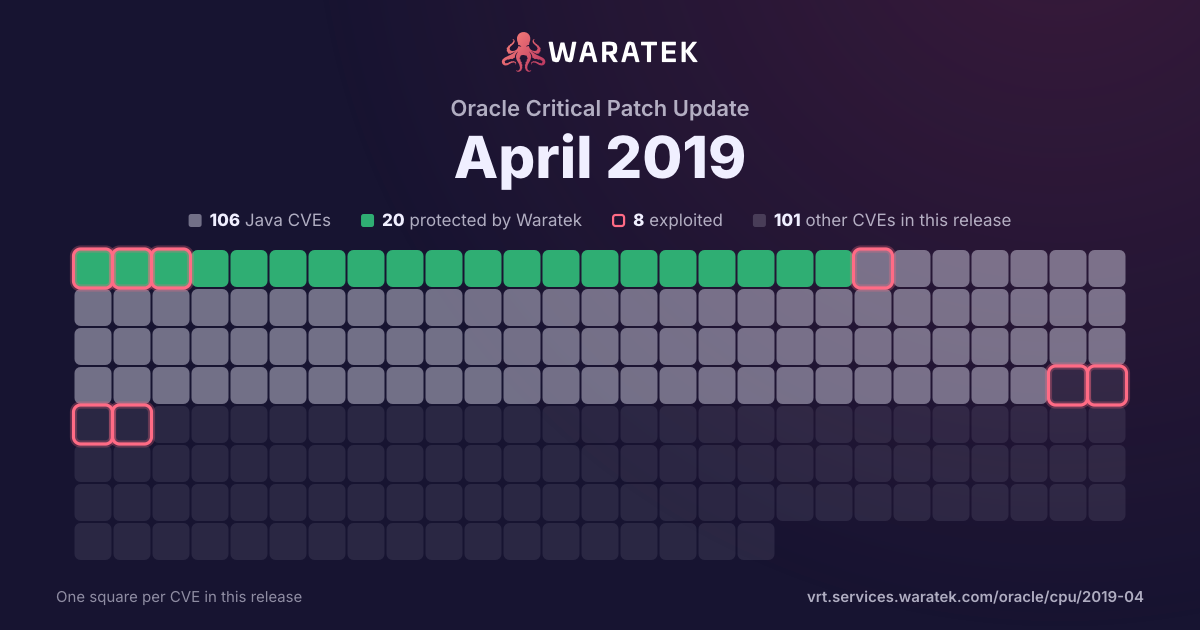
By status
20Protected by Waratek3Mitigation candidate83No exploit published58Outside Waratek scope43Not applicable
8Exploited, marked by the ring
No exploit published. For 80 of them, Oracle's security advisory is the source of public detail.
Protected by Waratek. Waratek RASP can block exploitation of these on systems that have not applied the patch yet.
Overview 207 matches · 106 in Waratek scope · 19 protected · 8 exploited · 1 CISA KEV · 16 public PoC · 8 EPSS ≥ 0.5
207matches
106in Waratek scope51.2%
19protected9.2%
8exploited3.9%
1CISA KEV0.5%
16public PoC7.7%
8EPSS ≥ 0.53.9%
Protected by Waratek
20
9.7%
Rule in development
0
0.0%
Mitigation candidate
3
1.4%
No exploit published
83
40.1%
Outside Waratek scope
58
28.0%
Not applicable
43
20.8%
Withdrawn CVE
0
0.0%
blocked by ARMR today
19
9.2%
partly blocked
1
0.5%
not blocked
187
90.3%
not established
0
0.0%
unrecorded
0
0.0%
split by
peak 161 / quarter
Q2 142
Protected by Waratek2
High2
blocked by ARMR today2
Exploited1
No public exploit1
Q3 140
Q4 140
Q1 150
Q2 150
Q3 151
Outside Waratek scope1
Critical1
not blocked1
No public exploit1
Q4 150
Q1 160
Q2 161
No exploit published1
Critical1
not blocked1
No public exploit1
Q3 162
Protected by Waratek1
Outside Waratek scope1
High2
blocked by ARMR today1
not blocked1
No public exploit2
Q4 162
Protected by Waratek1
Outside Waratek scope1
Critical2
blocked by ARMR today1
not blocked1
No public exploit2
Q1 171
Outside Waratek scope1
Medium1
not blocked1
No public exploit1
Q2 174
Protected by Waratek1
Outside Waratek scope1
Not applicable2
Critical3
High1
blocked by ARMR today1
not blocked3
Working exploit published1
No public exploit3
Q3 171
Protected by Waratek1
Critical1
blocked by ARMR today1
No public exploit1
Q4 174
Not applicable4
Critical3
High1
not blocked4
Proof of concept only1
No public exploit3
Q1 186
Protected by Waratek2
Outside Waratek scope3
Not applicable1
Critical2
Medium4
blocked by ARMR today2
not blocked4
Exploited2
Proof of concept only2
No public exploit2
Q2 187
Protected by Waratek1
No exploit published2
Outside Waratek scope1
Not applicable3
Critical3
High3
Medium1
blocked by ARMR today1
not blocked6
No public exploit7
Q3 184
Protected by Waratek2
No exploit published1
Outside Waratek scope1
High3
Medium1
blocked by ARMR today2
not blocked2
Exploited1
Proof of concept only1
No public exploit2
Q4 183
Outside Waratek scope3
High1
Medium2
not blocked3
Working exploit published1
No public exploit2
Q1 198
Protected by Waratek4
Outside Waratek scope3
Not applicable1
Critical4
High2
Medium2
blocked by ARMR today4
not blocked4
Exploited1
No public exploit7
Q2 19161
Protected by Waratek5
Mitigation candidate3
No exploit published79
Outside Waratek scope42
Not applicable32
Critical8
High62
Medium87
Low4
blocked by ARMR today4
partly blocked1
not blocked156
Exploited3
Working exploit published5
No public exploit153
Q2 14Q4 14Q2 15Q4 15Q2 16Q4 16Q2 17Q4 17Q2 18Q4 18Q2 19
| CVE | Severity | Published▾ | Status | Exploitation | Description |
|---|---|---|---|---|---|
| CVE-2019-2614 | Medium | 2019-04-23 | Not applicable | No public exploit | Vulnerability in the MySQL Server component of Oracle MySQL (subcomponent: Server: Replication). Supported versions that are affected are 5.6.43 and prior, 5.7.25 and prior and 8.0.15 and prior. Difficult to exploit vulnerability allows high privileged attacker with network access via multiple protocols to compromise MySQL Server. Successful attacks of this vulnerability can result in unauthorized ability to cause a hang or frequently repeatable crash (complete DOS) of MySQL Server. CVSS 3.0 Base Score 4.4 (Availability impacts). CVSS Vector: (CVSS:3.0/AV:N/AC:H/PR:H/UI:N/S:U/C:N/I:N/A:H). |
| CVE-2019-2613 | Medium | 2019-04-23 | Not applicable | No public exploit | Vulnerability in the Oracle Outside In Technology component of Oracle Fusion Middleware (subcomponent: Outside In Filters). Supported versions that are affected are 8.5.3 and 8.5.4. Easily exploitable vulnerability allows unauthenticated attacker with network access via HTTP to compromise Oracle Outside In Technology. Successful attacks of this vulnerability can result in unauthorized read access to a subset of Oracle Outside In Technology accessible data and unauthorized ability to cause a partial denial of service (partial DOS) of Oracle Outside In Technology. Note: Outside In Technology is a suite of software development kits (SDKs). The protocol and CVSS score depend on the software that uses the Outside In Technology code. The CVSS score assumes that the software passes data received over a network directly to Outside In Technology code, but if data is not received over a network the CVSS score may be lower. CVSS 3.0 Base Score 6.5 (Confidentiality and Availability impacts). CVSS Vector: (CVSS:3.0/AV:N/AC:L/PR:N/UI:N/S:U/C:L/I:N/A:L). |
| CVE-2019-2612 | Medium | 2019-04-23 | Not applicable | No public exploit | Vulnerability in the Oracle Outside In Technology component of Oracle Fusion Middleware (subcomponent: Outside In Filters). Supported versions that are affected are 8.5.3 and 8.5.4. Easily exploitable vulnerability allows unauthenticated attacker with network access via HTTP to compromise Oracle Outside In Technology. Successful attacks of this vulnerability can result in unauthorized read access to a subset of Oracle Outside In Technology accessible data and unauthorized ability to cause a partial denial of service (partial DOS) of Oracle Outside In Technology. Note: Outside In Technology is a suite of software development kits (SDKs). The protocol and CVSS score depend on the software that uses the Outside In Technology code. The CVSS score assumes that the software passes data received over a network directly to Outside In Technology code, but if data is not received over a network the CVSS score may be lower. CVSS 3.0 Base Score 6.5 (Confidentiality and Availability impacts). CVSS Vector: (CVSS:3.0/AV:N/AC:L/PR:N/UI:N/S:U/C:L/I:N/A:L). |
| CVE-2019-2611 | Medium | 2019-04-23 | Not applicable | No public exploit | Vulnerability in the Oracle Outside In Technology component of Oracle Fusion Middleware (subcomponent: Outside In Filters). Supported versions that are affected are 8.5.3 and 8.5.4. Easily exploitable vulnerability allows unauthenticated attacker with network access via HTTP to compromise Oracle Outside In Technology. Successful attacks of this vulnerability can result in unauthorized read access to a subset of Oracle Outside In Technology accessible data and unauthorized ability to cause a partial denial of service (partial DOS) of Oracle Outside In Technology. Note: Outside In Technology is a suite of software development kits (SDKs). The protocol and CVSS score depend on the software that uses the Outside In Technology code. The CVSS score assumes that the software passes data received over a network directly to Outside In Technology code, but if data is not received over a network the CVSS score may be lower. CVSS 3.0 Base Score 6.5 (Confidentiality and Availability impacts). CVSS Vector: (CVSS:3.0/AV:N/AC:L/PR:N/UI:N/S:U/C:L/I:N/A:L). |
| CVE-2019-2610 | Medium | 2019-04-23 | Not applicable | No public exploit | Vulnerability in the Oracle Outside In Technology component of Oracle Fusion Middleware (subcomponent: Outside In Filters). Supported versions that are affected are 8.5.3 and 8.5.4. Easily exploitable vulnerability allows unauthenticated attacker with network access via HTTP to compromise Oracle Outside In Technology. Successful attacks of this vulnerability can result in unauthorized read access to a subset of Oracle Outside In Technology accessible data and unauthorized ability to cause a partial denial of service (partial DOS) of Oracle Outside In Technology. Note: Outside In Technology is a suite of software development kits (SDKs). The protocol and CVSS score depend on the software that uses the Outside In Technology code. The CVSS score assumes that the software passes data received over a network directly to Outside In Technology code, but if data is not received over a network the CVSS score may be lower. CVSS 3.0 Base Score 6.5 (Confidentiality and Availability impacts). CVSS Vector: (CVSS:3.0/AV:N/AC:L/PR:N/UI:N/S:U/C:L/I:N/A:L). |
| CVE-2019-2609 | Medium | 2019-04-23 | Not applicable | No public exploit | Vulnerability in the Oracle Outside In Technology component of Oracle Fusion Middleware (subcomponent: Outside In Filters). Supported versions that are affected are 8.5.3 and 8.5.4. Easily exploitable vulnerability allows unauthenticated attacker with network access via HTTP to compromise Oracle Outside In Technology. Successful attacks of this vulnerability can result in unauthorized read access to a subset of Oracle Outside In Technology accessible data and unauthorized ability to cause a partial denial of service (partial DOS) of Oracle Outside In Technology. Note: Outside In Technology is a suite of software development kits (SDKs). The protocol and CVSS score depend on the software that uses the Outside In Technology code. The CVSS score assumes that the software passes data received over a network directly to Outside In Technology code, but if data is not received over a network the CVSS score may be lower. CVSS 3.0 Base Score 6.5 (Confidentiality and Availability impacts). CVSS Vector: (CVSS:3.0/AV:N/AC:L/PR:N/UI:N/S:U/C:L/I:N/A:L). |
| CVE-2019-2608 | High | 2019-04-23 | Not applicable | No public exploit | Vulnerability in the Oracle Outside In Technology component of Oracle Fusion Middleware (subcomponent: Outside In Filters). Supported versions that are affected are 8.5.3 and 8.5.4. Easily exploitable vulnerability allows unauthenticated attacker with network access via HTTP to compromise Oracle Outside In Technology. Successful attacks of this vulnerability can result in unauthorized update, insert or delete access to some of Oracle Outside In Technology accessible data as well as unauthorized read access to a subset of Oracle Outside In Technology accessible data and unauthorized ability to cause a partial denial of service (partial DOS) of Oracle Outside In Technology. Note: Outside In Technology is a suite of software development kits (SDKs). The protocol and CVSS score depend on the software that uses the Outside In Technology code. The CVSS score assumes that the software passes data received over a network directly to Outside In Technology code, but if data is not received over a network the CVSS score may be lower. CVSS 3.0 Base Score 7.3 (Confidentiality, Integrity and Availability impacts). CVSS Vector: (CVSS:3.0/AV:N/AC:L/PR:N/UI:N/S:U/C:L/I:L/A:L). |
| CVE-2019-2607 | Medium | 2019-04-23 | Outside Waratek scope | No public exploit | Vulnerability in the MySQL Server component of Oracle MySQL (subcomponent: Server: Optimizer). Supported versions that are affected are 8.0.15 and prior. Easily exploitable vulnerability allows high privileged attacker with network access via multiple protocols to compromise MySQL Server. Successful attacks of this vulnerability can result in unauthorized ability to cause a hang or frequently repeatable crash (complete DOS) of MySQL Server. CVSS 3.0 Base Score 4.9 (Availability impacts). CVSS Vector: (CVSS:3.0/AV:N/AC:L/PR:H/UI:N/S:U/C:N/I:N/A:H). |
| CVE-2019-2606 | Medium | 2019-04-23 | Outside Waratek scope | No public exploit | Vulnerability in the MySQL Server component of Oracle MySQL (subcomponent: Server: Security: Privileges). Supported versions that are affected are 8.0.15 and prior. Easily exploitable vulnerability allows high privileged attacker with network access via multiple protocols to compromise MySQL Server. Successful attacks of this vulnerability can result in unauthorized ability to cause a hang or frequently repeatable crash (complete DOS) of MySQL Server. CVSS 3.0 Base Score 4.9 (Availability impacts). CVSS Vector: (CVSS:3.0/AV:N/AC:L/PR:H/UI:N/S:U/C:N/I:N/A:H). |
| CVE-2019-2605 | Low | 2019-04-23 | No exploit published | No public exploit | Vulnerability in the Oracle Business Intelligence Enterprise Edition component of Oracle Fusion Middleware (subcomponent: Web Catalog). Supported versions that are affected are 11.1.1.9.0, 12.2.1.3.0 and 12.2.1.4.0. Difficult to exploit vulnerability allows unauthenticated attacker with network access via HTTP to compromise Oracle Business Intelligence Enterprise Edition. Successful attacks require human interaction from a person other than the attacker and while the vulnerability is in Oracle Business Intelligence Enterprise Edition, attacks may significantly impact additional products. Successful attacks of this vulnerability can result in unauthorized read access to a subset of Oracle Business Intelligence Enterprise Edition accessible data. CVSS 3.0 Base Score 3.4 (Confidentiality impacts). CVSS Vector: (CVSS:3.0/AV:N/AC:H/PR:N/UI:R/S:C/C:L/I:N/A:N). |
| CVE-2019-2604 | High | 2019-04-23 | No exploit published | No public exploit | Vulnerability in the Oracle Marketing component of Oracle E-Business Suite (subcomponent: Marketing Administration). Supported versions that are affected are 12.1.1, 12.1.2, 12.1.3, 12.2.3, 12.2.4, 12.2.5, 12.2.6, 12.2.7 and 12.2.8. Easily exploitable vulnerability allows unauthenticated attacker with network access via HTTP to compromise Oracle Marketing. Successful attacks require human interaction from a person other than the attacker and while the vulnerability is in Oracle Marketing, attacks may significantly impact additional products. Successful attacks of this vulnerability can result in unauthorized access to critical data or complete access to all Oracle Marketing accessible data as well as unauthorized update, insert or delete access to some of Oracle Marketing accessible data. CVSS 3.0 Base Score 8.2 (Confidentiality and Integrity impacts). CVSS Vector: (CVSS:3.0/AV:N/AC:L/PR:N/UI:R/S:C/C:H/I:L/A:N). |
| CVE-2019-2603 | High | 2019-04-23 | No exploit published | No public exploit | Vulnerability in the Oracle One-to-One Fulfillment component of Oracle E-Business Suite (subcomponent: Print Server). Supported versions that are affected are 12.1.1, 12.1.2, 12.1.3, 12.2.3, 12.2.4, 12.2.5, 12.2.6, 12.2.7 and 12.2.8. Easily exploitable vulnerability allows unauthenticated attacker with network access via HTTP to compromise Oracle One-to-One Fulfillment. Successful attacks require human interaction from a person other than the attacker and while the vulnerability is in Oracle One-to-One Fulfillment, attacks may significantly impact additional products. Successful attacks of this vulnerability can result in unauthorized access to critical data or complete access to all Oracle One-to-One Fulfillment accessible data as well as unauthorized update, insert or delete access to some of Oracle One-to-One Fulfillment accessible data. CVSS 3.0 Base Score 8.2 (Confidentiality and Integrity impacts). CVSS Vector: (CVSS:3.0/AV:N/AC:L/PR:N/UI:R/S:C/C:H/I:L/A:N). |
| CVE-2019-2602 | High | 2019-04-23 | Protected by Waratek | No public exploit | Vulnerability in the Java SE, Java SE Embedded component of Oracle Java SE (subcomponent: Libraries). Supported versions that are affected are Java SE: 7u211, 8u202, 11.0.2 and 12; Java SE Embedded: 8u201. Easily exploitable vulnerability allows unauthenticated attacker with network access via multiple protocols to compromise Java SE, Java SE Embedded. Successful attacks of this vulnerability can result in unauthorized ability to cause a hang or frequently repeatable crash (complete DOS) of Java SE, Java SE Embedded. Note: This vulnerability can only be exploited by supplying data to APIs in the specified Component without using Untrusted Java Web Start applications or Untrusted Java applets, such as through a web service. CVSS 3.0 Base Score 7.5 (Availability impacts). CVSS Vector: (CVSS:3.0/AV:N/AC:L/PR:N/UI:N/S:U/C:N/I:N/A:H). |
| CVE-2019-2601 | High | 2019-04-23 | No exploit published | No public exploit | Vulnerability in the BI Publisher (formerly XML Publisher) component of Oracle Fusion Middleware (subcomponent: BI Publisher Security). Supported versions that are affected are 11.1.1.9.0, 12.2.1.3.0 and 12.2.1.4.0. Easily exploitable vulnerability allows low privileged attacker with network access via HTTP to compromise BI Publisher (formerly XML Publisher). Successful attacks require human interaction from a person other than the attacker and while the vulnerability is in BI Publisher (formerly XML Publisher), attacks may significantly impact additional products. Successful attacks of this vulnerability can result in unauthorized access to critical data or complete access to all BI Publisher (formerly XML Publisher) accessible data as well as unauthorized update, insert or delete access to some of BI Publisher (formerly XML Publisher) accessible data. CVSS 3.0 Base Score 7.6 (Confidentiality and Integrity impacts). CVSS Vector: (CVSS:3.0/AV:N/AC:L/PR:L/UI:R/S:C/C:H/I:L/A:N). |
| CVE-2019-2600 | High | 2019-04-23 | No exploit published | No public exploit | Vulnerability in the Oracle Email Center component of Oracle E-Business Suite (subcomponent: Message Display). Supported versions that are affected are 12.1.1, 12.1.2, 12.1.3, 12.2.3, 12.2.4, 12.2.5, 12.2.6, 12.2.7 and 12.2.8. Easily exploitable vulnerability allows unauthenticated attacker with network access via HTTP to compromise Oracle Email Center. Successful attacks require human interaction from a person other than the attacker and while the vulnerability is in Oracle Email Center, attacks may significantly impact additional products. Successful attacks of this vulnerability can result in unauthorized access to critical data or complete access to all Oracle Email Center accessible data as well as unauthorized update, insert or delete access to some of Oracle Email Center accessible data. CVSS 3.0 Base Score 8.2 (Confidentiality and Integrity impacts). CVSS Vector: (CVSS:3.0/AV:N/AC:L/PR:N/UI:R/S:C/C:H/I:L/A:N). |
| CVE-2019-2598 | High | 2019-04-23 | No exploit published | No public exploit | Vulnerability in the PeopleSoft Enterprise PeopleTools component of Oracle PeopleSoft Products (subcomponent: SQR). Supported versions that are affected are 8.55, 8.56 and 8.57. Easily exploitable vulnerability allows high privileged attacker with network access via HTTP to compromise PeopleSoft Enterprise PeopleTools. While the vulnerability is in PeopleSoft Enterprise PeopleTools, attacks may significantly impact additional products. Successful attacks of this vulnerability can result in unauthorized creation, deletion or modification access to critical data or all PeopleSoft Enterprise PeopleTools accessible data as well as unauthorized access to critical data or complete access to all PeopleSoft Enterprise PeopleTools accessible data. CVSS 3.0 Base Score 8.7 (Confidentiality and Integrity impacts). CVSS Vector: (CVSS:3.0/AV:N/AC:L/PR:H/UI:N/S:C/C:H/I:H/A:N). |
| CVE-2019-2597 | Medium | 2019-04-23 | No exploit published | No public exploit | Vulnerability in the PeopleSoft Enterprise PeopleTools component of Oracle PeopleSoft Products (subcomponent: PIA Core Technology). Supported versions that are affected are 8.55, 8.56 and 8.57. Easily exploitable vulnerability allows unauthenticated attacker with network access via HTTP to compromise PeopleSoft Enterprise PeopleTools. Successful attacks require human interaction from a person other than the attacker. Successful attacks of this vulnerability can result in unauthorized update, insert or delete access to some of PeopleSoft Enterprise PeopleTools accessible data as well as unauthorized read access to a subset of PeopleSoft Enterprise PeopleTools accessible data. CVSS 3.0 Base Score 5.4 (Confidentiality and Integrity impacts). CVSS Vector: (CVSS:3.0/AV:N/AC:L/PR:N/UI:R/S:U/C:L/I:L/A:N). |
| CVE-2019-2596 | Medium | 2019-04-23 | Outside Waratek scope | No public exploit | Vulnerability in the MySQL Server component of Oracle MySQL (subcomponent: Server: Optimizer). Supported versions that are affected are 8.0.15 and prior. Easily exploitable vulnerability allows high privileged attacker with network access via multiple protocols to compromise MySQL Server. Successful attacks of this vulnerability can result in unauthorized ability to cause a hang or frequently repeatable crash (complete DOS) of MySQL Server. CVSS 3.0 Base Score 4.9 (Availability impacts). CVSS Vector: (CVSS:3.0/AV:N/AC:L/PR:H/UI:N/S:U/C:N/I:N/A:H). |
| CVE-2019-2595 | High | 2019-04-23 | No exploit published | No public exploit | Vulnerability in the BI Publisher (formerly XML Publisher) component of Oracle Fusion Middleware (subcomponent: BI Publisher Security). Supported versions that are affected are 11.1.1.9.0, 12.2.1.3.0 and 12.2.1.4.0. Easily exploitable vulnerability allows unauthenticated attacker with network access via HTTP to compromise BI Publisher (formerly XML Publisher). Successful attacks require human interaction from a person other than the attacker and while the vulnerability is in BI Publisher (formerly XML Publisher), attacks may significantly impact additional products. Successful attacks of this vulnerability can result in unauthorized access to critical data or complete access to all BI Publisher (formerly XML Publisher) accessible data as well as unauthorized update, insert or delete access to some of BI Publisher (formerly XML Publisher) accessible data. CVSS 3.0 Base Score 8.2 (Confidentiality and Integrity impacts). CVSS Vector: (CVSS:3.0/AV:N/AC:L/PR:N/UI:R/S:C/C:H/I:L/A:N). |
| CVE-2019-2594 | Medium | 2019-04-23 | No exploit published | No public exploit | Vulnerability in the PeopleSoft Enterprise PT PeopleTools component of Oracle PeopleSoft Products (subcomponent: Application Server). Supported versions that are affected are 8.55, 8.56 and 8.57. Difficult to exploit vulnerability allows low privileged attacker with network access via HTTP to compromise PeopleSoft Enterprise PT PeopleTools. Successful attacks of this vulnerability can result in unauthorized creation, deletion or modification access to critical data or all PeopleSoft Enterprise PT PeopleTools accessible data as well as unauthorized access to critical data or complete access to all PeopleSoft Enterprise PT PeopleTools accessible data. CVSS 3.0 Base Score 6.8 (Confidentiality and Integrity impacts). CVSS Vector: (CVSS:3.0/AV:N/AC:H/PR:L/UI:N/S:U/C:H/I:H/A:N). |
| CVE-2019-2593 | Medium | 2019-04-23 | Outside Waratek scope | No public exploit | Vulnerability in the MySQL Server component of Oracle MySQL (subcomponent: InnoDB). Supported versions that are affected are 8.0.15 and prior. Easily exploitable vulnerability allows high privileged attacker with network access via multiple protocols to compromise MySQL Server. Successful attacks of this vulnerability can result in unauthorized ability to cause a hang or frequently repeatable crash (complete DOS) of MySQL Server. CVSS 3.0 Base Score 4.9 (Availability impacts). CVSS Vector: (CVSS:3.0/AV:N/AC:L/PR:H/UI:N/S:U/C:N/I:N/A:H). |
| CVE-2019-2592 | Medium | 2019-04-23 | Outside Waratek scope | No public exploit | Vulnerability in the MySQL Server component of Oracle MySQL (subcomponent: Server: PS). Supported versions that are affected are 5.7.25 and prior and 8.0.15 and prior. Easily exploitable vulnerability allows high privileged attacker with network access via multiple protocols to compromise MySQL Server. Successful attacks of this vulnerability can result in unauthorized ability to cause a hang or frequently repeatable crash (complete DOS) of MySQL Server. CVSS 3.0 Base Score 4.9 (Availability impacts). CVSS Vector: (CVSS:3.0/AV:N/AC:L/PR:H/UI:N/S:U/C:N/I:N/A:H). |
| CVE-2019-2591 | Medium | 2019-04-23 | No exploit published | No public exploit | Vulnerability in the PeopleSoft Enterprise HRMS component of Oracle PeopleSoft Products (subcomponent: Candidate Gateway). The supported version that is affected is 9.2. Easily exploitable vulnerability allows unauthenticated attacker with network access via HTTP to compromise PeopleSoft Enterprise HRMS. Successful attacks require human interaction from a person other than the attacker and while the vulnerability is in PeopleSoft Enterprise HRMS, attacks may significantly impact additional products. Successful attacks of this vulnerability can result in unauthorized update, insert or delete access to some of PeopleSoft Enterprise HRMS accessible data as well as unauthorized read access to a subset of PeopleSoft Enterprise HRMS accessible data. CVSS 3.0 Base Score 6.1 (Confidentiality and Integrity impacts). CVSS Vector: (CVSS:3.0/AV:N/AC:L/PR:N/UI:R/S:C/C:L/I:L/A:N). |
| CVE-2019-2590 | High | 2019-04-23 | No exploit published | No public exploit | Vulnerability in the PeopleSoft Enterprise HCM Talent Acquisition Manager component of Oracle PeopleSoft Products (subcomponent: Job Opening). The supported version that is affected is 9.2. Easily exploitable vulnerability allows unauthenticated attacker with network access via HTTP to compromise PeopleSoft Enterprise HCM Talent Acquisition Manager. Successful attacks require human interaction from a person other than the attacker and while the vulnerability is in PeopleSoft Enterprise HCM Talent Acquisition Manager, attacks may significantly impact additional products. Successful attacks of this vulnerability can result in unauthorized access to critical data or complete access to all PeopleSoft Enterprise HCM Talent Acquisition Manager accessible data as well as unauthorized update, insert or delete access to some of PeopleSoft Enterprise HCM Talent Acquisition Manager accessible data. CVSS 3.0 Base Score 8.2 (Confidentiality and Integrity impacts). CVSS Vector: (CVSS:3.0/AV:N/AC:L/PR:N/UI:R/S:C/C:H/I:L/A:N). |
| CVE-2019-2589 | Medium | 2019-04-23 | Outside Waratek scope | No public exploit | Vulnerability in the MySQL Server component of Oracle MySQL (subcomponent: Server: Security: Privileges). Supported versions that are affected are 8.0.15 and prior. Easily exploitable vulnerability allows high privileged attacker with network access via multiple protocols to compromise MySQL Server. Successful attacks of this vulnerability can result in unauthorized ability to cause a hang or frequently repeatable crash (complete DOS) of MySQL Server. CVSS 3.0 Base Score 4.9 (Availability impacts). CVSS Vector: (CVSS:3.0/AV:N/AC:L/PR:H/UI:N/S:U/C:N/I:N/A:H). |
| CVE-2019-2588 | Medium | 2019-04-23 | Mitigation candidate | Exploited | Vulnerability in the BI Publisher (formerly XML Publisher) component of Oracle Fusion Middleware (subcomponent: BI Publisher Security). Supported versions that are affected are 11.1.1.9.0, 12.2.1.3.0 and 12.2.1.4.0. Easily exploitable vulnerability allows high privileged attacker with network access via HTTP to compromise BI Publisher (formerly XML Publisher). Successful attacks of this vulnerability can result in unauthorized access to critical data or complete access to all BI Publisher (formerly XML Publisher) accessible data. CVSS 3.0 Base Score 4.9 (Confidentiality impacts). CVSS Vector: (CVSS:3.0/AV:N/AC:L/PR:H/UI:N/S:U/C:H/I:N/A:N). |
| CVE-2019-2587 | Medium | 2019-04-23 | Outside Waratek scope | No public exploit | Vulnerability in the MySQL Server component of Oracle MySQL (subcomponent: Server: Partition). Supported versions that are affected are 8.0.15 and prior. Easily exploitable vulnerability allows high privileged attacker with network access via multiple protocols to compromise MySQL Server. Successful attacks of this vulnerability can result in unauthorized ability to cause a hang or frequently repeatable crash (complete DOS) of MySQL Server. CVSS 3.0 Base Score 4.9 (Availability impacts). CVSS Vector: (CVSS:3.0/AV:N/AC:L/PR:H/UI:N/S:U/C:N/I:N/A:H). |
| CVE-2019-2586 | Medium | 2019-04-23 | No exploit published | No public exploit | Vulnerability in the PeopleSoft Enterprise PT PeopleTools component of Oracle PeopleSoft Products (subcomponent: RemoteCall). Supported versions that are affected are 8.55, 8.56 and 8.57. Easily exploitable vulnerability allows low privileged attacker with network access via HTTP to compromise PeopleSoft Enterprise PT PeopleTools. Successful attacks of this vulnerability can result in unauthorized read access to a subset of PeopleSoft Enterprise PT PeopleTools accessible data. CVSS 3.0 Base Score 4.3 (Confidentiality impacts). CVSS Vector: (CVSS:3.0/AV:N/AC:L/PR:L/UI:N/S:U/C:L/I:N/A:N). |
| CVE-2019-2585 | Medium | 2019-04-23 | Outside Waratek scope | No public exploit | Vulnerability in the MySQL Server component of Oracle MySQL (subcomponent: InnoDB). Supported versions that are affected are 8.0.15 and prior. Easily exploitable vulnerability allows high privileged attacker with network access via multiple protocols to compromise MySQL Server. Successful attacks of this vulnerability can result in unauthorized ability to cause a hang or frequently repeatable crash (complete DOS) of MySQL Server. CVSS 3.0 Base Score 4.9 (Availability impacts). CVSS Vector: (CVSS:3.0/AV:N/AC:L/PR:H/UI:N/S:U/C:N/I:N/A:H). |
| CVE-2019-2584 | Medium | 2019-04-23 | Outside Waratek scope | No public exploit | Vulnerability in the MySQL Server component of Oracle MySQL (subcomponent: Server: Security: Privileges). Supported versions that are affected are 8.0.15 and prior. Easily exploitable vulnerability allows high privileged attacker with network access via multiple protocols to compromise MySQL Server. Successful attacks of this vulnerability can result in unauthorized ability to cause a hang or frequently repeatable crash (complete DOS) of MySQL Server. CVSS 3.0 Base Score 4.9 (Availability impacts). CVSS Vector: (CVSS:3.0/AV:N/AC:L/PR:H/UI:N/S:U/C:N/I:N/A:H). |
| CVE-2019-2583 | High | 2019-04-23 | No exploit published | No public exploit | Vulnerability in the Oracle iSupplier Portal component of Oracle E-Business Suite (subcomponent: Attachments). Supported versions that are affected are 12.1.3, 12.2.3, 12.2.4, 12.2.5, 12.2.6, 12.2.7 and 12.2.8. Easily exploitable vulnerability allows unauthenticated attacker with network access via HTTP to compromise Oracle iSupplier Portal. Successful attacks require human interaction from a person other than the attacker and while the vulnerability is in Oracle iSupplier Portal, attacks may significantly impact additional products. Successful attacks of this vulnerability can result in unauthorized access to critical data or complete access to all Oracle iSupplier Portal accessible data as well as unauthorized update, insert or delete access to some of Oracle iSupplier Portal accessible data. CVSS 3.0 Base Score 8.2 (Confidentiality and Integrity impacts). CVSS Vector: (CVSS:3.0/AV:N/AC:L/PR:N/UI:R/S:C/C:H/I:L/A:N). |
| CVE-2019-2582 | Medium | 2019-04-23 | Outside Waratek scope | No public exploit | Vulnerability in the Core RDBMS component of Oracle Database Server. Supported versions that are affected are 12.2.0.1 and 18c. Easily exploitable vulnerability allows unauthenticated attacker with network access via Oracle Net to compromise Core RDBMS. Successful attacks of this vulnerability can result in unauthorized read access to a subset of Core RDBMS accessible data. CVSS 3.0 Base Score 5.3 (Confidentiality impacts). CVSS Vector: (CVSS:3.0/AV:N/AC:L/PR:N/UI:N/S:U/C:L/I:N/A:N). |
| CVE-2019-2581 | Medium | 2019-04-23 | Outside Waratek scope | No public exploit | Vulnerability in the MySQL Server component of Oracle MySQL (subcomponent: Server: Optimizer). Supported versions that are affected are 5.7.25 and prior and 8.0.15 and prior. Easily exploitable vulnerability allows high privileged attacker with network access via multiple protocols to compromise MySQL Server. Successful attacks of this vulnerability can result in unauthorized ability to cause a hang or frequently repeatable crash (complete DOS) of MySQL Server. CVSS 3.0 Base Score 4.9 (Availability impacts). CVSS Vector: (CVSS:3.0/AV:N/AC:L/PR:H/UI:N/S:U/C:N/I:N/A:H). |
| CVE-2019-2580 | Medium | 2019-04-23 | Outside Waratek scope | No public exploit | Vulnerability in the MySQL Server component of Oracle MySQL (subcomponent: InnoDB). Supported versions that are affected are 8.0.15 and prior. Easily exploitable vulnerability allows high privileged attacker with network access via multiple protocols to compromise MySQL Server. Successful attacks of this vulnerability can result in unauthorized ability to cause a hang or frequently repeatable crash (complete DOS) of MySQL Server. CVSS 3.0 Base Score 4.9 (Availability impacts). CVSS Vector: (CVSS:3.0/AV:N/AC:L/PR:H/UI:N/S:U/C:N/I:N/A:H). |
| CVE-2019-2579 | Medium | 2019-04-23 | Mitigation candidate | Working exploit published | Vulnerability in the Oracle WebCenter Sites component of Oracle Fusion Middleware (subcomponent: Advanced UI). The supported version that is affected is 12.2.1.3.0. Easily exploitable vulnerability allows low privileged attacker with network access via HTTP to compromise Oracle WebCenter Sites. Successful attacks of this vulnerability can result in unauthorized read access to a subset of Oracle WebCenter Sites accessible data. CVSS 3.0 Base Score 4.3 (Confidentiality impacts). CVSS Vector: (CVSS:3.0/AV:N/AC:L/PR:L/UI:N/S:U/C:L/I:N/A:N). |
| CVE-2019-2578 | High | 2019-04-23 | Mitigation candidate | Working exploit published | Vulnerability in the Oracle WebCenter Sites component of Oracle Fusion Middleware (subcomponent: Advanced UI). The supported version that is affected is 12.2.1.3.0. Easily exploitable vulnerability allows unauthenticated attacker with network access via HTTP to compromise Oracle WebCenter Sites. While the vulnerability is in Oracle WebCenter Sites, attacks may significantly impact additional products. Successful attacks of this vulnerability can result in unauthorized access to critical data or complete access to all Oracle WebCenter Sites accessible data. CVSS 3.0 Base Score 8.6 (Confidentiality impacts). CVSS Vector: (CVSS:3.0/AV:N/AC:L/PR:N/UI:N/S:C/C:H/I:N/A:N). |
| CVE-2019-2577 | Low | 2019-04-23 | Not applicable | No public exploit | Vulnerability in the Oracle Solaris component of Oracle Sun Systems Products Suite (subcomponent: File Locking Services). The supported version that is affected is 11. Easily exploitable vulnerability allows low privileged attacker with logon to the infrastructure where Oracle Solaris executes to compromise Oracle Solaris. Successful attacks of this vulnerability can result in unauthorized ability to cause a partial denial of service (partial DOS) of Oracle Solaris. CVSS 3.0 Base Score 3.3 (Availability impacts). CVSS Vector: (CVSS:3.0/AV:L/AC:L/PR:L/UI:N/S:U/C:N/I:N/A:L). |
| CVE-2019-2576 | Medium | 2019-04-23 | No exploit published | No public exploit | Vulnerability in the Oracle Service Bus component of Oracle Fusion Middleware (subcomponent: Web Container). Supported versions that are affected are 11.1.1.9.0, 12.1.3.0.0 and 12.2.1.3.0. Easily exploitable vulnerability allows unauthenticated attacker with network access via HTTP to compromise Oracle Service Bus. Successful attacks of this vulnerability can result in unauthorized ability to cause a partial denial of service (partial DOS) of Oracle Service Bus. CVSS 3.0 Base Score 5.3 (Availability impacts). CVSS Vector: (CVSS:3.0/AV:N/AC:L/PR:N/UI:N/S:U/C:N/I:N/A:L). |
| CVE-2019-2575 | Medium | 2019-04-23 | Not applicable | No public exploit | Vulnerability in the Oracle AutoVue 3D Professional Advanced component of Oracle Supply Chain Products Suite (subcomponent: Format Handling - 2D). Supported versions that are affected are 21.0.0 and 21.0.1. Easily exploitable vulnerability allows unauthenticated attacker with network access via HTTP to compromise Oracle AutoVue 3D Professional Advanced. Successful attacks of this vulnerability can result in unauthorized read access to a subset of Oracle AutoVue 3D Professional Advanced accessible data. CVSS 3.0 Base Score 5.3 (Confidentiality impacts). CVSS Vector: (CVSS:3.0/AV:N/AC:L/PR:N/UI:N/S:U/C:L/I:N/A:N). |
| CVE-2019-2574 | Medium | 2019-04-23 | Not applicable | No public exploit | Vulnerability in the Oracle VM VirtualBox component of Oracle Virtualization (subcomponent: Core). Supported versions that are affected are Prior to 5.2.28 and prior to 6.0.6. Easily exploitable vulnerability allows low privileged attacker with logon to the infrastructure where Oracle VM VirtualBox executes to compromise Oracle VM VirtualBox. While the vulnerability is in Oracle VM VirtualBox, attacks may significantly impact additional products. Successful attacks of this vulnerability can result in unauthorized access to critical data or complete access to all Oracle VM VirtualBox accessible data. CVSS 3.0 Base Score 6.5 (Confidentiality impacts). CVSS Vector: (CVSS:3.0/AV:L/AC:L/PR:L/UI:N/S:C/C:H/I:N/A:N). |
| CVE-2019-2573 | Medium | 2019-04-23 | No exploit published | No public exploit | Vulnerability in the PeopleSoft Enterprise PeopleTools component of Oracle PeopleSoft Products (subcomponent: Fluid Homepage & Navigation). Supported versions that are affected are 8.56 and 8.57. Easily exploitable vulnerability allows unauthenticated attacker with network access via HTTP to compromise PeopleSoft Enterprise PeopleTools. Successful attacks require human interaction from a person other than the attacker. Successful attacks of this vulnerability can result in unauthorized update, insert or delete access to some of PeopleSoft Enterprise PeopleTools accessible data. CVSS 3.0 Base Score 4.3 (Integrity impacts). CVSS Vector: (CVSS:3.0/AV:N/AC:L/PR:N/UI:R/S:U/C:N/I:L/A:N). |
| CVE-2019-2572 | Medium | 2019-04-23 | No exploit published | No public exploit | Vulnerability in the Oracle SOA Suite component of Oracle Fusion Middleware (subcomponent: Fabric Layer). The supported version that is affected is 11.1.1.9.0. Easily exploitable vulnerability allows unauthenticated attacker with network access via HTTP to compromise Oracle SOA Suite. Successful attacks of this vulnerability can result in unauthorized read access to a subset of Oracle SOA Suite accessible data. CVSS 3.0 Base Score 5.3 (Confidentiality impacts). CVSS Vector: (CVSS:3.0/AV:N/AC:L/PR:N/UI:N/S:U/C:L/I:N/A:N). |
| CVE-2019-2571 | Medium | 2019-04-23 | Outside Waratek scope | No public exploit | Vulnerability in the RDBMS DataPump component of Oracle Database Server. Supported versions that are affected are 11.2.0.4, 12.1.0.2, 12.2.0.1 and 18c. Difficult to exploit vulnerability allows high privileged attacker having DBA role privilege with network access via Oracle Net to compromise RDBMS DataPump. Successful attacks of this vulnerability can result in takeover of RDBMS DataPump. CVSS 3.0 Base Score 6.6 (Confidentiality, Integrity and Availability impacts). CVSS Vector: (CVSS:3.0/AV:N/AC:H/PR:H/UI:N/S:U/C:H/I:H/A:H). |
| CVE-2019-2570 | Medium | 2019-04-23 | No exploit published | No public exploit | Vulnerability in the Siebel Core - Server BizLogic Script component of Oracle Siebel CRM (subcomponent: Integration - Scripting). The supported version that is affected is 19.3. Easily exploitable vulnerability allows high privileged attacker with network access via HTTP to compromise Siebel Core - Server BizLogic Script. Successful attacks of this vulnerability can result in unauthorized update, insert or delete access to some of Siebel Core - Server BizLogic Script accessible data as well as unauthorized read access to a subset of Siebel Core - Server BizLogic Script accessible data and unauthorized ability to cause a partial denial of service (partial DOS) of Siebel Core - Server BizLogic Script. CVSS 3.0 Base Score 4.7 (Confidentiality, Integrity and Availability impacts). CVSS Vector: (CVSS:3.0/AV:N/AC:L/PR:H/UI:N/S:U/C:L/I:L/A:L). |
| CVE-2019-2568 | Medium | 2019-04-23 | No exploit published | No public exploit | Vulnerability in the Oracle WebLogic Server component of Oracle Fusion Middleware (subcomponent: WLS Core Components). Supported versions that are affected are 10.3.6.0.0, 12.1.3.0.0 and 12.2.1.3.0. Easily exploitable vulnerability allows low privileged attacker with network access via HTTP to compromise Oracle WebLogic Server. While the vulnerability is in Oracle WebLogic Server, attacks may significantly impact additional products. Successful attacks of this vulnerability can result in unauthorized update, insert or delete access to some of Oracle WebLogic Server accessible data. CVSS 3.0 Base Score 5.0 (Integrity impacts). CVSS Vector: (CVSS:3.0/AV:N/AC:L/PR:L/UI:N/S:C/C:N/I:L/A:N). |
| CVE-2019-2567 | High | 2019-04-23 | No exploit published | No public exploit | Vulnerability in the Oracle Configurator component of Oracle Supply Chain Products Suite (subcomponent: Active Model Generation). Supported versions that are affected are 12.1 and 12.2. Easily exploitable vulnerability allows unauthenticated attacker with network access via HTTP to compromise Oracle Configurator. Successful attacks of this vulnerability can result in unauthorized access to critical data or complete access to all Oracle Configurator accessible data. CVSS 3.0 Base Score 7.5 (Confidentiality impacts). CVSS Vector: (CVSS:3.0/AV:N/AC:L/PR:N/UI:N/S:U/C:H/I:N/A:N). |
| CVE-2019-2566 | Medium | 2019-04-23 | Not applicable | No public exploit | Vulnerability in the MySQL Server component of Oracle MySQL (subcomponent: Server: Audit Plug-in). Supported versions that are affected are 5.7.25 and prior and 8.0.15 and prior. Easily exploitable vulnerability allows high privileged attacker with network access via multiple protocols to compromise MySQL Server. Successful attacks of this vulnerability can result in unauthorized ability to cause a hang or frequently repeatable crash (complete DOS) of MySQL Server. CVSS 3.0 Base Score 4.9 (Availability impacts). CVSS Vector: (CVSS:3.0/AV:N/AC:L/PR:H/UI:N/S:U/C:N/I:N/A:H). |
| CVE-2019-2565 | High | 2019-04-23 | No exploit published | No public exploit | Vulnerability in the JD Edwards World Technical Foundation component of Oracle JD Edwards Products (subcomponent: Service Enablement). Supported versions that are affected are A9.2, A9.3.1 and A9.4. Easily exploitable vulnerability allows unauthenticated attacker with network access via HTTP to compromise JD Edwards World Technical Foundation. Successful attacks of this vulnerability can result in unauthorized access to critical data or complete access to all JD Edwards World Technical Foundation accessible data. CVSS 3.0 Base Score 7.5 (Confidentiality impacts). CVSS Vector: (CVSS:3.0/AV:N/AC:L/PR:N/UI:N/S:U/C:H/I:N/A:N). |
| CVE-2019-2564 | Medium | 2019-04-23 | No exploit published | No public exploit | Vulnerability in the JD Edwards EnterpriseOne Tools component of Oracle JD Edwards Products (subcomponent: Web Runtime). The supported version that is affected is 9.2. Easily exploitable vulnerability allows low privileged attacker with network access via HTTP to compromise JD Edwards EnterpriseOne Tools. Successful attacks of this vulnerability can result in unauthorized read access to a subset of JD Edwards EnterpriseOne Tools accessible data. CVSS 3.0 Base Score 4.3 (Confidentiality impacts). CVSS Vector: (CVSS:3.0/AV:N/AC:L/PR:L/UI:N/S:U/C:L/I:N/A:N). |
| CVE-2019-2558 | High | 2019-04-23 | No exploit published | No public exploit | Vulnerability in the Oracle Retail Point-of-Service component of Oracle Retail Applications (subcomponent: Infrastructure). Supported versions that are affected are 13.4, 14.0 and 14.1. Easily exploitable vulnerability allows unauthenticated attacker with network access via HTTP to compromise Oracle Retail Point-of-Service. Successful attacks of this vulnerability can result in unauthorized update, insert or delete access to some of Oracle Retail Point-of-Service accessible data as well as unauthorized read access to a subset of Oracle Retail Point-of-Service accessible data and unauthorized ability to cause a partial denial of service (partial DOS) of Oracle Retail Point-of-Service. CVSS 3.0 Base Score 7.3 (Confidentiality, Integrity and Availability impacts). CVSS Vector: (CVSS:3.0/AV:N/AC:L/PR:N/UI:N/S:U/C:L/I:L/A:L). |
| CVE-2019-2557 | Medium | 2019-04-23 | No exploit published | No public exploit | Vulnerability in the Oracle Application Testing Suite component of Oracle Enterprise Manager Products Suite (subcomponent: Load Testing for Web Apps). The supported version that is affected is 13.3.0.1. Easily exploitable vulnerability allows low privileged attacker with network access via HTTP to compromise Oracle Application Testing Suite. Successful attacks of this vulnerability can result in unauthorized update, insert or delete access to some of Oracle Application Testing Suite accessible data as well as unauthorized read access to a subset of Oracle Application Testing Suite accessible data and unauthorized ability to cause a partial denial of service (partial DOS) of Oracle Application Testing Suite. CVSS 3.0 Base Score 6.3 (Confidentiality, Integrity and Availability impacts). CVSS Vector: (CVSS:3.0/AV:N/AC:L/PR:L/UI:N/S:U/C:L/I:L/A:L). |
| CVE-2019-2551 | High | 2019-04-23 | No exploit published | No public exploit | Vulnerability in the Oracle One-to-One Fulfillment component of Oracle E-Business Suite (subcomponent: Print Server). Supported versions that are affected are 12.1.1, 12.1.2, 12.1.3, 12.2.3, 12.2.4, 12.2.5, 12.2.6, 12.2.7 and 12.2.8. Easily exploitable vulnerability allows unauthenticated attacker with network access via HTTP to compromise Oracle One-to-One Fulfillment. Successful attacks require human interaction from a person other than the attacker and while the vulnerability is in Oracle One-to-One Fulfillment, attacks may significantly impact additional products. Successful attacks of this vulnerability can result in unauthorized access to critical data or complete access to all Oracle One-to-One Fulfillment accessible data as well as unauthorized update, insert or delete access to some of Oracle One-to-One Fulfillment accessible data. CVSS 3.0 Base Score 8.2 (Confidentiality and Integrity impacts). CVSS Vector: (CVSS:3.0/AV:N/AC:L/PR:N/UI:R/S:C/C:H/I:L/A:N). |
| CVE-2019-2518 | High | 2019-04-23 | Outside Waratek scope | No public exploit | Vulnerability in the Java VM component of Oracle Database Server. Supported versions that are affected are 11.2.0.4, 12.1.0.2, 12.2.0.1, 18c and 19c. Difficult to exploit vulnerability allows low privileged attacker having Create Session, Create Procedure privilege with network access via multiple protocols to compromise Java VM. Successful attacks of this vulnerability can result in takeover of Java VM. CVSS 3.0 Base Score 7.5 (Confidentiality, Integrity and Availability impacts). CVSS Vector: (CVSS:3.0/AV:N/AC:H/PR:L/UI:N/S:U/C:H/I:H/A:H). |
| CVE-2019-2517 | Critical | 2019-04-23 | Outside Waratek scope | No public exploit | Vulnerability in the Core RDBMS component of Oracle Database Server. Supported versions that are affected are 12.2.0.1 and 18c. Easily exploitable vulnerability allows high privileged attacker having DBFS_ROLE privilege with network access via Oracle Net to compromise Core RDBMS. While the vulnerability is in Core RDBMS, attacks may significantly impact additional products. Successful attacks of this vulnerability can result in takeover of Core RDBMS. CVSS 3.0 Base Score 9.1 (Confidentiality, Integrity and Availability impacts). CVSS Vector: (CVSS:3.0/AV:N/AC:L/PR:H/UI:N/S:C/C:H/I:H/A:H). |
| CVE-2019-2516 | High | 2019-04-23 | Outside Waratek scope | No public exploit | Vulnerability in the Portable Clusterware component of Oracle Database Server. Supported versions that are affected are 11.2.0.4, 12.1.0.2, 12.2.0.1 and 18c. Easily exploitable vulnerability allows high privileged attacker having Grid Infrastructure User privilege with logon to the infrastructure where Portable Clusterware executes to compromise Portable Clusterware. While the vulnerability is in Portable Clusterware, attacks may significantly impact additional products. Successful attacks of this vulnerability can result in takeover of Portable Clusterware. CVSS 3.0 Base Score 8.2 (Confidentiality, Integrity and Availability impacts). CVSS Vector: (CVSS:3.0/AV:L/AC:L/PR:H/UI:N/S:C/C:H/I:H/A:H). |
| CVE-2019-2424 | High | 2019-04-23 | No exploit published | No public exploit | Vulnerability in the Oracle Retail Convenience Store Back Office component of Oracle Retail Applications (subcomponent: Level 3 Maintenance Functions). The supported version that is affected is 3.6. Easily exploitable vulnerability allows unauthenticated attacker with network access via HTTP to compromise Oracle Retail Convenience Store Back Office. Successful attacks of this vulnerability can result in unauthorized update, insert or delete access to some of Oracle Retail Convenience Store Back Office accessible data as well as unauthorized read access to a subset of Oracle Retail Convenience Store Back Office accessible data and unauthorized ability to cause a partial denial of service (partial DOS) of Oracle Retail Convenience Store Back Office. CVSS 3.0 Base Score 7.3 (Confidentiality, Integrity and Availability impacts). CVSS Vector: (CVSS:3.0/AV:N/AC:L/PR:N/UI:N/S:U/C:L/I:L/A:L). |
| CVE-2018-3314 | High | 2019-04-23 | No exploit published | No public exploit | Vulnerability in the MICROS Relate CRM Software component of Oracle Retail Applications (subcomponent: Customer). The supported version that is affected is 11.4. Difficult to exploit vulnerability allows low privileged attacker with network access via HTTP to compromise MICROS Relate CRM Software. While the vulnerability is in MICROS Relate CRM Software, attacks may significantly impact additional products. Successful attacks of this vulnerability can result in unauthorized creation, deletion or modification access to critical data or all MICROS Relate CRM Software accessible data as well as unauthorized access to critical data or complete access to all MICROS Relate CRM Software accessible data. CVSS 3.0 Base Score 8.2 (Confidentiality and Integrity impacts). CVSS Vector: (CVSS:3.0/AV:N/AC:H/PR:L/UI:N/S:C/C:H/I:H/A:N). |
| CVE-2018-3312 | Medium | 2019-04-23 | No exploit published | No public exploit | Vulnerability in the Oracle Retail Customer Engagement component of Oracle Retail Applications (subcomponent: Segment). Supported versions that are affected are 16.0 and 17.0. Difficult to exploit vulnerability allows high privileged attacker with network access via HTTP to compromise Oracle Retail Customer Engagement. Successful attacks of this vulnerability can result in unauthorized creation, deletion or modification access to critical data or all Oracle Retail Customer Engagement accessible data as well as unauthorized read access to a subset of Oracle Retail Customer Engagement accessible data and unauthorized ability to cause a partial denial of service (partial DOS) of Oracle Retail Customer Engagement. CVSS 3.0 Base Score 5.5 (Confidentiality, Integrity and Availability impacts). CVSS Vector: (CVSS:3.0/AV:N/AC:H/PR:H/UI:N/S:U/C:L/I:H/A:L). |
| CVE-2018-3123 | Medium | 2019-04-23 | Not applicable | No public exploit | Vulnerability in the MySQL Server component of Oracle MySQL (subcomponent: Server: libmysqld). Supported versions that are affected are 5.6.42 and prior, 5.7.24 and prior and 8.0.13 and prior. Difficult to exploit vulnerability allows unauthenticated attacker with network access via multiple protocols to compromise MySQL Server. Successful attacks of this vulnerability can result in unauthorized access to critical data or complete access to all MySQL Server accessible data. CVSS 3.0 Base Score 5.9 (Confidentiality impacts). CVSS Vector: (CVSS:3.0/AV:N/AC:H/PR:N/UI:N/S:U/C:H/I:N/A:N). |
| CVE-2018-3120 | High | 2019-04-23 | No exploit published | No public exploit | Vulnerability in the MICROS Lucas component of Oracle Retail Applications (subcomponent: Security). Supported versions that are affected are 2.9.5.6 and 2.9.5.7. Difficult to exploit vulnerability allows low privileged attacker with network access via HTTP to compromise MICROS Lucas. Successful attacks of this vulnerability can result in takeover of MICROS Lucas. CVSS 3.0 Base Score 7.5 (Confidentiality, Integrity and Availability impacts). CVSS Vector: (CVSS:3.0/AV:N/AC:H/PR:L/UI:N/S:U/C:H/I:H/A:H). |
| CVE-2018-2880 | High | 2019-04-23 | No exploit published | No public exploit | Vulnerability in the MICROS Retail-J component of Oracle Retail Applications (subcomponent: Back Office). The supported version that is affected is 12.1.2. Easily exploitable vulnerability allows unauthenticated attacker with network access via HTTP to compromise MICROS Retail-J. Successful attacks of this vulnerability can result in unauthorized access to critical data or complete access to all MICROS Retail-J accessible data. CVSS 3.0 Base Score 7.5 (Confidentiality impacts). CVSS Vector: (CVSS:3.0/AV:N/AC:L/PR:N/UI:N/S:U/C:H/I:N/A:N). |
| CVE-2018-12023 | High | 2019-03-21 | Protected by Waratek | No public exploit | An issue was discovered in FasterXML jackson-databind prior to 2.7.9.4, 2.8.11.2, and 2.9.6. When Default Typing is enabled (either globally or for a specific property), the service has the Oracle JDBC jar in the classpath, and an attacker can provide an LDAP service to access, it is possible to make the service execute a malicious payload. |
| CVE-2019-1559 | Medium | 2019-02-27 | Outside Waratek scope | No public exploit | If an application encounters a fatal protocol error and then calls SSL_shutdown() twice (once to send a close_notify, and once to receive one) then OpenSSL can respond differently to the calling application if a 0 byte record is received with invalid padding compared to if a 0 byte record is received with an invalid MAC. If the application then behaves differently based on that in a way that is detectable to the remote peer, then this amounts to a padding oracle that could be used to decrypt data. In order for this to be exploitable "non-stitched" ciphersuites must be in use. Stitched ciphersuites are optimised implementations of certain commonly used ciphersuites. Also the application must call SSL_shutdown() twice even if a protocol error has occurred (applications should not do this but some do anyway). Fixed in OpenSSL 1.0.2r (Affected 1.0.2-1.0.2q). |
| CVE-2019-3822 | Critical | 2019-02-06 | Outside Waratek scope | No public exploit | libcurl versions from 7.36.0 to before 7.64.0 are vulnerable to a stack-based buffer overflow. The function creating an outgoing NTLM type-3 header (`lib/vauth/ntlm.c:Curl_auth_create_ntlm_type3_message()`), generates the request HTTP header contents based on previously received data. The check that exists to prevent the local buffer from getting overflowed is implemented wrongly (using unsigned math) and as such it does not prevent the overflow from happening. This output data can grow larger than the local buffer if very large 'nt response' data is extracted from a previous NTLMv2 header provided by the malicious or broken HTTP server. Such a 'large value' needs to be around 1000 bytes or more. The actual payload data copied to the target buffer comes from the NTLMv2 type-2 response header. |
| CVE-2019-3772 | Critical | 2019-01-18 | Protected by Waratek | No public exploit | Spring Integration (spring-integration-xml and spring-integration-ws modules), versions 4.3.18, 5.0.10, 5.1.1, and older unsupported versions, were susceptible to XML External Entity Injection (XXE) when receiving XML data from untrusted sources. |
| CVE-2018-16864 | High | 2019-01-11 | Not applicable | No public exploit | An allocation of memory without limits, that could result in the stack clashing with another memory region, was discovered in systemd-journald when a program with long command line arguments calls syslog. A local attacker may use this flaw to crash systemd-journald or escalate his privileges. Versions through v240 are vulnerable. |
| CVE-2018-20685 | Medium | 2019-01-10 | Outside Waratek scope | Exploited | In OpenSSH 7.9, scp.c in the scp client allows remote SSH servers to bypass intended access restrictions via the filename of . or an empty filename. The impact is modifying the permissions of the target directory on the client side. |
| CVE-2018-19362 | Critical | 2019-01-02 | Protected by Waratek | No public exploit | FasterXML jackson-databind 2.x before 2.9.8 might allow attackers to have unspecified impact by leveraging failure to block the jboss-common-core class from polymorphic deserialization. |
| CVE-2018-14718 | Critical | 2019-01-02 | Protected by Waratek | No public exploit | FasterXML jackson-databind 2.x before 2.9.7 might allow remote attackers to execute arbitrary code by leveraging failure to block the slf4j-ext class from polymorphic deserialization. |
| CVE-2018-0734 | Medium | 2018-10-30 | Outside Waratek scope | No public exploit | The OpenSSL DSA signature algorithm has been shown to be vulnerable to a timing side channel attack. An attacker could use variations in the signing algorithm to recover the private key. Fixed in OpenSSL 1.1.1a (Affected 1.1.1). Fixed in OpenSSL 1.1.0j (Affected 1.1.0-1.1.0i). Fixed in OpenSSL 1.0.2q (Affected 1.0.2-1.0.2p). |
| CVE-2018-15756 | High | 2018-10-18 | Outside Waratek scope | No public exploit | Spring Framework, version 5.1, versions 5.0.x prior to 5.0.10, versions 4.3.x prior to 4.3.20, and older unsupported versions on the 4.2.x branch provide support for range requests when serving static resources through the ResourceHttpRequestHandler, or starting in 5.0 when an annotated controller returns an org.springframework.core.io.Resource. A malicious user (or attacker) can add a range header with a high number of ranges, or with wide ranges that overlap, or both, for a denial of service attack. This vulnerability affects applications that depend on either spring-webmvc or spring-webflux. Such applications must also have a registration for serving static resources (e.g. JS, CSS, images, and others), or have an annotated controller that returns an org.springframework.core.io.Resource. Spring Boot applications that depend on spring-boot-starter-web or spring-boot-starter-webflux are ready to serve static resources out of the box and are therefore vulnerable. |
| CVE-2018-11784 | Medium | 2018-10-04 | Outside Waratek scope | Working exploit published | When the default servlet in Apache Tomcat versions 9.0.0.M1 to 9.0.11, 8.5.0 to 8.5.33 and 7.0.23 to 7.0.90 returned a redirect to a directory (e.g. redirecting to '/foo/' when the user requested '/foo') a specially crafted URL could be used to cause the redirect to be generated to any URI of the attackers choice. |
| CVE-2018-11763 | Medium | 2018-09-25 | Outside Waratek scope | Exploited | In Apache HTTP Server 2.4.17 to 2.4.34, by sending continuous, large SETTINGS frames a client can occupy a connection, server thread and CPU time without any connection timeout coming to effect. This affects only HTTP/2 connections. A possible mitigation is to not enable the h2 protocol. |
| CVE-2018-11761 | High | 2018-09-19 | Protected by Waratek | Proof of concept only | In Apache Tika 0.1 to 1.18, the XML parsers were not configured to limit entity expansion. They were therefore vulnerable to an entity expansion vulnerability which can lead to a denial of service attack. |
| CVE-2018-11775 | High | 2018-09-10 | No exploit published | No public exploit | TLS hostname verification when using the Apache ActiveMQ Client before 5.15.6 was missing which could make the client vulnerable to a MITM attack between a Java application using the ActiveMQ client and the ActiveMQ server. This is now enabled by default. |
| CVE-2018-1656 | High | 2018-08-20 | Protected by Waratek | No public exploit | The IBM Java Runtime Environment's Diagnostic Tooling Framework for Java (DTFJ) (IBM SDK, Java Technology Edition 6.0 , 7.0, and 8.0) does not protect against path traversal attacks when extracting compressed dump files. IBM X-Force ID: 144882. |
| CVE-2018-11219 | Critical | 2018-06-17 | Not applicable | No public exploit | An Integer Overflow issue was discovered in the struct library in the Lua subsystem in Redis before 3.2.12, 4.x before 4.0.10, and 5.x before 5.0 RC2, leading to a failure of bounds checking. |
| CVE-2018-0495 | Medium | 2018-06-13 | Not applicable | No public exploit | Libgcrypt before 1.7.10 and 1.8.x before 1.8.3 allows a memory-cache side-channel attack on ECDSA signatures that can be mitigated through the use of blinding during the signing process in the _gcry_ecc_ecdsa_sign function in cipher/ecc-ecdsa.c, aka the Return Of the Hidden Number Problem or ROHNP. To discover an ECDSA key, the attacker needs access to either the local machine or a different virtual machine on the same physical host. |
| CVE-2018-0732 | High | 2018-06-12 | Not applicable | No public exploit | During key agreement in a TLS handshake using a DH(E) based ciphersuite a malicious server can send a very large prime value to the client. This will cause the client to spend an unreasonably long period of time generating a key for this prime resulting in a hang until the client has finished. This could be exploited in a Denial Of Service attack. Fixed in OpenSSL 1.1.0i-dev (Affected 1.1.0-1.1.0h). Fixed in OpenSSL 1.0.2p-dev (Affected 1.0.2-1.0.2o). |
| CVE-2018-1000180 | High | 2018-06-05 | No exploit published | No public exploit | Bouncy Castle BC 1.54 - 1.59, BC-FJA 1.0.0, BC-FJA 1.0.1 and earlier have a flaw in the Low-level interface to RSA key pair generator, specifically RSA Key Pairs generated in low-level API with added certainty may have less M-R tests than expected. This appears to be fixed in versions BC 1.60 beta 4 and later, BC-FJA 1.0.2 and later. |
| CVE-2018-8013 | Critical | 2018-05-24 | Protected by Waratek | No public exploit | In Apache Batik 1.x before 1.10, when deserializing subclass of `AbstractDocument`, the class takes a string from the inputStream as the class name which then use it to call the no-arg constructor of the class. Fix was to check the class type before calling newInstance in deserialization. |
| CVE-2018-11236 | Critical | 2018-05-18 | Outside Waratek scope | No public exploit | stdlib/canonicalize.c in the GNU C Library (aka glibc or libc6) 2.27 and earlier, when processing very long pathname arguments to the realpath function, could encounter an integer overflow on 32-bit architectures, leading to a stack-based buffer overflow and, potentially, arbitrary code execution. |
| CVE-2018-1258 | High | 2018-05-11 | No exploit published | No public exploit | Spring Framework version 5.0.5 when used in combination with any versions of Spring Security contains an authorization bypass when using method security. An unauthorized malicious user can gain unauthorized access to methods that should be restricted. |
| CVE-2018-8088 | Critical | 2018-03-20 | Protected by Waratek | No public exploit | org.slf4j.ext.EventData in the slf4j-ext module in QOS.CH SLF4J before 1.8.0-beta2 allows remote attackers to bypass intended access restrictions via crafted data. EventData in the slf4j-ext module in QOS.CH SLF4J, has been fixed in SLF4J versions 1.7.26 later and in the 2.0.x series. |
| CVE-2018-7489 | Critical | 2018-02-26 | Protected by Waratek | No public exploit | FasterXML jackson-databind before 2.7.9.3, 2.8.x before 2.8.11.1 and 2.9.x before 2.9.5 allows unauthenticated remote code execution because of an incomplete fix for the CVE-2017-7525 deserialization flaw. This is exploitable by sending maliciously crafted JSON input to the readValue method of the ObjectMapper, bypassing a blacklist that is ineffective if the c3p0 libraries are available in the classpath. |
| CVE-2018-1305 | Medium | 2018-02-23 | Outside Waratek scope | Proof of concept only | Security constraints defined by annotations of Servlets in Apache Tomcat 9.0.0.M1 to 9.0.4, 8.5.0 to 8.5.27, 8.0.0.RC1 to 8.0.49 and 7.0.0 to 7.0.84 were only applied once a Servlet had been loaded. Because security constraints defined in this way apply to the URL pattern and any URLs below that point, it was possible - depending on the order Servlets were loaded - for some security constraints not to be applied. This could have exposed resources to users who were not authorised to access them. |
| CVE-2015-9251 | Medium | 2018-01-18 | Outside Waratek scope | Exploited | jQuery before 3.0.0 is vulnerable to Cross-site Scripting (XSS) attacks when a cross-domain Ajax request is performed without the dataType option, causing text/javascript responses to be executed. |
| CVE-2017-5754 | Medium | 2018-01-04 | Not applicable | Proof of concept only | Systems with microprocessors utilizing speculative execution and indirect branch prediction may allow unauthorized disclosure of information to an attacker with local user access via a side-channel analysis of the data cache. |
| CVE-2017-5753 | Medium | 2018-01-04 | Outside Waratek scope | Exploited | Systems with microprocessors utilizing speculative execution and branch prediction may allow unauthorized disclosure of information to an attacker with local user access via a side-channel analysis. |
| CVE-2014-9515 | Critical | 2017-12-29 | Not applicable | Proof of concept only | Dozer improperly uses a reflection-based approach to type conversion, which might allow remote attackers to execute arbitrary code via a crafted serialized object. |
| CVE-2017-0861 | High | 2017-11-16 | Not applicable | No public exploit | Use-after-free vulnerability in the snd_pcm_info function in the ALSA subsystem in the Linux kernel allows attackers to gain privileges via unspecified vectors. |
| CVE-2017-5533 | Critical | 2017-11-15 | Not applicable | No public exploit | A vulnerability in the server content cache of TIBCO JasperReports Server, TIBCO JasperReports Server Community Edition, TIBCO JasperReports Server for ActiveMatrix BPM, TIBCO Jaspersoft for AWS with Multi-Tenancy, and TIBCO Jaspersoft Reporting and Analytics for AWS contains a vulnerability which fails to prevent remote access to all the contents of the web application, including key configuration files. Affected releases are TIBCO JasperReports Server 6.4.0, TIBCO JasperReports Server Community Edition 6.4.0, TIBCO JasperReports Server for ActiveMatrix BPM 6.4.0, TIBCO Jaspersoft for AWS with Multi-Tenancy 6.4.0, TIBCO Jaspersoft Reporting and Analytics for AWS 6.4.0. |
| CVE-2017-14952 | Critical | 2017-10-16 | Not applicable | No public exploit | Double free in i18n/zonemeta.cpp in International Components for Unicode (ICU) for C/C++ through 59.1 allows remote attackers to execute arbitrary code via a crafted string, aka a "redundant UVector entry clean up function call" issue. |
| CVE-2016-4000 | Critical | 2017-07-06 | Protected by Waratek | No public exploit | Jython before 2.7.1rc1 allows attackers to execute arbitrary code via a crafted serialized PyFunction object. |
| CVE-2017-5664 | High | 2017-06-06 | Outside Waratek scope | No public exploit | The error page mechanism of the Java Servlet Specification requires that, when an error occurs and an error page is configured for the error that occurred, the original request and response are forwarded to the error page. This means that the request is presented to the error page with the original HTTP method. If the error page is a static file, expected behaviour is to serve content of the file as if processing a GET request, regardless of the actual HTTP method. The Default Servlet in Apache Tomcat 9.0.0.M1 to 9.0.0.M20, 8.5.0 to 8.5.14, 8.0.0.RC1 to 8.0.43 and 7.0.0 to 7.0.77 did not do this. Depending on the original request this could lead to unexpected and undesirable results for static error pages including, if the DefaultServlet is configured to permit writes, the replacement or removal of the custom error page. Notes for other user provided error pages: (1) Unless explicitly coded otherwise, JSPs ignore the HTTP method. JSPs used as error pages must must ensure that they handle any error dispatch as a GET request, regardless of the actual method. (2) By default, the response generated by a Servlet does depend on the HTTP method. Custom Servlets used as error pages must ensure that they handle any error dispatch as a GET request, regardless of the actual method. |
| CVE-2017-8287 | Critical | 2017-04-27 | Not applicable | No public exploit | FreeType 2 before 2017-03-26 has an out-of-bounds write caused by a heap-based buffer overflow related to the t1_builder_close_contour function in psaux/psobjs.c. |
| CVE-2017-8105 | Critical | 2017-04-24 | Not applicable | No public exploit | FreeType 2 before 2017-03-24 has an out-of-bounds write caused by a heap-based buffer overflow related to the t1_decoder_parse_charstrings function in psaux/t1decode.c. |
| CVE-2017-5645 | Critical | 2017-04-17 | Protected by Waratek | Working exploit published | In Apache Log4j 2.x before 2.8.2, when using the TCP socket server or UDP socket server to receive serialized log events from another application, a specially crafted binary payload can be sent that, when deserialized, can execute arbitrary code. |
| CVE-2016-7103 | Medium | 2017-03-15 | Outside Waratek scope | No public exploit | Cross-site scripting (XSS) vulnerability in jQuery UI before 1.12.0 might allow remote attackers to inject arbitrary web script or HTML via the closeText parameter of the dialog function. |
| CVE-2016-1000031 | Critical | 2016-10-25 | Protected by Waratek | No public exploit | Apache Commons FileUpload before 1.3.3 DiskFileItem File Manipulation Remote Code Execution |