
Oracle Critical Patch Update January 2019
Released January 2019 · Oracle's advisory ↗ · ← Critical Patch Update, October 2018 · Critical Patch Update, April 2019 →
198 CVEs in this release, one square each
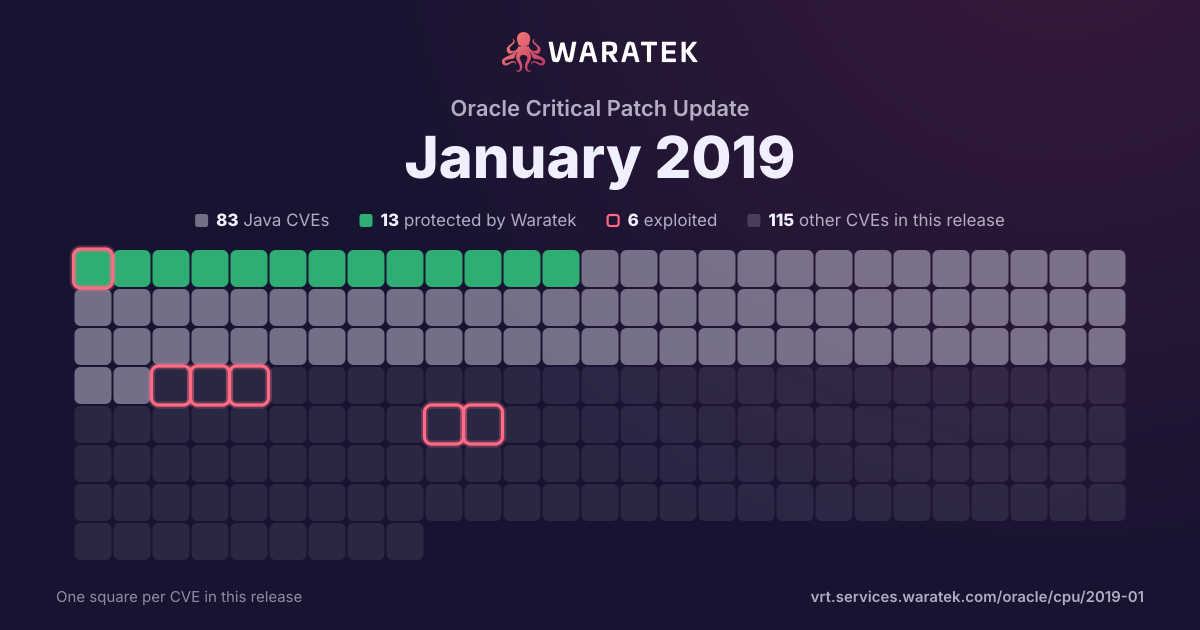
By status
13Protected by Waratek1Mitigation candidate69No exploit published34Outside Waratek scope81Not applicable
6Exploited, marked by the ring
No exploit published. For 67 of them, Oracle's security advisory is the source of public detail.
Protected by Waratek. Waratek RASP can block exploitation of these on systems that have not applied the patch yet.
Overview 198 matches · 83 in Waratek scope · 13 protected · 6 exploited · 1 CISA KEV · 10 public PoC · 10 EPSS ≥ 0.5
198matches
83in Waratek scope41.9%
13protected6.6%
6exploited3.0%
1CISA KEV0.5%
10public PoC5.1%
10EPSS ≥ 0.55.1%
Protected by Waratek
13
6.6%
Rule in development
0
0.0%
Mitigation candidate
1
0.5%
No exploit published
69
34.8%
Outside Waratek scope
34
17.2%
Not applicable
81
40.9%
Withdrawn CVE
0
0.0%
blocked by ARMR today
13
6.6%
partly blocked
0
0.0%
not blocked
185
93.4%
not established
0
0.0%
unrecorded
0
0.0%
split by
peak 158 / year
20164
Protected by Waratek2
Outside Waratek scope2
Critical2
High2
blocked by ARMR today2
not blocked2
No public exploit4
201711
Protected by Waratek3
No exploit published1
Not applicable7
Critical3
High6
Medium2
blocked by ARMR today3
not blocked8
Exploited1
Working exploit published1
No public exploit9
201824
Protected by Waratek5
No exploit published4
Outside Waratek scope7
Not applicable8
Critical8
High8
Medium8
blocked by ARMR today5
not blocked19
Exploited5
Working exploit published2
Forecast only2
No public exploit15
2019158
Protected by Waratek3
Mitigation candidate1
No exploit published63
Outside Waratek scope25
Not applicable66
Critical3
High45
Medium99
Low11
blocked by ARMR today3
not blocked155
Working exploit published1
Proof of concept only1
No public exploit156
20200
20210
20220
20230
20241
No exploit published1
High1
not blocked1
No public exploit1
201620172018201920202021202220232024
| CVE | Severity | Published▾ | Status | Exploitation | Description |
|---|---|---|---|---|---|
| CVE-2019-2448 | Medium | 2019-01-16 | Not applicable | No public exploit | Vulnerability in the Oracle VM VirtualBox component of Oracle Virtualization (subcomponent: Core). Supported versions that are affected are prior to 5.2.24 and prior to 6.0.2. Easily exploitable vulnerability allows low privileged attacker with logon to the infrastructure where Oracle VM VirtualBox executes to compromise Oracle VM VirtualBox. Successful attacks of this vulnerability can result in unauthorized access to critical data or complete access to all Oracle VM VirtualBox accessible data. CVSS 3.0 Base Score 5.5 (Confidentiality impacts). CVSS Vector: (CVSS:3.0/AV:L/AC:L/PR:L/UI:N/S:U/C:H/I:N/A:N). |
| CVE-2019-2447 | High | 2019-01-16 | No exploit published | No public exploit | Vulnerability in the Oracle Partner Management component of Oracle E-Business Suite (subcomponent: Partner Detail). Supported versions that are affected are 12.1.1, 12.1.2, 12.1.3, 12.2.3, 12.2.4, 12.2.5, 12.2.6, 12.2.7 and 12.2.8. Easily exploitable vulnerability allows unauthenticated attacker with network access via HTTP to compromise Oracle Partner Management. Successful attacks require human interaction from a person other than the attacker and while the vulnerability is in Oracle Partner Management, attacks may significantly impact additional products. Successful attacks of this vulnerability can result in unauthorized access to critical data or complete access to all Oracle Partner Management accessible data as well as unauthorized update, insert or delete access to some of Oracle Partner Management accessible data. CVSS 3.0 Base Score 8.2 (Confidentiality and Integrity impacts). CVSS Vector: (CVSS:3.0/AV:N/AC:L/PR:N/UI:R/S:C/C:H/I:L/A:N). |
| CVE-2019-2446 | Medium | 2019-01-16 | Not applicable | No public exploit | Vulnerability in the Oracle VM VirtualBox component of Oracle Virtualization (subcomponent: Core). Supported versions that are affected are prior to 5.2.24 and prior to 6.0.2. Easily exploitable vulnerability allows low privileged attacker with logon to the infrastructure where Oracle VM VirtualBox executes to compromise Oracle VM VirtualBox. Successful attacks of this vulnerability can result in unauthorized access to critical data or complete access to all Oracle VM VirtualBox accessible data. CVSS 3.0 Base Score 5.5 (Confidentiality impacts). CVSS Vector: (CVSS:3.0/AV:L/AC:L/PR:L/UI:N/S:U/C:H/I:N/A:N). |
| CVE-2019-2445 | High | 2019-01-16 | No exploit published | No public exploit | Vulnerability in the Oracle Content Manager component of Oracle E-Business Suite (subcomponent: Cover Letter). Supported versions that are affected are 12.1.1, 12.1.2, 12.1.3, 12.2.3, 12.2.4, 12.2.5, 12.2.6, 12.2.7 and 12.2.8. Easily exploitable vulnerability allows unauthenticated attacker with network access via HTTP to compromise Oracle Content Manager. Successful attacks require human interaction from a person other than the attacker and while the vulnerability is in Oracle Content Manager, attacks may significantly impact additional products. Successful attacks of this vulnerability can result in unauthorized access to critical data or complete access to all Oracle Content Manager accessible data as well as unauthorized update, insert or delete access to some of Oracle Content Manager accessible data. CVSS 3.0 Base Score 8.2 (Confidentiality and Integrity impacts). CVSS Vector: (CVSS:3.0/AV:N/AC:L/PR:N/UI:R/S:C/C:H/I:L/A:N). |
| CVE-2019-2444 | High | 2019-01-16 | Outside Waratek scope | No public exploit | Vulnerability in the Core RDBMS component of Oracle Database Server. Supported versions that are affected are 12.2.0.1 and 18c. Easily exploitable vulnerability allows low privileged attacker having Local Logon privilege with logon to the infrastructure where Core RDBMS executes to compromise Core RDBMS. Successful attacks require human interaction from a person other than the attacker and while the vulnerability is in Core RDBMS, attacks may significantly impact additional products. Successful attacks of this vulnerability can result in takeover of Core RDBMS. CVSS 3.0 Base Score 8.2 (Confidentiality, Integrity and Availability impacts). CVSS Vector: (CVSS:3.0/AV:L/AC:L/PR:L/UI:R/S:C/C:H/I:H/A:H). |
| CVE-2019-2443 | High | 2019-01-16 | No exploit published | No public exploit | Vulnerability in the PeopleSoft Enterprise PeopleTools component of Oracle PeopleSoft Products (subcomponent: XML Publisher). Supported versions that are affected are 8.55, 8.56 and 8.57. Easily exploitable vulnerability allows high privileged attacker with network access via HTTP to compromise PeopleSoft Enterprise PeopleTools. Successful attacks of this vulnerability can result in takeover of PeopleSoft Enterprise PeopleTools. CVSS 3.0 Base Score 7.2 (Confidentiality, Integrity and Availability impacts). CVSS Vector: (CVSS:3.0/AV:N/AC:L/PR:H/UI:N/S:U/C:H/I:H/A:H). |
| CVE-2019-2442 | Medium | 2019-01-16 | No exploit published | No public exploit | Vulnerability in the PeopleSoft Enterprise PeopleTools component of Oracle PeopleSoft Products (subcomponent: Fluid Core). Supported versions that are affected are 8.55, 8.56 and 8.57. Easily exploitable vulnerability allows unauthenticated attacker with network access via HTTP to compromise PeopleSoft Enterprise PeopleTools. Successful attacks require human interaction from a person other than the attacker and while the vulnerability is in PeopleSoft Enterprise PeopleTools, attacks may significantly impact additional products. Successful attacks of this vulnerability can result in unauthorized update, insert or delete access to some of PeopleSoft Enterprise PeopleTools accessible data as well as unauthorized read access to a subset of PeopleSoft Enterprise PeopleTools accessible data. CVSS 3.0 Base Score 6.1 (Confidentiality and Integrity impacts). CVSS Vector: (CVSS:3.0/AV:N/AC:L/PR:N/UI:R/S:C/C:L/I:L/A:N). |
| CVE-2019-2441 | Medium | 2019-01-16 | No exploit published | No public exploit | Vulnerability in the Oracle WebLogic Server component of Oracle Fusion Middleware (subcomponent: Application Container - JavaEE). The supported version that is affected is 12.2.1.3. Easily exploitable vulnerability allows unauthenticated attacker with network access via HTTP to compromise Oracle WebLogic Server. Successful attacks of this vulnerability can result in unauthorized read access to a subset of Oracle WebLogic Server accessible data. CVSS 3.0 Base Score 5.3 (Confidentiality impacts). CVSS Vector: (CVSS:3.0/AV:N/AC:L/PR:N/UI:N/S:U/C:L/I:N/A:N). |
| CVE-2019-2440 | High | 2019-01-16 | No exploit published | No public exploit | Vulnerability in the Oracle Marketing component of Oracle E-Business Suite (subcomponent: User Interface). Supported versions that are affected are 12.1.1, 12.1.2, 12.1.3, 12.2.3, 12.2.4, 12.2.5, 12.2.6, 12.2.7 and 12.2.8. Easily exploitable vulnerability allows unauthenticated attacker with network access via HTTP to compromise Oracle Marketing. Successful attacks require human interaction from a person other than the attacker and while the vulnerability is in Oracle Marketing, attacks may significantly impact additional products. Successful attacks of this vulnerability can result in unauthorized access to critical data or complete access to all Oracle Marketing accessible data as well as unauthorized update, insert or delete access to some of Oracle Marketing accessible data. CVSS 3.0 Base Score 8.2 (Confidentiality and Integrity impacts). CVSS Vector: (CVSS:3.0/AV:N/AC:L/PR:N/UI:R/S:C/C:H/I:L/A:N). |
| CVE-2019-2439 | Medium | 2019-01-16 | No exploit published | No public exploit | Vulnerability in the PeopleSoft Enterprise PeopleTools component of Oracle PeopleSoft Products (subcomponent: Portal). Supported versions that are affected are 8.55, 8.56 and 8.57. Easily exploitable vulnerability allows unauthenticated attacker with network access via HTTP to compromise PeopleSoft Enterprise PeopleTools. Successful attacks require human interaction from a person other than the attacker and while the vulnerability is in PeopleSoft Enterprise PeopleTools, attacks may significantly impact additional products. Successful attacks of this vulnerability can result in unauthorized update, insert or delete access to some of PeopleSoft Enterprise PeopleTools accessible data as well as unauthorized read access to a subset of PeopleSoft Enterprise PeopleTools accessible data. CVSS 3.0 Base Score 6.1 (Confidentiality and Integrity impacts). CVSS Vector: (CVSS:3.0/AV:N/AC:L/PR:N/UI:R/S:C/C:L/I:L/A:N). |
| CVE-2019-2438 | Medium | 2019-01-16 | No exploit published | No public exploit | Vulnerability in the Oracle Web Cache component of Oracle Fusion Middleware (subcomponent: ESI/Partial Page Caching). The supported version that is affected is 11.1.1.9.0. Difficult to exploit vulnerability allows unauthenticated attacker with network access via HTTP to compromise Oracle Web Cache. Successful attacks require human interaction from a person other than the attacker and while the vulnerability is in Oracle Web Cache, attacks may significantly impact additional products. Successful attacks of this vulnerability can result in unauthorized access to critical data or complete access to all Oracle Web Cache accessible data as well as unauthorized update, insert or delete access to some of Oracle Web Cache accessible data. CVSS 3.0 Base Score 6.9 (Confidentiality and Integrity impacts). CVSS Vector: (CVSS:3.0/AV:N/AC:H/PR:N/UI:R/S:C/C:H/I:L/A:N). |
| CVE-2019-2437 | High | 2019-01-16 | Not applicable | No public exploit | Vulnerability in the Oracle Solaris component of Oracle Sun Systems Products Suite (subcomponent: Kernel). The supported version that is affected is 11. Easily exploitable vulnerability allows unauthenticated attacker with network access via TCP to compromise Oracle Solaris. Successful attacks of this vulnerability can result in unauthorized ability to cause a hang or frequently repeatable crash (complete DOS) of Oracle Solaris. CVSS 3.0 Base Score 7.5 (Availability impacts). CVSS Vector: (CVSS:3.0/AV:N/AC:L/PR:N/UI:N/S:U/C:N/I:N/A:H). |
| CVE-2019-2436 | Medium | 2019-01-16 | Outside Waratek scope | No public exploit | Vulnerability in the MySQL Server component of Oracle MySQL (subcomponent: Server: Replication). Supported versions that are affected are 8.0.13 and prior. Easily exploitable vulnerability allows high privileged attacker with network access via multiple protocols to compromise MySQL Server. Successful attacks of this vulnerability can result in unauthorized ability to cause a hang or frequently repeatable crash (complete DOS) of MySQL Server as well as unauthorized update, insert or delete access to some of MySQL Server accessible data. CVSS 3.0 Base Score 5.5 (Integrity and Availability impacts). CVSS Vector: (CVSS:3.0/AV:N/AC:L/PR:H/UI:N/S:U/C:N/I:L/A:H). |
| CVE-2019-2435 | High | 2019-01-16 | Outside Waratek scope | No public exploit | Vulnerability in the MySQL Connectors component of Oracle MySQL (subcomponent: Connector/Python). Supported versions that are affected are 8.0.13 and prior and 2.1.8 and prior. Easily exploitable vulnerability allows unauthenticated attacker with network access via TLS to compromise MySQL Connectors. Successful attacks require human interaction from a person other than the attacker. Successful attacks of this vulnerability can result in unauthorized creation, deletion or modification access to critical data or all MySQL Connectors accessible data as well as unauthorized access to critical data or complete access to all MySQL Connectors accessible data. CVSS 3.0 Base Score 8.1 (Confidentiality and Integrity impacts). CVSS Vector: (CVSS:3.0/AV:N/AC:L/PR:N/UI:R/S:U/C:H/I:H/A:N). |
| CVE-2019-2434 | Medium | 2019-01-16 | Outside Waratek scope | No public exploit | Vulnerability in the MySQL Server component of Oracle MySQL (subcomponent: Server: Parser). Supported versions that are affected are 5.7.24 and prior and 8.0.13 and prior. Easily exploitable vulnerability allows low privileged attacker with network access via multiple protocols to compromise MySQL Server. Successful attacks of this vulnerability can result in unauthorized ability to cause a hang or frequently repeatable crash (complete DOS) of MySQL Server. CVSS 3.0 Base Score 6.5 (Availability impacts). CVSS Vector: (CVSS:3.0/AV:N/AC:L/PR:L/UI:N/S:U/C:N/I:N/A:H). |
| CVE-2019-2433 | High | 2019-01-16 | No exploit published | No public exploit | Vulnerability in the PeopleSoft Enterprise PeopleTools component of Oracle PeopleSoft Products (subcomponent: XML Publisher). Supported versions that are affected are 8.55, 8.56 and 8.57. Easily exploitable vulnerability allows high privileged attacker with network access via HTTP to compromise PeopleSoft Enterprise PeopleTools. Successful attacks of this vulnerability can result in takeover of PeopleSoft Enterprise PeopleTools. CVSS 3.0 Base Score 7.2 (Confidentiality, Integrity and Availability impacts). CVSS Vector: (CVSS:3.0/AV:N/AC:L/PR:H/UI:N/S:U/C:H/I:H/A:H). |
| CVE-2019-2432 | Medium | 2019-01-16 | No exploit published | No public exploit | Vulnerability in the Oracle Argus Safety component of Oracle Health Sciences Applications (subcomponent: Login). Supported versions that are affected are 8.1 and 8.2. Difficult to exploit vulnerability allows low privileged attacker with network access via HTTP to compromise Oracle Argus Safety. While the vulnerability is in Oracle Argus Safety, attacks may significantly impact additional products. Successful attacks of this vulnerability can result in unauthorized update, insert or delete access to some of Oracle Argus Safety accessible data as well as unauthorized read access to a subset of Oracle Argus Safety accessible data. CVSS 3.0 Base Score 4.9 (Confidentiality and Integrity impacts). CVSS Vector: (CVSS:3.0/AV:N/AC:H/PR:L/UI:N/S:C/C:L/I:L/A:N). |
| CVE-2019-2431 | Medium | 2019-01-16 | No exploit published | No public exploit | Vulnerability in the Oracle Argus Safety component of Oracle Health Sciences Applications (subcomponent: Console). Supported versions that are affected are 8.1 and 8.2. Difficult to exploit vulnerability allows unauthenticated attacker with network access via HTTP to compromise Oracle Argus Safety. Successful attacks require human interaction from a person other than the attacker and while the vulnerability is in Oracle Argus Safety, attacks may significantly impact additional products. Successful attacks of this vulnerability can result in unauthorized creation, deletion or modification access to critical data or all Oracle Argus Safety accessible data. CVSS 3.0 Base Score 6.1 (Integrity impacts). CVSS Vector: (CVSS:3.0/AV:N/AC:H/PR:N/UI:R/S:C/C:N/I:H/A:N). |
| CVE-2019-2430 | Medium | 2019-01-16 | No exploit published | No public exploit | Vulnerability in the Oracle Argus Safety component of Oracle Health Sciences Applications (subcomponent: Console). Supported versions that are affected are 8.1 and 8.2. Easily exploitable vulnerability allows low privileged attacker with network access via HTTP to compromise Oracle Argus Safety. Successful attacks of this vulnerability can result in unauthorized access to critical data or complete access to all Oracle Argus Safety accessible data. CVSS 3.0 Base Score 6.5 (Confidentiality impacts). CVSS Vector: (CVSS:3.0/AV:N/AC:L/PR:L/UI:N/S:U/C:H/I:N/A:N). |
| CVE-2019-2429 | High | 2019-01-16 | Not applicable | No public exploit | Vulnerability in the Oracle Outside In Technology component of Oracle Fusion Middleware (subcomponent: Outside In Filters). Supported versions that are affected are 8.5.3 and 8.5.4. Easily exploitable vulnerability allows unauthenticated attacker with network access via HTTP to compromise Oracle Outside In Technology. Successful attacks require human interaction from a person other than the attacker. Successful attacks of this vulnerability can result in unauthorized ability to cause a hang or frequently repeatable crash (complete DOS) of Oracle Outside In Technology and unauthorized read access to a subset of Oracle Outside In Technology accessible data. Note: Outside In Technology is a suite of software development kits (SDKs). The protocol and CVSS score depend on the software that uses the Outside In Technology code. The CVSS score assumes that the software passes data received over a network directly to Outside In Technology code, but if data is not received over a network the CVSS score may be lower. CVSS 3.0 Base Score 7.1 (Confidentiality and Availability impacts). CVSS Vector: (CVSS:3.0/AV:N/AC:L/PR:N/UI:R/S:U/C:L/I:N/A:H). |
| CVE-2019-2427 | Medium | 2019-01-16 | No exploit published | No public exploit | Vulnerability in the Oracle WebCenter Portal component of Oracle Fusion Middleware (subcomponent: WebCenter Spaces Application). Supported versions that are affected are 11.1.1.9.0 and 12.2.1.3.0. Easily exploitable vulnerability allows unauthenticated attacker with network access via HTTP to compromise Oracle WebCenter Portal. Successful attacks of this vulnerability can result in unauthorized update, insert or delete access to some of Oracle WebCenter Portal accessible data. CVSS 3.0 Base Score 5.3 (Integrity impacts). CVSS Vector: (CVSS:3.0/AV:N/AC:L/PR:N/UI:N/S:U/C:N/I:L/A:N). |
| CVE-2019-2426 | Low | 2019-01-16 | Protected by Waratek | No public exploit | Vulnerability in the Java SE component of Oracle Java SE (subcomponent: Networking). Supported versions that are affected are Java SE: 7u201, 8u192 and 11.0.1; Java SE Embedded: 8u191. Difficult to exploit vulnerability allows unauthenticated attacker with network access via multiple protocols to compromise Java SE. Successful attacks of this vulnerability can result in unauthorized read access to a subset of Java SE accessible data. Note: This vulnerability applies to Java deployments, typically in clients running sandboxed Java Web Start applications or sandboxed Java applets (in Java SE 8), that load and run untrusted code (e.g., code that comes from the internet) and rely on the Java sandbox for security. This vulnerability can also be exploited by using APIs in the specified Component, e.g., through a web service which supplies data to the APIs. CVSS 3.0 Base Score 3.7 (Confidentiality impacts). CVSS Vector: (CVSS:3.0/AV:N/AC:H/PR:N/UI:N/S:U/C:L/I:N/A:N). |
| CVE-2019-2425 | Medium | 2019-01-16 | No exploit published | No public exploit | Vulnerability in the Oracle Hospitality Reporting and Analytics component of Oracle Food and Beverage Applications. The supported version that is affected is 9.1.0. Easily exploitable vulnerability allows unauthenticated attacker with network access via HTTP to compromise Oracle Hospitality Reporting and Analytics. Successful attacks of this vulnerability can result in unauthorized update, insert or delete access to some of Oracle Hospitality Reporting and Analytics accessible data as well as unauthorized read access to a subset of Oracle Hospitality Reporting and Analytics accessible data. CVSS 3.0 Base Score 6.5 (Confidentiality and Integrity impacts). CVSS Vector: (CVSS:3.0/AV:N/AC:L/PR:N/UI:N/S:U/C:L/I:L/A:N). |
| CVE-2019-2423 | Medium | 2019-01-16 | No exploit published | No public exploit | Vulnerability in the PeopleSoft Enterprise PeopleTools component of Oracle PeopleSoft Products (subcomponent: PIA Search). Supported versions that are affected are 8.55, 8.56 and 8.57. Easily exploitable vulnerability allows unauthenticated attacker with network access via HTTP to compromise PeopleSoft Enterprise PeopleTools. Successful attacks require human interaction from a person other than the attacker and while the vulnerability is in PeopleSoft Enterprise PeopleTools, attacks may significantly impact additional products. Successful attacks of this vulnerability can result in unauthorized update, insert or delete access to some of PeopleSoft Enterprise PeopleTools accessible data as well as unauthorized read access to a subset of PeopleSoft Enterprise PeopleTools accessible data. CVSS 3.0 Base Score 6.1 (Confidentiality and Integrity impacts). CVSS Vector: (CVSS:3.0/AV:N/AC:L/PR:N/UI:R/S:C/C:L/I:L/A:N). |
| CVE-2019-2422 | Low | 2019-01-16 | Outside Waratek scope | No public exploit | Vulnerability in the Java SE component of Oracle Java SE (subcomponent: Libraries). Supported versions that are affected are Java SE: 7u201, 8u192 and 11.0.1; Java SE Embedded: 8u191. Difficult to exploit vulnerability allows unauthenticated attacker with network access via multiple protocols to compromise Java SE. Successful attacks require human interaction from a person other than the attacker. Successful attacks of this vulnerability can result in unauthorized read access to a subset of Java SE accessible data. Note: This vulnerability applies to Java deployments, typically in clients running sandboxed Java Web Start applications or sandboxed Java applets (in Java SE 8), that load and run untrusted code (e.g., code that comes from the internet) and rely on the Java sandbox for security. This vulnerability does not apply to Java deployments, typically in servers, that load and run only trusted code (e.g., code installed by an administrator). CVSS 3.0 Base Score 3.1 (Confidentiality impacts). CVSS Vector: (CVSS:3.0/AV:N/AC:H/PR:N/UI:R/S:U/C:L/I:N/A:N). |
| CVE-2019-2421 | Medium | 2019-01-16 | No exploit published | No public exploit | Vulnerability in the PeopleSoft Enterprise HCM eProfile Manager Desktop component of Oracle PeopleSoft Products (subcomponent: Guided Self Service). The supported version that is affected is 9.2. Easily exploitable vulnerability allows unauthenticated attacker with network access via HTTP to compromise PeopleSoft Enterprise HCM eProfile Manager Desktop. Successful attacks require human interaction from a person other than the attacker and while the vulnerability is in PeopleSoft Enterprise HCM eProfile Manager Desktop, attacks may significantly impact additional products. Successful attacks of this vulnerability can result in unauthorized update, insert or delete access to some of PeopleSoft Enterprise HCM eProfile Manager Desktop accessible data as well as unauthorized read access to a subset of PeopleSoft Enterprise HCM eProfile Manager Desktop accessible data. CVSS 3.0 Base Score 6.1 (Confidentiality and Integrity impacts). CVSS Vector: (CVSS:3.0/AV:N/AC:L/PR:N/UI:R/S:C/C:L/I:L/A:N). |
| CVE-2019-2420 | Medium | 2019-01-16 | Outside Waratek scope | No public exploit | Vulnerability in the MySQL Server component of Oracle MySQL (subcomponent: Server: Optimizer). Supported versions that are affected are 5.7.24 and prior and 8.0.13 and prior. Easily exploitable vulnerability allows high privileged attacker with network access via multiple protocols to compromise MySQL Server. Successful attacks of this vulnerability can result in unauthorized ability to cause a hang or frequently repeatable crash (complete DOS) of MySQL Server. CVSS 3.0 Base Score 4.9 (Availability impacts). CVSS Vector: (CVSS:3.0/AV:N/AC:L/PR:H/UI:N/S:U/C:N/I:N/A:H). |
| CVE-2019-2419 | Medium | 2019-01-16 | No exploit published | No public exploit | Vulnerability in the PeopleSoft Enterprise CC Common Application Objects component of Oracle PeopleSoft Products (subcomponent: Form and Approval Builder). The supported version that is affected is 9.2. Easily exploitable vulnerability allows low privileged attacker with network access via HTTP to compromise PeopleSoft Enterprise CC Common Application Objects. Successful attacks require human interaction from a person other than the attacker and while the vulnerability is in PeopleSoft Enterprise CC Common Application Objects, attacks may significantly impact additional products. Successful attacks of this vulnerability can result in unauthorized update, insert or delete access to some of PeopleSoft Enterprise CC Common Application Objects accessible data as well as unauthorized read access to a subset of PeopleSoft Enterprise CC Common Application Objects accessible data. Note: This Enterprise Common Component is used by all PeopleSoft Application products. Please refer to the <a target="_blank" href="https://support.oracle.com/rs?type=doc&id=2487756.1">MOS Note Doc ID 2493366.1 for patch information. CVSS 3.0 Base Score 5.4 (Confidentiality and Integrity impacts). CVSS Vector: (CVSS:3.0/AV:N/AC:L/PR:L/UI:R/S:C/C:L/I:L/A:N). |
| CVE-2019-2418 | Medium | 2019-01-16 | No exploit published | No public exploit | Vulnerability in the Oracle WebLogic Server component of Oracle Fusion Middleware (subcomponent: WLS Core Components). Supported versions that are affected are 10.3.6.0, 12.1.3.0 and 12.2.1.3. Difficult to exploit vulnerability allows unauthenticated attacker with network access via T3 to compromise Oracle WebLogic Server. While the vulnerability is in Oracle WebLogic Server, attacks may significantly impact additional products. Successful attacks of this vulnerability can result in unauthorized update, insert or delete access to some of Oracle WebLogic Server accessible data as well as unauthorized read access to a subset of Oracle WebLogic Server accessible data and unauthorized ability to cause a partial denial of service (partial DOS) of Oracle WebLogic Server. CVSS 3.0 Base Score 6.5 (Confidentiality, Integrity and Availability impacts). CVSS Vector: (CVSS:3.0/AV:N/AC:H/PR:N/UI:N/S:C/C:L/I:L/A:L). |
| CVE-2019-2417 | Medium | 2019-01-16 | No exploit published | No public exploit | Vulnerability in the PeopleSoft Enterprise PeopleTools component of Oracle PeopleSoft Products (subcomponent: Performance Monitor). Supported versions that are affected are 8.55, 8.56 and 8.57. Easily exploitable vulnerability allows unauthenticated attacker with network access via HTTP to compromise PeopleSoft Enterprise PeopleTools. Successful attacks of this vulnerability can result in unauthorized update, insert or delete access to some of PeopleSoft Enterprise PeopleTools accessible data as well as unauthorized read access to a subset of PeopleSoft Enterprise PeopleTools accessible data. CVSS 3.0 Base Score 6.5 (Confidentiality and Integrity impacts). CVSS Vector: (CVSS:3.0/AV:N/AC:L/PR:N/UI:N/S:U/C:L/I:L/A:N). |
| CVE-2019-2416 | High | 2019-01-16 | No exploit published | No public exploit | Vulnerability in the PeopleSoft Enterprise PeopleTools component of Oracle PeopleSoft Products (subcomponent: Application Server). Supported versions that are affected are 8.55, 8.56 and 8.57. Easily exploitable vulnerability allows low privileged attacker with network access via HTTP to compromise PeopleSoft Enterprise PeopleTools. Successful attacks of this vulnerability can result in takeover of PeopleSoft Enterprise PeopleTools. CVSS 3.0 Base Score 8.8 (Confidentiality, Integrity and Availability impacts). CVSS Vector: (CVSS:3.0/AV:N/AC:L/PR:L/UI:N/S:U/C:H/I:H/A:H). |
| CVE-2019-2415 | Medium | 2019-01-16 | No exploit published | No public exploit | Vulnerability in the Hyperion BI+ component of Oracle Hyperion (subcomponent: Foundation UI & Servlets). The supported version that is affected is 11.1.2.4. Easily exploitable vulnerability allows high privileged attacker with network access via HTTP to compromise Hyperion BI+. Successful attacks require human interaction from a person other than the attacker. Successful attacks of this vulnerability can result in unauthorized update, insert or delete access to some of Hyperion BI+ accessible data as well as unauthorized read access to a subset of Hyperion BI+ accessible data and unauthorized ability to cause a partial denial of service (partial DOS) of Hyperion BI+. CVSS 3.0 Base Score 4.3 (Confidentiality, Integrity and Availability impacts). CVSS Vector: (CVSS:3.0/AV:N/AC:L/PR:H/UI:R/S:U/C:L/I:L/A:L). |
| CVE-2019-2414 | High | 2019-01-16 | Not applicable | No public exploit | Vulnerability in the Oracle HTTP Server component of Oracle Fusion Middleware (subcomponent: Web Listener). The supported version that is affected is 12.2.1.3. Easily exploitable vulnerability allows low privileged attacker with logon to the infrastructure where Oracle HTTP Server executes to compromise Oracle HTTP Server. Successful attacks of this vulnerability can result in takeover of Oracle HTTP Server. CVSS 3.0 Base Score 7.8 (Confidentiality, Integrity and Availability impacts). CVSS Vector: (CVSS:3.0/AV:L/AC:L/PR:L/UI:N/S:U/C:H/I:H/A:H). |
| CVE-2019-2413 | Medium | 2019-01-16 | Mitigation candidate | Working exploit published | Vulnerability in the Oracle Reports Developer component of Oracle Fusion Middleware (subcomponent: Valid Session). The supported version that is affected is 12.2.1.3. Easily exploitable vulnerability allows unauthenticated attacker with network access via HTTP to compromise Oracle Reports Developer. Successful attacks require human interaction from a person other than the attacker and while the vulnerability is in Oracle Reports Developer, attacks may significantly impact additional products. Successful attacks of this vulnerability can result in unauthorized update, insert or delete access to some of Oracle Reports Developer accessible data as well as unauthorized read access to a subset of Oracle Reports Developer accessible data. CVSS 3.0 Base Score 6.1 (Confidentiality and Integrity impacts). CVSS Vector: (CVSS:3.0/AV:N/AC:L/PR:N/UI:R/S:C/C:L/I:L/A:N). |
| CVE-2019-2412 | Medium | 2019-01-16 | Not applicable | No public exploit | Vulnerability in the Sun ZFS Storage Appliance Kit (AK) component of Oracle Sun Systems Products Suite (subcomponent: Object Store). The supported version that is affected is prior to 8.8.2. Difficult to exploit vulnerability allows high privileged attacker with logon to the infrastructure where Sun ZFS Storage Appliance Kit (AK) executes to compromise Sun ZFS Storage Appliance Kit (AK). Successful attacks of this vulnerability can result in takeover of Sun ZFS Storage Appliance Kit (AK). CVSS 3.0 Base Score 6.4 (Confidentiality, Integrity and Availability impacts). CVSS Vector: (CVSS:3.0/AV:L/AC:H/PR:H/UI:N/S:U/C:H/I:H/A:H). |
| CVE-2019-2411 | High | 2019-01-16 | No exploit published | No public exploit | Vulnerability in the Oracle Hospitality Cruise Shipboard Property Management System component of Oracle Hospitality Applications (subcomponent: SPMS Suite). The supported version that is affected is 8.0.8. Easily exploitable vulnerability allows low privileged attacker with network access via TCP to compromise Oracle Hospitality Cruise Shipboard Property Management System. Successful attacks require human interaction from a person other than the attacker and while the vulnerability is in Oracle Hospitality Cruise Shipboard Property Management System, attacks may significantly impact additional products. Successful attacks of this vulnerability can result in unauthorized ability to cause a hang or frequently repeatable crash (complete DOS) of Oracle Hospitality Cruise Shipboard Property Management System as well as unauthorized update, insert or delete access to some of Oracle Hospitality Cruise Shipboard Property Management System accessible data. CVSS 3.0 Base Score 7.6 (Integrity and Availability impacts). CVSS Vector: (CVSS:3.0/AV:N/AC:L/PR:L/UI:R/S:C/C:N/I:L/A:H). |
| CVE-2019-2410 | Medium | 2019-01-16 | No exploit published | No public exploit | Vulnerability in the Oracle Hospitality Cruise Shipboard Property Management System component of Oracle Hospitality Applications (subcomponent: DGS RES Online, FMS Sender, FMS Receiver, OHC WPF Security). The supported version that is affected is 8.0.8. Easily exploitable vulnerability allows unauthenticated attacker with logon to the infrastructure where Oracle Hospitality Cruise Shipboard Property Management System executes to compromise Oracle Hospitality Cruise Shipboard Property Management System. Successful attacks of this vulnerability can result in unauthorized update, insert or delete access to some of Oracle Hospitality Cruise Shipboard Property Management System accessible data as well as unauthorized read access to a subset of Oracle Hospitality Cruise Shipboard Property Management System accessible data. CVSS 3.0 Base Score 5.1 (Confidentiality and Integrity impacts). CVSS Vector: (CVSS:3.0/AV:L/AC:L/PR:N/UI:N/S:U/C:L/I:L/A:N). |
| CVE-2019-2409 | Medium | 2019-01-16 | No exploit published | No public exploit | Vulnerability in the Oracle Hospitality Cruise Shipboard Property Management System component of Oracle Hospitality Applications (subcomponent: SPMS Suite). The supported version that is affected is 8.0.8. Easily exploitable vulnerability allows low privileged attacker with logon to the infrastructure where Oracle Hospitality Cruise Shipboard Property Management System executes to compromise Oracle Hospitality Cruise Shipboard Property Management System. Successful attacks require human interaction from a person other than the attacker and while the vulnerability is in Oracle Hospitality Cruise Shipboard Property Management System, attacks may significantly impact additional products. Successful attacks of this vulnerability can result in unauthorized ability to cause a hang or frequently repeatable crash (complete DOS) of Oracle Hospitality Cruise Shipboard Property Management System as well as unauthorized update, insert or delete access to some of Oracle Hospitality Cruise Shipboard Property Management System accessible data and unauthorized read access to a subset of Oracle Hospitality Cruise Shipboard Property Management System accessible data. CVSS 3.0 Base Score 7.3 (Confidentiality, Integrity and Availability impacts). CVSS Vector: (CVSS:3.0/AV:L/AC:L/PR:L/UI:R/S:C/C:L/I:L/A:H). |
| CVE-2019-2408 | Medium | 2019-01-16 | No exploit published | No public exploit | Vulnerability in the PeopleSoft Enterprise PeopleTools component of Oracle PeopleSoft Products (subcomponent: Feeds). Supported versions that are affected are 8.55, 8.56 and 8.57. Easily exploitable vulnerability allows unauthenticated attacker with network access via HTTP to compromise PeopleSoft Enterprise PeopleTools. Successful attacks require human interaction from a person other than the attacker. Successful attacks of this vulnerability can result in unauthorized read access to a subset of PeopleSoft Enterprise PeopleTools accessible data. CVSS 3.0 Base Score 4.3 (Confidentiality impacts). CVSS Vector: (CVSS:3.0/AV:N/AC:L/PR:N/UI:R/S:U/C:L/I:N/A:N). |
| CVE-2019-2407 | Medium | 2019-01-16 | No exploit published | No public exploit | Vulnerability in the Oracle Hospitality Reporting and Analytics component of Oracle Food and Beverage Applications. The supported version that is affected is 9.1.0. Easily exploitable vulnerability allows low privileged attacker having Report privilege with logon to the infrastructure where Oracle Hospitality Reporting and Analytics executes to compromise Oracle Hospitality Reporting and Analytics. Successful attacks of this vulnerability can result in unauthorized access to critical data or complete access to all Oracle Hospitality Reporting and Analytics accessible data as well as unauthorized update, insert or delete access to some of Oracle Hospitality Reporting and Analytics accessible data. CVSS 3.0 Base Score 6.1 (Confidentiality and Integrity impacts). CVSS Vector: (CVSS:3.0/AV:L/AC:L/PR:L/UI:N/S:U/C:H/I:L/A:N). |
| CVE-2019-2406 | High | 2019-01-16 | Outside Waratek scope | No public exploit | Vulnerability in the Core RDBMS component of Oracle Database Server. Supported versions that are affected are 12.1.0.2, 12.2.0.1 and 18c. Easily exploitable vulnerability allows high privileged attacker having Create Session, Execute Catalog Role privilege with network access via Oracle Net to compromise Core RDBMS. Successful attacks of this vulnerability can result in takeover of Core RDBMS. CVSS 3.0 Base Score 7.2 (Confidentiality, Integrity and Availability impacts). CVSS Vector: (CVSS:3.0/AV:N/AC:L/PR:H/UI:N/S:U/C:H/I:H/A:H). |
| CVE-2019-2405 | High | 2019-01-16 | No exploit published | No public exploit | Vulnerability in the PeopleSoft Enterprise PeopleTools component of Oracle PeopleSoft Products (subcomponent: Security). Supported versions that are affected are 8.55, 8.56 and 8.57. Difficult to exploit vulnerability allows low privileged attacker with network access via HTTP to compromise PeopleSoft Enterprise PeopleTools. Successful attacks of this vulnerability can result in takeover of PeopleSoft Enterprise PeopleTools. CVSS 3.0 Base Score 7.5 (Confidentiality, Integrity and Availability impacts). CVSS Vector: (CVSS:3.0/AV:N/AC:H/PR:L/UI:N/S:U/C:H/I:H/A:H). |
| CVE-2019-2404 | Medium | 2019-01-16 | No exploit published | No public exploit | Vulnerability in the PeopleSoft Enterprise PeopleTools component of Oracle PeopleSoft Products (subcomponent: Portal). Supported versions that are affected are 8.55, 8.56 and 8.57. Easily exploitable vulnerability allows unauthenticated attacker with network access via HTTP to compromise PeopleSoft Enterprise PeopleTools. Successful attacks of this vulnerability can result in unauthorized read access to a subset of PeopleSoft Enterprise PeopleTools accessible data. CVSS 3.0 Base Score 5.3 (Confidentiality impacts). CVSS Vector: (CVSS:3.0/AV:N/AC:L/PR:N/UI:N/S:U/C:L/I:N/A:N). |
| CVE-2019-2403 | Medium | 2019-01-16 | Not applicable | No public exploit | Vulnerability in the Oracle Hospitality Simphony component of Oracle Food and Beverage Applications. The supported version that is affected is 2.10. Easily exploitable vulnerability allows unauthenticated attacker with network access via HTTP to compromise Oracle Hospitality Simphony. Successful attacks of this vulnerability can result in unauthorized update, insert or delete access to some of Oracle Hospitality Simphony accessible data as well as unauthorized read access to a subset of Oracle Hospitality Simphony accessible data. CVSS 3.0 Base Score 6.5 (Confidentiality and Integrity impacts). CVSS Vector: (CVSS:3.0/AV:N/AC:L/PR:N/UI:N/S:U/C:L/I:L/A:N). |
| CVE-2019-2402 | High | 2019-01-16 | Not applicable | No public exploit | Vulnerability in the Oracle Hospitality Simphony component of Oracle Food and Beverage Applications. The supported version that is affected is 2.10. Difficult to exploit vulnerability allows unauthenticated attacker with network access via HTTP to compromise Oracle Hospitality Simphony. Successful attacks of this vulnerability can result in unauthorized creation, deletion or modification access to critical data or all Oracle Hospitality Simphony accessible data as well as unauthorized access to critical data or complete access to all Oracle Hospitality Simphony accessible data and unauthorized ability to cause a partial denial of service (partial DOS) of Oracle Hospitality Simphony. CVSS 3.0 Base Score 7.7 (Confidentiality, Integrity and Availability impacts). CVSS Vector: (CVSS:3.0/AV:N/AC:H/PR:N/UI:N/S:U/C:H/I:H/A:L). |
| CVE-2019-2401 | High | 2019-01-16 | No exploit published | No public exploit | Vulnerability in the Oracle Hospitality Reporting and Analytics component of Oracle Food and Beverage Applications. The supported version that is affected is 9.1.0. Easily exploitable vulnerability allows low privileged attacker having Admin privilege with network access via HTTP to compromise Oracle Hospitality Reporting and Analytics. Successful attacks of this vulnerability can result in unauthorized creation, deletion or modification access to critical data or all Oracle Hospitality Reporting and Analytics accessible data as well as unauthorized access to critical data or complete access to all Oracle Hospitality Reporting and Analytics accessible data. CVSS 3.0 Base Score 8.1 (Confidentiality and Integrity impacts). CVSS Vector: (CVSS:3.0/AV:N/AC:L/PR:L/UI:N/S:U/C:H/I:H/A:N). |
| CVE-2019-2400 | High | 2019-01-16 | No exploit published | No public exploit | Vulnerability in the Oracle iStore component of Oracle E-Business Suite (subcomponent: User Registration). Supported versions that are affected are 12.1.1, 12.1.2, 12.1.3, 12.2.3, 12.2.4, 12.2.5, 12.2.6, 12.2.7 and 12.2.8. Easily exploitable vulnerability allows unauthenticated attacker with network access via HTTP to compromise Oracle iStore. Successful attacks require human interaction from a person other than the attacker and while the vulnerability is in Oracle iStore, attacks may significantly impact additional products. Successful attacks of this vulnerability can result in unauthorized access to critical data or complete access to all Oracle iStore accessible data as well as unauthorized update, insert or delete access to some of Oracle iStore accessible data. CVSS 3.0 Base Score 8.2 (Confidentiality and Integrity impacts). CVSS Vector: (CVSS:3.0/AV:N/AC:L/PR:N/UI:R/S:C/C:H/I:L/A:N). |
| CVE-2019-2399 | Medium | 2019-01-16 | No exploit published | No public exploit | Vulnerability in the Oracle Communications Diameter Signaling Router (DSR) component of Oracle Communications Applications (subcomponent: Security). The supported version that is affected is prior to 8.3. Easily exploitable vulnerability allows unauthenticated attacker with network access via HTTP to compromise Oracle Communications Diameter Signaling Router (DSR). Successful attacks of this vulnerability can result in unauthorized read access to a subset of Oracle Communications Diameter Signaling Router (DSR) accessible data and unauthorized ability to cause a partial denial of service (partial DOS) of Oracle Communications Diameter Signaling Router (DSR). CVSS 3.0 Base Score 6.5 (Confidentiality and Availability impacts). CVSS Vector: (CVSS:3.0/AV:N/AC:L/PR:N/UI:N/S:U/C:L/I:N/A:L). |
| CVE-2019-2398 | Medium | 2019-01-16 | No exploit published | No public exploit | Vulnerability in the Oracle WebLogic Server component of Oracle Fusion Middleware (subcomponent: WLS - Deployment). Supported versions that are affected are 10.3.6.0, 12.1.3.0 and 12.2.1.3. Easily exploitable vulnerability allows low privileged attacker with network access via HTTP to compromise Oracle WebLogic Server. Successful attacks of this vulnerability can result in unauthorized update, insert or delete access to some of Oracle WebLogic Server accessible data. CVSS 3.0 Base Score 4.3 (Integrity impacts). CVSS Vector: (CVSS:3.0/AV:N/AC:L/PR:L/UI:N/S:U/C:N/I:L/A:N). |
| CVE-2019-2397 | Medium | 2019-01-16 | No exploit published | No public exploit | Vulnerability in the Oracle Hospitality Reporting and Analytics component of Oracle Food and Beverage Applications. The supported version that is affected is 9.1.0. Easily exploitable vulnerability allows low privileged attacker having Report privilege with logon to the infrastructure where Oracle Hospitality Reporting and Analytics executes to compromise Oracle Hospitality Reporting and Analytics. Successful attacks of this vulnerability can result in unauthorized update, insert or delete access to some of Oracle Hospitality Reporting and Analytics accessible data as well as unauthorized read access to a subset of Oracle Hospitality Reporting and Analytics accessible data. CVSS 3.0 Base Score 4.4 (Confidentiality and Integrity impacts). CVSS Vector: (CVSS:3.0/AV:L/AC:L/PR:L/UI:N/S:U/C:L/I:L/A:N). |
| CVE-2019-2396 | Medium | 2019-01-16 | No exploit published | No public exploit | Vulnerability in the Oracle CRM Technical Foundation component of Oracle E-Business Suite (subcomponent: Messages). Supported versions that are affected are 12.1.3, 12.2.3, 12.2.4, 12.2.5, 12.2.6, 12.2.7 and 12.2.8. Easily exploitable vulnerability allows unauthenticated attacker with network access via HTTP to compromise Oracle CRM Technical Foundation. Successful attacks require human interaction from a person other than the attacker and while the vulnerability is in Oracle CRM Technical Foundation, attacks may significantly impact additional products. Successful attacks of this vulnerability can result in unauthorized update, insert or delete access to some of Oracle CRM Technical Foundation accessible data. CVSS 3.0 Base Score 4.7 (Integrity impacts). CVSS Vector: (CVSS:3.0/AV:N/AC:L/PR:N/UI:R/S:C/C:N/I:L/A:N). |
| CVE-2019-2395 | Medium | 2019-01-16 | No exploit published | No public exploit | Vulnerability in the Oracle WebLogic Server component of Oracle Fusion Middleware (subcomponent: WLS - Web Services). The supported version that is affected is 10.3.6.0. Easily exploitable vulnerability allows low privileged attacker with network access via HTTP to compromise Oracle WebLogic Server. Successful attacks of this vulnerability can result in unauthorized read access to a subset of Oracle WebLogic Server accessible data and unauthorized ability to cause a partial denial of service (partial DOS) of Oracle WebLogic Server. CVSS 3.0 Base Score 5.4 (Confidentiality and Availability impacts). CVSS Vector: (CVSS:3.0/AV:N/AC:L/PR:L/UI:N/S:U/C:L/I:N/A:L). |
| CVE-2018-3311 | High | 2019-01-16 | No exploit published | No public exploit | Vulnerability in the Oracle Retail Xstore Payment component of Oracle Retail Applications (subcomponent: Security). The supported version that is affected is 3.3. Easily exploitable vulnerability allows unauthenticated attacker with network access via HTTP to compromise Oracle Retail Xstore Payment. Successful attacks of this vulnerability can result in unauthorized access to critical data or complete access to all Oracle Retail Xstore Payment accessible data as well as unauthorized update, insert or delete access to some of Oracle Retail Xstore Payment accessible data and unauthorized ability to cause a partial denial of service (partial DOS) of Oracle Retail Xstore Payment. CVSS 3.0 Base Score 8.6 (Confidentiality, Integrity and Availability impacts). CVSS Vector: (CVSS:3.0/AV:N/AC:L/PR:N/UI:N/S:U/C:H/I:L/A:L). |
| CVE-2018-3309 | High | 2019-01-16 | Not applicable | No public exploit | Vulnerability in the Oracle VM VirtualBox component of Oracle Virtualization (subcomponent: Core). The supported version that is affected is prior to 5.2.22. Easily exploitable vulnerability allows high privileged attacker with logon to the infrastructure where Oracle VM VirtualBox executes to compromise Oracle VM VirtualBox. While the vulnerability is in Oracle VM VirtualBox, attacks may significantly impact additional products. Successful attacks of this vulnerability can result in takeover of Oracle VM VirtualBox. CVSS 3.0 Base Score 8.2 (Confidentiality, Integrity and Availability impacts). CVSS Vector: (CVSS:3.0/AV:L/AC:L/PR:H/UI:N/S:C/C:H/I:H/A:H). |
| CVE-2018-3305 | Medium | 2019-01-16 | No exploit published | No public exploit | Vulnerability in the Oracle Application Testing Suite component of Oracle Enterprise Manager Products Suite (subcomponent: Load Testing for Web Apps). Supported versions that are affected are 12.5.0.3, 13.1.0.1, 13.2.0.1 and 13.3.0.1. Easily exploitable vulnerability allows low privileged attacker with network access via HTTP to compromise Oracle Application Testing Suite. Successful attacks of this vulnerability can result in unauthorized update, insert or delete access to some of Oracle Application Testing Suite accessible data as well as unauthorized read access to a subset of Oracle Application Testing Suite accessible data and unauthorized ability to cause a partial denial of service (partial DOS) of Oracle Application Testing Suite. CVSS 3.0 Base Score 6.3 (Confidentiality, Integrity and Availability impacts). CVSS Vector: (CVSS:3.0/AV:N/AC:L/PR:L/UI:N/S:U/C:L/I:L/A:L). |
| CVE-2018-3304 | Medium | 2019-01-16 | No exploit published | No public exploit | Vulnerability in the Oracle Application Testing Suite component of Oracle Enterprise Manager Products Suite (subcomponent: Load Testing for Web Apps). Supported versions that are affected are 12.5.0.3, 13.1.0.1, 13.2.0.1 and 13.3.0.1. Easily exploitable vulnerability allows unauthenticated attacker with network access via HTTP to compromise Oracle Application Testing Suite. Successful attacks of this vulnerability can result in unauthorized update, insert or delete access to some of Oracle Application Testing Suite accessible data and unauthorized ability to cause a partial denial of service (partial DOS) of Oracle Application Testing Suite. CVSS 3.0 Base Score 6.5 (Integrity and Availability impacts). CVSS Vector: (CVSS:3.0/AV:N/AC:L/PR:N/UI:N/S:U/C:N/I:L/A:L). |
| CVE-2018-3303 | Medium | 2019-01-16 | No exploit published | No public exploit | Vulnerability in the Enterprise Manager Base Platform component of Oracle Enterprise Manager Products Suite (subcomponent: EM Console). Supported versions that are affected are 13.2 and 13.3. Easily exploitable vulnerability allows unauthenticated attacker with network access via HTTP to compromise Enterprise Manager Base Platform. Successful attacks of this vulnerability can result in unauthorized update, insert or delete access to some of Enterprise Manager Base Platform accessible data as well as unauthorized read access to a subset of Enterprise Manager Base Platform accessible data. CVSS 3.0 Base Score 6.5 (Confidentiality and Integrity impacts). CVSS Vector: (CVSS:3.0/AV:N/AC:L/PR:N/UI:N/S:U/C:L/I:L/A:N). |
| CVE-2018-3125 | Medium | 2019-01-16 | No exploit published | No public exploit | Vulnerability in the Oracle Retail Merchandising System component of Oracle Retail Applications (subcomponent: Security (SQL Logger)). The supported version that is affected is 14.1. Easily exploitable vulnerability allows unauthenticated attacker with network access via HTTP to compromise Oracle Retail Merchandising System. Successful attacks of this vulnerability can result in unauthorized update, insert or delete access to some of Oracle Retail Merchandising System accessible data as well as unauthorized read access to a subset of Oracle Retail Merchandising System accessible data. CVSS 3.0 Base Score 6.5 (Confidentiality and Integrity impacts). CVSS Vector: (CVSS:3.0/AV:N/AC:L/PR:N/UI:N/S:U/C:L/I:L/A:N). |
| CVE-2018-14718 | Critical | 2019-01-02 | Protected by Waratek | No public exploit | FasterXML jackson-databind 2.x before 2.9.7 might allow remote attackers to execute arbitrary code by leveraging failure to block the slf4j-ext class from polymorphic deserialization. |
| CVE-2018-0734 | Medium | 2018-10-30 | Outside Waratek scope | No public exploit | The OpenSSL DSA signature algorithm has been shown to be vulnerable to a timing side channel attack. An attacker could use variations in the signing algorithm to recover the private key. Fixed in OpenSSL 1.1.1a (Affected 1.1.1). Fixed in OpenSSL 1.1.0j (Affected 1.1.0-1.1.0i). Fixed in OpenSSL 1.0.2q (Affected 1.0.2-1.0.2p). |
| CVE-2018-3147 | Medium | 2018-10-17 | Not applicable | No public exploit | Vulnerability in the Oracle Outside In Technology component of Oracle Fusion Middleware (subcomponent: Outside In Filters). The supported version that is affected are 8.5.3 and 8.5.4. Easily exploitable vulnerability allows unauthenticated attacker with network access via HTTP to compromise Oracle Outside In Technology. Successful attacks require human interaction from a person other than the attacker. Successful attacks of this vulnerability can result in unauthorized read access to a subset of Oracle Outside In Technology accessible data. Note: Outside In Technology is a suite of software development kits (SDKs). The protocol and CVSS score depend on the software that uses the Outside In Technology code. The CVSS score assumes that the software passes data received over a network directly to Outside In Technology code, but if data is not received over a network the CVSS score may be lower. CVSS 3.0 Base Score 4.3 (Confidentiality impacts). CVSS Vector: (CVSS:3.0/AV:N/AC:L/PR:N/UI:R/S:U/C:L/I:N/A:N). |
| CVE-2018-10933 | Critical | 2018-10-17 | Outside Waratek scope | Working exploit published | A vulnerability was found in libssh's server-side state machine before versions 0.7.6 and 0.8.4. A malicious client could create channels without first performing authentication, resulting in unauthorized access. |
| CVE-2018-9206 | Critical | 2018-10-11 | Not applicable | Exploited | Unauthenticated arbitrary file upload vulnerability in Blueimp jQuery-File-Upload <= v9.22.0 |
| CVE-2018-11784 | Medium | 2018-10-04 | Outside Waratek scope | Working exploit published | When the default servlet in Apache Tomcat versions 9.0.0.M1 to 9.0.11, 8.5.0 to 8.5.33 and 7.0.23 to 7.0.90 returned a redirect to a directory (e.g. redirecting to '/foo/' when the user requested '/foo') a specially crafted URL could be used to cause the redirect to be generated to any URI of the attackers choice. |
| CVE-2018-11763 | Medium | 2018-09-25 | Outside Waratek scope | Exploited | In Apache HTTP Server 2.4.17 to 2.4.34, by sending continuous, large SETTINGS frames a client can occupy a connection, server thread and CPU time without any connection timeout coming to effect. This affects only HTTP/2 connections. A possible mitigation is to not enable the h2 protocol. |
| CVE-2018-11775 | High | 2018-09-10 | No exploit published | No public exploit | TLS hostname verification when using the Apache ActiveMQ Client before 5.15.6 was missing which could make the client vulnerable to a MITM attack between a Java application using the ActiveMQ client and the ActiveMQ server. This is now enabled by default. |
| CVE-2018-11776 | High | 2018-08-22 | Protected by Waratek | Exploited | Apache Struts versions 2.3 to 2.3.34 and 2.5 to 2.5.16 suffer from possible Remote Code Execution when alwaysSelectFullNamespace is true (either by user or a plugin like Convention Plugin) and then: results are used with no namespace and in same time, its upper package have no or wildcard namespace and similar to results, same possibility when using url tag which doesn't have value and action set and in same time, its upper package have no or wildcard namespace. |
| CVE-2018-1000632 | High | 2018-08-20 | Protected by Waratek | No public exploit | dom4j version prior to version 2.1.1 contains a CWE-91: XML Injection vulnerability in Class: Element. Methods: addElement, addAttribute that can result in an attacker tampering with XML documents through XML injection. This attack appear to be exploitable via an attacker specifying attributes or elements in the XML document. This vulnerability appears to have been fixed in 2.1.1 or later. |
| CVE-2018-3646 | Medium | 2018-08-14 | Not applicable | No public exploit | Systems with microprocessors utilizing speculative execution and address translations may allow unauthorized disclosure of information residing in the L1 data cache to an attacker with local user access with guest OS privilege via a terminal page fault and a side-channel analysis. |
| CVE-2018-5390 | High | 2018-08-06 | Not applicable | Forecast only | Linux kernel versions 4.9+ can be forced to make very expensive calls to tcp_collapse_ofo_queue() and tcp_prune_ofo_queue() for every incoming packet which can lead to a denial of service. |
| CVE-2016-9583 | High | 2018-08-01 | Not applicable | No public exploit | An out-of-bounds heap read vulnerability was found in the jpc_pi_nextpcrl() function of jasper before 2.0.6 when processing crafted input. |
| CVE-2017-7658 | Critical | 2018-06-26 | No exploit published | No public exploit | In Eclipse Jetty Server, versions 9.2.x and older, 9.3.x (all non HTTP/1.x configurations), and 9.4.x (all HTTP/1.x configurations), when presented with two content-lengths headers, Jetty ignored the second. When presented with a content-length and a chunked encoding header, the content-length was ignored (as per RFC 2616). If an intermediary decided on the shorter length, but still passed on the longer body, then body content could be interpreted by Jetty as a pipelined request. If the intermediary was imposing authorization, the fake pipelined request would bypass that authorization. |
| CVE-2018-0732 | High | 2018-06-12 | Not applicable | No public exploit | During key agreement in a TLS handshake using a DH(E) based ciphersuite a malicious server can send a very large prime value to the client. This will cause the client to spend an unreasonably long period of time generating a key for this prime resulting in a hang until the client has finished. This could be exploited in a Denial Of Service attack. Fixed in OpenSSL 1.1.0i-dev (Affected 1.1.0-1.1.0h). Fixed in OpenSSL 1.0.2p-dev (Affected 1.0.2-1.0.2o). |
| CVE-2018-1000180 | High | 2018-06-05 | No exploit published | No public exploit | Bouncy Castle BC 1.54 - 1.59, BC-FJA 1.0.0, BC-FJA 1.0.1 and earlier have a flaw in the Low-level interface to RSA key pair generator, specifically RSA Key Pairs generated in low-level API with added certainty may have less M-R tests than expected. This appears to be fixed in versions BC 1.60 beta 4 and later, BC-FJA 1.0.2 and later. |
| CVE-2018-8013 | Critical | 2018-05-24 | Protected by Waratek | No public exploit | In Apache Batik 1.x before 1.10, when deserializing subclass of `AbstractDocument`, the class takes a string from the inputStream as the class name which then use it to call the no-arg constructor of the class. Fix was to check the class type before calling newInstance in deserialization. |
| CVE-2018-1000300 | Critical | 2018-05-24 | Not applicable | No public exploit | curl version curl 7.54.1 to and including curl 7.59.0 contains a CWE-122: Heap-based Buffer Overflow vulnerability in denial of service and more that can result in curl might overflow a heap based memory buffer when closing down an FTP connection with very long server command replies.. This vulnerability appears to have been fixed in curl < 7.54.1 and curl >= 7.60.0. |
| CVE-2018-3639 | Medium | 2018-05-22 | Outside Waratek scope | Exploited | Systems with microprocessors utilizing speculative execution and speculative execution of memory reads before the addresses of all prior memory writes are known may allow unauthorized disclosure of information to an attacker with local user access via a side-channel analysis, aka Speculative Store Bypass (SSB), Variant 4. |
| CVE-2018-11212 | Medium | 2018-05-16 | Not applicable | No public exploit | An issue was discovered in libjpeg 9a and 9d. The alloc_sarray function in jmemmgr.c allows remote attackers to cause a denial of service (divide-by-zero error) via a crafted file. |
| CVE-2018-1258 | High | 2018-05-11 | No exploit published | No public exploit | Spring Framework version 5.0.5 when used in combination with any versions of Spring Security contains an authorization bypass when using method security. An unauthorized malicious user can gain unauthorized access to methods that should be restricted. |
| CVE-2018-1275 | Critical | 2018-04-11 | Protected by Waratek | Forecast only | Spring Framework, versions 5.0 prior to 5.0.5 and versions 4.3 prior to 4.3.16 and older unsupported versions, allow applications to expose STOMP over WebSocket endpoints with a simple, in-memory STOMP broker through the spring-messaging module. A malicious user (or attacker) can craft a message to the broker that can lead to a remote code execution attack. This CVE addresses the partial fix for CVE-2018-1270 in the 4.3.x branch of the Spring Framework. |
| CVE-2017-15095 | Critical | 2018-02-06 | Protected by Waratek | No public exploit | A deserialization flaw was discovered in the jackson-databind in versions before 2.8.10 and 2.9.1, which could allow an unauthenticated user to perform code execution by sending the maliciously crafted input to the readValue method of the ObjectMapper. This issue extends the previous flaw CVE-2017-7525 by blacklisting more classes that could be used maliciously. |
| CVE-2016-6814 | Critical | 2018-01-18 | Outside Waratek scope | No public exploit | When an application with unsupported Codehaus versions of Groovy from 1.7.0 to 2.4.3, Apache Groovy 2.4.4 to 2.4.7 on classpath uses standard Java serialization mechanisms, e.g. to communicate between servers or to store local data, it was possible for an attacker to bake a special serialized object that will execute code directly when deserialized. All applications which rely on serialization and do not isolate the code which deserializes objects were subject to this vulnerability. |
| CVE-2015-9251 | Medium | 2018-01-18 | Outside Waratek scope | Exploited | jQuery before 3.0.0 is vulnerable to Cross-site Scripting (XSS) attacks when a cross-domain Ajax request is performed without the dataType option, causing text/javascript responses to be executed. |
| CVE-2017-14735 | Medium | 2017-09-25 | Protected by Waratek | No public exploit | OWASP AntiSamy before 1.5.7 allows XSS via HTML5 entities, as demonstrated by use of : to construct a javascript: URL. |
| CVE-2017-9798 | High | 2017-09-18 | Not applicable | Exploited | Apache httpd allows remote attackers to read secret data from process memory if the Limit directive can be set in a user's .htaccess file, or if httpd.conf has certain misconfigurations, aka Optionsbleed. This affects the Apache HTTP Server through 2.2.34 and 2.4.x through 2.4.27. The attacker sends an unauthenticated OPTIONS HTTP request when attempting to read secret data. This is a use-after-free issue and thus secret data is not always sent, and the specific data depends on many factors including configuration. Exploitation with .htaccess can be blocked with a patch to the ap_limit_section function in server/core.c. |
| CVE-2017-14229 | High | 2017-09-09 | Not applicable | No public exploit | There is an infinite loop in the jpc_dec_tileinit function in jpc/jpc_dec.c of Jasper 2.0.13. It will lead to a remote denial of service attack. |
| CVE-2017-13745 | High | 2017-08-29 | Not applicable | No public exploit | There is a reachable assertion abort in the function jpc_dec_process_sot() in jpc/jpc_dec.c in JasPer 2.0.12 that will lead to a remote denial of service attack by triggering an unexpected jpc_ppmstabtostreams return value, a different vulnerability than CVE-2018-9154. |
| CVE-2017-0379 | High | 2017-08-29 | Not applicable | No public exploit | Libgcrypt before 1.8.1 does not properly consider Curve25519 side-channel attacks, which makes it easier for attackers to discover a secret key, related to cipher/ecc.c and mpi/ec.c. |
| CVE-2016-4000 | Critical | 2017-07-06 | Protected by Waratek | No public exploit | Jython before 2.7.1rc1 allows attackers to execute arbitrary code via a crafted serialized PyFunction object. |
| CVE-2017-5645 | Critical | 2017-04-17 | Protected by Waratek | Working exploit published | In Apache Log4j 2.x before 2.8.2, when using the TCP socket server or UDP socket server to receive serialized log events from another application, a specially crafted binary payload can be sent that, when deserialized, can execute arbitrary code. |
| CVE-2015-8965 | Critical | 2017-04-06 | No exploit published | No public exploit | Rogue Wave JViews before 8.8 patch 21 and 8.9 before patch 1 allows remote attackers to execute arbitrary Java code that exists in the classpath, such as test code or administration code. The issue exists because the ilog.views.faces.IlvFacesController servlet in jviews-framework-all.jar does not require explicit configuration of servlets that can be called. |
| CVE-2016-9392 | Medium | 2017-03-23 | Not applicable | No public exploit | The calcstepsizes function in jpc_dec.c in JasPer before 1.900.17 allows remote attackers to cause a denial of service (assertion failure) via a crafted file. |
| CVE-2016-9389 | High | 2017-03-23 | Not applicable | No public exploit | The jpc_irct and jpc_iict functions in jpc_mct.c in JasPer before 1.900.14 allow remote attackers to cause a denial of service (assertion failure). |
| CVE-2016-5684 | High | 2017-01-06 | Not applicable | No public exploit | An exploitable out-of-bounds write vulnerability exists in the XMP image handling functionality of the FreeImage library. A specially crafted XMP file can cause an arbitrary memory overwrite resulting in code execution. An attacker can provide a malicious image to trigger this vulnerability. |
| CVE-2016-1000031 | Critical | 2016-10-25 | Protected by Waratek | No public exploit | Apache Commons FileUpload before 1.3.3 DiskFileItem File Manipulation Remote Code Execution |
| CVE-2015-1832 | Critical | 2016-10-03 | Outside Waratek scope | No public exploit | XML external entity (XXE) vulnerability in the SqlXmlUtil code in Apache Derby before 10.12.1.1, when a Java Security Manager is not in place, allows context-dependent attackers to read arbitrary files or cause a denial of service (resource consumption) via vectors involving XmlVTI and the XML datatype. |
| CVE-2016-0635 | High | 2016-07-21 | Outside Waratek scope | No public exploit | Unspecified vulnerability in the Enterprise Manager Ops Center component in Oracle Enterprise Manager Grid Control 12.1.4, 12.2.2, and 12.3.2; the Oracle Health Sciences Information Manager component in Oracle Health Sciences Applications 1.2.8.3, 2.0.2.3, and 3.0.1.0; the Oracle Healthcare Master Person Index component in Oracle Health Sciences Applications 2.0.12, 3.0.0, and 4.0.1; the Oracle Documaker component in Oracle Insurance Applications before 12.5; the Oracle Insurance Calculation Engine component in Oracle Insurance Applications 9.7.1, 10.1.2, and 10.2.2; the Oracle Insurance Policy Administration J2EE and Oracle Insurance Rules Palette components in Oracle Insurance Applications 9.6.1, 9.7.1, 10.0.1, 10.1.2, 10.2.0, and 10.2.2; the Oracle Retail Integration Bus component in Oracle Retail Applications 15.0; the Oracle Retail Order Broker component in Oracle Retail Applications 5.1, 5.2, and 15.0; the Primavera Contract Management component in Oracle Primavera Products Suite 14.2; the Primavera P6 Enterprise Project Portfolio Management component in Oracle Primavera Products Suite 8.2, 8.3, 8.4, 15.1, 15.2, and 16.1; the Oracle Financial Services Analytical Applications Infrastructure component in Oracle Financial Services Applications 8.0.0, 8.0.1, 8.0.2, and 8.0.3; the Oracle Commerce Guided Search / Oracle Commerce Experience Manager component in Oracle Commerce 3.1.1, 3.1.2, 11.0, 11.1, and 11.2; the Oracle Agile PLM component in Oracle Supply Chain Products Suite 9.3.4 and 9.3.5; the Oracle Communications BRM - Elastic Charging Engine 11.2.0.0.0 and 11.3.0.0.0; the Oracle Enterprise Repository Enterprise Repository 12.1.3.0.0; the Oracle Financial Services Behavior Detection Platform 8.0.1 and 8.0.2; the Oracle Hyperion Essbase 12.2.1.1; the Oracle Tuxedo System and Applications Monitor (TSAM) 11.1.1.2.0, 11.1.1.2.1, 11.1.1.2.1, 12.1.1.1.0, 12.1.3.0.0, and 12.2.2.0.0; the Oracle Communications WebRTC Session Controller component of Oracle Communications Applications (subcomponent: Security (Spring)) 7.0, 7.1 and 7.2; the Oracle Endeca Information Discovery Integrator 3.2; the Converged Commerce component of Oracle Retail Applications 16.0.1; the Oracle Identity Manager 11.1.2.3.0; Oracle Enterprise Manager for MySQL Database 12.1.0.4; Oracle Retail Invoice Matching 12.0, 13.0, 13.1, 13.2, 14.0, and 14.1; Oracle Communications Performance Intelligence Center (PIC) Software Prior to 10.2.1 and the Oracle Knowledge component of Oracle Siebel CRM (subcomponent: AnswerFlow (Spring Framework)) version 8.5.1.0 - 8.5.1.7 and 8.6.0 allows remote authenticated users to affect confidentiality, integrity, and availability via unknown vectors. |
| CVE-2016-1181 | High | 2016-07-04 | Protected by Waratek | No public exploit | ActionServlet.java in Apache Struts 1 1.x through 1.3.10 mishandles multithreaded access to an ActionForm instance, which allows remote attackers to execute arbitrary code or cause a denial of service (unexpected memory access) via a multipart request, a related issue to CVE-2015-0899. |