
Oracle Critical Patch Update October 2018
Released October 2018 · Oracle's advisory ↗ · ← Critical Patch Update, July 2018 · Critical Patch Update, January 2019 →
226 CVEs in this release, one square each
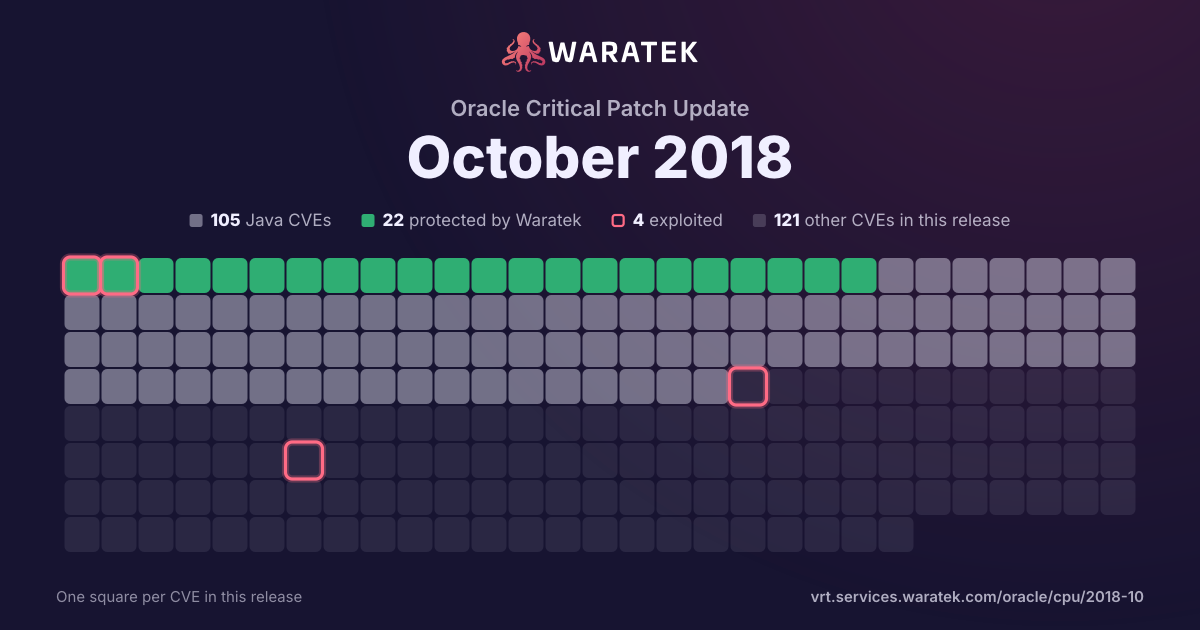
By status
22Protected by Waratek2Mitigation candidate81No exploit published46Outside Waratek scope75Not applicable
4Exploited, marked by the ring
No exploit published. For 81 of them, Oracle's security advisory is the source of public detail.
Protected by Waratek. Waratek RASP can block exploitation of these on systems that have not applied the patch yet.
Overview 32 matches · 4 protected · 1 exploited · 1 CISA KEV · 1 public PoC · 1 EPSS ≥ 0.5
Protected by Waratek
4
12.5%
Rule in development
0
0.0%
Mitigation candidate
0
0.0%
No exploit published
28
87.5%
blocked by ARMR today
4
12.5%
partly blocked
0
0.0%
not blocked
28
87.5%
not established
0
0.0%
unrecorded
0
0.0%
Exploited
1
3.1%
Working exploit published
0
0.0%
Proof of concept only
0
0.0%
Forecast only
0
0.0%
No public exploit
31
96.9%
split by
peak 28 / quarter
Q3 161
Protected by Waratek1
High1
blocked by ARMR today1
No public exploit1
Q4 160
Q1 170
Q2 170
Q3 170
Q4 170
Q1 180
Q2 181
No exploit published1
High1
not blocked1
No public exploit1
Q3 181
Protected by Waratek1
High1
blocked by ARMR today1
Exploited1
Q4 1828
Protected by Waratek1
No exploit published27
High28
blocked by ARMR today1
not blocked27
No public exploit28
Q1 191
Protected by Waratek1
High1
blocked by ARMR today1
No public exploit1
Q3 16Q4 16Q1 17Q2 17Q3 17Q4 17Q1 18Q2 18Q3 18Q4 18Q1 19
| CVE | Severity | Published▾ | Status | Exploitation | Description |
|---|---|---|---|---|---|
| CVE-2018-12023 | High | 2019-03-21 | Protected by Waratek | No public exploit | An issue was discovered in FasterXML jackson-databind prior to 2.7.9.4, 2.8.11.2, and 2.9.6. When Default Typing is enabled (either globally or for a specific property), the service has the Oracle JDBC jar in the classpath, and an attacker can provide an LDAP service to access, it is possible to make the service execute a malicious payload. |
| CVE-2018-3253 | High | 2018-10-17 | No exploit published | No public exploit | Vulnerability in the Oracle Virtual Directory component of Oracle Fusion Middleware (subcomponent: Virtual Directory Manager). Supported versions that are affected are 11.1.1.7.0 and 11.1.1.9.0. Difficult to exploit vulnerability allows low privileged attacker with network access via HTTP to compromise Oracle Virtual Directory. Successful attacks of this vulnerability can result in unauthorized update, insert or delete access to some of Oracle Virtual Directory accessible data as well as unauthorized read access to a subset of Oracle Virtual Directory accessible data and unauthorized ability to cause a partial denial of service (partial DOS) of Oracle Virtual Directory. CVSS 3.0 Base Score 8.5 (Confidentiality, Integrity and Availability impacts). CVSS Vector: (CVSS:3.0/AV:N/AC:H/PR:L/UI:N/S:C/C:H/I:H/A:H). |
| CVE-2018-3246 | High | 2018-10-17 | No exploit published | No public exploit | Vulnerability in the Oracle WebLogic Server component of Oracle Fusion Middleware (subcomponent: WLS - Web Services). Supported versions that are affected are 12.1.3.0 and 12.2.1.3. Easily exploitable vulnerability allows unauthenticated attacker with network access via HTTP to compromise Oracle WebLogic Server. Successful attacks of this vulnerability can result in unauthorized access to critical data or complete access to all Oracle WebLogic Server accessible data. CVSS 3.0 Base Score 7.5 (Confidentiality impacts). CVSS Vector: (CVSS:3.0/AV:N/AC:L/PR:N/UI:N/S:U/C:H/I:N/A:N). |
| CVE-2018-3243 | High | 2018-10-17 | No exploit published | No public exploit | Vulnerability in the Oracle Applications Framework component of Oracle E-Business Suite (subcomponent: None). Supported versions that are affected are 12.1.3, 12.2.3, 12.2.4, 12.2.5 and 12.2.6. Easily exploitable vulnerability allows unauthenticated attacker with network access via HTTP to compromise Oracle Applications Framework. Successful attacks require human interaction from a person other than the attacker and while the vulnerability is in Oracle Applications Framework, attacks may significantly impact additional products. Successful attacks of this vulnerability can result in unauthorized access to critical data or complete access to all Oracle Applications Framework accessible data as well as unauthorized update, insert or delete access to some of Oracle Applications Framework accessible data. CVSS 3.0 Base Score 8.2 (Confidentiality and Integrity impacts). CVSS Vector: (CVSS:3.0/AV:N/AC:L/PR:N/UI:R/S:C/C:H/I:L/A:N). |
| CVE-2018-3242 | High | 2018-10-17 | No exploit published | No public exploit | Vulnerability in the Oracle Marketing component of Oracle E-Business Suite (subcomponent: Marketing Administration). Supported versions that are affected are 12.1.1, 12.1.2, 12.1.3, 12.2.3, 12.2.4, 12.2.5, 12.2.6 and 12.2.7. Easily exploitable vulnerability allows unauthenticated attacker with network access via HTTP to compromise Oracle Marketing. Successful attacks require human interaction from a person other than the attacker and while the vulnerability is in Oracle Marketing, attacks may significantly impact additional products. Successful attacks of this vulnerability can result in unauthorized access to critical data or complete access to all Oracle Marketing accessible data as well as unauthorized update, insert or delete access to some of Oracle Marketing accessible data. CVSS 3.0 Base Score 8.2 (Confidentiality and Integrity impacts). CVSS Vector: (CVSS:3.0/AV:N/AC:L/PR:N/UI:R/S:C/C:H/I:L/A:N). |
| CVE-2018-3235 | High | 2018-10-17 | No exploit published | No public exploit | Vulnerability in the Oracle Applications Manager component of Oracle E-Business Suite (subcomponent: None). Supported versions that are affected are 12.1.3, 12.2.3, 12.2.4, 12.2.5, 12.2.6 and 12.2.7. Easily exploitable vulnerability allows unauthenticated attacker with network access via HTTP to compromise Oracle Applications Manager. Successful attacks require human interaction from a person other than the attacker and while the vulnerability is in Oracle Applications Manager, attacks may significantly impact additional products. Successful attacks of this vulnerability can result in unauthorized access to critical data or complete access to all Oracle Applications Manager accessible data as well as unauthorized update, insert or delete access to some of Oracle Applications Manager accessible data. CVSS 3.0 Base Score 8.2 (Confidentiality and Integrity impacts). CVSS Vector: (CVSS:3.0/AV:N/AC:L/PR:N/UI:R/S:C/C:H/I:L/A:N). |
| CVE-2018-3213 | High | 2018-10-17 | No exploit published | No public exploit | Vulnerability in the Oracle WebLogic Server component of Oracle Fusion Middleware (subcomponent: Docker Images). The supported version that is affected is prior to Docker 12.2.1.3.20180913. Easily exploitable vulnerability allows unauthenticated attacker with network access via T3 to compromise Oracle WebLogic Server. Successful attacks of this vulnerability can result in unauthorized access to critical data or complete access to all Oracle WebLogic Server accessible data. CVSS 3.0 Base Score 7.5 (Confidentiality impacts). CVSS Vector: (CVSS:3.0/AV:N/AC:L/PR:N/UI:N/S:U/C:H/I:N/A:N). |
| CVE-2018-3208 | High | 2018-10-17 | No exploit published | No public exploit | Vulnerability in the Hyperion Data Relationship Management component of Oracle Hyperion (subcomponent: Access and Security). The supported version that is affected is 11.1.2.4.345. Easily exploitable vulnerability allows low privileged attacker with network access via HTTP to compromise Hyperion Data Relationship Management. While the vulnerability is in Hyperion Data Relationship Management, attacks may significantly impact additional products. Successful attacks of this vulnerability can result in unauthorized access to critical data or complete access to all Hyperion Data Relationship Management accessible data. CVSS 3.0 Base Score 7.7 (Confidentiality impacts). CVSS Vector: (CVSS:3.0/AV:N/AC:L/PR:L/UI:N/S:C/C:H/I:N/A:N). |
| CVE-2018-3204 | High | 2018-10-17 | No exploit published | No public exploit | Vulnerability in the Oracle Business Intelligence Enterprise Edition component of Oracle Fusion Middleware (subcomponent: Analytics Server). The supported version that is affected is 12.2.1.3.0. Easily exploitable vulnerability allows unauthenticated attacker with network access via HTTP to compromise Oracle Business Intelligence Enterprise Edition. Successful attacks require human interaction from a person other than the attacker and while the vulnerability is in Oracle Business Intelligence Enterprise Edition, attacks may significantly impact additional products. Successful attacks of this vulnerability can result in unauthorized access to critical data or complete access to all Oracle Business Intelligence Enterprise Edition accessible data as well as unauthorized update, insert or delete access to some of Oracle Business Intelligence Enterprise Edition accessible data. CVSS 3.0 Base Score 8.2 (Confidentiality and Integrity impacts). CVSS Vector: (CVSS:3.0/AV:N/AC:L/PR:N/UI:R/S:C/C:H/I:L/A:N). |
| CVE-2018-3196 | High | 2018-10-17 | No exploit published | No public exploit | Vulnerability in the Oracle Partner Management component of Oracle E-Business Suite (subcomponent: Partner Dashboard). Supported versions that are affected are 12.1.1, 12.1.2, 12.1.3, 12.2.3, 12.2.4, 12.2.5, 12.2.6 and 12.2.7. Easily exploitable vulnerability allows unauthenticated attacker with network access via HTTP to compromise Oracle Partner Management. Successful attacks require human interaction from a person other than the attacker and while the vulnerability is in Oracle Partner Management, attacks may significantly impact additional products. Successful attacks of this vulnerability can result in unauthorized access to critical data or complete access to all Oracle Partner Management accessible data as well as unauthorized update, insert or delete access to some of Oracle Partner Management accessible data. CVSS 3.0 Base Score 8.2 (Confidentiality and Integrity impacts). CVSS Vector: (CVSS:3.0/AV:N/AC:L/PR:N/UI:R/S:C/C:H/I:L/A:N). |
| CVE-2018-3192 | High | 2018-10-17 | No exploit published | No public exploit | Vulnerability in the PeopleSoft Enterprise PeopleTools component of Oracle PeopleSoft Products (subcomponent: Query). Supported versions that are affected are 8.55 and 8.56. Easily exploitable vulnerability allows high privileged attacker with network access via HTTP to compromise PeopleSoft Enterprise PeopleTools. Successful attacks of this vulnerability can result in takeover of PeopleSoft Enterprise PeopleTools. CVSS 3.0 Base Score 7.2 (Confidentiality, Integrity and Availability impacts). CVSS Vector: (CVSS:3.0/AV:N/AC:L/PR:H/UI:N/S:U/C:H/I:H/A:H). |
| CVE-2018-3190 | High | 2018-10-17 | No exploit published | No public exploit | Vulnerability in the Oracle E-Business Intelligence component of Oracle E-Business Suite (subcomponent: Overview Page/Report Rendering). Supported versions that are affected are 12.1.1, 12.1.2 and 12.1.3. Easily exploitable vulnerability allows unauthenticated attacker with network access via HTTP to compromise Oracle E-Business Intelligence. Successful attacks require human interaction from a person other than the attacker and while the vulnerability is in Oracle E-Business Intelligence, attacks may significantly impact additional products. Successful attacks of this vulnerability can result in unauthorized access to critical data or complete access to all Oracle E-Business Intelligence accessible data as well as unauthorized update, insert or delete access to some of Oracle E-Business Intelligence accessible data. CVSS 3.0 Base Score 8.2 (Confidentiality and Integrity impacts). CVSS Vector: (CVSS:3.0/AV:N/AC:L/PR:N/UI:R/S:C/C:H/I:L/A:N). |
| CVE-2018-3189 | High | 2018-10-17 | No exploit published | No public exploit | Vulnerability in the Oracle Customer Interaction History component of Oracle E-Business Suite (subcomponent: Outcome-Result). Supported versions that are affected are 12.1.1, 12.1.2 and 12.1.3. Easily exploitable vulnerability allows unauthenticated attacker with network access via HTTP to compromise Oracle Customer Interaction History. Successful attacks require human interaction from a person other than the attacker and while the vulnerability is in Oracle Customer Interaction History, attacks may significantly impact additional products. Successful attacks of this vulnerability can result in unauthorized access to critical data or complete access to all Oracle Customer Interaction History accessible data as well as unauthorized update, insert or delete access to some of Oracle Customer Interaction History accessible data. CVSS 3.0 Base Score 8.2 (Confidentiality and Integrity impacts). CVSS Vector: (CVSS:3.0/AV:N/AC:L/PR:N/UI:R/S:C/C:H/I:L/A:N). |
| CVE-2018-3188 | High | 2018-10-17 | No exploit published | No public exploit | Vulnerability in the Oracle iStore component of Oracle E-Business Suite (subcomponent: Web interface). Supported versions that are affected are 12.1.1, 12.1.2, 12.1.3, 12.2.3, 12.2.4, 12.2.5, 12.2.6 and 12.2.7. Easily exploitable vulnerability allows unauthenticated attacker with network access via HTTP to compromise Oracle iStore. Successful attacks require human interaction from a person other than the attacker and while the vulnerability is in Oracle iStore, attacks may significantly impact additional products. Successful attacks of this vulnerability can result in unauthorized access to critical data or complete access to all Oracle iStore accessible data as well as unauthorized update, insert or delete access to some of Oracle iStore accessible data. CVSS 3.0 Base Score 8.2 (Confidentiality and Integrity impacts). CVSS Vector: (CVSS:3.0/AV:N/AC:L/PR:N/UI:R/S:C/C:H/I:L/A:N). |
| CVE-2018-3179 | High | 2018-10-17 | No exploit published | No public exploit | Vulnerability in the Oracle Identity Manager component of Oracle Fusion Middleware (subcomponent: Advanced Console). Supported versions that are affected are 11.1.2.3.0 and 12.2.1.3.0. Easily exploitable vulnerability allows unauthenticated attacker with network access via HTTP to compromise Oracle Identity Manager. While the vulnerability is in Oracle Identity Manager, attacks may significantly impact additional products. Successful attacks of this vulnerability can result in unauthorized read access to a subset of Oracle Identity Manager accessible data and unauthorized ability to cause a partial denial of service (partial DOS) of Oracle Identity Manager. CVSS 3.0 Base Score 7.2 (Confidentiality and Availability impacts). CVSS Vector: (CVSS:3.0/AV:N/AC:L/PR:N/UI:N/S:C/C:L/I:N/A:L). |
| CVE-2018-3168 | High | 2018-10-17 | No exploit published | No public exploit | Vulnerability in the Oracle Identity Analytics component of Oracle Fusion Middleware (subcomponent: Core Components). The supported version that is affected is 11.1.1.5.8. Easily exploitable vulnerability allows low privileged attacker with network access via HTTP to compromise Oracle Identity Analytics. Successful attacks of this vulnerability can result in unauthorized creation, deletion or modification access to critical data or all Oracle Identity Analytics accessible data as well as unauthorized read access to a subset of Oracle Identity Analytics accessible data. CVSS 3.0 Base Score 7.1 (Confidentiality and Integrity impacts). CVSS Vector: (CVSS:3.0/AV:N/AC:L/PR:L/UI:N/S:U/C:L/I:H/A:N). |
| CVE-2018-3165 | High | 2018-10-17 | No exploit published | No public exploit | Vulnerability in the PeopleSoft Enterprise PeopleTools component of Oracle PeopleSoft Products (subcomponent: SQR). Supported versions that are affected are 8.55 and 8.56. Easily exploitable vulnerability allows high privileged attacker with network access via HTTP to compromise PeopleSoft Enterprise PeopleTools. Successful attacks of this vulnerability can result in takeover of PeopleSoft Enterprise PeopleTools. CVSS 3.0 Base Score 7.2 (Confidentiality, Integrity and Availability impacts). CVSS Vector: (CVSS:3.0/AV:N/AC:L/PR:H/UI:N/S:U/C:H/I:H/A:H). |
| CVE-2018-3160 | High | 2018-10-17 | No exploit published | No public exploit | Vulnerability in the Oracle Hospitality Cruise Shipboard Property Management System component of Oracle Hospitality Applications (subcomponent: OHC Admin, OHC Management). The supported version that is affected is 8.0. Easily exploitable vulnerability allows high privileged attacker with logon to the infrastructure where Oracle Hospitality Cruise Shipboard Property Management System executes to compromise Oracle Hospitality Cruise Shipboard Property Management System. Successful attacks require human interaction from a person other than the attacker and while the vulnerability is in Oracle Hospitality Cruise Shipboard Property Management System, attacks may significantly impact additional products. Successful attacks of this vulnerability can result in takeover of Oracle Hospitality Cruise Shipboard Property Management System. CVSS 3.0 Base Score 7.7 (Confidentiality, Integrity and Availability impacts). CVSS Vector: (CVSS:3.0/AV:L/AC:L/PR:H/UI:R/S:C/C:H/I:H/A:H). |
| CVE-2018-3152 | High | 2018-10-17 | No exploit published | No public exploit | Vulnerability in the Oracle GlassFish Server component of Oracle Fusion Middleware (subcomponent: Administration). The supported version that is affected is 3.1.2. Easily exploitable vulnerability allows unauthenticated attacker with network access via HTTP to compromise Oracle GlassFish Server. Successful attacks of this vulnerability can result in unauthorized ability to cause a hang or frequently repeatable crash (complete DOS) of Oracle GlassFish Server. CVSS 3.0 Base Score 7.5 (Availability impacts). CVSS Vector: (CVSS:3.0/AV:N/AC:L/PR:N/UI:N/S:U/C:N/I:N/A:H). |
| CVE-2018-3151 | High | 2018-10-17 | No exploit published | No public exploit | Vulnerability in the Oracle iProcurement component of Oracle E-Business Suite (subcomponent: E-Content Manager Catalog). Supported versions that are affected are 12.1.1, 12.1.2, 12.1.3, 12.2.3, 12.2.4, 12.2.5, 12.2.6 and 12.2.7. Easily exploitable vulnerability allows unauthenticated attacker with network access via HTTP to compromise Oracle iProcurement. Successful attacks of this vulnerability can result in unauthorized access to critical data or complete access to all Oracle iProcurement accessible data. CVSS 3.0 Base Score 7.5 (Confidentiality impacts). CVSS Vector: (CVSS:3.0/AV:N/AC:L/PR:N/UI:N/S:U/C:H/I:N/A:N). |
| CVE-2018-3149 | High | 2018-10-17 | Protected by Waratek | No public exploit | Vulnerability in the Java SE, Java SE Embedded, JRockit component of Oracle Java SE (subcomponent: JNDI). Supported versions that are affected are Java SE: 6u201, 7u191, 8u182 and 11; Java SE Embedded: 8u181; JRockit: R28.3.19. Difficult to exploit vulnerability allows unauthenticated attacker with network access via multiple protocols to compromise Java SE, Java SE Embedded, JRockit. Successful attacks require human interaction from a person other than the attacker and while the vulnerability is in Java SE, Java SE Embedded, JRockit, attacks may significantly impact additional products. Successful attacks of this vulnerability can result in takeover of Java SE, Java SE Embedded, JRockit. Note: This vulnerability applies to Java deployments, typically in clients running sandboxed Java Web Start applications or sandboxed Java applets (in Java SE 8), that load and run untrusted code (e.g. code that comes from the internet) and rely on the Java sandbox for security. This vulnerability can also be exploited by using APIs in the specified Component, e.g. through a web service which supplies data to the APIs. CVSS 3.0 Base Score 8.3 (Confidentiality, Integrity and Availability impacts). CVSS Vector: (CVSS:3.0/AV:N/AC:H/PR:N/UI:R/S:C/C:H/I:H/A:H). |
| CVE-2018-3146 | High | 2018-10-17 | No exploit published | No public exploit | Vulnerability in the Oracle iLearning component of Oracle iLearning (subcomponent: Learner Administration). Supported versions that are affected are 6.1 and 6.2. Easily exploitable vulnerability allows unauthenticated attacker with network access via HTTP to compromise Oracle iLearning. Successful attacks require human interaction from a person other than the attacker and while the vulnerability is in Oracle iLearning, attacks may significantly impact additional products. Successful attacks of this vulnerability can result in unauthorized access to critical data or complete access to all Oracle iLearning accessible data as well as unauthorized update, insert or delete access to some of Oracle iLearning accessible data. CVSS 3.0 Base Score 8.2 (Confidentiality and Integrity impacts). CVSS Vector: (CVSS:3.0/AV:N/AC:L/PR:N/UI:R/S:C/C:H/I:L/A:N). |
| CVE-2018-3142 | High | 2018-10-17 | No exploit published | No public exploit | Vulnerability in the Hyperion Essbase Administration Services component of Oracle Hyperion (subcomponent: EAS Console). The supported version that is affected is 11.1.2.4. Easily exploitable vulnerability allows low privileged attacker with network access via HTTP to compromise Hyperion Essbase Administration Services. While the vulnerability is in Hyperion Essbase Administration Services, attacks may significantly impact additional products. Successful attacks of this vulnerability can result in unauthorized access to critical data or complete access to all Hyperion Essbase Administration Services accessible data. CVSS 3.0 Base Score 7.7 (Confidentiality impacts). CVSS Vector: (CVSS:3.0/AV:N/AC:L/PR:L/UI:N/S:C/C:H/I:N/A:N). |
| CVE-2018-3138 | High | 2018-10-17 | No exploit published | No public exploit | Vulnerability in the Oracle Application Object Library component of Oracle E-Business Suite (subcomponent: Attachments / File Upload). Supported versions that are affected are 12.1.3, 12.2.3, 12.2.4, 12.2.5, 12.2.6 and 12.2.7. Easily exploitable vulnerability allows unauthenticated attacker with network access via HTTP to compromise Oracle Application Object Library. Successful attacks require human interaction from a person other than the attacker and while the vulnerability is in Oracle Application Object Library, attacks may significantly impact additional products. Successful attacks of this vulnerability can result in unauthorized access to critical data or complete access to all Oracle Application Object Library accessible data as well as unauthorized update, insert or delete access to some of Oracle Application Object Library accessible data. CVSS 3.0 Base Score 8.2 (Confidentiality and Integrity impacts). CVSS Vector: (CVSS:3.0/AV:N/AC:L/PR:N/UI:R/S:C/C:H/I:L/A:N). |
| CVE-2018-3128 | High | 2018-10-17 | No exploit published | No public exploit | Vulnerability in the Oracle Hospitality Reporting and Analytics component of Oracle Food and Beverage Applications. The supported version that is affected is 9.0. Easily exploitable vulnerability allows low privileged attacker having Report privilege with network access via HTTP to compromise Oracle Hospitality Reporting and Analytics. Successful attacks of this vulnerability can result in unauthorized creation, deletion, or modification access to critical data or all Oracle Hospitality Reporting and Analytics accessible data as well as unauthorized access to critical data or complete access to all Oracle Hospitality Reporting and Analytics accessible data. CVSS 3.0 Base Score 8.1 (Confidentiality and Integrity impacts). CVSS Vector: (CVSS:3.0/AV:N/AC:L/PR:L/UI:N/S:U/C:H/I:H/A:N). |
| CVE-2018-3115 | High | 2018-10-17 | No exploit published | No public exploit | Vulnerability in the Oracle Retail Sales Audit component of Oracle Retail Applications (subcomponent: Operational Insights). Supported versions that are affected are 15.0 and 16.0. Difficult to exploit vulnerability allows low privileged attacker with network access via HTTP to compromise Oracle Retail Sales Audit. While the vulnerability is in Oracle Retail Sales Audit, attacks may significantly impact additional products. Successful attacks of this vulnerability can result in unauthorized access to critical data or complete access to all Oracle Retail Sales Audit accessible data as well as unauthorized update, insert or delete access to some of Oracle Retail Sales Audit accessible data and unauthorized ability to cause a partial denial of service (partial DOS) of Oracle Retail Sales Audit. CVSS 3.0 Base Score 7.7 (Confidentiality, Integrity and Availability impacts). CVSS Vector: (CVSS:3.0/AV:N/AC:H/PR:L/UI:N/S:C/C:H/I:L/A:L). |
| CVE-2018-3011 | High | 2018-10-17 | No exploit published | No public exploit | Vulnerability in the Oracle Trade Management component of Oracle E-Business Suite (subcomponent: User Interface). Supported versions that are affected are 12.1.1, 12.1.2, 12.1.3, 12.2.3, 12.2.4, 12.2.5, 12.2.6 and 12.2.7. Easily exploitable vulnerability allows unauthenticated attacker with network access via HTTP to compromise Oracle Trade Management. Successful attacks require human interaction from a person other than the attacker and while the vulnerability is in Oracle Trade Management, attacks may significantly impact additional products. Successful attacks of this vulnerability can result in unauthorized access to critical data or complete access to all Oracle Trade Management accessible data as well as unauthorized update, insert or delete access to some of Oracle Trade Management accessible data. CVSS 3.0 Base Score 8.2 (Confidentiality and Integrity impacts). CVSS Vector: (CVSS:3.0/AV:N/AC:L/PR:N/UI:R/S:C/C:H/I:L/A:N). |
| CVE-2018-2911 | High | 2018-10-17 | No exploit published | No public exploit | Vulnerability in the Oracle GlassFish Server component of Oracle Fusion Middleware (subcomponent: Java Server Faces). The supported version that is affected is 3.1.2. Easily exploitable vulnerability allows unauthenticated attacker with network access via HTTP to compromise Oracle GlassFish Server. Successful attacks require human interaction from a person other than the attacker. Successful attacks of this vulnerability can result in unauthorized creation, deletion or modification access to critical data or all Oracle GlassFish Server accessible data as well as unauthorized access to critical data or complete access to all Oracle GlassFish Server accessible data and unauthorized ability to cause a partial denial of service (partial DOS) of Oracle GlassFish Server. CVSS 3.0 Base Score 8.3 (Confidentiality, Integrity and Availability impacts). CVSS Vector: (CVSS:3.0/AV:N/AC:L/PR:N/UI:R/S:U/C:H/I:H/A:L). |
| CVE-2018-2889 | High | 2018-10-17 | No exploit published | No public exploit | Vulnerability in the MICROS Retail-J component of Oracle Retail Applications (subcomponent: Internal Operations). The supported version that is affected is 12.1.2. Easily exploitable vulnerability allows unauthenticated attacker with network access via HTTP to compromise MICROS Retail-J. Successful attacks of this vulnerability can result in unauthorized access to critical data or complete access to all MICROS Retail-J accessible data. CVSS 3.0 Base Score 7.5 (Confidentiality impacts). CVSS Vector: (CVSS:3.0/AV:N/AC:L/PR:N/UI:N/S:U/C:H/I:N/A:N). |
| CVE-2018-11776 | High | 2018-08-22 | Protected by Waratek | Exploited | Apache Struts versions 2.3 to 2.3.34 and 2.5 to 2.5.16 suffer from possible Remote Code Execution when alwaysSelectFullNamespace is true (either by user or a plugin like Convention Plugin) and then: results are used with no namespace and in same time, its upper package have no or wildcard namespace and similar to results, same possibility when using url tag which doesn't have value and action set and in same time, its upper package have no or wildcard namespace. |
| CVE-2018-1258 | High | 2018-05-11 | No exploit published | No public exploit | Spring Framework version 5.0.5 when used in combination with any versions of Spring Security contains an authorization bypass when using method security. An unauthorized malicious user can gain unauthorized access to methods that should be restricted. |
| CVE-2016-1182 | High | 2016-07-04 | Protected by Waratek | No public exploit | ActionServlet.java in Apache Struts 1 1.x through 1.3.10 does not properly restrict the Validator configuration, which allows remote attackers to conduct cross-site scripting (XSS) attacks or cause a denial of service via crafted input, a related issue to CVE-2015-0899. |