
Oracle Critical Patch Update July 2018
Released July 2018 · Oracle's advisory ↗ · ← Critical Patch Update, April 2018 · Critical Patch Update, October 2018 →
247 CVEs in this release, one square each
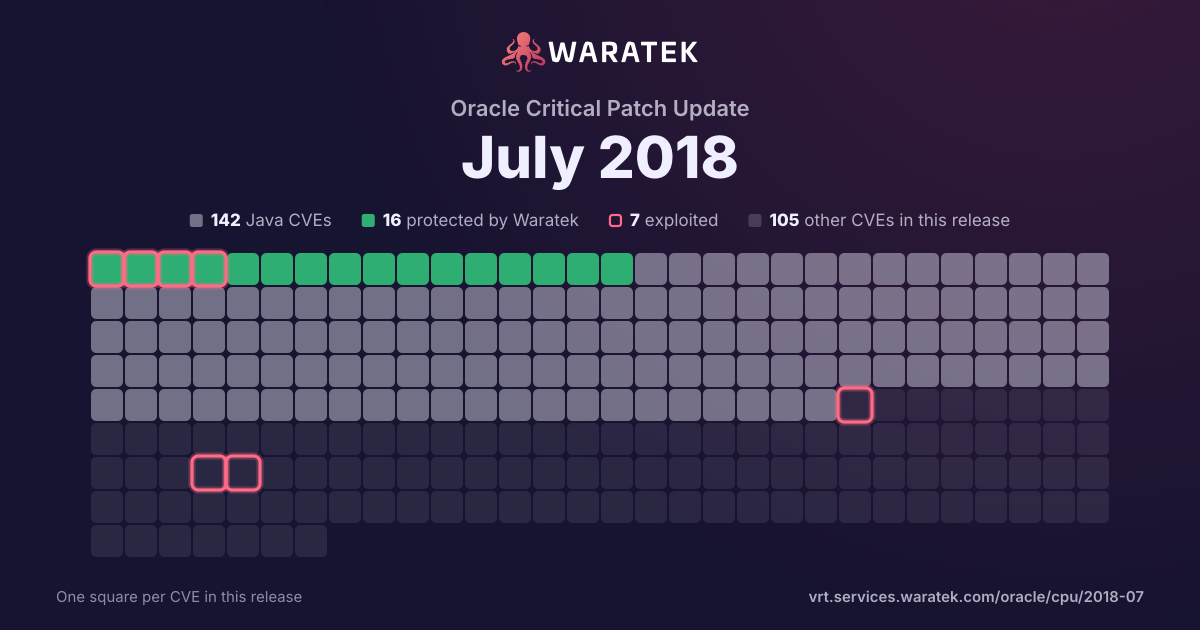
By status
16Protected by Waratek126No exploit published41Outside Waratek scope64Not applicable
7Exploited, marked by the ring
No exploit published. For 125 of them, Oracle's security advisory is the source of public detail.
Protected by Waratek. Waratek RASP can block exploitation of these on systems that have not applied the patch yet.
Overview 7 matches · 6 protected · 0 exploited · 0 CISA KEV · 0 public PoC · 0 EPSS ≥ 0.5
Protected by Waratek
6
85.7%
Rule in development
0
0.0%
Mitigation candidate
0
0.0%
No exploit published
1
14.3%
blocked by ARMR today
6
85.7%
partly blocked
0
0.0%
not blocked
1
14.3%
not established
0
0.0%
unrecorded
0
0.0%
Exploited
0
0.0%
Working exploit published
0
0.0%
Proof of concept only
0
0.0%
Forecast only
0
0.0%
No public exploit
7
100.0%
split by
peak 3 / year
20111
No exploit published1
Medium1
not blocked1
No public exploit1
20120
20130
20141
Protected by Waratek1
Medium1
blocked by ARMR today1
No public exploit1
20150
20163
Protected by Waratek3
Critical1
High2
blocked by ARMR today3
No public exploit3
20170
20182
Protected by Waratek2
Critical2
blocked by ARMR today2
No public exploit2
20112012201320142015201620172018
| CVE | Severity | Published▾ | Status | Exploitation | Description |
|---|---|---|---|---|---|
| CVE-2018-7489 | Critical | 2018-02-26 | Protected by Waratek | No public exploit | FasterXML jackson-databind before 2.7.9.3, 2.8.x before 2.8.11.1 and 2.9.x before 2.9.5 allows unauthenticated remote code execution because of an incomplete fix for the CVE-2017-7525 deserialization flaw. This is exploitable by sending maliciously crafted JSON input to the readValue method of the ObjectMapper, bypassing a blacklist that is ineffective if the c3p0 libraries are available in the classpath. |
| CVE-2017-15095 | Critical | 2018-02-06 | Protected by Waratek | No public exploit | A deserialization flaw was discovered in the jackson-databind in versions before 2.8.10 and 2.9.1, which could allow an unauthenticated user to perform code execution by sending the maliciously crafted input to the readValue method of the ObjectMapper. This issue extends the previous flaw CVE-2017-7525 by blacklisting more classes that could be used maliciously. |
| CVE-2016-9878 | High | 2016-12-29 | Protected by Waratek | No public exploit | An issue was discovered in Pivotal Spring Framework before 3.2.18, 4.2.x before 4.2.9, and 4.3.x before 4.3.5. Paths provided to the ResourceServlet were not properly sanitized and as a result exposed to directory traversal attacks. |
| CVE-2016-5019 | Critical | 2016-10-03 | Protected by Waratek | No public exploit | CoreResponseStateManager in Apache MyFaces Trinidad 1.0.0 through 1.0.13, 1.2.x before 1.2.15, 2.0.x before 2.0.2, and 2.1.x before 2.1.2 might allow attackers to conduct deserialization attacks via a crafted serialized view state string. |
| CVE-2016-1181 | High | 2016-07-04 | Protected by Waratek | No public exploit | ActionServlet.java in Apache Struts 1 1.x through 1.3.10 mishandles multithreaded access to an ActionForm instance, which allows remote attackers to execute arbitrary code or cause a denial of service (unexpected memory access) via a multipart request, a related issue to CVE-2015-0899. |
| CVE-2014-3577 | Medium | 2014-08-21 | Protected by Waratek | No public exploit | org.apache.http.conn.ssl.AbstractVerifier in Apache HttpComponents HttpClient before 4.3.5 and HttpAsyncClient before 4.0.2 does not properly verify that the server hostname matches a domain name in the subject's Common Name (CN) or subjectAltName field of the X.509 certificate, which allows man-in-the-middle attackers to spoof SSL servers via a "CN=" string in a field in the distinguished name (DN) of a certificate, as demonstrated by the "foo,CN=www.apache.org" string in the O field. |
| CVE-2011-4461 | Medium | 2011-12-30 | No exploit published | No public exploit | Jetty 8.1.0.RC2 and earlier computes hash values for form parameters without restricting the ability to trigger hash collisions predictably, which allows remote attackers to cause a denial of service (CPU consumption) by sending many crafted parameters. |