
Oracle Critical Patch Update July 2018
Released July 2018 · Oracle's advisory ↗ · ← Critical Patch Update, April 2018 · Critical Patch Update, October 2018 →
247 CVEs in this release, one square each
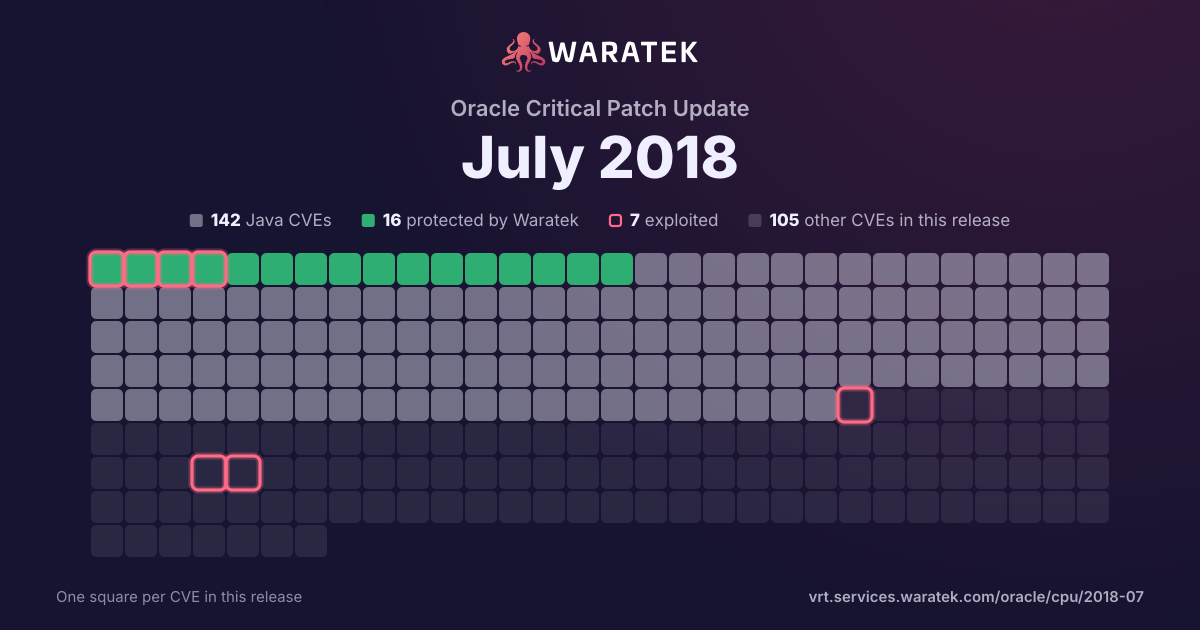
By status
16Protected by Waratek126No exploit published41Outside Waratek scope64Not applicable
7Exploited, marked by the ring
No exploit published. For 125 of them, Oracle's security advisory is the source of public detail.
Protected by Waratek. Waratek RASP can block exploitation of these on systems that have not applied the patch yet.
Overview 3 matches · 2 protected · 0 exploited · 0 CISA KEV · 0 public PoC · 0 EPSS ≥ 0.5
Protected by Waratek
2
66.7%
Rule in development
0
0.0%
Mitigation candidate
0
0.0%
No exploit published
1
33.3%
blocked by ARMR today
2
66.7%
partly blocked
0
0.0%
not blocked
1
33.3%
not established
0
0.0%
unrecorded
0
0.0%
Exploited
0
0.0%
Working exploit published
0
0.0%
Proof of concept only
0
0.0%
Forecast only
0
0.0%
No public exploit
3
100.0%
split by
peak 1 / quarter
Q4 111
No exploit published1
Medium1
not blocked1
No public exploit1
Q1 120
Q2 120
Q3 120
Q4 120
Q1 130
Q2 130
Q3 130
Q4 130
Q1 140
Q2 140
Q3 141
Protected by Waratek1
Medium1
blocked by ARMR today1
No public exploit1
Q4 140
Q1 150
Q2 150
Q3 150
Q4 150
Q1 160
Q2 160
Q3 161
Protected by Waratek1
High1
blocked by ARMR today1
No public exploit1
Q1 12Q3 12Q1 13Q3 13Q1 14Q3 14Q1 15Q3 15Q1 16Q3 16
| CVE | Severity | Published▾ | Status | Exploitation | Description |
|---|---|---|---|---|---|
| CVE-2016-1181 | High | 2016-07-04 | Protected by Waratek | No public exploit | ActionServlet.java in Apache Struts 1 1.x through 1.3.10 mishandles multithreaded access to an ActionForm instance, which allows remote attackers to execute arbitrary code or cause a denial of service (unexpected memory access) via a multipart request, a related issue to CVE-2015-0899. |
| CVE-2014-3577 | Medium | 2014-08-21 | Protected by Waratek | No public exploit | org.apache.http.conn.ssl.AbstractVerifier in Apache HttpComponents HttpClient before 4.3.5 and HttpAsyncClient before 4.0.2 does not properly verify that the server hostname matches a domain name in the subject's Common Name (CN) or subjectAltName field of the X.509 certificate, which allows man-in-the-middle attackers to spoof SSL servers via a "CN=" string in a field in the distinguished name (DN) of a certificate, as demonstrated by the "foo,CN=www.apache.org" string in the O field. |
| CVE-2011-4461 | Medium | 2011-12-30 | No exploit published | No public exploit | Jetty 8.1.0.RC2 and earlier computes hash values for form parameters without restricting the ability to trigger hash collisions predictably, which allows remote attackers to cause a denial of service (CPU consumption) by sending many crafted parameters. |