
Oracle Critical Patch Update January 2018
Released January 2018 · Oracle's advisory ↗ · ← Critical Patch Update, October 2017 · Critical Patch Update, April 2018 →
197 CVEs in this release, one square each
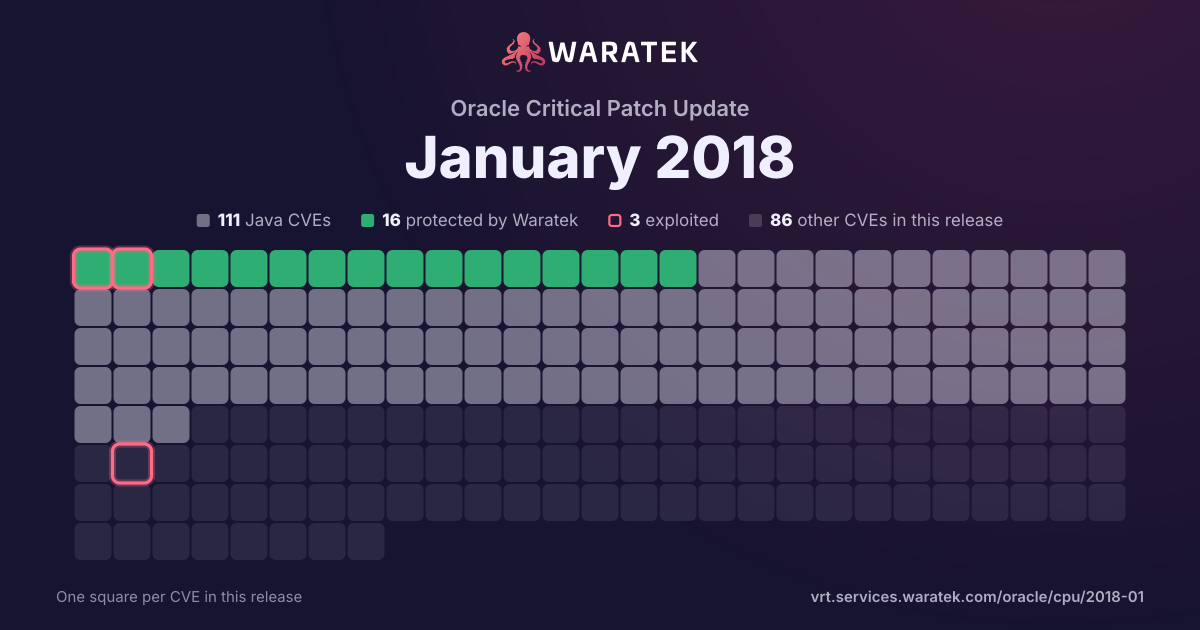
By status
16Protected by Waratek1Mitigation candidate94No exploit published25Outside Waratek scope61Not applicable
3Exploited, marked by the ring
No exploit published. For 94 of them, Oracle's security advisory is the source of public detail.
Protected by Waratek. Waratek RASP can block exploitation of these on systems that have not applied the patch yet.
Overview 20 matches · 5 in Waratek scope · 3 protected · 2 exploited · 1 CISA KEV · 6 public PoC · 6 EPSS ≥ 0.5
20matches
5in Waratek scope25.0%
3protected15.0%
2exploited10.0%
1CISA KEV5.0%
6public PoC30.0%
6EPSS ≥ 0.530.0%
Protected by Waratek
4
20.0%
Rule in development
0
0.0%
Mitigation candidate
1
5.0%
No exploit published
0
0.0%
Outside Waratek scope
6
30.0%
Not applicable
9
45.0%
Withdrawn CVE
0
0.0%
blocked by ARMR today
3
15.0%
partly blocked
1
5.0%
not blocked
16
80.0%
not established
0
0.0%
unrecorded
0
0.0%
split by
peak 5 / quarter
Q1 131
Outside Waratek scope1
Medium1
not blocked1
Forecast only1
Q2 130
Q3 130
Q4 130
Q1 140
Q2 140
Q3 140
Q4 140
Q1 150
Q2 150
Q3 151
Outside Waratek scope1
Critical1
not blocked1
No public exploit1
Q4 151
Outside Waratek scope1
Medium1
not blocked1
No public exploit1
Q1 161
Not applicable1
Medium1
not blocked1
No public exploit1
Q2 161
Not applicable1
Medium1
not blocked1
Working exploit published1
Q3 164
Protected by Waratek1
Outside Waratek scope2
Not applicable1
High4
blocked by ARMR today1
not blocked3
Forecast only1
No public exploit3
Q4 161
Protected by Waratek1
High1
blocked by ARMR today1
No public exploit1
Q1 170
Q2 175
Protected by Waratek1
Outside Waratek scope1
Not applicable3
Critical2
High1
Medium2
blocked by ARMR today1
not blocked4
Working exploit published1
No public exploit4
Q3 172
Not applicable2
High2
not blocked2
Exploited1
Working exploit published1
Q4 173
Protected by Waratek1
Mitigation candidate1
Not applicable1
Critical1
High1
Medium1
partly blocked1
not blocked2
Exploited1
Proof of concept only1
No public exploit1
Q2 13Q4 13Q2 14Q4 14Q2 15Q4 15Q2 16Q4 16Q2 17Q4 17
| CVE | Severity | Published▾ | Status | Exploitation | Description |
|---|---|---|---|---|---|
| CVE-2017-10352 | Critical | 2017-10-19 | Mitigation candidate | Proof of concept only | Vulnerability in the Oracle WebLogic Server component of Oracle Fusion Middleware (subcomponent: WLS - Web Services). The supported version that is affected are 10.3.6.0.0, 12.1.3.0.0, 12.2.1.1.0, 12.2.1.2.0 and 12.2.1.3.0. Easily exploitable vulnerability allows unauthenticated attacker with network access via HTTP to compromise Oracle WebLogic Server. While the vulnerability is in Oracle WebLogic Server, attacks may significantly impact additional products. Successful attacks of this vulnerability can result in unauthorized ability to cause a hang or frequently repeatable crash (complete DOS) of Oracle WebLogic Server as well as unauthorized update, insert or delete access to some of Oracle WebLogic Server accessible data and unauthorized read access to a subset of Oracle WebLogic Server accessible data. CVSS 3.0 Base Score 9.9 (Confidentiality, Integrity and Availability impacts). CVSS Vector: (CVSS:3.0/AV:N/AC:L/PR:N/UI:N/S:C/C:L/I:L/A:H). |
| CVE-2017-13077 | Medium | 2017-10-17 | Not applicable | No public exploit | Wi-Fi Protected Access (WPA and WPA2) allows reinstallation of the Pairwise Transient Key (PTK) Temporal Key (TK) during the four-way handshake, allowing an attacker within radio range to replay, decrypt, or spoof frames. |
| CVE-2017-12617 | High | 2017-10-04 | Protected by Waratek | Exploited | When running Apache Tomcat versions 9.0.0.M1 to 9.0.0, 8.5.0 to 8.5.22, 8.0.0.RC1 to 8.0.46 and 7.0.0 to 7.0.81 with HTTP PUTs enabled (e.g. via setting the readonly initialisation parameter of the Default servlet to false) it was possible to upload a JSP file to the server via a specially crafted request. This JSP could then be requested and any code it contained would be executed by the server. |
| CVE-2017-9798 | High | 2017-09-18 | Not applicable | Exploited | Apache httpd allows remote attackers to read secret data from process memory if the Limit directive can be set in a user's .htaccess file, or if httpd.conf has certain misconfigurations, aka Optionsbleed. This affects the Apache HTTP Server through 2.2.34 and 2.4.x through 2.4.27. The attacker sends an unauthenticated OPTIONS HTTP request when attempting to read secret data. This is a use-after-free issue and thus secret data is not always sent, and the specific data depends on many factors including configuration. Exploitation with .htaccess can be blocked with a patch to the ap_limit_section function in server/core.c. |
| CVE-2017-0781 | High | 2017-09-14 | Not applicable | Working exploit published | A remote code execution vulnerability in the Android system (bluetooth). Product: Android. Versions: 4.4.4, 5.0.2, 5.1.1, 6.0, 6.0.1, 7.0, 7.1.1, 7.1.2, 8.0. Android ID: A-63146105. |
| CVE-2017-5664 | High | 2017-06-06 | Outside Waratek scope | No public exploit | The error page mechanism of the Java Servlet Specification requires that, when an error occurs and an error page is configured for the error that occurred, the original request and response are forwarded to the error page. This means that the request is presented to the error page with the original HTTP method. If the error page is a static file, expected behaviour is to serve content of the file as if processing a GET request, regardless of the actual HTTP method. The Default Servlet in Apache Tomcat 9.0.0.M1 to 9.0.0.M20, 8.5.0 to 8.5.14, 8.0.0.RC1 to 8.0.43 and 7.0.0 to 7.0.77 did not do this. Depending on the original request this could lead to unexpected and undesirable results for static error pages including, if the DefaultServlet is configured to permit writes, the replacement or removal of the custom error page. Notes for other user provided error pages: (1) Unless explicitly coded otherwise, JSPs ignore the HTTP method. JSPs used as error pages must must ensure that they handle any error dispatch as a GET request, regardless of the actual method. (2) By default, the response generated by a Servlet does depend on the HTTP method. Custom Servlets used as error pages must ensure that they handle any error dispatch as a GET request, regardless of the actual method. |
| CVE-2017-9072 | Medium | 2017-05-18 | Not applicable | No public exploit | Two CalendarXP products have XSS in common parts of HTML files. CalendarXP FlatCalendarXP through 9.9.290 has XSS in iflateng.htm and nflateng.htm. CalendarXP PopCalendarXP through 9.8.308 has XSS in ipopeng.htm and npopeng.htm. |
| CVE-2017-5461 | Critical | 2017-05-11 | Not applicable | No public exploit | Mozilla Network Security Services (NSS) before 3.21.4, 3.22.x through 3.28.x before 3.28.4, 3.29.x before 3.29.5, and 3.30.x before 3.30.1 allows remote attackers to cause a denial of service (out-of-bounds write) or possibly have unspecified other impact by leveraging incorrect base64 operations. |
| CVE-2017-3732 | Medium | 2017-05-04 | Not applicable | No public exploit | There is a carry propagating bug in the x86_64 Montgomery squaring procedure in OpenSSL 1.0.2 before 1.0.2k and 1.1.0 before 1.1.0d. No EC algorithms are affected. Analysis suggests that attacks against RSA and DSA as a result of this defect would be very difficult to perform and are not believed likely. Attacks against DH are considered just feasible (although very difficult) because most of the work necessary to deduce information about a private key may be performed offline. The amount of resources required for such an attack would be very significant and likely only accessible to a limited number of attackers. An attacker would additionally need online access to an unpatched system using the target private key in a scenario with persistent DH parameters and a private key that is shared between multiple clients. For example this can occur by default in OpenSSL DHE based SSL/TLS ciphersuites. Note: This issue is very similar to CVE-2015-3193 but must be treated as a separate problem. |
| CVE-2017-5645 | Critical | 2017-04-17 | Protected by Waratek | Working exploit published | In Apache Log4j 2.x before 2.8.2, when using the TCP socket server or UDP socket server to receive serialized log events from another application, a specially crafted binary payload can be sent that, when deserialized, can execute arbitrary code. |
| CVE-2016-9878 | High | 2016-12-29 | Protected by Waratek | No public exploit | An issue was discovered in Pivotal Spring Framework before 3.2.18, 4.2.x before 4.2.9, and 4.3.x before 4.3.5. Paths provided to the ResourceServlet were not properly sanitized and as a result exposed to directory traversal attacks. |
| CVE-2016-2179 | High | 2016-09-16 | Not applicable | No public exploit | The DTLS implementation in OpenSSL before 1.1.0 does not properly restrict the lifetime of queue entries associated with unused out-of-order messages, which allows remote attackers to cause a denial of service (memory consumption) by maintaining many crafted DTLS sessions simultaneously, related to d1_lib.c, statem_dtls.c, statem_lib.c, and statem_srvr.c. |
| CVE-2016-0635 | High | 2016-07-21 | Outside Waratek scope | No public exploit | Unspecified vulnerability in the Enterprise Manager Ops Center component in Oracle Enterprise Manager Grid Control 12.1.4, 12.2.2, and 12.3.2; the Oracle Health Sciences Information Manager component in Oracle Health Sciences Applications 1.2.8.3, 2.0.2.3, and 3.0.1.0; the Oracle Healthcare Master Person Index component in Oracle Health Sciences Applications 2.0.12, 3.0.0, and 4.0.1; the Oracle Documaker component in Oracle Insurance Applications before 12.5; the Oracle Insurance Calculation Engine component in Oracle Insurance Applications 9.7.1, 10.1.2, and 10.2.2; the Oracle Insurance Policy Administration J2EE and Oracle Insurance Rules Palette components in Oracle Insurance Applications 9.6.1, 9.7.1, 10.0.1, 10.1.2, 10.2.0, and 10.2.2; the Oracle Retail Integration Bus component in Oracle Retail Applications 15.0; the Oracle Retail Order Broker component in Oracle Retail Applications 5.1, 5.2, and 15.0; the Primavera Contract Management component in Oracle Primavera Products Suite 14.2; the Primavera P6 Enterprise Project Portfolio Management component in Oracle Primavera Products Suite 8.2, 8.3, 8.4, 15.1, 15.2, and 16.1; the Oracle Financial Services Analytical Applications Infrastructure component in Oracle Financial Services Applications 8.0.0, 8.0.1, 8.0.2, and 8.0.3; the Oracle Commerce Guided Search / Oracle Commerce Experience Manager component in Oracle Commerce 3.1.1, 3.1.2, 11.0, 11.1, and 11.2; the Oracle Agile PLM component in Oracle Supply Chain Products Suite 9.3.4 and 9.3.5; the Oracle Communications BRM - Elastic Charging Engine 11.2.0.0.0 and 11.3.0.0.0; the Oracle Enterprise Repository Enterprise Repository 12.1.3.0.0; the Oracle Financial Services Behavior Detection Platform 8.0.1 and 8.0.2; the Oracle Hyperion Essbase 12.2.1.1; the Oracle Tuxedo System and Applications Monitor (TSAM) 11.1.1.2.0, 11.1.1.2.1, 11.1.1.2.1, 12.1.1.1.0, 12.1.3.0.0, and 12.2.2.0.0; the Oracle Communications WebRTC Session Controller component of Oracle Communications Applications (subcomponent: Security (Spring)) 7.0, 7.1 and 7.2; the Oracle Endeca Information Discovery Integrator 3.2; the Converged Commerce component of Oracle Retail Applications 16.0.1; the Oracle Identity Manager 11.1.2.3.0; Oracle Enterprise Manager for MySQL Database 12.1.0.4; Oracle Retail Invoice Matching 12.0, 13.0, 13.1, 13.2, 14.0, and 14.1; Oracle Communications Performance Intelligence Center (PIC) Software Prior to 10.2.1 and the Oracle Knowledge component of Oracle Siebel CRM (subcomponent: AnswerFlow (Spring Framework)) version 8.5.1.0 - 8.5.1.7 and 8.6.0 allows remote authenticated users to affect confidentiality, integrity, and availability via unknown vectors. |
| CVE-2016-5385 | High | 2016-07-19 | Outside Waratek scope | Forecast only | PHP through 7.0.8 does not attempt to address RFC 3875 section 4.1.18 namespace conflicts and therefore does not protect applications from the presence of untrusted client data in the HTTP_PROXY environment variable, which might allow remote attackers to redirect an application's outbound HTTP traffic to an arbitrary proxy server via a crafted Proxy header in an HTTP request, as demonstrated by (1) an application that makes a getenv('HTTP_PROXY') call or (2) a CGI configuration of PHP, aka an "httpoxy" issue. |
| CVE-2016-1182 | High | 2016-07-04 | Protected by Waratek | No public exploit | ActionServlet.java in Apache Struts 1 1.x through 1.3.10 does not properly restrict the Validator configuration, which allows remote attackers to conduct cross-site scripting (XSS) attacks or cause a denial of service via crafted input, a related issue to CVE-2015-0899. |
| CVE-2016-2107 | Medium | 2016-05-05 | Not applicable | Working exploit published | The AES-NI implementation in OpenSSL before 1.0.1t and 1.0.2 before 1.0.2h does not consider memory allocation during a certain padding check, which allows remote attackers to obtain sensitive cleartext information via a padding-oracle attack against an AES CBC session. NOTE: this vulnerability exists because of an incorrect fix for CVE-2013-0169. |
| CVE-2016-0704 | Medium | 2016-03-02 | Not applicable | No public exploit | An oracle protection mechanism in the get_client_master_key function in s2_srvr.c in the SSLv2 implementation in OpenSSL before 0.9.8zf, 1.0.0 before 1.0.0r, 1.0.1 before 1.0.1m, and 1.0.2 before 1.0.2a overwrites incorrect MASTER-KEY bytes during use of export cipher suites, which makes it easier for remote attackers to decrypt TLS ciphertext data by leveraging a Bleichenbacher RSA padding oracle, a related issue to CVE-2016-0800. |
| CVE-2015-7940 | Medium | 2015-11-09 | Outside Waratek scope | No public exploit | The Bouncy Castle Java library before 1.51 does not validate a point is withing the elliptic curve, which makes it easier for remote attackers to obtain private keys via a series of crafted elliptic curve Diffie Hellman (ECDH) key exchanges, aka an "invalid curve attack." |
| CVE-2015-3253 | Critical | 2015-08-13 | Outside Waratek scope | No public exploit | The MethodClosure class in runtime/MethodClosure.java in Apache Groovy 1.7.0 through 2.4.3 allows remote attackers to execute arbitrary code or cause a denial of service via a crafted serialized object. |
| CVE-2013-2566 | Medium | 2013-03-15 | Outside Waratek scope | Forecast only | The RC4 algorithm, as used in the TLS protocol and SSL protocol, has many single-byte biases, which makes it easier for remote attackers to conduct plaintext-recovery attacks via statistical analysis of ciphertext in a large number of sessions that use the same plaintext. |