
Oracle Critical Patch Update October 2017
Released October 2017 · Oracle's advisory ↗ · ← Critical Patch Update, July 2017 · Critical Patch Update, January 2018 →
225 CVEs in this release, one square each
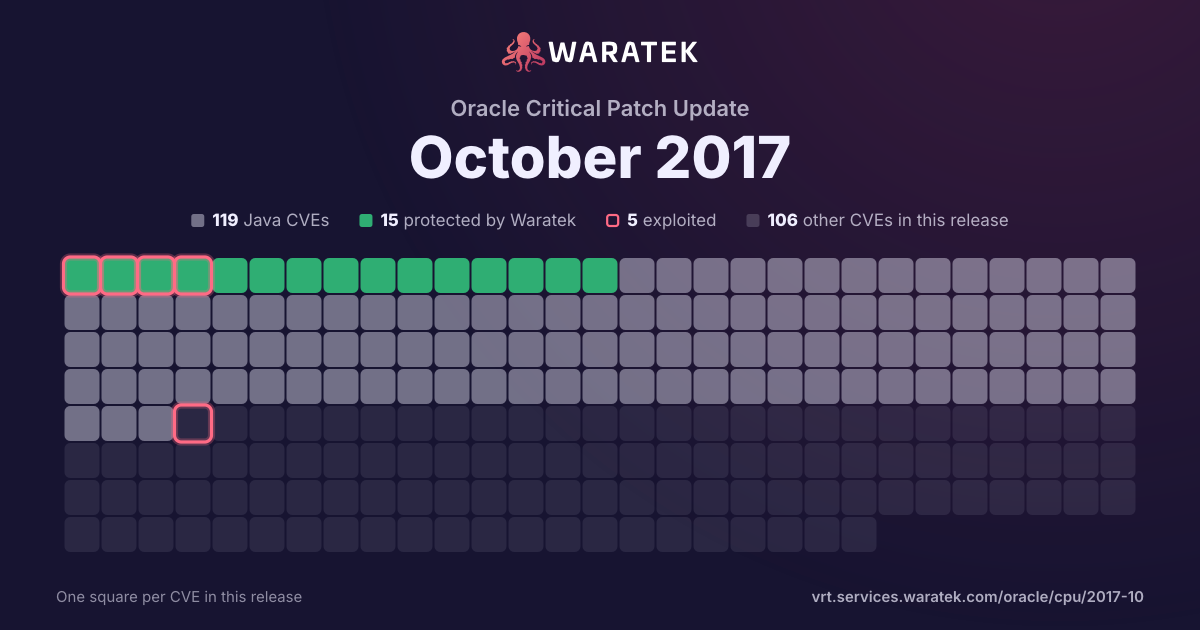
By status
15Protected by Waratek3Mitigation candidate101No exploit published34Outside Waratek scope72Not applicable
5Exploited, marked by the ring
No exploit published. For 100 of them, Oracle's security advisory is the source of public detail.
Protected by Waratek. Waratek RASP can block exploitation of these on systems that have not applied the patch yet.
Overview 115 matches · 56 in Waratek scope · 4 protected · 0 exploited · 0 CISA KEV · 3 public PoC · 1 EPSS ≥ 0.5
115matches
56in Waratek scope48.7%
4protected3.5%
0exploited0.0%
0CISA KEV0.0%
3public PoC2.6%
1EPSS ≥ 0.50.9%
Protected by Waratek
4
3.5%
Rule in development
0
0.0%
Mitigation candidate
1
0.9%
No exploit published
51
44.3%
Outside Waratek scope
15
13.0%
Not applicable
44
38.3%
Withdrawn CVE
0
0.0%
blocked by ARMR today
4
3.5%
partly blocked
0
0.0%
not blocked
111
96.5%
not established
0
0.0%
unrecorded
0
0.0%
Exploited
0
0.0%
Working exploit published
3
2.6%
Proof of concept only
0
0.0%
Forecast only
0
0.0%
No public exploit
112
97.4%
split by
peak 108 / year
20031
Not applicable1
Medium1
not blocked1
No public exploit1
20040
20050
20060
20070
20080
20090
20100
20110
20120
20130
20144
Not applicable4
Medium4
not blocked4
No public exploit4
20151
Outside Waratek scope1
Medium1
not blocked1
No public exploit1
20161
Not applicable1
Medium1
not blocked1
Working exploit published1
2017108
Protected by Waratek4
Mitigation candidate1
No exploit published51
Outside Waratek scope14
Not applicable38
Medium108
blocked by ARMR today4
not blocked104
Working exploit published2
No public exploit106
20032005200720092011201320152017
| CVE | Severity | Published▾ | Status | Exploitation | Description |
|---|---|---|---|---|---|
| CVE-2017-10077 | Medium | 2017-10-19 | No exploit published | No public exploit | Vulnerability in the Oracle Applications DBA component of Oracle E-Business Suite (subcomponent: AD Utilities). Supported versions that are affected are 12.1.3, 12.2.3, 12.2.4, 12.2.5, 12.2.6 and 12.2.7. Easily exploitable vulnerability allows high privileged attacker with network access via HTTP to compromise Oracle Applications DBA. Successful attacks of this vulnerability can result in unauthorized creation, deletion or modification access to critical data or all Oracle Applications DBA accessible data as well as unauthorized access to critical data or complete access to all Oracle Applications DBA accessible data. CVSS 3.0 Base Score 6.5 (Confidentiality and Integrity impacts). CVSS Vector: (CVSS:3.0/AV:N/AC:L/PR:H/UI:N/S:U/C:H/I:H/A:N). |
| CVE-2017-10066 | Medium | 2017-10-19 | No exploit published | No public exploit | Vulnerability in the Oracle Applications Technology Stack component of Oracle E-Business Suite (subcomponent: Oracle Forms). Supported versions that are affected are 12.1.3, 12.2.3, 12.2.4, 12.2.5, 12.2.6 and 12.2.7. Easily exploitable vulnerability allows unauthenticated attacker with network access via HTTP to compromise Oracle Applications Technology Stack. Successful attacks of this vulnerability can result in unauthorized update, insert or delete access to some of Oracle Applications Technology Stack accessible data. CVSS 3.0 Base Score 5.3 (Integrity impacts). CVSS Vector: (CVSS:3.0/AV:N/AC:L/PR:N/UI:N/S:U/C:N/I:L/A:N). |
| CVE-2017-10055 | Medium | 2017-10-19 | No exploit published | No public exploit | Vulnerability in the Oracle iPlanet Web Server component of Oracle Fusion Middleware (subcomponent: Admin Graphical User Interface). The supported version that is affected is 7.0. Easily exploitable vulnerability allows unauthenticated attacker with network access via HTTP to compromise Oracle iPlanet Web Server. Successful attacks require human interaction from a person other than the attacker and while the vulnerability is in Oracle iPlanet Web Server, attacks may significantly impact additional products. Successful attacks of this vulnerability can result in unauthorized update, insert or delete access to some of Oracle iPlanet Web Server accessible data as well as unauthorized read access to a subset of Oracle iPlanet Web Server accessible data. CVSS 3.0 Base Score 6.1 (Confidentiality and Integrity impacts). CVSS Vector: (CVSS:3.0/AV:N/AC:L/PR:N/UI:R/S:C/C:L/I:L/A:N). |
| CVE-2017-10054 | Medium | 2017-10-19 | Not applicable | No public exploit | Vulnerability in the Oracle Hospitality Cruise Materials Management component of Oracle Hospitality Applications (subcomponent: MMS). The supported version that is affected is 7.30.564.0. Easily exploitable vulnerability allows unauthenticated attacker with logon to the infrastructure where Oracle Hospitality Cruise Materials Management executes to compromise Oracle Hospitality Cruise Materials Management. Successful attacks of this vulnerability can result in unauthorized update, insert or delete access to some of Oracle Hospitality Cruise Materials Management accessible data as well as unauthorized read access to a subset of Oracle Hospitality Cruise Materials Management accessible data. CVSS 3.0 Base Score 5.1 (Confidentiality and Integrity impacts). CVSS Vector: (CVSS:3.0/AV:L/AC:L/PR:N/UI:N/S:U/C:L/I:L/A:N). |
| CVE-2017-10051 | Medium | 2017-10-19 | Not applicable | No public exploit | Vulnerability in the Oracle Outside In Technology component of Oracle Fusion Middleware (subcomponent: Outside In Filters). The supported version that is affected is 8.5.3.0. Easily exploitable vulnerability allows low privileged attacker with access to the physical communication segment attached to the hardware where the Oracle Outside In Technology executes to compromise Oracle Outside In Technology. Successful attacks of this vulnerability can result in unauthorized ability to cause a hang or frequently repeatable crash (complete DOS) of Oracle Outside In Technology. Note: Outside In Technology is a suite of software development kits (SDKs). The protocol and CVSS score depend on the software that uses the Outside In Technology code. The CVSS score assumes that the software passes data received over a network directly to Outside In Technology code, but if data is not received over a network the CVSS score may be lower. CVSS 3.0 Base Score 5.7 (Availability impacts). CVSS Vector: (CVSS:3.0/AV:A/AC:L/PR:L/UI:N/S:U/C:N/I:N/A:H). |
| CVE-2017-10033 | Medium | 2017-10-19 | Mitigation candidate | Working exploit published | Vulnerability in the Oracle WebCenter Sites component of Oracle Fusion Middleware (subcomponent: Support Tools). Supported versions that are affected are 11.1.1.8.0 and 12.2.1.2.0. Difficult to exploit vulnerability allows unauthenticated attacker with logon to the infrastructure where Oracle WebCenter Sites executes to compromise Oracle WebCenter Sites. Successful attacks of this vulnerability can result in unauthorized update, insert or delete access to some of Oracle WebCenter Sites accessible data as well as unauthorized read access to a subset of Oracle WebCenter Sites accessible data. Note: Please refer to Doc ID <a href="http://support.oracle.com/CSP/main/article?cmd=show&type=NOT&id=2318213.1">My Oracle Support Note 2318213.1 for instructions on how to address this issue. CVSS 3.0 Base Score 4.0 (Confidentiality and Integrity impacts). CVSS Vector: (CVSS:3.0/AV:L/AC:H/PR:N/UI:N/S:U/C:L/I:L/A:N). |
| CVE-2017-3732 | Medium | 2017-05-04 | Not applicable | No public exploit | There is a carry propagating bug in the x86_64 Montgomery squaring procedure in OpenSSL 1.0.2 before 1.0.2k and 1.1.0 before 1.1.0d. No EC algorithms are affected. Analysis suggests that attacks against RSA and DSA as a result of this defect would be very difficult to perform and are not believed likely. Attacks against DH are considered just feasible (although very difficult) because most of the work necessary to deduce information about a private key may be performed offline. The amount of resources required for such an attack would be very significant and likely only accessible to a limited number of attackers. An attacker would additionally need online access to an unpatched system using the target private key in a scenario with persistent DH parameters and a private key that is shared between multiple clients. For example this can occur by default in OpenSSL DHE based SSL/TLS ciphersuites. Note: This issue is very similar to CVE-2015-3193 but must be treated as a separate problem. |
| CVE-2016-7431 | Medium | 2017-01-13 | Not applicable | No public exploit | NTP before 4.2.8p9 allows remote attackers to bypass the origin timestamp protection mechanism via an origin timestamp of zero. NOTE: this vulnerability exists because of a CVE-2015-8138 regression. |
| CVE-2016-2107 | Medium | 2016-05-05 | Not applicable | Working exploit published | The AES-NI implementation in OpenSSL before 1.0.1t and 1.0.2 before 1.0.2h does not consider memory allocation during a certain padding check, which allows remote attackers to obtain sensitive cleartext information via a padding-oracle attack against an AES CBC session. NOTE: this vulnerability exists because of an incorrect fix for CVE-2013-0169. |
| CVE-2015-7940 | Medium | 2015-11-09 | Outside Waratek scope | No public exploit | The Bouncy Castle Java library before 1.51 does not validate a point is withing the elliptic curve, which makes it easier for remote attackers to obtain private keys via a series of crafted elliptic curve Diffie Hellman (ECDH) key exchanges, aka an "invalid curve attack." |
| CVE-2014-8714 | Medium | 2014-11-23 | Not applicable | No public exploit | The dissect_write_structured_field function in epan/dissectors/packet-tn5250.c in the TN5250 dissector in Wireshark 1.10.x before 1.10.11 and 1.12.x before 1.12.2 allows remote attackers to cause a denial of service (infinite loop) via a crafted packet. |
| CVE-2014-3707 | Medium | 2014-11-15 | Not applicable | No public exploit | The curl_easy_duphandle function in libcurl 7.17.1 through 7.38.0, when running with the CURLOPT_COPYPOSTFIELDS option, does not properly copy HTTP POST data for an easy handle, which triggers an out-of-bounds read that allows remote web servers to read sensitive memory information. |
| CVE-2014-3538 | Medium | 2014-07-03 | Not applicable | No public exploit | file before 5.19 does not properly restrict the amount of data read during a regex search, which allows remote attackers to cause a denial of service (CPU consumption) via a crafted file that triggers backtracking during processing of an awk rule. NOTE: this vulnerability exists because of an incomplete fix for CVE-2013-7345. |
| CVE-2014-0062 | Medium | 2014-03-31 | Not applicable | No public exploit | Race condition in the (1) CREATE INDEX and (2) unspecified ALTER TABLE commands in PostgreSQL before 8.4.20, 9.0.x before 9.0.16, 9.1.x before 9.1.12, 9.2.x before 9.2.7, and 9.3.x before 9.3.3 allows remote authenticated users to create an unauthorized index or read portions of unauthorized tables by creating or deleting a table with the same name during the timing window. |
| CVE-2003-1418 | Medium | 2003-12-31 | Not applicable | No public exploit | Apache HTTP Server 1.3.22 through 1.3.27 on OpenBSD allows remote attackers to obtain sensitive information via (1) the ETag header, which reveals the inode number, or (2) multipart MIME boundary, which reveals child process IDs (PID). |