
Oracle Critical Patch Update October 2017
Released October 2017 · Oracle's advisory ↗ · ← Critical Patch Update, July 2017 · Critical Patch Update, January 2018 →
225 CVEs in this release, one square each
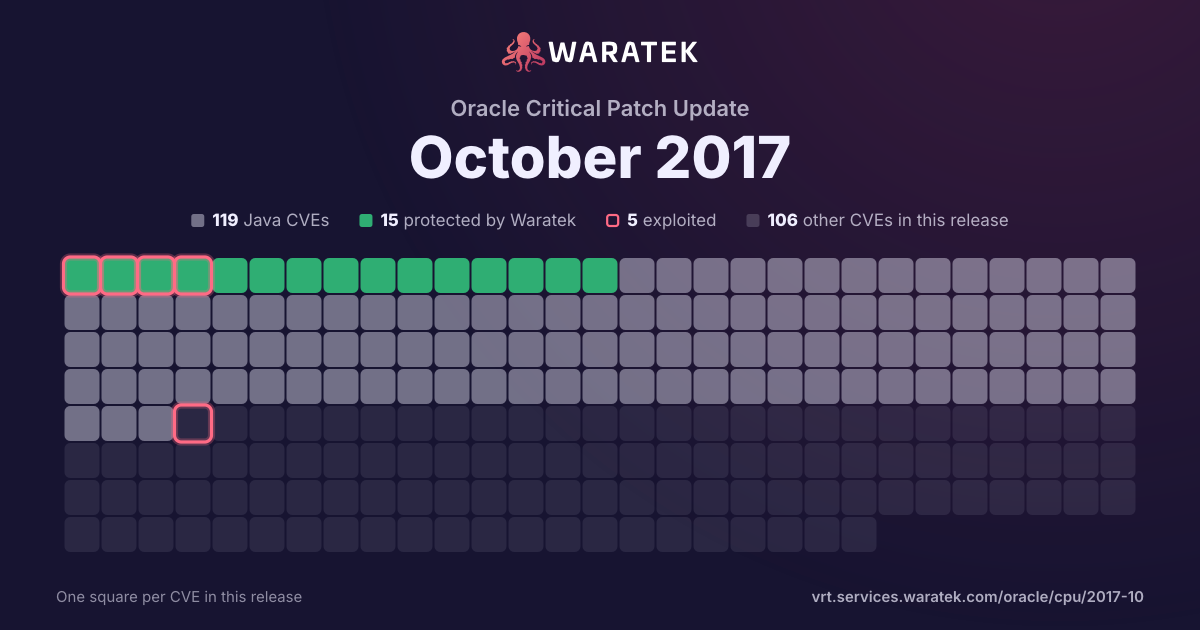
By status
15Protected by Waratek3Mitigation candidate101No exploit published34Outside Waratek scope72Not applicable
5Exploited, marked by the ring
No exploit published. For 100 of them, Oracle's security advisory is the source of public detail.
Protected by Waratek. Waratek RASP can block exploitation of these on systems that have not applied the patch yet.
Overview 14 matches · 7 in Waratek scope · 2 protected · 0 exploited · 0 CISA KEV · 0 public PoC · 0 EPSS ≥ 0.5
14matches
7in Waratek scope50.0%
2protected14.3%
0exploited0.0%
0CISA KEV0.0%
0public PoC0.0%
0EPSS ≥ 0.50.0%
Protected by Waratek
2
14.3%
Rule in development
0
0.0%
Mitigation candidate
0
0.0%
No exploit published
5
35.7%
Outside Waratek scope
4
28.6%
Not applicable
3
21.4%
Withdrawn CVE
0
0.0%
blocked by ARMR today
2
14.3%
partly blocked
0
0.0%
not blocked
12
85.7%
not established
0
0.0%
unrecorded
0
0.0%
Exploited
0
0.0%
Working exploit published
0
0.0%
Proof of concept only
0
0.0%
Forecast only
0
0.0%
No public exploit
14
100.0%
split by
peak 8 / quarter
Q3 151
Outside Waratek scope1
Critical1
not blocked1
No public exploit1
Q4 150
Q1 160
Q2 160
Q3 160
Q4 161
Protected by Waratek1
Critical1
blocked by ARMR today1
No public exploit1
Q1 170
Q2 173
Outside Waratek scope1
Not applicable2
Critical3
not blocked3
No public exploit3
Q3 170
Q4 178
Protected by Waratek1
No exploit published5
Outside Waratek scope1
Not applicable1
Critical8
blocked by ARMR today1
not blocked7
No public exploit8
Q1 181
Outside Waratek scope1
Critical1
not blocked1
No public exploit1
Q3 15Q4 15Q1 16Q2 16Q3 16Q4 16Q1 17Q2 17Q3 17Q4 17Q1 18
| CVE | Severity | Published▾ | Status | Exploitation | Description |
|---|---|---|---|---|---|
| CVE-2016-6814 | Critical | 2018-01-18 | Outside Waratek scope | No public exploit | When an application with unsupported Codehaus versions of Groovy from 1.7.0 to 2.4.3, Apache Groovy 2.4.4 to 2.4.7 on classpath uses standard Java serialization mechanisms, e.g. to communicate between servers or to store local data, it was possible for an attacker to bake a special serialized object that will execute code directly when deserialized. All applications which rely on serialization and do not isolate the code which deserializes objects were subject to this vulnerability. |
| CVE-2017-10405 | Critical | 2017-10-19 | No exploit published | No public exploit | Vulnerability in the Oracle Hospitality Reporting and Analytics component of Oracle Hospitality Applications (subcomponent: Report). Supported versions that are affected are 8.5.1 and 9.0.0. Easily exploitable vulnerability allows unauthenticated attacker with network access via HTTP to compromise Oracle Hospitality Reporting and Analytics. While the vulnerability is in Oracle Hospitality Reporting and Analytics, attacks may significantly impact additional products. Successful attacks of this vulnerability can result in unauthorized access to critical data or complete access to all Oracle Hospitality Reporting and Analytics accessible data and unauthorized ability to cause a hang or frequently repeatable crash (complete DOS) of Oracle Hospitality Reporting and Analytics. CVSS 3.0 Base Score 8.2 (Confidentiality and Availability impacts). CVSS Vector: (CVSS:3.0/AV:N/AC:L/PR:N/UI:N/S:U/C:H/I:N/A:L). |
| CVE-2017-10404 | Critical | 2017-10-19 | No exploit published | No public exploit | Vulnerability in the Oracle Hospitality Reporting and Analytics component of Oracle Hospitality Applications (subcomponent: iQuery). Supported versions that are affected are 8.5.1 and 9.0.0. Easily exploitable vulnerability allows low privileged attacker with network access via HTTP to compromise Oracle Hospitality Reporting and Analytics. While the vulnerability is in Oracle Hospitality Reporting and Analytics, attacks may significantly impact additional products. Successful attacks of this vulnerability can result in takeover of Oracle Hospitality Reporting and Analytics. CVSS 3.0 Base Score 8.3 (Confidentiality, Integrity and Availability impacts). CVSS Vector: (CVSS:3.0/AV:N/AC:L/PR:L/UI:N/S:U/C:H/I:H/A:L). |
| CVE-2017-10402 | Critical | 2017-10-19 | No exploit published | No public exploit | Vulnerability in the Oracle Hospitality Reporting and Analytics component of Oracle Hospitality Applications (subcomponent: Report). Supported versions that are affected are 8.5.1 and 9.0.0. Easily exploitable vulnerability allows unauthenticated attacker with network access via HTTP to compromise Oracle Hospitality Reporting and Analytics. While the vulnerability is in Oracle Hospitality Reporting and Analytics, attacks may significantly impact additional products. Successful attacks of this vulnerability can result in takeover of Oracle Hospitality Reporting and Analytics. CVSS 3.0 Base Score 10.0 (Confidentiality, Integrity and Availability impacts). CVSS Vector: (CVSS:3.0/AV:N/AC:L/PR:N/UI:N/S:C/C:H/I:H/A:H). |
| CVE-2017-10396 | Critical | 2017-10-19 | Not applicable | No public exploit | Vulnerability in the Oracle Hospitality Cruise AffairWhere component of Oracle Hospitality Applications (subcomponent: AffairWhere). Supported versions that are affected are 2.2.5.0, 2.2.6.0 and 2.2.7.0. Easily exploitable vulnerability allows low privileged attacker with logon to the infrastructure where Oracle Hospitality Cruise AffairWhere executes to compromise Oracle Hospitality Cruise AffairWhere. Successful attacks require human interaction from a person other than the attacker and while the vulnerability is in Oracle Hospitality Cruise AffairWhere, attacks may significantly impact additional products. Successful attacks of this vulnerability can result in takeover of Oracle Hospitality Cruise AffairWhere. CVSS 3.0 Base Score 8.2 (Confidentiality, Integrity and Availability impacts). CVSS Vector: (CVSS:3.0/AV:L/AC:L/PR:L/UI:R/S:C/C:H/I:H/A:H). |
| CVE-2017-10346 | Critical | 2017-10-19 | Outside Waratek scope | No public exploit | Vulnerability in the Java SE, Java SE Embedded component of Oracle Java SE (subcomponent: Hotspot). Supported versions that are affected are Java SE: 6u161, 7u151, 8u144 and 9; Java SE Embedded: 8u144. Easily exploitable vulnerability allows unauthenticated attacker with network access via multiple protocols to compromise Java SE, Java SE Embedded. Successful attacks require human interaction from a person other than the attacker and while the vulnerability is in Java SE, Java SE Embedded, attacks may significantly impact additional products. Successful attacks of this vulnerability can result in takeover of Java SE, Java SE Embedded. Note: This vulnerability applies to Java deployments, typically in clients running sandboxed Java Web Start applications or sandboxed Java applets, that load and run untrusted code (e.g., code that comes from the internet) and rely on the Java sandbox for security. This vulnerability does not apply to Java deployments, typically in servers, that load and run only trusted code (e.g., code installed by an administrator). CVSS 3.0 Base Score 9.6 (Confidentiality, Integrity and Availability impacts). CVSS Vector: (CVSS:3.0/AV:N/AC:L/PR:N/UI:R/S:C/C:H/I:H/A:H). |
| CVE-2017-10330 | Critical | 2017-10-19 | No exploit published | No public exploit | Vulnerability in the Oracle Common Applications component of Oracle E-Business Suite (subcomponent: Gantt Server). Supported versions that are affected are 12.1.3, 12.2.3, 12.2.4, 12.2.5, 12.2.6 and 12.2.7. Easily exploitable vulnerability allows unauthenticated attacker with network access via HTTP to compromise Oracle Common Applications. Successful attacks of this vulnerability can result in unauthorized creation, deletion or modification access to critical data or all Oracle Common Applications accessible data as well as unauthorized access to critical data or complete access to all Oracle Common Applications accessible data. CVSS 3.0 Base Score 9.1 (Confidentiality and Integrity impacts). CVSS Vector: (CVSS:3.0/AV:N/AC:L/PR:N/UI:N/S:U/C:H/I:H/A:N). |
| CVE-2017-10329 | Critical | 2017-10-19 | No exploit published | No public exploit | Vulnerability in the Oracle Global Order Promising component of Oracle E-Business Suite (subcomponent: Reschedule Sales Orders). Supported versions that are affected are 12.1.1, 12.1.2, 12.1.3, 12.2.3, 12.2.4, 12.2.5, 12.2.6 and 12.2.7. Easily exploitable vulnerability allows unauthenticated attacker with network access via HTTP to compromise Oracle Global Order Promising. Successful attacks of this vulnerability can result in unauthorized creation, deletion or modification access to critical data or all Oracle Global Order Promising accessible data as well as unauthorized access to critical data or complete access to all Oracle Global Order Promising accessible data. CVSS 3.0 Base Score 9.1 (Confidentiality and Integrity impacts). CVSS Vector: (CVSS:3.0/AV:N/AC:L/PR:N/UI:N/S:U/C:H/I:H/A:N). |
| CVE-2017-10285 | Critical | 2017-10-19 | Protected by Waratek | No public exploit | Vulnerability in the Java SE, Java SE Embedded component of Oracle Java SE (subcomponent: RMI). Supported versions that are affected are Java SE: 6u161, 7u151, 8u144 and 9; Java SE Embedded: 8u144. Easily exploitable vulnerability allows unauthenticated attacker with network access via multiple protocols to compromise Java SE, Java SE Embedded. Successful attacks require human interaction from a person other than the attacker and while the vulnerability is in Java SE, Java SE Embedded, attacks may significantly impact additional products. Successful attacks of this vulnerability can result in takeover of Java SE, Java SE Embedded. Note: This vulnerability applies to Java deployments, typically in clients running sandboxed Java Web Start applications or sandboxed Java applets, that load and run untrusted code (e.g., code that comes from the internet) and rely on the Java sandbox for security. This vulnerability does not apply to Java deployments, typically in servers, that load and run only trusted code (e.g., code installed by an administrator). CVSS 3.0 Base Score 9.6 (Confidentiality, Integrity and Availability impacts). CVSS Vector: (CVSS:3.0/AV:N/AC:L/PR:N/UI:R/S:C/C:H/I:H/A:H). |
| CVE-2017-3167 | Critical | 2017-06-20 | Outside Waratek scope | No public exploit | In Apache httpd 2.2.x before 2.2.33 and 2.4.x before 2.4.26, use of the ap_get_basic_auth_pw() by third-party modules outside of the authentication phase may lead to authentication requirements being bypassed. |
| CVE-2016-9841 | Critical | 2017-05-23 | Not applicable | No public exploit | inffast.c in zlib 1.2.8 might allow context-dependent attackers to have unspecified impact by leveraging improper pointer arithmetic. |
| CVE-2017-5461 | Critical | 2017-05-11 | Not applicable | No public exploit | Mozilla Network Security Services (NSS) before 3.21.4, 3.22.x through 3.28.x before 3.28.4, 3.29.x before 3.29.5, and 3.30.x before 3.30.1 allows remote attackers to cause a denial of service (out-of-bounds write) or possibly have unspecified other impact by leveraging incorrect base64 operations. |
| CVE-2016-5019 | Critical | 2016-10-03 | Protected by Waratek | No public exploit | CoreResponseStateManager in Apache MyFaces Trinidad 1.0.0 through 1.0.13, 1.2.x before 1.2.15, 2.0.x before 2.0.2, and 2.1.x before 2.1.2 might allow attackers to conduct deserialization attacks via a crafted serialized view state string. |
| CVE-2015-3253 | Critical | 2015-08-13 | Outside Waratek scope | No public exploit | The MethodClosure class in runtime/MethodClosure.java in Apache Groovy 1.7.0 through 2.4.3 allows remote attackers to execute arbitrary code or cause a denial of service via a crafted serialized object. |