
Oracle Critical Patch Update July 2017
Released July 2017 · Oracle's advisory ↗ · ← Critical Patch Update, April 2017 · Critical Patch Update, October 2017 →
272 CVEs in this release, one square each
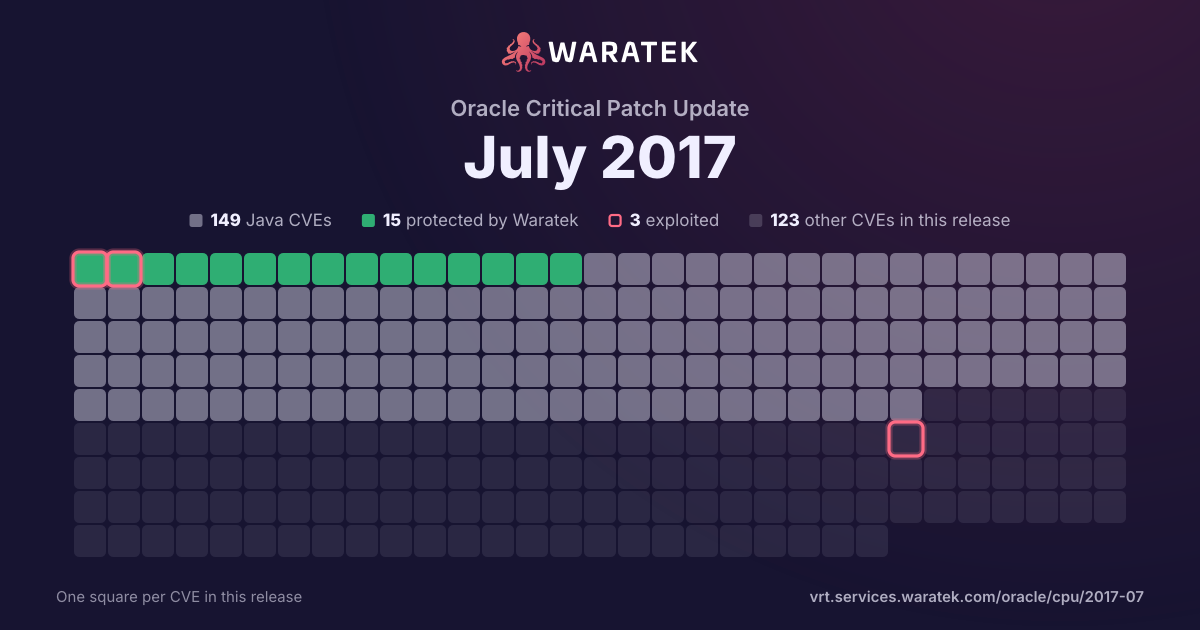
By status
15Protected by Waratek3Mitigation candidate131No exploit published30Outside Waratek scope93Not applicable
3Exploited, marked by the ring
No exploit published. For 126 of them, Oracle's security advisory is the source of public detail.
Protected by Waratek. Waratek RASP can block exploitation of these on systems that have not applied the patch yet.
Overview 10 matches · 3 in Waratek scope · 2 protected · 0 exploited · 0 CISA KEV · 2 public PoC · 2 EPSS ≥ 0.5
10matches
3in Waratek scope30.0%
2protected20.0%
0exploited0.0%
0CISA KEV0.0%
2public PoC20.0%
2EPSS ≥ 0.520.0%
Protected by Waratek
2
20.0%
Rule in development
0
0.0%
Mitigation candidate
0
0.0%
No exploit published
1
10.0%
Outside Waratek scope
3
30.0%
Not applicable
4
40.0%
Withdrawn CVE
0
0.0%
blocked by ARMR today
2
20.0%
partly blocked
0
0.0%
not blocked
8
80.0%
not established
0
0.0%
unrecorded
0
0.0%
Exploited
0
0.0%
Working exploit published
2
20.0%
Proof of concept only
0
0.0%
Forecast only
1
10.0%
No public exploit
7
70.0%
split by
peak 5 / quarter
Q1 141
Not applicable1
High1
not blocked1
Working exploit published1
Q2 140
Q3 140
Q4 140
Q1 152
Protected by Waratek1
Outside Waratek scope1
High2
blocked by ARMR today1
not blocked1
Working exploit published1
No public exploit1
Q2 150
Q3 150
Q4 150
Q1 160
Q2 162
Not applicable2
High2
not blocked2
No public exploit2
Q3 165
Protected by Waratek1
No exploit published1
Outside Waratek scope2
Not applicable1
High5
blocked by ARMR today1
not blocked4
Forecast only1
No public exploit4
Q1 14Q2 14Q3 14Q4 14Q1 15Q2 15Q3 15Q4 15Q1 16Q2 16Q3 16
| CVE | Severity | Published▾ | Status | Exploitation | Description |
|---|---|---|---|---|---|
| CVE-2016-3506 | High | 2016-07-21 | Not applicable | No public exploit | Unspecified vulnerability in the JDBC component in Oracle Database Server 11.2.0.4, 12.1.0.1, and 12.1.0.2; the Oracle Retail Xstore Point of Service 5.5, 6.0, 6.5, 7.0, 7.1, 15.0, and 16.0; the Oracle Retail Warehouse Management System 14.04, 14.1.3, and 15.0.1; the Oracle Retail Workforce Management 1.60.7, and 1.64.0; the Oracle Retail Clearance Optimization Engine 13.4; the Oracle Retail Markdown Optimization 13.4 and 14.0; and Oracle Retail Merchandising System 16.0 allows remote attackers to affect confidentiality, integrity, and availability via unknown vectors. |
| CVE-2016-0635 | High | 2016-07-21 | Outside Waratek scope | No public exploit | Unspecified vulnerability in the Enterprise Manager Ops Center component in Oracle Enterprise Manager Grid Control 12.1.4, 12.2.2, and 12.3.2; the Oracle Health Sciences Information Manager component in Oracle Health Sciences Applications 1.2.8.3, 2.0.2.3, and 3.0.1.0; the Oracle Healthcare Master Person Index component in Oracle Health Sciences Applications 2.0.12, 3.0.0, and 4.0.1; the Oracle Documaker component in Oracle Insurance Applications before 12.5; the Oracle Insurance Calculation Engine component in Oracle Insurance Applications 9.7.1, 10.1.2, and 10.2.2; the Oracle Insurance Policy Administration J2EE and Oracle Insurance Rules Palette components in Oracle Insurance Applications 9.6.1, 9.7.1, 10.0.1, 10.1.2, 10.2.0, and 10.2.2; the Oracle Retail Integration Bus component in Oracle Retail Applications 15.0; the Oracle Retail Order Broker component in Oracle Retail Applications 5.1, 5.2, and 15.0; the Primavera Contract Management component in Oracle Primavera Products Suite 14.2; the Primavera P6 Enterprise Project Portfolio Management component in Oracle Primavera Products Suite 8.2, 8.3, 8.4, 15.1, 15.2, and 16.1; the Oracle Financial Services Analytical Applications Infrastructure component in Oracle Financial Services Applications 8.0.0, 8.0.1, 8.0.2, and 8.0.3; the Oracle Commerce Guided Search / Oracle Commerce Experience Manager component in Oracle Commerce 3.1.1, 3.1.2, 11.0, 11.1, and 11.2; the Oracle Agile PLM component in Oracle Supply Chain Products Suite 9.3.4 and 9.3.5; the Oracle Communications BRM - Elastic Charging Engine 11.2.0.0.0 and 11.3.0.0.0; the Oracle Enterprise Repository Enterprise Repository 12.1.3.0.0; the Oracle Financial Services Behavior Detection Platform 8.0.1 and 8.0.2; the Oracle Hyperion Essbase 12.2.1.1; the Oracle Tuxedo System and Applications Monitor (TSAM) 11.1.1.2.0, 11.1.1.2.1, 11.1.1.2.1, 12.1.1.1.0, 12.1.3.0.0, and 12.2.2.0.0; the Oracle Communications WebRTC Session Controller component of Oracle Communications Applications (subcomponent: Security (Spring)) 7.0, 7.1 and 7.2; the Oracle Endeca Information Discovery Integrator 3.2; the Converged Commerce component of Oracle Retail Applications 16.0.1; the Oracle Identity Manager 11.1.2.3.0; Oracle Enterprise Manager for MySQL Database 12.1.0.4; Oracle Retail Invoice Matching 12.0, 13.0, 13.1, 13.2, 14.0, and 14.1; Oracle Communications Performance Intelligence Center (PIC) Software Prior to 10.2.1 and the Oracle Knowledge component of Oracle Siebel CRM (subcomponent: AnswerFlow (Spring Framework)) version 8.5.1.0 - 8.5.1.7 and 8.6.0 allows remote authenticated users to affect confidentiality, integrity, and availability via unknown vectors. |
| CVE-2016-5387 | High | 2016-07-19 | Outside Waratek scope | Forecast only | The Apache HTTP Server through 2.4.23 follows RFC 3875 section 4.1.18 and therefore does not protect applications from the presence of untrusted client data in the HTTP_PROXY environment variable, which might allow remote attackers to redirect an application's outbound HTTP traffic to an arbitrary proxy server via a crafted Proxy header in an HTTP request, aka an "httpoxy" issue. NOTE: the vendor states "This mitigation has been assigned the identifier CVE-2016-5387"; in other words, this is not a CVE ID for a vulnerability. |
| CVE-2016-3092 | High | 2016-07-04 | No exploit published | No public exploit | The MultipartStream class in Apache Commons Fileupload before 1.3.2, as used in Apache Tomcat 7.x before 7.0.70, 8.x before 8.0.36, 8.5.x before 8.5.3, and 9.x before 9.0.0.M7 and other products, allows remote attackers to cause a denial of service (CPU consumption) via a long boundary string. |
| CVE-2016-1181 | High | 2016-07-04 | Protected by Waratek | No public exploit | ActionServlet.java in Apache Struts 1 1.x through 1.3.10 mishandles multithreaded access to an ActionForm instance, which allows remote attackers to execute arbitrary code or cause a denial of service (unexpected memory access) via a multipart request, a related issue to CVE-2015-0899. |
| CVE-2016-2834 | High | 2016-06-13 | Not applicable | No public exploit | Mozilla Network Security Services (NSS) before 3.23, as used in Mozilla Firefox before 47.0, allows remote attackers to cause a denial of service (memory corruption and application crash) or possibly have unspecified other impact via unknown vectors. |
| CVE-2016-2381 | High | 2016-04-08 | Not applicable | No public exploit | Perl might allow context-dependent attackers to bypass the taint protection mechanism in a child process via duplicate environment variables in envp. |
| CVE-2015-0254 | High | 2015-03-09 | Protected by Waratek | No public exploit | Apache Standard Taglibs before 1.2.3 allows remote attackers to execute arbitrary code or conduct external XML entity (XXE) attacks via a crafted XSLT extension in a (1) <x:parse> or (2) <x:transform> JSTL XML tag. |
| CVE-2015-0235 | High | 2015-01-28 | Outside Waratek scope | Working exploit published | Heap-based buffer overflow in the __nss_hostname_digits_dots function in glibc 2.2, and other 2.x versions before 2.18, allows context-dependent attackers to execute arbitrary code via vectors related to the (1) gethostbyname or (2) gethostbyname2 function, aka "GHOST." |
| CVE-2014-1912 | High | 2014-03-01 | Not applicable | Working exploit published | Buffer overflow in the socket.recvfrom_into function in Modules/socketmodule.c in Python 2.5 before 2.7.7, 3.x before 3.3.4, and 3.4.x before 3.4rc1 allows remote attackers to execute arbitrary code via a crafted string. |