
Oracle Critical Patch Update April 2017
Released April 2017 · Oracle's advisory ↗ · ← Critical Patch Update, January 2017 · Critical Patch Update, July 2017 →
227 CVEs in this release, one square each
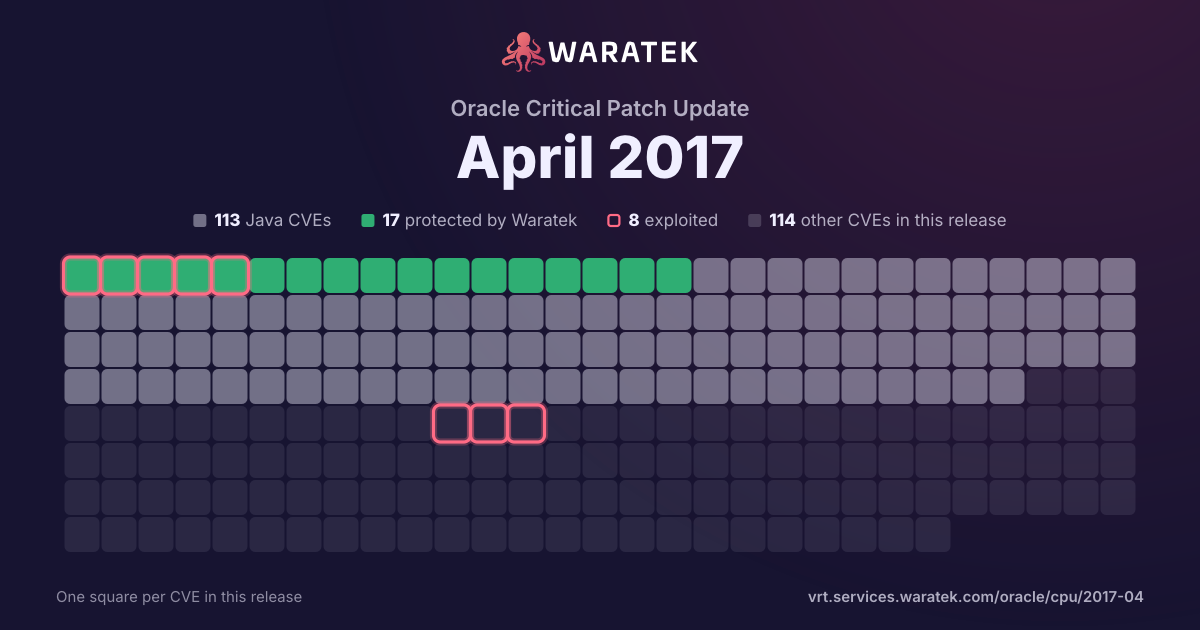
By status
17Protected by Waratek1Mitigation candidate95No exploit published13Outside Waratek scope101Not applicable
8Exploited, marked by the ring
No exploit published. For 93 of them, Oracle's security advisory is the source of public detail.
Protected by Waratek. Waratek RASP can block exploitation of these on systems that have not applied the patch yet.
Overview 7 matches · 3 in Waratek scope · 2 protected · 1 exploited · 1 CISA KEV · 2 public PoC · 1 EPSS ≥ 0.5
7matches
3in Waratek scope42.9%
2protected28.6%
1exploited14.3%
1CISA KEV14.3%
2public PoC28.6%
1EPSS ≥ 0.514.3%
Protected by Waratek
2
28.6%
Rule in development
0
0.0%
Mitigation candidate
0
0.0%
No exploit published
1
14.3%
Outside Waratek scope
0
0.0%
Not applicable
4
57.1%
Withdrawn CVE
0
0.0%
blocked by ARMR today
2
28.6%
partly blocked
0
0.0%
not blocked
5
71.4%
not established
0
0.0%
unrecorded
0
0.0%
Exploited
1
14.3%
Working exploit published
1
14.3%
Proof of concept only
0
0.0%
Forecast only
0
0.0%
No public exploit
5
71.4%
split by
peak 5 / year
20091
Not applicable1
Critical1
not blocked1
Working exploit published1
20100
20110
20120
20130
20140
20151
Protected by Waratek1
Critical1
blocked by ARMR today1
Exploited1
20165
Protected by Waratek1
No exploit published1
Not applicable3
Critical5
blocked by ARMR today1
not blocked4
No public exploit5
20092010201120122013201420152016
| CVE | Severity | Published▾ | Status | Exploitation | Description |
|---|---|---|---|---|---|
| CVE-2016-5019 | Critical | 2016-10-03 | Protected by Waratek | No public exploit | CoreResponseStateManager in Apache MyFaces Trinidad 1.0.0 through 1.0.13, 1.2.x before 1.2.15, 2.0.x before 2.0.2, and 2.1.x before 2.1.2 might allow attackers to conduct deserialization attacks via a crafted serialized view state string. |
| CVE-2016-6303 | Critical | 2016-09-16 | Not applicable | No public exploit | Integer overflow in the MDC2_Update function in crypto/mdc2/mdc2dgst.c in OpenSSL before 1.1.0 allows remote attackers to cause a denial of service (out-of-bounds write and application crash) or possibly have unspecified other impact via unknown vectors. |
| CVE-2016-6290 | Critical | 2016-07-25 | Not applicable | No public exploit | ext/session/session.c in PHP before 5.5.38, 5.6.x before 5.6.24, and 7.x before 7.0.9 does not properly maintain a certain hash data structure, which allows remote attackers to cause a denial of service (use-after-free) or possibly have unspecified other impact via vectors related to session deserialization. |
| CVE-2016-3607 | Critical | 2016-07-21 | No exploit published | No public exploit | Unspecified vulnerability in the Oracle GlassFish Server component in Oracle Fusion Middleware 3.0.1 and 3.1.2 allows remote attackers to affect confidentiality, integrity, and availability via vectors related to Web Container. |
| CVE-2016-0729 | Critical | 2016-04-07 | Not applicable | No public exploit | Multiple buffer overflows in (1) internal/XMLReader.cpp, (2) util/XMLURL.cpp, and (3) util/XMLUri.cpp in the XML Parser library in Apache Xerces-C before 3.1.3 allow remote attackers to cause a denial of service (segmentation fault or memory corruption) or possibly execute arbitrary code via a crafted document. |
| CVE-2015-4852 | Critical | 2015-11-18 | Protected by Waratek | Exploited | The WLS Security component in Oracle WebLogic Server 10.3.6.0, 12.1.2.0, 12.1.3.0, and 12.2.1.0 allows remote attackers to execute arbitrary commands via a crafted serialized Java object in T3 protocol traffic to TCP port 7001, related to oracle_common/modules/com.bea.core.apache.commons.collections.jar. NOTE: the scope of this CVE is limited to the WebLogic Server product. |
| CVE-2004-2761 | Critical | 2009-01-05 | Not applicable | Working exploit published | The MD5 Message-Digest Algorithm is not collision resistant, which makes it easier for context-dependent attackers to conduct spoofing attacks, as demonstrated by attacks on the use of MD5 in the signature algorithm of an X.509 certificate. |