
Oracle Critical Patch Update April 2017
Released April 2017 · Oracle's advisory ↗ · ← Critical Patch Update, January 2017 · Critical Patch Update, July 2017 →
227 CVEs in this release, one square each
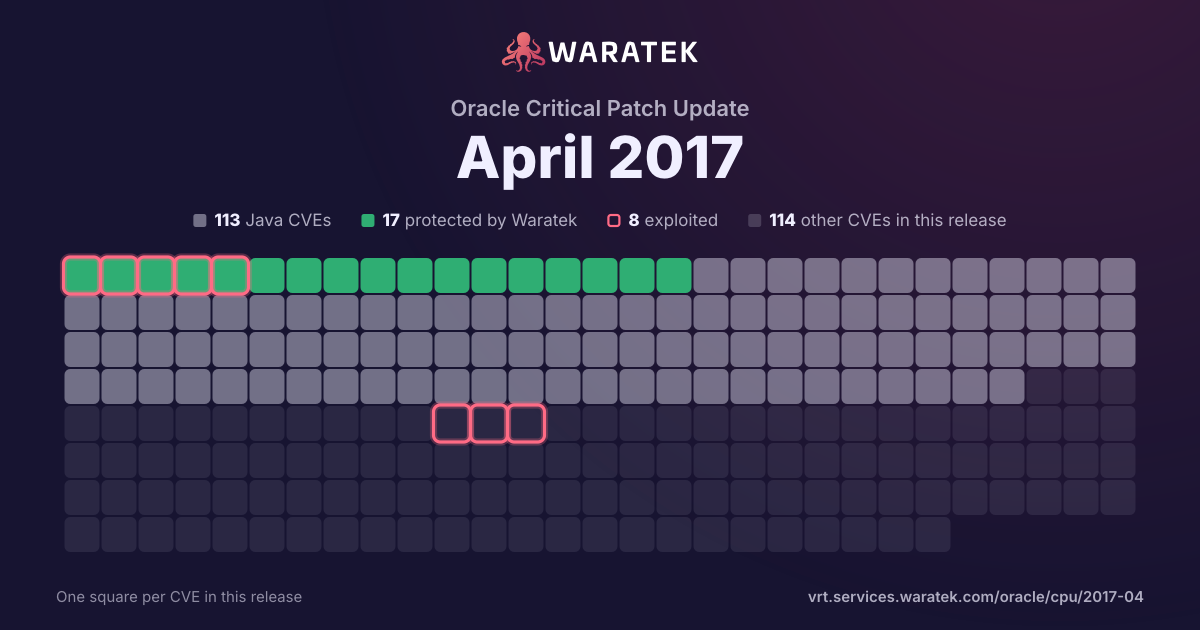
By status
17Protected by Waratek1Mitigation candidate95No exploit published13Outside Waratek scope101Not applicable
8Exploited, marked by the ring
No exploit published. For 93 of them, Oracle's security advisory is the source of public detail.
Protected by Waratek. Waratek RASP can block exploitation of these on systems that have not applied the patch yet.
Overview 92 matches · 34 in Waratek scope · 0 protected · 1 exploited · 0 CISA KEV · 8 public PoC · 3 EPSS ≥ 0.5
92matches
34in Waratek scope37.0%
0protected0.0%
1exploited1.1%
0CISA KEV0.0%
8public PoC8.7%
3EPSS ≥ 0.53.3%
Protected by Waratek
0
0.0%
Rule in development
0
0.0%
Mitigation candidate
0
0.0%
No exploit published
34
37.0%
Outside Waratek scope
6
6.5%
Not applicable
52
56.5%
Withdrawn CVE
0
0.0%
blocked by ARMR today
0
0.0%
partly blocked
0
0.0%
not blocked
92
100.0%
not established
0
0.0%
unrecorded
0
0.0%
Exploited
1
1.1%
Working exploit published
7
7.6%
Proof of concept only
0
0.0%
Forecast only
2
2.2%
No public exploit
82
89.1%
split by
peak 81 / quarter
Q2 121
Not applicable1
High1
not blocked1
No public exploit1
Q3 120
Q4 120
Q1 130
Q2 130
Q3 131
Not applicable1
High1
not blocked1
No public exploit1
Q4 130
Q1 140
Q2 140
Q3 140
Q4 140
Q1 150
Q2 150
Q3 150
Q4 151
Not applicable1
High1
not blocked1
No public exploit1
Q1 161
Outside Waratek scope1
High1
not blocked1
No public exploit1
Q2 161
Not applicable1
High1
not blocked1
No public exploit1
Q3 164
No exploit published1
Outside Waratek scope1
Not applicable2
High4
not blocked4
Forecast only1
No public exploit3
Q4 160
Q1 171
Not applicable1
High1
not blocked1
No public exploit1
Q2 1781
No exploit published33
Outside Waratek scope3
Not applicable45
High81
not blocked81
Exploited1
Working exploit published7
Forecast only1
No public exploit72
Q3 171
Outside Waratek scope1
High1
not blocked1
No public exploit1
Q3 12Q1 13Q3 13Q1 14Q3 14Q1 15Q3 15Q1 16Q3 16Q1 17Q3 17
| CVE | Severity | Published▾ | Status | Exploitation | Description |
|---|---|---|---|---|---|
| CVE-2016-8743 | High | 2017-07-27 | Outside Waratek scope | No public exploit | Apache HTTP Server, in all releases prior to 2.2.32 and 2.4.25, was liberal in the whitespace accepted from requests and sent in response lines and headers. Accepting these different behaviors represented a security concern when httpd participates in any chain of proxies or interacts with back-end application servers, either through mod_proxy or using conventional CGI mechanisms, and may result in request smuggling, response splitting and cache pollution. |
| CVE-2017-3731 | High | 2017-05-04 | Not applicable | Forecast only | If an SSL/TLS server or client is running on a 32-bit host, and a specific cipher is being used, then a truncated packet can cause that server or client to perform an out-of-bounds read, usually resulting in a crash. For OpenSSL 1.1.0, the crash can be triggered when using CHACHA20/POLY1305; users should upgrade to 1.1.0d. For Openssl 1.0.2, the crash can be triggered when using RC4-MD5; users who have not disabled that algorithm should update to 1.0.2k. |
| CVE-2017-3625 | High | 2017-04-24 | No exploit published | No public exploit | Vulnerability in the Oracle WebCenter Content component of Oracle Fusion Middleware (subcomponent: Content Server). Supported versions that are affected are 11.1.1.7, 11.1.1.9, 12.2.1.0, 12.2.1.1 and 12.2.1.2. Easily "exploitable" vulnerability allows unauthenticated attacker with network access via HTTP to compromise Oracle WebCenter Content. Successful attacks require human interaction from a person other than the attacker and while the vulnerability is in Oracle WebCenter Content, attacks may significantly impact additional products. Successful attacks of this vulnerability can result in unauthorized access to critical data or complete access to all Oracle WebCenter Content accessible data as well as unauthorized update, insert or delete access to some of Oracle WebCenter Content accessible data. CVSS 3.0 Base Score 8.2 (Confidentiality and Integrity impacts). CVSS Vector: (CVSS:3.0/AV:N/AC:L/PR:N/UI:R/S:C/C:H/I:L/A:N). |
| CVE-2017-3622 | High | 2017-04-24 | Not applicable | Exploited | Vulnerability in the Solaris component of Oracle Sun Systems Products Suite (subcomponent: Common Desktop Environment (CDE)). The supported version that is affected is 10. Easily "exploitable" vulnerability allows low privileged attacker with logon to the infrastructure where Solaris executes to compromise Solaris. Successful attacks of this vulnerability can result in takeover of Solaris. Note: CVE-2017-3622 is assigned for the "Extremeparr". CVSS 3.0 Base Score 7.8 (Confidentiality, Integrity and Availability impacts). CVSS Vector: (CVSS:3.0/AV:L/AC:L/PR:L/UI:N/S:U/C:H/I:H/A:H). |
| CVE-2017-3621 | High | 2017-04-24 | Not applicable | No public exploit | Vulnerability in the Sun ZFS Storage Appliance Kit (AK) component of Oracle Sun Systems Products Suite (subcomponent: IPC Frameworks). The supported version that is affected is AK 2013. Easily "exploitable" vulnerability allows unauthenticated attacker with network access via multiple protocols to compromise Sun ZFS Storage Appliance Kit (AK). Successful attacks of this vulnerability can result in unauthorized ability to cause a hang or frequently repeatable crash (complete DOS) of Sun ZFS Storage Appliance Kit (AK). CVSS 3.0 Base Score 7.5 (Availability impacts). CVSS Vector: (CVSS:3.0/AV:N/AC:L/PR:N/UI:N/S:U/C:N/I:N/A:H). |
| CVE-2017-3620 | High | 2017-04-24 | Not applicable | No public exploit | Vulnerability in the Automatic Service Request (ASR) component of Oracle Support Tools (subcomponent: ASR Manager). The supported version that is affected is Prior to 5.7. Easily "exploitable" vulnerability allows low privileged attacker with logon to the infrastructure where Automatic Service Request (ASR) executes to compromise Automatic Service Request (ASR). Successful attacks of this vulnerability can result in takeover of Automatic Service Request (ASR). CVSS 3.0 Base Score 7.8 (Confidentiality, Integrity and Availability impacts). CVSS Vector: (CVSS:3.0/AV:L/AC:L/PR:L/UI:N/S:U/C:H/I:H/A:H). |
| CVE-2017-3618 | High | 2017-04-24 | Not applicable | No public exploit | Vulnerability in the Automatic Service Request (ASR) component of Oracle Support Tools (subcomponent: ASR Manager). The supported version that is affected is Prior to 5.7. Easily "exploitable" vulnerability allows low privileged attacker with logon to the infrastructure where Automatic Service Request (ASR) executes to compromise Automatic Service Request (ASR). Successful attacks of this vulnerability can result in unauthorized creation, deletion or modification access to critical data or all Automatic Service Request (ASR) accessible data as well as unauthorized access to critical data or complete access to all Automatic Service Request (ASR) accessible data. CVSS 3.0 Base Score 7.1 (Confidentiality and Integrity impacts). CVSS Vector: (CVSS:3.0/AV:L/AC:L/PR:L/UI:N/S:U/C:H/I:H/A:N). |
| CVE-2017-3617 | High | 2017-04-24 | Not applicable | No public exploit | Vulnerability in the Data Store component of Oracle Berkeley DB. The supported version that is affected is Prior to 6.2.32. Difficult to exploit vulnerability allows unauthenticated attacker with logon to the infrastructure where Data Store executes to compromise Data Store. Successful attacks require human interaction from a person other than the attacker. Successful attacks of this vulnerability can result in takeover of Data Store. CVSS 3.0 Base Score 7.0 (Confidentiality, Integrity and Availability impacts). CVSS Vector: (CVSS:3.0/AV:L/AC:H/PR:N/UI:R/S:U/C:H/I:H/A:H). |
| CVE-2017-3616 | High | 2017-04-24 | Not applicable | No public exploit | Vulnerability in the Data Store component of Oracle Berkeley DB. The supported version that is affected is Prior to 6.2.32. Difficult to exploit vulnerability allows unauthenticated attacker with logon to the infrastructure where Data Store executes to compromise Data Store. Successful attacks require human interaction from a person other than the attacker. Successful attacks of this vulnerability can result in takeover of Data Store. CVSS 3.0 Base Score 7.0 (Confidentiality, Integrity and Availability impacts). CVSS Vector: (CVSS:3.0/AV:L/AC:H/PR:N/UI:R/S:U/C:H/I:H/A:H). |
| CVE-2017-3615 | High | 2017-04-24 | Not applicable | No public exploit | Vulnerability in the Data Store component of Oracle Berkeley DB. The supported version that is affected is Prior to 6.2.32. Difficult to exploit vulnerability allows unauthenticated attacker with logon to the infrastructure where Data Store executes to compromise Data Store. Successful attacks require human interaction from a person other than the attacker. Successful attacks of this vulnerability can result in takeover of Data Store. CVSS 3.0 Base Score 7.0 (Confidentiality, Integrity and Availability impacts). CVSS Vector: (CVSS:3.0/AV:L/AC:H/PR:N/UI:R/S:U/C:H/I:H/A:H). |
| CVE-2017-3614 | High | 2017-04-24 | Not applicable | No public exploit | Vulnerability in the Data Store component of Oracle Berkeley DB. The supported version that is affected is Prior to 6.2.32. Difficult to exploit vulnerability allows unauthenticated attacker with logon to the infrastructure where Data Store executes to compromise Data Store. Successful attacks require human interaction from a person other than the attacker. Successful attacks of this vulnerability can result in takeover of Data Store. CVSS 3.0 Base Score 7.0 (Confidentiality, Integrity and Availability impacts). CVSS Vector: (CVSS:3.0/AV:L/AC:H/PR:N/UI:R/S:U/C:H/I:H/A:H). |
| CVE-2017-3613 | High | 2017-04-24 | Not applicable | No public exploit | Vulnerability in the Data Store component of Oracle Berkeley DB. The supported version that is affected is Prior to 6.2.32. Difficult to exploit vulnerability allows unauthenticated attacker with logon to the infrastructure where Data Store executes to compromise Data Store. Successful attacks require human interaction from a person other than the attacker. Successful attacks of this vulnerability can result in takeover of Data Store. CVSS 3.0 Base Score 7.0 (Confidentiality, Integrity and Availability impacts). CVSS Vector: (CVSS:3.0/AV:L/AC:H/PR:N/UI:R/S:U/C:H/I:H/A:H). |
| CVE-2017-3612 | High | 2017-04-24 | Not applicable | No public exploit | Vulnerability in the Data Store component of Oracle Berkeley DB. The supported version that is affected is Prior to 6.2.32. Difficult to exploit vulnerability allows unauthenticated attacker with logon to the infrastructure where Data Store executes to compromise Data Store. Successful attacks require human interaction from a person other than the attacker. Successful attacks of this vulnerability can result in takeover of Data Store. CVSS 3.0 Base Score 7.0 (Confidentiality, Integrity and Availability impacts). CVSS Vector: (CVSS:3.0/AV:L/AC:H/PR:N/UI:R/S:U/C:H/I:H/A:H). |
| CVE-2017-3611 | High | 2017-04-24 | Not applicable | No public exploit | Vulnerability in the Data Store component of Oracle Berkeley DB. The supported version that is affected is Prior to 6.2.32. Difficult to exploit vulnerability allows unauthenticated attacker with logon to the infrastructure where Data Store executes to compromise Data Store. Successful attacks require human interaction from a person other than the attacker. Successful attacks of this vulnerability can result in takeover of Data Store. CVSS 3.0 Base Score 7.0 (Confidentiality, Integrity and Availability impacts). CVSS Vector: (CVSS:3.0/AV:L/AC:H/PR:N/UI:R/S:U/C:H/I:H/A:H). |
| CVE-2017-3610 | High | 2017-04-24 | Not applicable | No public exploit | Vulnerability in the Data Store component of Oracle Berkeley DB. The supported version that is affected is Prior to 6.2.32. Difficult to exploit vulnerability allows unauthenticated attacker with logon to the infrastructure where Data Store executes to compromise Data Store. Successful attacks require human interaction from a person other than the attacker. Successful attacks of this vulnerability can result in takeover of Data Store. CVSS 3.0 Base Score 7.0 (Confidentiality, Integrity and Availability impacts). CVSS Vector: (CVSS:3.0/AV:L/AC:H/PR:N/UI:R/S:U/C:H/I:H/A:H). |
| CVE-2017-3609 | High | 2017-04-24 | Not applicable | No public exploit | Vulnerability in the Data Store component of Oracle Berkeley DB. The supported version that is affected is Prior to 6.2.32. Difficult to exploit vulnerability allows unauthenticated attacker with logon to the infrastructure where Data Store executes to compromise Data Store. Successful attacks require human interaction from a person other than the attacker. Successful attacks of this vulnerability can result in takeover of Data Store. CVSS 3.0 Base Score 7.0 (Confidentiality, Integrity and Availability impacts). CVSS Vector: (CVSS:3.0/AV:L/AC:H/PR:N/UI:R/S:U/C:H/I:H/A:H). |
| CVE-2017-3608 | High | 2017-04-24 | Not applicable | No public exploit | Vulnerability in the Data Store component of Oracle Berkeley DB. The supported version that is affected is Prior to 6.2.32. Difficult to exploit vulnerability allows unauthenticated attacker with logon to the infrastructure where Data Store executes to compromise Data Store. Successful attacks require human interaction from a person other than the attacker. Successful attacks of this vulnerability can result in takeover of Data Store. CVSS 3.0 Base Score 7.0 (Confidentiality, Integrity and Availability impacts). CVSS Vector: (CVSS:3.0/AV:L/AC:H/PR:N/UI:R/S:U/C:H/I:H/A:H). |
| CVE-2017-3607 | High | 2017-04-24 | Not applicable | No public exploit | Vulnerability in the Data Store component of Oracle Berkeley DB. The supported version that is affected is Prior to 6.2.32. Difficult to exploit vulnerability allows unauthenticated attacker with logon to the infrastructure where Data Store executes to compromise Data Store. Successful attacks require human interaction from a person other than the attacker. Successful attacks of this vulnerability can result in takeover of Data Store. CVSS 3.0 Base Score 7.0 (Confidentiality, Integrity and Availability impacts). CVSS Vector: (CVSS:3.0/AV:L/AC:H/PR:N/UI:R/S:U/C:H/I:H/A:H). |
| CVE-2017-3606 | High | 2017-04-24 | Not applicable | No public exploit | Vulnerability in the Data Store component of Oracle Berkeley DB. The supported version that is affected is Prior to 6.2.32. Difficult to exploit vulnerability allows unauthenticated attacker with logon to the infrastructure where Data Store executes to compromise Data Store. Successful attacks require human interaction from a person other than the attacker. Successful attacks of this vulnerability can result in takeover of Data Store. CVSS 3.0 Base Score 7.0 (Confidentiality, Integrity and Availability impacts). CVSS Vector: (CVSS:3.0/AV:L/AC:H/PR:N/UI:R/S:U/C:H/I:H/A:H). |
| CVE-2017-3605 | High | 2017-04-24 | Not applicable | No public exploit | Vulnerability in the Data Store component of Oracle Berkeley DB. The supported version that is affected is Prior to 6.2.32. Difficult to exploit vulnerability allows unauthenticated attacker with logon to the infrastructure where Data Store executes to compromise Data Store. Successful attacks require human interaction from a person other than the attacker. Successful attacks of this vulnerability can result in takeover of Data Store. CVSS 3.0 Base Score 7.0 (Confidentiality, Integrity and Availability impacts). CVSS Vector: (CVSS:3.0/AV:L/AC:H/PR:N/UI:R/S:U/C:H/I:H/A:H). |
| CVE-2017-3604 | High | 2017-04-24 | Not applicable | No public exploit | Vulnerability in the Data Store component of Oracle Berkeley DB. The supported version that is affected is Prior to 6.2.32. Difficult to exploit vulnerability allows unauthenticated attacker with logon to the infrastructure where Data Store executes to compromise Data Store. Successful attacks require human interaction from a person other than the attacker. Successful attacks of this vulnerability can result in takeover of Data Store. CVSS 3.0 Base Score 7.0 (Confidentiality, Integrity and Availability impacts). CVSS Vector: (CVSS:3.0/AV:L/AC:H/PR:N/UI:R/S:U/C:H/I:H/A:H). |
| CVE-2017-3602 | High | 2017-04-24 | No exploit published | No public exploit | Vulnerability in the Oracle WebCenter Sites component of Oracle Fusion Middleware (subcomponent: Advanced UI). Supported versions that are affected are 11.1.1.8.0, 12.2.1.0.0, 12.2.1.1.0 and 12.2.1.2.0. Easily "exploitable" vulnerability allows low privileged attacker with network access via HTTP to compromise Oracle WebCenter Sites. Successful attacks of this vulnerability can result in unauthorized creation, deletion or modification access to critical data or all Oracle WebCenter Sites accessible data as well as unauthorized access to critical data or complete access to all Oracle WebCenter Sites accessible data. CVSS 3.0 Base Score 8.1 (Confidentiality and Integrity impacts). CVSS Vector: (CVSS:3.0/AV:N/AC:L/PR:L/UI:N/S:U/C:H/I:H/A:N). |
| CVE-2017-3601 | High | 2017-04-24 | No exploit published | No public exploit | Vulnerability in the Oracle API Gateway component of Oracle Fusion Middleware (subcomponent: Oracle API Gateway). The supported version that is affected is 11.1.2.4.0. Easily "exploitable" vulnerability allows unauthenticated attacker with network access via HTTP to compromise Oracle API Gateway. Successful attacks require human interaction from a person other than the attacker. Successful attacks of this vulnerability can result in unauthorized creation, deletion or modification access to critical data or all Oracle API Gateway accessible data as well as unauthorized access to critical data or complete access to all Oracle API Gateway accessible data. CVSS 3.0 Base Score 8.1 (Confidentiality and Integrity impacts). CVSS Vector: (CVSS:3.0/AV:N/AC:L/PR:N/UI:R/S:U/C:H/I:H/A:N). |
| CVE-2017-3599 | High | 2017-04-24 | Not applicable | Working exploit published | Vulnerability in the MySQL Server component of Oracle MySQL (subcomponent: Server: Pluggable Auth). Supported versions that are affected are 5.6.35 and earlier and 5.7.17 and earlier. Easily "exploitable" vulnerability allows unauthenticated attacker with network access via multiple protocols to compromise MySQL Server. Successful attacks of this vulnerability can result in unauthorized ability to cause a hang or frequently repeatable crash (complete DOS) of MySQL Server. CVSS 3.0 Base Score 7.5 (Availability impacts). CVSS Vector: (CVSS:3.0/AV:N/AC:L/PR:N/UI:N/S:U/C:N/I:N/A:H). NOTE: the previous information is from the April 2017 CPU. Oracle has not commented on third-party claims that this issue is an integer overflow in sql/auth/sql_authentication.cc which allows remote attackers to cause a denial of service via a crafted authentication packet. |
| CVE-2017-3596 | High | 2017-04-24 | No exploit published | No public exploit | Vulnerability in the Oracle WebCenter Sites component of Oracle Fusion Middleware (subcomponent: Advanced UI). Supported versions that are affected are 11.1.1.8.0, 12.2.1.0.0, 12.2.1.1.0 and 12.2.1.2.0. Easily "exploitable" vulnerability allows low privileged attacker with network access via HTTP to compromise Oracle WebCenter Sites. Successful attacks of this vulnerability can result in unauthorized access to critical data or complete access to all Oracle WebCenter Sites accessible data as well as unauthorized update, insert or delete access to some of Oracle WebCenter Sites accessible data and unauthorized ability to cause a partial denial of service (partial DOS) of Oracle WebCenter Sites. CVSS 3.0 Base Score 7.6 (Confidentiality, Integrity and Availability impacts). CVSS Vector: (CVSS:3.0/AV:N/AC:L/PR:L/UI:N/S:U/C:H/I:L/A:L). |
| CVE-2017-3595 | High | 2017-04-24 | No exploit published | No public exploit | Vulnerability in the Oracle WebCenter Sites component of Oracle Fusion Middleware (subcomponent: Advanced UI). Supported versions that are affected are 11.1.1.8.0, 12.2.1.0.0, 12.2.1.1.0 and 12.2.1.2.0. Easily "exploitable" vulnerability allows low privileged attacker with network access via HTTP to compromise Oracle WebCenter Sites. Successful attacks of this vulnerability can result in unauthorized access to critical data or complete access to all Oracle WebCenter Sites accessible data as well as unauthorized update, insert or delete access to some of Oracle WebCenter Sites accessible data. CVSS 3.0 Base Score 7.1 (Confidentiality and Integrity impacts). CVSS Vector: (CVSS:3.0/AV:N/AC:L/PR:L/UI:N/S:U/C:H/I:L/A:N). |
| CVE-2017-3593 | High | 2017-04-24 | No exploit published | No public exploit | Vulnerability in the Oracle WebCenter Sites component of Oracle Fusion Middleware (subcomponent: Advanced UI). Supported versions that are affected are 11.1.1.8.0, 12.2.1.0.0, 12.2.1.1.0 and 12.2.1.2.0. Easily "exploitable" vulnerability allows unauthenticated attacker with network access via HTTP to compromise Oracle WebCenter Sites. Successful attacks require human interaction from a person other than the attacker. Successful attacks of this vulnerability can result in unauthorized access to critical data or complete access to all Oracle WebCenter Sites accessible data as well as unauthorized update, insert or delete access to some of Oracle WebCenter Sites accessible data. CVSS 3.0 Base Score 7.1 (Confidentiality and Integrity impacts). CVSS Vector: (CVSS:3.0/AV:N/AC:L/PR:N/UI:R/S:U/C:H/I:L/A:N). |
| CVE-2017-3591 | High | 2017-04-24 | No exploit published | No public exploit | Vulnerability in the Oracle WebCenter Sites component of Oracle Fusion Middleware (subcomponent: Catalog Mover). Supported versions that are affected are 11.1.1.8.0, 12.2.1.0.0, 12.2.1.1.0 and 12.2.1.2.0. Easily "exploitable" vulnerability allows unauthenticated attacker with network access via HTTP to compromise Oracle WebCenter Sites. Successful attacks require human interaction from a person other than the attacker. Successful attacks of this vulnerability can result in unauthorized creation, deletion or modification access to critical data or all Oracle WebCenter Sites accessible data as well as unauthorized read access to a subset of Oracle WebCenter Sites accessible data. CVSS 3.0 Base Score 7.1 (Confidentiality and Integrity impacts). CVSS Vector: (CVSS:3.0/AV:N/AC:L/PR:N/UI:R/S:U/C:L/I:H/A:N). |
| CVE-2017-3587 | High | 2017-04-24 | Not applicable | Working exploit published | Vulnerability in the Oracle VM VirtualBox component of Oracle Virtualization (subcomponent: Shared Folder). Supported versions that are affected are Prior to 5.0.38 and Prior to 5.1.20. Easily "exploitable" vulnerability allows low privileged attacker with logon to the infrastructure where Oracle VM VirtualBox executes to compromise Oracle VM VirtualBox. While the vulnerability is in Oracle VM VirtualBox, attacks may significantly impact additional products. Successful attacks of this vulnerability can result in unauthorized creation, deletion or modification access to critical data or all Oracle VM VirtualBox accessible data and unauthorized ability to cause a hang or frequently repeatable crash (complete DOS) of Oracle VM VirtualBox. CVSS 3.0 Base Score 8.4 (Integrity and Availability impacts). CVSS Vector: (CVSS:3.0/AV:L/AC:L/PR:L/UI:N/S:C/C:N/I:H/A:H). |
| CVE-2017-3584 | High | 2017-04-24 | Not applicable | No public exploit | Vulnerability in the Sun ZFS Storage Appliance Kit (AK) component of Oracle Sun Systems Products Suite (subcomponent: RAS subsystems). The supported version that is affected is AK 2013. Difficult to exploit vulnerability allows low privileged attacker with logon to the infrastructure where Sun ZFS Storage Appliance Kit (AK) executes to compromise Sun ZFS Storage Appliance Kit (AK). While the vulnerability is in Sun ZFS Storage Appliance Kit (AK), attacks may significantly impact additional products. Successful attacks of this vulnerability can result in takeover of Sun ZFS Storage Appliance Kit (AK). CVSS 3.0 Base Score 7.8 (Confidentiality, Integrity and Availability impacts). CVSS Vector: (CVSS:3.0/AV:L/AC:H/PR:L/UI:N/S:C/C:H/I:H/A:H). |
| CVE-2017-3583 | High | 2017-04-24 | No exploit published | No public exploit | Vulnerability in the Primavera P6 Enterprise Project Portfolio Management component of Oracle Primavera Products Suite (subcomponent: Web Access). Supported versions that are affected are 8.3, 8.4, 15.1, 15.2, 16.1 and 16.2. Easily "exploitable" vulnerability allows unauthenticated attacker with network access via HTTP to compromise Primavera P6 Enterprise Project Portfolio Management. Successful attacks require human interaction from a person other than the attacker. Successful attacks of this vulnerability can result in unauthorized creation, deletion or modification access to critical data or all Primavera P6 Enterprise Project Portfolio Management accessible data as well as unauthorized access to critical data or complete access to all Primavera P6 Enterprise Project Portfolio Management accessible data. CVSS 3.0 Base Score 8.1 (Confidentiality and Integrity impacts). CVSS Vector: (CVSS:3.0/AV:N/AC:L/PR:N/UI:R/S:U/C:H/I:H/A:N). |
| CVE-2017-3582 | High | 2017-04-24 | Not applicable | No public exploit | Vulnerability in the Oracle SuperCluster Specific Software component of Oracle Sun Systems Products Suite (subcomponent: Backup/Restore Utility). Supported versions that are affected are 2.3.8 and 2.3.13. Easily "exploitable" vulnerability allows unauthenticated attacker with logon to the infrastructure where Oracle SuperCluster Specific Software executes to compromise Oracle SuperCluster Specific Software. Successful attacks of this vulnerability can result in takeover of Oracle SuperCluster Specific Software. CVSS 3.0 Base Score 8.4 (Confidentiality, Integrity and Availability impacts). CVSS Vector: (CVSS:3.0/AV:L/AC:L/PR:N/UI:N/S:U/C:H/I:H/A:H). |
| CVE-2017-3581 | High | 2017-04-24 | Not applicable | No public exploit | Vulnerability in the Automatic Service Request (ASR) component of Oracle Support Tools (subcomponent: ASR Manager). The supported version that is affected is Prior to 5.7. Easily "exploitable" vulnerability allows low privileged attacker with logon to the infrastructure where Automatic Service Request (ASR) executes to compromise Automatic Service Request (ASR). Successful attacks of this vulnerability can result in takeover of Automatic Service Request (ASR). CVSS 3.0 Base Score 7.8 (Confidentiality, Integrity and Availability impacts). CVSS Vector: (CVSS:3.0/AV:L/AC:L/PR:L/UI:N/S:U/C:H/I:H/A:H). |
| CVE-2017-3580 | High | 2017-04-24 | Not applicable | No public exploit | Vulnerability in the Sun ZFS Storage Appliance Kit (AK) component of Oracle Sun Systems Products Suite (subcomponent: RAS subsystems). The supported version that is affected is AK 2013. Difficult to exploit vulnerability allows unauthenticated attacker with network access via multiple protocols to compromise Sun ZFS Storage Appliance Kit (AK). Successful attacks require human interaction from a person other than the attacker and while the vulnerability is in Sun ZFS Storage Appliance Kit (AK), attacks may significantly impact additional products. Successful attacks of this vulnerability can result in takeover of Sun ZFS Storage Appliance Kit (AK). CVSS 3.0 Base Score 8.3 (Confidentiality, Integrity and Availability impacts). CVSS Vector: (CVSS:3.0/AV:N/AC:H/PR:N/UI:R/S:C/C:H/I:H/A:H). |
| CVE-2017-3578 | High | 2017-04-24 | Not applicable | No public exploit | Vulnerability in the Sun ZFS Storage Appliance Kit (AK) component of Oracle Sun Systems Products Suite (subcomponent: RAS subsystems). The supported version that is affected is AK 2013. Easily "exploitable" vulnerability allows low privileged attacker with logon to the infrastructure where Sun ZFS Storage Appliance Kit (AK) executes to compromise Sun ZFS Storage Appliance Kit (AK). While the vulnerability is in Sun ZFS Storage Appliance Kit (AK), attacks may significantly impact additional products. Successful attacks of this vulnerability can result in takeover of Sun ZFS Storage Appliance Kit (AK). CVSS 3.0 Base Score 8.8 (Confidentiality, Integrity and Availability impacts). CVSS Vector: (CVSS:3.0/AV:L/AC:L/PR:L/UI:N/S:C/C:H/I:H/A:H). |
| CVE-2017-3576 | High | 2017-04-24 | Not applicable | Working exploit published | Vulnerability in the Oracle VM VirtualBox component of Oracle Virtualization (subcomponent: Core). Supported versions that are affected are Prior to 5.0.38 and Prior to 5.1.20. Easily "exploitable" vulnerability allows low privileged attacker with logon to the infrastructure where Oracle VM VirtualBox executes to compromise Oracle VM VirtualBox. While the vulnerability is in Oracle VM VirtualBox, attacks may significantly impact additional products. Successful attacks of this vulnerability can result in takeover of Oracle VM VirtualBox. CVSS 3.0 Base Score 8.8 (Confidentiality, Integrity and Availability impacts). CVSS Vector: (CVSS:3.0/AV:L/AC:L/PR:L/UI:N/S:C/C:H/I:H/A:H). |
| CVE-2017-3575 | High | 2017-04-24 | Not applicable | Working exploit published | Vulnerability in the Oracle VM VirtualBox component of Oracle Virtualization (subcomponent: Core). Supported versions that are affected are Prior to 5.0.38 and Prior to 5.1.20. Easily "exploitable" vulnerability allows high privileged attacker with logon to the infrastructure where Oracle VM VirtualBox executes to compromise Oracle VM VirtualBox. While the vulnerability is in Oracle VM VirtualBox, attacks may significantly impact additional products. Successful attacks of this vulnerability can result in unauthorized creation, deletion or modification access to critical data or all Oracle VM VirtualBox accessible data and unauthorized ability to cause a hang or frequently repeatable crash (complete DOS) of Oracle VM VirtualBox. CVSS 3.0 Base Score 7.9 (Integrity and Availability impacts). CVSS Vector: (CVSS:3.0/AV:L/AC:L/PR:H/UI:N/S:C/C:N/I:H/A:H). |
| CVE-2017-3574 | High | 2017-04-24 | No exploit published | No public exploit | Vulnerability in the Oracle Hospitality OPERA 5 Property Services component of Oracle Hospitality Applications (subcomponent: OPERA License code configuration). Supported versions that are affected are 5.4.0.x, 5.4.1.x, 5.4.2.x, 5.4.3.x, 5.5.0.x and 5.5.1.x. Easily "exploitable" vulnerability allows low privileged attacker with network access via HTTP to compromise Oracle Hospitality OPERA 5 Property Services. Successful attacks of this vulnerability can result in unauthorized access to critical data or complete access to all Oracle Hospitality OPERA 5 Property Services accessible data as well as unauthorized update, insert or delete access to some of Oracle Hospitality OPERA 5 Property Services accessible data. CVSS 3.0 Base Score 7.1 (Confidentiality and Integrity impacts). CVSS Vector: (CVSS:3.0/AV:N/AC:L/PR:L/UI:N/S:U/C:H/I:L/A:N). |
| CVE-2017-3572 | High | 2017-04-24 | No exploit published | No public exploit | Vulnerability in the Oracle Commerce Guided Search / Oracle Commerce Experience Manager component of Oracle Commerce (subcomponent: MDEX). Supported versions that are affected are 6.2.2, 6.3.0, 6.4.1.2, 6.5.0, 6.5.1 and 6.5.2. Easily "exploitable" vulnerability allows unauthenticated attacker with network access via HTTP to compromise Oracle Commerce Guided Search / Oracle Commerce Experience Manager. Successful attacks of this vulnerability can result in unauthorized ability to cause a hang or frequently repeatable crash (complete DOS) of Oracle Commerce Guided Search / Oracle Commerce Experience Manager. CVSS 3.0 Base Score 7.5 (Availability impacts). CVSS Vector: (CVSS:3.0/AV:N/AC:L/PR:N/UI:N/S:U/C:N/I:N/A:H). |
| CVE-2017-3565 | High | 2017-04-24 | Not applicable | No public exploit | Vulnerability in the Solaris component of Oracle Sun Systems Products Suite (subcomponent: RBAC). The supported version that is affected is 11.3. Easily "exploitable" vulnerability allows low privileged attacker with logon to the infrastructure where Solaris executes to compromise Solaris. Successful attacks require human interaction from a person other than the attacker and while the vulnerability is in Solaris, attacks may significantly impact additional products. Successful attacks of this vulnerability can result in unauthorized creation, deletion or modification access to critical data or all Solaris accessible data as well as unauthorized access to critical data or complete access to all Solaris accessible data. CVSS 3.0 Base Score 7.9 (Confidentiality and Integrity impacts). CVSS Vector: (CVSS:3.0/AV:L/AC:L/PR:L/UI:R/S:C/C:H/I:H/A:N). |
| CVE-2017-3564 | High | 2017-04-24 | Not applicable | No public exploit | Vulnerability in the Solaris component of Oracle Sun Systems Products Suite (subcomponent: RBAC). The supported version that is affected is 11.3. Easily "exploitable" vulnerability allows low privileged attacker with logon to the infrastructure where Solaris executes to compromise Solaris. Successful attacks require human interaction from a person other than the attacker and while the vulnerability is in Solaris, attacks may significantly impact additional products. Successful attacks of this vulnerability can result in takeover of Solaris. CVSS 3.0 Base Score 8.2 (Confidentiality, Integrity and Availability impacts). CVSS Vector: (CVSS:3.0/AV:L/AC:L/PR:L/UI:R/S:C/C:H/I:H/A:H). |
| CVE-2017-3563 | High | 2017-04-24 | Not applicable | Working exploit published | Vulnerability in the Oracle VM VirtualBox component of Oracle Virtualization (subcomponent: Core). Supported versions that are affected are Prior to 5.0.38 and Prior to 5.1.20. Easily "exploitable" vulnerability allows low privileged attacker with logon to the infrastructure where Oracle VM VirtualBox executes to compromise Oracle VM VirtualBox. While the vulnerability is in Oracle VM VirtualBox, attacks may significantly impact additional products. Successful attacks of this vulnerability can result in takeover of Oracle VM VirtualBox. CVSS 3.0 Base Score 8.8 (Confidentiality, Integrity and Availability impacts). CVSS Vector: (CVSS:3.0/AV:L/AC:L/PR:L/UI:N/S:C/C:H/I:H/A:H). |
| CVE-2017-3561 | High | 2017-04-24 | Not applicable | Working exploit published | Vulnerability in the Oracle VM VirtualBox component of Oracle Virtualization (subcomponent: Core). Supported versions that are affected are Prior to 5.0.38 and Prior to 5.1.20. Easily "exploitable" vulnerability allows low privileged attacker with logon to the infrastructure where Oracle VM VirtualBox executes to compromise Oracle VM VirtualBox. While the vulnerability is in Oracle VM VirtualBox, attacks may significantly impact additional products. Successful attacks of this vulnerability can result in takeover of Oracle VM VirtualBox. CVSS 3.0 Base Score 8.8 (Confidentiality, Integrity and Availability impacts). CVSS Vector: (CVSS:3.0/AV:L/AC:L/PR:L/UI:N/S:C/C:H/I:H/A:H). |
| CVE-2017-3559 | High | 2017-04-24 | Not applicable | No public exploit | Vulnerability in the Oracle VM VirtualBox component of Oracle Virtualization (subcomponent: Core). Supported versions that are affected are Prior to 5.0.38 and Prior to 5.1.20. Easily "exploitable" vulnerability allows low privileged attacker with logon to the infrastructure where Oracle VM VirtualBox executes to compromise Oracle VM VirtualBox. While the vulnerability is in Oracle VM VirtualBox, attacks may significantly impact additional products. Successful attacks of this vulnerability can result in unauthorized ability to cause a hang or frequently repeatable crash (complete DOS) of Oracle VM VirtualBox as well as unauthorized update, insert or delete access to some of Oracle VM VirtualBox accessible data and unauthorized read access to a subset of Oracle VM VirtualBox accessible data. CVSS 3.0 Base Score 7.9 (Confidentiality, Integrity and Availability impacts). CVSS Vector: (CVSS:3.0/AV:L/AC:L/PR:L/UI:N/S:C/C:L/I:L/A:H). |
| CVE-2017-3558 | High | 2017-04-24 | Not applicable | Working exploit published | Vulnerability in the Oracle VM VirtualBox component of Oracle Virtualization (subcomponent: Core). Supported versions that are affected are Prior to 5.0.38 and Prior to 5.1.20. Easily "exploitable" vulnerability allows unauthenticated attacker with logon to the infrastructure where Oracle VM VirtualBox executes to compromise Oracle VM VirtualBox. While the vulnerability is in Oracle VM VirtualBox, attacks may significantly impact additional products. Successful attacks of this vulnerability can result in unauthorized ability to cause a hang or frequently repeatable crash (complete DOS) of Oracle VM VirtualBox as well as unauthorized update, insert or delete access to some of Oracle VM VirtualBox accessible data and unauthorized read access to a subset of Oracle VM VirtualBox accessible data. CVSS 3.0 Base Score 8.5 (Confidentiality, Integrity and Availability impacts). CVSS Vector: (CVSS:3.0/AV:L/AC:L/PR:N/UI:N/S:C/C:L/I:L/A:H). |
| CVE-2017-3557 | High | 2017-04-24 | No exploit published | No public exploit | Vulnerability in the Oracle One-to-One Fulfillment component of Oracle E-Business Suite (subcomponent: Print Server). Supported versions that are affected are 12.1.3, 12.2.3, 12.2.4, 12.2.5 and 12.2.6. Easily "exploitable" vulnerability allows unauthenticated attacker with network access via HTTP to compromise Oracle One-to-One Fulfillment. Successful attacks require human interaction from a person other than the attacker and while the vulnerability is in Oracle One-to-One Fulfillment, attacks may significantly impact additional products. Successful attacks of this vulnerability can result in unauthorized access to critical data or complete access to all Oracle One-to-One Fulfillment accessible data as well as unauthorized update, insert or delete access to some of Oracle One-to-One Fulfillment accessible data. CVSS 3.0 Base Score 8.2 (Confidentiality and Integrity impacts). CVSS Vector: (CVSS:3.0/AV:N/AC:L/PR:N/UI:R/S:C/C:H/I:L/A:N). |
| CVE-2017-3555 | High | 2017-04-24 | No exploit published | No public exploit | Vulnerability in the Oracle iReceivables component of Oracle E-Business Suite (subcomponent: Self Registration). Supported versions that are affected are 12.1.1, 12.1.2, 12.1.3, 12.2.3, 12.2.4, 12.2.5 and 12.2.6. Easily "exploitable" vulnerability allows unauthenticated attacker with network access via HTTP to compromise Oracle iReceivables. Successful attacks of this vulnerability can result in unauthorized ability to cause a hang or frequently repeatable crash (complete DOS) of Oracle iReceivables. CVSS 3.0 Base Score 7.5 (Availability impacts). CVSS Vector: (CVSS:3.0/AV:N/AC:L/PR:N/UI:N/S:U/C:N/I:N/A:H). |
| CVE-2017-3554 | High | 2017-04-24 | No exploit published | No public exploit | Vulnerability in the Oracle WebCenter Sites component of Oracle Fusion Middleware (subcomponent: Catalog Mover). Supported versions that are affected are 11.1.1.8.0, 12.2.1.0.0, 12.2.1.1.0 and 12.2.1.2.0. Easily "exploitable" vulnerability allows low privileged attacker with network access via HTTP to compromise Oracle WebCenter Sites. Successful attacks of this vulnerability can result in unauthorized creation, deletion or modification access to critical data or all Oracle WebCenter Sites accessible data as well as unauthorized access to critical data or complete access to all Oracle WebCenter Sites accessible data. CVSS 3.0 Base Score 8.1 (Confidentiality and Integrity impacts). CVSS Vector: (CVSS:3.0/AV:N/AC:L/PR:L/UI:N/S:U/C:H/I:H/A:N). |
| CVE-2017-3550 | High | 2017-04-24 | No exploit published | No public exploit | Vulnerability in the Oracle Customer Interaction History component of Oracle E-Business Suite (subcomponent: Admin Console). Supported versions that are affected are 12.1.1, 12.1.2 and 12.1.3. Easily "exploitable" vulnerability allows unauthenticated attacker with network access via HTTP to compromise Oracle Customer Interaction History. Successful attacks require human interaction from a person other than the attacker and while the vulnerability is in Oracle Customer Interaction History, attacks may significantly impact additional products. Successful attacks of this vulnerability can result in unauthorized access to critical data or complete access to all Oracle Customer Interaction History accessible data as well as unauthorized update, insert or delete access to some of Oracle Customer Interaction History accessible data. CVSS 3.0 Base Score 8.2 (Confidentiality and Integrity impacts). CVSS Vector: (CVSS:3.0/AV:N/AC:L/PR:N/UI:R/S:C/C:H/I:L/A:N). |
| CVE-2017-3547 | High | 2017-04-24 | No exploit published | No public exploit | Vulnerability in the PeopleSoft Enterprise PeopleTools component of Oracle PeopleSoft Products (subcomponent: MultiChannel Framework). Supported versions that are affected are 8.54 and 8.55. Easily "exploitable" vulnerability allows unauthenticated attacker with network access via HTTP to compromise PeopleSoft Enterprise PeopleTools. Successful attacks require human interaction from a person other than the attacker and while the vulnerability is in PeopleSoft Enterprise PeopleTools, attacks may significantly impact additional products. Successful attacks of this vulnerability can result in unauthorized creation, deletion or modification access to critical data or all PeopleSoft Enterprise PeopleTools accessible data. CVSS 3.0 Base Score 7.4 (Integrity impacts). CVSS Vector: (CVSS:3.0/AV:N/AC:L/PR:N/UI:R/S:C/C:N/I:H/A:N). |
| CVE-2017-3545 | High | 2017-04-24 | No exploit published | No public exploit | Vulnerability in the Oracle WebCenter Sites component of Oracle Fusion Middleware (subcomponent: Blob Server). Supported versions that are affected are 11.1.1.8.0, 12.2.1.0.0, 12.2.1.1.0 and 12.2.1.2.0. Easily "exploitable" vulnerability allows unauthenticated attacker with network access via HTTP to compromise Oracle WebCenter Sites. Successful attacks of this vulnerability can result in unauthorized creation, deletion or modification access to critical data or all Oracle WebCenter Sites accessible data as well as unauthorized read access to a subset of Oracle WebCenter Sites accessible data. CVSS 3.0 Base Score 8.2 (Confidentiality and Integrity impacts). CVSS Vector: (CVSS:3.0/AV:N/AC:L/PR:N/UI:N/S:U/C:L/I:H/A:N). |
| CVE-2017-3543 | High | 2017-04-24 | No exploit published | No public exploit | Vulnerability in the Oracle WebCenter Sites component of Oracle Fusion Middleware (subcomponent: Server). Supported versions that are affected are 11.1.1.8.0, 12.2.1.0.0, 12.2.1.1.0 and 12.2.1.2.0. Easily "exploitable" vulnerability allows unauthenticated attacker with network access via HTTP to compromise Oracle WebCenter Sites. Successful attacks of this vulnerability can result in unauthorized access to critical data or complete access to all Oracle WebCenter Sites accessible data as well as unauthorized update, insert or delete access to some of Oracle WebCenter Sites accessible data and unauthorized ability to cause a partial denial of service (partial DOS) of Oracle WebCenter Sites. CVSS 3.0 Base Score 8.6 (Confidentiality, Integrity and Availability impacts). CVSS Vector: (CVSS:3.0/AV:N/AC:L/PR:N/UI:N/S:U/C:H/I:L/A:L). |
| CVE-2017-3542 | High | 2017-04-24 | No exploit published | No public exploit | Vulnerability in the Oracle WebCenter Sites component of Oracle Fusion Middleware (subcomponent: Server). Supported versions that are affected are 11.1.1.8.0, 12.2.1.0.0, 12.2.1.1.0 and 12.2.1.2.0. Easily "exploitable" vulnerability allows unauthenticated attacker with network access via HTTP to compromise Oracle WebCenter Sites. Successful attacks of this vulnerability can result in unauthorized access to critical data or complete access to all Oracle WebCenter Sites accessible data as well as unauthorized update, insert or delete access to some of Oracle WebCenter Sites accessible data and unauthorized ability to cause a partial denial of service (partial DOS) of Oracle WebCenter Sites. CVSS 3.0 Base Score 8.6 (Confidentiality, Integrity and Availability impacts). CVSS Vector: (CVSS:3.0/AV:N/AC:L/PR:N/UI:N/S:U/C:H/I:L/A:L). |
| CVE-2017-3541 | High | 2017-04-24 | No exploit published | No public exploit | Vulnerability in the Oracle WebCenter Sites component of Oracle Fusion Middleware (subcomponent: Server). Supported versions that are affected are 11.1.1.8.0, 12.2.1.0.0, 12.2.1.1.0 and 12.2.1.2.0. Easily "exploitable" vulnerability allows unauthenticated attacker with network access via HTTP to compromise Oracle WebCenter Sites. Successful attacks of this vulnerability can result in unauthorized access to critical data or complete access to all Oracle WebCenter Sites accessible data as well as unauthorized update, insert or delete access to some of Oracle WebCenter Sites accessible data. CVSS 3.0 Base Score 8.2 (Confidentiality and Integrity impacts). CVSS Vector: (CVSS:3.0/AV:N/AC:L/PR:N/UI:N/S:U/C:H/I:L/A:N). |
| CVE-2017-3540 | High | 2017-04-24 | No exploit published | No public exploit | Vulnerability in the Oracle WebCenter Sites component of Oracle Fusion Middleware (subcomponent: Server). Supported versions that are affected are 11.1.1.8.0, 12.2.1.0.0, 12.2.1.1.0 and 12.2.1.2.0. Easily "exploitable" vulnerability allows unauthenticated attacker with network access via HTTP to compromise Oracle WebCenter Sites. Successful attacks of this vulnerability can result in unauthorized ability to cause a hang or frequently repeatable crash (complete DOS) of Oracle WebCenter Sites as well as unauthorized update, insert or delete access to some of Oracle WebCenter Sites accessible data and unauthorized read access to a subset of Oracle WebCenter Sites accessible data. CVSS 3.0 Base Score 8.6 (Confidentiality, Integrity and Availability impacts). CVSS Vector: (CVSS:3.0/AV:N/AC:L/PR:N/UI:N/S:U/C:L/I:L/A:H). |
| CVE-2017-3538 | High | 2017-04-24 | Not applicable | No public exploit | Vulnerability in the Oracle VM VirtualBox component of Oracle Virtualization (subcomponent: Shared Folder). Supported versions that are affected are Prior to 5.0.34 and Prior to 5.1.16. Difficult to exploit vulnerability allows low privileged attacker with logon to the infrastructure where Oracle VM VirtualBox executes to compromise Oracle VM VirtualBox. While the vulnerability is in Oracle VM VirtualBox, attacks may significantly impact additional products. Successful attacks of this vulnerability can result in unauthorized creation, deletion or modification access to critical data or all Oracle VM VirtualBox accessible data as well as unauthorized access to critical data or complete access to all Oracle VM VirtualBox accessible data. CVSS 3.0 Base Score 7.5 (Confidentiality and Integrity impacts). CVSS Vector: (CVSS:3.0/AV:L/AC:H/PR:L/UI:N/S:C/C:H/I:H/A:N). |
| CVE-2017-3523 | High | 2017-04-24 | Not applicable | No public exploit | Vulnerability in the MySQL Connectors component of Oracle MySQL (subcomponent: Connector/J). Supported versions that are affected are 5.1.40 and earlier. Difficult to exploit vulnerability allows low privileged attacker with network access via multiple protocols to compromise MySQL Connectors. While the vulnerability is in MySQL Connectors, attacks may significantly impact additional products. Successful attacks of this vulnerability can result in takeover of MySQL Connectors. CVSS 3.0 Base Score 8.5 (Confidentiality, Integrity and Availability impacts). CVSS Vector: (CVSS:3.0/AV:N/AC:H/PR:L/UI:N/S:C/C:H/I:H/A:H). |
| CVE-2017-3519 | High | 2017-04-24 | No exploit published | No public exploit | Vulnerability in the PeopleSoft Enterprise PeopleTools component of Oracle PeopleSoft Products (subcomponent: Security). Supported versions that are affected are 8.54 and 8.55. Easily "exploitable" vulnerability allows unauthenticated attacker with network access via HTTP to compromise PeopleSoft Enterprise PeopleTools. Successful attacks of this vulnerability can result in unauthorized access to critical data or complete access to all PeopleSoft Enterprise PeopleTools accessible data. CVSS 3.0 Base Score 7.5 (Confidentiality impacts). CVSS Vector: (CVSS:3.0/AV:N/AC:L/PR:N/UI:N/S:U/C:H/I:N/A:N). |
| CVE-2017-3518 | High | 2017-04-24 | No exploit published | No public exploit | Vulnerability in the Enterprise Manager Base Platform component of Oracle Enterprise Manager Grid Control (subcomponent: Discovery Framework). Supported versions that are affected are 12.1.0, 13.1.0 and 13.2.0. Easily "exploitable" vulnerability allows unauthenticated attacker with network access via HTTPS to compromise Enterprise Manager Base Platform. Successful attacks of this vulnerability can result in unauthorized ability to cause a hang or frequently repeatable crash (complete DOS) of Enterprise Manager Base Platform. CVSS 3.0 Base Score 7.5 (Availability impacts). CVSS Vector: (CVSS:3.0/AV:N/AC:L/PR:N/UI:N/S:U/C:N/I:N/A:H). |
| CVE-2017-3516 | High | 2017-04-24 | Not applicable | No public exploit | Vulnerability in the Solaris component of Oracle Sun Systems Products Suite (subcomponent: Kernel Zones virtualized NIC driver). The supported version that is affected is 11.3. Easily "exploitable" vulnerability allows low privileged attacker with network access via multiple protocols to compromise Solaris. While the vulnerability is in Solaris, attacks may significantly impact additional products. Successful attacks of this vulnerability can result in unauthorized ability to cause a hang or frequently repeatable crash (complete DOS) of Solaris. CVSS 3.0 Base Score 7.7 (Availability impacts). CVSS Vector: (CVSS:3.0/AV:N/AC:L/PR:L/UI:N/S:C/C:N/I:N/A:H). |
| CVE-2017-3514 | High | 2017-04-24 | Outside Waratek scope | No public exploit | Vulnerability in the Java SE component of Oracle Java SE (subcomponent: AWT). Supported versions that are affected are Java SE: 6u141, 7u131 and 8u121. Difficult to exploit vulnerability allows unauthenticated attacker with network access via multiple protocols to compromise Java SE. Successful attacks require human interaction from a person other than the attacker and while the vulnerability is in Java SE, attacks may significantly impact additional products. Successful attacks of this vulnerability can result in takeover of Java SE. Note: This vulnerability applies to Java deployments, typically in clients running sandboxed Java Web Start applications or sandboxed Java applets, that load and run untrusted code (e.g., code that comes from the internet) and rely on the Java sandbox for security. This vulnerability does not apply to Java deployments, typically in servers, that load and run only trusted code (e.g., code installed by an administrator). CVSS 3.0 Base Score 8.3 (Confidentiality, Integrity and Availability impacts). CVSS Vector: (CVSS:3.0/AV:N/AC:H/PR:N/UI:R/S:C/C:H/I:H/A:H). |
| CVE-2017-3512 | High | 2017-04-24 | Outside Waratek scope | No public exploit | Vulnerability in the Java SE component of Oracle Java SE (subcomponent: AWT). Supported versions that are affected are Java SE: 7u131 and 8u121. Difficult to exploit vulnerability allows unauthenticated attacker with network access via multiple protocols to compromise Java SE. Successful attacks require human interaction from a person other than the attacker and while the vulnerability is in Java SE, attacks may significantly impact additional products. Successful attacks of this vulnerability can result in takeover of Java SE. Note: This vulnerability applies to Java deployments, typically in clients running sandboxed Java Web Start applications or sandboxed Java applets, that load and run untrusted code (e.g., code that comes from the internet) and rely on the Java sandbox for security. This vulnerability does not apply to Java deployments, typically in servers, that load and run only trusted code (e.g., code installed by an administrator). CVSS 3.0 Base Score 8.3 (Confidentiality, Integrity and Availability impacts). CVSS Vector: (CVSS:3.0/AV:N/AC:H/PR:N/UI:R/S:C/C:H/I:H/A:H). |
| CVE-2017-3507 | High | 2017-04-24 | No exploit published | No public exploit | Vulnerability in the Oracle Service Bus component of Oracle Fusion Middleware (subcomponent: Web Console Design). Supported versions that are affected are 12.1.3.0.0, 12.2.1.0.0, 12.2.1.1.0 and 12.2.1.2.0. Easily "exploitable" vulnerability allows unauthenticated attacker with network access via HTTP to compromise Oracle Service Bus. Successful attacks of this vulnerability can result in unauthorized update, insert or delete access to some of Oracle Service Bus accessible data as well as unauthorized read access to a subset of Oracle Service Bus accessible data and unauthorized ability to cause a partial denial of service (partial DOS) of Oracle Service Bus. CVSS 3.0 Base Score 7.3 (Confidentiality, Integrity and Availability impacts). CVSS Vector: (CVSS:3.0/AV:N/AC:L/PR:N/UI:N/S:U/C:L/I:L/A:L). |
| CVE-2017-3500 | High | 2017-04-24 | No exploit published | No public exploit | Vulnerability in the Primavera Gateway component of Oracle Primavera Products Suite (subcomponent: Primavera Desktop Integration). Supported versions that are affected are 1.0, 1.1, 14.2, 15.1, 15.2, 16.1 and 16.2. Easily "exploitable" vulnerability allows high privileged attacker with network access via HTTP to compromise Primavera Gateway. While the vulnerability is in Primavera Gateway, attacks may significantly impact additional products. Successful attacks of this vulnerability can result in unauthorized access to critical data or complete access to all Primavera Gateway accessible data and unauthorized ability to cause a hang or frequently repeatable crash (complete DOS) of Primavera Gateway. CVSS 3.0 Base Score 8.7 (Confidentiality and Availability impacts). CVSS Vector: (CVSS:3.0/AV:N/AC:L/PR:H/UI:N/S:C/C:H/I:N/A:H). |
| CVE-2017-3499 | High | 2017-04-24 | No exploit published | No public exploit | Vulnerability in the Oracle Social Network component of Oracle Fusion Middleware (subcomponent: Android Client). The supported version that is affected is prior to 11.1.12.0.0 (17019101). Easily "exploitable" vulnerability allows unauthenticated attacker with network access via HTTPS to compromise Oracle Social Network. Successful attacks of this vulnerability can result in unauthorized access to critical data or complete access to all Oracle Social Network accessible data. CVSS 3.0 Base Score 7.5 (Confidentiality impacts). CVSS Vector: (CVSS:3.0/AV:N/AC:L/PR:N/UI:N/S:U/C:H/I:N/A:N). |
| CVE-2017-3497 | High | 2017-04-24 | Not applicable | No public exploit | Vulnerability in the Solaris component of Oracle Sun Systems Products Suite (subcomponent: Remote Administration Daemon). The supported version that is affected is 11.3. Easily "exploitable" vulnerability allows unauthenticated attacker with network access via multiple protocols to compromise Solaris. Successful attacks of this vulnerability can result in unauthorized update, insert or delete access to some of Solaris accessible data as well as unauthorized read access to a subset of Solaris accessible data and unauthorized ability to cause a partial denial of service (partial DOS) of Solaris. CVSS 3.0 Base Score 7.3 (Confidentiality, Integrity and Availability impacts). CVSS Vector: (CVSS:3.0/AV:N/AC:L/PR:N/UI:N/S:U/C:L/I:L/A:L). |
| CVE-2017-3493 | High | 2017-04-24 | No exploit published | No public exploit | Vulnerability in the Oracle FLEXCUBE Enterprise Limits and Collateral Management component of Oracle Financial Services Applications (subcomponent: Infrastructure). Supported versions that are affected are 12.0.0 and 12.1.0. Easily "exploitable" vulnerability allows low privileged attacker with network access via HTTP to compromise Oracle FLEXCUBE Enterprise Limits and Collateral Management. While the vulnerability is in Oracle FLEXCUBE Enterprise Limits and Collateral Management, attacks may significantly impact additional products. Successful attacks of this vulnerability can result in unauthorized access to critical data or complete access to all Oracle FLEXCUBE Enterprise Limits and Collateral Management accessible data and unauthorized ability to cause a partial denial of service (partial DOS) of Oracle FLEXCUBE Enterprise Limits and Collateral Management. CVSS 3.0 Base Score 8.5 (Confidentiality and Availability impacts). CVSS Vector: (CVSS:3.0/AV:N/AC:L/PR:L/UI:N/S:C/C:H/I:N/A:L). |
| CVE-2017-3486 | High | 2017-04-24 | Not applicable | No public exploit | Vulnerability in the SQL*Plus component of Oracle Database Server. Supported versions that are affected are 11.2.0.4 and 12.1.0.2. Difficult to exploit vulnerability allows high privileged attacker having Local Logon privilege with logon to the infrastructure where SQL*Plus executes to compromise SQL*Plus. Successful attacks require human interaction from a person other than the attacker and while the vulnerability is in SQL*Plus, attacks may significantly impact additional products. Successful attacks of this vulnerability can result in takeover of SQL*Plus. Note: This score is for Windows platform version 11.2.0.4 of Database. For Windows platform version 12.1.0.2 and Linux, the score is 6.3 with scope Unchanged. CVSS 3.0 Base Score 7.2 (Confidentiality, Integrity and Availability impacts). CVSS Vector: (CVSS:3.0/AV:L/AC:H/PR:H/UI:R/S:C/C:H/I:H/A:H). |
| CVE-2017-3476 | High | 2017-04-24 | No exploit published | No public exploit | Vulnerability in the Oracle FLEXCUBE Private Banking component of Oracle Financial Services Applications (subcomponent: Miscellaneous). Supported versions that are affected are 2.0.0, 2.0.1, 2.2.0.1 and 12.0.1. Easily "exploitable" vulnerability allows low privileged attacker with network access via HTTP to compromise Oracle FLEXCUBE Private Banking. Successful attacks of this vulnerability can result in unauthorized access to critical data or complete access to all Oracle FLEXCUBE Private Banking accessible data as well as unauthorized update, insert or delete access to some of Oracle FLEXCUBE Private Banking accessible data. CVSS 3.0 Base Score 7.1 (Confidentiality and Integrity impacts). CVSS Vector: (CVSS:3.0/AV:N/AC:L/PR:L/UI:N/S:U/C:H/I:L/A:N). |
| CVE-2017-3472 | High | 2017-04-24 | No exploit published | No public exploit | Vulnerability in the Oracle FLEXCUBE Private Banking component of Oracle Financial Services Applications (subcomponent: Portfolio Management). Supported versions that are affected are 2.0.0, 2.0.1, 2.2.0.1 and 12.0.1. Easily "exploitable" vulnerability allows low privileged attacker with network access via HTTP to compromise Oracle FLEXCUBE Private Banking. Successful attacks of this vulnerability can result in unauthorized creation, deletion or modification access to critical data or all Oracle FLEXCUBE Private Banking accessible data as well as unauthorized access to critical data or complete access to all Oracle FLEXCUBE Private Banking accessible data. CVSS 3.0 Base Score 8.1 (Confidentiality and Integrity impacts). CVSS Vector: (CVSS:3.0/AV:N/AC:L/PR:L/UI:N/S:U/C:H/I:H/A:N). |
| CVE-2017-3450 | High | 2017-04-24 | Not applicable | No public exploit | Vulnerability in the MySQL Server component of Oracle MySQL (subcomponent: Server: Memcached). Supported versions that are affected are 5.6.35 and earlier and 5.7.17 and earlier. Easily "exploitable" vulnerability allows unauthenticated attacker with network access via multiple protocols to compromise MySQL Server. Successful attacks of this vulnerability can result in unauthorized ability to cause a hang or frequently repeatable crash (complete DOS) of MySQL Server. CVSS 3.0 Base Score 7.5 (Availability impacts). CVSS Vector: (CVSS:3.0/AV:N/AC:L/PR:N/UI:N/S:U/C:N/I:N/A:H). |
| CVE-2017-3432 | High | 2017-04-24 | No exploit published | No public exploit | Vulnerability in the Oracle One-to-One Fulfillment component of Oracle E-Business Suite (subcomponent: Audience workbench). Supported versions that are affected are 12.1.1, 12.1.2 and 12.1.3. Easily "exploitable" vulnerability allows unauthenticated attacker with network access via HTTP to compromise Oracle One-to-One Fulfillment. Successful attacks require human interaction from a person other than the attacker and while the vulnerability is in Oracle One-to-One Fulfillment, attacks may significantly impact additional products. Successful attacks of this vulnerability can result in unauthorized access to critical data or complete access to all Oracle One-to-One Fulfillment accessible data as well as unauthorized update, insert or delete access to some of Oracle One-to-One Fulfillment accessible data. CVSS 3.0 Base Score 8.2 (Confidentiality and Integrity impacts). CVSS Vector: (CVSS:3.0/AV:N/AC:L/PR:N/UI:R/S:C/C:H/I:L/A:N). |
| CVE-2017-3393 | High | 2017-04-24 | No exploit published | No public exploit | Vulnerability in the Oracle Advanced Outbound Telephony component of Oracle E-Business Suite (subcomponent: Interaction History). Supported versions that are affected are 12.2.3, 12.2.4, 12.2.5 and 12.2.6. Easily "exploitable" vulnerability allows unauthenticated attacker with network access via HTTP to compromise Oracle Advanced Outbound Telephony. Successful attacks require human interaction from a person other than the attacker and while the vulnerability is in Oracle Advanced Outbound Telephony, attacks may significantly impact additional products. Successful attacks of this vulnerability can result in unauthorized access to critical data or complete access to all Oracle Advanced Outbound Telephony accessible data as well as unauthorized update, insert or delete access to some of Oracle Advanced Outbound Telephony accessible data. CVSS 3.0 Base Score 8.2 (Confidentiality and Integrity impacts). CVSS Vector: (CVSS:3.0/AV:N/AC:L/PR:N/UI:R/S:C/C:H/I:L/A:N). |
| CVE-2017-3337 | High | 2017-04-24 | No exploit published | No public exploit | Vulnerability in the Oracle Marketing component of Oracle E-Business Suite (subcomponent: User Interface). Supported versions that are affected are 12.1.1, 12.1.2, 12.1.3, 12.2.3, 12.2.4, 12.2.5 and 12.2.6. Easily "exploitable" vulnerability allows unauthenticated attacker with network access via HTTP to compromise Oracle Marketing. Successful attacks require human interaction from a person other than the attacker and while the vulnerability is in Oracle Marketing, attacks may significantly impact additional products. Successful attacks of this vulnerability can result in unauthorized access to critical data or complete access to all Oracle Marketing accessible data as well as unauthorized update, insert or delete access to some of Oracle Marketing accessible data. CVSS 3.0 Base Score 8.2 (Confidentiality and Integrity impacts). CVSS Vector: (CVSS:3.0/AV:N/AC:L/PR:N/UI:R/S:C/C:H/I:L/A:N). |
| CVE-2017-3329 | High | 2017-04-24 | Not applicable | No public exploit | Vulnerability in the MySQL Server component of Oracle MySQL (subcomponent: Server: Thread Pooling). Supported versions that are affected are 5.5.54 and earlier, 5.6.35 and earlier and 5.7.17 and earlier. Easily "exploitable" vulnerability allows unauthenticated attacker with network access via multiple protocols to compromise MySQL Server. Successful attacks of this vulnerability can result in unauthorized ability to cause a hang or frequently repeatable crash (complete DOS) of MySQL Server. CVSS 3.0 Base Score 7.5 (Availability impacts). CVSS Vector: (CVSS:3.0/AV:N/AC:L/PR:N/UI:N/S:U/C:N/I:N/A:H). |
| CVE-2017-3309 | High | 2017-04-24 | Not applicable | No public exploit | Vulnerability in the MySQL Server component of Oracle MySQL (subcomponent: Server: Optimizer). Supported versions that are affected are 5.5.54 and earlier, 5.6.35 and earlier and 5.7.17 and earlier. Easily "exploitable" vulnerability allows low privileged attacker with network access via multiple protocols to compromise MySQL Server. While the vulnerability is in MySQL Server, attacks may significantly impact additional products. Successful attacks of this vulnerability can result in unauthorized ability to cause a hang or frequently repeatable crash (complete DOS) of MySQL Server. CVSS 3.0 Base Score 7.7 (Availability impacts). CVSS Vector: (CVSS:3.0/AV:N/AC:L/PR:L/UI:N/S:C/C:N/I:N/A:H). |
| CVE-2017-3308 | High | 2017-04-24 | Not applicable | No public exploit | Vulnerability in the MySQL Server component of Oracle MySQL (subcomponent: Server: DML). Supported versions that are affected are 5.5.54 and earlier, 5.6.35 and earlier and 5.7.17 and earlier. Easily "exploitable" vulnerability allows low privileged attacker with network access via multiple protocols to compromise MySQL Server. While the vulnerability is in MySQL Server, attacks may significantly impact additional products. Successful attacks of this vulnerability can result in unauthorized ability to cause a hang or frequently repeatable crash (complete DOS) of MySQL Server. CVSS 3.0 Base Score 7.7 (Availability impacts). CVSS Vector: (CVSS:3.0/AV:N/AC:L/PR:L/UI:N/S:C/C:N/I:N/A:H). |
| CVE-2017-3306 | High | 2017-04-24 | Outside Waratek scope | No public exploit | Vulnerability in the MySQL Enterprise Monitor component of Oracle MySQL (subcomponent: Monitoring: Server). Supported versions that are affected are 3.1.6.8003 and earlier, 3.2.1182 and earlier and 3.3.2.1162 and earlier. Easily "exploitable" vulnerability allows high privileged attacker with network access via multiple protocols to compromise MySQL Enterprise Monitor. Successful attacks require human interaction from a person other than the attacker and while the vulnerability is in MySQL Enterprise Monitor, attacks may significantly impact additional products. Successful attacks of this vulnerability can result in unauthorized creation, deletion or modification access to critical data or all MySQL Enterprise Monitor accessible data as well as unauthorized access to critical data or complete access to all MySQL Enterprise Monitor accessible data and unauthorized ability to cause a partial denial of service (partial DOS) of MySQL Enterprise Monitor. CVSS 3.0 Base Score 8.3 (Confidentiality, Integrity and Availability impacts). CVSS Vector: (CVSS:3.0/AV:N/AC:L/PR:H/UI:R/S:C/C:H/I:H/A:L). |
| CVE-2017-3254 | High | 2017-04-24 | No exploit published | No public exploit | Vulnerability in the Oracle Retail Invoice Matching component of Oracle Retail Applications (subcomponent: Security). Supported versions that are affected are 12.0 and 13.0. Easily "exploitable" vulnerability allows unauthenticated attacker with network access via HTTP to compromise Oracle Retail Invoice Matching. Successful attacks require human interaction from a person other than the attacker. Successful attacks of this vulnerability can result in unauthorized access to critical data or complete access to all Oracle Retail Invoice Matching accessible data as well as unauthorized update, insert or delete access to some of Oracle Retail Invoice Matching accessible data and unauthorized ability to cause a partial denial of service (partial DOS) of Oracle Retail Invoice Matching. CVSS 3.0 Base Score 7.6 (Confidentiality, Integrity and Availability impacts). CVSS Vector: (CVSS:3.0/AV:N/AC:L/PR:N/UI:R/S:U/C:H/I:L/A:L). |
| CVE-2017-3237 | High | 2017-04-24 | Not applicable | No public exploit | Vulnerability in the Automatic Service Request (ASR) component of Oracle Support Tools (subcomponent: ASR Manager). The supported version that is affected is Prior to 5.7. Easily "exploitable" vulnerability allows low privileged attacker with logon to the infrastructure where Automatic Service Request (ASR) executes to compromise Automatic Service Request (ASR). Successful attacks of this vulnerability can result in takeover of Automatic Service Request (ASR). CVSS 3.0 Base Score 7.8 (Confidentiality, Integrity and Availability impacts). CVSS Vector: (CVSS:3.0/AV:L/AC:L/PR:L/UI:N/S:U/C:H/I:H/A:H). |
| CVE-2017-3233 | High | 2017-04-24 | Not applicable | No public exploit | Vulnerability in the Automatic Service Request (ASR) component of Oracle Support Tools (subcomponent: ASR Manager). The supported version that is affected is Prior to 5.7. Easily "exploitable" vulnerability allows unauthenticated attacker with network access via HTTP to compromise Automatic Service Request (ASR). Successful attacks of this vulnerability can result in unauthorized creation, deletion or modification access to critical data or all Automatic Service Request (ASR) accessible data. CVSS 3.0 Base Score 7.5 (Integrity impacts). CVSS Vector: (CVSS:3.0/AV:N/AC:L/PR:N/UI:N/S:U/C:N/I:H/A:N). |
| CVE-2017-3230 | High | 2017-04-24 | No exploit published | No public exploit | Vulnerability in the Oracle Fusion Middleware MapViewer component of Oracle Fusion Middleware (subcomponent: Map Builder). Supported versions that are affected are 11.1.1.9, 12.2.1.1 and 12.2.1.2. Easily "exploitable" vulnerability allows unauthenticated attacker with network access via HTTP to compromise Oracle Fusion Middleware MapViewer. Successful attacks of this vulnerability can result in unauthorized creation, deletion or modification access to critical data or all Oracle Fusion Middleware MapViewer accessible data as well as unauthorized read access to a subset of Oracle Fusion Middleware MapViewer accessible data and unauthorized ability to cause a partial denial of service (partial DOS) of Oracle Fusion Middleware MapViewer. CVSS 3.0 Base Score 8.6 (Confidentiality, Integrity and Availability impacts). CVSS Vector: (CVSS:3.0/AV:N/AC:L/PR:N/UI:N/S:U/C:L/I:H/A:L). |
| CVE-2017-3302 | High | 2017-02-12 | Not applicable | No public exploit | Crash in libmysqlclient.so in Oracle MySQL before 5.6.21 and 5.7.x before 5.7.5 and MariaDB through 5.5.54, 10.0.x through 10.0.29, 10.1.x through 10.1.21, and 10.2.x through 10.2.3. |
| CVE-2016-6304 | High | 2016-09-26 | Not applicable | Forecast only | Multiple memory leaks in t1_lib.c in OpenSSL before 1.0.1u, 1.0.2 before 1.0.2i, and 1.1.0 before 1.1.0a allow remote attackers to cause a denial of service (memory consumption) via large OCSP Status Request extensions. |
| CVE-2016-3506 | High | 2016-07-21 | Not applicable | No public exploit | Unspecified vulnerability in the JDBC component in Oracle Database Server 11.2.0.4, 12.1.0.1, and 12.1.0.2; the Oracle Retail Xstore Point of Service 5.5, 6.0, 6.5, 7.0, 7.1, 15.0, and 16.0; the Oracle Retail Warehouse Management System 14.04, 14.1.3, and 15.0.1; the Oracle Retail Workforce Management 1.60.7, and 1.64.0; the Oracle Retail Clearance Optimization Engine 13.4; the Oracle Retail Markdown Optimization 13.4 and 14.0; and Oracle Retail Merchandising System 16.0 allows remote attackers to affect confidentiality, integrity, and availability via unknown vectors. |
| CVE-2016-0635 | High | 2016-07-21 | Outside Waratek scope | No public exploit | Unspecified vulnerability in the Enterprise Manager Ops Center component in Oracle Enterprise Manager Grid Control 12.1.4, 12.2.2, and 12.3.2; the Oracle Health Sciences Information Manager component in Oracle Health Sciences Applications 1.2.8.3, 2.0.2.3, and 3.0.1.0; the Oracle Healthcare Master Person Index component in Oracle Health Sciences Applications 2.0.12, 3.0.0, and 4.0.1; the Oracle Documaker component in Oracle Insurance Applications before 12.5; the Oracle Insurance Calculation Engine component in Oracle Insurance Applications 9.7.1, 10.1.2, and 10.2.2; the Oracle Insurance Policy Administration J2EE and Oracle Insurance Rules Palette components in Oracle Insurance Applications 9.6.1, 9.7.1, 10.0.1, 10.1.2, 10.2.0, and 10.2.2; the Oracle Retail Integration Bus component in Oracle Retail Applications 15.0; the Oracle Retail Order Broker component in Oracle Retail Applications 5.1, 5.2, and 15.0; the Primavera Contract Management component in Oracle Primavera Products Suite 14.2; the Primavera P6 Enterprise Project Portfolio Management component in Oracle Primavera Products Suite 8.2, 8.3, 8.4, 15.1, 15.2, and 16.1; the Oracle Financial Services Analytical Applications Infrastructure component in Oracle Financial Services Applications 8.0.0, 8.0.1, 8.0.2, and 8.0.3; the Oracle Commerce Guided Search / Oracle Commerce Experience Manager component in Oracle Commerce 3.1.1, 3.1.2, 11.0, 11.1, and 11.2; the Oracle Agile PLM component in Oracle Supply Chain Products Suite 9.3.4 and 9.3.5; the Oracle Communications BRM - Elastic Charging Engine 11.2.0.0.0 and 11.3.0.0.0; the Oracle Enterprise Repository Enterprise Repository 12.1.3.0.0; the Oracle Financial Services Behavior Detection Platform 8.0.1 and 8.0.2; the Oracle Hyperion Essbase 12.2.1.1; the Oracle Tuxedo System and Applications Monitor (TSAM) 11.1.1.2.0, 11.1.1.2.1, 11.1.1.2.1, 12.1.1.1.0, 12.1.3.0.0, and 12.2.2.0.0; the Oracle Communications WebRTC Session Controller component of Oracle Communications Applications (subcomponent: Security (Spring)) 7.0, 7.1 and 7.2; the Oracle Endeca Information Discovery Integrator 3.2; the Converged Commerce component of Oracle Retail Applications 16.0.1; the Oracle Identity Manager 11.1.2.3.0; Oracle Enterprise Manager for MySQL Database 12.1.0.4; Oracle Retail Invoice Matching 12.0, 13.0, 13.1, 13.2, 14.0, and 14.1; Oracle Communications Performance Intelligence Center (PIC) Software Prior to 10.2.1 and the Oracle Knowledge component of Oracle Siebel CRM (subcomponent: AnswerFlow (Spring Framework)) version 8.5.1.0 - 8.5.1.7 and 8.6.0 allows remote authenticated users to affect confidentiality, integrity, and availability via unknown vectors. |
| CVE-2016-3092 | High | 2016-07-04 | No exploit published | No public exploit | The MultipartStream class in Apache Commons Fileupload before 1.3.2, as used in Apache Tomcat 7.x before 7.0.70, 8.x before 8.0.36, 8.5.x before 8.5.3, and 9.x before 9.0.0.M7 and other products, allows remote attackers to cause a denial of service (CPU consumption) via a long boundary string. |
| CVE-2016-2176 | High | 2016-05-05 | Not applicable | No public exploit | The X509_NAME_oneline function in crypto/x509/x509_obj.c in OpenSSL before 1.0.1t and 1.0.2 before 1.0.2h allows remote attackers to obtain sensitive information from process stack memory or cause a denial of service (buffer over-read) via crafted EBCDIC ASN.1 data. |
| CVE-2016-0714 | High | 2016-02-25 | Outside Waratek scope | No public exploit | The session-persistence implementation in Apache Tomcat 6.x before 6.0.45, 7.x before 7.0.68, 8.x before 8.0.31, and 9.x before 9.0.0.M2 mishandles session attributes, which allows remote authenticated users to bypass intended SecurityManager restrictions and execute arbitrary code in a privileged context via a web application that places a crafted object in a session. |
| CVE-2015-5252 | High | 2015-12-29 | Not applicable | No public exploit | vfs.c in smbd in Samba 3.x and 4.x before 4.1.22, 4.2.x before 4.2.7, and 4.3.x before 4.3.3, when share names with certain substring relationships exist, allows remote attackers to bypass intended file-access restrictions via a symlink that points outside of a share. |
| CVE-2013-5209 | High | 2013-08-29 | Not applicable | No public exploit | The sctp_send_initiate_ack function in sys/netinet/sctp_output.c in the SCTP implementation in the kernel in FreeBSD 8.3 through 9.2-PRERELEASE does not properly initialize the state-cookie data structure, which allows remote attackers to obtain sensitive information from kernel stack memory by reading packet data in INIT-ACK chunks. |
| CVE-2012-0920 | High | 2012-06-05 | Not applicable | No public exploit | Use-after-free vulnerability in Dropbear SSH Server 0.52 through 2012.54, when command restriction and public key authentication are enabled, allows remote authenticated users to execute arbitrary code and bypass command restrictions via multiple crafted command requests, related to "channels concurrency." |