
Java SE CPU Apr 2013
Released April 2013 · Oracle's advisory ↗ · ← Critical Patch Update, April 2013 · Java SE Critical Patch Update, June 2013 →
42 CVEs in this release, one square each
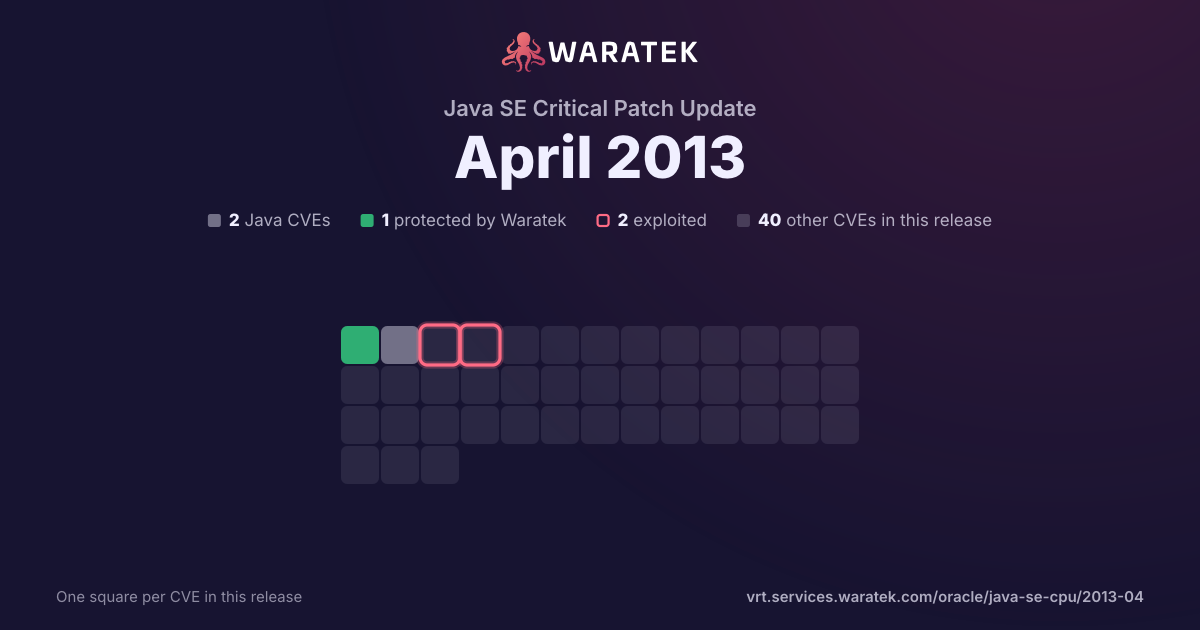
By status
Protected by Waratek. Waratek RASP can block exploitation of these on systems that have not applied the patch yet.
Overview 4 matches · 0 in Waratek scope · 0 protected · 0 exploited · 0 CISA KEV · 2 public PoC · 1 EPSS ≥ 0.5
4matches
0in Waratek scope0.0%
0protected0.0%
0exploited0.0%
0CISA KEV0.0%
2public PoC50.0%
1EPSS ≥ 0.525.0%
Protected by Waratek
0
0.0%
Rule in development
0
0.0%
Mitigation candidate
0
0.0%
No exploit published
0
0.0%
Outside Waratek scope
4
100.0%
Not applicable
0
0.0%
Withdrawn CVE
0
0.0%
blocked by ARMR today
0
0.0%
partly blocked
0
0.0%
not blocked
4
100.0%
not established
0
0.0%
unrecorded
0
0.0%
Exploited
0
0.0%
Working exploit published
1
25.0%
Proof of concept only
1
25.0%
Forecast only
0
0.0%
No public exploit
2
50.0%
split by
peak 4 / month
Mar 13
| CVE | Severity | Published▾ | Status | Exploitation | Description |
|---|---|---|---|---|---|
| CVE-2013-1491 | High | 2013-03-08 | Outside Waratek scope | Proof of concept only | The Java Runtime Environment (JRE) component in Oracle Java SE 7 Update 17 and earlier, 6 Update 43 and earlier, 5.0 Update 41 and earlier, and JavaFX 2.2.7 and earlier allows remote attackers to execute arbitrary code via vectors related to 2D, as demonstrated by Joshua Drake during a Pwn2Own competition at CanSecWest 2013. |
| CVE-2013-1488 | High | 2013-03-08 | Outside Waratek scope | Working exploit published | The Java Runtime Environment (JRE) component in Oracle Java SE 7 Update 17 and earlier, and OpenJDK 6 and 7, allows remote attackers to execute arbitrary code via unspecified vectors involving reflection, Libraries, "improper toString calls," and the JDBC driver manager, as demonstrated by James Forshaw during a Pwn2Own competition at CanSecWest 2013. |
| CVE-2013-0402 | High | 2013-03-08 | Outside Waratek scope | No public exploit | Heap-based buffer overflow in the Java Runtime Environment (JRE) component in Oracle Java SE 7 Update 17 and earlier and JavaFX 2.2.7 and earlier allows remote attackers to execute arbitrary code via unspecified vectors related to JavaFX, as demonstrated by VUPEN during a Pwn2Own competition at CanSecWest 2013. |
| CVE-2013-0401 | High | 2013-03-08 | Outside Waratek scope | No public exploit | The Java Runtime Environment (JRE) component in Oracle Java SE 7 Update 17 and earlier, 6 Update 43 and earlier, and 5.0 Update 41 and earlier; and OpenJDK 6 and 7; allows remote attackers to execute arbitrary code via vectors related to AWT, as demonstrated by Ben Murphy during a Pwn2Own competition at CanSecWest 2013. NOTE: the previous information is from the April 2013 CPU. Oracle has not commented on claims from another vendor that this issue is related to invocation of the system class loader by the sun.awt.datatransfer.ClassLoaderObjectInputStream class, which allows remote attackers to bypass Java sandbox restrictions. |