
Oracle Critical Security Patch Update September 2026
Released September 2026 · Oracle's advisory ↗ · ← Security Patch Update, August 2026 · Critical Patch Update, October 2026 →
806 CVEs in this release, one square each
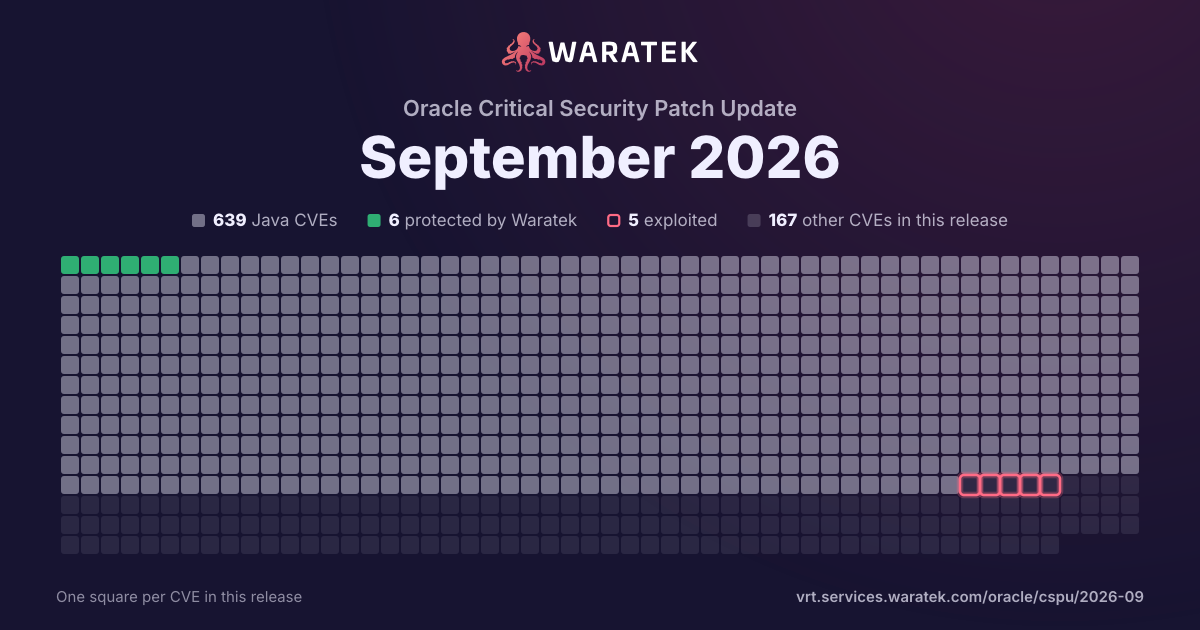
By status
No exploit published. For 596 of them, Oracle's security advisory is the source of public detail.
Protected by Waratek. Waratek RASP can block exploitation of these on systems that have not applied the patch yet.
Overview 19 matches · 9 in Waratek scope · 3 protected · 2 exploited · 0 CISA KEV · 2 public PoC · 0 EPSS ≥ 0.5
19matches
9in Waratek scope47.4%
3protected15.8%
2exploited10.5%
0CISA KEV0.0%
2public PoC10.5%
0EPSS ≥ 0.50.0%
Protected by Waratek
3
15.8%
Rule in development
0
0.0%
Mitigation candidate
0
0.0%
No exploit published
6
31.6%
Outside Waratek scope
0
0.0%
Not applicable
10
52.6%
Withdrawn CVE
0
0.0%
blocked by ARMR today
3
15.8%
partly blocked
0
0.0%
not blocked
16
84.2%
not established
0
0.0%
unrecorded
0
0.0%
Exploited
2
10.5%
Working exploit published
0
0.0%
Proof of concept only
5
26.3%
Forecast only
0
0.0%
No public exploit
12
63.2%
split by
peak 14 / quarter
Q4 232
Not applicable2
Medium2
not blocked2
Exploited1
No public exploit1
Q1 240
Q2 240
Q3 240
Q4 240
Q1 250
Q2 250
Q3 250
Q4 251
No exploit published1
Medium1
not blocked1
No public exploit1
Q1 262
Not applicable2
High1
Medium1
not blocked2
Exploited1
No public exploit1
Q2 2614
Protected by Waratek3
No exploit published5
Not applicable6
Critical4
Medium10
blocked by ARMR today3
not blocked11
Proof of concept only5
No public exploit9
Q4 23Q1 24Q2 24Q3 24Q4 24Q1 25Q2 25Q3 25Q4 25Q1 26Q2 26
| CVE | Severity | Published▾ | Status | Exploitation | Description |
|---|---|---|---|---|---|
| CVE-2026-7598 | Medium | 2026-05-01 | Not applicable | Proof of concept only | A security vulnerability has been detected in libssh2 up to 1.11.1. The impacted element is the function userauth_password of the file src/userauth.c. Such manipulation of the argument username_len/password_len leads to integer overflow. The attack may be launched remotely. The name of the patch is 256d04b60d80bf1190e96b0ad1e91b2174d744b1. A patch should be applied to remediate this issue. |
| CVE-2026-42779 | Critical | 2026-05-01 | Protected by Waratek | Proof of concept only | The fix for CVE-2026-41635 was not applied to the 2.1.X and 2.2.X branches. Here was the original issue description: Apache MINA's AbstractIoBuffer.resolveClass() contains two branches, one of them (for static classes or primitive types) does not check the class at all, bypassing the classname allowlist and allowing arbitrary code to be executed. The fix checks if the class is present in the accepted class filter before calling Class.forName(). Affected versions are Apache MINA 2.1.0 <= 2.1.11, and 2.2.0 <= 2.2.6. The problem is resolved in Apache MINA 2.1.12, and 2.2.7 by applying the classname allowlist earlier. Affected are applications using Apache MINA that call IoBuffer.getObject(). Applications using Apache MINA are advised to upgrade. |
| CVE-2026-41635 | Critical | 2026-04-27 | Protected by Waratek | No public exploit | Apache MINA's AbstractIoBuffer.resolveClass() contains two branches, one of them (for static classes or primitive types) does not check the class at all, bypassing the classname allowlist and allowing arbitrary code to be executed. The fix checks if the class is present in the accepted class filter before calling Class.forName(). Affected versions are Apache MINA 2.0.0 <= 2.0.27, 2.1.0 <= 2.1.10, and 2.2.0 <= 2.2.5. The problem is resolved in Apache MINA 2.0.28, 2.1.11, and 2.2.6 by applying the classname allowlist earlier. Affected are applications using Apache MINA that call IoBuffer.getObject(). Applications using Apache MINA are advised to upgrade. |
| CVE-2026-41409 | Critical | 2026-04-27 | Protected by Waratek | No public exploit | The fix for CVE-2024-52046 in Apache MINA AbstractIoBuffer.getObject() was incomplete. The classname allowlist of classes allowed to be deserialized was applied too late after a static initializer in a class to be read might already have been executed. Affected versions are Apache MINA 2.0.0 <= 2.0.27, 2.1.0 <= 2.1.10, and 2.2.0 <= 2.2.5. The problem is resolved in Apache MINA 2.0.28, 2.1.11, and 2.2.6 by applying the classname allowlist earlier. Affected are applications using Apache MINA that call IoBuffer.getObject(). Applications using Apache MINA are advised to upgrade |
| CVE-2026-41990 | Medium | 2026-04-23 | Not applicable | No public exploit | Libgcrypt before 1.12.2 mishandles Dilithium signing. Writes to a static array lack a bounds check but do not use attacker-controlled data. |
| CVE-2026-41989 | Medium | 2026-04-23 | Not applicable | No public exploit | Libgcrypt before 1.12.2 sometimes allows a heap-based buffer overflow and denial of service via crafted ECDH ciphertext to gcry_pk_decrypt. |
| CVE-2026-41240 | Medium | 2026-04-23 | Not applicable | Proof of concept only | DOMPurify is a DOM-only cross-site scripting sanitizer for HTML, MathML, and SVG. Versions prior to 3.4.0 have an inconsistency between FORBID_TAGS and FORBID_ATTR handling when function-based ADD_TAGS is used. Commit c361baa added an early exit for FORBID_ATTR at line 1214. The same fix was not applied to FORBID_TAGS. At line 1118-1123, when EXTRA_ELEMENT_HANDLING.tagCheck returns true, the short-circuit evaluation skips the FORBID_TAGS check entirely. This allows forbidden elements to survive sanitization with their attributes intact. Version 3.4.0 patches the issue. |
| CVE-2026-41239 | Medium | 2026-04-23 | Not applicable | No public exploit | DOMPurify is a DOM-only cross-site scripting sanitizer for HTML, MathML, and SVG. Starting in version 1.0.10 and prior to version 3.4.0, `SAFE_FOR_TEMPLATES` strips `{{...}}` expressions from untrusted HTML. This works in string mode but not with `RETURN_DOM` or `RETURN_DOM_FRAGMENT`, allowing XSS via template-evaluating frameworks like Vue 2. Version 3.4.0 patches the issue. |
| CVE-2026-41238 | Medium | 2026-04-23 | Not applicable | Proof of concept only | DOMPurify is a DOM-only cross-site scripting sanitizer for HTML, MathML, and SVG. Versions 3.0.1 through 3.3.3 are vulnerable to a prototype pollution-based XSS bypass. When an application uses `DOMPurify.sanitize()` with the default configuration (no `CUSTOM_ELEMENT_HANDLING` option), a prior prototype pollution gadget can inject permissive `tagNameCheck` and `attributeNameCheck` regex values into `Object.prototype`, causing DOMPurify to allow arbitrary custom elements with arbitrary attributes — including event handlers — through sanitization. Version 3.4.0 fixes the issue. |
| CVE-2026-2332 | Critical | 2026-04-14 | No exploit published | Proof of concept only | In Eclipse Jetty, the HTTP/1.1 parser is vulnerable to request smuggling when chunk extensions are used, similar to the "funky chunks" techniques outlined here: * https://w4ke.info/2025/06/18/funky-chunks.html * https://w4ke.info/2025/10/29/funky-chunks-2.html Jetty terminates chunk extension parsing at \r\n inside quoted strings instead of treating this as an error. POST / HTTP/1.1 Host: localhost Transfer-Encoding: chunked 1;ext="val X 0 GET /smuggled HTTP/1.1 ... Note how the chunk extension does not close the double quotes, and it is able to inject a smuggled request. |
| CVE-2026-34480 | Medium | 2026-04-10 | No exploit published | No public exploit | Apache Log4j Core's XmlLayout https://logging.apache.org/log4j/2.x/manual/layouts.html#XmlLayout , in versions up to and including 2.25.3, fails to sanitize characters forbidden by the XML 1.0 specification https://www.w3.org/TR/xml/#charsets producing invalid XML output whenever a log message or MDC value contains such characters. The impact depends on the StAX implementation in use: * JRE built-in StAX: Forbidden characters are silently written to the output, producing malformed XML. Conforming parsers must reject such documents with a fatal error, which may cause downstream log-processing systems to drop the affected records. * Alternative StAX implementations (e.g., Woodstox https://github.com/FasterXML/woodstox , a transitive dependency of the Jackson XML Dataformat module): An exception is thrown during the logging call, and the log event is never delivered to its intended appender, only to Log4j's internal status logger. Users are advised to upgrade to Apache Log4j Core 2.25.4, which corrects this issue by sanitizing forbidden characters before XML output. |
| CVE-2026-34479 | Medium | 2026-04-10 | No exploit published | No public exploit | The Log4j1XmlLayout from the Apache Log4j 1-to-Log4j 2 bridge fails to escape characters forbidden by the XML 1.0 standard, producing malformed XML output. Conforming XML parsers are required to reject documents containing such characters with a fatal error, which may cause downstream log processing systems to drop or fail to index affected records. Two groups of users are affected: * Those using Log4j1XmlLayout directly in a Log4j Core 2 configuration file. * Those using the Log4j 1 configuration compatibility layer with org.apache.log4j.xml.XMLLayout specified as the layout class. Users are advised to upgrade to Apache Log4j 1-to-Log4j 2 bridge version 2.25.4, which corrects this issue. Note: The Apache Log4j 1-to-Log4j 2 bridge is deprecated and will not be present in Log4j 3. Users are encouraged to consult the Log4j 1 to Log4j 2 migration guide https://logging.apache.org/log4j/2.x/migrate-from-log4j1.html , and specifically the section on eliminating reliance on the bridge. |
| CVE-2026-34478 | Medium | 2026-04-10 | No exploit published | No public exploit | Apache Log4j Core's Rfc5424Layout https://logging.apache.org/log4j/2.x/manual/layouts.html#RFC5424Layout , in versions 2.21.0 through 2.25.3, is vulnerable to log injection via CRLF sequences due to undocumented renames of security-relevant configuration attributes. Two distinct issues affect users of stream-based syslog services who configure Rfc5424Layout directly: * The newLineEscape attribute was silently renamed, causing newline escaping to stop working for users of TCP framing (RFC 6587), exposing them to CRLF injection in log output. * The useTlsMessageFormat attribute was silently renamed, causing users of TLS framing (RFC 5425) to be silently downgraded to unframed TCP (RFC 6587), without newline escaping. Users of the SyslogAppender are not affected, as its configuration attributes were not modified. Users are advised to upgrade to Apache Log4j Core 2.25.4, which corrects this issue. |
| CVE-2026-34477 | Medium | 2026-04-10 | No exploit published | No public exploit | The fix for CVE-2025-68161 https://logging.apache.org/security.html#CVE-2025-68161 was incomplete: it addressed hostname verification only when enabled via the log4j2.sslVerifyHostName https://logging.apache.org/log4j/2.x/manual/systemproperties.html#log4j2.sslVerifyHostName system property, but not when configured through the verifyHostName https://logging.apache.org/log4j/2.x/manual/appenders/network.html#SslConfiguration-attr-verifyHostName attribute of the <Ssl> element. Although the verifyHostName configuration attribute was introduced in Log4j Core 2.12.0, it was silently ignored in all versions through 2.25.3, leaving TLS connections vulnerable to interception regardless of the configured value. A network-based attacker may be able to perform a man-in-the-middle attack when all of the following conditions are met: * An SMTP, Socket, or Syslog appender is in use. * TLS is configured via a nested <Ssl> element. * The attacker can present a certificate issued by a CA trusted by the appender's configured trust store, or by the default Java trust store if none is configured. This issue does not affect users of the HTTP appender, which uses a separate verifyHostname https://logging.apache.org/log4j/2.x/manual/appenders/network.html#HttpAppender-attr-verifyHostName attribute that was not subject to this bug and verifies host names by default. Users are advised to upgrade to Apache Log4j Core 2.25.4, which corrects this issue. |
| CVE-2026-0540 | Medium | 2026-03-03 | Not applicable | No public exploit | DOMPurify 3.1.3 through 3.3.1 and 2.5.3 through 2.5.8, fixed in commit 2726c74, contain a cross-site scripting vulnerability that allows attackers to bypass attribute sanitization by exploiting five missing rawtext elements (noscript, xmp, noembed, noframes, iframe) in the SAFE_FOR_XML regex. Attackers can include payloads like </noscript><img src=x onerror=alert(1)> in attribute values to execute JavaScript when sanitized output is placed inside these unprotected rawtext contexts. |
| CVE-2026-25639 | High | 2026-02-09 | Not applicable | Exploited | Axios is a promise based HTTP client for the browser and Node.js. Prior to versions 0.30.3 and 1.13.5, the mergeConfig function in axios crashes with a TypeError when processing configuration objects containing __proto__ as an own property. An attacker can trigger this by providing a malicious configuration object created via JSON.parse(), causing complete denial of service. This vulnerability is fixed in versions 0.30.3 and 1.13.5. |
| CVE-2025-68161 | Medium | 2025-12-18 | No exploit published | No public exploit | The Socket Appender in Apache Log4j Core versions 2.0-beta9 through 2.25.2 does not perform TLS hostname verification of the peer certificate, even when the verifyHostName https://logging.apache.org/log4j/2.x/manual/appenders/network.html#SslConfiguration-attr-verifyHostName configuration attribute or the log4j2.sslVerifyHostName https://logging.apache.org/log4j/2.x/manual/systemproperties.html#log4j2.sslVerifyHostName system property is set to true. This issue may allow a man-in-the-middle attacker to intercept or redirect log traffic under the following conditions: * The attacker is able to intercept or redirect network traffic between the client and the log receiver. * The attacker can present a server certificate issued by a certification authority trusted by the Socket Appender’s configured trust store (or by the default Java trust store if no custom trust store is configured). Users are advised to upgrade to Apache Log4j Core version 2.25.3, which addresses this issue. As an alternative mitigation, the Socket Appender may be configured to use a private or restricted trust root to limit the set of trusted certificates. |
| CVE-2023-6918 | Medium | 2023-12-19 | Not applicable | No public exploit | A flaw was found in the libssh implements abstract layer for message digest (MD) operations implemented by different supported crypto backends. The return values from these were not properly checked, which could cause low-memory situations failures, NULL dereferences, crashes, or usage of the uninitialized memory as an input for the KDF. In this case, non-matching keys will result in decryption/integrity failures, terminating the connection. |
| CVE-2023-48795 | Medium | 2023-12-18 | Not applicable | Exploited | The SSH transport protocol with certain OpenSSH extensions, found in OpenSSH before 9.6 and other products, allows remote attackers to bypass integrity checks such that some packets are omitted (from the extension negotiation message), and a client and server may consequently end up with a connection for which some security features have been downgraded or disabled, aka a Terrapin attack. This occurs because the SSH Binary Packet Protocol (BPP), implemented by these extensions, mishandles the handshake phase and mishandles use of sequence numbers. For example, there is an effective attack against SSH's use of ChaCha20-Poly1305 (and CBC with Encrypt-then-MAC). The bypass occurs in chacha20-poly1305@openssh.com and (if CBC is used) the -etm@openssh.com MAC algorithms. This also affects Maverick Synergy Java SSH API before 3.1.0-SNAPSHOT, Dropbear through 2022.83, Ssh before 5.1.1 in Erlang/OTP, PuTTY before 0.80, AsyncSSH before 2.14.2, golang.org/x/crypto before 0.17.0, libssh before 0.10.6, libssh2 through 1.11.0, Thorn Tech SFTP Gateway before 3.4.6, Tera Term before 5.1, Paramiko before 3.4.0, jsch before 0.2.15, SFTPGo before 2.5.6, Netgate pfSense Plus through 23.09.1, Netgate pfSense CE through 2.7.2, HPN-SSH through 18.2.0, ProFTPD before 1.3.8b (and before 1.3.9rc2), ORYX CycloneSSH before 2.3.4, NetSarang XShell 7 before Build 0144, CrushFTP before 10.6.0, ConnectBot SSH library before 2.2.22, Apache MINA sshd through 2.11.0, sshj through 0.37.0, TinySSH through 20230101, trilead-ssh2 6401, LANCOM LCOS and LANconfig, FileZilla before 3.66.4, Nova before 11.8, PKIX-SSH before 14.4, SecureCRT before 9.4.3, Transmit5 before 5.10.4, Win32-OpenSSH before 9.5.0.0p1-Beta, WinSCP before 6.2.2, Bitvise SSH Server before 9.32, Bitvise SSH Client before 9.33, KiTTY through 0.76.1.13, the net-ssh gem 7.2.0 for Ruby, the mscdex ssh2 module before 1.15.0 for Node.js, the thrussh library before 0.35.1 for Rust, and the Russh crate before 0.40.2 for Rust. |