
Oracle Critical Security Patch Update September 2026
Released September 2026 · Oracle's advisory ↗ · ← Security Patch Update, August 2026 · Critical Patch Update, October 2026 →
806 CVEs in this release, one square each
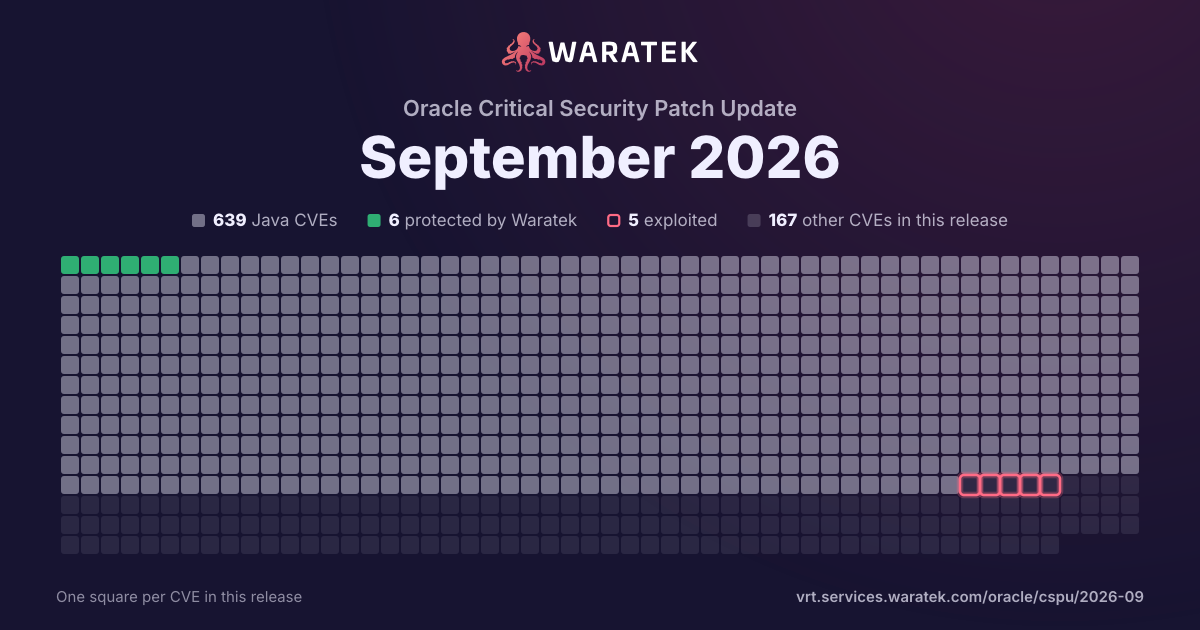
By status
6Protected by Waratek633No exploit published1Outside Waratek scope166Not applicable
5Exploited, marked by the ring
No exploit published. For 596 of them, Oracle's security advisory is the source of public detail.
Protected by Waratek. Waratek RASP can block exploitation of these on systems that have not applied the patch yet.
Overview 117 matches · 97 in Waratek scope · 4 protected · 1 exploited · 1 CISA KEV · 2 public PoC · 0 EPSS ≥ 0.5
117matches
97in Waratek scope82.9%
4protected3.4%
1exploited0.9%
1CISA KEV0.9%
2public PoC1.7%
0EPSS ≥ 0.50.0%
Protected by Waratek
4
3.4%
Rule in development
0
0.0%
Mitigation candidate
0
0.0%
No exploit published
93
79.5%
Outside Waratek scope
0
0.0%
Not applicable
20
17.1%
Withdrawn CVE
0
0.0%
blocked by ARMR today
4
3.4%
partly blocked
0
0.0%
not blocked
113
96.6%
not established
0
0.0%
unrecorded
0
0.0%
Exploited
1
0.9%
Working exploit published
0
0.0%
Proof of concept only
5
4.3%
Forecast only
0
0.0%
No public exploit
111
94.9%
split by
peak 97 / month
Apr 263
Protected by Waratek2
No exploit published1
Critical3
blocked by ARMR today2
not blocked1
Proof of concept only1
No public exploit2
May 261
Protected by Waratek1
Critical1
blocked by ARMR today1
Proof of concept only1
Jun 267
Protected by Waratek1
No exploit published4
Not applicable2
Critical7
blocked by ARMR today1
not blocked6
No public exploit7
Jul 265
Not applicable5
Critical5
not blocked5
Proof of concept only2
No public exploit3
Aug 264
No exploit published1
Not applicable3
Critical4
not blocked4
Exploited1
Proof of concept only1
No public exploit2
Sep 2697
No exploit published87
Not applicable10
Critical97
not blocked97
No public exploit97
Apr 26May 26Jun 26Jul 26Aug 26Sep 26
| CVE | Severity | Published▾ | Status | Exploitation | Description |
|---|---|---|---|---|---|
| CVE-2026-71290 | Critical | 2026-08-11 | No exploit published | No public exploit | Improper TLS hostname verification vulnerability in Apache HttpComponents Client 5.4 or newer. HostnameVerificationPolicy#BUILTIN setting has no effect when used with the async version of HttpClient. An attacker that can intercept and modify traffic between the client and the server can impersonate the server by presenting a valid certificate for a different domain. Please note the classic version of HttpClient is not affected by this vulnerability. Affected users are recommended to upgrade to at least version 5.6.4, which fixes the issue. |
| CVE-2026-57216 | Critical | 2026-07-10 | Not applicable | Proof of concept only | RabbitMQ is a messaging and streaming broker. Prior to 3.13.15, 4.0.20, 4.1.11, and 4.2.6, AMQP 0-9-1, AMQP 1.0, and Stream Protocol authentication can allow a loopback-restricted user such as guest to connect remotely when traffic is accepted through a trusted PROXY-protocol path and the backend listener is loopback-bound because the loopback check uses the listener-side socket address instead of the real client source. This issue is fixed in versions 3.13.15, 4.0.20, 4.1.11, and 4.2.6. |
| CVE-2026-57211 | Critical | 2026-07-10 | Not applicable | Proof of concept only | RabbitMQ is a messaging and streaming broker. Prior to 4.1.11 and 4.2.6 on Windows, the RabbitMQ management plugin static file handler rabbit_mgmt_wm_static can pass URL-encoded backslashes to erl_prim_loader:read_file_info before path validation when multiple management extension plugins are enabled, causing outbound DNS and SMB requests to attacker-controlled UNC paths. This issue is fixed in versions 4.1.11 and 4.2.6. |
| CVE-2026-44024 | Critical | 2026-07-08 | Not applicable | No public exploit | Fluentd collects events from various data sources and writes them to files, RDBMS, NoSQL, IaaS, SaaS, Hadoop and so on. Prior to 1.19.3, Fluentd allows dynamically constructing file paths using the ${tag} placeholder, and insufficient validation of ${tag} in file configurations such as the path parameter of the out_file plugin allows attackers sending untrusted tags containing path traversal characters to write or overwrite arbitrary files and potentially achieve remote code execution. This issue is fixed in version 1.19.3. |
| CVE-2026-14740 | Critical | 2026-07-07 | Not applicable | No public exploit | DBI versions before 1.650 for Perl read one byte out-of-bounds in preparse when deleting an initial SQL comment. The preparse method normalises SQL and removes comments. When the SQL starts with a comment line, the deletion of that line during normalisation led to an out-of-bounds read by one byte. The result is a fault on memory-hardened builds and nondeterministic newline retention on normal builds. |
| CVE-2026-14739 | Critical | 2026-07-07 | Not applicable | No public exploit | DBI versions before 1.650 for Perl have a heap overflow when preparsing SQL statements with an extreme number of placeholders. The fix for CVE-2026-10879 did not allocate enough memory to handle approximately 1.2-million placeholders. DBI version 1.650 sets a hard limit of 99,999 placeholders. |
| CVE-2026-55276 | Critical | 2026-06-29 | No exploit published | No public exploit | Always-Incorrect Control Flow Implementation vulnerability in Apache Tomcat meant that special roles and empty authorisation constraints were not included when the effective web.xml was logged. This issue affects Apache Tomcat: from 11.0.0-M1 through 11.0.22, from 10.1.0-M1 through 10.1.55, from 9.0.0.M1 through 9.0.118, from 8.5.0 through 8.5.100. Other versions that have reached end of support may also be affected. Users are recommended to upgrade to version 11.0.23, 10.1.56 or 9.0.119 which fixes the issue. |
| CVE-2026-53434 | Critical | 2026-06-29 | No exploit published | No public exploit | Detection of Error Condition Without Action vulnerability in Apache Tomcat when configuring CRLs for a FFM based connector. This issue affects Apache Tomcat: from 11.0.0-M1 through 11.0.22, from 10.1.0-M7 through 10.1.55, from 9.0.83 through 9.0.118. Users are recommended to upgrade to version 11.0.23, 10.1.56 or 9.0.119, which fixes the issue. |
| CVE-2026-47691 | Critical | 2026-06-12 | No exploit published | No public exploit | Netty is a network application framework for development of protocol servers and clients. Prior to versions 4.1.135.Final and 4.2.15.Final, Netty's `DnsResolveContext` insufficiently validates the bailiwick of NS records, enabling DNS Cache Poisoning. An attacker controlling an authoritative name server for a subdomain can poison the cache for parent domains (like `.co.uk`). In `io.netty.resolver.dns.DnsResolveContext.AuthoritativeNameServerList#add` method accepts any NS record from the AUTHORITY section as long as the record's name is a suffix of the questionName. Subsequently, the `handleWithAdditional` method caches the associated A records from the ADDITIONAL section directly into the `authoritativeDnsServerCache` under the parent domain's key. This bypasses standard bailiwick rules, where a server authoritative for a subdomain should not be trusted to provide authoritative records for its parent. The poisoned cache is then used for all future resolutions under the parent domain's key. Versions 4.1.135.Final and 4.2.15.Final patch the issue. |
| CVE-2026-45674 | Critical | 2026-06-12 | No exploit published | No public exploit | Netty is a network application framework for development of protocol servers and clients. Prior to versions 4.1.135.Final and 4.2.15.Final, Netty's DnsResolveContext fails to validate the origin (bailiwick) of CNAME records in DNS responses. Versions 4.1.135.Final and 4.2.15.Final patch the issue. |
| CVE-2026-9698 | Critical | 2026-06-09 | Not applicable | No public exploit | DBI versions before 1.648 for Perl saved errors in a limited-sized buffer. Error messages that were returned when RaiseError, PrintError or HandleError were set were written to a 200-byte buffer without a length limit. Attackers that can influence the error text in an application can trigger a buffer overflow. |
| CVE-2026-10879 | Critical | 2026-06-05 | Not applicable | No public exploit | DBI versions before 1.648 for Perl have a heap overflow when preparsing SQL statements with more than 9 binders. The preparse method expands SQL placeholder characters to numbered binders of the form :pN, but only allocates three characters per binder in the buffer. Placeholders 10-99 require four characters, 100-999 require five characters, et cetera. |
| CVE-2026-47065 | Critical | 2026-06-03 | Protected by Waratek | No public exploit | ZDRES-232: resolveProxyClass Not Overridden - acceptMatchers Filter Bypass via java.lang.reflect.Proxy Assessment: Fully addressed. When the serialised stream contains a TC_PROXYCLASSDESC (the marker for a java.lang.reflect.Proxy ), JDK’s ObjectInputStream.readProxyDesc() is dispatched. JDK then calls the default ObjectInputStream.resolveProxyClass(interfaces) implementation, which performs Class.forName(intf, false, latestUserDefinedLoader()) for EACH interface name and constructs the proxy class — bypassing the accepted classes list . ZDRES-233: Class.forName(name, initialize=true, classLoader) in readClassDescriptor Triggers Static Initialiser of Allow-Listed Classes Assessment: Fully addressed. For ANY class on the allow-list, deserialising a stream that names it triggers the class’s (static initialiser) BEFORE any instance is constructed. This means an attacker who supplies a class name on the allow-list (e.g., the developer wrote accept(“com.myapp.*") , attacker supplies com.myapp.SomeClass ) causes <clinit> of SomeClass — and many real-world classes have side-effecting static initialisers Both issues have been fixed. |
| CVE-2026-42779 | Critical | 2026-05-01 | Protected by Waratek | Proof of concept only | The fix for CVE-2026-41635 was not applied to the 2.1.X and 2.2.X branches. Here was the original issue description: Apache MINA's AbstractIoBuffer.resolveClass() contains two branches, one of them (for static classes or primitive types) does not check the class at all, bypassing the classname allowlist and allowing arbitrary code to be executed. The fix checks if the class is present in the accepted class filter before calling Class.forName(). Affected versions are Apache MINA 2.1.0 <= 2.1.11, and 2.2.0 <= 2.2.6. The problem is resolved in Apache MINA 2.1.12, and 2.2.7 by applying the classname allowlist earlier. Affected are applications using Apache MINA that call IoBuffer.getObject(). Applications using Apache MINA are advised to upgrade. |
| CVE-2026-41635 | Critical | 2026-04-27 | Protected by Waratek | No public exploit | Apache MINA's AbstractIoBuffer.resolveClass() contains two branches, one of them (for static classes or primitive types) does not check the class at all, bypassing the classname allowlist and allowing arbitrary code to be executed. The fix checks if the class is present in the accepted class filter before calling Class.forName(). Affected versions are Apache MINA 2.0.0 <= 2.0.27, 2.1.0 <= 2.1.10, and 2.2.0 <= 2.2.5. The problem is resolved in Apache MINA 2.0.28, 2.1.11, and 2.2.6 by applying the classname allowlist earlier. Affected are applications using Apache MINA that call IoBuffer.getObject(). Applications using Apache MINA are advised to upgrade. |
| CVE-2026-41409 | Critical | 2026-04-27 | Protected by Waratek | No public exploit | The fix for CVE-2024-52046 in Apache MINA AbstractIoBuffer.getObject() was incomplete. The classname allowlist of classes allowed to be deserialized was applied too late after a static initializer in a class to be read might already have been executed. Affected versions are Apache MINA 2.0.0 <= 2.0.27, 2.1.0 <= 2.1.10, and 2.2.0 <= 2.2.5. The problem is resolved in Apache MINA 2.0.28, 2.1.11, and 2.2.6 by applying the classname allowlist earlier. Affected are applications using Apache MINA that call IoBuffer.getObject(). Applications using Apache MINA are advised to upgrade |
| CVE-2026-2332 | Critical | 2026-04-14 | No exploit published | Proof of concept only | In Eclipse Jetty, the HTTP/1.1 parser is vulnerable to request smuggling when chunk extensions are used, similar to the "funky chunks" techniques outlined here: * https://w4ke.info/2025/06/18/funky-chunks.html * https://w4ke.info/2025/10/29/funky-chunks-2.html Jetty terminates chunk extension parsing at \r\n inside quoted strings instead of treating this as an error. POST / HTTP/1.1 Host: localhost Transfer-Encoding: chunked 1;ext="val X 0 GET /smuggled HTTP/1.1 ... Note how the chunk extension does not close the double quotes, and it is able to inject a smuggled request. |