
Oracle Critical Security Patch Update September 2026
Released September 2026 · Oracle's advisory ↗ · ← Security Patch Update, August 2026 · Critical Patch Update, October 2026 →
806 CVEs in this release, one square each
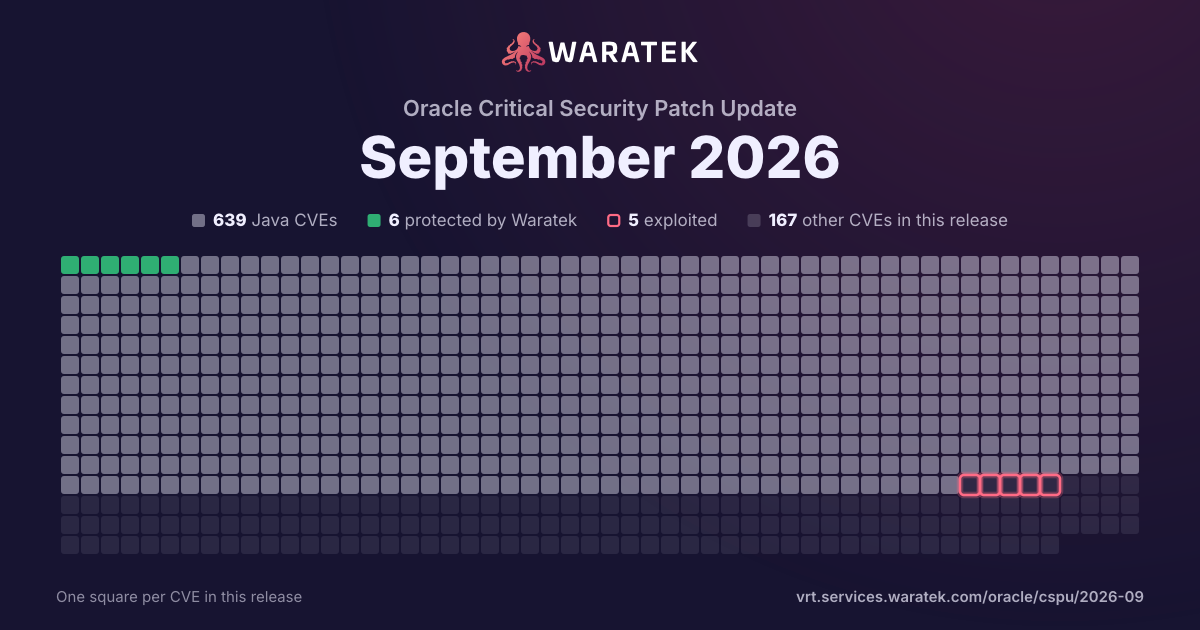
By status
No exploit published. For 596 of them, Oracle's security advisory is the source of public detail.
Protected by Waratek. Waratek RASP can block exploitation of these on systems that have not applied the patch yet.
Overview 12 matches · 7 in Waratek scope · 2 protected · 0 exploited · 0 CISA KEV · 0 public PoC · 0 EPSS ≥ 0.5
12matches
7in Waratek scope58.3%
2protected16.7%
0exploited0.0%
0CISA KEV0.0%
0public PoC0.0%
0EPSS ≥ 0.50.0%
Protected by Waratek
2
16.7%
Rule in development
0
0.0%
Mitigation candidate
0
0.0%
No exploit published
5
41.7%
Outside Waratek scope
0
0.0%
Not applicable
5
41.7%
Withdrawn CVE
0
0.0%
blocked by ARMR today
2
16.7%
partly blocked
0
0.0%
not blocked
10
83.3%
not established
0
0.0%
unrecorded
0
0.0%
Exploited
0
0.0%
Working exploit published
0
0.0%
Proof of concept only
0
0.0%
Forecast only
0
0.0%
No public exploit
12
100.0%
split by
peak 9 / quarter
Q4 231
Not applicable1
Medium1
not blocked1
No public exploit1
Q1 240
Q2 240
Q3 240
Q4 240
Q1 250
Q2 250
Q3 250
Q4 251
No exploit published1
Medium1
not blocked1
No public exploit1
Q1 261
Not applicable1
Medium1
not blocked1
No public exploit1
Q2 269
Protected by Waratek2
No exploit published4
Not applicable3
Critical2
Medium7
blocked by ARMR today2
not blocked7
No public exploit9
Q4 23Q1 24Q2 24Q3 24Q4 24Q1 25Q2 25Q3 25Q4 25Q1 26Q2 26
| CVE | Severity | Published▾ | Status | Exploitation | Description |
|---|---|---|---|---|---|
| CVE-2026-41635 | Critical | 2026-04-27 | Protected by Waratek | No public exploit | Apache MINA's AbstractIoBuffer.resolveClass() contains two branches, one of them (for static classes or primitive types) does not check the class at all, bypassing the classname allowlist and allowing arbitrary code to be executed. The fix checks if the class is present in the accepted class filter before calling Class.forName(). Affected versions are Apache MINA 2.0.0 <= 2.0.27, 2.1.0 <= 2.1.10, and 2.2.0 <= 2.2.5. The problem is resolved in Apache MINA 2.0.28, 2.1.11, and 2.2.6 by applying the classname allowlist earlier. Affected are applications using Apache MINA that call IoBuffer.getObject(). Applications using Apache MINA are advised to upgrade. |
| CVE-2026-41409 | Critical | 2026-04-27 | Protected by Waratek | No public exploit | The fix for CVE-2024-52046 in Apache MINA AbstractIoBuffer.getObject() was incomplete. The classname allowlist of classes allowed to be deserialized was applied too late after a static initializer in a class to be read might already have been executed. Affected versions are Apache MINA 2.0.0 <= 2.0.27, 2.1.0 <= 2.1.10, and 2.2.0 <= 2.2.5. The problem is resolved in Apache MINA 2.0.28, 2.1.11, and 2.2.6 by applying the classname allowlist earlier. Affected are applications using Apache MINA that call IoBuffer.getObject(). Applications using Apache MINA are advised to upgrade |
| CVE-2026-41990 | Medium | 2026-04-23 | Not applicable | No public exploit | Libgcrypt before 1.12.2 mishandles Dilithium signing. Writes to a static array lack a bounds check but do not use attacker-controlled data. |
| CVE-2026-41989 | Medium | 2026-04-23 | Not applicable | No public exploit | Libgcrypt before 1.12.2 sometimes allows a heap-based buffer overflow and denial of service via crafted ECDH ciphertext to gcry_pk_decrypt. |
| CVE-2026-41239 | Medium | 2026-04-23 | Not applicable | No public exploit | DOMPurify is a DOM-only cross-site scripting sanitizer for HTML, MathML, and SVG. Starting in version 1.0.10 and prior to version 3.4.0, `SAFE_FOR_TEMPLATES` strips `{{...}}` expressions from untrusted HTML. This works in string mode but not with `RETURN_DOM` or `RETURN_DOM_FRAGMENT`, allowing XSS via template-evaluating frameworks like Vue 2. Version 3.4.0 patches the issue. |
| CVE-2026-34480 | Medium | 2026-04-10 | No exploit published | No public exploit | Apache Log4j Core's XmlLayout https://logging.apache.org/log4j/2.x/manual/layouts.html#XmlLayout , in versions up to and including 2.25.3, fails to sanitize characters forbidden by the XML 1.0 specification https://www.w3.org/TR/xml/#charsets producing invalid XML output whenever a log message or MDC value contains such characters. The impact depends on the StAX implementation in use: * JRE built-in StAX: Forbidden characters are silently written to the output, producing malformed XML. Conforming parsers must reject such documents with a fatal error, which may cause downstream log-processing systems to drop the affected records. * Alternative StAX implementations (e.g., Woodstox https://github.com/FasterXML/woodstox , a transitive dependency of the Jackson XML Dataformat module): An exception is thrown during the logging call, and the log event is never delivered to its intended appender, only to Log4j's internal status logger. Users are advised to upgrade to Apache Log4j Core 2.25.4, which corrects this issue by sanitizing forbidden characters before XML output. |
| CVE-2026-34479 | Medium | 2026-04-10 | No exploit published | No public exploit | The Log4j1XmlLayout from the Apache Log4j 1-to-Log4j 2 bridge fails to escape characters forbidden by the XML 1.0 standard, producing malformed XML output. Conforming XML parsers are required to reject documents containing such characters with a fatal error, which may cause downstream log processing systems to drop or fail to index affected records. Two groups of users are affected: * Those using Log4j1XmlLayout directly in a Log4j Core 2 configuration file. * Those using the Log4j 1 configuration compatibility layer with org.apache.log4j.xml.XMLLayout specified as the layout class. Users are advised to upgrade to Apache Log4j 1-to-Log4j 2 bridge version 2.25.4, which corrects this issue. Note: The Apache Log4j 1-to-Log4j 2 bridge is deprecated and will not be present in Log4j 3. Users are encouraged to consult the Log4j 1 to Log4j 2 migration guide https://logging.apache.org/log4j/2.x/migrate-from-log4j1.html , and specifically the section on eliminating reliance on the bridge. |
| CVE-2026-34478 | Medium | 2026-04-10 | No exploit published | No public exploit | Apache Log4j Core's Rfc5424Layout https://logging.apache.org/log4j/2.x/manual/layouts.html#RFC5424Layout , in versions 2.21.0 through 2.25.3, is vulnerable to log injection via CRLF sequences due to undocumented renames of security-relevant configuration attributes. Two distinct issues affect users of stream-based syslog services who configure Rfc5424Layout directly: * The newLineEscape attribute was silently renamed, causing newline escaping to stop working for users of TCP framing (RFC 6587), exposing them to CRLF injection in log output. * The useTlsMessageFormat attribute was silently renamed, causing users of TLS framing (RFC 5425) to be silently downgraded to unframed TCP (RFC 6587), without newline escaping. Users of the SyslogAppender are not affected, as its configuration attributes were not modified. Users are advised to upgrade to Apache Log4j Core 2.25.4, which corrects this issue. |
| CVE-2026-34477 | Medium | 2026-04-10 | No exploit published | No public exploit | The fix for CVE-2025-68161 https://logging.apache.org/security.html#CVE-2025-68161 was incomplete: it addressed hostname verification only when enabled via the log4j2.sslVerifyHostName https://logging.apache.org/log4j/2.x/manual/systemproperties.html#log4j2.sslVerifyHostName system property, but not when configured through the verifyHostName https://logging.apache.org/log4j/2.x/manual/appenders/network.html#SslConfiguration-attr-verifyHostName attribute of the <Ssl> element. Although the verifyHostName configuration attribute was introduced in Log4j Core 2.12.0, it was silently ignored in all versions through 2.25.3, leaving TLS connections vulnerable to interception regardless of the configured value. A network-based attacker may be able to perform a man-in-the-middle attack when all of the following conditions are met: * An SMTP, Socket, or Syslog appender is in use. * TLS is configured via a nested <Ssl> element. * The attacker can present a certificate issued by a CA trusted by the appender's configured trust store, or by the default Java trust store if none is configured. This issue does not affect users of the HTTP appender, which uses a separate verifyHostname https://logging.apache.org/log4j/2.x/manual/appenders/network.html#HttpAppender-attr-verifyHostName attribute that was not subject to this bug and verifies host names by default. Users are advised to upgrade to Apache Log4j Core 2.25.4, which corrects this issue. |
| CVE-2026-0540 | Medium | 2026-03-03 | Not applicable | No public exploit | DOMPurify 3.1.3 through 3.3.1 and 2.5.3 through 2.5.8, fixed in commit 2726c74, contain a cross-site scripting vulnerability that allows attackers to bypass attribute sanitization by exploiting five missing rawtext elements (noscript, xmp, noembed, noframes, iframe) in the SAFE_FOR_XML regex. Attackers can include payloads like </noscript><img src=x onerror=alert(1)> in attribute values to execute JavaScript when sanitized output is placed inside these unprotected rawtext contexts. |
| CVE-2025-68161 | Medium | 2025-12-18 | No exploit published | No public exploit | The Socket Appender in Apache Log4j Core versions 2.0-beta9 through 2.25.2 does not perform TLS hostname verification of the peer certificate, even when the verifyHostName https://logging.apache.org/log4j/2.x/manual/appenders/network.html#SslConfiguration-attr-verifyHostName configuration attribute or the log4j2.sslVerifyHostName https://logging.apache.org/log4j/2.x/manual/systemproperties.html#log4j2.sslVerifyHostName system property is set to true. This issue may allow a man-in-the-middle attacker to intercept or redirect log traffic under the following conditions: * The attacker is able to intercept or redirect network traffic between the client and the log receiver. * The attacker can present a server certificate issued by a certification authority trusted by the Socket Appender’s configured trust store (or by the default Java trust store if no custom trust store is configured). Users are advised to upgrade to Apache Log4j Core version 2.25.3, which addresses this issue. As an alternative mitigation, the Socket Appender may be configured to use a private or restricted trust root to limit the set of trusted certificates. |
| CVE-2023-6918 | Medium | 2023-12-19 | Not applicable | No public exploit | A flaw was found in the libssh implements abstract layer for message digest (MD) operations implemented by different supported crypto backends. The return values from these were not properly checked, which could cause low-memory situations failures, NULL dereferences, crashes, or usage of the uninitialized memory as an input for the KDF. In this case, non-matching keys will result in decryption/integrity failures, terminating the connection. |