
Oracle Critical Security Patch Update September 2026
Released September 2026 · Oracle's advisory ↗ · ← Security Patch Update, August 2026 · Critical Patch Update, October 2026 →
806 CVEs in this release, one square each
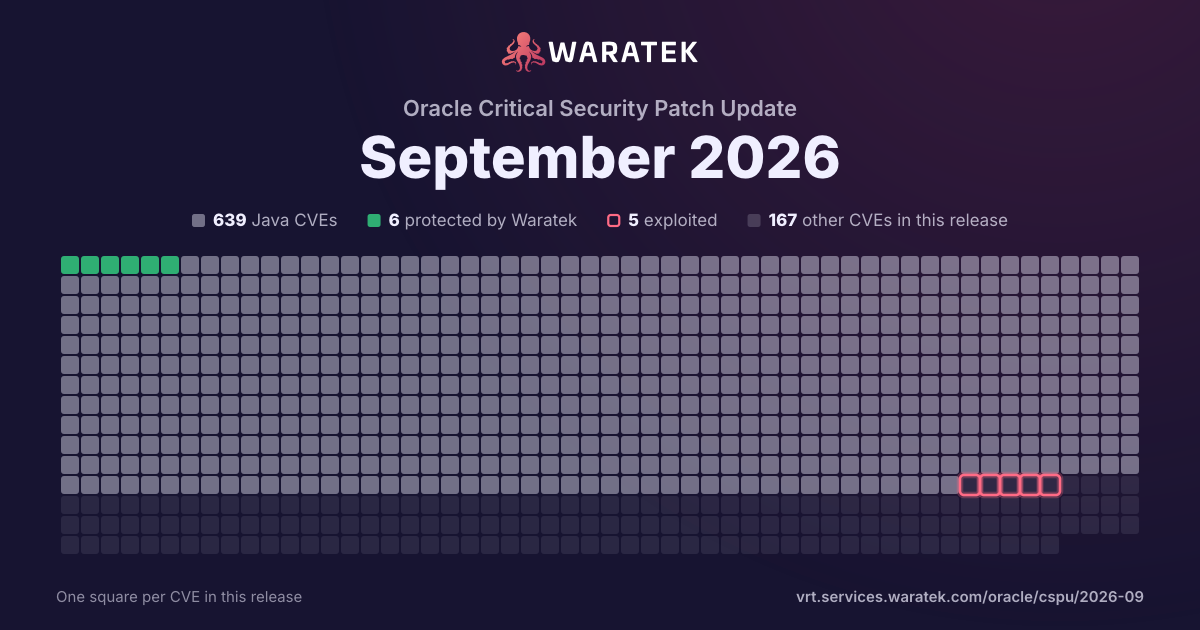
By status
No exploit published. For 596 of them, Oracle's security advisory is the source of public detail.
Protected by Waratek. Waratek RASP can block exploitation of these on systems that have not applied the patch yet.
Overview 61 matches · 33 in Waratek scope · 5 protected · 3 exploited · 0 CISA KEV · 3 public PoC · 0 EPSS ≥ 0.5
61matches
33in Waratek scope54.1%
5protected8.2%
3exploited4.9%
0CISA KEV0.0%
3public PoC4.9%
0EPSS ≥ 0.50.0%
Protected by Waratek
5
8.2%
Rule in development
0
0.0%
Mitigation candidate
0
0.0%
No exploit published
28
45.9%
Outside Waratek scope
0
0.0%
Not applicable
28
45.9%
Withdrawn CVE
0
0.0%
blocked by ARMR today
5
8.2%
partly blocked
0
0.0%
not blocked
56
91.8%
not established
0
0.0%
unrecorded
0
0.0%
split by
peak 56 / quarter
Q4 232
Not applicable2
Medium2
not blocked2
Exploited1
No public exploit1
Q1 240
Q2 240
Q3 240
Q4 240
Q1 250
Q2 250
Q3 250
Q4 251
No exploit published1
Medium1
not blocked1
No public exploit1
Q1 262
Not applicable2
High1
Medium1
not blocked2
Exploited1
No public exploit1
Q2 2656
Protected by Waratek5
No exploit published27
Not applicable24
Critical11
High12
Medium29
Low4
blocked by ARMR today5
not blocked51
Exploited1
Working exploit published1
Proof of concept only10
No public exploit44
Q4 23Q1 24Q2 24Q3 24Q4 24Q1 25Q2 25Q3 25Q4 25Q1 26Q2 26
| CVE | Severity | Published▾ | Status | Exploitation | Description |
|---|---|---|---|---|---|
| CVE-2026-50734 | High | 2026-06-30 | No exploit published | No public exploit | Memory Allocation with Excessive Size Value vulnerability in Apache ActiveMQ Client, Apache ActiveMQ, Apache ActiveMQ All. An unauthenticated network attacker can cause a broker DoS by sending a crafted WireFormatInfo frame with a malicious large size value. The value is not validate and causes the broker to attempt allocation during pre-auth negotiation which can trigger OOM and crash the broker. This issue affects Apache ActiveMQ Client: before 5.19.8, from 6.0.0 before 6.2.7; Apache ActiveMQ: before 5.19.8, from 6.0.0 before 6.2.7; Apache ActiveMQ All: before 5.19.8, from 6.0.0 before 6.2.7. Users are recommended to upgrade to version 6.2.7 or 5.19.8, which fixes the issue. |
| CVE-2026-55956 | Medium | 2026-06-29 | No exploit published | No public exploit | Improper Authorization vulnerability in Apache Tomcat leads to security constraints specified for the default servlet ignoring any method or method omission configured as part of the constraint. This issue affects Apache Tomcat: from 11.0.0-M1 through 11.0.22, from 10.1.0-M1 through 10.1.55, from 9.0.0.M1 through 9.0.118, from 8.5.0 through 8.5.100, from 7.0.0 through 7.0.109. Other versions that have reached end of support may also be affected. Users are recommended to upgrade to version 11.0.23, 10.1.56 or 9.0.119, which fix the issue. |
| CVE-2026-55955 | Medium | 2026-06-29 | No exploit published | No public exploit | Improper Authentication vulnerability in Apache Tomcat allowed a replay attack against the EncryptionInterceptor in the cluster component. This issue affects Apache Tomcat: from 11.0.0-M1 through 11.0.22, from 10.1.0-M1 through 10.1.55, from 9.0.13 through 9.0.18, from 8.5.38 through 8.5.100, from 7.0.100 through 7.0.109. Users are recommended to upgrade to version 11.0.23, 10.1.56, 9.0.119, which fixes the issue. |
| CVE-2026-55276 | Critical | 2026-06-29 | No exploit published | No public exploit | Always-Incorrect Control Flow Implementation vulnerability in Apache Tomcat meant that special roles and empty authorisation constraints were not included when the effective web.xml was logged. This issue affects Apache Tomcat: from 11.0.0-M1 through 11.0.22, from 10.1.0-M1 through 10.1.55, from 9.0.0.M1 through 9.0.118, from 8.5.0 through 8.5.100. Other versions that have reached end of support may also be affected. Users are recommended to upgrade to version 11.0.23, 10.1.56 or 9.0.119 which fixes the issue. |
| CVE-2026-53434 | Critical | 2026-06-29 | No exploit published | No public exploit | Detection of Error Condition Without Action vulnerability in Apache Tomcat when configuring CRLs for a FFM based connector. This issue affects Apache Tomcat: from 11.0.0-M1 through 11.0.22, from 10.1.0-M7 through 10.1.55, from 9.0.83 through 9.0.118. Users are recommended to upgrade to version 11.0.23, 10.1.56 or 9.0.119, which fixes the issue. |
| CVE-2026-53404 | High | 2026-06-29 | No exploit published | No public exploit | Always-Incorrect Control Flow Implementation vulnerability in Apache Tomcat's rewrite valve meant that if the first condition in an OR chain matched, subsequent non-OR conditions were skipped. This issue affects Apache Tomcat: from 11.0.0-M1 through 11.0.22, from 10.1.0-M1 through 10.1.55, from 9.0.0.M1 through 9.0.118, from 8.5.0 through 8.5.100. Other versions that have reached end of support may also be affected. Users are recommended to upgrade to version 11.0.23, 10.1.56 or 9.0.119, which fix the issue. |
| CVE-2026-50229 | Medium | 2026-06-29 | Protected by Waratek | Working exploit published | Improper Neutralization of Script-Related HTML Tags in a Web Page (Basic XSS) vulnerability in the number guess example for Apache Tomcat. This issue affects Apache Tomcat: from 11.0.0-M1 through 11.0.22, from 10.1.0-M1 through 10.1.55, from 9.0.0.M1 through 9.0.118, from 8.5.0 through 8.5.100, from 7.0.0 through 7.0.109. Other versions that have reached end of support may also be affected. Users are recommended to upgrade to version 11.0.23, 10.1.56 or 9.0.119, which fix the issue. |
| CVE-2026-13758 | Low | 2026-06-29 | Not applicable | No public exploit | CryptX versions before 0.088_001 for Perl compare AEAD authentication tags in non-constant time in the streaming decrypt_done path. The decrypt_done($tag) form compares it against the computed tag with memNE (memcmp() != 0), which short-circuits on the first differing byte, so its run time depends on the number of matching leading bytes. This affects all five AEAD modes: GCM, CCM, ChaCha20Poly1305, EAX and OCB. The one-shot *_decrypt_verify helpers are unaffected; they verify the tag inside libtomcrypt with a constant-time comparison. The timing difference is a tag-verification oracle. An attacker who can submit many candidate tags for the same nonce, ciphertext and associated data while measuring the timing precisely enough may recover the expected tag byte by byte and forge a message that verifies. |
| CVE-2026-13484 | Low | 2026-06-28 | Not applicable | Proof of concept only | A vulnerability has been found in MLflow up to 4666cffc7912ea606d592fc38d6a75e2935f65e7. The impacted element is an unknown function of the component Experiment-scoped Label Schema CRUD API. Such manipulation leads to missing authorization. It is possible to launch the attack remotely. A high complexity level is associated with this attack. The exploitability is regarded as difficult. The exploit has been disclosed to the public and may be used. A reply to the GitHub issue explains, that "[t]he labeling schema PR has not been merged yet. The auth handlers will be added before the release." |
| CVE-2026-13006 | High | 2026-06-24 | No exploit published | No public exploit | ACE vulnerability in conditional configuration file processing by QOS.CH logback-core up to and including version 1.5.36 in Java applications, allows an attacker to execute arbitrary code circumventing existing protections against CVE-2025-11226 by compromising an existing logback configuration file or by injecting an environment variable before program execution. A successful attack requires the presence of Janino library to be present on the user's class path. In addition, the attacker must have write access to a configuration file. Alternatively, the attacker could inject a malicious environment variable pointing to a malicious configuration file. In both cases, the attack requires existing privilege. Please note that in logack version 1.5.37 conditional processing using Janino was removed. |
| CVE-2026-55767 | Medium | 2026-06-23 | Not applicable | No public exploit | Guzzle is an extensible PHP HTTP client. Prior to 7.12.1, CookieJar incorrectly accepts cookies with a dot-only Domain attribute and whitespace-padded variants. SetCookie::matchesDomain() removes leading dots from the cookie domain, normalizing dot-only values to the empty string; SetCookie::validate() only rejected a strictly empty domain, so these cookies could be stored and the empty normalized domain was treated as matching any request host. An attacker-controlled origin that an application requests with a shared cookie jar can therefore set a cookie that Guzzle later sends to unrelated hosts using the same jar. This may allow cookie injection or session fixation against downstream services, depending on how those services interpret the injected cookie. This vulnerability is fixed in 7.12.1. |
| CVE-2026-55766 | Medium | 2026-06-23 | Not applicable | No public exploit | guzzlehttp/psr7 is a PSR-7 HTTP message library implementation in PHP. Prior to 2.12.1, guzzlehttp/psr7 did not reject CR/LF characters in certain first-party HTTP start-line fields: the request method, protocol version, and response reason phrase. If an application placed attacker-controlled data into one of those fields and later serialized the PSR-7 message as raw HTTP/1.x, for example with Message::toString() or an equivalent serializer, the serialized message could contain attacker-controlled header lines. The issue can also be reached through Message::parseRequest() or Message::parseResponse() when malformed raw messages are parsed into first-party PSR-7 objects and then serialized again. Creating or modifying a Request, Response, or other PSR-7 object alone is not sufficient. The issue requires the malformed message to be serialized and written to the network, forwarded, replayed, or otherwise processed by software that does not independently reject the malformed start line. This vulnerability is fixed in 2.12.1. |
| CVE-2026-55568 | Medium | 2026-06-23 | Not applicable | No public exploit | Guzzle is an extensible PHP HTTP client. Prior to 7.12.1, in certain configurations, traffic expected to be protected by TLS on the hop to the proxy is transmitted in cleartext. Proxy authentication credentials (the Proxy-Authorization header, proxy userinfo in the proxy URL, or CURLOPT_PROXYUSERPWD) are sent without encryption, and the CONNECT target host and port for tunneled HTTPS requests are exposed. The built-in cURL handlers (GuzzleHttp\Handler\CurlHandler and GuzzleHttp\Handler\CurlMultiHandler, used by default whenever the PHP cURL extension is available) accept an https:// proxy. libcurl older than 7.50.2 silently treats an https:// proxy as a plaintext http:// proxy. The TLS connection to the proxy is never established, and the proxy leg is cleartext with no error or warning. An application is affected when it sends requests through one of the built-in cURL handlers, configures an https:// proxy expecting the proxy connection itself to be encrypted, and runs with libcurl older than 7.50.2. This vulnerability is fixed in 7.12.1. |
| CVE-2026-54518 | Medium | 2026-06-23 | No exploit published | No public exploit | jackson-databind contains the general-purpose data-binding functionality and tree-model for Jackson Data Processor. From 2.21.0 until 2.21.4 and 3.1.4, UnwrappedPropertyHandler.processUnwrappedCreatorProperties() replays buffered JSON into creator parameters but never consults prop.visibleInView(activeView). The normal property-based creator path gates creator properties on the active view, but this unwrapped-creator replay path bypasses that check, so a constructor parameter annotated with both @JsonView(AdminView.class) and @JsonUnwrapped is populated from attacker JSON even when a more restrictive view is active. This vulnerability is fixed in 2.21.4 and 3.1.4. |
| CVE-2026-54517 | Medium | 2026-06-23 | No exploit published | No public exploit | jackson-databind contains the general-purpose data-binding functionality and tree-model for Jackson Data Processor. From 2.21.0 until 2.21.4 and 3.1.4, in BeanDeserializer._deserializeUsingPropertyBased, the active-view (@JsonView) filter was applied only to creator properties; the regular property-buffering branch performed no prop.visibleInView(activeView) check. A change making SetterlessProperty.isMerging() return true routed setterless Collection/Map properties through this unguarded path, so a setterless collection annotated with a restricted @JsonView is populated from attacker JSON even when the active view excludes it. This vulnerability is fixed in 2.21.4 and 3.1.4. |
| CVE-2026-54516 | Medium | 2026-06-23 | No exploit published | No public exploit | jackson-databind contains the general-purpose data-binding functionality and tree-model for Jackson Data Processor. From 2.21.0 until 2.21.4 and 3.1.4, POJOPropertiesCollector._renameProperties() allows a property with @JsonProperty("renamed") on the getter and @JsonIgnore on the setter to be renamed rather than dropped. With MapperFeature.INFER_PROPERTY_MUTATORS enabled (default), the private backing field is retained; during deserialization BeanDeserializerFactory.addBeanProps() sees hasField()==true, builds a FieldProperty, and makes the backing field writable. An attacker supplying the renamed JSON key writes the backing field directly, bypassing the @JsonIgnore on the setter. This vulnerability is fixed in 3.1.4. |
| CVE-2026-54515 | Medium | 2026-06-23 | No exploit published | No public exploit | jackson-databind contains the general-purpose data-binding functionality and tree-model for Jackson Data Processor. From 2.8.0 until 2.18.9, 2.21.5, and 3.1.4, in BeanDeserializerBase.createContextual(), per-property @JsonIgnoreProperties exclusions are applied by _handleByNameInclusion(), producing a contextual deserializer whose BeanPropertyMap has the ignored properties removed. The subsequent per-property case-insensitivity block (triggered by @JsonFormat(ACCEPT_CASE_INSENSITIVE_PROPERTIES)) rebuilds from this._beanProperties (the original, unfiltered map) instead of contextual._beanProperties, then overwrites the filtered map — restoring every property _handleByNameInclusion had just removed. The ignored property becomes writable again. This vulnerability is fixed in 2.18.9, 2.21.5, and 3.1.4. |
| CVE-2026-54514 | Medium | 2026-06-23 | No exploit published | No public exploit | jackson-databind contains the general-purpose data-binding functionality and tree-model for Jackson Data Processor. From 2.0.0 until 2.18.8, 2.21.4, and 3.1.4, JDKFromStringDeserializer constructed InetSocketAddress with new InetSocketAddress(host, port), which performs eager DNS name resolution for hostname inputs at deserialization time. An application that binds untrusted JSON into a type containing an InetSocketAddress field issues an attacker-chosen DNS query during readValue, before any application-level validation or connect logic. The fix uses InetSocketAddress.createUnresolved(host, port), deferring DNS to an explicit connect. This vulnerability is fixed in 2.18.8, 2.21.4, and 3.1.4. |
| CVE-2026-54513 | High | 2026-06-23 | No exploit published | No public exploit | jackson-databind contains the general-purpose data-binding functionality and tree-model for Jackson Data Processor. From 2.10.0 until 2.18.8, 2.21.4, and 3.1.4, BasicPolymorphicTypeValidator.Builder.allowIfSubTypeIsArray() allowlists any array type based only on clazz.isArray(), without validating the array's component (element) type against the configured allowlist. A PTV built with allowIfSubTypeIsArray() plus an explicit concrete-type allowlist therefore still permits EvilType[] even though EvilType is not allowlisted. When Jackson deserializes the elements and no per-element type IDs are present, it instantiates the component type directly with no further PTV check, bypassing the allowlist. This vulnerability is fixed in 2.18.8, 2.21.4, and 3.1.4. |
| CVE-2026-54512 | High | 2026-06-23 | No exploit published | Proof of concept only | jackson-databind contains the general-purpose data-binding functionality and tree-model for Jackson Data Processor. From 2.10.0 until 2.18.8, 2.21.4, and 3.1.4, jackson-databind's PolymorphicTypeValidator (PTV) is the primary safety mechanism guarding polymorphic deserialization. When polymorphic typing is enabled and a type identifier contains generic parameters (i.e. the type ID string contains <), DatabindContext._resolveAndValidateGeneric() validates only the raw container class name (the substring before <) against the configured PTV. If the container type is approved, the method parses the full canonical type string via TypeFactory.constructFromCanonical() and returns the fully parameterized type without ever validating the nested type arguments against the PTV. The nested type arguments are then resolved, instantiated, and populated as beans during deserialization. An attacker who controls the type ID can therefore place a denied class as a generic type parameter of an allowed container — for example java.util.ArrayList<com.evil.Gadget> when only java.util.ArrayList is allow-listed. The container passes the PTV check; com.evil.Gadget is loaded via Class.forName(name, true, loader), instantiated, and its properties are set from attacker-controlled JSON. This completely bypasses an explicitly configured PTV allow-list. This vulnerability is fixed in 2.18.8, 2.21.4, and 3.1.4. |
| CVE-2026-50020 | Medium | 2026-06-12 | No exploit published | Proof of concept only | Netty is a network application framework for development of protocol servers and clients. Prior to versions 4.1.135.Final and 4.2.15.Final, before reading the first request-line, `HttpObjectDecoder` skips every byte for which `Character.isISOControl(b)` is `true` (0x00–0x1F and 0x7F) as well as all whitespace. RFC 9112 §2.2 only asks servers to ignore empty CRLF lines preceding the request-line — a carefully scoped robustness allowance intended to handle HTTP/1.0 POST workarounds. Silently absorbing NUL bytes, SOH, STX, and other non-CRLF control characters goes significantly beyond this, and can be exploited for request-boundary confusion in pipelined or multiplexed transports where a front-end component treats those bytes differently. Versions 4.1.135.Final and 4.2.15.Final patch the issue. |
| CVE-2026-50010 | High | 2026-06-12 | No exploit published | No public exploit | Netty is a network application framework for development of protocol servers and clients. Prior to versions 4.1.135.Final and 4.2.15.Final, SimpleTrustManagerFactory.engineGetTrustManagers() and related paths wrap any user-supplied plain X509TrustManager in X509TrustManagerWrapper, which extends X509ExtendedTrustManager but implements the 3-arg checkServerTrusted(chain, authType, SSLEngine) by discarding the SSLEngine and calling the 2-arg delegate. Because the object now IS an X509ExtendedTrustManager, neither SunJSSE's internal AbstractTrustManagerWrapper nor Netty's own OpenSslX509TrustManagerWrapper will re-wrap it to add endpoint-identification. Consequently, even though Netty 4.2 sets endpointIdentificationAlgorithm="HTTPS" by default, a client built with `SslContextBuilder.forClient().trustManager(somePlainX509TrustManager)` performs no hostname verification at all. Versions 4.1.135.Final and 4.2.15.Final patch the issue. |
| CVE-2026-47691 | Critical | 2026-06-12 | No exploit published | No public exploit | Netty is a network application framework for development of protocol servers and clients. Prior to versions 4.1.135.Final and 4.2.15.Final, Netty's `DnsResolveContext` insufficiently validates the bailiwick of NS records, enabling DNS Cache Poisoning. An attacker controlling an authoritative name server for a subdomain can poison the cache for parent domains (like `.co.uk`). In `io.netty.resolver.dns.DnsResolveContext.AuthoritativeNameServerList#add` method accepts any NS record from the AUTHORITY section as long as the record's name is a suffix of the questionName. Subsequently, the `handleWithAdditional` method caches the associated A records from the ADDITIONAL section directly into the `authoritativeDnsServerCache` under the parent domain's key. This bypasses standard bailiwick rules, where a server authoritative for a subdomain should not be trusted to provide authoritative records for its parent. The poisoned cache is then used for all future resolutions under the parent domain's key. Versions 4.1.135.Final and 4.2.15.Final patch the issue. |
| CVE-2026-45674 | Critical | 2026-06-12 | No exploit published | No public exploit | Netty is a network application framework for development of protocol servers and clients. Prior to versions 4.1.135.Final and 4.2.15.Final, Netty's DnsResolveContext fails to validate the origin (bailiwick) of CNAME records in DNS responses. Versions 4.1.135.Final and 4.2.15.Final patch the issue. |
| CVE-2026-45673 | Medium | 2026-06-12 | No exploit published | No public exploit | Netty is a network application framework for development of protocol servers and clients. Prior to versions 4.1.135.Final and 4.2.15.Final, Netty's DNS resolver uses a predictable PRNG for generating DNS transaction IDs and defaults to a static UDP source port. This combination reduces the entropy of DNS queries, enabling DNS Cache Poisoning (Kaminsky attack). Versions 4.1.135.Final and 4.2.15.Final patch the issue. |
| CVE-2026-45536 | Medium | 2026-06-12 | No exploit published | No public exploit | Netty is a network application framework for development of protocol servers and clients. Prior to versions 4.1.135.Final and 4.2.15.Final, netty_unix_socket_recvFd sets msg_control to `char control[CMSG_SPACE(sizeof(int))]` (line 940) — 24 bytes on 64-bit Linux. A peer-sent SCM_RIGHTS cmsg carrying two ints has cmsg_len = CMSG_LEN(8) = 24, which fits exactly with no MSG_CTRUNC, so the kernel installs both fds in the receiving process. The subsequent check `cmsg->cmsg_len == CMSG_LEN(sizeof(int))` (line 972, expected 20) fails, the branch that would read the fd is skipped, and neither installed fd is closed. The for(;;) loop calls recvmsg again (non-blocking → EAGAIN → Java maps to 0 → read loop exits normally), leaving two leaked fds per message. There is no MSG_CTRUNC handling. Reachable via Epoll/KQueue DomainSocketChannel when the application opts into DomainSocketReadMode.FILE_DESCRIPTORS (non-default). Versions 4.1.135.Final and 4.2.15.Final patch the issue. |
| CVE-2026-45416 | High | 2026-06-12 | No exploit published | No public exploit | Netty is a network application framework for development of protocol servers and clients. Prior to versions 4.1.135.Final and 4.2.15.Final, SslClientHelloHandler.decode() reads the 24-bit TLS handshake length and, when the ClientHello does not fit in the first record, eagerly allocates `ctx.alloc().buffer(handshakeLength)` (line 161). The guard at line 140 is `handshakeLength > maxClientHelloLength && maxClientHelloLength != 0`, and the commonly-used SniHandler/AbstractSniHandler constructors (SniHandler(Mapping), SniHandler(AsyncMapping), AbstractSniHandler()) pass maxClientHelloLength=0 and handshakeTimeoutMillis=0, so the length guard is disabled and no timeout is scheduled. A 16 MiB request exceeds the default pooled chunk size and becomes a huge/unpooled allocation performed immediately. The buffer is retained in the handler until the channel closes. Versions 4.1.135.Final and 4.2.15.Final patch the issue. |
| CVE-2026-49214 | Medium | 2026-06-11 | Not applicable | No public exploit | guzzlehttp/psr7 is a PSR-7 HTTP message library implementation in PHP. Versions prior to 2.10.2 did not reject ASCII control characters, whitespace, or DEL in first-party URI host components. A vulnerable flow is: First, an application accepts a user-controlled URL. Second, the URL is used to construct a PSR-7 `Uri` or `Request`. Third, the host component contains CRLF or another header-unsafe character. Fourth, the host is copied into the PSR-7 `Host` header when no explicit `Host` header is provided. Finally, the request is serialized or sent by an HTTP client that does not independently reject the malformed host. In that flow, an attacker can cause the serialized request to contain additional attacker-controlled header lines. For example, a host containing `"\r\nX-Injected: yes"` can cause the generated `Host` header to span multiple HTTP header lines. Applications are affected when they use user-controlled URLs for outbound HTTP requests, URL forwarding, proxying, crawling, webhook delivery, or similar request-dispatch flows. In deployments involving HTTP/1.1 connection reuse, proxies, gateways, or load balancers, this malformed request may also contribute to request smuggling or cache poisoning, depending on how downstream components parse the request. The issue is patched in `2.10.2` and later. `1.x` is end-of-life and will not receive a patch. As a workaround, validate and reject all untrusted URI strings before constructing PSR-7 `Uri` or `Request` instances. Reject input containing ASCII control characters, whitespace, or DEL, including CRLF, tab, space, NUL, or DEL characters. Applications that forward requests should also ensure the final HTTP client or serializer rejects invalid URI and header data before writing requests to the network. |
| CVE-2026-48998 | Medium | 2026-06-11 | Not applicable | No public exploit | guzzlehttp/psr7 is a PSR-7 HTTP message library implementation in PHP. Versions prior to 2.10.2 contain improper Host header validation when parsing raw HTTP request messages and when deriving a server request URI from server variables. An attacker can provide a malformed Host header containing URI authority delimiters, such as `trusted.example@evil.example`. When the Host value is used to construct a URI, the malformed value can be reinterpreted as URI userinfo and host. This can cause the PSR-7 request URI host to differ from the original Host header value. Applications are affected if they parse attacker-controlled raw HTTP requests with `GuzzleHttp\Psr7\Message::parseRequest()` or the legacy 1.x `GuzzleHttp\Psr7\parse_request()` function, or if they build server requests from attacker-controlled server variables, then rely on the resulting URI host for routing, allow-list checks, or forwarding decisions. In affected forwarding or gateway scenarios, this may cause requests or credentials to be sent to an unintended host. The issue is patched in `2.10.2`. `1.x` is end-of-life and will not receive a patch. Some workarounds are available. Validate the `Host` header as `uri-host [ ":" port ]` before calling `Message::parseRequest()` or legacy `parse_request()` on untrusted HTTP request data, or before deriving routing and forwarding decisions from a parsed request URI. Reject Host values containing userinfo, path, query, or fragment delimiters. |
| CVE-2026-44249 | High | 2026-06-11 | No exploit published | No public exploit | Netty is a network application framework for development of protocol servers and clients. In netty-handler prior to versions 4.1.135.Final and 4.2.15.Final, an attacker can bypass IPv6 subnet rules due to an incorrect masking operation in IpSubnetFilterRule.compareTo(). Valid public IP addresses can bypass the restrictions. Versions 4.1.135.Final and 4.2.15.Final patch the issue. |
| CVE-2026-49760 | Medium | 2026-06-10 | Not applicable | No public exploit | Stack-based Buffer Overflow vulnerability in Erlang OTP (erl_interface) allows Stack-based Buffer Overflow. This vulnerability is associated with program file lib/erl_interface/src/misc/ei_printterm.c and program routine ei_s_print_term. The C function ei_s_print_term uses an internal 2000-character stack buffer to format terms. When called with an encoded Erlang term containing a very large integer (encoded representation exceeding 2000 characters), the buffer overflows. The overflow bytes are restricted to the ASCII values of 0-9 and A-F, which limits exploitation to Denial of Service. The companion function ei_print_term, which prints directly to a FILE instead of a memory buffer, does not contain this bug. This issue affects OTP from OTP 17.0 before OTP 27.3.4.13, OTP 28.5.0.2, and OTP 29.0.2, corresponding to erl_interface from 3.7.16 before 5.5.2.1, 5.7.0.1, and 5.8.1. Whether OTP before OTP 17.0, corresponding to erl_interface before 3.7.16, is affected is unknown. |
| CVE-2026-49759 | High | 2026-06-10 | Not applicable | No public exploit | Stack-based Buffer Overflow vulnerability in Erlang OTP erts (inet_drv) allows an unauthenticated remote attacker to crash the BEAM VM by sending a crafted SCTP ERROR chunk. The sctp_parse_error_chunk function in erts/emulator/drivers/common/inet_drv.c parses SCTP ERROR chunks and writes cause codes into a fixed-size stack-allocated ErlDrvTermData spec[] array without checking bounds. A remote attacker who has established an SCTP association to a listening port can send a single crafted SCTP ERROR chunk containing enough cause codes to overflow the stack buffer, crashing the VM. The attacker can only write 16-bit values interleaved with a fixed tag, so the overflow does not provide a controlled return address, limiting exploitation to Denial of Service. A crafted SCTP ERROR chunk may also leak bits and pieces of Erlang VM memory into the received error packet observed by the Erlang process. Such data is already readable by the user running the Erlang VM, so the disclosure scope is limited. This issue affects OTP from OTP 17.0 before OTP 27.3.4.13, OTP 28.5.0.2, and OTP 29.0.2, corresponding to erts from 6.0 before 15.2.7.9, 16.4.0.2, and 17.0.2. Whether OTP before OTP 17.0, corresponding to erts before 6.0, is affected is unknown. |
| CVE-2026-48860 | High | 2026-06-10 | Not applicable | No public exploit | Reliance on IP Address for Authentication vulnerability in Erlang/OTP ssl (inet_tls_dist module) allows unauthenticated bypass of the distribution-over-TLS LAN allowlist. The inet_tls_dist:check_ip/1 function, which enforces a LAN allowlist for Erlang distribution over TLS, calls inet:sockname/1 instead of inet:peername/1 to obtain the peer's IP address. Because inet:sockname/1 returns the local socket address, both the local IP and the supposed peer IP resolve to the same value, causing the subnet mask comparison to always succeed regardless of the actual remote address. Any holder of a CA-signed TLS certificate can therefore bypass the LAN restriction and gain full Erlang distribution access to the node, including rpc:call/4 and code:load_binary/3. This vulnerability is associated with program file lib/ssl/src/inet_tls_dist.erl. This issue affects OTP from OTP 26.0 before OTP 27.3.4.13, OTP 28.5.0.2, and OTP 29.0.2, corresponding to ssl from 11.0 before 11.2.12.9, 11.6.0.2, and 11.7.2. |
| CVE-2026-48858 | Medium | 2026-06-10 | Not applicable | No public exploit | Server-Side Request Forgery (SSRF) vulnerability in Erlang/OTP ftp (ftp_internal module) allows FTP bounce attacks and SSRF via an unvalidated PASV response IP address. The ftp_internal:handle_ctrl_result/2 PASV handler (mode=passive, ipfamily=inet, ftp_extension=false) extracts the IP address from the server's 227 response and passes it directly to gen_tcp:connect/4 without validating it against the control connection peer address. The adjacent EPSV handlers correctly call peername(CSock) to derive the IP from the control connection, but the PASV handler does not. A malicious or compromised FTP server can redirect the client's data connection to an arbitrary internal host and port. On read operations (ftp:ls/1,2, ftp:nlist/1,2, ftp:recv/2,3), data from the redirected target is returned to the caller. On write operations (ftp:send/2,3, ftp:append/2,3), file content is sent to the redirected target. This enables SSRF against internal hosts, cloud metadata endpoints, and FTP bounce attacks against third-party hosts. The vulnerable path is the default configuration (mode=passive, ipfamily=inet, ftp_extension=false). RFC 2577 section 3 explicitly recommends validating the PASV response IP against the control connection peer. The ftp application is deprecated and scheduled for removal in OTP-30. This vulnerability is associated with program files lib/inets/src/ftp/ftp_internal.erl (inets 5.10.4 through 6.5, OTP 17.4 through 20.3) and lib/ftp/src/ftp_internal.erl (ftp 1.0 and later, OTP 21.0 and later). This issue affects OTP from OTP 17.4 before OTP 27.3.4.13, OTP 28.5.0.2, and OTP 29.0.2, corresponding to ftp from 1.0 before 1.2.3.1, 1.2.4.1, and 1.2.6, and inets from 5.10.4 before 7.0. |
| CVE-2026-48856 | High | 2026-06-10 | Not applicable | No public exploit | Sensitive Data Exposure vulnerability in Erlang OTP inets (httpc_response module) allows Retrieve Embedded Sensitive Data. The httpc client forwards the Authorization and Proxy-Authorization request headers to redirect targets without checking whether the redirect crosses an origin boundary. httpc_response:redirect/2 constructs the redirected request by updating only the host field of the header record; all other fields (including authorization and proxy_authorization) are copied verbatim. The redirect target host is never compared against the original host. autoredirect defaults to true, so this affects all httpc callers that do not explicitly disable automatic redirects. An attacker who controls a server that the victim contacts via httpc can issue a cross-origin 3xx redirect to a server they also control. The Authorization header (including Basic credentials derived from URL userinfo via httpc_request:handle_user_info/2) is forwarded to the redirect target, allowing credential theft. The same applies to the Proxy-Authorization header. This vulnerability is associated with program files lib/inets/src/http_client/httpc_response.erl. This issue affects OTP from OTP 17.0 before OTP 27.3.4.19, OTP 28.5.0.8, and OTP 29.1.2, corresponding to inets from 5.10 before 9.3.2.8, 9.6.2.4, and 9.8.1. Whether OTP before OTP 17.0, corresponding to inets before 5.10, is affected is unknown. |
| CVE-2026-48855 | Low | 2026-06-10 | Not applicable | No public exploit | Exposure of Sensitive Information to an Unauthorized Actor vulnerability in Erlang OTP ssh (ssh_sftpd module) allows File Discovery. The SSH_FXP_READLINK handler in ssh_sftpd sends the raw result of file:read_link/2 to the client without calling chroot_filename/2 to strip the backend root prefix. An authenticated SFTP client can create a symlink inside the chroot pointing to /; ssh_sftpd resolves the target to the absolute backend root and stores it on disk. Reading the symlink back via SSH_FXP_READLINK returns that absolute path, for example /data/sftp, instead of the chrooted value /. The information disclosed is the absolute filesystem path of the SFTP root directory and of any symlink targets within it. No file contents, credentials, or access to paths outside the root directory are obtainable through this issue alone. This vulnerability is associated with program files lib/ssh/src/ssh_sftpd.erl. This issue affects OTP from OTP 17.0 before OTP 27.3.4.13, OTP 28.5.0.2, and OTP 29.0.2, corresponding to ssh from 3.0.1 before 5.2.11.8, 5.5.2.1, and 6.0.1. Whether OTP before OTP 17.0, corresponding to ssh before 3.0.1, is affected is unknown. |
| CVE-2026-9698 | Critical | 2026-06-09 | Not applicable | No public exploit | DBI versions before 1.648 for Perl saved errors in a limited-sized buffer. Error messages that were returned when RaiseError, PrintError or HandleError were set were written to a 200-byte buffer without a length limit. Attackers that can influence the error text in an application can trigger a buffer overflow. |
| CVE-2026-10879 | Critical | 2026-06-05 | Not applicable | No public exploit | DBI versions before 1.648 for Perl have a heap overflow when preparsing SQL statements with more than 9 binders. The preparse method expands SQL placeholder characters to numbered binders of the form :pN, but only allocates three characters per binder in the buffer. Placeholders 10-99 require four characters, 100-999 require five characters, et cetera. |
| CVE-2026-10803 | Low | 2026-06-04 | Not applicable | Proof of concept only | A flaw has been found in MLflow up to 3.10.0. This issue affects the function mlflow.data.digest_utils of the file mlflow/data/digest_utils.py of the component Dataset Digest Computation. This manipulation causes use of weak hash. It is possible to launch the attack on the local host. The attack is considered to have high complexity. The exploitability is assessed as difficult. The exploit has been published and may be used. The project was informed of the problem early through a pull request but has not reacted yet. |
| CVE-2026-47065 | Critical | 2026-06-03 | Protected by Waratek | No public exploit | ZDRES-232: resolveProxyClass Not Overridden - acceptMatchers Filter Bypass via java.lang.reflect.Proxy Assessment: Fully addressed. When the serialised stream contains a TC_PROXYCLASSDESC (the marker for a java.lang.reflect.Proxy ), JDK’s ObjectInputStream.readProxyDesc() is dispatched. JDK then calls the default ObjectInputStream.resolveProxyClass(interfaces) implementation, which performs Class.forName(intf, false, latestUserDefinedLoader()) for EACH interface name and constructs the proxy class — bypassing the accepted classes list . ZDRES-233: Class.forName(name, initialize=true, classLoader) in readClassDescriptor Triggers Static Initialiser of Allow-Listed Classes Assessment: Fully addressed. For ANY class on the allow-list, deserialising a stream that names it triggers the class’s (static initialiser) BEFORE any instance is constructed. This means an attacker who supplies a class name on the allow-list (e.g., the developer wrote accept(“com.myapp.*") , attacker supplies com.myapp.SomeClass ) causes <clinit> of SomeClass — and many real-world classes have side-effecting static initialisers Both issues have been fixed. |
| CVE-2026-4035 | High | 2026-06-03 | Not applicable | Exploited | A vulnerability in mlflow/mlflow versions prior to 3.11.0 allows for the resolution of environment variables in AI Gateway secrets, which can be exploited to exfiltrate sensitive server-side environment credentials to an attacker-controlled endpoint. This issue arises because the `api_key` field in gateway secrets can accept `$ENV_VAR` references, which are resolved against the MLflow server's environment during runtime. The resolved secrets are then sent in provider authentication headers to the configured upstream `api_base`. This vulnerability can be exploited by low-privileged authenticated users in basic-auth deployments or by unauthenticated users in default deployments without `basic-auth`. The impact includes potential leakage of sensitive credentials such as cloud artifact credentials (`AWS_ACCESS_KEY_ID`, `AWS_SECRET_ACCESS_KEY`), which could lead to artifact poisoning and cross-boundary code execution in downstream environments. The issue is fixed in version 3.11.0. |
| CVE-2026-3198 | Medium | 2026-06-02 | Not applicable | Proof of concept only | MLflow 3.9.0 with basic-auth (`--app-name basic-auth`) fails to enforce authorization checks for multiple Gateway API 'list' endpoints. Specifically, the `BEFORE_REQUEST_HANDLERS` dictionary in `mlflow/server/auth/__init__.py` does not include entries for `ListGatewaySecretInfos`, `ListGatewayEndpoints`, and `ListGatewayModelDefinitions`. This allows any authenticated user, regardless of their assigned permissions, to enumerate all gateway secrets, endpoints, and model definitions. This vulnerability exposes sensitive information, such as API keys, endpoint configurations, and proprietary model definitions, to unauthorized users. |
| CVE-2026-7598 | Medium | 2026-05-01 | Not applicable | Proof of concept only | A security vulnerability has been detected in libssh2 up to 1.11.1. The impacted element is the function userauth_password of the file src/userauth.c. Such manipulation of the argument username_len/password_len leads to integer overflow. The attack may be launched remotely. The name of the patch is 256d04b60d80bf1190e96b0ad1e91b2174d744b1. A patch should be applied to remediate this issue. |
| CVE-2026-42779 | Critical | 2026-05-01 | Protected by Waratek | Proof of concept only | The fix for CVE-2026-41635 was not applied to the 2.1.X and 2.2.X branches. Here was the original issue description: Apache MINA's AbstractIoBuffer.resolveClass() contains two branches, one of them (for static classes or primitive types) does not check the class at all, bypassing the classname allowlist and allowing arbitrary code to be executed. The fix checks if the class is present in the accepted class filter before calling Class.forName(). Affected versions are Apache MINA 2.1.0 <= 2.1.11, and 2.2.0 <= 2.2.6. The problem is resolved in Apache MINA 2.1.12, and 2.2.7 by applying the classname allowlist earlier. Affected are applications using Apache MINA that call IoBuffer.getObject(). Applications using Apache MINA are advised to upgrade. |
| CVE-2026-41635 | Critical | 2026-04-27 | Protected by Waratek | No public exploit | Apache MINA's AbstractIoBuffer.resolveClass() contains two branches, one of them (for static classes or primitive types) does not check the class at all, bypassing the classname allowlist and allowing arbitrary code to be executed. The fix checks if the class is present in the accepted class filter before calling Class.forName(). Affected versions are Apache MINA 2.0.0 <= 2.0.27, 2.1.0 <= 2.1.10, and 2.2.0 <= 2.2.5. The problem is resolved in Apache MINA 2.0.28, 2.1.11, and 2.2.6 by applying the classname allowlist earlier. Affected are applications using Apache MINA that call IoBuffer.getObject(). Applications using Apache MINA are advised to upgrade. |
| CVE-2026-41409 | Critical | 2026-04-27 | Protected by Waratek | No public exploit | The fix for CVE-2024-52046 in Apache MINA AbstractIoBuffer.getObject() was incomplete. The classname allowlist of classes allowed to be deserialized was applied too late after a static initializer in a class to be read might already have been executed. Affected versions are Apache MINA 2.0.0 <= 2.0.27, 2.1.0 <= 2.1.10, and 2.2.0 <= 2.2.5. The problem is resolved in Apache MINA 2.0.28, 2.1.11, and 2.2.6 by applying the classname allowlist earlier. Affected are applications using Apache MINA that call IoBuffer.getObject(). Applications using Apache MINA are advised to upgrade |
| CVE-2026-41990 | Medium | 2026-04-23 | Not applicable | No public exploit | Libgcrypt before 1.12.2 mishandles Dilithium signing. Writes to a static array lack a bounds check but do not use attacker-controlled data. |
| CVE-2026-41989 | Medium | 2026-04-23 | Not applicable | No public exploit | Libgcrypt before 1.12.2 sometimes allows a heap-based buffer overflow and denial of service via crafted ECDH ciphertext to gcry_pk_decrypt. |
| CVE-2026-41240 | Medium | 2026-04-23 | Not applicable | Proof of concept only | DOMPurify is a DOM-only cross-site scripting sanitizer for HTML, MathML, and SVG. Versions prior to 3.4.0 have an inconsistency between FORBID_TAGS and FORBID_ATTR handling when function-based ADD_TAGS is used. Commit c361baa added an early exit for FORBID_ATTR at line 1214. The same fix was not applied to FORBID_TAGS. At line 1118-1123, when EXTRA_ELEMENT_HANDLING.tagCheck returns true, the short-circuit evaluation skips the FORBID_TAGS check entirely. This allows forbidden elements to survive sanitization with their attributes intact. Version 3.4.0 patches the issue. |
| CVE-2026-41239 | Medium | 2026-04-23 | Not applicable | No public exploit | DOMPurify is a DOM-only cross-site scripting sanitizer for HTML, MathML, and SVG. Starting in version 1.0.10 and prior to version 3.4.0, `SAFE_FOR_TEMPLATES` strips `{{...}}` expressions from untrusted HTML. This works in string mode but not with `RETURN_DOM` or `RETURN_DOM_FRAGMENT`, allowing XSS via template-evaluating frameworks like Vue 2. Version 3.4.0 patches the issue. |
| CVE-2026-41238 | Medium | 2026-04-23 | Not applicable | Proof of concept only | DOMPurify is a DOM-only cross-site scripting sanitizer for HTML, MathML, and SVG. Versions 3.0.1 through 3.3.3 are vulnerable to a prototype pollution-based XSS bypass. When an application uses `DOMPurify.sanitize()` with the default configuration (no `CUSTOM_ELEMENT_HANDLING` option), a prior prototype pollution gadget can inject permissive `tagNameCheck` and `attributeNameCheck` regex values into `Object.prototype`, causing DOMPurify to allow arbitrary custom elements with arbitrary attributes — including event handlers — through sanitization. Version 3.4.0 fixes the issue. |
| CVE-2026-2332 | Critical | 2026-04-14 | No exploit published | Proof of concept only | In Eclipse Jetty, the HTTP/1.1 parser is vulnerable to request smuggling when chunk extensions are used, similar to the "funky chunks" techniques outlined here: * https://w4ke.info/2025/06/18/funky-chunks.html * https://w4ke.info/2025/10/29/funky-chunks-2.html Jetty terminates chunk extension parsing at \r\n inside quoted strings instead of treating this as an error. POST / HTTP/1.1 Host: localhost Transfer-Encoding: chunked 1;ext="val X 0 GET /smuggled HTTP/1.1 ... Note how the chunk extension does not close the double quotes, and it is able to inject a smuggled request. |
| CVE-2026-34480 | Medium | 2026-04-10 | No exploit published | No public exploit | Apache Log4j Core's XmlLayout https://logging.apache.org/log4j/2.x/manual/layouts.html#XmlLayout , in versions up to and including 2.25.3, fails to sanitize characters forbidden by the XML 1.0 specification https://www.w3.org/TR/xml/#charsets producing invalid XML output whenever a log message or MDC value contains such characters. The impact depends on the StAX implementation in use: * JRE built-in StAX: Forbidden characters are silently written to the output, producing malformed XML. Conforming parsers must reject such documents with a fatal error, which may cause downstream log-processing systems to drop the affected records. * Alternative StAX implementations (e.g., Woodstox https://github.com/FasterXML/woodstox , a transitive dependency of the Jackson XML Dataformat module): An exception is thrown during the logging call, and the log event is never delivered to its intended appender, only to Log4j's internal status logger. Users are advised to upgrade to Apache Log4j Core 2.25.4, which corrects this issue by sanitizing forbidden characters before XML output. |
| CVE-2026-34479 | Medium | 2026-04-10 | No exploit published | No public exploit | The Log4j1XmlLayout from the Apache Log4j 1-to-Log4j 2 bridge fails to escape characters forbidden by the XML 1.0 standard, producing malformed XML output. Conforming XML parsers are required to reject documents containing such characters with a fatal error, which may cause downstream log processing systems to drop or fail to index affected records. Two groups of users are affected: * Those using Log4j1XmlLayout directly in a Log4j Core 2 configuration file. * Those using the Log4j 1 configuration compatibility layer with org.apache.log4j.xml.XMLLayout specified as the layout class. Users are advised to upgrade to Apache Log4j 1-to-Log4j 2 bridge version 2.25.4, which corrects this issue. Note: The Apache Log4j 1-to-Log4j 2 bridge is deprecated and will not be present in Log4j 3. Users are encouraged to consult the Log4j 1 to Log4j 2 migration guide https://logging.apache.org/log4j/2.x/migrate-from-log4j1.html , and specifically the section on eliminating reliance on the bridge. |
| CVE-2026-34478 | Medium | 2026-04-10 | No exploit published | No public exploit | Apache Log4j Core's Rfc5424Layout https://logging.apache.org/log4j/2.x/manual/layouts.html#RFC5424Layout , in versions 2.21.0 through 2.25.3, is vulnerable to log injection via CRLF sequences due to undocumented renames of security-relevant configuration attributes. Two distinct issues affect users of stream-based syslog services who configure Rfc5424Layout directly: * The newLineEscape attribute was silently renamed, causing newline escaping to stop working for users of TCP framing (RFC 6587), exposing them to CRLF injection in log output. * The useTlsMessageFormat attribute was silently renamed, causing users of TLS framing (RFC 5425) to be silently downgraded to unframed TCP (RFC 6587), without newline escaping. Users of the SyslogAppender are not affected, as its configuration attributes were not modified. Users are advised to upgrade to Apache Log4j Core 2.25.4, which corrects this issue. |
| CVE-2026-34477 | Medium | 2026-04-10 | No exploit published | No public exploit | The fix for CVE-2025-68161 https://logging.apache.org/security.html#CVE-2025-68161 was incomplete: it addressed hostname verification only when enabled via the log4j2.sslVerifyHostName https://logging.apache.org/log4j/2.x/manual/systemproperties.html#log4j2.sslVerifyHostName system property, but not when configured through the verifyHostName https://logging.apache.org/log4j/2.x/manual/appenders/network.html#SslConfiguration-attr-verifyHostName attribute of the <Ssl> element. Although the verifyHostName configuration attribute was introduced in Log4j Core 2.12.0, it was silently ignored in all versions through 2.25.3, leaving TLS connections vulnerable to interception regardless of the configured value. A network-based attacker may be able to perform a man-in-the-middle attack when all of the following conditions are met: * An SMTP, Socket, or Syslog appender is in use. * TLS is configured via a nested <Ssl> element. * The attacker can present a certificate issued by a CA trusted by the appender's configured trust store, or by the default Java trust store if none is configured. This issue does not affect users of the HTTP appender, which uses a separate verifyHostname https://logging.apache.org/log4j/2.x/manual/appenders/network.html#HttpAppender-attr-verifyHostName attribute that was not subject to this bug and verifies host names by default. Users are advised to upgrade to Apache Log4j Core 2.25.4, which corrects this issue. |
| CVE-2026-0540 | Medium | 2026-03-03 | Not applicable | No public exploit | DOMPurify 3.1.3 through 3.3.1 and 2.5.3 through 2.5.8, fixed in commit 2726c74, contain a cross-site scripting vulnerability that allows attackers to bypass attribute sanitization by exploiting five missing rawtext elements (noscript, xmp, noembed, noframes, iframe) in the SAFE_FOR_XML regex. Attackers can include payloads like </noscript><img src=x onerror=alert(1)> in attribute values to execute JavaScript when sanitized output is placed inside these unprotected rawtext contexts. |
| CVE-2026-25639 | High | 2026-02-09 | Not applicable | Exploited | Axios is a promise based HTTP client for the browser and Node.js. Prior to versions 0.30.3 and 1.13.5, the mergeConfig function in axios crashes with a TypeError when processing configuration objects containing __proto__ as an own property. An attacker can trigger this by providing a malicious configuration object created via JSON.parse(), causing complete denial of service. This vulnerability is fixed in versions 0.30.3 and 1.13.5. |
| CVE-2025-68161 | Medium | 2025-12-18 | No exploit published | No public exploit | The Socket Appender in Apache Log4j Core versions 2.0-beta9 through 2.25.2 does not perform TLS hostname verification of the peer certificate, even when the verifyHostName https://logging.apache.org/log4j/2.x/manual/appenders/network.html#SslConfiguration-attr-verifyHostName configuration attribute or the log4j2.sslVerifyHostName https://logging.apache.org/log4j/2.x/manual/systemproperties.html#log4j2.sslVerifyHostName system property is set to true. This issue may allow a man-in-the-middle attacker to intercept or redirect log traffic under the following conditions: * The attacker is able to intercept or redirect network traffic between the client and the log receiver. * The attacker can present a server certificate issued by a certification authority trusted by the Socket Appender’s configured trust store (or by the default Java trust store if no custom trust store is configured). Users are advised to upgrade to Apache Log4j Core version 2.25.3, which addresses this issue. As an alternative mitigation, the Socket Appender may be configured to use a private or restricted trust root to limit the set of trusted certificates. |
| CVE-2023-6918 | Medium | 2023-12-19 | Not applicable | No public exploit | A flaw was found in the libssh implements abstract layer for message digest (MD) operations implemented by different supported crypto backends. The return values from these were not properly checked, which could cause low-memory situations failures, NULL dereferences, crashes, or usage of the uninitialized memory as an input for the KDF. In this case, non-matching keys will result in decryption/integrity failures, terminating the connection. |
| CVE-2023-48795 | Medium | 2023-12-18 | Not applicable | Exploited | The SSH transport protocol with certain OpenSSH extensions, found in OpenSSH before 9.6 and other products, allows remote attackers to bypass integrity checks such that some packets are omitted (from the extension negotiation message), and a client and server may consequently end up with a connection for which some security features have been downgraded or disabled, aka a Terrapin attack. This occurs because the SSH Binary Packet Protocol (BPP), implemented by these extensions, mishandles the handshake phase and mishandles use of sequence numbers. For example, there is an effective attack against SSH's use of ChaCha20-Poly1305 (and CBC with Encrypt-then-MAC). The bypass occurs in chacha20-poly1305@openssh.com and (if CBC is used) the -etm@openssh.com MAC algorithms. This also affects Maverick Synergy Java SSH API before 3.1.0-SNAPSHOT, Dropbear through 2022.83, Ssh before 5.1.1 in Erlang/OTP, PuTTY before 0.80, AsyncSSH before 2.14.2, golang.org/x/crypto before 0.17.0, libssh before 0.10.6, libssh2 through 1.11.0, Thorn Tech SFTP Gateway before 3.4.6, Tera Term before 5.1, Paramiko before 3.4.0, jsch before 0.2.15, SFTPGo before 2.5.6, Netgate pfSense Plus through 23.09.1, Netgate pfSense CE through 2.7.2, HPN-SSH through 18.2.0, ProFTPD before 1.3.8b (and before 1.3.9rc2), ORYX CycloneSSH before 2.3.4, NetSarang XShell 7 before Build 0144, CrushFTP before 10.6.0, ConnectBot SSH library before 2.2.22, Apache MINA sshd through 2.11.0, sshj through 0.37.0, TinySSH through 20230101, trilead-ssh2 6401, LANCOM LCOS and LANconfig, FileZilla before 3.66.4, Nova before 11.8, PKIX-SSH before 14.4, SecureCRT before 9.4.3, Transmit5 before 5.10.4, Win32-OpenSSH before 9.5.0.0p1-Beta, WinSCP before 6.2.2, Bitvise SSH Server before 9.32, Bitvise SSH Client before 9.33, KiTTY through 0.76.1.13, the net-ssh gem 7.2.0 for Ruby, the mscdex ssh2 module before 1.15.0 for Node.js, the thrussh library before 0.35.1 for Rust, and the Russh crate before 0.40.2 for Rust. |