
Oracle Critical Security Patch Update August 2026
Released August 2026 · Oracle's advisory ↗ · ← Critical Patch Update, July 2026 · Security Patch Update, September 2026 →
1,021 CVEs in this release, one square each
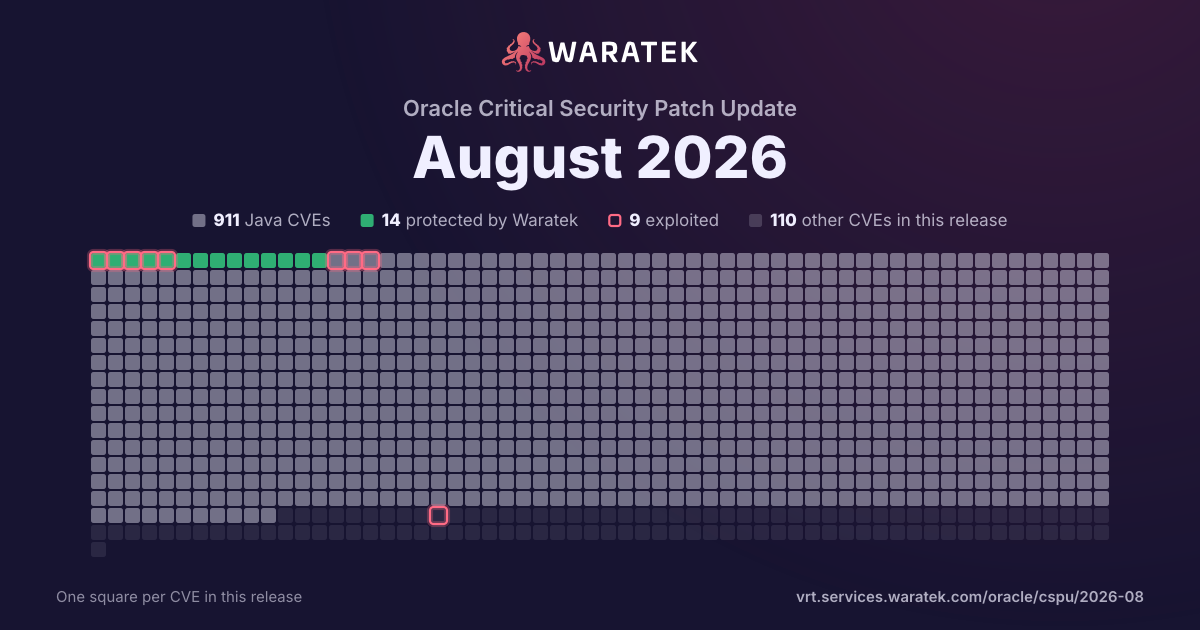
By status
14Protected by Waratek3Mitigation candidate894No exploit published9Outside Waratek scope101Not applicable
9Exploited, marked by the ring
No exploit published. For 848 of them, Oracle's security advisory is the source of public detail.
Protected by Waratek. Waratek RASP can block exploitation of these on systems that have not applied the patch yet.
Overview 35 matches · 0 in Waratek scope · 0 protected · 0 exploited · 0 CISA KEV · 2 public PoC · 0 EPSS ≥ 0.5
35matches
0in Waratek scope0.0%
0protected0.0%
0exploited0.0%
0CISA KEV0.0%
2public PoC5.7%
0EPSS ≥ 0.50.0%
Protected by Waratek
0
0.0%
Rule in development
0
0.0%
Mitigation candidate
0
0.0%
No exploit published
0
0.0%
Outside Waratek scope
0
0.0%
Not applicable
35
100.0%
Withdrawn CVE
0
0.0%
blocked by ARMR today
0
0.0%
partly blocked
0
0.0%
not blocked
35
100.0%
not established
0
0.0%
unrecorded
0
0.0%
Exploited
0
0.0%
Working exploit published
0
0.0%
Proof of concept only
3
8.6%
Forecast only
0
0.0%
No public exploit
32
91.4%
split by
peak 18 / month
Jan 261
Not applicable1
High1
not blocked1
No public exploit1
Feb 260
Mar 261
Not applicable1
High1
not blocked1
No public exploit1
Apr 261
Not applicable1
High1
not blocked1
No public exploit1
May 260
Jun 2613
Not applicable13
High13
not blocked13
Proof of concept only2
No public exploit11
Jul 261
Not applicable1
High1
not blocked1
Proof of concept only1
Aug 2618
Not applicable18
High18
not blocked18
No public exploit18
Jan 26Feb 26Mar 26Apr 26May 26Jun 26Jul 26Aug 26
| CVE | Severity | Published▾ | Status | Exploitation | Description |
|---|---|---|---|---|---|
| CVE-2026-71141 | High | 2026-08-18 | Not applicable | No public exploit | Vulnerability in the Oracle VM VirtualBox product of Oracle Virtualization (component: Core). The supported version that is affected is 7.2.14. Easily exploitable vulnerability allows unauthenticated attacker with logon to the infrastructure where Oracle VM VirtualBox executes to compromise Oracle VM VirtualBox. Successful attacks require human interaction from a person other than the attacker and while the vulnerability is in Oracle VM VirtualBox, attacks may significantly impact additional products (scope change). Successful attacks of this vulnerability can result in unauthorized creation, deletion or modification access to critical data or all Oracle VM VirtualBox accessible data as well as unauthorized read access to a subset of Oracle VM VirtualBox accessible data and unauthorized ability to cause a partial denial of service (partial DOS) of Oracle VM VirtualBox. CVSS 3.1 Base Score 7.7 (Confidentiality, Integrity and Availability impacts). CVSS Vector: (CVSS:3.1/AV:L/AC:L/PR:N/UI:R/S:C/C:L/I:H/A:L). |
| CVE-2026-71138 | High | 2026-08-18 | Not applicable | No public exploit | Vulnerability in the Oracle VM VirtualBox product of Oracle Virtualization (component: Core). The supported version that is affected is 7.2.14. Easily exploitable vulnerability allows high privileged attacker with logon to the infrastructure where Oracle VM VirtualBox executes to compromise Oracle VM VirtualBox. While the vulnerability is in Oracle VM VirtualBox, attacks may significantly impact additional products (scope change). Successful attacks of this vulnerability can result in unauthorized ability to cause a hang or frequently repeatable crash (complete DOS) of Oracle VM VirtualBox as well as unauthorized update, insert or delete access to some of Oracle VM VirtualBox accessible data and unauthorized read access to a subset of Oracle VM VirtualBox accessible data. CVSS 3.1 Base Score 7.3 (Confidentiality, Integrity and Availability impacts). CVSS Vector: (CVSS:3.1/AV:L/AC:L/PR:H/UI:N/S:C/C:L/I:L/A:H). |
| CVE-2026-71136 | High | 2026-08-18 | Not applicable | No public exploit | Vulnerability in the Oracle VM VirtualBox product of Oracle Virtualization (component: Core). The supported version that is affected is 7.2.14. Easily exploitable vulnerability allows high privileged attacker with logon to the infrastructure where Oracle VM VirtualBox executes to compromise Oracle VM VirtualBox. While the vulnerability is in Oracle VM VirtualBox, attacks may significantly impact additional products (scope change). Successful attacks of this vulnerability can result in unauthorized ability to cause a hang or frequently repeatable crash (complete DOS) of Oracle VM VirtualBox as well as unauthorized update, insert or delete access to some of Oracle VM VirtualBox accessible data and unauthorized read access to a subset of Oracle VM VirtualBox accessible data. CVSS 3.1 Base Score 7.3 (Confidentiality, Integrity and Availability impacts). CVSS Vector: (CVSS:3.1/AV:L/AC:L/PR:H/UI:N/S:C/C:L/I:L/A:H). |
| CVE-2026-71131 | High | 2026-08-18 | Not applicable | No public exploit | Vulnerability in the Oracle VM VirtualBox product of Oracle Virtualization (component: Core). The supported version that is affected is 7.2.14. Easily exploitable vulnerability allows unauthenticated attacker with logon to the infrastructure where Oracle VM VirtualBox executes to compromise Oracle VM VirtualBox. Successful attacks require human interaction from a person other than the attacker and while the vulnerability is in Oracle VM VirtualBox, attacks may significantly impact additional products (scope change). Successful attacks of this vulnerability can result in takeover of Oracle VM VirtualBox. CVSS 3.1 Base Score 8.6 (Confidentiality, Integrity and Availability impacts). CVSS Vector: (CVSS:3.1/AV:L/AC:L/PR:N/UI:R/S:C/C:H/I:H/A:H). |
| CVE-2026-71130 | High | 2026-08-18 | Not applicable | No public exploit | Vulnerability in the Oracle VM VirtualBox product of Oracle Virtualization (component: Core). The supported version that is affected is 7.2.14. Easily exploitable vulnerability allows unauthenticated attacker with network access via RDP to compromise Oracle VM VirtualBox. Successful attacks of this vulnerability can result in unauthorized access to critical data or complete access to all Oracle VM VirtualBox accessible data as well as unauthorized update, insert or delete access to some of Oracle VM VirtualBox accessible data. CVSS 3.1 Base Score 8.2 (Confidentiality and Integrity impacts). CVSS Vector: (CVSS:3.1/AV:N/AC:L/PR:N/UI:N/S:U/C:H/I:L/A:N). |
| CVE-2026-71129 | High | 2026-08-18 | Not applicable | No public exploit | Vulnerability in the Oracle VM VirtualBox product of Oracle Virtualization (component: Core). The supported version that is affected is 7.2.14. Easily exploitable vulnerability allows high privileged attacker with logon to the infrastructure where Oracle VM VirtualBox executes to compromise Oracle VM VirtualBox. While the vulnerability is in Oracle VM VirtualBox, attacks may significantly impact additional products (scope change). Successful attacks of this vulnerability can result in takeover of Oracle VM VirtualBox. CVSS 3.1 Base Score 8.2 (Confidentiality, Integrity and Availability impacts). CVSS Vector: (CVSS:3.1/AV:L/AC:L/PR:H/UI:N/S:C/C:H/I:H/A:H). |
| CVE-2026-71126 | High | 2026-08-18 | Not applicable | No public exploit | Vulnerability in the Oracle VM VirtualBox product of Oracle Virtualization (component: Core). The supported version that is affected is 7.2.14. Difficult to exploit vulnerability allows low privileged attacker with logon to the infrastructure where Oracle VM VirtualBox executes to compromise Oracle VM VirtualBox. While the vulnerability is in Oracle VM VirtualBox, attacks may significantly impact additional products (scope change). Successful attacks of this vulnerability can result in takeover of Oracle VM VirtualBox. CVSS 3.1 Base Score 7.8 (Confidentiality, Integrity and Availability impacts). CVSS Vector: (CVSS:3.1/AV:L/AC:H/PR:L/UI:N/S:C/C:H/I:H/A:H). |
| CVE-2026-71116 | High | 2026-08-18 | Not applicable | No public exploit | Vulnerability in the Oracle VM VirtualBox product of Oracle Virtualization (component: Core). The supported version that is affected is 7.2.14. Difficult to exploit vulnerability allows high privileged attacker with logon to the infrastructure where Oracle VM VirtualBox executes to compromise Oracle VM VirtualBox. While the vulnerability is in Oracle VM VirtualBox, attacks may significantly impact additional products (scope change). Successful attacks of this vulnerability can result in takeover of Oracle VM VirtualBox. CVSS 3.1 Base Score 7.5 (Confidentiality, Integrity and Availability impacts). CVSS Vector: (CVSS:3.1/AV:L/AC:H/PR:H/UI:N/S:C/C:H/I:H/A:H). |
| CVE-2026-71113 | High | 2026-08-18 | Not applicable | No public exploit | Vulnerability in the Oracle VM VirtualBox product of Oracle Virtualization (component: Core). The supported version that is affected is 7.2.14. Easily exploitable vulnerability allows unauthenticated attacker with network access via RDP to compromise Oracle VM VirtualBox. Successful attacks of this vulnerability can result in unauthorized ability to cause a hang or frequently repeatable crash (complete DOS) of Oracle VM VirtualBox. CVSS 3.1 Base Score 7.5 (Availability impacts). CVSS Vector: (CVSS:3.1/AV:N/AC:L/PR:N/UI:N/S:U/C:N/I:N/A:H). |
| CVE-2026-71062 | High | 2026-08-18 | Not applicable | No public exploit | Vulnerability in the RDBMS component of Oracle Database Server. Supported versions that are affected are 23.4.0-23.26.3. Difficult to exploit vulnerability allows low privileged attacker having Authenticated User privilege with network access via Oracle Net to compromise RDBMS. While the vulnerability is in RDBMS, attacks may significantly impact additional products (scope change). Successful attacks of this vulnerability can result in takeover of RDBMS. CVSS 3.1 Base Score 8.5 (Confidentiality, Integrity and Availability impacts). CVSS Vector: (CVSS:3.1/AV:N/AC:H/PR:L/UI:N/S:C/C:H/I:H/A:H). |
| CVE-2026-70724 | High | 2026-08-18 | Not applicable | No public exploit | Vulnerability in the MySQL Cluster product of Oracle MySQL (component: Cluster: General). Supported versions that are affected are 8.0.0-8.0.48, 8.4.0-8.4.11 and 9.7.0-9.7.2. Difficult to exploit vulnerability allows unauthenticated attacker with network access via HTTP to compromise MySQL Cluster. Successful attacks require human interaction from a person other than the attacker. Successful attacks of this vulnerability can result in takeover of MySQL Cluster. CVSS 3.1 Base Score 7.5 (Confidentiality, Integrity and Availability impacts). CVSS Vector: (CVSS:3.1/AV:N/AC:H/PR:N/UI:R/S:U/C:H/I:H/A:H). |
| CVE-2026-60592 | High | 2026-08-18 | Not applicable | No public exploit | Vulnerability in the MySQL Cluster product of Oracle MySQL (component: Cluster: NDB Operator). Supported versions that are affected are 8.0.0-8.0.47, 8.4.0-8.4.10 and 9.7.0-9.7.1. Easily exploitable vulnerability allows unauthenticated attacker with network access via multiple protocols to compromise MySQL Cluster. Successful attacks of this vulnerability can result in unauthorized ability to cause a hang or frequently repeatable crash (complete DOS) of MySQL Cluster as well as unauthorized update, insert or delete access to some of MySQL Cluster accessible data. CVSS 3.1 Base Score 8.2 (Integrity and Availability impacts). CVSS Vector: (CVSS:3.1/AV:N/AC:L/PR:N/UI:N/S:U/C:N/I:L/A:H). |
| CVE-2026-60590 | High | 2026-08-18 | Not applicable | No public exploit | Vulnerability in the Oracle Hospitality Simphony product of Oracle Food and Beverage Applications (component: POS). Supported versions that are affected are 19.8-19.8.5, 19.9-19.9.3 and 19.10-19.10.1. Easily exploitable vulnerability allows unauthenticated attacker with network access via HTTP to compromise Oracle Hospitality Simphony. Successful attacks of this vulnerability can result in unauthorized access to critical data or complete access to all Oracle Hospitality Simphony accessible data. CVSS 3.1 Base Score 7.5 (Confidentiality impacts). CVSS Vector: (CVSS:3.1/AV:N/AC:L/PR:N/UI:N/S:U/C:H/I:N/A:N). |
| CVE-2026-60414 | High | 2026-08-18 | Not applicable | No public exploit | Vulnerability in the Oracle Outside In Technology product of Oracle Fusion Middleware (component: Outside In Core). The supported version that is affected is 8.5.8. Easily exploitable vulnerability allows unauthenticated attacker with logon to the infrastructure where Oracle Outside In Technology executes to compromise Oracle Outside In Technology. Successful attacks require human interaction from a person other than the attacker. Successful attacks of this vulnerability can result in takeover of Oracle Outside In Technology. CVSS 3.1 Base Score 7.8 (Confidentiality, Integrity and Availability impacts). CVSS Vector: (CVSS:3.1/AV:L/AC:L/PR:N/UI:R/S:U/C:H/I:H/A:H). |
| CVE-2026-60413 | High | 2026-08-18 | Not applicable | No public exploit | Vulnerability in the Oracle Outside In Technology product of Oracle Fusion Middleware (component: Outside In Core). The supported version that is affected is 8.5.8. Easily exploitable vulnerability allows unauthenticated attacker with logon to the infrastructure where Oracle Outside In Technology executes to compromise Oracle Outside In Technology. Successful attacks require human interaction from a person other than the attacker. Successful attacks of this vulnerability can result in takeover of Oracle Outside In Technology. CVSS 3.1 Base Score 7.8 (Confidentiality, Integrity and Availability impacts). CVSS Vector: (CVSS:3.1/AV:L/AC:L/PR:N/UI:R/S:U/C:H/I:H/A:H). |
| CVE-2026-60412 | High | 2026-08-18 | Not applicable | No public exploit | Vulnerability in the Oracle Outside In Technology product of Oracle Fusion Middleware (component: Outside In Core). The supported version that is affected is 8.5.8. Easily exploitable vulnerability allows unauthenticated attacker with logon to the infrastructure where Oracle Outside In Technology executes to compromise Oracle Outside In Technology. Successful attacks require human interaction from a person other than the attacker. Successful attacks of this vulnerability can result in takeover of Oracle Outside In Technology. CVSS 3.1 Base Score 7.8 (Confidentiality, Integrity and Availability impacts). CVSS Vector: (CVSS:3.1/AV:L/AC:L/PR:N/UI:R/S:U/C:H/I:H/A:H). |
| CVE-2026-60392 | High | 2026-08-18 | Not applicable | No public exploit | Vulnerability in the Oracle Outside In Technology product of Oracle Fusion Middleware (component: Outside In PDF Export SDK). The supported version that is affected is 8.5.8. Easily exploitable vulnerability allows unauthenticated attacker with logon to the infrastructure where Oracle Outside In Technology executes to compromise Oracle Outside In Technology. Successful attacks require human interaction from a person other than the attacker. Successful attacks of this vulnerability can result in takeover of Oracle Outside In Technology. CVSS 3.1 Base Score 7.8 (Confidentiality, Integrity and Availability impacts). CVSS Vector: (CVSS:3.1/AV:L/AC:L/PR:N/UI:R/S:U/C:H/I:H/A:H). |
| CVE-2026-69247 | High | 2026-08-03 | Not applicable | No public exploit | cryptography is a package designed to expose cryptographic primitives and recipes to Python developers. From 44.0.0 until 50.0.0, pkcs7_decrypt_der, pkcs7_decrypt_pem, and pkcs7_decrypt_smime reported the outcome of decrypting a RecipientInfo's encryptedKey in several distinguishable ways, one of which disclosed the exact length recovered from the RSA operation. The same distinction was also observable by timing. An application that decrypts attacker-supplied EnvelopedData and reflects the outcome gives the attacker a Bleichenbacher oracle against the content-encryption key. Decryption ran as RSA PKCS#1 v1.5 decrypt of encryptedKey, build an AES cipher from the result, then AES-CBC decrypt and PKCS#7 unpad. Invalid RSA padding, a valid padding with a bad key length, a correct length with a wrong key, and the real key each failed or succeeded differently. Case 1 is reachable only where the linked library lacks implicit rejection: OpenSSL 3.0 and 3.1, LibreSSL, and BoringSSL. Exploitation requires a service that auto-decrypts untrusted EnvelopedData matching the victim certificate and answers adaptively at high volume, such as an S/MIME gateway or mail filter. This issue is fixed in 50.0.0. |
| CVE-2026-9563 | High | 2026-07-02 | Not applicable | Proof of concept only | In Eclipse Parsson published Maven Central artifacts before version 1.1.8, the JSON parser did not enforce a default maximum on the number of characters consumed while parsing a single JSON document. Applications that parse attacker- controlled JSON can be forced to consume excessive CPU and memory by processing very large documents, including large arrays, objects, strings, numbers, whitespace, or nested structures, resulting in a denial of service. Eclipse Parsson 1.1.8 introduces a configurable maximum parsing limit with a default limit of 15 million parser-consumed characters. |
| CVE-2026-9076 | High | 2026-06-09 | Not applicable | No public exploit | Issue summary: When CMS password-based decryption (RFC 3211 / PWRI key unwrap) processes attacker-supplied CMS data, an attacker-chosen stream-mode KEK cipher can trigger a heap out-of-bounds read in kek_unwrap_key(). Impact summary: A heap buffer over-read may trigger a crash which leads to Denial of Service for an application if the input buffer ends at a memory page boundary and the following page is unmapped. There is no information disclosure as the over-read bytes are not revealed to the attacker. The key unwrapping function performs a check-byte test as specified in the RFC that reads 7 bytes from a heap allocation that is based on the wrapped key length from the message. There is a minimum length check based on the block length of the wrapping cipher. However the cipher is selected from an OID carried in the attacker's PWRI keyEncryptionAlgorithm with no requirement that the cipher be a block cipher. When an attacker selects a stream-mode cipher the guard will be ineffective and the allocated buffer containing the unwrapped key can be too small to fit the check-bytes specified in the RFC and a buffer over-read can happen. Applications calling CMS_decrypt() or CMS_decrypt_set1_password() (equivalently openssl cms -decrypt -pwri_password ...) on untrusted CMS data are vulnerable to this issue. No password knowledge is required: the over-read happens during the unwrap attempt before any authentication succeeds. The over-read is limited to a few bytes and is not written to output, so there is no information disclosure. Triggering a crash requires the allocation to border unmapped memory, which is unlikely with the normal allocator. The FIPS modules are not affected by this issue. |
| CVE-2026-7383 | High | 2026-06-09 | Not applicable | No public exploit | Issue summary: A signed integer overflow when sizing the destination buffer for Unicode output in ASN1_mbstring_ncopy() can lead to a heap buffer overflow. Impact summary: A heap buffer overflow may lead to a crash or possibly attacker controlled code execution or other undefined behaviour. In ASN1_mbstring_copy() and ASN1_mbstring_ncopy() the destination size for Unicode output is computed in a signed int: by left shift of the input character count for BMPSTRING (UTF-16) and UNIVERSALSTRING (UTF-32), and by summing per-character byte counts for UTF8STRING. The calculation overflows when the input reaches around 2^30 characters. In the worst case (UNIVERSALSTRING at 2^30 characters) the size wraps to zero, OPENSSL_malloc(1) is called, and the subsequent character copy writes several gigabytes past the one-byte allocation. X.509 certificate processing routes through ASN1_STRING_set_by_NID(), whose DIRSTRING_TYPE mask excludes UNIVERSALSTRING and whose per-NID size limits cap the input length; no network protocol or certificate-handling path in OpenSSL exercises the overflow. Triggering the bug requires an application that calls ASN1_mbstring_copy() or ASN1_mbstring_ncopy() directly, or registers a custom string type via ASN1_STRING_TABLE_add(), with attacker-controlled input on the order of half a gigabyte or more. For these reasons this issue was assigned Low severity. The FIPS modules in 4.0, 3.6, 3.5, 3.4 and 3.0 are not affected by this issue, as the affected code is outside the OpenSSL FIPS module boundary. |
| CVE-2026-45447 | High | 2026-06-09 | Not applicable | No public exploit | Issue summary: A specially crafted PKCS#7 or S/MIME signed message could trigger a use-after-free during PKCS#7 signature verification. Impact summary: A use-after-free may result in process crashes, heap corruption, or potentially remote code execution. When processing a PKCS#7 or S/MIME signed message, if the SignedData digestAlgorithms field is present as an empty ASN.1 SET, OpenSSL may incorrectly free a caller-owned BIO during PKCS7_verify(). A subsequent use of the BIO by the calling application results in a use-after-free condition. In the common case this occurs when the application later calls BIO_free() on the BIO originally passed to PKCS7_verify(). Depending on allocator behavior and application-specific BIO usage patterns, this may result in a crash or other memory corruption. In some application contexts this may potentially be exploitable for remote code execution. Applications that process PKCS#7 or S/MIME signed messages using OpenSSL PKCS#7 APIs may be affected. Applications using the CMS APIs for this processing are not affected. The FIPS modules in 4.0, 3.6, 3.5, 3.4, and 3.0 are not affected by this issue, as the affected code is outside the OpenSSL FIPS module boundary. |
| CVE-2026-45445 | High | 2026-06-09 | Not applicable | No public exploit | Issue summary: When an application drives an AES-OCB context through the public EVP_Cipher() one-shot interface, the application-supplied initialisation vector (IV) is silently discarded. Impact summary: Every message encrypted under the same key uses the same effective nonce regardless of the IV supplied by the caller, resulting in (key, nonce) reuse and loss of confidentiality. If the same code path is used to compute the authentication tag, the tag depends only on the (key, IV) pair and not on the plaintext or ciphertext, allowing universal forgery of arbitrary ciphertext from a single captured message. OpenSSL provides two ways to drive a cipher: the documented streaming interface (EVP_CipherUpdate / EVP_CipherFinal_ex) and a lower-level one-shot, EVP_Cipher(), whose documentation explicitly recommends against use by applications in favour of EVP_CipherUpdate() and EVP_CipherFinal_ex(). The OCB provider's streaming handler flushes the application-supplied IV into the OCB context before processing data; the one-shot handler did not. Every call to EVP_Cipher() on an AES-OCB context therefore ran with the all-zero key-derived offset state left by cipher initialisation, regardless of the caller's IV. If EVP_EncryptFinal_ex() is subsequently used to obtain the authentication tag, the deferred IV setup runs at that point and clears the running checksum that should have been accumulated over the plaintext. The resulting tag is a function of (key, IV) only and verifies against any ciphertext produced under the same (key, IV) pair. The OpenSSL SSL/TLS implementation is not affected: AES-OCB is not a TLS cipher suite, and libssl does not call EVP_Cipher() in any case. Applications that drive AES-OCB through the documented streaming AEAD API (EVP_CipherUpdate / EVP_CipherFinal_ex) are not affected. Only applications that combine the AES-OCB cipher with the EVP_Cipher() one-shot API are vulnerable. The FIPS modules in 4.0, 3.6, 3.5, 3.4 and 3.0 are not affected by this issue, as AES-OCB is outside the OpenSSL FIPS module boundary. |
| CVE-2026-42764 | High | 2026-06-09 | Not applicable | No public exploit | Issue summary: Receiving a QUIC initial packet with an invalid token may trigger a NULL pointer dereference in the OpenSSL QUIC server with address validation disabled. Impact summary: NULL pointer dereference typically causes abnormal termination of the affected QUIC server process and a Denial of Service. If the address validation is disabled in the OpenSSL QUIC server implementation, an attacker can crash the server by sending an initial packet with an invalid or expired token. By default, the client address validation is enabled in the OpenSSL QUIC server implementation, which makes the default configuration not vulnerable to this issue. However if the SSL_LISTENER_FLAG_NO_VALIDATE is used with the SSL_new_listener() call, the address validation is disabled making the vulnerable code reachable. The FIPS modules in 4.0, 3.6, 3.5, 3.4, and 3.0 are not affected by this issue, as the affected code is outside the OpenSSL FIPS module boundary. |
| CVE-2026-34180 | High | 2026-06-09 | Not applicable | No public exploit | Issue summary: Parsing a crafted DER-encoded ASN.1 structure with a primitive element whose content exceeds 2 gigabytes in length may cause a heap buffer over-read on 64-bit Unix and Unix-like platforms. Impact summary: The heap buffer over-read may crash the application (Denial of Service) or to load into the decoded ASN.1 object contents of memory beyond the end of the input buffer. More typically such ASN.1 elements would instead be truncated. An integer truncation in OpenSSL's ASN.1 decoder causes the content length of an ASN.1 primitive element to be mishandled when it exceeds 2 gigabytes. In the worst case the truncated length is treated as a request to scan the binary content for a terminating zero byte, possibly causing OpenSSL to read either less than or beyond the end of the allocated buffer. Applications that pass attacker-supplied data to d2i_X509(), d2i_PKCS7(), or any other d2i_* decoding function are affected. OpenSSL's own command-line tools are not vulnerable, as data read through the BIO layer is checked before it reaches the affected code. The issue only affects 64-bit Unix and Unix-like platforms; 32-bit platforms and 64-bit Windows are not affected. The FIPS modules in 4.0, 3.6, 3.5, 3.4 and 3.0 are not affected by this issue, as the affected code is outside the OpenSSL FIPS module boundary. |
| CVE-2026-49975 | High | 2026-06-08 | Not applicable | Proof of concept only | Memory Allocation with Excessive Size Value vulnerability in Apache HTTP Server's mod_http leads to denial of service via malicious HTTP requests. This issue affects Apache HTTP Server: from 2.4.17 through 2.4.67. |
| CVE-2026-48913 | High | 2026-06-08 | Not applicable | No public exploit | Use After Free vulnerability in Apache HTTP Server module mod_http2 when file handles are already exhausted. This issue affects Apache HTTP Server: from 2.4.55 through 2.4.67. |
| CVE-2026-44186 | High | 2026-06-08 | Not applicable | No public exploit | Loop with Unreachable Exit Condition ('Infinite Loop') vulnerability in the mod_proxy_ftp module in Apache HTTP Server with an attacker controlled backend FTP server. This issue affects undefined: from 2.4.0 through 2.4.67. Users are recommended to upgrade to version 2.4.68, which fixes the issue. |
| CVE-2026-44185 | High | 2026-06-08 | Not applicable | No public exploit | Buffer Over-read vulnerability in Apache HTTP Server via outbound OCSP requests to an attacker controlled OCSP server This issue affects Apache HTTP Server: from 2.4.0 through 2.4.67. Users are recommended to upgrade to version 2.4.68, which fixes the issue. |
| CVE-2026-42536 | High | 2026-06-08 | Not applicable | Proof of concept only | Heap-based Buffer Overflow vulnerability in Apache HTTP Server with mod_xml2enc, xml2StartParse, and untrusted content This issue affects Apache HTTP Server: from 2.4.0 through 2.4.67. Users are recommended to upgrade to version 2.4.68, which fixes the issue. |
| CVE-2026-34356 | High | 2026-06-08 | Not applicable | No public exploit | Heap-based Buffer Overflow vulnerability in Apache HTTP Server with malicious backend servers and ProxyPassReverseCookie* This issue affects Apache HTTP Server: from 2.4.0 through 2.4.67. Users are recommended to upgrade to version 2.4.68, which fixes the issue. |
| CVE-2026-34355 | High | 2026-06-08 | Not applicable | No public exploit | A buffer overflow in mod_proxy_html in Apache HTTP Server 2.4.67 and earlier allows an attack by an untrusted backend. Users are recommended to upgrade to version 2.4.68, which fixes this issue. |
| CVE-2025-14821 | High | 2026-04-07 | Not applicable | No public exploit | A flaw was found in libssh. This vulnerability allows local man-in-the-middle attacks, security downgrades of SSH (Secure Shell) connections, and manipulation of trusted host information, posing a significant risk to the confidentiality, integrity, and availability of SSH communications via an insecure default configuration on Windows systems where the library automatically loads configuration files from the C:\etc directory, which can be created and modified by unprivileged local users. |
| CVE-2026-0966 | High | 2026-03-26 | Not applicable | No public exploit | A flaw was found in libssh. The API function `ssh_get_hexa()` is vulnerable to a denial of service when processing zero-length input. This can be exploited remotely by an attacker during GSSAPI (Generic Security Service Application Program Interface) authentication if the server's logging verbosity is set to `SSH_LOG_PACKET (3)` or higher. Successful exploitation could lead to a self-Denial of Service of the per-connection daemon process. |
| CVE-2025-13151 | High | 2026-01-07 | Not applicable | No public exploit | Stack-based buffer overflow in libtasn1 version: v4.20.0. The function fails to validate the size of input data resulting in a buffer overflow in asn1_expend_octet_string. |