
Oracle Critical Security Patch Update August 2026
Released August 2026 · Oracle's advisory ↗ · ← Critical Patch Update, July 2026 · Security Patch Update, September 2026 →
1,021 CVEs in this release, one square each
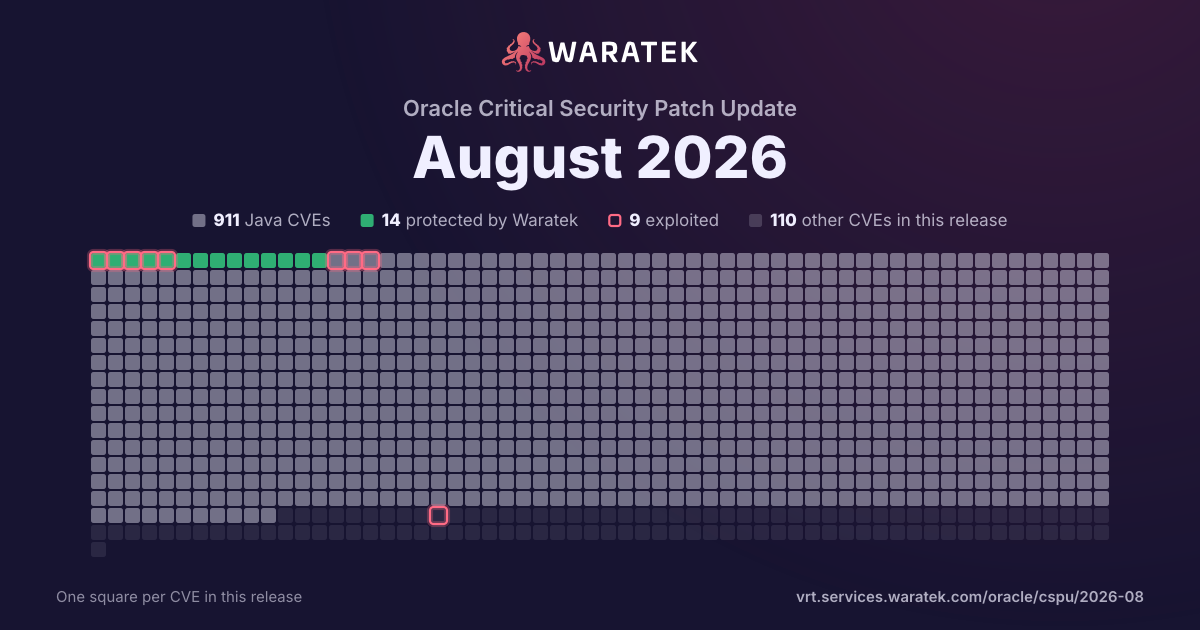
By status
14Protected by Waratek3Mitigation candidate894No exploit published9Outside Waratek scope101Not applicable
9Exploited, marked by the ring
No exploit published. For 848 of them, Oracle's security advisory is the source of public detail.
Protected by Waratek. Waratek RASP can block exploitation of these on systems that have not applied the patch yet.
Overview 17 matches · 0 in Waratek scope · 0 protected · 1 exploited · 0 CISA KEV · 0 public PoC · 0 EPSS ≥ 0.5
17matches
0in Waratek scope0.0%
0protected0.0%
1exploited5.9%
0CISA KEV0.0%
0public PoC0.0%
0EPSS ≥ 0.50.0%
Protected by Waratek
0
0.0%
Rule in development
0
0.0%
Mitigation candidate
0
0.0%
No exploit published
0
0.0%
Outside Waratek scope
0
0.0%
Not applicable
17
100.0%
Withdrawn CVE
0
0.0%
blocked by ARMR today
0
0.0%
partly blocked
0
0.0%
not blocked
17
100.0%
not established
0
0.0%
unrecorded
0
0.0%
Exploited
1
5.9%
Working exploit published
0
0.0%
Proof of concept only
1
5.9%
Forecast only
0
0.0%
No public exploit
15
88.2%
split by
peak 7 / quarter
Q3 241
Not applicable1
Critical1
not blocked1
Exploited1
Q4 241
Not applicable1
Critical1
not blocked1
No public exploit1
Q1 250
Q2 250
Q3 250
Q4 250
Q1 264
Not applicable4
Critical4
not blocked4
No public exploit4
Q2 264
Not applicable4
Critical4
not blocked4
No public exploit4
Q3 267
Not applicable7
Critical7
not blocked7
Proof of concept only1
No public exploit6
Q3 24Q4 24Q1 25Q2 25Q3 25Q4 25Q1 26Q2 26Q3 26
| CVE | Severity | Published▾ | Status | Exploitation | Description |
|---|---|---|---|---|---|
| CVE-2026-71102 | Critical | 2026-08-18 | Not applicable | No public exploit | Vulnerability in the Portable Clusterware component of Oracle Database Server. Supported versions that are affected are 19.3-19.32, 21.3-21.23 and 23.4.0-23.26.3. Easily exploitable vulnerability allows unauthenticated attacker with network access via HTTP to compromise Portable Clusterware. Successful attacks of this vulnerability can result in unauthorized creation, deletion or modification access to critical data or all Portable Clusterware accessible data and unauthorized ability to cause a hang or frequently repeatable crash (complete DOS) of Portable Clusterware. CVSS 3.1 Base Score 9.1 (Integrity and Availability impacts). CVSS Vector: (CVSS:3.1/AV:N/AC:L/PR:N/UI:N/S:U/C:N/I:H/A:H). |
| CVE-2026-71064 | Critical | 2026-08-18 | Not applicable | No public exploit | Vulnerability in the Portable Clusterware component of Oracle Database Server. Supported versions that are affected are 19.3-19.32, 21.3-21.23 and 23.4.0-23.26.3. Easily exploitable vulnerability allows unauthenticated attacker with access to the physical communication segment attached to the hardware where the Portable Clusterware executes to compromise Portable Clusterware. While the vulnerability is in Portable Clusterware, attacks may significantly impact additional products (scope change). Successful attacks of this vulnerability can result in takeover of Portable Clusterware. CVSS 3.1 Base Score 9.6 (Confidentiality, Integrity and Availability impacts). CVSS Vector: (CVSS:3.1/AV:A/AC:L/PR:N/UI:N/S:C/C:H/I:H/A:H). |
| CVE-2026-71063 | Critical | 2026-08-18 | Not applicable | No public exploit | Vulnerability in the Portable Clusterware component of Oracle Database Server. Supported versions that are affected are 19.3-19.32, 21.3-21.23 and 23.4.0-23.26.3. Easily exploitable vulnerability allows unauthenticated attacker with access to the physical communication segment attached to the hardware where the Portable Clusterware executes to compromise Portable Clusterware. While the vulnerability is in Portable Clusterware, attacks may significantly impact additional products (scope change). Successful attacks of this vulnerability can result in takeover of Portable Clusterware. CVSS 3.1 Base Score 9.6 (Confidentiality, Integrity and Availability impacts). CVSS Vector: (CVSS:3.1/AV:A/AC:L/PR:N/UI:N/S:C/C:H/I:H/A:H). |
| CVE-2026-61258 | Critical | 2026-08-18 | Not applicable | No public exploit | Vulnerability in the Oracle Internet Directory product of Oracle Fusion Middleware (component: OID LDAP Server). Supported versions that are affected are 12.2.1.4.0 and 14.1.2.1.0. Easily exploitable vulnerability allows unauthenticated attacker with network access via LDAP to compromise Oracle Internet Directory. Successful attacks of this vulnerability can result in takeover of Oracle Internet Directory. CVSS 3.1 Base Score 9.8 (Confidentiality, Integrity and Availability impacts). CVSS Vector: (CVSS:3.1/AV:N/AC:L/PR:N/UI:N/S:U/C:H/I:H/A:H). |
| CVE-2026-61248 | Critical | 2026-08-18 | Not applicable | No public exploit | Vulnerability in the Oracle Internet Directory product of Oracle Fusion Middleware (component: OID LDAP Server). Supported versions that are affected are 12.2.1.4.0 and 14.1.2.1.0. Easily exploitable vulnerability allows low privileged attacker with network access via LDAP to compromise Oracle Internet Directory. While the vulnerability is in Oracle Internet Directory, attacks may significantly impact additional products (scope change). Successful attacks of this vulnerability can result in takeover of Oracle Internet Directory. CVSS 3.1 Base Score 9.9 (Confidentiality, Integrity and Availability impacts). CVSS Vector: (CVSS:3.1/AV:N/AC:L/PR:L/UI:N/S:C/C:H/I:H/A:H). |
| CVE-2026-61241 | Critical | 2026-08-18 | Not applicable | No public exploit | Vulnerability in the Oracle Internet Directory product of Oracle Fusion Middleware (component: OID LDAP Server). Supported versions that are affected are 12.2.1.4.0 and 14.1.2.1.0. Easily exploitable vulnerability allows unauthenticated attacker with network access via LDAP to compromise Oracle Internet Directory. While the vulnerability is in Oracle Internet Directory, attacks may significantly impact additional products (scope change). Successful attacks of this vulnerability can result in takeover of Oracle Internet Directory. CVSS 3.1 Base Score 10.0 (Confidentiality, Integrity and Availability impacts). CVSS Vector: (CVSS:3.1/AV:N/AC:L/PR:N/UI:N/S:C/C:H/I:H/A:H). |
| CVE-2026-60591 | Critical | 2026-08-18 | Not applicable | Proof of concept only | Vulnerability in the Oracle Hospitality Simphony product of Oracle Food and Beverage Applications (component: POS). Supported versions that are affected are 19.8-19.8.5, 19.9-19.9.3 and 19.10-19.10.1. Easily exploitable vulnerability allows unauthenticated attacker with network access via HTTP to compromise Oracle Hospitality Simphony. Successful attacks of this vulnerability can result in unauthorized creation, deletion or modification access to critical data or all Oracle Hospitality Simphony accessible data and unauthorized ability to cause a hang or frequently repeatable crash (complete DOS) of Oracle Hospitality Simphony. CVSS 3.1 Base Score 9.1 (Integrity and Availability impacts). CVSS Vector: (CVSS:3.1/AV:N/AC:L/PR:N/UI:N/S:U/C:N/I:H/A:H). |
| CVE-2026-34182 | Critical | 2026-06-09 | Not applicable | No public exploit | Issue Summary: Cryptographic Message Services (CMS) processing fails to perform sufficient input validation on the cipher and tag length fields of AuthEnvelopedData containers, leading to various potential compromises. Impact Summary: Attackers making use of these vulnerabilities may achieve key-equivalent functionality for a given CMS recipient and/or bypass integrity validation for a given message. In one use case, an attacker may send a CMS message containing AuthEnvelopedData with the cipher specified as a non-AEAD cipher. OpenSSL erroneously allows this selection, and attempts to decrypt and validate the message. An on-path attacker who captures one legitimate AES-GCM AuthEnvelopedData addressed to the victim can re-emit it with the recipientInfos set left byte-for-byte intact, so the victim's private key still unwraps the genuine CEK (the content-encryption key), but with the inner OID rewritten to AES-256-OFB (Output Feedback Mode, an unauthenticated keystream mode) and with an attacker-chosen IV and ciphertext. The victim initializes AES-256-OFB under the real CEK, never consults the MAC field, and CMS_decrypt() returns success. If the application under attack responds to the attacker with any indicator showing success or failure of the decryption effort, it is possible for the attacker to use this as an oracle to obtain key equivalent functionality for the CEK used for the chosen recipient of the message. In another use case, an attacker can reduce the tag length of the chosen AEAD cipher for a given AuthEnvelopedData container to be a single byte long, allowing an attacker to brute force CMS decryption, producing an integrity bypass for applications that trust CMS_decrypt() to reject modified content. The FIPS modules are not affected by this issue. |
| CVE-2026-44631 | Critical | 2026-06-08 | Not applicable | No public exploit | Buffer Underwrite vulnerability in Apache HTTP Server on crafted regular expressions in the configuration. This issue affects Apache HTTP Server: from 2.4.0 through 2.4.67. Users are recommended to upgrade to version 2.4.68, which fixes the issue. |
| CVE-2026-42535 | Critical | 2026-06-08 | Not applicable | No public exploit | A path handling issue in mod_dav_fs in Apache 2.4.67 and earlier allows a WebDAV content author to directly manipulate trusted DAV property databases, potentially causing child process crashes. Users are recommended to upgrade to version 2.4.68, which fixes this issue. |
| CVE-2026-29167 | Critical | 2026-06-08 | Not applicable | No public exploit | Use After Free vulnerability in Apache HTTP Server with mod_ldap in per-directory configuration This issue affects Apache HTTP Server: from 2.4.0 through 2.4.67. Users are recommended to upgrade to version 2.4.68, which fixes the issue. |
| CVE-2026-4800 | Critical | 2026-03-31 | Not applicable | No public exploit | The fix for CVE-2021-23337 added validation for the variable option in _.template but did not apply the same validation to options.imports key names, and both paths flow into the same Function() constructor sink. When an application passes untrusted input as options.imports key names, an attacker can inject default-parameter expressions that execute arbitrary code at template compilation time. Additionally, _.template uses assignInWith to merge imports, which enumerates inherited properties via for..in, so if Object.prototype has been polluted by another vector the polluted keys are copied into the imports object and passed to Function(). The issue is fixed in 4.18.1 for lodash, lodash-es, lodash-amd, and lodash.template. As a workaround, do not pass untrusted input as key names in options.imports; use only developer-controlled, static key names. |
| CVE-2026-4176 | Critical | 2026-03-29 | Not applicable | No public exploit | Perl versions from 5.9.4 before 5.40.4-RC1, from 5.41.0 before 5.42.2-RC1, from 5.43.0 before 5.43.9 contain a vulnerable version of Compress::Raw::Zlib. Compress::Raw::Zlib is included in the Perl package as a dual-life core module, and is vulnerable to CVE-2026-3381 due to a vendored version of zlib which has several vulnerabilities, including CVE-2026-27171. The bundled Compress::Raw::Zlib was updated to version 2.221 in Perl blead commit c75ae9cc164205e1b6d6dbd57bd2c65c8593fe94. |
| CVE-2026-33186 | Critical | 2026-03-20 | Not applicable | No public exploit | gRPC-Go is the Go language implementation of gRPC. Versions prior to 1.79.3 have an authorization bypass resulting from improper input validation of the HTTP/2 `:path` pseudo-header. The gRPC-Go server was too lenient in its routing logic, accepting requests where the `:path` omitted the mandatory leading slash (e.g., `Service/Method` instead of `/Service/Method`). While the server successfully routed these requests to the correct handler, authorization interceptors (including the official `grpc/authz` package) evaluated the raw, non-canonical path string. Consequently, "deny" rules defined using canonical paths (starting with `/`) failed to match the incoming request, allowing it to bypass the policy if a fallback "allow" rule was present. This affects gRPC-Go servers that use path-based authorization interceptors, such as the official RBAC implementation in `google.golang.org/grpc/authz` or custom interceptors relying on `info.FullMethod` or `grpc.Method(ctx)`; AND that have a security policy contains specific "deny" rules for canonical paths but allows other requests by default (a fallback "allow" rule). The vulnerability is exploitable by an attacker who can send raw HTTP/2 frames with malformed `:path` headers directly to the gRPC server. The fix in version 1.79.3 ensures that any request with a `:path` that does not start with a leading slash is immediately rejected with a `codes.Unimplemented` error, preventing it from reaching authorization interceptors or handlers with a non-canonical path string. While upgrading is the most secure and recommended path, users can mitigate the vulnerability using one of the following methods: Use a validating interceptor (recommended mitigation); infrastructure-level normalization; and/or policy hardening. |
| CVE-2026-3381 | Critical | 2026-03-05 | Not applicable | No public exploit | Compress::Raw::Zlib versions through 2.219 for Perl use potentially insecure versions of zlib. Compress::Raw::Zlib includes a copy of the zlib library. Compress::Raw::Zlib version 2.220 includes zlib 1.3.2, which addresses findings fron the 7ASecurity audit of zlib. The includes fixs for CVE-2026-27171. |
| CVE-2024-10095 | Critical | 2024-12-16 | Not applicable | No public exploit | In Progress Telerik UI for WPF versions prior to 2024 Q4 (2024.4.1213), a code execution attack is possible through an insecure deserialization vulnerability. |
| CVE-2024-7575 | Critical | 2024-09-25 | Not applicable | Exploited | In Progress Telerik UI for WPF versions prior to 2024 Q3 (2024.3.924), a command injection attack is possible through improper neutralization of hyperlink elements. |