
Oracle Critical Security Patch Update August 2026
Released August 2026 · Oracle's advisory ↗ · ← Critical Patch Update, July 2026 · Security Patch Update, September 2026 →
1,021 CVEs in this release, one square each
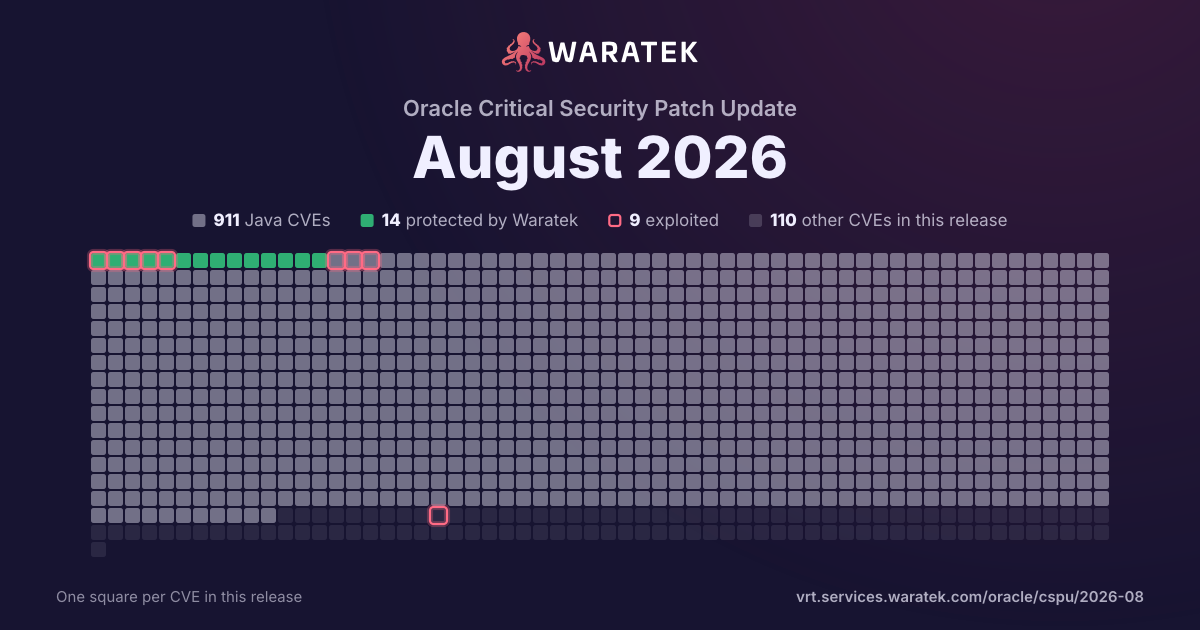
By status
14Protected by Waratek4Mitigation candidate893No exploit published2Outside Waratek scope108Not applicable
9Exploited, marked by the ring
No exploit published. For 847 of them, Oracle's security advisory is the source of public detail.
Protected by Waratek. Waratek RASP can block exploitation of these on systems that have not applied the patch yet.
Overview 54 matches · 0 in Waratek scope · 0 protected · 1 exploited · 0 CISA KEV · 2 public PoC · 0 EPSS ≥ 0.5
54matches
0in Waratek scope0.0%
0protected0.0%
1exploited1.9%
0CISA KEV0.0%
2public PoC3.7%
0EPSS ≥ 0.50.0%
Protected by Waratek
0
0.0%
Rule in development
0
0.0%
Mitigation candidate
0
0.0%
No exploit published
0
0.0%
Outside Waratek scope
0
0.0%
Not applicable
54
100.0%
Withdrawn CVE
0
0.0%
blocked by ARMR today
0
0.0%
partly blocked
0
0.0%
not blocked
54
100.0%
not established
0
0.0%
unrecorded
0
0.0%
Exploited
1
1.9%
Working exploit published
0
0.0%
Proof of concept only
6
11.1%
Forecast only
0
0.0%
No public exploit
47
87.0%
split by
peak 28 / quarter
Q3 221
Not applicable1
Critical1
not blocked1
Proof of concept only1
Q4 220
Q1 230
Q2 230
Q3 230
Q4 230
Q1 242
Not applicable2
Medium2
not blocked2
No public exploit2
Q2 243
Not applicable3
Critical1
Medium2
not blocked3
No public exploit3
Q3 242
Not applicable2
Critical1
High1
not blocked2
Exploited1
No public exploit1
Q4 243
Not applicable3
Critical2
High1
not blocked3
No public exploit3
Q1 251
Not applicable1
Medium1
not blocked1
No public exploit1
Q2 250
Q3 250
Q4 250
Q1 2614
Not applicable14
Critical4
High2
Medium6
Low2
not blocked14
Proof of concept only1
No public exploit13
Q2 2628
Not applicable28
Critical4
High14
Medium9
Low1
not blocked28
Proof of concept only4
No public exploit24
Q4 22Q2 23Q4 23Q2 24Q4 24Q2 25Q4 25Q2 26
| CVE | Severity | Published▾ | Status | Exploitation | Description |
|---|---|---|---|---|---|
| CVE-2026-9076 | High | 2026-06-09 | Not applicable | No public exploit | Issue summary: When CMS password-based decryption (RFC 3211 / PWRI key unwrap) processes attacker-supplied CMS data, an attacker-chosen stream-mode KEK cipher can trigger a heap out-of-bounds read in kek_unwrap_key(). Impact summary: A heap buffer over-read may trigger a crash which leads to Denial of Service for an application if the input buffer ends at a memory page boundary and the following page is unmapped. There is no information disclosure as the over-read bytes are not revealed to the attacker. The key unwrapping function performs a check-byte test as specified in the RFC that reads 7 bytes from a heap allocation that is based on the wrapped key length from the message. There is a minimum length check based on the block length of the wrapping cipher. However the cipher is selected from an OID carried in the attacker's PWRI keyEncryptionAlgorithm with no requirement that the cipher be a block cipher. When an attacker selects a stream-mode cipher the guard will be ineffective and the allocated buffer containing the unwrapped key can be too small to fit the check-bytes specified in the RFC and a buffer over-read can happen. Applications calling CMS_decrypt() or CMS_decrypt_set1_password() (equivalently openssl cms -decrypt -pwri_password ...) on untrusted CMS data are vulnerable to this issue. No password knowledge is required: the over-read happens during the unwrap attempt before any authentication succeeds. The over-read is limited to a few bytes and is not written to output, so there is no information disclosure. Triggering a crash requires the allocation to border unmapped memory, which is unlikely with the normal allocator. The FIPS modules are not affected by this issue. |
| CVE-2026-7383 | High | 2026-06-09 | Not applicable | No public exploit | Issue summary: A signed integer overflow when sizing the destination buffer for Unicode output in ASN1_mbstring_ncopy() can lead to a heap buffer overflow. Impact summary: A heap buffer overflow may lead to a crash or possibly attacker controlled code execution or other undefined behaviour. In ASN1_mbstring_copy() and ASN1_mbstring_ncopy() the destination size for Unicode output is computed in a signed int: by left shift of the input character count for BMPSTRING (UTF-16) and UNIVERSALSTRING (UTF-32), and by summing per-character byte counts for UTF8STRING. The calculation overflows when the input reaches around 2^30 characters. In the worst case (UNIVERSALSTRING at 2^30 characters) the size wraps to zero, OPENSSL_malloc(1) is called, and the subsequent character copy writes several gigabytes past the one-byte allocation. X.509 certificate processing routes through ASN1_STRING_set_by_NID(), whose DIRSTRING_TYPE mask excludes UNIVERSALSTRING and whose per-NID size limits cap the input length; no network protocol or certificate-handling path in OpenSSL exercises the overflow. Triggering the bug requires an application that calls ASN1_mbstring_copy() or ASN1_mbstring_ncopy() directly, or registers a custom string type via ASN1_STRING_TABLE_add(), with attacker-controlled input on the order of half a gigabyte or more. For these reasons this issue was assigned Low severity. The FIPS modules in 4.0, 3.6, 3.5, 3.4 and 3.0 are not affected by this issue, as the affected code is outside the OpenSSL FIPS module boundary. |
| CVE-2026-45447 | High | 2026-06-09 | Not applicable | No public exploit | Issue summary: A specially crafted PKCS#7 or S/MIME signed message could trigger a use-after-free during PKCS#7 signature verification. Impact summary: A use-after-free may result in process crashes, heap corruption, or potentially remote code execution. When processing a PKCS#7 or S/MIME signed message, if the SignedData digestAlgorithms field is present as an empty ASN.1 SET, OpenSSL may incorrectly free a caller-owned BIO during PKCS7_verify(). A subsequent use of the BIO by the calling application results in a use-after-free condition. In the common case this occurs when the application later calls BIO_free() on the BIO originally passed to PKCS7_verify(). Depending on allocator behavior and application-specific BIO usage patterns, this may result in a crash or other memory corruption. In some application contexts this may potentially be exploitable for remote code execution. Applications that process PKCS#7 or S/MIME signed messages using OpenSSL PKCS#7 APIs may be affected. Applications using the CMS APIs for this processing are not affected. The FIPS modules in 4.0, 3.6, 3.5, 3.4, and 3.0 are not affected by this issue, as the affected code is outside the OpenSSL FIPS module boundary. |
| CVE-2026-45446 | Medium | 2026-06-09 | Not applicable | No public exploit | Issue summary: The implementations of AES-SIV (RFC 5297) and AES-GCM-SIV (RFC 8452) mishandle the authentication of AAD (Additional Authenticated Data) with an empty ciphertext allowing a forgery of such messages. Impact summary: An attacker can forge empty messages with arbitrary AAD to the victim's application using these ciphers. AES-SIV (RFC 5297) and AES-GCM-SIV (RFC 8452) are nonce-misuse-resistant AEAD modes: they accept a key, nonce, optional AAD (bytes that are authenticated but not encrypted), and plaintext, and produces ciphertext plus a 16-byte tag. On decrypt, `EVP_DecryptFinal_ex()` is documented to return success only if the tag is verified succesfully. In OpenSSL's provider implementation of these ciphers, the expected tag is computed only when decryption function is invoked with non-empty data. If the caller supplies AAD and then calls `EVP_DecryptFinal_ex()` without invocation of the ciphertext update, which can happen when the received ciphertext length is zero, the tag is never recalculated and still holds its all-zeros value. When AES-GCM-SIV is used, an attacker who sends arbitrary AAD, empty ciphertext, and all-zeros tag passes authentication under any key they do not know, single-shot. When AES-SIV is used, for mounting the attack it's necessary for the application to reuse the decryption context without resetting the key. AES-SIV is implemented since OpenSSL 3.0. AES-GCM-SIV is implemented since OpenSSL 3.2. No protocols implemented in OpenSSL itself (TLS/CMS/PKCS7/HPKE/QUIC) support either AES-GCM-SIV or AES-SIV. To mount an attack, the applications must implement their own protocol and use the EVP interface. Also they must skip the ciphertext update when a message with an empty ciphertext arrives. The FIPS modules in 4.0, 3.6, 3.5, 3.4, and 3.0 are not affected by this issue, as these algorithms are not FIPS approved and the affected code is outside the OpenSSL FIPS module boundary. |
| CVE-2026-45445 | High | 2026-06-09 | Not applicable | No public exploit | Issue summary: When an application drives an AES-OCB context through the public EVP_Cipher() one-shot interface, the application-supplied initialisation vector (IV) is silently discarded. Impact summary: Every message encrypted under the same key uses the same effective nonce regardless of the IV supplied by the caller, resulting in (key, nonce) reuse and loss of confidentiality. If the same code path is used to compute the authentication tag, the tag depends only on the (key, IV) pair and not on the plaintext or ciphertext, allowing universal forgery of arbitrary ciphertext from a single captured message. OpenSSL provides two ways to drive a cipher: the documented streaming interface (EVP_CipherUpdate / EVP_CipherFinal_ex) and a lower-level one-shot, EVP_Cipher(), whose documentation explicitly recommends against use by applications in favour of EVP_CipherUpdate() and EVP_CipherFinal_ex(). The OCB provider's streaming handler flushes the application-supplied IV into the OCB context before processing data; the one-shot handler did not. Every call to EVP_Cipher() on an AES-OCB context therefore ran with the all-zero key-derived offset state left by cipher initialisation, regardless of the caller's IV. If EVP_EncryptFinal_ex() is subsequently used to obtain the authentication tag, the deferred IV setup runs at that point and clears the running checksum that should have been accumulated over the plaintext. The resulting tag is a function of (key, IV) only and verifies against any ciphertext produced under the same (key, IV) pair. The OpenSSL SSL/TLS implementation is not affected: AES-OCB is not a TLS cipher suite, and libssl does not call EVP_Cipher() in any case. Applications that drive AES-OCB through the documented streaming AEAD API (EVP_CipherUpdate / EVP_CipherFinal_ex) are not affected. Only applications that combine the AES-OCB cipher with the EVP_Cipher() one-shot API are vulnerable. The FIPS modules in 4.0, 3.6, 3.5, 3.4 and 3.0 are not affected by this issue, as AES-OCB is outside the OpenSSL FIPS module boundary. |
| CVE-2026-42770 | Low | 2026-06-09 | Not applicable | No public exploit | Issue summary: When EVP_PKEY_derive_set_peer() is called with a DHX (X9.42) peer key, the peer key is not properly checked for the subgroup membership. Impact summary: A malicious peer which presents an X9.42 key carrying the victim's p and g parameters, a forged q = r (a small prime factor of the cofactor (p−1)/q_local), and a public value Y of order r can recover the victim's private key after a small number of key exchange attempts. When EVP_PKEY_derive_set_peer() is called with a DHX (X9.42) peer key, the subgroup membership check Y^q ≡ 1 (mod p) is performed using the peer's own q parameter, not the local key's q. The peer's domain parameters are then matched against the domain parameters of the private key, but the value of q is not compared. A malicious peer who presents an X9.42 key carrying the victim's p, g, a forged q = r (a small prime factor of the cofactor), and a public value Y of order r passes all checks. The shared secret then takes only r distinct values, leaking priv mod r. Repeating for each small-prime factor of the cofactor and combining via CRT recovers the full private key (Lim–Lee / small-subgroup-confinement attack). The realistic attack surface is narrow: principally CMP deployments with long-lived RA/CA DHX keys and bespoke enterprise or government applications using X9.42 DHX static keys with interactive protocols and therefore this issue was assigned Low severity. The FIPS modules in 4.0, 3.6, 3.5, 3.4, 3.1.2 and 3.0 are affected by this issue. |
| CVE-2026-42767 | Medium | 2026-06-09 | Not applicable | No public exploit | Issue summary: An attacker-controlled CMP (Certificate Management Protocol) server could trigger a NULL pointer dereference in a CMP client application. Impact summary: A NULL pointer dereference causes a crash of the application and a Denial of Service. An attacker controlling a CMP server (or acting as a man-in-the-middle) could craft a CMP response containing a CRMF (Certificate Request Message Format) CertRepMessage with an EncryptedValue structure where the symmAlg field has an algorithm OID but no parameters field. When the OpenSSL CMP client processes this response, the NULL dereference occurs, causing a crash of the CMP client. Applications that process untrusted CMP/CRMF messages may be affected. The FIPS modules in 4.0, 3.6, 3.5, 3.4, and 3.0 are not affected by this issue, as the affected code is outside the OpenSSL FIPS module boundary. |
| CVE-2026-42766 | Medium | 2026-06-09 | Not applicable | No public exploit | Issue summary: A specially crafted password-encrypted CMS message can trigger a NULL pointer dereference during CMS decryption. Impact summary: This NULL pointer dereference leads to an application crash and a Denial of Service. The CMS PasswordRecipientInfo.keyDerivationAlgorithm field is defined as OPTIONAL in the ASN.1 specification and may therefore be absent in specially crafted inputs. During the password-based CMS decryption the OpenSSL CMS implementation dereferences this field without first checking whether it was present. An attacker who supplies such a CMS message to an application performing password-based CMS decryption can trigger an application crash, leading to a Denial of Service. Applications that process password-encrypted CMS messages may be affected. The FIPS modules in 4.0, 3.6, 3.5, 3.4, and 3.0 are not affected by this issue, as the affected code is outside the OpenSSL FIPS module boundary. |
| CVE-2026-42764 | High | 2026-06-09 | Not applicable | No public exploit | Issue summary: Receiving a QUIC initial packet with an invalid token may trigger a NULL pointer dereference in the OpenSSL QUIC server with address validation disabled. Impact summary: NULL pointer dereference typically causes abnormal termination of the affected QUIC server process and a Denial of Service. If the address validation is disabled in the OpenSSL QUIC server implementation, an attacker can crash the server by sending an initial packet with an invalid or expired token. By default, the client address validation is enabled in the OpenSSL QUIC server implementation, which makes the default configuration not vulnerable to this issue. However if the SSL_LISTENER_FLAG_NO_VALIDATE is used with the SSL_new_listener() call, the address validation is disabled making the vulnerable code reachable. The FIPS modules in 4.0, 3.6, 3.5, 3.4, and 3.0 are not affected by this issue, as the affected code is outside the OpenSSL FIPS module boundary. |
| CVE-2026-34182 | Critical | 2026-06-09 | Not applicable | No public exploit | Issue Summary: Cryptographic Message Services (CMS) processing fails to perform sufficient input validation on the cipher and tag length fields of AuthEnvelopedData containers, leading to various potential compromises. Impact Summary: Attackers making use of these vulnerabilities may achieve key-equivalent functionality for a given CMS recipient and/or bypass integrity validation for a given message. In one use case, an attacker may send a CMS message containing AuthEnvelopedData with the cipher specified as a non-AEAD cipher. OpenSSL erroneously allows this selection, and attempts to decrypt and validate the message. An on-path attacker who captures one legitimate AES-GCM AuthEnvelopedData addressed to the victim can re-emit it with the recipientInfos set left byte-for-byte intact, so the victim's private key still unwraps the genuine CEK (the content-encryption key), but with the inner OID rewritten to AES-256-OFB (Output Feedback Mode, an unauthenticated keystream mode) and with an attacker-chosen IV and ciphertext. The victim initializes AES-256-OFB under the real CEK, never consults the MAC field, and CMS_decrypt() returns success. If the application under attack responds to the attacker with any indicator showing success or failure of the decryption effort, it is possible for the attacker to use this as an oracle to obtain key equivalent functionality for the CEK used for the chosen recipient of the message. In another use case, an attacker can reduce the tag length of the chosen AEAD cipher for a given AuthEnvelopedData container to be a single byte long, allowing an attacker to brute force CMS decryption, producing an integrity bypass for applications that trust CMS_decrypt() to reject modified content. The FIPS modules are not affected by this issue. |
| CVE-2026-34180 | High | 2026-06-09 | Not applicable | No public exploit | Issue summary: Parsing a crafted DER-encoded ASN.1 structure with a primitive element whose content exceeds 2 gigabytes in length may cause a heap buffer over-read on 64-bit Unix and Unix-like platforms. Impact summary: The heap buffer over-read may crash the application (Denial of Service) or to load into the decoded ASN.1 object contents of memory beyond the end of the input buffer. More typically such ASN.1 elements would instead be truncated. An integer truncation in OpenSSL's ASN.1 decoder causes the content length of an ASN.1 primitive element to be mishandled when it exceeds 2 gigabytes. In the worst case the truncated length is treated as a request to scan the binary content for a terminating zero byte, possibly causing OpenSSL to read either less than or beyond the end of the allocated buffer. Applications that pass attacker-supplied data to d2i_X509(), d2i_PKCS7(), or any other d2i_* decoding function are affected. OpenSSL's own command-line tools are not vulnerable, as data read through the BIO layer is checked before it reaches the affected code. The issue only affects 64-bit Unix and Unix-like platforms; 32-bit platforms and 64-bit Windows are not affected. The FIPS modules in 4.0, 3.6, 3.5, 3.4 and 3.0 are not affected by this issue, as the affected code is outside the OpenSSL FIPS module boundary. |
| CVE-2026-49975 | High | 2026-06-08 | Not applicable | Proof of concept only | Memory Allocation with Excessive Size Value vulnerability in Apache HTTP Server's mod_http leads to denial of service via malicious HTTP requests. This issue affects Apache HTTP Server: from 2.4.17 through 2.4.67. |
| CVE-2026-48913 | High | 2026-06-08 | Not applicable | No public exploit | Use After Free vulnerability in Apache HTTP Server module mod_http2 when file handles are already exhausted. This issue affects Apache HTTP Server: from 2.4.55 through 2.4.67. |
| CVE-2026-44631 | Critical | 2026-06-08 | Not applicable | No public exploit | Buffer Underwrite vulnerability in Apache HTTP Server on crafted regular expressions in the configuration. This issue affects Apache HTTP Server: from 2.4.0 through 2.4.67. Users are recommended to upgrade to version 2.4.68, which fixes the issue. |
| CVE-2026-44186 | High | 2026-06-08 | Not applicable | No public exploit | Loop with Unreachable Exit Condition ('Infinite Loop') vulnerability in the mod_proxy_ftp module in Apache HTTP Server with an attacker controlled backend FTP server. This issue affects undefined: from 2.4.0 through 2.4.67. Users are recommended to upgrade to version 2.4.68, which fixes the issue. |
| CVE-2026-44185 | High | 2026-06-08 | Not applicable | No public exploit | Buffer Over-read vulnerability in Apache HTTP Server via outbound OCSP requests to an attacker controlled OCSP server This issue affects Apache HTTP Server: from 2.4.0 through 2.4.67. Users are recommended to upgrade to version 2.4.68, which fixes the issue. |
| CVE-2026-44119 | Medium | 2026-06-08 | Not applicable | No public exploit | Improper Privilege Management vulnerability in Apache HTTP Server 2.4.67 and earlier allows local .htaccess authors to read files with the privileges of the httpd user. This issue affects Apache HTTP Server: from through 2.4.67. Users are recommended to upgrade to version 2.4.68, which fixes the issue. |
| CVE-2026-43951 | Medium | 2026-06-08 | Not applicable | No public exploit | Out-of-bounds Read vulnerability in Apache HTTP Server with mod_headers and mod_mime and multiple response languages. This issue affects Apache HTTP Server: from 2.4.0 through 2.4.67. |
| CVE-2026-42536 | High | 2026-06-08 | Not applicable | Proof of concept only | Heap-based Buffer Overflow vulnerability in Apache HTTP Server with mod_xml2enc, xml2StartParse, and untrusted content This issue affects Apache HTTP Server: from 2.4.0 through 2.4.67. Users are recommended to upgrade to version 2.4.68, which fixes the issue. |
| CVE-2026-42535 | Critical | 2026-06-08 | Not applicable | No public exploit | A path handling issue in mod_dav_fs in Apache 2.4.67 and earlier allows a WebDAV content author to directly manipulate trusted DAV property databases, potentially causing child process crashes. Users are recommended to upgrade to version 2.4.68, which fixes this issue. |
| CVE-2026-34356 | High | 2026-06-08 | Not applicable | No public exploit | Heap-based Buffer Overflow vulnerability in Apache HTTP Server with malicious backend servers and ProxyPassReverseCookie* This issue affects Apache HTTP Server: from 2.4.0 through 2.4.67. Users are recommended to upgrade to version 2.4.68, which fixes the issue. |
| CVE-2026-34355 | High | 2026-06-08 | Not applicable | No public exploit | A buffer overflow in mod_proxy_html in Apache HTTP Server 2.4.67 and earlier allows an attack by an untrusted backend. Users are recommended to upgrade to version 2.4.68, which fixes this issue. |
| CVE-2026-29170 | Medium | 2026-06-08 | Not applicable | No public exploit | A cross-site scripting vulnerability exists in mod_proxy_ftp's HTML directory list generation in Apache HTTP Server 2.4.67 and earlier when listing FTP directory contents either via forward or reverse proxy configuration. Users are recommended to upgrade to version 2.4.68, which fixes this issue. |
| CVE-2026-29167 | Critical | 2026-06-08 | Not applicable | No public exploit | Use After Free vulnerability in Apache HTTP Server with mod_ldap in per-directory configuration This issue affects Apache HTTP Server: from 2.4.0 through 2.4.67. Users are recommended to upgrade to version 2.4.68, which fixes the issue. |
| CVE-2026-41240 | Medium | 2026-04-23 | Not applicable | Proof of concept only | DOMPurify is a DOM-only cross-site scripting sanitizer for HTML, MathML, and SVG. Versions prior to 3.4.0 have an inconsistency between FORBID_TAGS and FORBID_ATTR handling when function-based ADD_TAGS is used. Commit c361baa added an early exit for FORBID_ATTR at line 1214. The same fix was not applied to FORBID_TAGS. At line 1118-1123, when EXTRA_ELEMENT_HANDLING.tagCheck returns true, the short-circuit evaluation skips the FORBID_TAGS check entirely. This allows forbidden elements to survive sanitization with their attributes intact. Version 3.4.0 patches the issue. |
| CVE-2026-41239 | Medium | 2026-04-23 | Not applicable | No public exploit | DOMPurify is a DOM-only cross-site scripting sanitizer for HTML, MathML, and SVG. Starting in version 1.0.10 and prior to version 3.4.0, `SAFE_FOR_TEMPLATES` strips `{{...}}` expressions from untrusted HTML. This works in string mode but not with `RETURN_DOM` or `RETURN_DOM_FRAGMENT`, allowing XSS via template-evaluating frameworks like Vue 2. Version 3.4.0 patches the issue. |
| CVE-2026-41238 | Medium | 2026-04-23 | Not applicable | Proof of concept only | DOMPurify is a DOM-only cross-site scripting sanitizer for HTML, MathML, and SVG. Versions 3.0.1 through 3.3.3 are vulnerable to a prototype pollution-based XSS bypass. When an application uses `DOMPurify.sanitize()` with the default configuration (no `CUSTOM_ELEMENT_HANDLING` option), a prior prototype pollution gadget can inject permissive `tagNameCheck` and `attributeNameCheck` regex values into `Object.prototype`, causing DOMPurify to allow arbitrary custom elements with arbitrary attributes — including event handlers — through sanitization. Version 3.4.0 fixes the issue. |
| CVE-2025-14821 | High | 2026-04-07 | Not applicable | No public exploit | A flaw was found in libssh. This vulnerability allows local man-in-the-middle attacks, security downgrades of SSH (Secure Shell) connections, and manipulation of trusted host information, posing a significant risk to the confidentiality, integrity, and availability of SSH communications via an insecure default configuration on Windows systems where the library automatically loads configuration files from the C:\etc directory, which can be created and modified by unprivileged local users. |
| CVE-2026-4800 | Critical | 2026-03-31 | Not applicable | No public exploit | The fix for CVE-2021-23337 added validation for the variable option in _.template but did not apply the same validation to options.imports key names, and both paths flow into the same Function() constructor sink. When an application passes untrusted input as options.imports key names, an attacker can inject default-parameter expressions that execute arbitrary code at template compilation time. Additionally, _.template uses assignInWith to merge imports, which enumerates inherited properties via for..in, so if Object.prototype has been polluted by another vector the polluted keys are copied into the imports object and passed to Function(). The issue is fixed in 4.18.1 for lodash, lodash-es, lodash-amd, and lodash.template. As a workaround, do not pass untrusted input as key names in options.imports; use only developer-controlled, static key names. |
| CVE-2026-2950 | Medium | 2026-03-31 | Not applicable | No public exploit | The _.unset and _.omit functions in Lodash are vulnerable to prototype pollution. The fix for CVE-2025-13465 only guards against string key members, so an attacker can bypass the check by passing array-wrapped path segments. This allows deletion of properties from built-in prototypes such as Object.prototype, Number.prototype, and String.prototype. The issue permits deletion of prototype properties but does not allow overwriting their original behavior. The issue is patched from 4.18.0 to 4.18.1 depending on the package: lodash, lodash-es, and lodash-amd in 4.18.1, and the standalone lodash.unset and lodash.omit packages in 4.18.0. |
| CVE-2026-4176 | Critical | 2026-03-29 | Not applicable | No public exploit | Perl versions from 5.9.4 before 5.40.4-RC1, from 5.41.0 before 5.42.2-RC1, from 5.43.0 before 5.43.9 contain a vulnerable version of Compress::Raw::Zlib. Compress::Raw::Zlib is included in the Perl package as a dual-life core module, and is vulnerable to CVE-2026-3381 due to a vendored version of zlib which has several vulnerabilities, including CVE-2026-27171. The bundled Compress::Raw::Zlib was updated to version 2.221 in Perl blead commit c75ae9cc164205e1b6d6dbd57bd2c65c8593fe94. |
| CVE-2026-0968 | Low | 2026-03-26 | Not applicable | No public exploit | A flaw was found in libssh in which a malicious SFTP (SSH File Transfer Protocol) server can exploit this by sending a malformed 'longname' field within an `SSH_FXP_NAME` message during a file listing operation. This missing null check can lead to reading beyond allocated memory on the heap. This can cause unexpected behavior or lead to a denial of service (DoS) due to application crashes. |
| CVE-2026-0967 | Medium | 2026-03-26 | Not applicable | No public exploit | A flaw was found in libssh. A remote attacker, by controlling client configuration files or known_hosts files, could craft specific hostnames that when processed by the `match_pattern()` function can lead to inefficient regular expression backtracking. This can cause timeouts and resource exhaustion, resulting in a Denial of Service (DoS) for the client. |
| CVE-2026-0966 | High | 2026-03-26 | Not applicable | No public exploit | A flaw was found in libssh. The API function `ssh_get_hexa()` is vulnerable to a denial of service when processing zero-length input. This can be exploited remotely by an attacker during GSSAPI (Generic Security Service Application Program Interface) authentication if the server's logging verbosity is set to `SSH_LOG_PACKET (3)` or higher. Successful exploitation could lead to a self-Denial of Service of the per-connection daemon process. |
| CVE-2026-0965 | Low | 2026-03-26 | Not applicable | No public exploit | A flaw was found in libssh where it can attempt to open arbitrary files during configuration parsing. A local attacker can exploit this by providing a malicious configuration file or when the system is misconfigured. This vulnerability could lead to a Denial of Service (DoS) by causing the system to try and access dangerous files, such as block devices or large system files, which can disrupt normal operations. |
| CVE-2026-0964 | Medium | 2026-03-26 | Not applicable | No public exploit | A malicious SCP server can send unexpected paths that could make the client application override local files outside of working directory. This could be misused to create malicious executable or configuration files and make the user execute them under specific consequences. This is the same issue as in OpenSSH, tracked as CVE-2019-6111. |
| CVE-2026-33186 | Critical | 2026-03-20 | Not applicable | No public exploit | gRPC-Go is the Go language implementation of gRPC. Versions prior to 1.79.3 have an authorization bypass resulting from improper input validation of the HTTP/2 `:path` pseudo-header. The gRPC-Go server was too lenient in its routing logic, accepting requests where the `:path` omitted the mandatory leading slash (e.g., `Service/Method` instead of `/Service/Method`). While the server successfully routed these requests to the correct handler, authorization interceptors (including the official `grpc/authz` package) evaluated the raw, non-canonical path string. Consequently, "deny" rules defined using canonical paths (starting with `/`) failed to match the incoming request, allowing it to bypass the policy if a fallback "allow" rule was present. This affects gRPC-Go servers that use path-based authorization interceptors, such as the official RBAC implementation in `google.golang.org/grpc/authz` or custom interceptors relying on `info.FullMethod` or `grpc.Method(ctx)`; AND that have a security policy contains specific "deny" rules for canonical paths but allows other requests by default (a fallback "allow" rule). The vulnerability is exploitable by an attacker who can send raw HTTP/2 frames with malformed `:path` headers directly to the gRPC server. The fix in version 1.79.3 ensures that any request with a `:path` that does not start with a leading slash is immediately rejected with a `codes.Unimplemented` error, preventing it from reaching authorization interceptors or handlers with a non-canonical path string. While upgrading is the most secure and recommended path, users can mitigate the vulnerability using one of the following methods: Use a validating interceptor (recommended mitigation); infrastructure-level normalization; and/or policy hardening. |
| CVE-2026-3381 | Critical | 2026-03-05 | Not applicable | No public exploit | Compress::Raw::Zlib versions through 2.219 for Perl use potentially insecure versions of zlib. Compress::Raw::Zlib includes a copy of the zlib library. Compress::Raw::Zlib version 2.220 includes zlib 1.3.2, which addresses findings fron the 7ASecurity audit of zlib. The includes fixs for CVE-2026-27171. |
| CVE-2026-0540 | Medium | 2026-03-03 | Not applicable | No public exploit | DOMPurify 3.1.3 through 3.3.1 and 2.5.3 through 2.5.8, fixed in commit 2726c74, contain a cross-site scripting vulnerability that allows attackers to bypass attribute sanitization by exploiting five missing rawtext elements (noscript, xmp, noembed, noframes, iframe) in the SAFE_FOR_XML regex. Attackers can include payloads like </noscript><img src=x onerror=alert(1)> in attribute values to execute JavaScript when sanitized output is placed inside these unprotected rawtext contexts. |
| CVE-2025-15599 | Medium | 2026-03-03 | Not applicable | No public exploit | DOMPurify 3.1.3 through 3.2.6 and 2.5.3 through 2.5.8 contain a cross-site scripting vulnerability that allows attackers to bypass attribute sanitization by exploiting missing textarea rawtext element validation in the SAFE_FOR_XML regex. Attackers can include closing rawtext tags like </textarea> in attribute values to break out of rawtext contexts and execute JavaScript when sanitized output is placed inside rawtext elements. The 3.x branch was fixed in 3.2.7; the 2.x branch was never patched. |
| CVE-2026-27171 | Medium | 2026-02-18 | Not applicable | Proof of concept only | zlib before 1.3.2 allows CPU consumption via crc32_combine64 and crc32_combine_gen64 because x2nmodp can do right shifts within a loop that has no termination condition. |
| CVE-2025-13151 | High | 2026-01-07 | Not applicable | No public exploit | Stack-based buffer overflow in libtasn1 version: v4.20.0. The function fails to validate the size of input data resulting in a buffer overflow in asn1_expend_octet_string. |
| CVE-2024-13176 | Medium | 2025-01-20 | Not applicable | No public exploit | Issue summary: A timing side-channel which could potentially allow recovering the private key exists in the ECDSA signature computation. Impact summary: A timing side-channel in ECDSA signature computations could allow recovering the private key by an attacker. However, measuring the timing would require either local access to the signing application or a very fast network connection with low latency. There is a timing signal of around 300 nanoseconds when the top word of the inverted ECDSA nonce value is zero. This can happen with significant probability only for some of the supported elliptic curves. In particular the NIST P-521 curve is affected. To be able to measure this leak, the attacker process must either be located in the same physical computer or must have a very fast network connection with low latency. For that reason the severity of this vulnerability is Low. The FIPS modules in 3.4, 3.3, 3.2, 3.1 and 3.0 are affected by this issue. |
| CVE-2024-10095 | Critical | 2024-12-16 | Not applicable | No public exploit | In Progress Telerik UI for WPF versions prior to 2024 Q4 (2024.4.1213), a code execution attack is possible through an insecure deserialization vulnerability. |
| CVE-2024-4741 | Critical | 2024-11-13 | Not applicable | No public exploit | Issue summary: Calling the OpenSSL API function SSL_free_buffers may cause memory to be accessed that was previously freed in some situations Impact summary: A use after free can have a range of potential consequences such as the corruption of valid data, crashes or execution of arbitrary code. However, only applications that directly call the SSL_free_buffers function are affected by this issue. Applications that do not call this function are not vulnerable. Our investigations indicate that this function is rarely used by applications. The SSL_free_buffers function is used to free the internal OpenSSL buffer used when processing an incoming record from the network. The call is only expected to succeed if the buffer is not currently in use. However, two scenarios have been identified where the buffer is freed even when still in use. The first scenario occurs where a record header has been received from the network and processed by OpenSSL, but the full record body has not yet arrived. In this case calling SSL_free_buffers will succeed even though a record has only been partially processed and the buffer is still in use. The second scenario occurs where a full record containing application data has been received and processed by OpenSSL but the application has only read part of this data. Again a call to SSL_free_buffers will succeed even though the buffer is still in use. While these scenarios could occur accidentally during normal operation a malicious attacker could attempt to engineer a stituation where this occurs. We are not aware of this issue being actively exploited. The FIPS modules in 3.3, 3.2, 3.1 and 3.0 are not affected by this issue. |
| CVE-2024-9143 | High | 2024-10-16 | Not applicable | No public exploit | Issue summary: Use of the low-level GF(2^m) elliptic curve APIs with untrusted explicit values for the field polynomial can lead to out-of-bounds memory reads or writes. Impact summary: Out of bound memory writes can lead to an application crash or even a possibility of a remote code execution, however, in all the protocols involving Elliptic Curve Cryptography that we're aware of, either only "named curves" are supported, or, if explicit curve parameters are supported, they specify an X9.62 encoding of binary (GF(2^m)) curves that can't represent problematic input values. Thus the likelihood of existence of a vulnerable application is low. In particular, the X9.62 encoding is used for ECC keys in X.509 certificates, so problematic inputs cannot occur in the context of processing X.509 certificates. Any problematic use-cases would have to be using an "exotic" curve encoding. The affected APIs include: EC_GROUP_new_curve_GF2m(), EC_GROUP_new_from_params(), and various supporting BN_GF2m_*() functions. Applications working with "exotic" explicit binary (GF(2^m)) curve parameters, that make it possible to represent invalid field polynomials with a zero constant term, via the above or similar APIs, may terminate abruptly as a result of reading or writing outside of array bounds. Remote code execution cannot easily be ruled out. The FIPS modules in 3.3, 3.2, 3.1 and 3.0 are not affected by this issue. |
| CVE-2024-7575 | Critical | 2024-09-25 | Not applicable | Exploited | In Progress Telerik UI for WPF versions prior to 2024 Q3 (2024.3.924), a command injection attack is possible through improper neutralization of hyperlink elements. |
| CVE-2024-6119 | High | 2024-09-03 | Not applicable | No public exploit | Issue summary: Applications performing certificate name checks (e.g., TLS clients checking server certificates) may attempt to read an invalid memory address resulting in abnormal termination of the application process. Impact summary: Abnormal termination of an application can a cause a denial of service. Applications performing certificate name checks (e.g., TLS clients checking server certificates) may attempt to read an invalid memory address when comparing the expected name with an `otherName` subject alternative name of an X.509 certificate. This may result in an exception that terminates the application program. Note that basic certificate chain validation (signatures, dates, ...) is not affected, the denial of service can occur only when the application also specifies an expected DNS name, Email address or IP address. TLS servers rarely solicit client certificates, and even when they do, they generally don't perform a name check against a reference identifier (expected identity), but rather extract the presented identity after checking the certificate chain. So TLS servers are generally not affected and the severity of the issue is Moderate. The FIPS modules in 3.3, 3.2, 3.1 and 3.0 are not affected by this issue. |
| CVE-2024-5535 | Critical | 2024-06-27 | Not applicable | No public exploit | Issue summary: Calling the OpenSSL API function SSL_select_next_proto with an empty supported client protocols buffer may cause a crash or memory contents to be sent to the peer. Impact summary: A buffer overread can have a range of potential consequences such as unexpected application beahviour or a crash. In particular this issue could result in up to 255 bytes of arbitrary private data from memory being sent to the peer leading to a loss of confidentiality. However, only applications that directly call the SSL_select_next_proto function with a 0 length list of supported client protocols are affected by this issue. This would normally never be a valid scenario and is typically not under attacker control but may occur by accident in the case of a configuration or programming error in the calling application. The OpenSSL API function SSL_select_next_proto is typically used by TLS applications that support ALPN (Application Layer Protocol Negotiation) or NPN (Next Protocol Negotiation). NPN is older, was never standardised and is deprecated in favour of ALPN. We believe that ALPN is significantly more widely deployed than NPN. The SSL_select_next_proto function accepts a list of protocols from the server and a list of protocols from the client and returns the first protocol that appears in the server list that also appears in the client list. In the case of no overlap between the two lists it returns the first item in the client list. In either case it will signal whether an overlap between the two lists was found. In the case where SSL_select_next_proto is called with a zero length client list it fails to notice this condition and returns the memory immediately following the client list pointer (and reports that there was no overlap in the lists). This function is typically called from a server side application callback for ALPN or a client side application callback for NPN. In the case of ALPN the list of protocols supplied by the client is guaranteed by libssl to never be zero in length. The list of server protocols comes from the application and should never normally be expected to be of zero length. In this case if the SSL_select_next_proto function has been called as expected (with the list supplied by the client passed in the client/client_len parameters), then the application will not be vulnerable to this issue. If the application has accidentally been configured with a zero length server list, and has accidentally passed that zero length server list in the client/client_len parameters, and has additionally failed to correctly handle a "no overlap" response (which would normally result in a handshake failure in ALPN) then it will be vulnerable to this problem. In the case of NPN, the protocol permits the client to opportunistically select a protocol when there is no overlap. OpenSSL returns the first client protocol in the no overlap case in support of this. The list of client protocols comes from the application and should never normally be expected to be of zero length. However if the SSL_select_next_proto function is accidentally called with a client_len of 0 then an invalid memory pointer will be returned instead. If the application uses this output as the opportunistic protocol then the loss of confidentiality will occur. This issue has been assessed as Low severity because applications are most likely to be vulnerable if they are using NPN instead of ALPN - but NPN is not widely used. It also requires an application configuration or programming error. Finally, this issue would not typically be under attacker control making active exploitation unlikely. The FIPS modules in 3.3, 3.2, 3.1 and 3.0 are not affected by this issue. Due to the low severity of this issue we are not issuing new releases of OpenSSL at this time. The fix will be included in the next releases when they become available. |
| CVE-2023-6237 | Medium | 2024-04-25 | Not applicable | No public exploit | Issue summary: Checking excessively long invalid RSA public keys may take a long time. Impact summary: Applications that use the function EVP_PKEY_public_check() to check RSA public keys may experience long delays. Where the key that is being checked has been obtained from an untrusted source this may lead to a Denial of Service. When function EVP_PKEY_public_check() is called on RSA public keys, a computation is done to confirm that the RSA modulus, n, is composite. For valid RSA keys, n is a product of two or more large primes and this computation completes quickly. However, if n is an overly large prime, then this computation would take a long time. An application that calls EVP_PKEY_public_check() and supplies an RSA key obtained from an untrusted source could be vulnerable to a Denial of Service attack. The function EVP_PKEY_public_check() is not called from other OpenSSL functions however it is called from the OpenSSL pkey command line application. For that reason that application is also vulnerable if used with the '-pubin' and '-check' options on untrusted data. The OpenSSL SSL/TLS implementation is not affected by this issue. The OpenSSL 3.0 and 3.1 FIPS providers are affected by this issue. |
| CVE-2024-2511 | Medium | 2024-04-08 | Not applicable | No public exploit | Issue summary: Some non-default TLS server configurations can cause unbounded memory growth when processing TLSv1.3 sessions Impact summary: An attacker may exploit certain server configurations to trigger unbounded memory growth that would lead to a Denial of Service This problem can occur in TLSv1.3 if the non-default SSL_OP_NO_TICKET option is being used (but not if early_data support is also configured and the default anti-replay protection is in use). In this case, under certain conditions, the session cache can get into an incorrect state and it will fail to flush properly as it fills. The session cache will continue to grow in an unbounded manner. A malicious client could deliberately create the scenario for this failure to force a Denial of Service. It may also happen by accident in normal operation. This issue only affects TLS servers supporting TLSv1.3. It does not affect TLS clients. The FIPS modules in 3.2, 3.1 and 3.0 are not affected by this issue. OpenSSL 1.0.2 is also not affected by this issue. |
| CVE-2024-0727 | Medium | 2024-01-26 | Not applicable | No public exploit | Issue summary: Processing a maliciously formatted PKCS12 file may lead OpenSSL to crash leading to a potential Denial of Service attack Impact summary: Applications loading files in the PKCS12 format from untrusted sources might terminate abruptly. A file in PKCS12 format can contain certificates and keys and may come from an untrusted source. The PKCS12 specification allows certain fields to be NULL, but OpenSSL does not correctly check for this case. This can lead to a NULL pointer dereference that results in OpenSSL crashing. If an application processes PKCS12 files from an untrusted source using the OpenSSL APIs then that application will be vulnerable to this issue. OpenSSL APIs that are vulnerable to this are: PKCS12_parse(), PKCS12_unpack_p7data(), PKCS12_unpack_p7encdata(), PKCS12_unpack_authsafes() and PKCS12_newpass(). We have also fixed a similar issue in SMIME_write_PKCS7(). However since this function is related to writing data we do not consider it security significant. The FIPS modules in 3.2, 3.1 and 3.0 are not affected by this issue. |
| CVE-2023-6129 | Medium | 2024-01-09 | Not applicable | No public exploit | Issue summary: The POLY1305 MAC (message authentication code) implementation contains a bug that might corrupt the internal state of applications running on PowerPC CPU based platforms if the CPU provides vector instructions. Impact summary: If an attacker can influence whether the POLY1305 MAC algorithm is used, the application state might be corrupted with various application dependent consequences. The POLY1305 MAC (message authentication code) implementation in OpenSSL for PowerPC CPUs restores the contents of vector registers in a different order than they are saved. Thus the contents of some of these vector registers are corrupted when returning to the caller. The vulnerable code is used only on newer PowerPC processors supporting the PowerISA 2.07 instructions. The consequences of this kind of internal application state corruption can be various - from no consequences, if the calling application does not depend on the contents of non-volatile XMM registers at all, to the worst consequences, where the attacker could get complete control of the application process. However unless the compiler uses the vector registers for storing pointers, the most likely consequence, if any, would be an incorrect result of some application dependent calculations or a crash leading to a denial of service. The POLY1305 MAC algorithm is most frequently used as part of the CHACHA20-POLY1305 AEAD (authenticated encryption with associated data) algorithm. The most common usage of this AEAD cipher is with TLS protocol versions 1.2 and 1.3. If this cipher is enabled on the server a malicious client can influence whether this AEAD cipher is used. This implies that TLS server applications using OpenSSL can be potentially impacted. However we are currently not aware of any concrete application that would be affected by this issue therefore we consider this a Low severity security issue. |
| CVE-2022-37434 | Critical | 2022-08-05 | Not applicable | Proof of concept only | zlib through 1.2.12 has a heap-based buffer over-read or buffer overflow in inflate in inflate.c via a large gzip header extra field. NOTE: only applications that call inflateGetHeader are affected. Some common applications bundle the affected zlib source code but may be unable to call inflateGetHeader (e.g., see the nodejs/node reference). |