
Oracle Critical Security Patch Update August 2026
Released August 2026 · Oracle's advisory ↗ · ← Critical Patch Update, July 2026 · Security Patch Update, September 2026 →
1,021 CVEs in this release, one square each
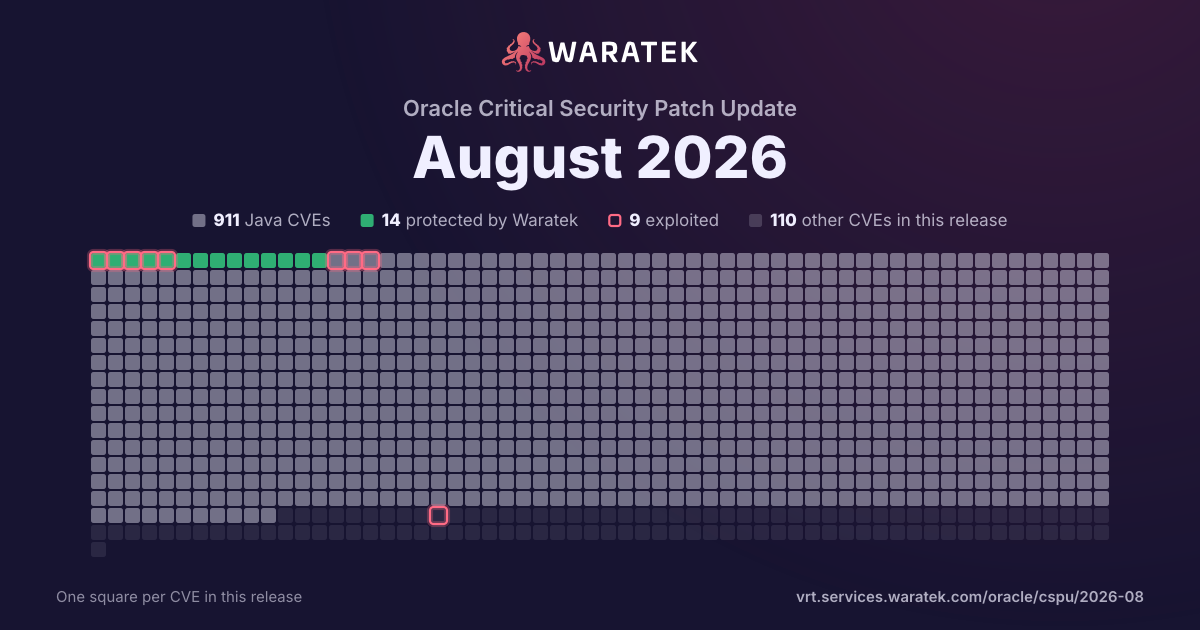
By status
14Protected by Waratek4Mitigation candidate893No exploit published2Outside Waratek scope108Not applicable
9Exploited, marked by the ring
No exploit published. For 847 of them, Oracle's security advisory is the source of public detail.
Protected by Waratek. Waratek RASP can block exploitation of these on systems that have not applied the patch yet.
Overview 10 matches · 8 in Waratek scope · 4 protected · 4 exploited · 2 CISA KEV · 5 public PoC · 3 EPSS ≥ 0.5
10matches
8in Waratek scope80.0%
4protected40.0%
4exploited40.0%
2CISA KEV20.0%
5public PoC50.0%
3EPSS ≥ 0.530.0%
Protected by Waratek
4
40.0%
Rule in development
0
0.0%
Mitigation candidate
2
20.0%
No exploit published
2
20.0%
Outside Waratek scope
0
0.0%
Not applicable
2
20.0%
Withdrawn CVE
0
0.0%
blocked by ARMR today
4
40.0%
partly blocked
0
0.0%
not blocked
6
60.0%
not established
0
0.0%
unrecorded
0
0.0%
Exploited
4
40.0%
Working exploit published
0
0.0%
Proof of concept only
3
30.0%
Forecast only
0
0.0%
No public exploit
3
30.0%
split by
peak 3 / quarter
Q4 211
Protected by Waratek1
High1
blocked by ARMR today1
Exploited1
Q1 220
Q2 220
Q3 223
Protected by Waratek1
No exploit published2
High3
blocked by ARMR today1
not blocked2
Proof of concept only2
No public exploit1
Q4 220
Q1 232
Protected by Waratek2
High2
blocked by ARMR today2
Exploited2
Q2 230
Q3 230
Q4 231
Mitigation candidate1
High1
not blocked1
Exploited1
Q1 241
Mitigation candidate1
High1
not blocked1
Proof of concept only1
Q2 240
Q3 241
Not applicable1
High1
not blocked1
No public exploit1
Q4 241
Not applicable1
High1
not blocked1
No public exploit1
Q4 21Q2 22Q4 22Q2 23Q4 23Q2 24Q4 24
| CVE | Severity | Published▾ | Status | Exploitation | Description |
|---|---|---|---|---|---|
| CVE-2024-9143 | High | 2024-10-16 | Not applicable | No public exploit | Issue summary: Use of the low-level GF(2^m) elliptic curve APIs with untrusted explicit values for the field polynomial can lead to out-of-bounds memory reads or writes. Impact summary: Out of bound memory writes can lead to an application crash or even a possibility of a remote code execution, however, in all the protocols involving Elliptic Curve Cryptography that we're aware of, either only "named curves" are supported, or, if explicit curve parameters are supported, they specify an X9.62 encoding of binary (GF(2^m)) curves that can't represent problematic input values. Thus the likelihood of existence of a vulnerable application is low. In particular, the X9.62 encoding is used for ECC keys in X.509 certificates, so problematic inputs cannot occur in the context of processing X.509 certificates. Any problematic use-cases would have to be using an "exotic" curve encoding. The affected APIs include: EC_GROUP_new_curve_GF2m(), EC_GROUP_new_from_params(), and various supporting BN_GF2m_*() functions. Applications working with "exotic" explicit binary (GF(2^m)) curve parameters, that make it possible to represent invalid field polynomials with a zero constant term, via the above or similar APIs, may terminate abruptly as a result of reading or writing outside of array bounds. Remote code execution cannot easily be ruled out. The FIPS modules in 3.3, 3.2, 3.1 and 3.0 are not affected by this issue. |
| CVE-2024-6119 | High | 2024-09-03 | Not applicable | No public exploit | Issue summary: Applications performing certificate name checks (e.g., TLS clients checking server certificates) may attempt to read an invalid memory address resulting in abnormal termination of the application process. Impact summary: Abnormal termination of an application can a cause a denial of service. Applications performing certificate name checks (e.g., TLS clients checking server certificates) may attempt to read an invalid memory address when comparing the expected name with an `otherName` subject alternative name of an X.509 certificate. This may result in an exception that terminates the application program. Note that basic certificate chain validation (signatures, dates, ...) is not affected, the denial of service can occur only when the application also specifies an expected DNS name, Email address or IP address. TLS servers rarely solicit client certificates, and even when they do, they generally don't perform a name check against a reference identifier (expected identity), but rather extract the presented identity after checking the certificate chain. So TLS servers are generally not affected and the severity of the issue is Moderate. The FIPS modules in 3.3, 3.2, 3.1 and 3.0 are not affected by this issue. |
| CVE-2024-20931 | High | 2024-02-17 | Mitigation candidate | Proof of concept only | Vulnerability in the Oracle WebLogic Server product of Oracle Fusion Middleware (component: Core). Supported versions that are affected are 12.2.1.4.0 and 14.1.1.0.0. Easily exploitable vulnerability allows unauthenticated attacker with network access via T3, IIOP to compromise Oracle WebLogic Server. Successful attacks of this vulnerability can result in unauthorized access to critical data or complete access to all Oracle WebLogic Server accessible data. CVSS 3.1 Base Score 7.5 (Confidentiality impacts). CVSS Vector: (CVSS:3.1/AV:N/AC:L/PR:N/UI:N/S:U/C:H/I:N/A:N). |
| CVE-2023-44487 | High | 2023-10-10 | Mitigation candidate | Exploited | The HTTP/2 protocol allows a denial of service (server resource consumption) because request cancellation can reset many streams quickly, as exploited in the wild in August through October 2023. |
| CVE-2023-26464 | High | 2023-03-10 | Protected by Waratek | Exploited | ** UNSUPPORTED WHEN ASSIGNED ** When using the Chainsaw or SocketAppender components with Log4j 1.x on JRE less than 1.7, an attacker that manages to cause a logging entry involving a specially-crafted (ie, deeply nested) hashmap or hashtable (depending on which logging component is in use) to be processed could exhaust the available memory in the virtual machine and achieve Denial of Service when the object is deserialized. This issue affects Apache Log4j before 2. Affected users are recommended to update to Log4j 2.x. NOTE: This vulnerability only affects products that are no longer supported by the maintainer. |
| CVE-2023-21839 | High | 2023-01-18 | Protected by Waratek | Exploited | Vulnerability in the Oracle WebLogic Server product of Oracle Fusion Middleware (component: Core). Supported versions that are affected are 12.2.1.3.0, 12.2.1.4.0 and 14.1.1.0.0. Easily exploitable vulnerability allows unauthenticated attacker with network access via T3, IIOP to compromise Oracle WebLogic Server. Successful attacks of this vulnerability can result in unauthorized access to critical data or complete access to all Oracle WebLogic Server accessible data. CVSS 3.1 Base Score 7.5 (Confidentiality impacts). CVSS Vector: (CVSS:3.1/AV:N/AC:L/PR:N/UI:N/S:U/C:H/I:N/A:N). |
| CVE-2022-40152 | High | 2022-09-16 | No exploit published | Proof of concept only | Those using Woodstox to parse XML data may be vulnerable to Denial of Service attacks (DOS) if DTD support is enabled. If the parser is running on user supplied input, an attacker may supply content that causes the parser to crash by stackoverflow. This effect may support a denial of service attack. |
| CVE-2022-40150 | High | 2022-09-16 | No exploit published | No public exploit | Those using Jettison to parse untrusted XML or JSON data may be vulnerable to Denial of Service attacks (DOS). If the parser is running on user supplied input, an attacker may supply content that causes the parser to crash by Out of memory. This effect may support a denial of service attack. |
| CVE-2022-34169 | High | 2022-07-19 | Protected by Waratek | Proof of concept only | The Apache Xalan Java XSLT library is vulnerable to an integer truncation issue when processing malicious XSLT stylesheets. This can be used to corrupt Java class files generated by the internal XSLTC compiler and execute arbitrary Java bytecode. Users are recommended to update to version 2.7.3 or later. Note: Java runtimes (such as OpenJDK) include repackaged copies of Xalan. |
| CVE-2021-4104 | High | 2021-12-14 | Protected by Waratek | Exploited | JMSAppender in Log4j 1.2 is vulnerable to deserialization of untrusted data when the attacker has write access to the Log4j configuration. The attacker can provide TopicBindingName and TopicConnectionFactoryBindingName configurations causing JMSAppender to perform JNDI requests that result in remote code execution in a similar fashion to CVE-2021-44228. Note this issue only affects Log4j 1.2 when specifically configured to use JMSAppender, which is not the default. Apache Log4j 1.2 reached end of life in August 2015. Users should upgrade to Log4j 2 as it addresses numerous other issues from the previous versions. |