
Oracle Critical Security Patch Update August 2026
Released August 2026 · Oracle's advisory ↗ · ← Critical Patch Update, July 2026 · Security Patch Update, September 2026 →
1,021 CVEs in this release, one square each
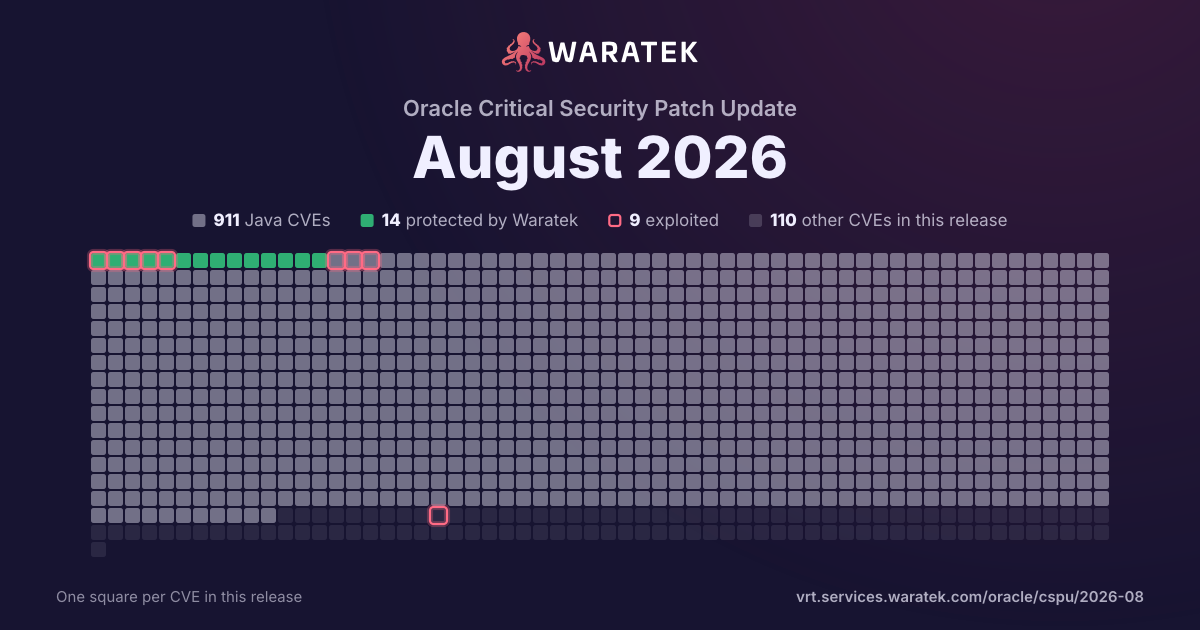
By status
14Protected by Waratek4Mitigation candidate893No exploit published2Outside Waratek scope108Not applicable
9Exploited, marked by the ring
No exploit published. For 847 of them, Oracle's security advisory is the source of public detail.
Protected by Waratek. Waratek RASP can block exploitation of these on systems that have not applied the patch yet.
Overview 54 matches · 0 in Waratek scope · 0 protected · 0 exploited · 0 CISA KEV · 0 public PoC · 0 EPSS ≥ 0.5
54matches
0in Waratek scope0.0%
0protected0.0%
0exploited0.0%
0CISA KEV0.0%
0public PoC0.0%
0EPSS ≥ 0.50.0%
Protected by Waratek
0
0.0%
Rule in development
0
0.0%
Mitigation candidate
0
0.0%
No exploit published
0
0.0%
Outside Waratek scope
0
0.0%
Not applicable
54
100.0%
Withdrawn CVE
0
0.0%
blocked by ARMR today
0
0.0%
partly blocked
0
0.0%
not blocked
54
100.0%
not established
0
0.0%
unrecorded
0
0.0%
Exploited
0
0.0%
Working exploit published
0
0.0%
Proof of concept only
9
16.7%
Forecast only
0
0.0%
No public exploit
45
83.3%
| CVE | Severity | Published▾ | Status | Exploitation | Description |
|---|---|---|---|---|---|
| CVE-2026-71151 | Medium | 2026-08-18 | Not applicable | No public exploit | Vulnerability in the Oracle VM VirtualBox product of Oracle Virtualization (component: Core). The supported version that is affected is 7.2.14. Difficult to exploit vulnerability allows low privileged attacker with logon to the infrastructure where Oracle VM VirtualBox executes to compromise Oracle VM VirtualBox. While the vulnerability is in Oracle VM VirtualBox, attacks may significantly impact additional products (scope change). Successful attacks of this vulnerability can result in unauthorized access to critical data or complete access to all Oracle VM VirtualBox accessible data. CVSS 3.1 Base Score 5.6 (Confidentiality impacts). CVSS Vector: (CVSS:3.1/AV:L/AC:H/PR:L/UI:N/S:C/C:H/I:N/A:N). |
| CVE-2026-71141 | High | 2026-08-18 | Not applicable | No public exploit | Vulnerability in the Oracle VM VirtualBox product of Oracle Virtualization (component: Core). The supported version that is affected is 7.2.14. Easily exploitable vulnerability allows unauthenticated attacker with logon to the infrastructure where Oracle VM VirtualBox executes to compromise Oracle VM VirtualBox. Successful attacks require human interaction from a person other than the attacker and while the vulnerability is in Oracle VM VirtualBox, attacks may significantly impact additional products (scope change). Successful attacks of this vulnerability can result in unauthorized creation, deletion or modification access to critical data or all Oracle VM VirtualBox accessible data as well as unauthorized read access to a subset of Oracle VM VirtualBox accessible data and unauthorized ability to cause a partial denial of service (partial DOS) of Oracle VM VirtualBox. CVSS 3.1 Base Score 7.7 (Confidentiality, Integrity and Availability impacts). CVSS Vector: (CVSS:3.1/AV:L/AC:L/PR:N/UI:R/S:C/C:L/I:H/A:L). |
| CVE-2026-71140 | Low | 2026-08-18 | Not applicable | No public exploit | Vulnerability in the Oracle VM VirtualBox product of Oracle Virtualization (component: Core). The supported version that is affected is 7.2.14. Easily exploitable vulnerability allows high privileged attacker with logon to the infrastructure where Oracle VM VirtualBox executes to compromise Oracle VM VirtualBox. Successful attacks of this vulnerability can result in unauthorized update, insert or delete access to some of Oracle VM VirtualBox accessible data as well as unauthorized read access to a subset of Oracle VM VirtualBox accessible data. CVSS 3.1 Base Score 3.4 (Confidentiality and Integrity impacts). CVSS Vector: (CVSS:3.1/AV:L/AC:L/PR:H/UI:N/S:U/C:L/I:L/A:N). |
| CVE-2026-71139 | Medium | 2026-08-18 | Not applicable | No public exploit | Vulnerability in the Oracle VM VirtualBox product of Oracle Virtualization (component: Core). The supported version that is affected is 7.2.14. Easily exploitable vulnerability allows high privileged attacker with logon to the infrastructure where Oracle VM VirtualBox executes to compromise Oracle VM VirtualBox. Successful attacks of this vulnerability can result in unauthorized ability to cause a hang or frequently repeatable crash (complete DOS) of Oracle VM VirtualBox. CVSS 3.1 Base Score 4.4 (Availability impacts). CVSS Vector: (CVSS:3.1/AV:L/AC:L/PR:H/UI:N/S:U/C:N/I:N/A:H). |
| CVE-2026-71138 | High | 2026-08-18 | Not applicable | No public exploit | Vulnerability in the Oracle VM VirtualBox product of Oracle Virtualization (component: Core). The supported version that is affected is 7.2.14. Easily exploitable vulnerability allows high privileged attacker with logon to the infrastructure where Oracle VM VirtualBox executes to compromise Oracle VM VirtualBox. While the vulnerability is in Oracle VM VirtualBox, attacks may significantly impact additional products (scope change). Successful attacks of this vulnerability can result in unauthorized ability to cause a hang or frequently repeatable crash (complete DOS) of Oracle VM VirtualBox as well as unauthorized update, insert or delete access to some of Oracle VM VirtualBox accessible data and unauthorized read access to a subset of Oracle VM VirtualBox accessible data. CVSS 3.1 Base Score 7.3 (Confidentiality, Integrity and Availability impacts). CVSS Vector: (CVSS:3.1/AV:L/AC:L/PR:H/UI:N/S:C/C:L/I:L/A:H). |
| CVE-2026-71137 | Medium | 2026-08-18 | Not applicable | No public exploit | Vulnerability in the Oracle VM VirtualBox product of Oracle Virtualization (component: Core). The supported version that is affected is 7.2.14. Easily exploitable vulnerability allows high privileged attacker with logon to the infrastructure where Oracle VM VirtualBox executes to compromise Oracle VM VirtualBox. While the vulnerability is in Oracle VM VirtualBox, attacks may significantly impact additional products (scope change). Successful attacks of this vulnerability can result in unauthorized ability to cause a hang or frequently repeatable crash (complete DOS) of Oracle VM VirtualBox. CVSS 3.1 Base Score 6.0 (Availability impacts). CVSS Vector: (CVSS:3.1/AV:L/AC:L/PR:H/UI:N/S:C/C:N/I:N/A:H). |
| CVE-2026-71136 | High | 2026-08-18 | Not applicable | No public exploit | Vulnerability in the Oracle VM VirtualBox product of Oracle Virtualization (component: Core). The supported version that is affected is 7.2.14. Easily exploitable vulnerability allows high privileged attacker with logon to the infrastructure where Oracle VM VirtualBox executes to compromise Oracle VM VirtualBox. While the vulnerability is in Oracle VM VirtualBox, attacks may significantly impact additional products (scope change). Successful attacks of this vulnerability can result in unauthorized ability to cause a hang or frequently repeatable crash (complete DOS) of Oracle VM VirtualBox as well as unauthorized update, insert or delete access to some of Oracle VM VirtualBox accessible data and unauthorized read access to a subset of Oracle VM VirtualBox accessible data. CVSS 3.1 Base Score 7.3 (Confidentiality, Integrity and Availability impacts). CVSS Vector: (CVSS:3.1/AV:L/AC:L/PR:H/UI:N/S:C/C:L/I:L/A:H). |
| CVE-2026-71135 | Medium | 2026-08-18 | Not applicable | No public exploit | Vulnerability in the Oracle VM VirtualBox product of Oracle Virtualization (component: Core). The supported version that is affected is 7.2.14. Easily exploitable vulnerability allows high privileged attacker with logon to the infrastructure where Oracle VM VirtualBox executes to compromise Oracle VM VirtualBox. While the vulnerability is in Oracle VM VirtualBox, attacks may significantly impact additional products (scope change). Successful attacks of this vulnerability can result in unauthorized ability to cause a hang or frequently repeatable crash (complete DOS) of Oracle VM VirtualBox. CVSS 3.1 Base Score 6.0 (Availability impacts). CVSS Vector: (CVSS:3.1/AV:L/AC:L/PR:H/UI:N/S:C/C:N/I:N/A:H). |
| CVE-2026-71134 | Medium | 2026-08-18 | Not applicable | No public exploit | Vulnerability in the Oracle VM VirtualBox product of Oracle Virtualization (component: Core). The supported version that is affected is 7.2.14. Easily exploitable vulnerability allows high privileged attacker with logon to the infrastructure where Oracle VM VirtualBox executes to compromise Oracle VM VirtualBox. While the vulnerability is in Oracle VM VirtualBox, attacks may significantly impact additional products (scope change). Successful attacks of this vulnerability can result in unauthorized update, insert or delete access to some of Oracle VM VirtualBox accessible data as well as unauthorized read access to a subset of Oracle VM VirtualBox accessible data and unauthorized ability to cause a partial denial of service (partial DOS) of Oracle VM VirtualBox. CVSS 3.1 Base Score 5.7 (Confidentiality, Integrity and Availability impacts). CVSS Vector: (CVSS:3.1/AV:L/AC:L/PR:H/UI:N/S:C/C:L/I:L/A:L). |
| CVE-2026-71132 | Medium | 2026-08-18 | Not applicable | No public exploit | Vulnerability in the Oracle VM VirtualBox product of Oracle Virtualization (component: Core). The supported version that is affected is 7.2.14. Difficult to exploit vulnerability allows high privileged attacker with logon to the infrastructure where Oracle VM VirtualBox executes to compromise Oracle VM VirtualBox. While the vulnerability is in Oracle VM VirtualBox, attacks may significantly impact additional products (scope change). Successful attacks of this vulnerability can result in unauthorized access to critical data or complete access to all Oracle VM VirtualBox accessible data. CVSS 3.1 Base Score 5.3 (Confidentiality impacts). CVSS Vector: (CVSS:3.1/AV:L/AC:H/PR:H/UI:N/S:C/C:H/I:N/A:N). |
| CVE-2026-71131 | High | 2026-08-18 | Not applicable | No public exploit | Vulnerability in the Oracle VM VirtualBox product of Oracle Virtualization (component: Core). The supported version that is affected is 7.2.14. Easily exploitable vulnerability allows unauthenticated attacker with logon to the infrastructure where Oracle VM VirtualBox executes to compromise Oracle VM VirtualBox. Successful attacks require human interaction from a person other than the attacker and while the vulnerability is in Oracle VM VirtualBox, attacks may significantly impact additional products (scope change). Successful attacks of this vulnerability can result in takeover of Oracle VM VirtualBox. CVSS 3.1 Base Score 8.6 (Confidentiality, Integrity and Availability impacts). CVSS Vector: (CVSS:3.1/AV:L/AC:L/PR:N/UI:R/S:C/C:H/I:H/A:H). |
| CVE-2026-71130 | High | 2026-08-18 | Not applicable | No public exploit | Vulnerability in the Oracle VM VirtualBox product of Oracle Virtualization (component: Core). The supported version that is affected is 7.2.14. Easily exploitable vulnerability allows unauthenticated attacker with network access via RDP to compromise Oracle VM VirtualBox. Successful attacks of this vulnerability can result in unauthorized access to critical data or complete access to all Oracle VM VirtualBox accessible data as well as unauthorized update, insert or delete access to some of Oracle VM VirtualBox accessible data. CVSS 3.1 Base Score 8.2 (Confidentiality and Integrity impacts). CVSS Vector: (CVSS:3.1/AV:N/AC:L/PR:N/UI:N/S:U/C:H/I:L/A:N). |
| CVE-2026-71129 | High | 2026-08-18 | Not applicable | No public exploit | Vulnerability in the Oracle VM VirtualBox product of Oracle Virtualization (component: Core). The supported version that is affected is 7.2.14. Easily exploitable vulnerability allows high privileged attacker with logon to the infrastructure where Oracle VM VirtualBox executes to compromise Oracle VM VirtualBox. While the vulnerability is in Oracle VM VirtualBox, attacks may significantly impact additional products (scope change). Successful attacks of this vulnerability can result in takeover of Oracle VM VirtualBox. CVSS 3.1 Base Score 8.2 (Confidentiality, Integrity and Availability impacts). CVSS Vector: (CVSS:3.1/AV:L/AC:L/PR:H/UI:N/S:C/C:H/I:H/A:H). |
| CVE-2026-71128 | Medium | 2026-08-18 | Not applicable | No public exploit | Vulnerability in the Oracle VM VirtualBox product of Oracle Virtualization (component: Core). The supported version that is affected is 7.2.14. Easily exploitable vulnerability allows high privileged attacker with logon to the infrastructure where Oracle VM VirtualBox executes to compromise Oracle VM VirtualBox. While the vulnerability is in Oracle VM VirtualBox, attacks may significantly impact additional products (scope change). Successful attacks of this vulnerability can result in unauthorized ability to cause a hang or frequently repeatable crash (complete DOS) of Oracle VM VirtualBox. CVSS 3.1 Base Score 6.0 (Availability impacts). CVSS Vector: (CVSS:3.1/AV:L/AC:L/PR:H/UI:N/S:C/C:N/I:N/A:H). |
| CVE-2026-71127 | Medium | 2026-08-18 | Not applicable | No public exploit | Vulnerability in the Oracle VM VirtualBox product of Oracle Virtualization (component: Core). The supported version that is affected is 7.2.14. Easily exploitable vulnerability allows high privileged attacker with logon to the infrastructure where Oracle VM VirtualBox executes to compromise Oracle VM VirtualBox. While the vulnerability is in Oracle VM VirtualBox, attacks may significantly impact additional products (scope change). Successful attacks of this vulnerability can result in unauthorized ability to cause a hang or frequently repeatable crash (complete DOS) of Oracle VM VirtualBox. CVSS 3.1 Base Score 6.0 (Availability impacts). CVSS Vector: (CVSS:3.1/AV:L/AC:L/PR:H/UI:N/S:C/C:N/I:N/A:H). |
| CVE-2026-71126 | High | 2026-08-18 | Not applicable | No public exploit | Vulnerability in the Oracle VM VirtualBox product of Oracle Virtualization (component: Core). The supported version that is affected is 7.2.14. Difficult to exploit vulnerability allows low privileged attacker with logon to the infrastructure where Oracle VM VirtualBox executes to compromise Oracle VM VirtualBox. While the vulnerability is in Oracle VM VirtualBox, attacks may significantly impact additional products (scope change). Successful attacks of this vulnerability can result in takeover of Oracle VM VirtualBox. CVSS 3.1 Base Score 7.8 (Confidentiality, Integrity and Availability impacts). CVSS Vector: (CVSS:3.1/AV:L/AC:H/PR:L/UI:N/S:C/C:H/I:H/A:H). |
| CVE-2026-71125 | Medium | 2026-08-18 | Not applicable | No public exploit | Vulnerability in the Oracle VM VirtualBox product of Oracle Virtualization (component: Core). The supported version that is affected is 7.2.14. Easily exploitable vulnerability allows unauthenticated attacker with logon to the infrastructure where Oracle VM VirtualBox executes to compromise Oracle VM VirtualBox. Successful attacks require human interaction from a person other than the attacker. Successful attacks of this vulnerability can result in unauthorized ability to cause a hang or frequently repeatable crash (complete DOS) of Oracle VM VirtualBox as well as unauthorized update, insert or delete access to some of Oracle VM VirtualBox accessible data. CVSS 3.1 Base Score 6.1 (Integrity and Availability impacts). CVSS Vector: (CVSS:3.1/AV:L/AC:L/PR:N/UI:R/S:U/C:N/I:L/A:H). |
| CVE-2026-71116 | High | 2026-08-18 | Not applicable | No public exploit | Vulnerability in the Oracle VM VirtualBox product of Oracle Virtualization (component: Core). The supported version that is affected is 7.2.14. Difficult to exploit vulnerability allows high privileged attacker with logon to the infrastructure where Oracle VM VirtualBox executes to compromise Oracle VM VirtualBox. While the vulnerability is in Oracle VM VirtualBox, attacks may significantly impact additional products (scope change). Successful attacks of this vulnerability can result in takeover of Oracle VM VirtualBox. CVSS 3.1 Base Score 7.5 (Confidentiality, Integrity and Availability impacts). CVSS Vector: (CVSS:3.1/AV:L/AC:H/PR:H/UI:N/S:C/C:H/I:H/A:H). |
| CVE-2026-71115 | Medium | 2026-08-18 | Not applicable | No public exploit | Vulnerability in the Oracle VM VirtualBox product of Oracle Virtualization (component: Core). The supported version that is affected is 7.2.14. Easily exploitable vulnerability allows high privileged attacker with logon to the infrastructure where Oracle VM VirtualBox executes to compromise Oracle VM VirtualBox. While the vulnerability is in Oracle VM VirtualBox, attacks may significantly impact additional products (scope change). Successful attacks of this vulnerability can result in unauthorized access to critical data or complete access to all Oracle VM VirtualBox accessible data. CVSS 3.1 Base Score 6.0 (Confidentiality impacts). CVSS Vector: (CVSS:3.1/AV:L/AC:L/PR:H/UI:N/S:C/C:H/I:N/A:N). |
| CVE-2026-71114 | Medium | 2026-08-18 | Not applicable | No public exploit | Vulnerability in the Oracle VM VirtualBox product of Oracle Virtualization (component: Core). The supported version that is affected is 7.2.14. Easily exploitable vulnerability allows high privileged attacker with logon to the infrastructure where Oracle VM VirtualBox executes to compromise Oracle VM VirtualBox. While the vulnerability is in Oracle VM VirtualBox, attacks may significantly impact additional products (scope change). Successful attacks of this vulnerability can result in unauthorized access to critical data or complete access to all Oracle VM VirtualBox accessible data. CVSS 3.1 Base Score 6.0 (Confidentiality impacts). CVSS Vector: (CVSS:3.1/AV:L/AC:L/PR:H/UI:N/S:C/C:H/I:N/A:N). |
| CVE-2026-71113 | High | 2026-08-18 | Not applicable | No public exploit | Vulnerability in the Oracle VM VirtualBox product of Oracle Virtualization (component: Core). The supported version that is affected is 7.2.14. Easily exploitable vulnerability allows unauthenticated attacker with network access via RDP to compromise Oracle VM VirtualBox. Successful attacks of this vulnerability can result in unauthorized ability to cause a hang or frequently repeatable crash (complete DOS) of Oracle VM VirtualBox. CVSS 3.1 Base Score 7.5 (Availability impacts). CVSS Vector: (CVSS:3.1/AV:N/AC:L/PR:N/UI:N/S:U/C:N/I:N/A:H). |
| CVE-2026-71102 | Critical | 2026-08-18 | Not applicable | No public exploit | Vulnerability in the Portable Clusterware component of Oracle Database Server. Supported versions that are affected are 19.3-19.32, 21.3-21.23 and 23.4.0-23.26.3. Easily exploitable vulnerability allows unauthenticated attacker with network access via HTTP to compromise Portable Clusterware. Successful attacks of this vulnerability can result in unauthorized creation, deletion or modification access to critical data or all Portable Clusterware accessible data and unauthorized ability to cause a hang or frequently repeatable crash (complete DOS) of Portable Clusterware. CVSS 3.1 Base Score 9.1 (Integrity and Availability impacts). CVSS Vector: (CVSS:3.1/AV:N/AC:L/PR:N/UI:N/S:U/C:N/I:H/A:H). |
| CVE-2026-71100 | Medium | 2026-08-18 | Not applicable | No public exploit | Vulnerability in the RDBMS component of Oracle Database Server. Supported versions that are affected are 19.3-19.32, 21.3-21.23 and 23.4.0-23.26.3. Easily exploitable vulnerability allows unauthenticated attacker with network access via Oracle Net to compromise RDBMS. Successful attacks of this vulnerability can result in unauthorized read access to a subset of RDBMS accessible data. CVSS 3.1 Base Score 5.3 (Confidentiality impacts). CVSS Vector: (CVSS:3.1/AV:N/AC:L/PR:N/UI:N/S:U/C:L/I:N/A:N). |
| CVE-2026-71084 | Medium | 2026-08-18 | Not applicable | No public exploit | Vulnerability in the MySQL Connectors product of Oracle MySQL (component: Connector/ODBC). The supported version that is affected is 26.7.0. Easily exploitable vulnerability allows unauthenticated attacker with logon to the infrastructure where MySQL Connectors executes to compromise MySQL Connectors. Successful attacks of this vulnerability can result in unauthorized ability to cause a hang or frequently repeatable crash (complete DOS) of MySQL Connectors and unauthorized read access to a subset of MySQL Connectors accessible data. CVSS 3.1 Base Score 6.8 (Confidentiality and Availability impacts). CVSS Vector: (CVSS:3.1/AV:L/AC:L/PR:N/UI:N/S:U/C:L/I:N/A:H). |
| CVE-2026-71079 | Medium | 2026-08-18 | Not applicable | No public exploit | Vulnerability in the MySQL Connectors product of Oracle MySQL (component: Connector/ODBC). The supported version that is affected is 26.7.0. Easily exploitable vulnerability allows low privileged attacker with network access via multiple protocols to compromise MySQL Connectors. Successful attacks of this vulnerability can result in unauthorized ability to cause a hang or frequently repeatable crash (complete DOS) of MySQL Connectors. CVSS 3.1 Base Score 6.5 (Availability impacts). CVSS Vector: (CVSS:3.1/AV:N/AC:L/PR:L/UI:N/S:U/C:N/I:N/A:H). |
| CVE-2026-71073 | Medium | 2026-08-18 | Not applicable | No public exploit | Vulnerability in the MySQL Connectors product of Oracle MySQL (component: Connector/ODBC). The supported version that is affected is 26.7.0. Easily exploitable vulnerability allows unauthenticated attacker with logon to the infrastructure where MySQL Connectors executes to compromise MySQL Connectors. Successful attacks require human interaction from a person other than the attacker. Successful attacks of this vulnerability can result in unauthorized ability to cause a hang or frequently repeatable crash (complete DOS) of MySQL Connectors. CVSS 3.1 Base Score 5.5 (Availability impacts). CVSS Vector: (CVSS:3.1/AV:L/AC:L/PR:N/UI:R/S:U/C:N/I:N/A:H). |
| CVE-2026-71064 | Critical | 2026-08-18 | Not applicable | No public exploit | Vulnerability in the Portable Clusterware component of Oracle Database Server. Supported versions that are affected are 19.3-19.32, 21.3-21.23 and 23.4.0-23.26.3. Easily exploitable vulnerability allows unauthenticated attacker with access to the physical communication segment attached to the hardware where the Portable Clusterware executes to compromise Portable Clusterware. While the vulnerability is in Portable Clusterware, attacks may significantly impact additional products (scope change). Successful attacks of this vulnerability can result in takeover of Portable Clusterware. CVSS 3.1 Base Score 9.6 (Confidentiality, Integrity and Availability impacts). CVSS Vector: (CVSS:3.1/AV:A/AC:L/PR:N/UI:N/S:C/C:H/I:H/A:H). |
| CVE-2026-71063 | Critical | 2026-08-18 | Not applicable | No public exploit | Vulnerability in the Portable Clusterware component of Oracle Database Server. Supported versions that are affected are 19.3-19.32, 21.3-21.23 and 23.4.0-23.26.3. Easily exploitable vulnerability allows unauthenticated attacker with access to the physical communication segment attached to the hardware where the Portable Clusterware executes to compromise Portable Clusterware. While the vulnerability is in Portable Clusterware, attacks may significantly impact additional products (scope change). Successful attacks of this vulnerability can result in takeover of Portable Clusterware. CVSS 3.1 Base Score 9.6 (Confidentiality, Integrity and Availability impacts). CVSS Vector: (CVSS:3.1/AV:A/AC:L/PR:N/UI:N/S:C/C:H/I:H/A:H). |
| CVE-2026-71062 | High | 2026-08-18 | Not applicable | No public exploit | Vulnerability in the RDBMS component of Oracle Database Server. Supported versions that are affected are 23.4.0-23.26.3. Difficult to exploit vulnerability allows low privileged attacker having Authenticated User privilege with network access via Oracle Net to compromise RDBMS. While the vulnerability is in RDBMS, attacks may significantly impact additional products (scope change). Successful attacks of this vulnerability can result in takeover of RDBMS. CVSS 3.1 Base Score 8.5 (Confidentiality, Integrity and Availability impacts). CVSS Vector: (CVSS:3.1/AV:N/AC:H/PR:L/UI:N/S:C/C:H/I:H/A:H). |
| CVE-2026-70724 | High | 2026-08-18 | Not applicable | No public exploit | Vulnerability in the MySQL Cluster product of Oracle MySQL (component: Cluster: General). Supported versions that are affected are 8.0.0-8.0.48, 8.4.0-8.4.11 and 9.7.0-9.7.2. Difficult to exploit vulnerability allows unauthenticated attacker with network access via HTTP to compromise MySQL Cluster. Successful attacks require human interaction from a person other than the attacker. Successful attacks of this vulnerability can result in takeover of MySQL Cluster. CVSS 3.1 Base Score 7.5 (Confidentiality, Integrity and Availability impacts). CVSS Vector: (CVSS:3.1/AV:N/AC:H/PR:N/UI:R/S:U/C:H/I:H/A:H). |
| CVE-2026-61258 | Critical | 2026-08-18 | Not applicable | No public exploit | Vulnerability in the Oracle Internet Directory product of Oracle Fusion Middleware (component: OID LDAP Server). Supported versions that are affected are 12.2.1.4.0 and 14.1.2.1.0. Easily exploitable vulnerability allows unauthenticated attacker with network access via LDAP to compromise Oracle Internet Directory. Successful attacks of this vulnerability can result in takeover of Oracle Internet Directory. CVSS 3.1 Base Score 9.8 (Confidentiality, Integrity and Availability impacts). CVSS Vector: (CVSS:3.1/AV:N/AC:L/PR:N/UI:N/S:U/C:H/I:H/A:H). |
| CVE-2026-61248 | Critical | 2026-08-18 | Not applicable | No public exploit | Vulnerability in the Oracle Internet Directory product of Oracle Fusion Middleware (component: OID LDAP Server). Supported versions that are affected are 12.2.1.4.0 and 14.1.2.1.0. Easily exploitable vulnerability allows low privileged attacker with network access via LDAP to compromise Oracle Internet Directory. While the vulnerability is in Oracle Internet Directory, attacks may significantly impact additional products (scope change). Successful attacks of this vulnerability can result in takeover of Oracle Internet Directory. CVSS 3.1 Base Score 9.9 (Confidentiality, Integrity and Availability impacts). CVSS Vector: (CVSS:3.1/AV:N/AC:L/PR:L/UI:N/S:C/C:H/I:H/A:H). |
| CVE-2026-61241 | Critical | 2026-08-18 | Not applicable | No public exploit | Vulnerability in the Oracle Internet Directory product of Oracle Fusion Middleware (component: OID LDAP Server). Supported versions that are affected are 12.2.1.4.0 and 14.1.2.1.0. Easily exploitable vulnerability allows unauthenticated attacker with network access via LDAP to compromise Oracle Internet Directory. While the vulnerability is in Oracle Internet Directory, attacks may significantly impact additional products (scope change). Successful attacks of this vulnerability can result in takeover of Oracle Internet Directory. CVSS 3.1 Base Score 10.0 (Confidentiality, Integrity and Availability impacts). CVSS Vector: (CVSS:3.1/AV:N/AC:L/PR:N/UI:N/S:C/C:H/I:H/A:H). |
| CVE-2026-60592 | High | 2026-08-18 | Not applicable | No public exploit | Vulnerability in the MySQL Cluster product of Oracle MySQL (component: Cluster: NDB Operator). Supported versions that are affected are 8.0.0-8.0.47, 8.4.0-8.4.10 and 9.7.0-9.7.1. Easily exploitable vulnerability allows unauthenticated attacker with network access via multiple protocols to compromise MySQL Cluster. Successful attacks of this vulnerability can result in unauthorized ability to cause a hang or frequently repeatable crash (complete DOS) of MySQL Cluster as well as unauthorized update, insert or delete access to some of MySQL Cluster accessible data. CVSS 3.1 Base Score 8.2 (Integrity and Availability impacts). CVSS Vector: (CVSS:3.1/AV:N/AC:L/PR:N/UI:N/S:U/C:N/I:L/A:H). |
| CVE-2026-60591 | Critical | 2026-08-18 | Not applicable | Proof of concept only | Vulnerability in the Oracle Hospitality Simphony product of Oracle Food and Beverage Applications (component: POS). Supported versions that are affected are 19.8-19.8.5, 19.9-19.9.3 and 19.10-19.10.1. Easily exploitable vulnerability allows unauthenticated attacker with network access via HTTP to compromise Oracle Hospitality Simphony. Successful attacks of this vulnerability can result in unauthorized creation, deletion or modification access to critical data or all Oracle Hospitality Simphony accessible data and unauthorized ability to cause a hang or frequently repeatable crash (complete DOS) of Oracle Hospitality Simphony. CVSS 3.1 Base Score 9.1 (Integrity and Availability impacts). CVSS Vector: (CVSS:3.1/AV:N/AC:L/PR:N/UI:N/S:U/C:N/I:H/A:H). |
| CVE-2026-60590 | High | 2026-08-18 | Not applicable | No public exploit | Vulnerability in the Oracle Hospitality Simphony product of Oracle Food and Beverage Applications (component: POS). Supported versions that are affected are 19.8-19.8.5, 19.9-19.9.3 and 19.10-19.10.1. Easily exploitable vulnerability allows unauthenticated attacker with network access via HTTP to compromise Oracle Hospitality Simphony. Successful attacks of this vulnerability can result in unauthorized access to critical data or complete access to all Oracle Hospitality Simphony accessible data. CVSS 3.1 Base Score 7.5 (Confidentiality impacts). CVSS Vector: (CVSS:3.1/AV:N/AC:L/PR:N/UI:N/S:U/C:H/I:N/A:N). |
| CVE-2026-60414 | High | 2026-08-18 | Not applicable | No public exploit | Vulnerability in the Oracle Outside In Technology product of Oracle Fusion Middleware (component: Outside In Core). The supported version that is affected is 8.5.8. Easily exploitable vulnerability allows unauthenticated attacker with logon to the infrastructure where Oracle Outside In Technology executes to compromise Oracle Outside In Technology. Successful attacks require human interaction from a person other than the attacker. Successful attacks of this vulnerability can result in takeover of Oracle Outside In Technology. CVSS 3.1 Base Score 7.8 (Confidentiality, Integrity and Availability impacts). CVSS Vector: (CVSS:3.1/AV:L/AC:L/PR:N/UI:R/S:U/C:H/I:H/A:H). |
| CVE-2026-60413 | High | 2026-08-18 | Not applicable | No public exploit | Vulnerability in the Oracle Outside In Technology product of Oracle Fusion Middleware (component: Outside In Core). The supported version that is affected is 8.5.8. Easily exploitable vulnerability allows unauthenticated attacker with logon to the infrastructure where Oracle Outside In Technology executes to compromise Oracle Outside In Technology. Successful attacks require human interaction from a person other than the attacker. Successful attacks of this vulnerability can result in takeover of Oracle Outside In Technology. CVSS 3.1 Base Score 7.8 (Confidentiality, Integrity and Availability impacts). CVSS Vector: (CVSS:3.1/AV:L/AC:L/PR:N/UI:R/S:U/C:H/I:H/A:H). |
| CVE-2026-60412 | High | 2026-08-18 | Not applicable | No public exploit | Vulnerability in the Oracle Outside In Technology product of Oracle Fusion Middleware (component: Outside In Core). The supported version that is affected is 8.5.8. Easily exploitable vulnerability allows unauthenticated attacker with logon to the infrastructure where Oracle Outside In Technology executes to compromise Oracle Outside In Technology. Successful attacks require human interaction from a person other than the attacker. Successful attacks of this vulnerability can result in takeover of Oracle Outside In Technology. CVSS 3.1 Base Score 7.8 (Confidentiality, Integrity and Availability impacts). CVSS Vector: (CVSS:3.1/AV:L/AC:L/PR:N/UI:R/S:U/C:H/I:H/A:H). |
| CVE-2026-60392 | High | 2026-08-18 | Not applicable | No public exploit | Vulnerability in the Oracle Outside In Technology product of Oracle Fusion Middleware (component: Outside In PDF Export SDK). The supported version that is affected is 8.5.8. Easily exploitable vulnerability allows unauthenticated attacker with logon to the infrastructure where Oracle Outside In Technology executes to compromise Oracle Outside In Technology. Successful attacks require human interaction from a person other than the attacker. Successful attacks of this vulnerability can result in takeover of Oracle Outside In Technology. CVSS 3.1 Base Score 7.8 (Confidentiality, Integrity and Availability impacts). CVSS Vector: (CVSS:3.1/AV:L/AC:L/PR:N/UI:R/S:U/C:H/I:H/A:H). |
| CVE-2026-69247 | High | 2026-08-03 | Not applicable | No public exploit | cryptography is a package designed to expose cryptographic primitives and recipes to Python developers. From 44.0.0 until 50.0.0, pkcs7_decrypt_der, pkcs7_decrypt_pem, and pkcs7_decrypt_smime reported the outcome of decrypting a RecipientInfo's encryptedKey in several distinguishable ways, one of which disclosed the exact length recovered from the RSA operation. The same distinction was also observable by timing. An application that decrypts attacker-supplied EnvelopedData and reflects the outcome gives the attacker a Bleichenbacher oracle against the content-encryption key. Decryption ran as RSA PKCS#1 v1.5 decrypt of encryptedKey, build an AES cipher from the result, then AES-CBC decrypt and PKCS#7 unpad. Invalid RSA padding, a valid padding with a bad key length, a correct length with a wrong key, and the real key each failed or succeeded differently. Case 1 is reachable only where the linked library lacks implicit rejection: OpenSSL 3.0 and 3.1, LibreSSL, and BoringSSL. Exploitation requires a service that auto-decrypts untrusted EnvelopedData matching the victim certificate and answers adaptively at high volume, such as an S/MIME gateway or mail filter. This issue is fixed in 50.0.0. |
| CVE-2026-65914 | Medium | 2026-07-23 | Not applicable | Proof of concept only | DOMPurify before 3.3.2 contains a mutation-XSS vulnerability when sanitized HTML is reinserted into special parsing contexts using innerHTML with wrappers like script, xmp, iframe, noembed, noframes, or noscript. Attackers can craft payloads with closing sequences that break out of the wrapper context during reparsing, reactivating dangerous markup with event handlers to execute JavaScript. |
| CVE-2026-65913 | Medium | 2026-07-23 | Not applicable | No public exploit | DOMPurify before 3.3.2 contains a prototype pollution vulnerability in USE_PROFILES mode that allows attackers to bypass attribute filtering by polluting Array.prototype properties. Attackers can set Array.prototype properties like onclick to true, causing DOMPurify to accept event handlers as allowlisted attributes and resulting in DOM-based XSS when sanitized markup is rendered. |
| CVE-2026-65912 | Medium | 2026-07-23 | Not applicable | No public exploit | DOMPurify before 3.3.2 contains a URI validation bypass vulnerability when ADD_ATTR is provided as a predicate function via EXTRA_ELEMENT_HANDLING.attributeCheck. Attackers can supply a predicate that accepts specific attribute and tag combinations to bypass URI-safe validation, allowing unsafe protocols like javascript: to survive sanitization and execute as DOM-based XSS when the link is activated. |
| CVE-2026-65903 | Medium | 2026-07-23 | Not applicable | No public exploit | DOMPurify before 3.4.0 contains a logic error in the ADD_TAGS function where short-circuit evaluation allows forbidden tags to bypass FORBID_TAGS restrictions. Attackers can craft input containing tags listed in FORBID_TAGS that are also added via ADD_TAGS function, causing them to be retained in sanitized output. |
| CVE-2026-65902 | Medium | 2026-07-23 | Not applicable | Proof of concept only | DOMPurify before 3.4.7 passes direct references to the module-level DEFAULT_ALLOWED_TAGS and DEFAULT_ALLOWED_ATTR sets to the uponSanitizeElement and uponSanitizeAttribute hooks via data.allowedTags / data.allowedAttributes when sanitize is called without an explicit cfg.ALLOWED_TAGS / cfg.ALLOWED_ATTR array. A hook that mutates these fields permanently widens the default allow-lists for the lifetime of the DOMPurify instance, so all subsequent default-config sanitize calls inherit the widened defaults and attacker payloads using the poisoned tag/attribute name survive sanitization. removeAllHooks(), clearConfig(), and passing a fresh cfg do not recover the state; only constructing a new DOMPurify instance does. |
| CVE-2026-65901 | Medium | 2026-07-23 | Not applicable | Proof of concept only | DOMPurify through 3.4.6 contains a cross-site scripting vulnerability in IN_PLACE mode that trusts attacker-controlled nodeName on live non-form nodes. Attackers can supply hostile live DOM objects with real script children whose observable nodeName is clobbered to appear as allowed elements, causing scripts to execute when the sanitized tree is inserted into a live document. |
| CVE-2026-65900 | Medium | 2026-07-23 | Not applicable | Proof of concept only | DOMPurify versions >=3.0.0 and before 3.4.8, when configured with SAFE_FOR_TEMPLATES together with a DOM output mode (RETURN_DOM, RETURN_DOM_FRAGMENT, or IN_PLACE), fail to strip template expressions (e.g. ${evil}, {{evil}}, <%evil%>) inside <template> element content. The final normalization/scrub pass (_scrubTemplateExpressions) uses a NodeIterator and node.normalize() that do not descend into template.content, so expressions that only form after adjacent text nodes merge survive sanitization. This bypasses SAFE_FOR_TEMPLATES and can allow a downstream template engine to evaluate attacker-supplied expressions. The string output path is not affected. |
| CVE-2026-65899 | Medium | 2026-07-23 | Not applicable | No public exploit | DOMPurify 3.0.0 before 3.4.9 does not reset the retained Trusted Types policy when clearConfig() is called, so a DOMPurify instance reused across trust boundaries stays bound to a previously supplied TRUSTED_TYPES_POLICY. A later caller that requests RETURN_TRUSTED_TYPE output receives a TrustedHTML object created by the old (potentially unsafe) policy rather than a clean default, which can lead to script execution at a Trusted Types sink. Passing TRUSTED_TYPES_POLICY: null on the later call also does not clear the retained policy. |
| CVE-2026-65898 | Medium | 2026-07-23 | Not applicable | No public exploit | DOMPurify before 3.4.11 fails to clone the ALLOWED_ATTR allowlist when setConfig() is used with an uponSanitizeAttribute hook, allowing the hook to permanently mutate the shared allowlist. Attackers can register a hook that conditionally allows dangerous attributes like onerror for trusted elements, then submit untrusted content that inherits the polluted allowlist and executes event handlers as stored XSS. |
| CVE-2026-49978 | Medium | 2026-07-14 | Not applicable | Proof of concept only | DOMPurify is a DOM-only cross-site scripting sanitizer for HTML, MathML, and SVG. Prior to 3.4.7, DOMPurify IN_PLACE sanitization could skip shadow contents attached to an element inside <template>.content, allowing attacker-controlled markup such as event handlers, JavaScript URLs, or scripts to survive and execute when an application cloned and inserted the sanitized template. This issue is fixed in version 3.4.7. |
| CVE-2026-49459 | Medium | 2026-07-14 | Not applicable | Proof of concept only | DOMPurify is a DOM-only cross-site scripting sanitizer for HTML, MathML, and SVG. Prior to 3.4.6, DOMPurify.sanitize(root, { IN_PLACE: true }) could preserve event-handler attributes on an attacker-controlled <form> root when a descendant name clobbered properties checked by _isClobbered, because _forceRemove no-opped on the parent-less root and _sanitizeAttributes returned early. This issue is fixed in version 3.4.6. |
| CVE-2026-49458 | Medium | 2026-07-14 | Not applicable | Proof of concept only | DOMPurify is a DOM-only cross-site scripting sanitizer for HTML, MathML, and SVG. Prior to 3.4.6, DOMPurify.sanitize(node, { IN_PLACE: true }) accepted same-origin foreign-realm DOM nodes while follow-on checks used parent-realm constructors, causing instanceof checks for forms, named node maps, document fragments, and elements to fail and skip clobber, template-content, and shadow-DOM sanitization branches so executable markup could survive. This issue is fixed in version 3.4.6. |
| CVE-2026-9563 | High | 2026-07-02 | Not applicable | Proof of concept only | In Eclipse Parsson published Maven Central artifacts before version 1.1.8, the JSON parser did not enforce a default maximum on the number of characters consumed while parsing a single JSON document. Applications that parse attacker- controlled JSON can be forced to consume excessive CPU and memory by processing very large documents, including large arrays, objects, strings, numbers, whitespace, or nested structures, resulting in a denial of service. Eclipse Parsson 1.1.8 introduces a configurable maximum parsing limit with a default limit of 15 million parser-consumed characters. |