
Oracle Critical Security Patch Update August 2026
Released August 2026 · Oracle's advisory ↗ · ← Critical Patch Update, July 2026 · Security Patch Update, September 2026 →
1,021 CVEs in this release, one square each
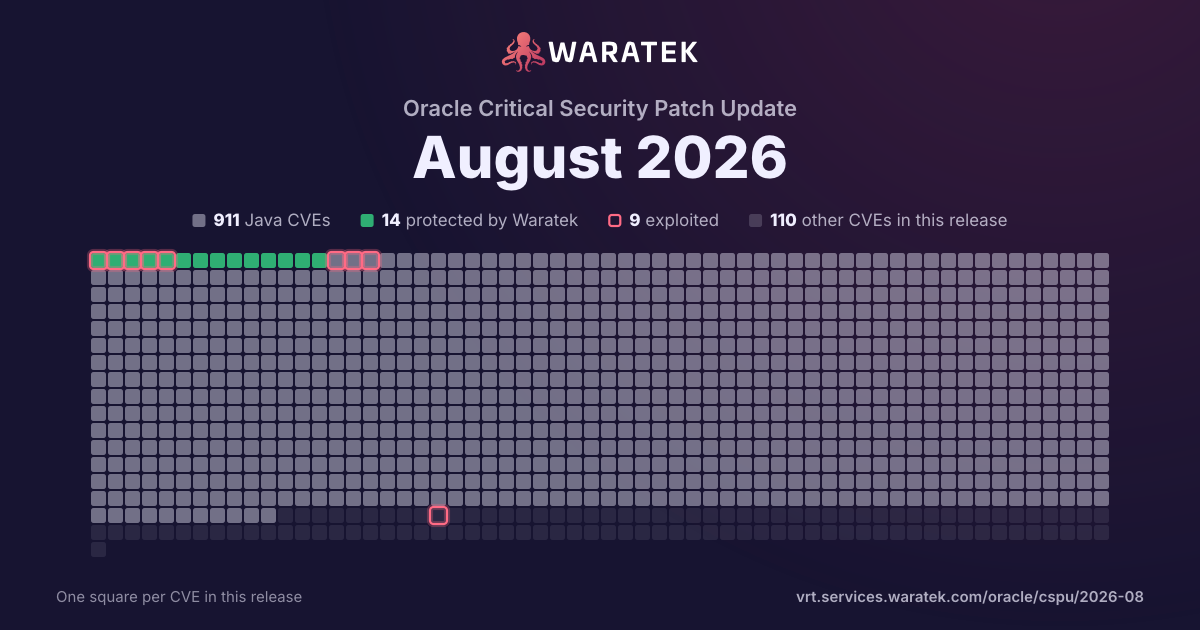
By status
14Protected by Waratek4Mitigation candidate893No exploit published2Outside Waratek scope108Not applicable
9Exploited, marked by the ring
No exploit published. For 847 of them, Oracle's security advisory is the source of public detail.
Protected by Waratek. Waratek RASP can block exploitation of these on systems that have not applied the patch yet.
Overview 116 matches · 48 in Waratek scope · 0 protected · 3 exploited · 1 CISA KEV · 5 public PoC · 1 EPSS ≥ 0.5
116matches
48in Waratek scope41.4%
0protected0.0%
3exploited2.6%
1CISA KEV0.9%
5public PoC4.3%
1EPSS ≥ 0.50.9%
Protected by Waratek
0
0.0%
Rule in development
0
0.0%
Mitigation candidate
3
2.6%
No exploit published
45
38.8%
Outside Waratek scope
1
0.9%
Not applicable
67
57.8%
Withdrawn CVE
0
0.0%
blocked by ARMR today
0
0.0%
partly blocked
0
0.0%
not blocked
116
100.0%
not established
0
0.0%
unrecorded
0
0.0%
Exploited
3
2.6%
Working exploit published
0
0.0%
Proof of concept only
26
22.4%
Forecast only
0
0.0%
No public exploit
87
75.0%
split by
peak 67 / quarter
Q3 223
No exploit published2
Not applicable1
Critical1
High2
not blocked3
Proof of concept only2
No public exploit1
Q4 220
Q1 230
Q2 230
Q3 230
Q4 232
Mitigation candidate2
Critical1
High1
not blocked2
Exploited2
Q1 243
Mitigation candidate1
Not applicable2
High1
Medium2
not blocked3
Proof of concept only1
No public exploit2
Q2 243
Not applicable3
Critical1
Medium2
not blocked3
No public exploit3
Q3 242
Not applicable2
Critical1
High1
not blocked2
Exploited1
No public exploit1
Q4 243
Not applicable3
Critical2
High1
not blocked3
No public exploit3
Q1 251
Not applicable1
Medium1
not blocked1
No public exploit1
Q2 250
Q3 250
Q4 251
No exploit published1
Medium1
not blocked1
No public exploit1
Q1 2614
Not applicable14
Critical4
High2
Medium6
Low2
not blocked14
Proof of concept only1
No public exploit13
Q2 2667
No exploit published39
Not applicable28
Critical12
High27
Medium26
Low2
not blocked67
Proof of concept only14
No public exploit53
Q3 2617
No exploit published3
Outside Waratek scope1
Not applicable13
Critical2
High2
Medium13
not blocked17
Proof of concept only8
No public exploit9
Q3 22Q1 23Q3 23Q1 24Q3 24Q1 25Q3 25Q1 26Q3 26
| CVE | Severity | Published▾ | Status | Exploitation | Description |
|---|---|---|---|---|---|
| CVE-2026-65914 | Medium | 2026-07-23 | Not applicable | Proof of concept only | DOMPurify before 3.3.2 contains a mutation-XSS vulnerability when sanitized HTML is reinserted into special parsing contexts using innerHTML with wrappers like script, xmp, iframe, noembed, noframes, or noscript. Attackers can craft payloads with closing sequences that break out of the wrapper context during reparsing, reactivating dangerous markup with event handlers to execute JavaScript. |
| CVE-2026-65913 | Medium | 2026-07-23 | Not applicable | No public exploit | DOMPurify before 3.3.2 contains a prototype pollution vulnerability in USE_PROFILES mode that allows attackers to bypass attribute filtering by polluting Array.prototype properties. Attackers can set Array.prototype properties like onclick to true, causing DOMPurify to accept event handlers as allowlisted attributes and resulting in DOM-based XSS when sanitized markup is rendered. |
| CVE-2026-65912 | Medium | 2026-07-23 | Not applicable | No public exploit | DOMPurify before 3.3.2 contains a URI validation bypass vulnerability when ADD_ATTR is provided as a predicate function via EXTRA_ELEMENT_HANDLING.attributeCheck. Attackers can supply a predicate that accepts specific attribute and tag combinations to bypass URI-safe validation, allowing unsafe protocols like javascript: to survive sanitization and execute as DOM-based XSS when the link is activated. |
| CVE-2026-65903 | Medium | 2026-07-23 | Not applicable | No public exploit | DOMPurify before 3.4.0 contains a logic error in the ADD_TAGS function where short-circuit evaluation allows forbidden tags to bypass FORBID_TAGS restrictions. Attackers can craft input containing tags listed in FORBID_TAGS that are also added via ADD_TAGS function, causing them to be retained in sanitized output. |
| CVE-2026-65902 | Medium | 2026-07-23 | Not applicable | Proof of concept only | DOMPurify before 3.4.7 passes direct references to the module-level DEFAULT_ALLOWED_TAGS and DEFAULT_ALLOWED_ATTR sets to the uponSanitizeElement and uponSanitizeAttribute hooks via data.allowedTags / data.allowedAttributes when sanitize is called without an explicit cfg.ALLOWED_TAGS / cfg.ALLOWED_ATTR array. A hook that mutates these fields permanently widens the default allow-lists for the lifetime of the DOMPurify instance, so all subsequent default-config sanitize calls inherit the widened defaults and attacker payloads using the poisoned tag/attribute name survive sanitization. removeAllHooks(), clearConfig(), and passing a fresh cfg do not recover the state; only constructing a new DOMPurify instance does. |
| CVE-2026-65901 | Medium | 2026-07-23 | Not applicable | Proof of concept only | DOMPurify through 3.4.6 contains a cross-site scripting vulnerability in IN_PLACE mode that trusts attacker-controlled nodeName on live non-form nodes. Attackers can supply hostile live DOM objects with real script children whose observable nodeName is clobbered to appear as allowed elements, causing scripts to execute when the sanitized tree is inserted into a live document. |
| CVE-2026-65900 | Medium | 2026-07-23 | Not applicable | Proof of concept only | DOMPurify versions >=3.0.0 and before 3.4.8, when configured with SAFE_FOR_TEMPLATES together with a DOM output mode (RETURN_DOM, RETURN_DOM_FRAGMENT, or IN_PLACE), fail to strip template expressions (e.g. ${evil}, {{evil}}, <%evil%>) inside <template> element content. The final normalization/scrub pass (_scrubTemplateExpressions) uses a NodeIterator and node.normalize() that do not descend into template.content, so expressions that only form after adjacent text nodes merge survive sanitization. This bypasses SAFE_FOR_TEMPLATES and can allow a downstream template engine to evaluate attacker-supplied expressions. The string output path is not affected. |
| CVE-2026-65899 | Medium | 2026-07-23 | Not applicable | No public exploit | DOMPurify 3.0.0 before 3.4.9 does not reset the retained Trusted Types policy when clearConfig() is called, so a DOMPurify instance reused across trust boundaries stays bound to a previously supplied TRUSTED_TYPES_POLICY. A later caller that requests RETURN_TRUSTED_TYPE output receives a TrustedHTML object created by the old (potentially unsafe) policy rather than a clean default, which can lead to script execution at a Trusted Types sink. Passing TRUSTED_TYPES_POLICY: null on the later call also does not clear the retained policy. |
| CVE-2026-65898 | Medium | 2026-07-23 | Not applicable | No public exploit | DOMPurify before 3.4.11 fails to clone the ALLOWED_ATTR allowlist when setConfig() is used with an uponSanitizeAttribute hook, allowing the hook to permanently mutate the shared allowlist. Attackers can register a hook that conditionally allows dangerous attributes like onerror for trusted elements, then submit untrusted content that inherits the polluted allowlist and executes event handlers as stored XSS. |
| CVE-2026-62574 | High | 2026-07-21 | Outside Waratek scope | No public exploit | Vulnerability in the Oracle Java SE, Oracle GraalVM for JDK, Oracle GraalVM Enterprise Edition product of Oracle Java SE (component: Install). Supported versions that are affected are Oracle Java SE: 8u501, 11.0.32, 17.0.20, 21.0.12, 25.0.4, 26.0.2; Oracle GraalVM for JDK: 17.0.20 and 21.0.12; Oracle GraalVM Enterprise Edition: 21.3.19. Easily exploitable vulnerability allows low privileged attacker with logon to the infrastructure where Oracle Java SE, Oracle GraalVM for JDK, Oracle GraalVM Enterprise Edition executes to compromise Oracle Java SE, Oracle GraalVM for JDK, Oracle GraalVM Enterprise Edition. Successful attacks of this vulnerability can result in takeover of Oracle Java SE, Oracle GraalVM for JDK, Oracle GraalVM Enterprise Edition. CVSS 3.1 Base Score 7.8 (Confidentiality, Integrity and Availability impacts). CVSS Vector: (CVSS:3.1/AV:L/AC:L/PR:L/UI:N/S:U/C:H/I:H/A:H). |
| CVE-2026-59889 | Medium | 2026-07-14 | No exploit published | No public exploit | jackson-databind contains the general-purpose data-binding functionality and tree-model for Jackson Data Processor. From 2.18.0 until 2.18.9, 2.21.5, 2.22.1, 3.1.5, and 3.2.1, UnwrappedPropertyHandler.processUnwrapped() replays buffered JSON for a @JsonUnwrapped property and calls prop.deserializeAndSet() without a prop.visibleInView(ctxt.getActiveView()) guard, allowing a property annotated with both @JsonView and @JsonUnwrapped to be written from attacker JSON under a less-privileged active view. This issue is fixed in versions 2.18.9, 2.21.5, 2.22.1, 3.1.5, and 3.2.1. |
| CVE-2026-59084 | Critical | 2026-07-14 | No exploit published | No public exploit | Insufficient Technical Documentation vulnerability in Apache Tomcat since the requirements to securely configure the EncryptInterceptor were not clearly documented. This issue affects Apache Tomcat: from 11.0.0-M1 through 11.0.23, from 10.1.0-M1 through 10.1.56, from 9.0.13 through 9.0.119, from 8.5.38 through 8.5.100, from 7.0.100 through 7.0.109. Other versions that have reached end of support may also be affected. Users are recommended to upgrade to version 11.0.24, 10.1.57 or 9.0.120 which fix the issue. |
| CVE-2026-59083 | Critical | 2026-07-14 | No exploit published | No public exploit | Improper Handling of URL Encoding (Hex Encoding) vulnerability in Apache Tomcat's rewrite valve allowed security constraint bypass for some configurations. This issue affects Apache Tomcat: from 11.0.0-M1 through 11.0.23, from 10.1.0-M1 through 10.1.56, from 9.0.0.M1 through 9.0.119, from 8.5.0 through 8.5.100. Other versions that have reached end of support may also be affected. Users are recommended to upgrade to version 11.0.24, 10.1.57 or 9.0.120, which fix the issue. |
| CVE-2026-49978 | Medium | 2026-07-14 | Not applicable | Proof of concept only | DOMPurify is a DOM-only cross-site scripting sanitizer for HTML, MathML, and SVG. Prior to 3.4.7, DOMPurify IN_PLACE sanitization could skip shadow contents attached to an element inside <template>.content, allowing attacker-controlled markup such as event handlers, JavaScript URLs, or scripts to survive and execute when an application cloned and inserted the sanitized template. This issue is fixed in version 3.4.7. |
| CVE-2026-49459 | Medium | 2026-07-14 | Not applicable | Proof of concept only | DOMPurify is a DOM-only cross-site scripting sanitizer for HTML, MathML, and SVG. Prior to 3.4.6, DOMPurify.sanitize(root, { IN_PLACE: true }) could preserve event-handler attributes on an attacker-controlled <form> root when a descendant name clobbered properties checked by _isClobbered, because _forceRemove no-opped on the parent-less root and _sanitizeAttributes returned early. This issue is fixed in version 3.4.6. |
| CVE-2026-49458 | Medium | 2026-07-14 | Not applicable | Proof of concept only | DOMPurify is a DOM-only cross-site scripting sanitizer for HTML, MathML, and SVG. Prior to 3.4.6, DOMPurify.sanitize(node, { IN_PLACE: true }) accepted same-origin foreign-realm DOM nodes while follow-on checks used parent-realm constructors, causing instanceof checks for forms, named node maps, document fragments, and elements to fail and skip clobber, template-content, and shadow-DOM sanitization branches so executable markup could survive. This issue is fixed in version 3.4.6. |
| CVE-2026-9563 | High | 2026-07-02 | Not applicable | Proof of concept only | In Eclipse Parsson published Maven Central artifacts before version 1.1.8, the JSON parser did not enforce a default maximum on the number of characters consumed while parsing a single JSON document. Applications that parse attacker- controlled JSON can be forced to consume excessive CPU and memory by processing very large documents, including large arrays, objects, strings, numbers, whitespace, or nested structures, resulting in a denial of service. Eclipse Parsson 1.1.8 introduces a configurable maximum parsing limit with a default limit of 15 million parser-consumed characters. |
| CVE-2026-55956 | Medium | 2026-06-29 | No exploit published | No public exploit | Improper Authorization vulnerability in Apache Tomcat leads to security constraints specified for the default servlet ignoring any method or method omission configured as part of the constraint. This issue affects Apache Tomcat: from 11.0.0-M1 through 11.0.22, from 10.1.0-M1 through 10.1.55, from 9.0.0.M1 through 9.0.118, from 8.5.0 through 8.5.100, from 7.0.0 through 7.0.109. Other versions that have reached end of support may also be affected. Users are recommended to upgrade to version 11.0.23, 10.1.56 or 9.0.119, which fix the issue. |
| CVE-2026-55955 | Medium | 2026-06-29 | No exploit published | No public exploit | Improper Authentication vulnerability in Apache Tomcat allowed a replay attack against the EncryptionInterceptor in the cluster component. This issue affects Apache Tomcat: from 11.0.0-M1 through 11.0.22, from 10.1.0-M1 through 10.1.55, from 9.0.13 through 9.0.18, from 8.5.38 through 8.5.100, from 7.0.100 through 7.0.109. Users are recommended to upgrade to version 11.0.23, 10.1.56, 9.0.119, which fixes the issue. |
| CVE-2026-55276 | Critical | 2026-06-29 | No exploit published | No public exploit | Always-Incorrect Control Flow Implementation vulnerability in Apache Tomcat meant that special roles and empty authorisation constraints were not included when the effective web.xml was logged. This issue affects Apache Tomcat: from 11.0.0-M1 through 11.0.22, from 10.1.0-M1 through 10.1.55, from 9.0.0.M1 through 9.0.118, from 8.5.0 through 8.5.100. Other versions that have reached end of support may also be affected. Users are recommended to upgrade to version 11.0.23, 10.1.56 or 9.0.119 which fixes the issue. |
| CVE-2026-53434 | Critical | 2026-06-29 | No exploit published | No public exploit | Detection of Error Condition Without Action vulnerability in Apache Tomcat when configuring CRLs for a FFM based connector. This issue affects Apache Tomcat: from 11.0.0-M1 through 11.0.22, from 10.1.0-M7 through 10.1.55, from 9.0.83 through 9.0.118. Users are recommended to upgrade to version 11.0.23, 10.1.56 or 9.0.119, which fixes the issue. |
| CVE-2026-53404 | High | 2026-06-29 | No exploit published | No public exploit | Always-Incorrect Control Flow Implementation vulnerability in Apache Tomcat's rewrite valve meant that if the first condition in an OR chain matched, subsequent non-OR conditions were skipped. This issue affects Apache Tomcat: from 11.0.0-M1 through 11.0.22, from 10.1.0-M1 through 10.1.55, from 9.0.0.M1 through 9.0.118, from 8.5.0 through 8.5.100. Other versions that have reached end of support may also be affected. Users are recommended to upgrade to version 11.0.23, 10.1.56 or 9.0.119, which fix the issue. |
| CVE-2026-9076 | High | 2026-06-09 | Not applicable | No public exploit | Issue summary: When CMS password-based decryption (RFC 3211 / PWRI key unwrap) processes attacker-supplied CMS data, an attacker-chosen stream-mode KEK cipher can trigger a heap out-of-bounds read in kek_unwrap_key(). Impact summary: A heap buffer over-read may trigger a crash which leads to Denial of Service for an application if the input buffer ends at a memory page boundary and the following page is unmapped. There is no information disclosure as the over-read bytes are not revealed to the attacker. The key unwrapping function performs a check-byte test as specified in the RFC that reads 7 bytes from a heap allocation that is based on the wrapped key length from the message. There is a minimum length check based on the block length of the wrapping cipher. However the cipher is selected from an OID carried in the attacker's PWRI keyEncryptionAlgorithm with no requirement that the cipher be a block cipher. When an attacker selects a stream-mode cipher the guard will be ineffective and the allocated buffer containing the unwrapped key can be too small to fit the check-bytes specified in the RFC and a buffer over-read can happen. Applications calling CMS_decrypt() or CMS_decrypt_set1_password() (equivalently openssl cms -decrypt -pwri_password ...) on untrusted CMS data are vulnerable to this issue. No password knowledge is required: the over-read happens during the unwrap attempt before any authentication succeeds. The over-read is limited to a few bytes and is not written to output, so there is no information disclosure. Triggering a crash requires the allocation to border unmapped memory, which is unlikely with the normal allocator. The FIPS modules are not affected by this issue. |
| CVE-2026-7383 | High | 2026-06-09 | Not applicable | No public exploit | Issue summary: A signed integer overflow when sizing the destination buffer for Unicode output in ASN1_mbstring_ncopy() can lead to a heap buffer overflow. Impact summary: A heap buffer overflow may lead to a crash or possibly attacker controlled code execution or other undefined behaviour. In ASN1_mbstring_copy() and ASN1_mbstring_ncopy() the destination size for Unicode output is computed in a signed int: by left shift of the input character count for BMPSTRING (UTF-16) and UNIVERSALSTRING (UTF-32), and by summing per-character byte counts for UTF8STRING. The calculation overflows when the input reaches around 2^30 characters. In the worst case (UNIVERSALSTRING at 2^30 characters) the size wraps to zero, OPENSSL_malloc(1) is called, and the subsequent character copy writes several gigabytes past the one-byte allocation. X.509 certificate processing routes through ASN1_STRING_set_by_NID(), whose DIRSTRING_TYPE mask excludes UNIVERSALSTRING and whose per-NID size limits cap the input length; no network protocol or certificate-handling path in OpenSSL exercises the overflow. Triggering the bug requires an application that calls ASN1_mbstring_copy() or ASN1_mbstring_ncopy() directly, or registers a custom string type via ASN1_STRING_TABLE_add(), with attacker-controlled input on the order of half a gigabyte or more. For these reasons this issue was assigned Low severity. The FIPS modules in 4.0, 3.6, 3.5, 3.4 and 3.0 are not affected by this issue, as the affected code is outside the OpenSSL FIPS module boundary. |
| CVE-2026-45447 | High | 2026-06-09 | Not applicable | No public exploit | Issue summary: A specially crafted PKCS#7 or S/MIME signed message could trigger a use-after-free during PKCS#7 signature verification. Impact summary: A use-after-free may result in process crashes, heap corruption, or potentially remote code execution. When processing a PKCS#7 or S/MIME signed message, if the SignedData digestAlgorithms field is present as an empty ASN.1 SET, OpenSSL may incorrectly free a caller-owned BIO during PKCS7_verify(). A subsequent use of the BIO by the calling application results in a use-after-free condition. In the common case this occurs when the application later calls BIO_free() on the BIO originally passed to PKCS7_verify(). Depending on allocator behavior and application-specific BIO usage patterns, this may result in a crash or other memory corruption. In some application contexts this may potentially be exploitable for remote code execution. Applications that process PKCS#7 or S/MIME signed messages using OpenSSL PKCS#7 APIs may be affected. Applications using the CMS APIs for this processing are not affected. The FIPS modules in 4.0, 3.6, 3.5, 3.4, and 3.0 are not affected by this issue, as the affected code is outside the OpenSSL FIPS module boundary. |
| CVE-2026-45446 | Medium | 2026-06-09 | Not applicable | No public exploit | Issue summary: The implementations of AES-SIV (RFC 5297) and AES-GCM-SIV (RFC 8452) mishandle the authentication of AAD (Additional Authenticated Data) with an empty ciphertext allowing a forgery of such messages. Impact summary: An attacker can forge empty messages with arbitrary AAD to the victim's application using these ciphers. AES-SIV (RFC 5297) and AES-GCM-SIV (RFC 8452) are nonce-misuse-resistant AEAD modes: they accept a key, nonce, optional AAD (bytes that are authenticated but not encrypted), and plaintext, and produces ciphertext plus a 16-byte tag. On decrypt, `EVP_DecryptFinal_ex()` is documented to return success only if the tag is verified succesfully. In OpenSSL's provider implementation of these ciphers, the expected tag is computed only when decryption function is invoked with non-empty data. If the caller supplies AAD and then calls `EVP_DecryptFinal_ex()` without invocation of the ciphertext update, which can happen when the received ciphertext length is zero, the tag is never recalculated and still holds its all-zeros value. When AES-GCM-SIV is used, an attacker who sends arbitrary AAD, empty ciphertext, and all-zeros tag passes authentication under any key they do not know, single-shot. When AES-SIV is used, for mounting the attack it's necessary for the application to reuse the decryption context without resetting the key. AES-SIV is implemented since OpenSSL 3.0. AES-GCM-SIV is implemented since OpenSSL 3.2. No protocols implemented in OpenSSL itself (TLS/CMS/PKCS7/HPKE/QUIC) support either AES-GCM-SIV or AES-SIV. To mount an attack, the applications must implement their own protocol and use the EVP interface. Also they must skip the ciphertext update when a message with an empty ciphertext arrives. The FIPS modules in 4.0, 3.6, 3.5, 3.4, and 3.0 are not affected by this issue, as these algorithms are not FIPS approved and the affected code is outside the OpenSSL FIPS module boundary. |
| CVE-2026-45445 | High | 2026-06-09 | Not applicable | No public exploit | Issue summary: When an application drives an AES-OCB context through the public EVP_Cipher() one-shot interface, the application-supplied initialisation vector (IV) is silently discarded. Impact summary: Every message encrypted under the same key uses the same effective nonce regardless of the IV supplied by the caller, resulting in (key, nonce) reuse and loss of confidentiality. If the same code path is used to compute the authentication tag, the tag depends only on the (key, IV) pair and not on the plaintext or ciphertext, allowing universal forgery of arbitrary ciphertext from a single captured message. OpenSSL provides two ways to drive a cipher: the documented streaming interface (EVP_CipherUpdate / EVP_CipherFinal_ex) and a lower-level one-shot, EVP_Cipher(), whose documentation explicitly recommends against use by applications in favour of EVP_CipherUpdate() and EVP_CipherFinal_ex(). The OCB provider's streaming handler flushes the application-supplied IV into the OCB context before processing data; the one-shot handler did not. Every call to EVP_Cipher() on an AES-OCB context therefore ran with the all-zero key-derived offset state left by cipher initialisation, regardless of the caller's IV. If EVP_EncryptFinal_ex() is subsequently used to obtain the authentication tag, the deferred IV setup runs at that point and clears the running checksum that should have been accumulated over the plaintext. The resulting tag is a function of (key, IV) only and verifies against any ciphertext produced under the same (key, IV) pair. The OpenSSL SSL/TLS implementation is not affected: AES-OCB is not a TLS cipher suite, and libssl does not call EVP_Cipher() in any case. Applications that drive AES-OCB through the documented streaming AEAD API (EVP_CipherUpdate / EVP_CipherFinal_ex) are not affected. Only applications that combine the AES-OCB cipher with the EVP_Cipher() one-shot API are vulnerable. The FIPS modules in 4.0, 3.6, 3.5, 3.4 and 3.0 are not affected by this issue, as AES-OCB is outside the OpenSSL FIPS module boundary. |
| CVE-2026-42770 | Low | 2026-06-09 | Not applicable | No public exploit | Issue summary: When EVP_PKEY_derive_set_peer() is called with a DHX (X9.42) peer key, the peer key is not properly checked for the subgroup membership. Impact summary: A malicious peer which presents an X9.42 key carrying the victim's p and g parameters, a forged q = r (a small prime factor of the cofactor (p−1)/q_local), and a public value Y of order r can recover the victim's private key after a small number of key exchange attempts. When EVP_PKEY_derive_set_peer() is called with a DHX (X9.42) peer key, the subgroup membership check Y^q ≡ 1 (mod p) is performed using the peer's own q parameter, not the local key's q. The peer's domain parameters are then matched against the domain parameters of the private key, but the value of q is not compared. A malicious peer who presents an X9.42 key carrying the victim's p, g, a forged q = r (a small prime factor of the cofactor), and a public value Y of order r passes all checks. The shared secret then takes only r distinct values, leaking priv mod r. Repeating for each small-prime factor of the cofactor and combining via CRT recovers the full private key (Lim–Lee / small-subgroup-confinement attack). The realistic attack surface is narrow: principally CMP deployments with long-lived RA/CA DHX keys and bespoke enterprise or government applications using X9.42 DHX static keys with interactive protocols and therefore this issue was assigned Low severity. The FIPS modules in 4.0, 3.6, 3.5, 3.4, 3.1.2 and 3.0 are affected by this issue. |
| CVE-2026-42767 | Medium | 2026-06-09 | Not applicable | No public exploit | Issue summary: An attacker-controlled CMP (Certificate Management Protocol) server could trigger a NULL pointer dereference in a CMP client application. Impact summary: A NULL pointer dereference causes a crash of the application and a Denial of Service. An attacker controlling a CMP server (or acting as a man-in-the-middle) could craft a CMP response containing a CRMF (Certificate Request Message Format) CertRepMessage with an EncryptedValue structure where the symmAlg field has an algorithm OID but no parameters field. When the OpenSSL CMP client processes this response, the NULL dereference occurs, causing a crash of the CMP client. Applications that process untrusted CMP/CRMF messages may be affected. The FIPS modules in 4.0, 3.6, 3.5, 3.4, and 3.0 are not affected by this issue, as the affected code is outside the OpenSSL FIPS module boundary. |
| CVE-2026-42766 | Medium | 2026-06-09 | Not applicable | No public exploit | Issue summary: A specially crafted password-encrypted CMS message can trigger a NULL pointer dereference during CMS decryption. Impact summary: This NULL pointer dereference leads to an application crash and a Denial of Service. The CMS PasswordRecipientInfo.keyDerivationAlgorithm field is defined as OPTIONAL in the ASN.1 specification and may therefore be absent in specially crafted inputs. During the password-based CMS decryption the OpenSSL CMS implementation dereferences this field without first checking whether it was present. An attacker who supplies such a CMS message to an application performing password-based CMS decryption can trigger an application crash, leading to a Denial of Service. Applications that process password-encrypted CMS messages may be affected. The FIPS modules in 4.0, 3.6, 3.5, 3.4, and 3.0 are not affected by this issue, as the affected code is outside the OpenSSL FIPS module boundary. |
| CVE-2026-42764 | High | 2026-06-09 | Not applicable | No public exploit | Issue summary: Receiving a QUIC initial packet with an invalid token may trigger a NULL pointer dereference in the OpenSSL QUIC server with address validation disabled. Impact summary: NULL pointer dereference typically causes abnormal termination of the affected QUIC server process and a Denial of Service. If the address validation is disabled in the OpenSSL QUIC server implementation, an attacker can crash the server by sending an initial packet with an invalid or expired token. By default, the client address validation is enabled in the OpenSSL QUIC server implementation, which makes the default configuration not vulnerable to this issue. However if the SSL_LISTENER_FLAG_NO_VALIDATE is used with the SSL_new_listener() call, the address validation is disabled making the vulnerable code reachable. The FIPS modules in 4.0, 3.6, 3.5, 3.4, and 3.0 are not affected by this issue, as the affected code is outside the OpenSSL FIPS module boundary. |
| CVE-2026-41855 | Critical | 2026-06-09 | No exploit published | No public exploit | In an untrusted JMS environment, org.springframework.jms.support.converter.MappingJackson2MessageConverter and org.springframework.jms.support.converter.JacksonJsonMessageConverter allow arbitrary class instantiation, which can lead to unauthorized actions via gadget class deserialization. Affected versions: Spring Framework 7.0.0 through 7.0.7; 6.2.0 through 6.2.18; 6.1.0 through 6.1.27; 5.3.0 through 5.3.48. |
| CVE-2026-41854 | Medium | 2026-06-09 | No exploit published | No public exploit | Due to incorrect host parsing, applications that rely on UriComponentsBuilder to parse and validate an externally provided URL string may be exposed to a server-side request forgery (SSRF) attack. Affected versions: Spring Framework 7.0.0 through 7.0.7; 6.2.0 through 6.2.18. |
| CVE-2026-41853 | Medium | 2026-06-09 | No exploit published | No public exploit | Spring MVC and WebFlux applications are vulnerable to Multipart request smuggling attacks. Affected versions: Spring Framework 7.0.0 through 7.0.7; 6.2.0 through 6.2.18; 6.1.0 through 6.1.27; 5.3.0 through 5.3.48. |
| CVE-2026-41852 | Medium | 2026-06-09 | No exploit published | No public exploit | A vulnerability in Spring Expression Language (SpEL) evaluation logic allows for arbitrary zero-argument method invocation, even within restricted or read-only contexts, which may allow an attacker to invoke unintended application logic. Affected versions: Spring Framework 7.0.0 through 7.0.7; 6.2.0 through 6.2.18; 6.1.0 through 6.1.27; 5.3.0 through 5.3.48. |
| CVE-2026-41851 | High | 2026-06-09 | No exploit published | No public exploit | Applications which accept user-supplied Spring Expression Language (SpEL) expressions may be vulnerable to a Denial of Service (DoS) attack if the evaluation of a SpEL expression triggers unbounded cache growth. Affected versions: Spring Framework 7.0.0 through 7.0.7; 6.2.0 through 6.2.18; 6.1.0 through 6.1.27; 5.3.0 through 5.3.48. |
| CVE-2026-41850 | High | 2026-06-09 | No exploit published | No public exploit | Applications that evaluate user-supplied Spring Expression Language (SpEL) expressions are vulnerable to an Algorithmic Denial of Service (DoS). By providing a specially crafted expression, an attacker can trigger excessive resource consumption during evaluation, leading to application degradation or unavailability. Affected versions: Spring Framework 7.0.0 through 7.0.7; 6.2.0 through 6.2.18; 6.1.0 through 6.1.27; 5.3.0 through 5.3.48. |
| CVE-2026-41848 | High | 2026-06-09 | No exploit published | No public exploit | Applications may be vulnerable to a Regular Expression Denial of Service (ReDoS) attack if an attacker is able to provide a pattern which is then directly or indirectly supplied to one of the following methods in AntPathMatcher: match(String pattern, String path), matchStart(String pattern, String path), extractUriTemplateVariables(String pattern, String path). Affected versions: Spring Framework 7.0.0 through 7.0.7; 6.2.0 through 6.2.18; 6.1.0 through 6.1.27; 5.3.0 through 5.3.48. |
| CVE-2026-41846 | Medium | 2026-06-09 | No exploit published | No public exploit | Spring MVC applications which accept user-supplied values in the cssClass, cssErrorClass, or cssStyle attributes of JSP form tags allow arbitrary HTML/JavaScript code injection, potentially resulting in a cross-site scripting (XSS) vulnerability. Affected versions: Spring Framework 7.0.0 through 7.0.7; 6.2.0 through 6.2.18; 6.1.0 through 6.1.27; 5.3.0 through 5.3.48. |
| CVE-2026-41845 | High | 2026-06-09 | No exploit published | No public exploit | Due to incorrect escaping, the use of JavaScriptUtils.javaScriptEscape() may lead to JavaScript code injection in the browser, potentially resulting in a cross-site scripting (XSS) vulnerability. Affected versions: Spring Framework 7.0.0 through 7.0.7; 6.2.0 through 6.2.18; 6.1.0 through 6.1.27; 5.3.0 through 5.3.48. |
| CVE-2026-41844 | Medium | 2026-06-09 | No exploit published | No public exploit | A Spring MVC or Spring WebFlux application which configures a mapping for "/**" where the view name is not explicitly specified allows an attacker to craft a link resulting in a 302 redirect to an arbitrary external host via the redirect: prefix. Affected versions: Spring Framework 7.0.0 through 7.0.7; 6.2.0 through 6.2.18; 6.1.0 through 6.1.27; 5.3.0 through 5.3.48. |
| CVE-2026-41842 | High | 2026-06-09 | No exploit published | No public exploit | Spring MVC and WebFlux applications are vulnerable to Denial of Service (DoS) attacks when resolving static resources. Affected versions: Spring Framework 7.0.0 through 7.0.7; 6.2.0 through 6.2.18; 6.1.0 through 6.1.27; 5.3.0 through 5.3.48. |
| CVE-2026-41841 | Medium | 2026-06-09 | No exploit published | No public exploit | Spring MVC and WebFlux applications are vulnerable to Information Disclosure attacks when resolving static resources. Affected versions: Spring Framework 7.0.0 through 7.0.7; 6.2.0 through 6.2.18; 6.1.0 through 6.1.27; 5.3.0 through 5.3.48. |
| CVE-2026-41840 | Medium | 2026-06-09 | No exploit published | No public exploit | Spring WebFlux applications are vulnerable to Denial of Service (DoS) attacks when processing multipart requests. Affected versions: Spring Framework 7.0.0 through 7.0.7, 6.2.0 through 6.2.18, 6.1.0 through 6.1.27, 5.3.0 through 5.3.48. |
| CVE-2026-41839 | Medium | 2026-06-09 | No exploit published | No public exploit | A WebFlux application with a compromised subdomain (for example, compromised via cross-site scripting (XSS)) is vulnerable to an escalation attack exchanging a known session ID for that of an authenticated user. Affected versions: Spring Framework 7.0.0 through 7.0.7; 6.2.0 through 6.2.18; 6.1.0 through 6.1.27; 5.3.0 through 5.3.48. |
| CVE-2026-41838 | High | 2026-06-09 | No exploit published | No public exploit | IDs for WebSocket sessions in the spring-websocket module are not cryptographically unpredictable, which may be possible to exploit in combination with inadequate authorization rules. Affected versions: Spring Framework 7.0.0 through 7.0.7; 6.2.0 through 6.2.18; 6.1.0 through 6.1.27; 5.3.0 through 5.3.48. |
| CVE-2026-34182 | Critical | 2026-06-09 | Not applicable | No public exploit | Issue Summary: Cryptographic Message Services (CMS) processing fails to perform sufficient input validation on the cipher and tag length fields of AuthEnvelopedData containers, leading to various potential compromises. Impact Summary: Attackers making use of these vulnerabilities may achieve key-equivalent functionality for a given CMS recipient and/or bypass integrity validation for a given message. In one use case, an attacker may send a CMS message containing AuthEnvelopedData with the cipher specified as a non-AEAD cipher. OpenSSL erroneously allows this selection, and attempts to decrypt and validate the message. An on-path attacker who captures one legitimate AES-GCM AuthEnvelopedData addressed to the victim can re-emit it with the recipientInfos set left byte-for-byte intact, so the victim's private key still unwraps the genuine CEK (the content-encryption key), but with the inner OID rewritten to AES-256-OFB (Output Feedback Mode, an unauthenticated keystream mode) and with an attacker-chosen IV and ciphertext. The victim initializes AES-256-OFB under the real CEK, never consults the MAC field, and CMS_decrypt() returns success. If the application under attack responds to the attacker with any indicator showing success or failure of the decryption effort, it is possible for the attacker to use this as an oracle to obtain key equivalent functionality for the CEK used for the chosen recipient of the message. In another use case, an attacker can reduce the tag length of the chosen AEAD cipher for a given AuthEnvelopedData container to be a single byte long, allowing an attacker to brute force CMS decryption, producing an integrity bypass for applications that trust CMS_decrypt() to reject modified content. The FIPS modules are not affected by this issue. |
| CVE-2026-34180 | High | 2026-06-09 | Not applicable | No public exploit | Issue summary: Parsing a crafted DER-encoded ASN.1 structure with a primitive element whose content exceeds 2 gigabytes in length may cause a heap buffer over-read on 64-bit Unix and Unix-like platforms. Impact summary: The heap buffer over-read may crash the application (Denial of Service) or to load into the decoded ASN.1 object contents of memory beyond the end of the input buffer. More typically such ASN.1 elements would instead be truncated. An integer truncation in OpenSSL's ASN.1 decoder causes the content length of an ASN.1 primitive element to be mishandled when it exceeds 2 gigabytes. In the worst case the truncated length is treated as a request to scan the binary content for a terminating zero byte, possibly causing OpenSSL to read either less than or beyond the end of the allocated buffer. Applications that pass attacker-supplied data to d2i_X509(), d2i_PKCS7(), or any other d2i_* decoding function are affected. OpenSSL's own command-line tools are not vulnerable, as data read through the BIO layer is checked before it reaches the affected code. The issue only affects 64-bit Unix and Unix-like platforms; 32-bit platforms and 64-bit Windows are not affected. The FIPS modules in 4.0, 3.6, 3.5, 3.4 and 3.0 are not affected by this issue, as the affected code is outside the OpenSSL FIPS module boundary. |
| CVE-2026-49975 | High | 2026-06-08 | Not applicable | Proof of concept only | Memory Allocation with Excessive Size Value vulnerability in Apache HTTP Server's mod_http leads to denial of service via malicious HTTP requests. This issue affects Apache HTTP Server: from 2.4.17 through 2.4.67. |
| CVE-2026-48913 | High | 2026-06-08 | Not applicable | No public exploit | Use After Free vulnerability in Apache HTTP Server module mod_http2 when file handles are already exhausted. This issue affects Apache HTTP Server: from 2.4.55 through 2.4.67. |
| CVE-2026-44631 | Critical | 2026-06-08 | Not applicable | No public exploit | Buffer Underwrite vulnerability in Apache HTTP Server on crafted regular expressions in the configuration. This issue affects Apache HTTP Server: from 2.4.0 through 2.4.67. Users are recommended to upgrade to version 2.4.68, which fixes the issue. |
| CVE-2026-44186 | High | 2026-06-08 | Not applicable | No public exploit | Loop with Unreachable Exit Condition ('Infinite Loop') vulnerability in the mod_proxy_ftp module in Apache HTTP Server with an attacker controlled backend FTP server. This issue affects undefined: from 2.4.0 through 2.4.67. Users are recommended to upgrade to version 2.4.68, which fixes the issue. |
| CVE-2026-44185 | High | 2026-06-08 | Not applicable | No public exploit | Buffer Over-read vulnerability in Apache HTTP Server via outbound OCSP requests to an attacker controlled OCSP server This issue affects Apache HTTP Server: from 2.4.0 through 2.4.67. Users are recommended to upgrade to version 2.4.68, which fixes the issue. |
| CVE-2026-44119 | Medium | 2026-06-08 | Not applicable | No public exploit | Improper Privilege Management vulnerability in Apache HTTP Server 2.4.67 and earlier allows local .htaccess authors to read files with the privileges of the httpd user. This issue affects Apache HTTP Server: from through 2.4.67. Users are recommended to upgrade to version 2.4.68, which fixes the issue. |
| CVE-2026-43951 | Medium | 2026-06-08 | Not applicable | No public exploit | Out-of-bounds Read vulnerability in Apache HTTP Server with mod_headers and mod_mime and multiple response languages. This issue affects Apache HTTP Server: from 2.4.0 through 2.4.67. |
| CVE-2026-42536 | High | 2026-06-08 | Not applicable | Proof of concept only | Heap-based Buffer Overflow vulnerability in Apache HTTP Server with mod_xml2enc, xml2StartParse, and untrusted content This issue affects Apache HTTP Server: from 2.4.0 through 2.4.67. Users are recommended to upgrade to version 2.4.68, which fixes the issue. |
| CVE-2026-42535 | Critical | 2026-06-08 | Not applicable | No public exploit | A path handling issue in mod_dav_fs in Apache 2.4.67 and earlier allows a WebDAV content author to directly manipulate trusted DAV property databases, potentially causing child process crashes. Users are recommended to upgrade to version 2.4.68, which fixes this issue. |
| CVE-2026-34356 | High | 2026-06-08 | Not applicable | No public exploit | Heap-based Buffer Overflow vulnerability in Apache HTTP Server with malicious backend servers and ProxyPassReverseCookie* This issue affects Apache HTTP Server: from 2.4.0 through 2.4.67. Users are recommended to upgrade to version 2.4.68, which fixes the issue. |
| CVE-2026-34355 | High | 2026-06-08 | Not applicable | No public exploit | A buffer overflow in mod_proxy_html in Apache HTTP Server 2.4.67 and earlier allows an attack by an untrusted backend. Users are recommended to upgrade to version 2.4.68, which fixes this issue. |
| CVE-2026-29170 | Medium | 2026-06-08 | Not applicable | No public exploit | A cross-site scripting vulnerability exists in mod_proxy_ftp's HTML directory list generation in Apache HTTP Server 2.4.67 and earlier when listing FTP directory contents either via forward or reverse proxy configuration. Users are recommended to upgrade to version 2.4.68, which fixes this issue. |
| CVE-2026-29167 | Critical | 2026-06-08 | Not applicable | No public exploit | Use After Free vulnerability in Apache HTTP Server with mod_ldap in per-directory configuration This issue affects Apache HTTP Server: from 2.4.0 through 2.4.67. Users are recommended to upgrade to version 2.4.68, which fixes the issue. |
| CVE-2026-44248 | High | 2026-05-13 | No exploit published | No public exploit | Netty is an asynchronous, event-driven network application framework. Prior to 4.2.13.Final and 4.1.133.Final, the MQTT 5 header Properties section is parsed and buffered before any message size limit is applied. Specifically, in MqttDecoder, the decodeVariableHeader() method is called before the bytesRemainingBeforeVariableHeader > maxBytesInMessage check. The decodeVariableHeader() can call other methods which will call decodeProperties(). Effectively, Netty does not apply any limits to the size of the properties being decoded. Additionally, because MqttDecoder extends ReplayingDecoder, Netty will repeatedly re-parse the enormous Properties sections and buffer the bytes in memory, until the entire thing parses to completion. This can cause high resource usage in both CPU and memory. This vulnerability is fixed in 4.2.13.Final and 4.1.133.Final. |
| CVE-2026-42587 | High | 2026-05-13 | No exploit published | Proof of concept only | Netty is an asynchronous, event-driven network application framework. Prior to 4.2.13.Final and 4.1.133.Final, HttpContentDecompressor accepts a maxAllocation parameter to limit decompression buffer size and prevent decompression bomb attacks. This limit is correctly enforced for gzip and deflate encodings via ZlibDecoder, but is silently ignored when the content encoding is br (Brotli), zstd, or snappy. An attacker can bypass the configured decompression limit by sending a compressed payload with Content-Encoding: br instead of Content-Encoding: gzip, causing unbounded memory allocation and out-of-memory denial of service. The same vulnerability exists in DelegatingDecompressorFrameListener for HTTP/2 connections. This vulnerability is fixed in 4.2.13.Final and 4.1.133.Final. |
| CVE-2026-42586 | High | 2026-05-13 | No exploit published | No public exploit | Netty is an asynchronous, event-driven network application framework. Prior to 4.2.13.Final and 4.1.133.Final, the Netty Redis codec encoder (RedisEncoder) writes user-controlled string content directly to the network output buffer without validating or sanitizing CRLF (\r\n) characters. Since the Redis Serialization Protocol (RESP) uses CRLF as the command/response delimiter, an attacker who can control the content of a Redis message can inject arbitrary Redis commands or forge fake responses. This vulnerability is fixed in 4.2.13.Final and 4.1.133.Final. |
| CVE-2026-42585 | High | 2026-05-13 | No exploit published | Proof of concept only | Netty is an asynchronous, event-driven network application framework. Prior to 4.2.13.Final and 4.1.133.Final, Netty incorrectly parses malformed Transfer-Encoding, enabling request smuggling attacks. This vulnerability is fixed in 4.2.13.Final and 4.1.133.Final. |
| CVE-2026-42584 | Critical | 2026-05-13 | No exploit published | Proof of concept only | Netty is an asynchronous, event-driven network application framework. Prior to 4.2.13.Final and 4.1.133.Final, HttpClientCodec pairs each inbound response with an outbound request by queue.poll() once per response, including for 1xx. If the client pipelines GET then HEAD and the server sends 103, then 200 with GET body, then 200 for HEAD, the queue pairs HEAD with the first 200. The HEAD rule then skips reading that message’s body, so the GET entity bytes stay on the stream and the following 200 is parsed from the wrong offset. This vulnerability is fixed in 4.2.13.Final and 4.1.133.Final. |
| CVE-2026-42583 | High | 2026-05-13 | No exploit published | Proof of concept only | Netty is an asynchronous, event-driven network application framework. Prior to 4.2.13.Final and 4.1.133.Final, Lz4FrameDecoder allocates a ByteBuf of size decompressedLength (up to 32 MB per block) before LZ4 runs. A peer only needs a 21-byte header plus compressedLength payload bytes - 22 bytes if compressedLength == 1 - to force that allocation. This vulnerability is fixed in 4.2.13.Final and 4.1.133.Final. |
| CVE-2026-42581 | Critical | 2026-05-13 | No exploit published | Proof of concept only | Netty is an asynchronous, event-driven network application framework. Prior to 4.2.13.Final and 4.1.133.Final, HttpObjectDecoder strips a conflicting Content-Length header when a request carries both Transfer-Encoding: chunked and Content-Length, but only for HTTP/1.1 messages. The guard is absent for HTTP/1.0. An attacker that sends an HTTP/1.0 request with both headers causes Netty to decode the body as chunked while leaving Content-Length intact in the forwarded HttpMessage. Any downstream proxy or handler that trusts Content-Length over Transfer-Encoding will disagree on message boundaries, enabling request smuggling. This vulnerability is fixed in 4.2.13.Final and 4.1.133.Final. |
| CVE-2026-42580 | Medium | 2026-05-13 | No exploit published | Proof of concept only | Netty is an asynchronous, event-driven network application framework. Prior to 4.2.13.Final and 4.1.133.Final, Netty's chunk size parser silently overflows int, enabling request smuggling attacks. This vulnerability is fixed in 4.2.13.Final and 4.1.133.Final. |
| CVE-2026-42579 | Critical | 2026-05-13 | No exploit published | Proof of concept only | Netty is an asynchronous, event-driven network application framework. Prior to 4.2.13.Final and 4.1.133.Final, Netty's DNS codec does not enforce RFC 1035 domain name constraints during either encoding or decoding. This creates a bidirectional attack surface: malicious DNS responses can exploit the decoder, and user-influenced hostnames can exploit the encoder. This vulnerability is fixed in 4.2.13.Final and 4.1.133.Final. |
| CVE-2026-42578 | Low | 2026-05-13 | No exploit published | Proof of concept only | Netty is an asynchronous, event-driven network application framework. Prior to 4.2.13.Final and 4.1.133.Final, Netty's HttpProxyHandler constructs HTTP CONNECT requests with header validation explicitly disabled. The newInitialMessage() method creates headers using DefaultHttpHeadersFactory.headersFactory().withValidation(false), then adds user-provided outboundHeaders without any CRLF validation. This allows an attacker who can influence the outbound headers to inject arbitrary HTTP headers into the CONNECT request sent to the proxy server. This vulnerability is fixed in 4.2.13.Final and 4.1.133.Final. |
| CVE-2026-41417 | Medium | 2026-05-06 | No exploit published | Proof of concept only | Netty allows request-line validation to be bypassed when a `DefaultHttpRequest` or `DefaultFullHttpRequest` is created first and its URI is later changed via `setUri()`. The constructors reject CRLF and whitespace characters that would break the start-line, but `setUri()` does not apply the same validation. `HttpRequestEncoder` and `RtspEncoder` then write the URI into the request line verbatim. If attacker-controlled input reaches `setUri()`, this enables CRLF injection and insertion of additional HTTP or RTSP requests, leading to HTTP request smuggling or desynchronization on the HTTP side and request injection on the RTSP side. This issue is fixed in versions 4.2.13.Final and 4.1.133.Final. |
| CVE-2026-41240 | Medium | 2026-04-23 | Not applicable | Proof of concept only | DOMPurify is a DOM-only cross-site scripting sanitizer for HTML, MathML, and SVG. Versions prior to 3.4.0 have an inconsistency between FORBID_TAGS and FORBID_ATTR handling when function-based ADD_TAGS is used. Commit c361baa added an early exit for FORBID_ATTR at line 1214. The same fix was not applied to FORBID_TAGS. At line 1118-1123, when EXTRA_ELEMENT_HANDLING.tagCheck returns true, the short-circuit evaluation skips the FORBID_TAGS check entirely. This allows forbidden elements to survive sanitization with their attributes intact. Version 3.4.0 patches the issue. |
| CVE-2026-41239 | Medium | 2026-04-23 | Not applicable | No public exploit | DOMPurify is a DOM-only cross-site scripting sanitizer for HTML, MathML, and SVG. Starting in version 1.0.10 and prior to version 3.4.0, `SAFE_FOR_TEMPLATES` strips `{{...}}` expressions from untrusted HTML. This works in string mode but not with `RETURN_DOM` or `RETURN_DOM_FRAGMENT`, allowing XSS via template-evaluating frameworks like Vue 2. Version 3.4.0 patches the issue. |
| CVE-2026-41238 | Medium | 2026-04-23 | Not applicable | Proof of concept only | DOMPurify is a DOM-only cross-site scripting sanitizer for HTML, MathML, and SVG. Versions 3.0.1 through 3.3.3 are vulnerable to a prototype pollution-based XSS bypass. When an application uses `DOMPurify.sanitize()` with the default configuration (no `CUSTOM_ELEMENT_HANDLING` option), a prior prototype pollution gadget can inject permissive `tagNameCheck` and `attributeNameCheck` regex values into `Object.prototype`, causing DOMPurify to allow arbitrary custom elements with arbitrary attributes — including event handlers — through sanitization. Version 3.4.0 fixes the issue. |
| CVE-2026-33557 | Critical | 2026-04-20 | No exploit published | No public exploit | A possible security vulnerability has been identified in Apache Kafka. By default, the broker property `sasl.oauthbearer.jwt.validator.class` is set to `org.apache.kafka.common.security.oauthbearer.DefaultJwtValidator`. It accepts any JWT token without validating its signature, issuer, or audience. An attacker can generate a JWT token from any issuer with the `preferred_username` set to any user, and the broker will accept it. We advise the Kafka users using kafka v4.1.0 or v4.1.1 to set the config `sasl.oauthbearer.jwt.validator.class` to `org.apache.kafka.common.security.oauthbearer.BrokerJwtValidator` explicitly to avoid this vulnerability. Since Kafka v4.1.2 and v4.2.0 and later, the issue is fixed and will correctly validate the JWT token. |
| CVE-2026-2332 | Critical | 2026-04-14 | No exploit published | Proof of concept only | In Eclipse Jetty, the HTTP/1.1 parser is vulnerable to request smuggling when chunk extensions are used, similar to the "funky chunks" techniques outlined here: * https://w4ke.info/2025/06/18/funky-chunks.html * https://w4ke.info/2025/10/29/funky-chunks-2.html Jetty terminates chunk extension parsing at \r\n inside quoted strings instead of treating this as an error. POST / HTTP/1.1 Host: localhost Transfer-Encoding: chunked 1;ext="val X 0 GET /smuggled HTTP/1.1 ... Note how the chunk extension does not close the double quotes, and it is able to inject a smuggled request. |
| CVE-2026-34481 | Medium | 2026-04-10 | No exploit published | No public exploit | Apache Log4j's JsonTemplateLayout https://logging.apache.org/log4j/2.x/manual/json-template-layout.html , in versions up to and including 2.25.3, produces invalid JSON output when log events contain non-finite floating-point values (NaN, Infinity, or -Infinity), which are prohibited by RFC 8259. This may cause downstream log processing systems to reject or fail to index affected records. An attacker can exploit this issue only if both of the following conditions are met: * The application uses JsonTemplateLayout. * The application logs a MapMessage, or logs an object directly (e.g., via Logger.info(Object), which wraps it in an ObjectMessage), where the message contains an attacker-controlled floating-point value. Users are advised to upgrade to Apache Log4j JSON Template Layout 2.25.4, which corrects this issue. Note: The fix released in version 2.25.4 did not cover all affected code paths. CVE-2026-49844 was assigned to the remaining issue, which concerns the MapMessage.asJson() serialization in Apache Log4j API and is fixed in versions 2.25.5 and 2.26.1. |
| CVE-2026-34480 | Medium | 2026-04-10 | No exploit published | No public exploit | Apache Log4j Core's XmlLayout https://logging.apache.org/log4j/2.x/manual/layouts.html#XmlLayout , in versions up to and including 2.25.3, fails to sanitize characters forbidden by the XML 1.0 specification https://www.w3.org/TR/xml/#charsets producing invalid XML output whenever a log message or MDC value contains such characters. The impact depends on the StAX implementation in use: * JRE built-in StAX: Forbidden characters are silently written to the output, producing malformed XML. Conforming parsers must reject such documents with a fatal error, which may cause downstream log-processing systems to drop the affected records. * Alternative StAX implementations (e.g., Woodstox https://github.com/FasterXML/woodstox , a transitive dependency of the Jackson XML Dataformat module): An exception is thrown during the logging call, and the log event is never delivered to its intended appender, only to Log4j's internal status logger. Users are advised to upgrade to Apache Log4j Core 2.25.4, which corrects this issue by sanitizing forbidden characters before XML output. |
| CVE-2026-34479 | Medium | 2026-04-10 | No exploit published | No public exploit | The Log4j1XmlLayout from the Apache Log4j 1-to-Log4j 2 bridge fails to escape characters forbidden by the XML 1.0 standard, producing malformed XML output. Conforming XML parsers are required to reject documents containing such characters with a fatal error, which may cause downstream log processing systems to drop or fail to index affected records. Two groups of users are affected: * Those using Log4j1XmlLayout directly in a Log4j Core 2 configuration file. * Those using the Log4j 1 configuration compatibility layer with org.apache.log4j.xml.XMLLayout specified as the layout class. Users are advised to upgrade to Apache Log4j 1-to-Log4j 2 bridge version 2.25.4, which corrects this issue. Note: The Apache Log4j 1-to-Log4j 2 bridge is deprecated and will not be present in Log4j 3. Users are encouraged to consult the Log4j 1 to Log4j 2 migration guide https://logging.apache.org/log4j/2.x/migrate-from-log4j1.html , and specifically the section on eliminating reliance on the bridge. |
| CVE-2026-34478 | Medium | 2026-04-10 | No exploit published | No public exploit | Apache Log4j Core's Rfc5424Layout https://logging.apache.org/log4j/2.x/manual/layouts.html#RFC5424Layout , in versions 2.21.0 through 2.25.3, is vulnerable to log injection via CRLF sequences due to undocumented renames of security-relevant configuration attributes. Two distinct issues affect users of stream-based syslog services who configure Rfc5424Layout directly: * The newLineEscape attribute was silently renamed, causing newline escaping to stop working for users of TCP framing (RFC 6587), exposing them to CRLF injection in log output. * The useTlsMessageFormat attribute was silently renamed, causing users of TLS framing (RFC 5425) to be silently downgraded to unframed TCP (RFC 6587), without newline escaping. Users of the SyslogAppender are not affected, as its configuration attributes were not modified. Users are advised to upgrade to Apache Log4j Core 2.25.4, which corrects this issue. |
| CVE-2026-34477 | Medium | 2026-04-10 | No exploit published | No public exploit | The fix for CVE-2025-68161 https://logging.apache.org/security.html#CVE-2025-68161 was incomplete: it addressed hostname verification only when enabled via the log4j2.sslVerifyHostName https://logging.apache.org/log4j/2.x/manual/systemproperties.html#log4j2.sslVerifyHostName system property, but not when configured through the verifyHostName https://logging.apache.org/log4j/2.x/manual/appenders/network.html#SslConfiguration-attr-verifyHostName attribute of the <Ssl> element. Although the verifyHostName configuration attribute was introduced in Log4j Core 2.12.0, it was silently ignored in all versions through 2.25.3, leaving TLS connections vulnerable to interception regardless of the configured value. A network-based attacker may be able to perform a man-in-the-middle attack when all of the following conditions are met: * An SMTP, Socket, or Syslog appender is in use. * TLS is configured via a nested <Ssl> element. * The attacker can present a certificate issued by a CA trusted by the appender's configured trust store, or by the default Java trust store if none is configured. This issue does not affect users of the HTTP appender, which uses a separate verifyHostname https://logging.apache.org/log4j/2.x/manual/appenders/network.html#HttpAppender-attr-verifyHostName attribute that was not subject to this bug and verifies host names by default. Users are advised to upgrade to Apache Log4j Core 2.25.4, which corrects this issue. |
| CVE-2026-5795 | High | 2026-04-08 | No exploit published | No public exploit | In Eclipse Jetty, the class JASPIAuthenticator initiates the authentication checks, which set two ThreadLocal variable. Upon returning from the initial checks, there are conditions that cause an early return from the JASPIAuthenticator code without clearing those ThreadLocals. A subsequent request using the same thread inherits the ThreadLocal values, leading to a broken access control and privilege escalation. |
| CVE-2025-14821 | High | 2026-04-07 | Not applicable | No public exploit | A flaw was found in libssh. This vulnerability allows local man-in-the-middle attacks, security downgrades of SSH (Secure Shell) connections, and manipulation of trusted host information, posing a significant risk to the confidentiality, integrity, and availability of SSH communications via an insecure default configuration on Windows systems where the library automatically loads configuration files from the C:\etc directory, which can be created and modified by unprivileged local users. |
| CVE-2026-4800 | Critical | 2026-03-31 | Not applicable | No public exploit | The fix for CVE-2021-23337 added validation for the variable option in _.template but did not apply the same validation to options.imports key names, and both paths flow into the same Function() constructor sink. When an application passes untrusted input as options.imports key names, an attacker can inject default-parameter expressions that execute arbitrary code at template compilation time. Additionally, _.template uses assignInWith to merge imports, which enumerates inherited properties via for..in, so if Object.prototype has been polluted by another vector the polluted keys are copied into the imports object and passed to Function(). The issue is fixed in 4.18.1 for lodash, lodash-es, lodash-amd, and lodash.template. As a workaround, do not pass untrusted input as key names in options.imports; use only developer-controlled, static key names. |
| CVE-2026-2950 | Medium | 2026-03-31 | Not applicable | No public exploit | The _.unset and _.omit functions in Lodash are vulnerable to prototype pollution. The fix for CVE-2025-13465 only guards against string key members, so an attacker can bypass the check by passing array-wrapped path segments. This allows deletion of properties from built-in prototypes such as Object.prototype, Number.prototype, and String.prototype. The issue permits deletion of prototype properties but does not allow overwriting their original behavior. The issue is patched from 4.18.0 to 4.18.1 depending on the package: lodash, lodash-es, and lodash-amd in 4.18.1, and the standalone lodash.unset and lodash.omit packages in 4.18.0. |
| CVE-2026-4176 | Critical | 2026-03-29 | Not applicable | No public exploit | Perl versions from 5.9.4 before 5.40.4-RC1, from 5.41.0 before 5.42.2-RC1, from 5.43.0 before 5.43.9 contain a vulnerable version of Compress::Raw::Zlib. Compress::Raw::Zlib is included in the Perl package as a dual-life core module, and is vulnerable to CVE-2026-3381 due to a vendored version of zlib which has several vulnerabilities, including CVE-2026-27171. The bundled Compress::Raw::Zlib was updated to version 2.221 in Perl blead commit c75ae9cc164205e1b6d6dbd57bd2c65c8593fe94. |
| CVE-2026-0968 | Low | 2026-03-26 | Not applicable | No public exploit | A flaw was found in libssh in which a malicious SFTP (SSH File Transfer Protocol) server can exploit this by sending a malformed 'longname' field within an `SSH_FXP_NAME` message during a file listing operation. This missing null check can lead to reading beyond allocated memory on the heap. This can cause unexpected behavior or lead to a denial of service (DoS) due to application crashes. |
| CVE-2026-0967 | Medium | 2026-03-26 | Not applicable | No public exploit | A flaw was found in libssh. A remote attacker, by controlling client configuration files or known_hosts files, could craft specific hostnames that when processed by the `match_pattern()` function can lead to inefficient regular expression backtracking. This can cause timeouts and resource exhaustion, resulting in a Denial of Service (DoS) for the client. |
| CVE-2026-0966 | High | 2026-03-26 | Not applicable | No public exploit | A flaw was found in libssh. The API function `ssh_get_hexa()` is vulnerable to a denial of service when processing zero-length input. This can be exploited remotely by an attacker during GSSAPI (Generic Security Service Application Program Interface) authentication if the server's logging verbosity is set to `SSH_LOG_PACKET (3)` or higher. Successful exploitation could lead to a self-Denial of Service of the per-connection daemon process. |
| CVE-2026-0965 | Low | 2026-03-26 | Not applicable | No public exploit | A flaw was found in libssh where it can attempt to open arbitrary files during configuration parsing. A local attacker can exploit this by providing a malicious configuration file or when the system is misconfigured. This vulnerability could lead to a Denial of Service (DoS) by causing the system to try and access dangerous files, such as block devices or large system files, which can disrupt normal operations. |
| CVE-2026-0964 | Medium | 2026-03-26 | Not applicable | No public exploit | A malicious SCP server can send unexpected paths that could make the client application override local files outside of working directory. This could be misused to create malicious executable or configuration files and make the user execute them under specific consequences. This is the same issue as in OpenSSH, tracked as CVE-2019-6111. |
| CVE-2026-33186 | Critical | 2026-03-20 | Not applicable | No public exploit | gRPC-Go is the Go language implementation of gRPC. Versions prior to 1.79.3 have an authorization bypass resulting from improper input validation of the HTTP/2 `:path` pseudo-header. The gRPC-Go server was too lenient in its routing logic, accepting requests where the `:path` omitted the mandatory leading slash (e.g., `Service/Method` instead of `/Service/Method`). While the server successfully routed these requests to the correct handler, authorization interceptors (including the official `grpc/authz` package) evaluated the raw, non-canonical path string. Consequently, "deny" rules defined using canonical paths (starting with `/`) failed to match the incoming request, allowing it to bypass the policy if a fallback "allow" rule was present. This affects gRPC-Go servers that use path-based authorization interceptors, such as the official RBAC implementation in `google.golang.org/grpc/authz` or custom interceptors relying on `info.FullMethod` or `grpc.Method(ctx)`; AND that have a security policy contains specific "deny" rules for canonical paths but allows other requests by default (a fallback "allow" rule). The vulnerability is exploitable by an attacker who can send raw HTTP/2 frames with malformed `:path` headers directly to the gRPC server. The fix in version 1.79.3 ensures that any request with a `:path` that does not start with a leading slash is immediately rejected with a `codes.Unimplemented` error, preventing it from reaching authorization interceptors or handlers with a non-canonical path string. While upgrading is the most secure and recommended path, users can mitigate the vulnerability using one of the following methods: Use a validating interceptor (recommended mitigation); infrastructure-level normalization; and/or policy hardening. |
| CVE-2026-3381 | Critical | 2026-03-05 | Not applicable | No public exploit | Compress::Raw::Zlib versions through 2.219 for Perl use potentially insecure versions of zlib. Compress::Raw::Zlib includes a copy of the zlib library. Compress::Raw::Zlib version 2.220 includes zlib 1.3.2, which addresses findings fron the 7ASecurity audit of zlib. The includes fixs for CVE-2026-27171. |
| CVE-2026-0540 | Medium | 2026-03-03 | Not applicable | No public exploit | DOMPurify 3.1.3 through 3.3.1 and 2.5.3 through 2.5.8, fixed in commit 2726c74, contain a cross-site scripting vulnerability that allows attackers to bypass attribute sanitization by exploiting five missing rawtext elements (noscript, xmp, noembed, noframes, iframe) in the SAFE_FOR_XML regex. Attackers can include payloads like </noscript><img src=x onerror=alert(1)> in attribute values to execute JavaScript when sanitized output is placed inside these unprotected rawtext contexts. |
| CVE-2025-15599 | Medium | 2026-03-03 | Not applicable | No public exploit | DOMPurify 3.1.3 through 3.2.6 and 2.5.3 through 2.5.8 contain a cross-site scripting vulnerability that allows attackers to bypass attribute sanitization by exploiting missing textarea rawtext element validation in the SAFE_FOR_XML regex. Attackers can include closing rawtext tags like </textarea> in attribute values to break out of rawtext contexts and execute JavaScript when sanitized output is placed inside rawtext elements. The 3.x branch was fixed in 3.2.7; the 2.x branch was never patched. |
| CVE-2026-27171 | Medium | 2026-02-18 | Not applicable | Proof of concept only | zlib before 1.3.2 allows CPU consumption via crc32_combine64 and crc32_combine_gen64 because x2nmodp can do right shifts within a loop that has no termination condition. |
| CVE-2025-13151 | High | 2026-01-07 | Not applicable | No public exploit | Stack-based buffer overflow in libtasn1 version: v4.20.0. The function fails to validate the size of input data resulting in a buffer overflow in asn1_expend_octet_string. |
| CVE-2025-68161 | Medium | 2025-12-18 | No exploit published | No public exploit | The Socket Appender in Apache Log4j Core versions 2.0-beta9 through 2.25.2 does not perform TLS hostname verification of the peer certificate, even when the verifyHostName https://logging.apache.org/log4j/2.x/manual/appenders/network.html#SslConfiguration-attr-verifyHostName configuration attribute or the log4j2.sslVerifyHostName https://logging.apache.org/log4j/2.x/manual/systemproperties.html#log4j2.sslVerifyHostName system property is set to true. This issue may allow a man-in-the-middle attacker to intercept or redirect log traffic under the following conditions: * The attacker is able to intercept or redirect network traffic between the client and the log receiver. * The attacker can present a server certificate issued by a certification authority trusted by the Socket Appender’s configured trust store (or by the default Java trust store if no custom trust store is configured). Users are advised to upgrade to Apache Log4j Core version 2.25.3, which addresses this issue. As an alternative mitigation, the Socket Appender may be configured to use a private or restricted trust root to limit the set of trusted certificates. |
| CVE-2024-13176 | Medium | 2025-01-20 | Not applicable | No public exploit | Issue summary: A timing side-channel which could potentially allow recovering the private key exists in the ECDSA signature computation. Impact summary: A timing side-channel in ECDSA signature computations could allow recovering the private key by an attacker. However, measuring the timing would require either local access to the signing application or a very fast network connection with low latency. There is a timing signal of around 300 nanoseconds when the top word of the inverted ECDSA nonce value is zero. This can happen with significant probability only for some of the supported elliptic curves. In particular the NIST P-521 curve is affected. To be able to measure this leak, the attacker process must either be located in the same physical computer or must have a very fast network connection with low latency. For that reason the severity of this vulnerability is Low. The FIPS modules in 3.4, 3.3, 3.2, 3.1 and 3.0 are affected by this issue. |