
Oracle Critical Security Patch Update August 2026
Released August 2026 · Oracle's advisory ↗ · ← Critical Patch Update, July 2026 · Security Patch Update, September 2026 →
1,021 CVEs in this release, one square each
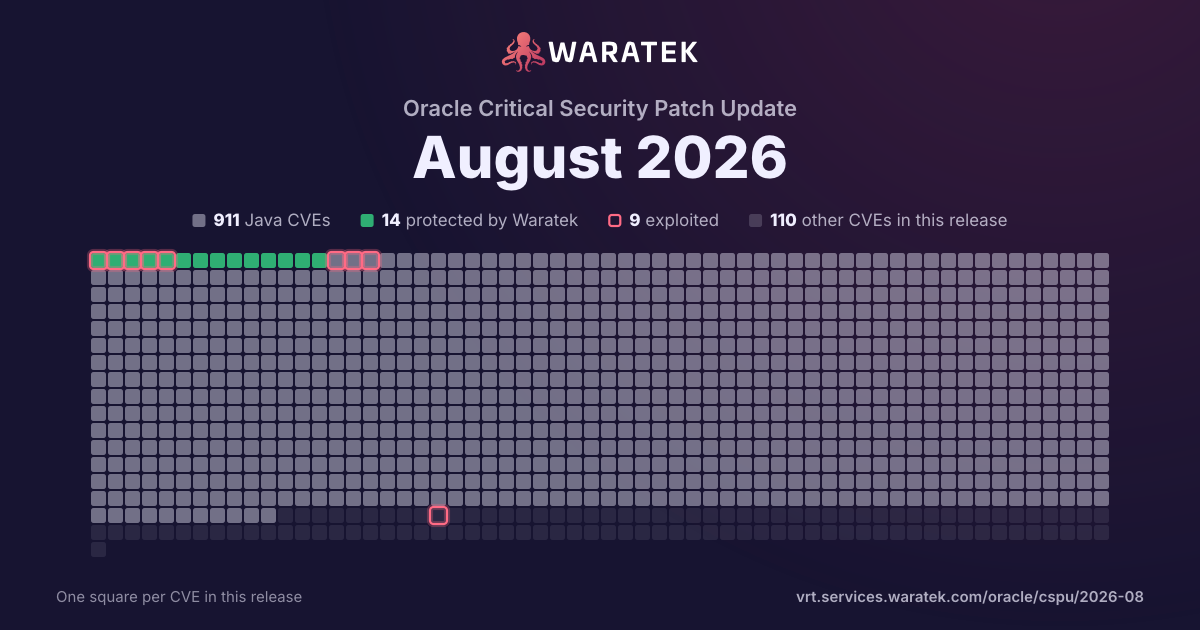
By status
14Protected by Waratek4Mitigation candidate893No exploit published2Outside Waratek scope108Not applicable
9Exploited, marked by the ring
No exploit published. For 847 of them, Oracle's security advisory is the source of public detail.
Protected by Waratek. Waratek RASP can block exploitation of these on systems that have not applied the patch yet.
Overview 7 matches · 4 in Waratek scope · 0 protected · 2 exploited · 1 CISA KEV · 2 public PoC · 1 EPSS ≥ 0.5
7matches
4in Waratek scope57.1%
0protected0.0%
2exploited28.6%
1CISA KEV14.3%
2public PoC28.6%
1EPSS ≥ 0.514.3%
Protected by Waratek
0
0.0%
Rule in development
0
0.0%
Mitigation candidate
2
28.6%
No exploit published
2
28.6%
Outside Waratek scope
0
0.0%
Not applicable
3
42.9%
Withdrawn CVE
0
0.0%
blocked by ARMR today
0
0.0%
partly blocked
0
0.0%
not blocked
7
100.0%
not established
0
0.0%
unrecorded
0
0.0%
Exploited
2
28.6%
Working exploit published
0
0.0%
Proof of concept only
2
28.6%
Forecast only
0
0.0%
No public exploit
3
42.9%
split by
peak 2 / month
Aug 221
Not applicable1
Critical1
not blocked1
Proof of concept only1
Sep 222
No exploit published2
High2
not blocked2
Proof of concept only1
No public exploit1
Oct 220
Nov 220
Dec 220
Jan 230
Feb 230
Mar 230
Apr 230
May 230
Jun 230
Jul 230
Aug 230
Sep 230
Oct 231
Mitigation candidate1
High1
not blocked1
Exploited1
Nov 230
Dec 231
Mitigation candidate1
Critical1
not blocked1
Exploited1
Jan 242
Not applicable2
Medium2
not blocked2
No public exploit2
Sep 22Nov 22Jan 23Mar 23May 23Jul 23Sep 23Nov 23Jan 24
| CVE | Severity | Published▾ | Status | Exploitation | Description |
|---|---|---|---|---|---|
| CVE-2024-0727 | Medium | 2024-01-26 | Not applicable | No public exploit | Issue summary: Processing a maliciously formatted PKCS12 file may lead OpenSSL to crash leading to a potential Denial of Service attack Impact summary: Applications loading files in the PKCS12 format from untrusted sources might terminate abruptly. A file in PKCS12 format can contain certificates and keys and may come from an untrusted source. The PKCS12 specification allows certain fields to be NULL, but OpenSSL does not correctly check for this case. This can lead to a NULL pointer dereference that results in OpenSSL crashing. If an application processes PKCS12 files from an untrusted source using the OpenSSL APIs then that application will be vulnerable to this issue. OpenSSL APIs that are vulnerable to this are: PKCS12_parse(), PKCS12_unpack_p7data(), PKCS12_unpack_p7encdata(), PKCS12_unpack_authsafes() and PKCS12_newpass(). We have also fixed a similar issue in SMIME_write_PKCS7(). However since this function is related to writing data we do not consider it security significant. The FIPS modules in 3.2, 3.1 and 3.0 are not affected by this issue. |
| CVE-2023-6129 | Medium | 2024-01-09 | Not applicable | No public exploit | Issue summary: The POLY1305 MAC (message authentication code) implementation contains a bug that might corrupt the internal state of applications running on PowerPC CPU based platforms if the CPU provides vector instructions. Impact summary: If an attacker can influence whether the POLY1305 MAC algorithm is used, the application state might be corrupted with various application dependent consequences. The POLY1305 MAC (message authentication code) implementation in OpenSSL for PowerPC CPUs restores the contents of vector registers in a different order than they are saved. Thus the contents of some of these vector registers are corrupted when returning to the caller. The vulnerable code is used only on newer PowerPC processors supporting the PowerISA 2.07 instructions. The consequences of this kind of internal application state corruption can be various - from no consequences, if the calling application does not depend on the contents of non-volatile XMM registers at all, to the worst consequences, where the attacker could get complete control of the application process. However unless the compiler uses the vector registers for storing pointers, the most likely consequence, if any, would be an incorrect result of some application dependent calculations or a crash leading to a denial of service. The POLY1305 MAC algorithm is most frequently used as part of the CHACHA20-POLY1305 AEAD (authenticated encryption with associated data) algorithm. The most common usage of this AEAD cipher is with TLS protocol versions 1.2 and 1.3. If this cipher is enabled on the server a malicious client can influence whether this AEAD cipher is used. This implies that TLS server applications using OpenSSL can be potentially impacted. However we are currently not aware of any concrete application that would be affected by this issue therefore we consider this a Low severity security issue. |
| CVE-2023-50164 | Critical | 2023-12-07 | Mitigation candidate | Exploited | An attacker can manipulate file upload params to enable paths traversal and under some circumstances this can lead to uploading a malicious file which can be used to perform Remote Code Execution. Users are recommended to upgrade to versions Struts 2.5.33 or Struts 6.3.0.2 or greater to fix this issue. |
| CVE-2023-44487 | High | 2023-10-10 | Mitigation candidate | Exploited | The HTTP/2 protocol allows a denial of service (server resource consumption) because request cancellation can reset many streams quickly, as exploited in the wild in August through October 2023. |
| CVE-2022-40152 | High | 2022-09-16 | No exploit published | Proof of concept only | Those using Woodstox to parse XML data may be vulnerable to Denial of Service attacks (DOS) if DTD support is enabled. If the parser is running on user supplied input, an attacker may supply content that causes the parser to crash by stackoverflow. This effect may support a denial of service attack. |
| CVE-2022-40150 | High | 2022-09-16 | No exploit published | No public exploit | Those using Jettison to parse untrusted XML or JSON data may be vulnerable to Denial of Service attacks (DOS). If the parser is running on user supplied input, an attacker may supply content that causes the parser to crash by Out of memory. This effect may support a denial of service attack. |
| CVE-2022-37434 | Critical | 2022-08-05 | Not applicable | Proof of concept only | zlib through 1.2.12 has a heap-based buffer over-read or buffer overflow in inflate in inflate.c via a large gzip header extra field. NOTE: only applications that call inflateGetHeader are affected. Some common applications bundle the affected zlib source code but may be unable to call inflateGetHeader (e.g., see the nodejs/node reference). |