
Oracle Critical Security Patch Update August 2026
Released August 2026 · Oracle's advisory ↗ · ← Critical Patch Update, July 2026 · Security Patch Update, September 2026 →
1,021 CVEs in this release, one square each
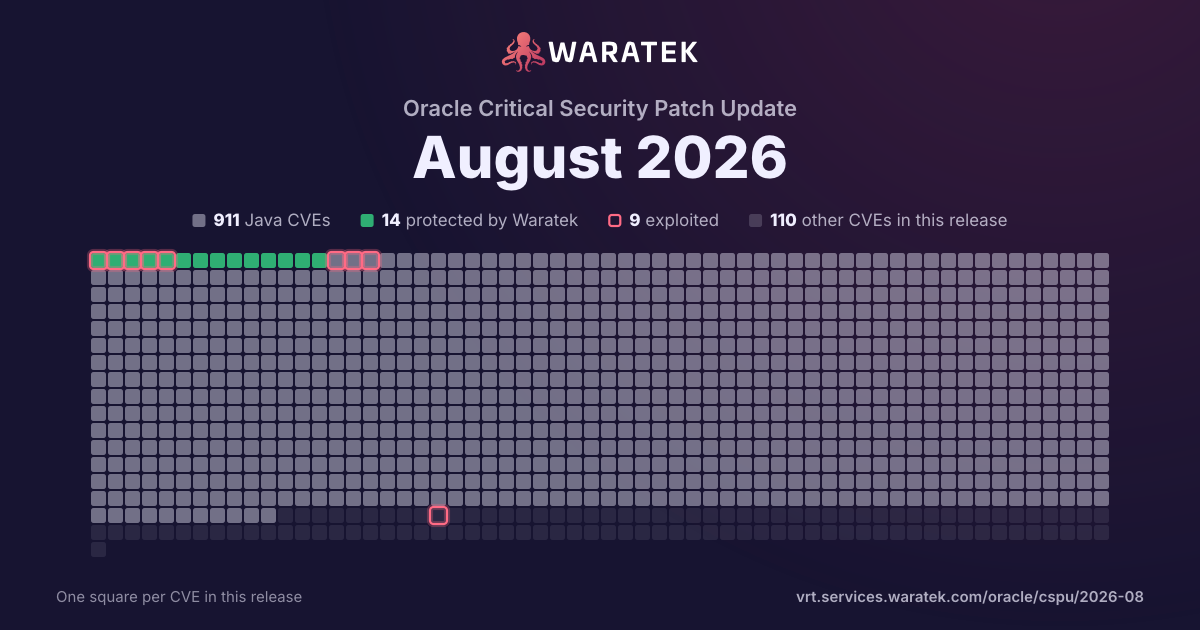
By status
14Protected by Waratek3Mitigation candidate894No exploit published2Outside Waratek scope108Not applicable
9Exploited, marked by the ring
No exploit published. For 848 of them, Oracle's security advisory is the source of public detail.
Protected by Waratek. Waratek RASP can block exploitation of these on systems that have not applied the patch yet.
Overview 12 matches · 1 protected · 0 exploited · 0 CISA KEV · 0 public PoC · 0 EPSS ≥ 0.5
Protected by Waratek
1
8.3%
Rule in development
0
0.0%
Mitigation candidate
0
0.0%
No exploit published
11
91.7%
blocked by ARMR today
1
8.3%
partly blocked
0
0.0%
not blocked
11
91.7%
not established
0
0.0%
unrecorded
0
0.0%
Exploited
0
0.0%
Working exploit published
0
0.0%
Proof of concept only
0
0.0%
Forecast only
0
0.0%
No public exploit
12
100.0%
split by
peak 11 / quarter
Q4 22Q2 23Q4 23Q2 24Q4 24Q2 25Q4 25Q2 26
| CVE | Severity | Published▾ | Status | Exploitation | Description |
|---|---|---|---|---|---|
| CVE-2026-53404 | High | 2026-06-29 | No exploit published | No public exploit | Always-Incorrect Control Flow Implementation vulnerability in Apache Tomcat's rewrite valve meant that if the first condition in an OR chain matched, subsequent non-OR conditions were skipped. This issue affects Apache Tomcat: from 11.0.0-M1 through 11.0.22, from 10.1.0-M1 through 10.1.55, from 9.0.0.M1 through 9.0.118, from 8.5.0 through 8.5.100. Other versions that have reached end of support may also be affected. Users are recommended to upgrade to version 11.0.23, 10.1.56 or 9.0.119, which fix the issue. |
| CVE-2026-41851 | High | 2026-06-09 | No exploit published | No public exploit | Applications which accept user-supplied Spring Expression Language (SpEL) expressions may be vulnerable to a Denial of Service (DoS) attack if the evaluation of a SpEL expression triggers unbounded cache growth. Affected versions: Spring Framework 7.0.0 through 7.0.7; 6.2.0 through 6.2.18; 6.1.0 through 6.1.27; 5.3.0 through 5.3.48. |
| CVE-2026-41850 | High | 2026-06-09 | No exploit published | No public exploit | Applications that evaluate user-supplied Spring Expression Language (SpEL) expressions are vulnerable to an Algorithmic Denial of Service (DoS). By providing a specially crafted expression, an attacker can trigger excessive resource consumption during evaluation, leading to application degradation or unavailability. Affected versions: Spring Framework 7.0.0 through 7.0.7; 6.2.0 through 6.2.18; 6.1.0 through 6.1.27; 5.3.0 through 5.3.48. |
| CVE-2026-41848 | High | 2026-06-09 | No exploit published | No public exploit | Applications may be vulnerable to a Regular Expression Denial of Service (ReDoS) attack if an attacker is able to provide a pattern which is then directly or indirectly supplied to one of the following methods in AntPathMatcher: match(String pattern, String path), matchStart(String pattern, String path), extractUriTemplateVariables(String pattern, String path). Affected versions: Spring Framework 7.0.0 through 7.0.7; 6.2.0 through 6.2.18; 6.1.0 through 6.1.27; 5.3.0 through 5.3.48. |
| CVE-2026-41845 | High | 2026-06-09 | No exploit published | No public exploit | Due to incorrect escaping, the use of JavaScriptUtils.javaScriptEscape() may lead to JavaScript code injection in the browser, potentially resulting in a cross-site scripting (XSS) vulnerability. Affected versions: Spring Framework 7.0.0 through 7.0.7; 6.2.0 through 6.2.18; 6.1.0 through 6.1.27; 5.3.0 through 5.3.48. |
| CVE-2026-41842 | High | 2026-06-09 | No exploit published | No public exploit | Spring MVC and WebFlux applications are vulnerable to Denial of Service (DoS) attacks when resolving static resources. Affected versions: Spring Framework 7.0.0 through 7.0.7; 6.2.0 through 6.2.18; 6.1.0 through 6.1.27; 5.3.0 through 5.3.48. |
| CVE-2026-41838 | High | 2026-06-09 | No exploit published | No public exploit | IDs for WebSocket sessions in the spring-websocket module are not cryptographically unpredictable, which may be possible to exploit in combination with inadequate authorization rules. Affected versions: Spring Framework 7.0.0 through 7.0.7; 6.2.0 through 6.2.18; 6.1.0 through 6.1.27; 5.3.0 through 5.3.48. |
| CVE-2026-44248 | High | 2026-05-13 | No exploit published | No public exploit | Netty is an asynchronous, event-driven network application framework. Prior to 4.2.13.Final and 4.1.133.Final, the MQTT 5 header Properties section is parsed and buffered before any message size limit is applied. Specifically, in MqttDecoder, the decodeVariableHeader() method is called before the bytesRemainingBeforeVariableHeader > maxBytesInMessage check. The decodeVariableHeader() can call other methods which will call decodeProperties(). Effectively, Netty does not apply any limits to the size of the properties being decoded. Additionally, because MqttDecoder extends ReplayingDecoder, Netty will repeatedly re-parse the enormous Properties sections and buffer the bytes in memory, until the entire thing parses to completion. This can cause high resource usage in both CPU and memory. This vulnerability is fixed in 4.2.13.Final and 4.1.133.Final. |
| CVE-2026-42586 | High | 2026-05-13 | No exploit published | No public exploit | Netty is an asynchronous, event-driven network application framework. Prior to 4.2.13.Final and 4.1.133.Final, the Netty Redis codec encoder (RedisEncoder) writes user-controlled string content directly to the network output buffer without validating or sanitizing CRLF (\r\n) characters. Since the Redis Serialization Protocol (RESP) uses CRLF as the command/response delimiter, an attacker who can control the content of a Redis message can inject arbitrary Redis commands or forge fake responses. This vulnerability is fixed in 4.2.13.Final and 4.1.133.Final. |
| CVE-2026-5795 | High | 2026-04-08 | No exploit published | No public exploit | In Eclipse Jetty, the class JASPIAuthenticator initiates the authentication checks, which set two ThreadLocal variable. Upon returning from the initial checks, there are conditions that cause an early return from the JASPIAuthenticator code without clearing those ThreadLocals. A subsequent request using the same thread inherits the ThreadLocal values, leading to a broken access control and privilege escalation. |
| CVE-2026-35554 | High | 2026-04-07 | Protected by Waratek | No public exploit | A race condition in the Apache Kafka Java producer client’s buffer pool management can cause messages to be silently delivered to incorrect topics. When a produce batch expires due to delivery.timeout.ms while a network request containing that batch is still in flight, the batch’s ByteBuffer is prematurely deallocated and returned to the buffer pool. If a subsequent producer batch—potentially destined for a different topic—reuses this freed buffer before the original network request completes, the buffer contents may become corrupted. This can result in messages being delivered to unintended topics without any error being reported to the producer. Data Confidentiality: Messages intended for one topic may be delivered to a different topic, potentially exposing sensitive data to consumers who have access to the destination topic but not the intended source topic. Data Integrity: Consumers on the receiving topic may encounter unexpected or incompatible messages, leading to deserialization failures, processing errors, and corrupted downstream data. This issue affects Apache Kafka versions ≤ 3.9.1, ≤ 4.0.1, and ≤ 4.1.1. Kafka users are advised to upgrade to 3.9.2, 4.0.2, 4.1.2, 4.2.0, or later to address this vulnerability. |
| CVE-2022-40150 | High | 2022-09-16 | No exploit published | No public exploit | Those using Jettison to parse untrusted XML or JSON data may be vulnerable to Denial of Service attacks (DOS). If the parser is running on user supplied input, an attacker may supply content that causes the parser to crash by Out of memory. This effect may support a denial of service attack. |