
Oracle Critical Security Patch Update August 2026
Released August 2026 · Oracle's advisory ↗ · ← Critical Patch Update, July 2026 · Security Patch Update, September 2026 →
1,021 CVEs in this release, one square each
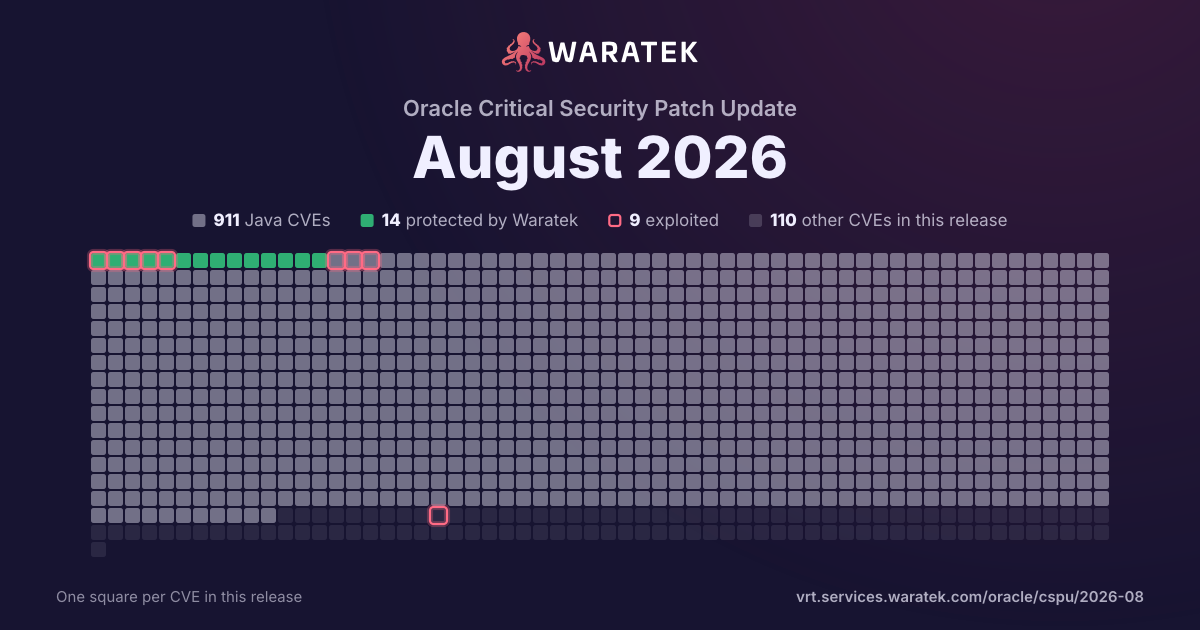
By status
14Protected by Waratek4Mitigation candidate893No exploit published2Outside Waratek scope108Not applicable
9Exploited, marked by the ring
No exploit published. For 847 of them, Oracle's security advisory is the source of public detail.
Protected by Waratek. Waratek RASP can block exploitation of these on systems that have not applied the patch yet.
Overview 15 matches · 0 in Waratek scope · 0 protected · 0 exploited · 0 CISA KEV · 2 public PoC · 0 EPSS ≥ 0.5
15matches
0in Waratek scope0.0%
0protected0.0%
0exploited0.0%
0CISA KEV0.0%
2public PoC13.3%
0EPSS ≥ 0.50.0%
Protected by Waratek
0
0.0%
Rule in development
0
0.0%
Mitigation candidate
0
0.0%
No exploit published
0
0.0%
Outside Waratek scope
0
0.0%
Not applicable
15
100.0%
Withdrawn CVE
0
0.0%
blocked by ARMR today
0
0.0%
partly blocked
0
0.0%
not blocked
15
100.0%
not established
0
0.0%
unrecorded
0
0.0%
Exploited
0
0.0%
Working exploit published
0
0.0%
Proof of concept only
15
100.0%
Forecast only
0
0.0%
No public exploit
0
0.0%
split by
peak 9 / quarter
Q3 221
Not applicable1
Critical1
not blocked1
Proof of concept only1
Q4 220
Q1 230
Q2 230
Q3 230
Q4 230
Q1 240
Q2 240
Q3 240
Q4 240
Q1 250
Q2 250
Q3 250
Q4 250
Q1 261
Not applicable1
Medium1
not blocked1
Proof of concept only1
Q2 264
Not applicable4
High2
Medium2
not blocked4
Proof of concept only4
Q3 269
Not applicable9
Critical1
High1
Medium7
not blocked9
Proof of concept only9
Q3 22Q1 23Q3 23Q1 24Q3 24Q1 25Q3 25Q1 26Q3 26
| CVE | Severity | Published▾ | Status | Exploitation | Description |
|---|---|---|---|---|---|
| CVE-2026-60591 | Critical | 2026-08-18 | Not applicable | Proof of concept only | Vulnerability in the Oracle Hospitality Simphony product of Oracle Food and Beverage Applications (component: POS). Supported versions that are affected are 19.8-19.8.5, 19.9-19.9.3 and 19.10-19.10.1. Easily exploitable vulnerability allows unauthenticated attacker with network access via HTTP to compromise Oracle Hospitality Simphony. Successful attacks of this vulnerability can result in unauthorized creation, deletion or modification access to critical data or all Oracle Hospitality Simphony accessible data and unauthorized ability to cause a hang or frequently repeatable crash (complete DOS) of Oracle Hospitality Simphony. CVSS 3.1 Base Score 9.1 (Integrity and Availability impacts). CVSS Vector: (CVSS:3.1/AV:N/AC:L/PR:N/UI:N/S:U/C:N/I:H/A:H). |
| CVE-2026-65914 | Medium | 2026-07-23 | Not applicable | Proof of concept only | DOMPurify before 3.3.2 contains a mutation-XSS vulnerability when sanitized HTML is reinserted into special parsing contexts using innerHTML with wrappers like script, xmp, iframe, noembed, noframes, or noscript. Attackers can craft payloads with closing sequences that break out of the wrapper context during reparsing, reactivating dangerous markup with event handlers to execute JavaScript. |
| CVE-2026-65902 | Medium | 2026-07-23 | Not applicable | Proof of concept only | DOMPurify before 3.4.7 passes direct references to the module-level DEFAULT_ALLOWED_TAGS and DEFAULT_ALLOWED_ATTR sets to the uponSanitizeElement and uponSanitizeAttribute hooks via data.allowedTags / data.allowedAttributes when sanitize is called without an explicit cfg.ALLOWED_TAGS / cfg.ALLOWED_ATTR array. A hook that mutates these fields permanently widens the default allow-lists for the lifetime of the DOMPurify instance, so all subsequent default-config sanitize calls inherit the widened defaults and attacker payloads using the poisoned tag/attribute name survive sanitization. removeAllHooks(), clearConfig(), and passing a fresh cfg do not recover the state; only constructing a new DOMPurify instance does. |
| CVE-2026-65901 | Medium | 2026-07-23 | Not applicable | Proof of concept only | DOMPurify through 3.4.6 contains a cross-site scripting vulnerability in IN_PLACE mode that trusts attacker-controlled nodeName on live non-form nodes. Attackers can supply hostile live DOM objects with real script children whose observable nodeName is clobbered to appear as allowed elements, causing scripts to execute when the sanitized tree is inserted into a live document. |
| CVE-2026-65900 | Medium | 2026-07-23 | Not applicable | Proof of concept only | DOMPurify versions >=3.0.0 and before 3.4.8, when configured with SAFE_FOR_TEMPLATES together with a DOM output mode (RETURN_DOM, RETURN_DOM_FRAGMENT, or IN_PLACE), fail to strip template expressions (e.g. ${evil}, {{evil}}, <%evil%>) inside <template> element content. The final normalization/scrub pass (_scrubTemplateExpressions) uses a NodeIterator and node.normalize() that do not descend into template.content, so expressions that only form after adjacent text nodes merge survive sanitization. This bypasses SAFE_FOR_TEMPLATES and can allow a downstream template engine to evaluate attacker-supplied expressions. The string output path is not affected. |
| CVE-2026-49978 | Medium | 2026-07-14 | Not applicable | Proof of concept only | DOMPurify is a DOM-only cross-site scripting sanitizer for HTML, MathML, and SVG. Prior to 3.4.7, DOMPurify IN_PLACE sanitization could skip shadow contents attached to an element inside <template>.content, allowing attacker-controlled markup such as event handlers, JavaScript URLs, or scripts to survive and execute when an application cloned and inserted the sanitized template. This issue is fixed in version 3.4.7. |
| CVE-2026-49459 | Medium | 2026-07-14 | Not applicable | Proof of concept only | DOMPurify is a DOM-only cross-site scripting sanitizer for HTML, MathML, and SVG. Prior to 3.4.6, DOMPurify.sanitize(root, { IN_PLACE: true }) could preserve event-handler attributes on an attacker-controlled <form> root when a descendant name clobbered properties checked by _isClobbered, because _forceRemove no-opped on the parent-less root and _sanitizeAttributes returned early. This issue is fixed in version 3.4.6. |
| CVE-2026-49458 | Medium | 2026-07-14 | Not applicable | Proof of concept only | DOMPurify is a DOM-only cross-site scripting sanitizer for HTML, MathML, and SVG. Prior to 3.4.6, DOMPurify.sanitize(node, { IN_PLACE: true }) accepted same-origin foreign-realm DOM nodes while follow-on checks used parent-realm constructors, causing instanceof checks for forms, named node maps, document fragments, and elements to fail and skip clobber, template-content, and shadow-DOM sanitization branches so executable markup could survive. This issue is fixed in version 3.4.6. |
| CVE-2026-9563 | High | 2026-07-02 | Not applicable | Proof of concept only | In Eclipse Parsson published Maven Central artifacts before version 1.1.8, the JSON parser did not enforce a default maximum on the number of characters consumed while parsing a single JSON document. Applications that parse attacker- controlled JSON can be forced to consume excessive CPU and memory by processing very large documents, including large arrays, objects, strings, numbers, whitespace, or nested structures, resulting in a denial of service. Eclipse Parsson 1.1.8 introduces a configurable maximum parsing limit with a default limit of 15 million parser-consumed characters. |
| CVE-2026-49975 | High | 2026-06-08 | Not applicable | Proof of concept only | Memory Allocation with Excessive Size Value vulnerability in Apache HTTP Server's mod_http leads to denial of service via malicious HTTP requests. This issue affects Apache HTTP Server: from 2.4.17 through 2.4.67. |
| CVE-2026-42536 | High | 2026-06-08 | Not applicable | Proof of concept only | Heap-based Buffer Overflow vulnerability in Apache HTTP Server with mod_xml2enc, xml2StartParse, and untrusted content This issue affects Apache HTTP Server: from 2.4.0 through 2.4.67. Users are recommended to upgrade to version 2.4.68, which fixes the issue. |
| CVE-2026-41240 | Medium | 2026-04-23 | Not applicable | Proof of concept only | DOMPurify is a DOM-only cross-site scripting sanitizer for HTML, MathML, and SVG. Versions prior to 3.4.0 have an inconsistency between FORBID_TAGS and FORBID_ATTR handling when function-based ADD_TAGS is used. Commit c361baa added an early exit for FORBID_ATTR at line 1214. The same fix was not applied to FORBID_TAGS. At line 1118-1123, when EXTRA_ELEMENT_HANDLING.tagCheck returns true, the short-circuit evaluation skips the FORBID_TAGS check entirely. This allows forbidden elements to survive sanitization with their attributes intact. Version 3.4.0 patches the issue. |
| CVE-2026-41238 | Medium | 2026-04-23 | Not applicable | Proof of concept only | DOMPurify is a DOM-only cross-site scripting sanitizer for HTML, MathML, and SVG. Versions 3.0.1 through 3.3.3 are vulnerable to a prototype pollution-based XSS bypass. When an application uses `DOMPurify.sanitize()` with the default configuration (no `CUSTOM_ELEMENT_HANDLING` option), a prior prototype pollution gadget can inject permissive `tagNameCheck` and `attributeNameCheck` regex values into `Object.prototype`, causing DOMPurify to allow arbitrary custom elements with arbitrary attributes — including event handlers — through sanitization. Version 3.4.0 fixes the issue. |
| CVE-2026-27171 | Medium | 2026-02-18 | Not applicable | Proof of concept only | zlib before 1.3.2 allows CPU consumption via crc32_combine64 and crc32_combine_gen64 because x2nmodp can do right shifts within a loop that has no termination condition. |
| CVE-2022-37434 | Critical | 2022-08-05 | Not applicable | Proof of concept only | zlib through 1.2.12 has a heap-based buffer over-read or buffer overflow in inflate in inflate.c via a large gzip header extra field. NOTE: only applications that call inflateGetHeader are affected. Some common applications bundle the affected zlib source code but may be unable to call inflateGetHeader (e.g., see the nodejs/node reference). |