
Oracle Critical Security Patch Update August 2026
Released August 2026 · Oracle's advisory ↗ · ← Critical Patch Update, July 2026 · Security Patch Update, September 2026 →
1,021 CVEs in this release, one square each
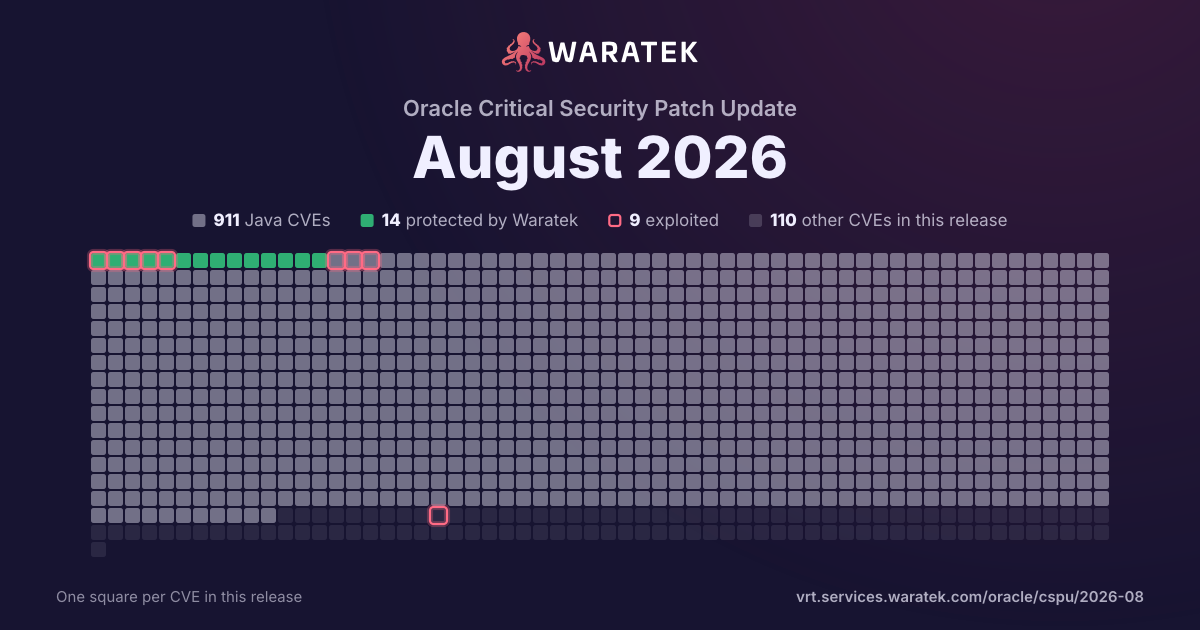
By status
14Protected by Waratek3Mitigation candidate894No exploit published2Outside Waratek scope108Not applicable
9Exploited, marked by the ring
No exploit published. For 848 of them, Oracle's security advisory is the source of public detail.
Protected by Waratek. Waratek RASP can block exploitation of these on systems that have not applied the patch yet.
Overview 9 matches · 6 in Waratek scope · 2 protected · 0 exploited · 0 CISA KEV · 4 public PoC · 2 EPSS ≥ 0.5
9matches
6in Waratek scope66.7%
2protected22.2%
0exploited0.0%
0CISA KEV0.0%
4public PoC44.4%
2EPSS ≥ 0.522.2%
Protected by Waratek
2
22.2%
Rule in development
0
0.0%
Mitigation candidate
0
0.0%
No exploit published
4
44.4%
Outside Waratek scope
0
0.0%
Not applicable
3
33.3%
Withdrawn CVE
0
0.0%
blocked by ARMR today
2
22.2%
partly blocked
0
0.0%
not blocked
7
77.8%
not established
0
0.0%
unrecorded
0
0.0%
Exploited
0
0.0%
Working exploit published
0
0.0%
Proof of concept only
9
100.0%
Forecast only
0
0.0%
No public exploit
0
0.0%
split by
peak 5 / quarter
Q3 222
Protected by Waratek1
No exploit published1
High2
blocked by ARMR today1
not blocked1
Proof of concept only2
Q4 220
Q1 230
Q2 230
Q3 230
Q4 230
Q1 241
Protected by Waratek1
High1
blocked by ARMR today1
Proof of concept only1
Q2 240
Q3 240
Q4 240
Q1 250
Q2 250
Q3 250
Q4 250
Q1 260
Q2 265
No exploit published3
Not applicable2
High5
not blocked5
Proof of concept only5
Q3 261
Not applicable1
High1
not blocked1
Proof of concept only1
Q3 22Q1 23Q3 23Q1 24Q3 24Q1 25Q3 25Q1 26Q3 26
| CVE | Severity | Published▾ | Status | Exploitation | Description |
|---|---|---|---|---|---|
| CVE-2026-9563 | High | 2026-07-02 | Not applicable | Proof of concept only | In Eclipse Parsson published Maven Central artifacts before version 1.1.8, the JSON parser did not enforce a default maximum on the number of characters consumed while parsing a single JSON document. Applications that parse attacker- controlled JSON can be forced to consume excessive CPU and memory by processing very large documents, including large arrays, objects, strings, numbers, whitespace, or nested structures, resulting in a denial of service. Eclipse Parsson 1.1.8 introduces a configurable maximum parsing limit with a default limit of 15 million parser-consumed characters. |
| CVE-2026-49975 | High | 2026-06-08 | Not applicable | Proof of concept only | Memory Allocation with Excessive Size Value vulnerability in Apache HTTP Server's mod_http leads to denial of service via malicious HTTP requests. This issue affects Apache HTTP Server: from 2.4.17 through 2.4.67. |
| CVE-2026-42536 | High | 2026-06-08 | Not applicable | Proof of concept only | Heap-based Buffer Overflow vulnerability in Apache HTTP Server with mod_xml2enc, xml2StartParse, and untrusted content This issue affects Apache HTTP Server: from 2.4.0 through 2.4.67. Users are recommended to upgrade to version 2.4.68, which fixes the issue. |
| CVE-2026-42587 | High | 2026-05-13 | No exploit published | Proof of concept only | Netty is an asynchronous, event-driven network application framework. Prior to 4.2.13.Final and 4.1.133.Final, HttpContentDecompressor accepts a maxAllocation parameter to limit decompression buffer size and prevent decompression bomb attacks. This limit is correctly enforced for gzip and deflate encodings via ZlibDecoder, but is silently ignored when the content encoding is br (Brotli), zstd, or snappy. An attacker can bypass the configured decompression limit by sending a compressed payload with Content-Encoding: br instead of Content-Encoding: gzip, causing unbounded memory allocation and out-of-memory denial of service. The same vulnerability exists in DelegatingDecompressorFrameListener for HTTP/2 connections. This vulnerability is fixed in 4.2.13.Final and 4.1.133.Final. |
| CVE-2026-42585 | High | 2026-05-13 | No exploit published | Proof of concept only | Netty is an asynchronous, event-driven network application framework. Prior to 4.2.13.Final and 4.1.133.Final, Netty incorrectly parses malformed Transfer-Encoding, enabling request smuggling attacks. This vulnerability is fixed in 4.2.13.Final and 4.1.133.Final. |
| CVE-2026-42583 | High | 2026-05-13 | No exploit published | Proof of concept only | Netty is an asynchronous, event-driven network application framework. Prior to 4.2.13.Final and 4.1.133.Final, Lz4FrameDecoder allocates a ByteBuf of size decompressedLength (up to 32 MB per block) before LZ4 runs. A peer only needs a 21-byte header plus compressedLength payload bytes - 22 bytes if compressedLength == 1 - to force that allocation. This vulnerability is fixed in 4.2.13.Final and 4.1.133.Final. |
| CVE-2024-20931 | High | 2024-02-17 | Protected by Waratek | Proof of concept only | Vulnerability in the Oracle WebLogic Server product of Oracle Fusion Middleware (component: Core). Supported versions that are affected are 12.2.1.4.0 and 14.1.1.0.0. Easily exploitable vulnerability allows unauthenticated attacker with network access via T3, IIOP to compromise Oracle WebLogic Server. Successful attacks of this vulnerability can result in unauthorized access to critical data or complete access to all Oracle WebLogic Server accessible data. CVSS 3.1 Base Score 7.5 (Confidentiality impacts). CVSS Vector: (CVSS:3.1/AV:N/AC:L/PR:N/UI:N/S:U/C:H/I:N/A:N). |
| CVE-2022-40152 | High | 2022-09-16 | No exploit published | Proof of concept only | Those using Woodstox to parse XML data may be vulnerable to Denial of Service attacks (DOS) if DTD support is enabled. If the parser is running on user supplied input, an attacker may supply content that causes the parser to crash by stackoverflow. This effect may support a denial of service attack. |
| CVE-2022-34169 | High | 2022-07-19 | Protected by Waratek | Proof of concept only | The Apache Xalan Java XSLT library is vulnerable to an integer truncation issue when processing malicious XSLT stylesheets. This can be used to corrupt Java class files generated by the internal XSLTC compiler and execute arbitrary Java bytecode. Users are recommended to update to version 2.7.3 or later. Note: Java runtimes (such as OpenJDK) include repackaged copies of Xalan. |