
Oracle Critical Security Patch Update August 2026
Released August 2026 · Oracle's advisory ↗ · ← Critical Patch Update, July 2026 · Security Patch Update, September 2026 →
1,021 CVEs in this release, one square each
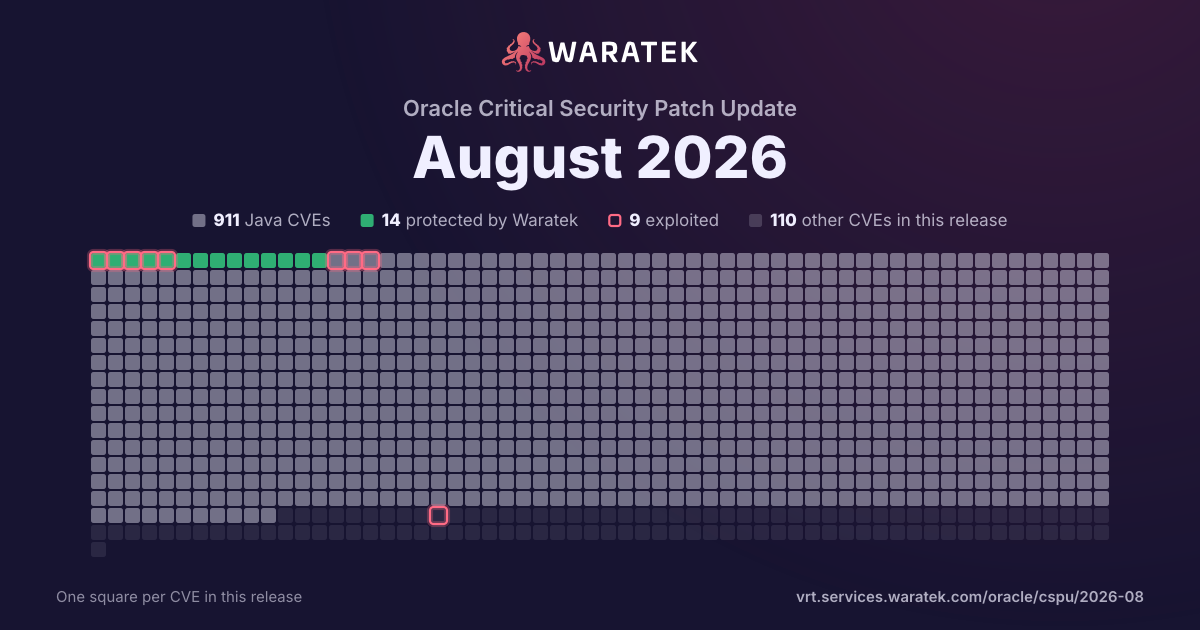
By status
14Protected by Waratek3Mitigation candidate894No exploit published2Outside Waratek scope108Not applicable
9Exploited, marked by the ring
No exploit published. For 848 of them, Oracle's security advisory is the source of public detail.
Protected by Waratek. Waratek RASP can block exploitation of these on systems that have not applied the patch yet.
Overview 30 matches · 15 in Waratek scope · 4 protected · 0 exploited · 0 CISA KEV · 6 public PoC · 3 EPSS ≥ 0.5
30matches
15in Waratek scope50.0%
4protected13.3%
0exploited0.0%
0CISA KEV0.0%
6public PoC20.0%
3EPSS ≥ 0.510.0%
Protected by Waratek
4
13.3%
Rule in development
0
0.0%
Mitigation candidate
0
0.0%
No exploit published
11
36.7%
Outside Waratek scope
0
0.0%
Not applicable
15
50.0%
Withdrawn CVE
0
0.0%
blocked by ARMR today
4
13.3%
partly blocked
0
0.0%
not blocked
26
86.7%
not established
0
0.0%
unrecorded
0
0.0%
Exploited
0
0.0%
Working exploit published
0
0.0%
Proof of concept only
30
100.0%
Forecast only
0
0.0%
No public exploit
0
0.0%
split by
peak 15 / quarter
Q1 221
Protected by Waratek1
Critical1
blocked by ARMR today1
Proof of concept only1
Q2 220
Q3 223
Protected by Waratek1
No exploit published1
Not applicable1
Critical1
High2
blocked by ARMR today1
not blocked2
Proof of concept only3
Q4 220
Q1 230
Q2 230
Q3 230
Q4 230
Q1 241
Protected by Waratek1
High1
blocked by ARMR today1
Proof of concept only1
Q2 240
Q3 240
Q4 240
Q1 250
Q2 250
Q3 250
Q4 250
Q1 261
Not applicable1
Medium1
not blocked1
Proof of concept only1
Q2 2615
Protected by Waratek1
No exploit published10
Not applicable4
Critical5
High5
Medium4
Low1
blocked by ARMR today1
not blocked14
Proof of concept only15
Q3 269
Not applicable9
Critical1
High1
Medium7
not blocked9
Proof of concept only9
Q1 22Q3 22Q1 23Q3 23Q1 24Q3 24Q1 25Q3 25Q1 26Q3 26
| CVE | Severity | Published▾ | Status | Exploitation | Description |
|---|---|---|---|---|---|
| CVE-2026-60591 | Critical | 2026-08-18 | Not applicable | Proof of concept only | Vulnerability in the Oracle Hospitality Simphony product of Oracle Food and Beverage Applications (component: POS). Supported versions that are affected are 19.8-19.8.5, 19.9-19.9.3 and 19.10-19.10.1. Easily exploitable vulnerability allows unauthenticated attacker with network access via HTTP to compromise Oracle Hospitality Simphony. Successful attacks of this vulnerability can result in unauthorized creation, deletion or modification access to critical data or all Oracle Hospitality Simphony accessible data and unauthorized ability to cause a hang or frequently repeatable crash (complete DOS) of Oracle Hospitality Simphony. CVSS 3.1 Base Score 9.1 (Integrity and Availability impacts). CVSS Vector: (CVSS:3.1/AV:N/AC:L/PR:N/UI:N/S:U/C:N/I:H/A:H). |
| CVE-2026-65914 | Medium | 2026-07-23 | Not applicable | Proof of concept only | DOMPurify before 3.3.2 contains a mutation-XSS vulnerability when sanitized HTML is reinserted into special parsing contexts using innerHTML with wrappers like script, xmp, iframe, noembed, noframes, or noscript. Attackers can craft payloads with closing sequences that break out of the wrapper context during reparsing, reactivating dangerous markup with event handlers to execute JavaScript. |
| CVE-2026-65902 | Medium | 2026-07-23 | Not applicable | Proof of concept only | DOMPurify before 3.4.7 passes direct references to the module-level DEFAULT_ALLOWED_TAGS and DEFAULT_ALLOWED_ATTR sets to the uponSanitizeElement and uponSanitizeAttribute hooks via data.allowedTags / data.allowedAttributes when sanitize is called without an explicit cfg.ALLOWED_TAGS / cfg.ALLOWED_ATTR array. A hook that mutates these fields permanently widens the default allow-lists for the lifetime of the DOMPurify instance, so all subsequent default-config sanitize calls inherit the widened defaults and attacker payloads using the poisoned tag/attribute name survive sanitization. removeAllHooks(), clearConfig(), and passing a fresh cfg do not recover the state; only constructing a new DOMPurify instance does. |
| CVE-2026-65901 | Medium | 2026-07-23 | Not applicable | Proof of concept only | DOMPurify through 3.4.6 contains a cross-site scripting vulnerability in IN_PLACE mode that trusts attacker-controlled nodeName on live non-form nodes. Attackers can supply hostile live DOM objects with real script children whose observable nodeName is clobbered to appear as allowed elements, causing scripts to execute when the sanitized tree is inserted into a live document. |
| CVE-2026-65900 | Medium | 2026-07-23 | Not applicable | Proof of concept only | DOMPurify versions >=3.0.0 and before 3.4.8, when configured with SAFE_FOR_TEMPLATES together with a DOM output mode (RETURN_DOM, RETURN_DOM_FRAGMENT, or IN_PLACE), fail to strip template expressions (e.g. ${evil}, {{evil}}, <%evil%>) inside <template> element content. The final normalization/scrub pass (_scrubTemplateExpressions) uses a NodeIterator and node.normalize() that do not descend into template.content, so expressions that only form after adjacent text nodes merge survive sanitization. This bypasses SAFE_FOR_TEMPLATES and can allow a downstream template engine to evaluate attacker-supplied expressions. The string output path is not affected. |
| CVE-2026-49978 | Medium | 2026-07-14 | Not applicable | Proof of concept only | DOMPurify is a DOM-only cross-site scripting sanitizer for HTML, MathML, and SVG. Prior to 3.4.7, DOMPurify IN_PLACE sanitization could skip shadow contents attached to an element inside <template>.content, allowing attacker-controlled markup such as event handlers, JavaScript URLs, or scripts to survive and execute when an application cloned and inserted the sanitized template. This issue is fixed in version 3.4.7. |
| CVE-2026-49459 | Medium | 2026-07-14 | Not applicable | Proof of concept only | DOMPurify is a DOM-only cross-site scripting sanitizer for HTML, MathML, and SVG. Prior to 3.4.6, DOMPurify.sanitize(root, { IN_PLACE: true }) could preserve event-handler attributes on an attacker-controlled <form> root when a descendant name clobbered properties checked by _isClobbered, because _forceRemove no-opped on the parent-less root and _sanitizeAttributes returned early. This issue is fixed in version 3.4.6. |
| CVE-2026-49458 | Medium | 2026-07-14 | Not applicable | Proof of concept only | DOMPurify is a DOM-only cross-site scripting sanitizer for HTML, MathML, and SVG. Prior to 3.4.6, DOMPurify.sanitize(node, { IN_PLACE: true }) accepted same-origin foreign-realm DOM nodes while follow-on checks used parent-realm constructors, causing instanceof checks for forms, named node maps, document fragments, and elements to fail and skip clobber, template-content, and shadow-DOM sanitization branches so executable markup could survive. This issue is fixed in version 3.4.6. |
| CVE-2026-9563 | High | 2026-07-02 | Not applicable | Proof of concept only | In Eclipse Parsson published Maven Central artifacts before version 1.1.8, the JSON parser did not enforce a default maximum on the number of characters consumed while parsing a single JSON document. Applications that parse attacker- controlled JSON can be forced to consume excessive CPU and memory by processing very large documents, including large arrays, objects, strings, numbers, whitespace, or nested structures, resulting in a denial of service. Eclipse Parsson 1.1.8 introduces a configurable maximum parsing limit with a default limit of 15 million parser-consumed characters. |
| CVE-2026-49975 | High | 2026-06-08 | Not applicable | Proof of concept only | Memory Allocation with Excessive Size Value vulnerability in Apache HTTP Server's mod_http leads to denial of service via malicious HTTP requests. This issue affects Apache HTTP Server: from 2.4.17 through 2.4.67. |
| CVE-2026-42536 | High | 2026-06-08 | Not applicable | Proof of concept only | Heap-based Buffer Overflow vulnerability in Apache HTTP Server with mod_xml2enc, xml2StartParse, and untrusted content This issue affects Apache HTTP Server: from 2.4.0 through 2.4.67. Users are recommended to upgrade to version 2.4.68, which fixes the issue. |
| CVE-2026-42587 | High | 2026-05-13 | No exploit published | Proof of concept only | Netty is an asynchronous, event-driven network application framework. Prior to 4.2.13.Final and 4.1.133.Final, HttpContentDecompressor accepts a maxAllocation parameter to limit decompression buffer size and prevent decompression bomb attacks. This limit is correctly enforced for gzip and deflate encodings via ZlibDecoder, but is silently ignored when the content encoding is br (Brotli), zstd, or snappy. An attacker can bypass the configured decompression limit by sending a compressed payload with Content-Encoding: br instead of Content-Encoding: gzip, causing unbounded memory allocation and out-of-memory denial of service. The same vulnerability exists in DelegatingDecompressorFrameListener for HTTP/2 connections. This vulnerability is fixed in 4.2.13.Final and 4.1.133.Final. |
| CVE-2026-42585 | High | 2026-05-13 | No exploit published | Proof of concept only | Netty is an asynchronous, event-driven network application framework. Prior to 4.2.13.Final and 4.1.133.Final, Netty incorrectly parses malformed Transfer-Encoding, enabling request smuggling attacks. This vulnerability is fixed in 4.2.13.Final and 4.1.133.Final. |
| CVE-2026-42584 | Critical | 2026-05-13 | No exploit published | Proof of concept only | Netty is an asynchronous, event-driven network application framework. Prior to 4.2.13.Final and 4.1.133.Final, HttpClientCodec pairs each inbound response with an outbound request by queue.poll() once per response, including for 1xx. If the client pipelines GET then HEAD and the server sends 103, then 200 with GET body, then 200 for HEAD, the queue pairs HEAD with the first 200. The HEAD rule then skips reading that message’s body, so the GET entity bytes stay on the stream and the following 200 is parsed from the wrong offset. This vulnerability is fixed in 4.2.13.Final and 4.1.133.Final. |
| CVE-2026-42583 | High | 2026-05-13 | No exploit published | Proof of concept only | Netty is an asynchronous, event-driven network application framework. Prior to 4.2.13.Final and 4.1.133.Final, Lz4FrameDecoder allocates a ByteBuf of size decompressedLength (up to 32 MB per block) before LZ4 runs. A peer only needs a 21-byte header plus compressedLength payload bytes - 22 bytes if compressedLength == 1 - to force that allocation. This vulnerability is fixed in 4.2.13.Final and 4.1.133.Final. |
| CVE-2026-42581 | Critical | 2026-05-13 | No exploit published | Proof of concept only | Netty is an asynchronous, event-driven network application framework. Prior to 4.2.13.Final and 4.1.133.Final, HttpObjectDecoder strips a conflicting Content-Length header when a request carries both Transfer-Encoding: chunked and Content-Length, but only for HTTP/1.1 messages. The guard is absent for HTTP/1.0. An attacker that sends an HTTP/1.0 request with both headers causes Netty to decode the body as chunked while leaving Content-Length intact in the forwarded HttpMessage. Any downstream proxy or handler that trusts Content-Length over Transfer-Encoding will disagree on message boundaries, enabling request smuggling. This vulnerability is fixed in 4.2.13.Final and 4.1.133.Final. |
| CVE-2026-42580 | Medium | 2026-05-13 | No exploit published | Proof of concept only | Netty is an asynchronous, event-driven network application framework. Prior to 4.2.13.Final and 4.1.133.Final, Netty's chunk size parser silently overflows int, enabling request smuggling attacks. This vulnerability is fixed in 4.2.13.Final and 4.1.133.Final. |
| CVE-2026-42579 | Critical | 2026-05-13 | No exploit published | Proof of concept only | Netty is an asynchronous, event-driven network application framework. Prior to 4.2.13.Final and 4.1.133.Final, Netty's DNS codec does not enforce RFC 1035 domain name constraints during either encoding or decoding. This creates a bidirectional attack surface: malicious DNS responses can exploit the decoder, and user-influenced hostnames can exploit the encoder. This vulnerability is fixed in 4.2.13.Final and 4.1.133.Final. |
| CVE-2026-42578 | Low | 2026-05-13 | No exploit published | Proof of concept only | Netty is an asynchronous, event-driven network application framework. Prior to 4.2.13.Final and 4.1.133.Final, Netty's HttpProxyHandler constructs HTTP CONNECT requests with header validation explicitly disabled. The newInitialMessage() method creates headers using DefaultHttpHeadersFactory.headersFactory().withValidation(false), then adds user-provided outboundHeaders without any CRLF validation. This allows an attacker who can influence the outbound headers to inject arbitrary HTTP headers into the CONNECT request sent to the proxy server. This vulnerability is fixed in 4.2.13.Final and 4.1.133.Final. |
| CVE-2026-41417 | Medium | 2026-05-06 | No exploit published | Proof of concept only | Netty allows request-line validation to be bypassed when a `DefaultHttpRequest` or `DefaultFullHttpRequest` is created first and its URI is later changed via `setUri()`. The constructors reject CRLF and whitespace characters that would break the start-line, but `setUri()` does not apply the same validation. `HttpRequestEncoder` and `RtspEncoder` then write the URI into the request line verbatim. If attacker-controlled input reaches `setUri()`, this enables CRLF injection and insertion of additional HTTP or RTSP requests, leading to HTTP request smuggling or desynchronization on the HTTP side and request injection on the RTSP side. This issue is fixed in versions 4.2.13.Final and 4.1.133.Final. |
| CVE-2026-42779 | Critical | 2026-05-01 | Protected by Waratek | Proof of concept only | The fix for CVE-2026-41635 was not applied to the 2.1.X and 2.2.X branches. Here was the original issue description: Apache MINA's AbstractIoBuffer.resolveClass() contains two branches, one of them (for static classes or primitive types) does not check the class at all, bypassing the classname allowlist and allowing arbitrary code to be executed. The fix checks if the class is present in the accepted class filter before calling Class.forName(). Affected versions are Apache MINA 2.1.0 <= 2.1.11, and 2.2.0 <= 2.2.6. The problem is resolved in Apache MINA 2.1.12, and 2.2.7 by applying the classname allowlist earlier. Affected are applications using Apache MINA that call IoBuffer.getObject(). Applications using Apache MINA are advised to upgrade. |
| CVE-2026-41240 | Medium | 2026-04-23 | Not applicable | Proof of concept only | DOMPurify is a DOM-only cross-site scripting sanitizer for HTML, MathML, and SVG. Versions prior to 3.4.0 have an inconsistency between FORBID_TAGS and FORBID_ATTR handling when function-based ADD_TAGS is used. Commit c361baa added an early exit for FORBID_ATTR at line 1214. The same fix was not applied to FORBID_TAGS. At line 1118-1123, when EXTRA_ELEMENT_HANDLING.tagCheck returns true, the short-circuit evaluation skips the FORBID_TAGS check entirely. This allows forbidden elements to survive sanitization with their attributes intact. Version 3.4.0 patches the issue. |
| CVE-2026-41238 | Medium | 2026-04-23 | Not applicable | Proof of concept only | DOMPurify is a DOM-only cross-site scripting sanitizer for HTML, MathML, and SVG. Versions 3.0.1 through 3.3.3 are vulnerable to a prototype pollution-based XSS bypass. When an application uses `DOMPurify.sanitize()` with the default configuration (no `CUSTOM_ELEMENT_HANDLING` option), a prior prototype pollution gadget can inject permissive `tagNameCheck` and `attributeNameCheck` regex values into `Object.prototype`, causing DOMPurify to allow arbitrary custom elements with arbitrary attributes — including event handlers — through sanitization. Version 3.4.0 fixes the issue. |
| CVE-2026-2332 | Critical | 2026-04-14 | No exploit published | Proof of concept only | In Eclipse Jetty, the HTTP/1.1 parser is vulnerable to request smuggling when chunk extensions are used, similar to the "funky chunks" techniques outlined here: * https://w4ke.info/2025/06/18/funky-chunks.html * https://w4ke.info/2025/10/29/funky-chunks-2.html Jetty terminates chunk extension parsing at \r\n inside quoted strings instead of treating this as an error. POST / HTTP/1.1 Host: localhost Transfer-Encoding: chunked 1;ext="val X 0 GET /smuggled HTTP/1.1 ... Note how the chunk extension does not close the double quotes, and it is able to inject a smuggled request. |
| CVE-2026-27171 | Medium | 2026-02-18 | Not applicable | Proof of concept only | zlib before 1.3.2 allows CPU consumption via crc32_combine64 and crc32_combine_gen64 because x2nmodp can do right shifts within a loop that has no termination condition. |
| CVE-2024-20931 | High | 2024-02-17 | Protected by Waratek | Proof of concept only | Vulnerability in the Oracle WebLogic Server product of Oracle Fusion Middleware (component: Core). Supported versions that are affected are 12.2.1.4.0 and 14.1.1.0.0. Easily exploitable vulnerability allows unauthenticated attacker with network access via T3, IIOP to compromise Oracle WebLogic Server. Successful attacks of this vulnerability can result in unauthorized access to critical data or complete access to all Oracle WebLogic Server accessible data. CVSS 3.1 Base Score 7.5 (Confidentiality impacts). CVSS Vector: (CVSS:3.1/AV:N/AC:L/PR:N/UI:N/S:U/C:H/I:N/A:N). |
| CVE-2022-40152 | High | 2022-09-16 | No exploit published | Proof of concept only | Those using Woodstox to parse XML data may be vulnerable to Denial of Service attacks (DOS) if DTD support is enabled. If the parser is running on user supplied input, an attacker may supply content that causes the parser to crash by stackoverflow. This effect may support a denial of service attack. |
| CVE-2022-37434 | Critical | 2022-08-05 | Not applicable | Proof of concept only | zlib through 1.2.12 has a heap-based buffer over-read or buffer overflow in inflate in inflate.c via a large gzip header extra field. NOTE: only applications that call inflateGetHeader are affected. Some common applications bundle the affected zlib source code but may be unable to call inflateGetHeader (e.g., see the nodejs/node reference). |
| CVE-2022-34169 | High | 2022-07-19 | Protected by Waratek | Proof of concept only | The Apache Xalan Java XSLT library is vulnerable to an integer truncation issue when processing malicious XSLT stylesheets. This can be used to corrupt Java class files generated by the internal XSLTC compiler and execute arbitrary Java bytecode. Users are recommended to update to version 2.7.3 or later. Note: Java runtimes (such as OpenJDK) include repackaged copies of Xalan. |
| CVE-2022-23305 | Critical | 2022-01-18 | Protected by Waratek | Proof of concept only | By design, the JDBCAppender in Log4j 1.2.x accepts an SQL statement as a configuration parameter where the values to be inserted are converters from PatternLayout. The message converter, %m, is likely to always be included. This allows attackers to manipulate the SQL by entering crafted strings into input fields or headers of an application that are logged allowing unintended SQL queries to be executed. Note this issue only affects Log4j 1.x when specifically configured to use the JDBCAppender, which is not the default. Beginning in version 2.0-beta8, the JDBCAppender was re-introduced with proper support for parameterized SQL queries and further customization over the columns written to in logs. Apache Log4j 1.2 reached end of life in August 2015. Users should upgrade to Log4j 2 as it addresses numerous other issues from the previous versions. |